
Venturing into protectedmode A first look at the
![Segment-Descriptor Format 63 32 Base[31. . 24] RA D CR Limit GDS V P](https://slidetodoc.com/presentation_image_h2/7e9bcbc52bf51e463ae2679e7da911be/image-6.jpg "Segment-Descriptor Format 63 32 Base[31. . 24] RA D CR Limit GDS V P")
- Slides: 23
Venturing into protected-mode A first look at the CPU registers and instructions which provide the essential supporting infrastructure
A need for Diagnostics • Upon entering protected-mode, the “rules” change regarding the allowed CPU actions • Memory-addresses are computed using a different set of circuitry within the CPU • Restrictions are enforced by generating a variety of “exceptions” which interrupt the CPU’s normal fetch-execute cycle • We will need to “diagnose” their causes
Memory-addresses • The first change programmers encounter when the CPU is switched into Protected Mode concerns the way in which the CPU constructs its memory-addresses (i. e. , the segment registers play a different role) • Some formerly “hidden” aspects of those segment-registers will come to the fore! • (Some terminology also gets revised)
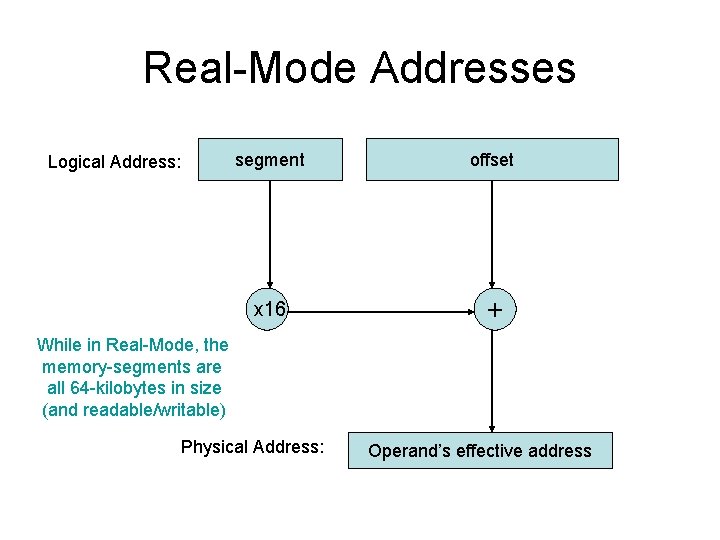
Real-Mode Addresses Logical Address: segment offset x 16 + While in Real-Mode, the memory-segments are all 64 -kilobytes in size (and readable/writable) Physical Address: Operand’s effective address
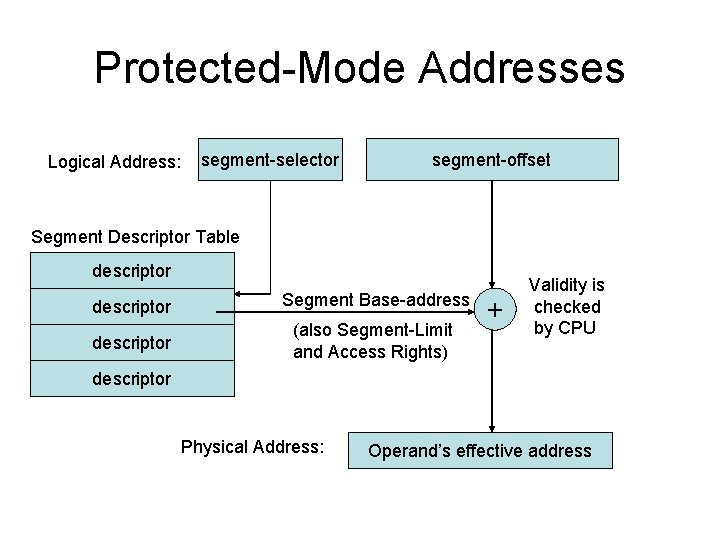
Protected-Mode Addresses Logical Address: segment-selector segment-offset Segment Descriptor Table descriptor Segment Base-address descriptor (also Segment-Limit and Access Rights) + Validity is checked by CPU descriptor Physical Address: Operand’s effective address
Segment-Descriptor Format 63 32 Base[31. . 24] RA D CR Limit GDS V P P SX / / A [19. . 16] VL L DW Base[15. . 0] 31 Base[23. . 16] Limit[15. . 0] 0 Several instances of this basic ‘segment-descriptor’ data-structure will occur in the Global Descriptor Table (and maybe also in some Local Descriptor Tables)
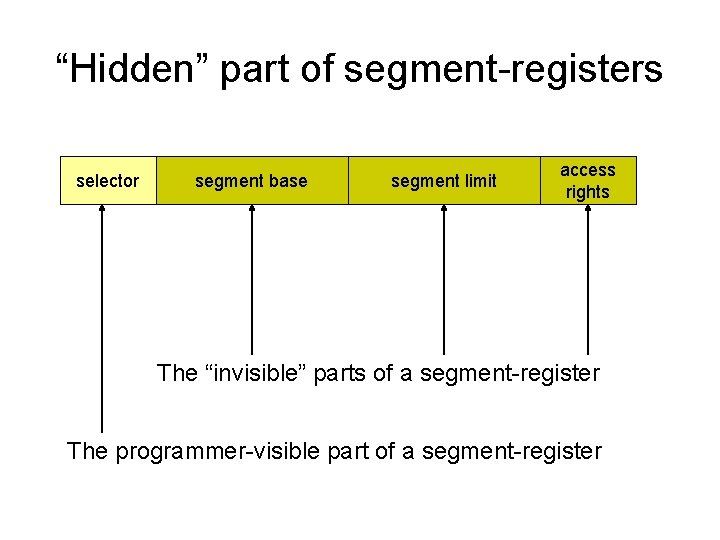
“Hidden” part of segment-registers selector segment base segment limit access rights The “invisible” parts of a segment-register The programmer-visible part of a segment-register
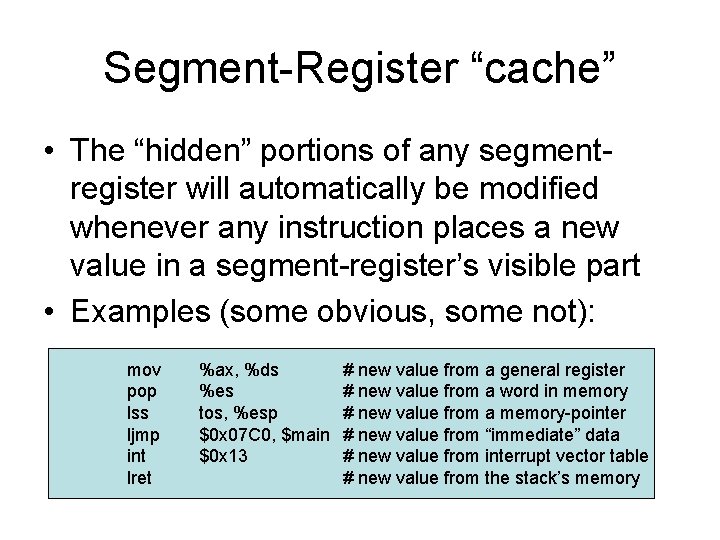
Segment-Register “cache” • The “hidden” portions of any segmentregister will automatically be modified whenever any instruction places a new value in a segment-register’s visible part • Examples (some obvious, some not): mov pop lss ljmp int lret %ax, %ds %es tos, %esp $0 x 07 C 0, $main $0 x 13 # new value from a general register # new value from a word in memory # new value from a memory-pointer # new value from “immediate” data # new value from interrupt vector table # new value from the stack’s memory
Illegal segment-values • In Real-Mode, any 16 -bit value was ‘legal’ to be loaded into any segment-register • But in Protected-Mode, the CPU doesn’t allow certain 16 -bit values to be placed in certain particular segment-registers • For example: the selector for a descriptor that isn’t ‘executable’ cannot go into CS, and one that’s legal for CS can’t go in SS
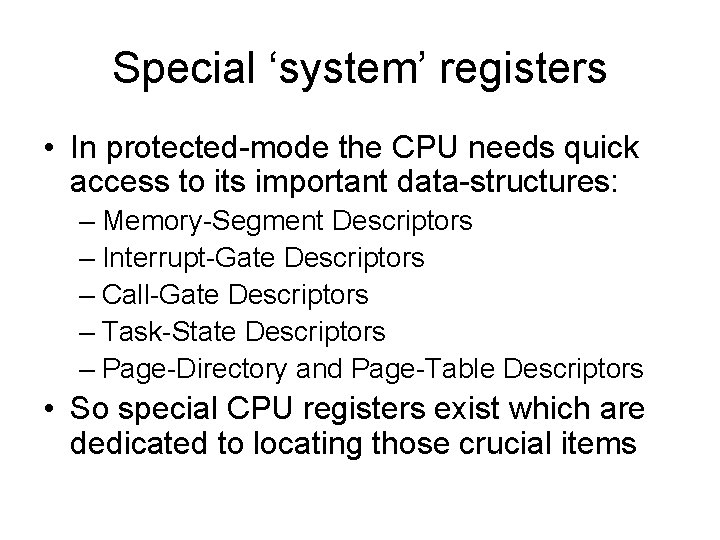
Special ‘system’ registers • In protected-mode the CPU needs quick access to its important data-structures: – Memory-Segment Descriptors – Interrupt-Gate Descriptors – Call-Gate Descriptors – Task-State Descriptors – Page-Directory and Page-Table Descriptors • So special CPU registers exist which are dedicated to locating those crucial items
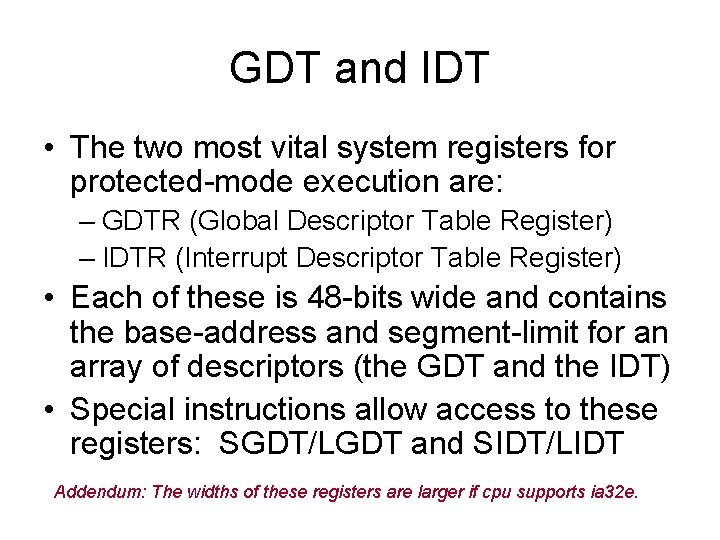
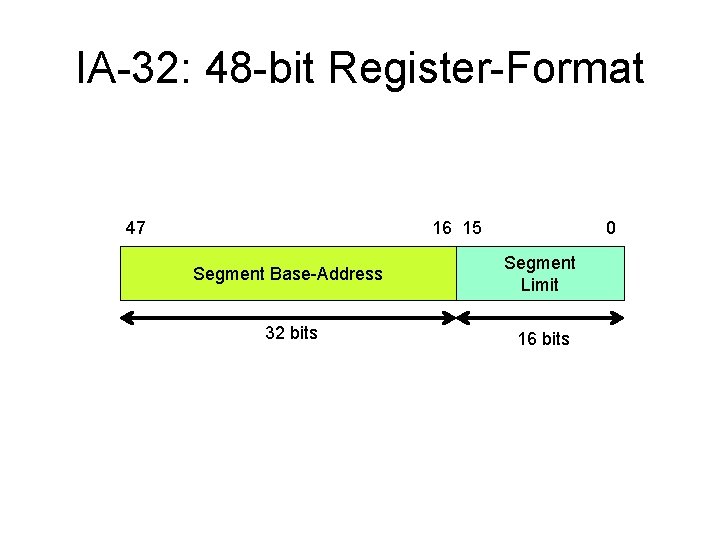
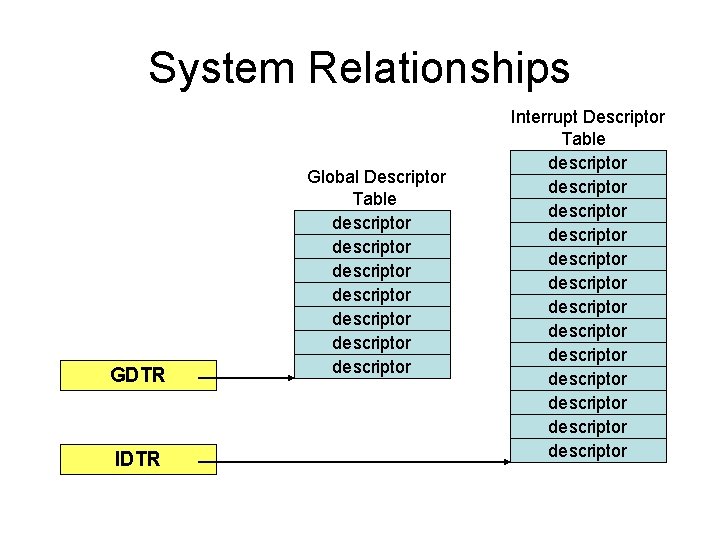
GDT and IDT • The two most vital system registers for protected-mode execution are: – GDTR (Global Descriptor Table Register) – IDTR (Interrupt Descriptor Table Register) • Each of these is 48 -bits wide and contains the base-address and segment-limit for an array of descriptors (the GDT and the IDT) • Special instructions allow access to these registers: SGDT/LGDT and SIDT/LIDT Addendum: The widths of these registers are larger if cpu supports ia 32 e.
IA-32: 48 -bit Register-Format 47 16 15 0 Segment Base-Address Segment Limit 32 bits 16 bits
System Relationships GDTR IDTR Global Descriptor Table descriptor descriptor Interrupt Descriptor Table descriptor descriptor descriptor descriptor
LDT and TSS • For protected-mode multitasking, the CPU needs to access two other data-structures: – The current Local Descriptor Table (LDT) – The current Task-State Segment (TSS) • Again, special registers tell the CPU where to find these data-structures in memory (assuming protected-mode is enabled) • And special instructions afford access to them: SLDT/LLDT and STR/LTR
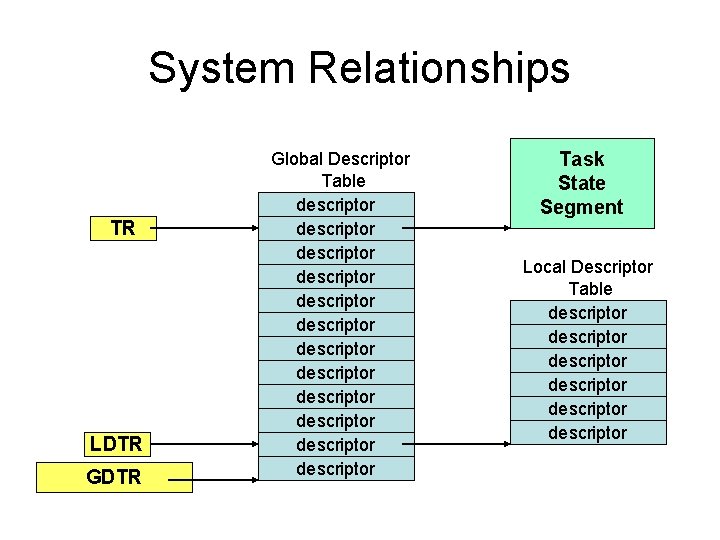
Indirection • Registers LDTR and TR are like segmentregisters: they have a visible part (16 -bits) and a “hidden” descriptor-cache part • The programmer-visible portion of these two registers holds a “segment-selector” (i. e. , an array-index into the GDT array) • The hidden portion is updated from the GDT whenever these register get loaded
System Relationships TR LDTR Global Descriptor Table descriptor descriptor descriptor Task State Segment Local Descriptor Table descriptor descriptor
Reading LDTR and TR • The LDTR and TR registers are not able to be accessed while executing in real-mode • An “Undefined Opcode” exception (INT-6) will be generated if SLDT or STR opcodes are encountered in a “real-mode” program • So to obtain the values in these registers, any bootsector program must temporarily enable protected-mode
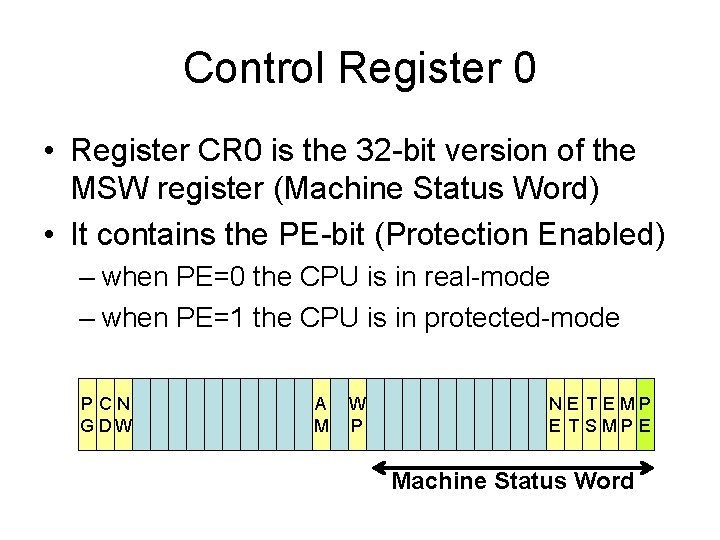
Control Register 0 • Register CR 0 is the 32 -bit version of the MSW register (Machine Status Word) • It contains the PE-bit (Protection Enabled) – when PE=0 the CPU is in real-mode – when PE=1 the CPU is in protected-mode PCN G DW A M W P NE T EMP E T SMP E Machine Status Word
Using the LMSW instruction • You can use the LMSW instruction to turn on the PE-bit (enabling ‘protected-mode’) • But you cannot use LMSW to turn off PE (i. e. , PE was a “sticky bit” in the 80286) • The Intel 80386 processor introduced a new name and enlarged size for the MSW • Special version of the ‘MOV’ instruction can either enable or disable the PE-bit
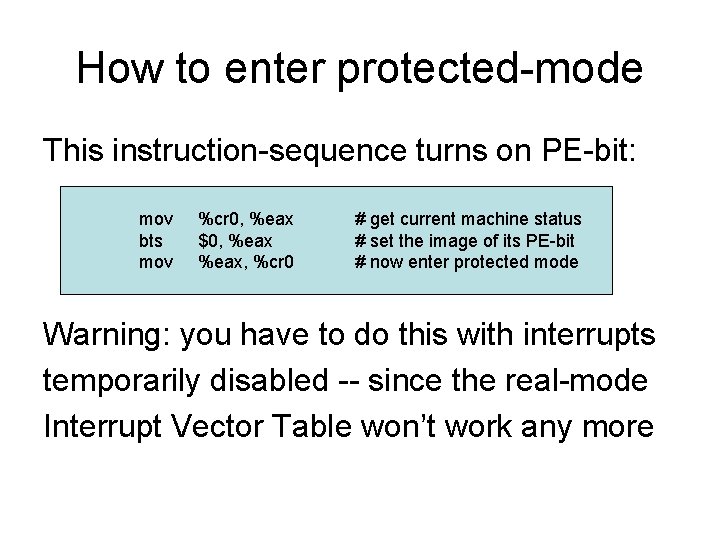
How to enter protected-mode This instruction-sequence turns on PE-bit: mov bts mov %cr 0, %eax $0, %eax, %cr 0 # get current machine status # set the image of its PE-bit # now enter protected mode Warning: you have to do this with interrupts temporarily disabled -- since the real-mode Interrupt Vector Table won’t work any more
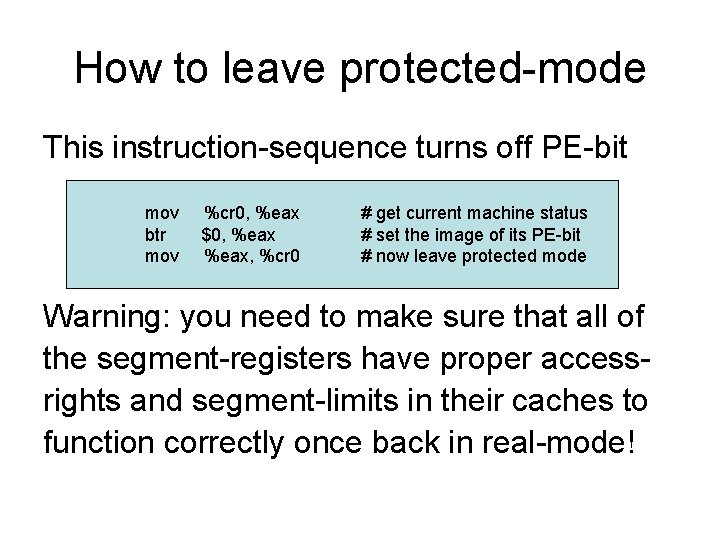
How to leave protected-mode This instruction-sequence turns off PE-bit mov btr mov %cr 0, %eax $0, %eax, %cr 0 # get current machine status # set the image of its PE-bit # now leave protected mode Warning: you need to make sure that all of the segment-registers have proper accessrights and segment-limits in their caches to function correctly once back in real-mode!
An observation • If we can enter protected-mode, but NOT do anything to alter any segment-register, then we won’t need to construct Tables of Segment-Descriptors • The left-over ‘real-mode’ descriptor-values will still be in any segment-register’s cache • Let’s pursue this idea in a program ‘demo’
In-class exercises • Can you modify the ‘ourfirst. s’ program so it will display the following register-values (in hexadecimal format, showing names)? – The 32 -bit control-register CR 0 – The 48 -bit system-register IDTR – The 16 -bit segment-register TR