
Venturimeter and Pitot Tube Dr J Badshah University

Venturimeter and Pitot Tube Dr. J. Badshah University Professor – cum - Chief Scientist Dairy Engineering Department Sanjay Gandhi Institute of Dairy Science & Technology, Jagdeopath, Patna (Bihar Animal Sciences University, Patna)
Flow Measurement • Introduction • A flowmeter to measure linear, nonlinear, mass or volumetric flow rate of a liquid or a gas in liters per second or kilograms per second • Positive-displacement flow meters • Ventury meter • Orifice Flow meter • Rotameter • Pitot Tube

Venturimeter with U tube manometer
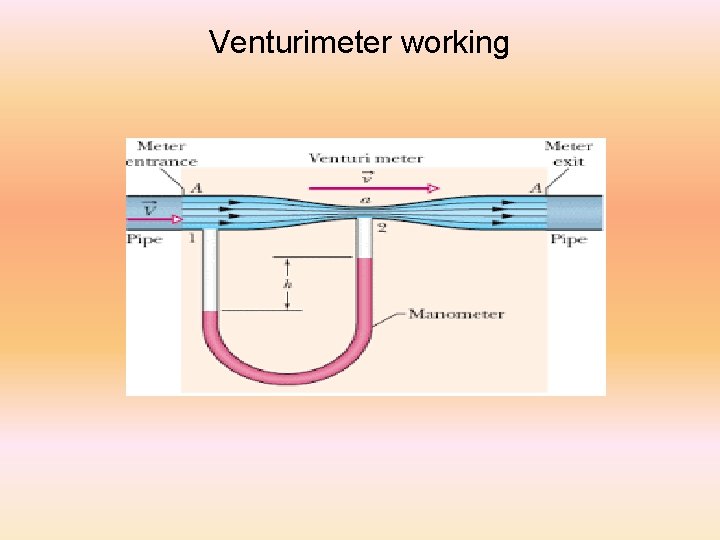
Venturimeter working
Venturimeter q Venturimeter is used to the measurement of flow rate. It is generally used for large diameter pipes. The venturi tube has a entrance zone, converging conical inlet, a cylindrical throat, and a diverging recovery cone. q Entrance Section is a straight cylinder having length equal to 5 to 8 times the diameter of the pipe. q The diameter of the tube of convergence section gradually decreases. The angle of cone = 21 ± 2°. When liquid flows inside the venturimeter, the velocity of fluid increases and correspondingly the pressure falls. q At throat, the diameter of the venturemeter cylindrical tube is minimum. Velocity is maximum and pressure is minimum. Throat diameter = 1/3 to 1/4 th inlet diameter. q The diameter of the tube at diverging section gradually increases. Here due to gradual divergence, the pressure is build up to the original inlet pressure. The cone angle is 5 -7°. Small size venturimeter are made of brass or, bronze and large venturimeters are made of cast iron or stainless steel. q The pressure difference between the upstream side of the cone and the throat is measured and provides a signal for the rate of flow.
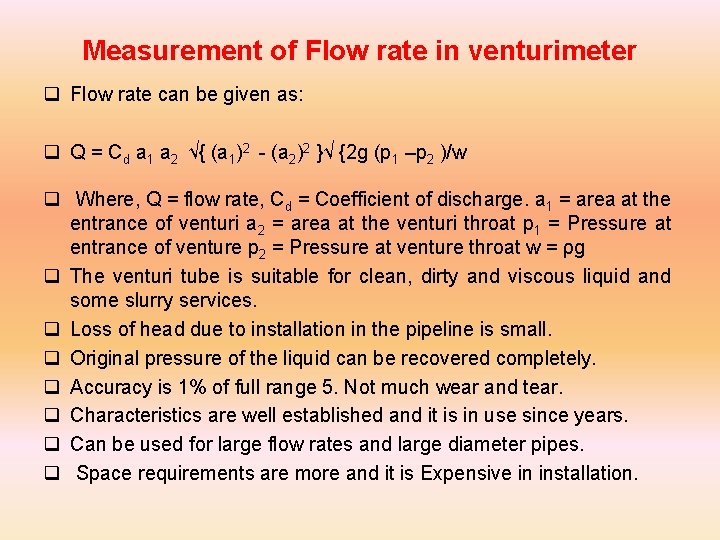
Measurement of Flow rate in venturimeter q Flow rate can be given as: q Q = Cd a 1 a 2 √{ (a 1)2 - (a 2)2 }√ {2 g (p 1 –p 2 )/w q Where, Q = flow rate, Cd = Coefficient of discharge. a 1 = area at the entrance of venturi a 2 = area at the venturi throat p 1 = Pressure at entrance of venture p 2 = Pressure at venture throat w = ρg q The venturi tube is suitable for clean, dirty and viscous liquid and some slurry services. q Loss of head due to installation in the pipeline is small. q Original pressure of the liquid can be recovered completely. q Accuracy is 1% of full range 5. Not much wear and tear. q Characteristics are well established and it is in use since years. q Can be used for large flow rates and large diameter pipes. q Space requirements are more and it is Expensive in installation.

Pitot Tube for velocity and flow Measurement
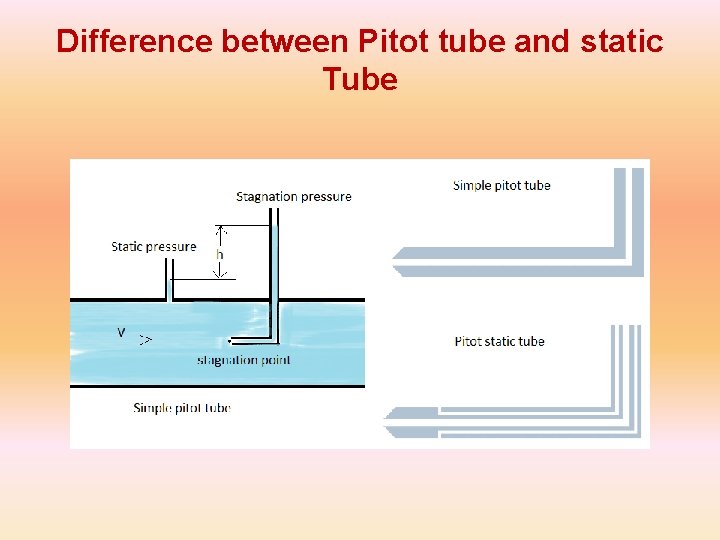
Difference between Pitot tube and static Tube
Pitot Tube q Pitot tube is used to measure flow velocity. q Outer body of pilot tube consist of ports at point A, for sensing the static pressure of fluid. At point B fluid velocity become zero and inner tube is for sensing the stagnation pressure. q The outlet C & D is connected to U-tube manometer for measuring the pressure difference between the points A and B. q Pitot tube The flow velocity is given by the following equation: q V = √ (2 g h)

- Slides: 10