
Venture Capital Methods of Valuation HighGrowth StartUp Companies



- Slides: 16
Venture Capital Methods of Valuation: High-Growth Start-Up Companies Lauren Thomas
Key Concepts • Decisions venture capitalists face when valuating high-growth start-up companies • 3 valuation approaches • Pros & cons associated with the various approaches • Valuating early stage ventures such as Solar. Winds • What is the best method for a venture capitalist to use when valuating a high-growth start-up company?
Venture Capitalists • The two aspects of valuation that make new investment decisions extremely difficult: 1. The future cash flows of a prospective venture are volatile and hard to forecast 2. Discount rates appropriate for new venture investments can be challenging to estimate • The importance of good decision making cannot be overemphasized
How VC’s differ from traditional financing sources • Focus on young, high growth companies • Invests equity capital rather than debt • Take higher risk in exchange for potential higher return • Longer investment horizon • Actively monitor companies through board participation, strategic marketing, governance and capital structure
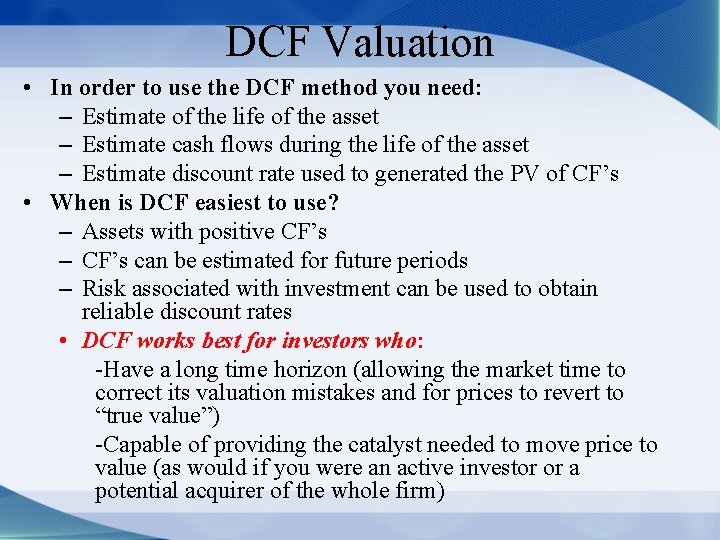
DCF Valuation • In order to use the DCF method you need: – Estimate of the life of the asset – Estimate cash flows during the life of the asset – Estimate discount rate used to generated the PV of CF’s • When is DCF easiest to use? – Assets with positive CF’s – CF’s can be estimated for future periods – Risk associated with investment can be used to obtain reliable discount rates • DCF works best for investors who: -Have a long time horizon (allowing the market time to correct its valuation mistakes and for prices to revert to “true value”) -Capable of providing the catalyst needed to move price to value (as would if you were an active investor or a potential acquirer of the whole firm)
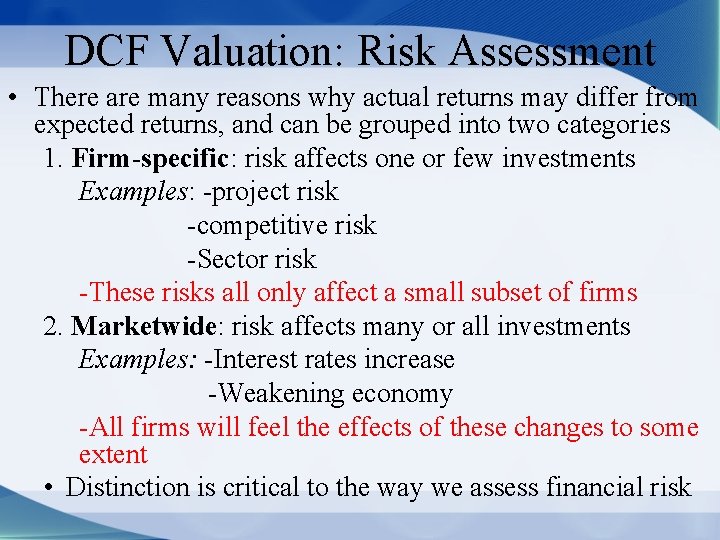
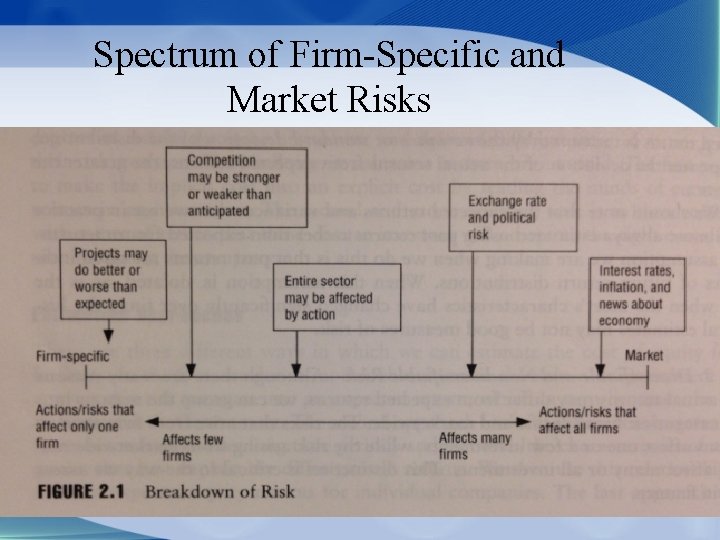
DCF Valuation: Risk Assessment • There are many reasons why actual returns may differ from expected returns, and can be grouped into two categories 1. Firm-specific: risk affects one or few investments Examples: -project risk -competitive risk -Sector risk -These risks all only affect a small subset of firms 2. Marketwide: risk affects many or all investments Examples: -Interest rates increase -Weakening economy -All firms will feel the effects of these changes to some extent • Distinction is critical to the way we assess financial risk
Spectrum of Firm-Specific and Market Risks
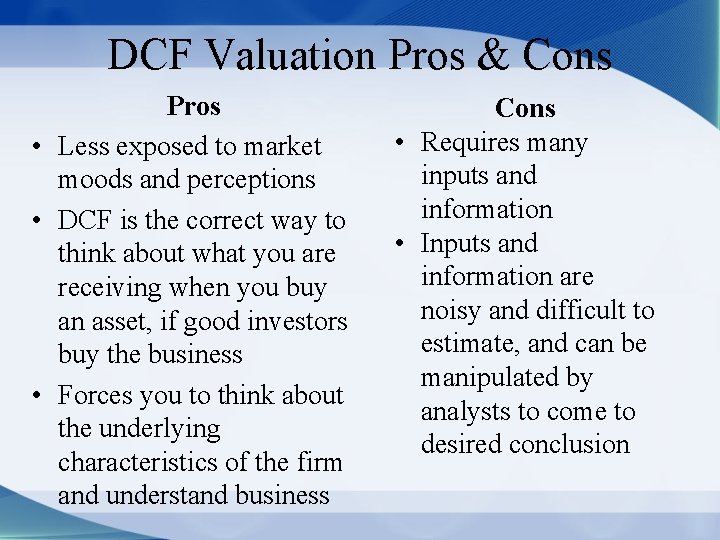
DCF Valuation Pros & Cons Pros • Less exposed to market moods and perceptions • DCF is the correct way to think about what you are receiving when you buy an asset, if good investors buy the business • Forces you to think about the underlying characteristics of the firm and understand business Cons • Requires many inputs and information • Inputs and information are noisy and difficult to estimate, and can be manipulated by analysts to come to desired conclusion
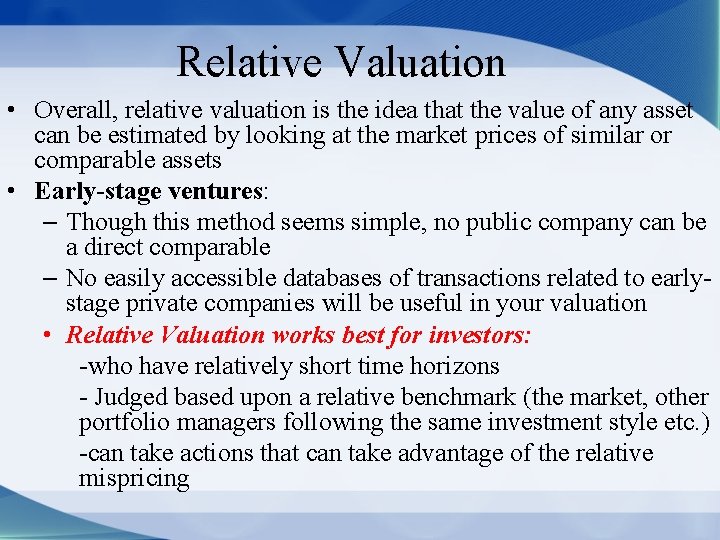
Relative Valuation • Overall, relative valuation is the idea that the value of any asset can be estimated by looking at the market prices of similar or comparable assets • Early-stage ventures: – Though this method seems simple, no public company can be a direct comparable – No easily accessible databases of transactions related to earlystage private companies will be useful in your valuation • Relative Valuation works best for investors: -who have relatively short time horizons - Judged based upon a relative benchmark (the market, other portfolio managers following the same investment style etc. ) -can take actions that can take advantage of the relative mispricing
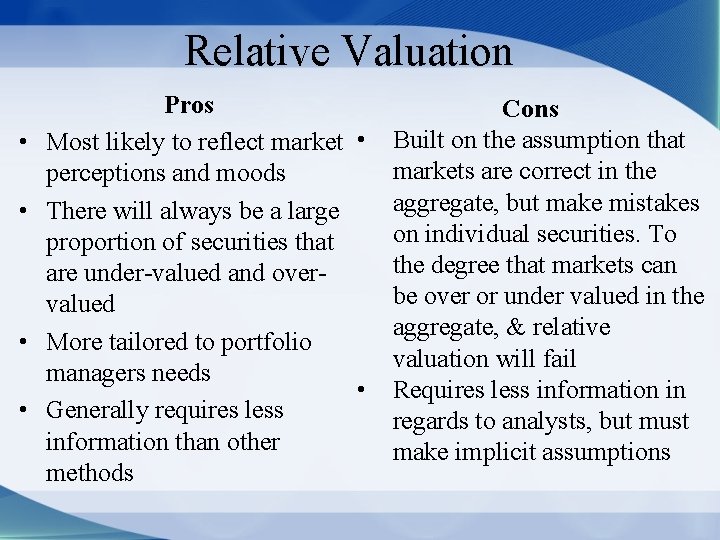
Relative Valuation • • Pros Most likely to reflect market • perceptions and moods There will always be a large proportion of securities that are under-valued and overvalued More tailored to portfolio managers needs • Generally requires less information than other methods Cons Built on the assumption that markets are correct in the aggregate, but make mistakes on individual securities. To the degree that markets can be over or under valued in the aggregate, & relative valuation will fail Requires less information in regards to analysts, but must make implicit assumptions
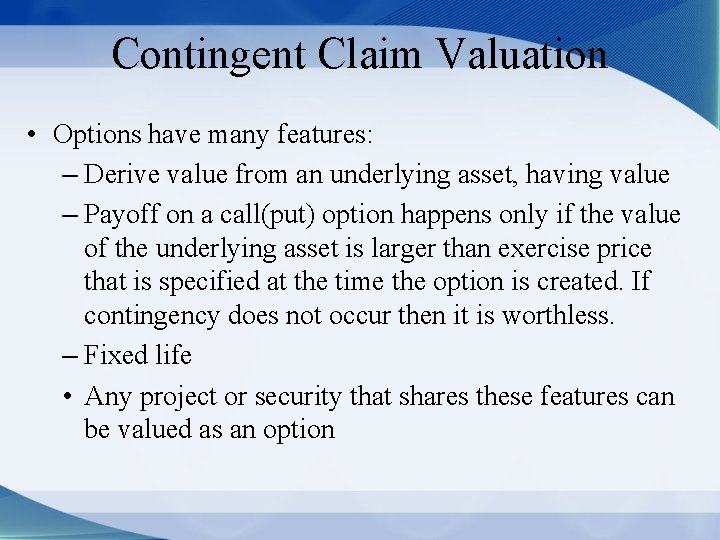
Contingent Claim Valuation • Options have many features: – Derive value from an underlying asset, having value – Payoff on a call(put) option happens only if the value of the underlying asset is larger than exercise price that is specified at the time the option is created. If contingency does not occur then it is worthless. – Fixed life • Any project or security that shares these features can be valued as an option
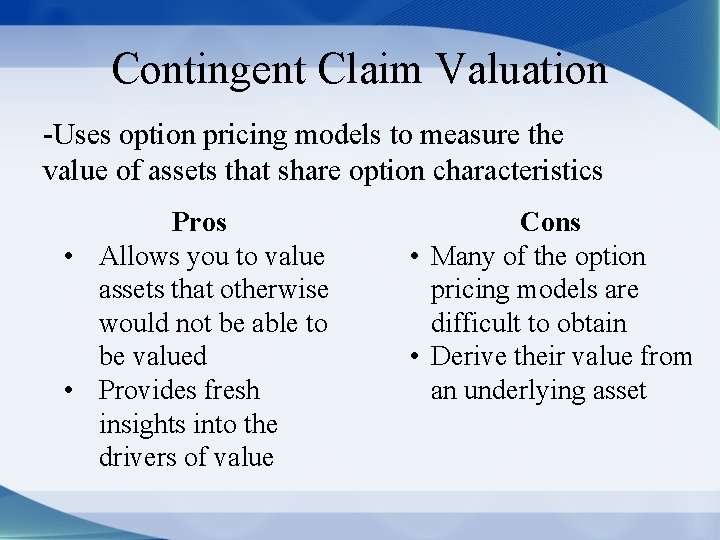
Contingent Claim Valuation -Uses option pricing models to measure the value of assets that share option characteristics Pros • Allows you to value assets that otherwise would not be able to be valued • Provides fresh insights into the drivers of value Cons • Many of the option pricing models are difficult to obtain • Derive their value from an underlying asset
Solar. Winds • Mission: To provide purpose built products designed to make IT professionals job easier • Offer value-driven products that solve broad range of IT management challenges such as servers, storage, networks ect. • Solar. Winds approach is to deliver “unexpected simplicity” and redefine the expectations IT professional shave for enterprise software
Solar. Winds: High-Growth Potential • Solar. Winds was named by Forbes as the number five top small public company in American with potential for highgrowth • Sales of over $171 M • Average ROE has increased to 67% over the past five years Quick Glance 2014: • Total Revenue: $429 M • Year-over- Year Growth: 27. 8% • Operating Margin: 43. 6% 2013: • Total Revenue: $335 M • Year-over- Year Growth: 25% • Operating Margin: 51%
Conclusion • Valuation is crucial for VC’s when making business decisions • VC’s must have clear understanding of the three valuation methods in order to make better investment decisions • Understanding why the 3 valuation methods may yield different estimates of value in order to choose the best model for your specific business • What circumstances require a VC to choose one valuation method over the others?
Questions?