
Venture Capital Financing The Venture Capital Method B
Venture Capital Financing The Venture Capital Method B. G. Bisson
Valuation and Pricing l l l l l Magnitude of investment Staging of investment Syndication Target IRR Investment time horizon Terminal value of firm % ownership required Deal structure Future financing and dilution – “The Venture Capital Method”
Magnitude of Investment l Typically >$1. 0 million for institutional l Small deals too costly l Typically less than $10 million in Canada l Most deals $1. 0 -$3. 0 l Based on business plan pro formas l Free cash flow (EBIAT, working capital, capital expenditures)
Investment Time Horizon l 4 -7 years l How long will it take to create value? l Years to cash flow breakeven
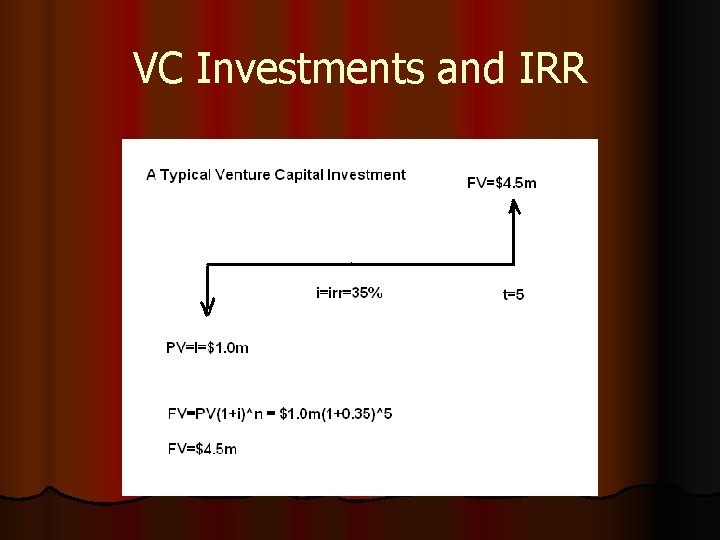
VC Investments and IRR
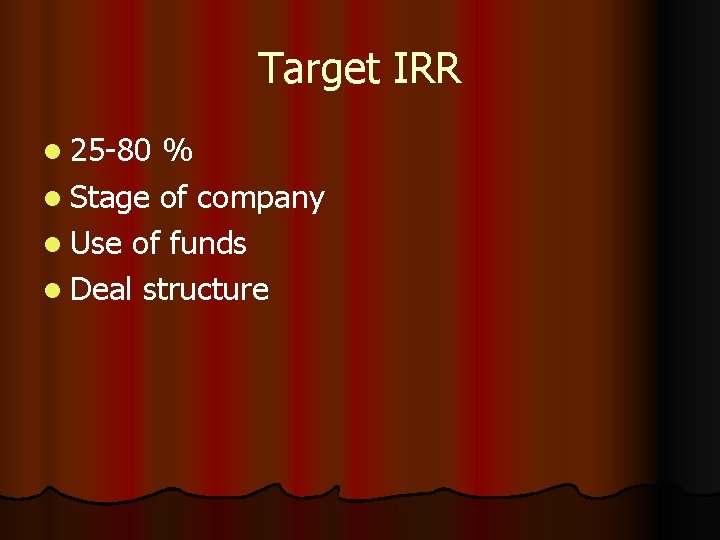
Target IRR l 25 -80 % l Stage of company l Use of funds l Deal structure
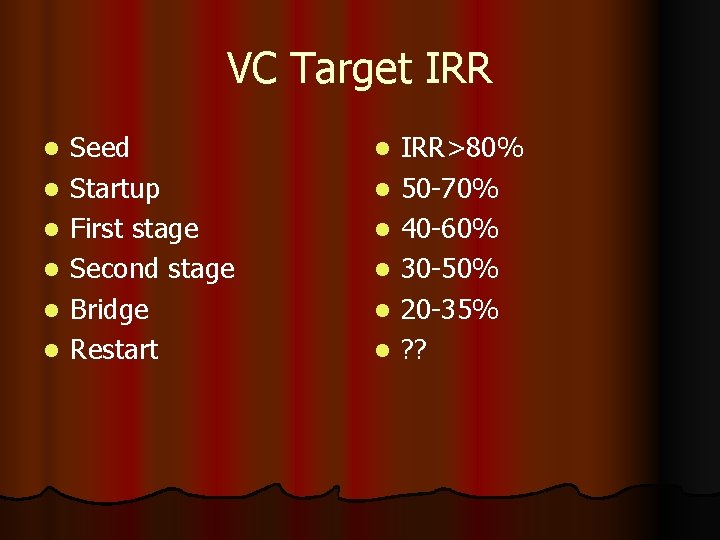
VC Target IRR l l l Seed Startup First stage Second stage Bridge Restart l l l IRR>80% 50 -70% 40 -60% 30 -50% 20 -35% ? ?
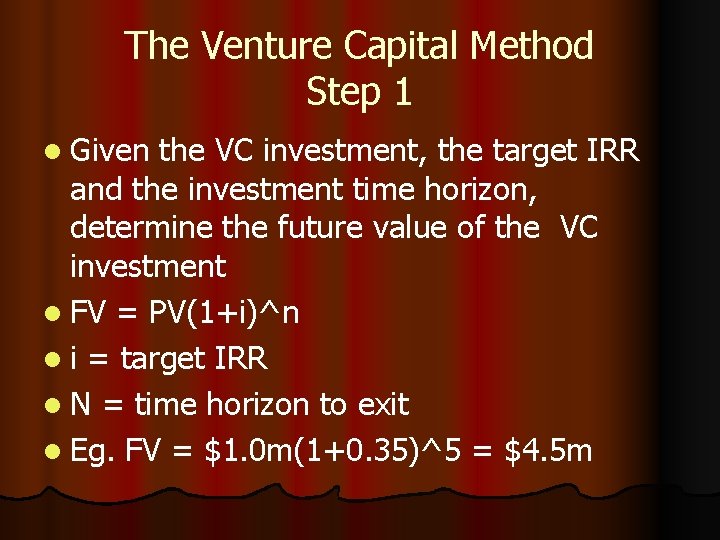
The Venture Capital Method Step 1 l Given the VC investment, the target IRR and the investment time horizon, determine the future value of the VC investment l FV = PV(1+i)^n l i = target IRR l N = time horizon to exit l Eg. FV = $1. 0 m(1+0. 35)^5 = $4. 5 m
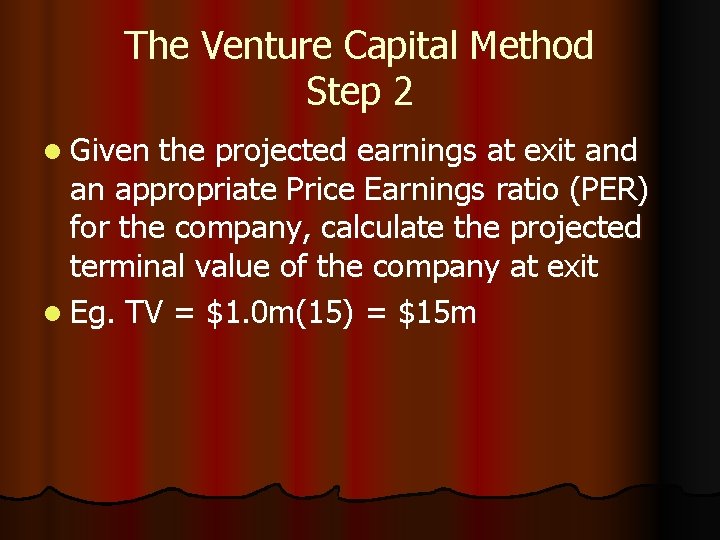
The Venture Capital Method Step 2 l Given the projected earnings at exit and an appropriate Price Earnings ratio (PER) for the company, calculate the projected terminal value of the company at exit l Eg. TV = $1. 0 m(15) = $15 m
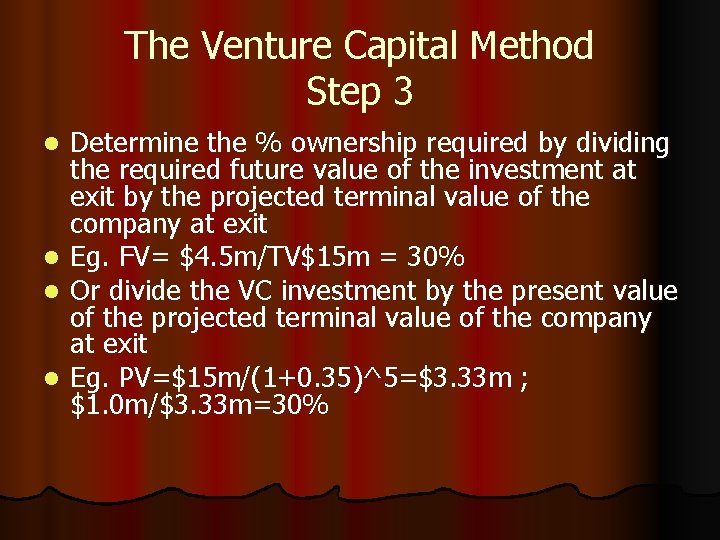
The Venture Capital Method Step 3 l l Determine the % ownership required by dividing the required future value of the investment at exit by the projected terminal value of the company at exit Eg. FV= $4. 5 m/TV$15 m = 30% Or divide the VC investment by the present value of the projected terminal value of the company at exit Eg. PV=$15 m/(1+0. 35)^5=$3. 33 m ; $1. 0 m/$3. 33 m=30%
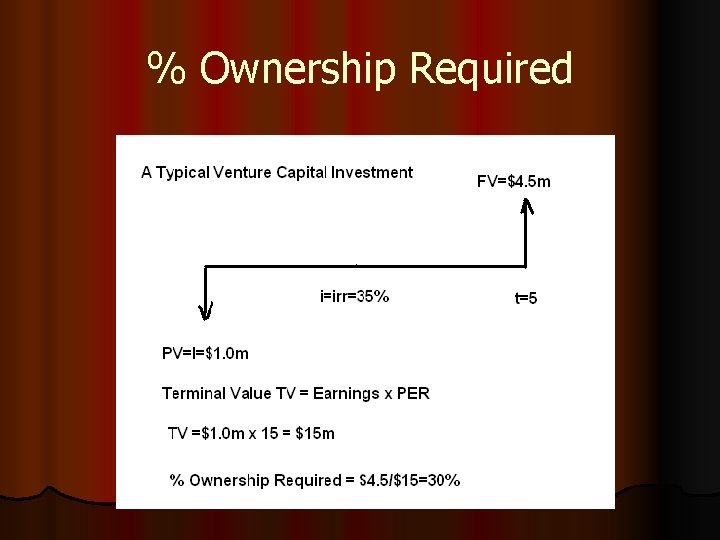
% Ownership Required
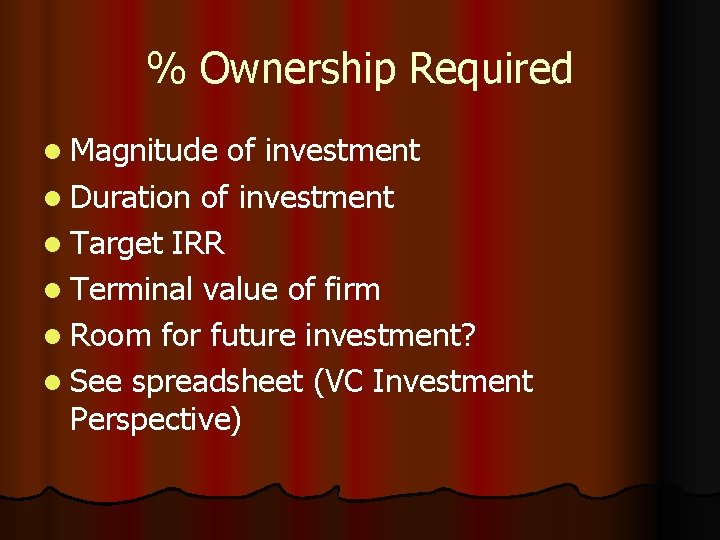
% Ownership Required l Magnitude of investment l Duration of investment l Target IRR l Terminal value of firm l Room for future investment? l See spreadsheet (VC Investment Perspective)
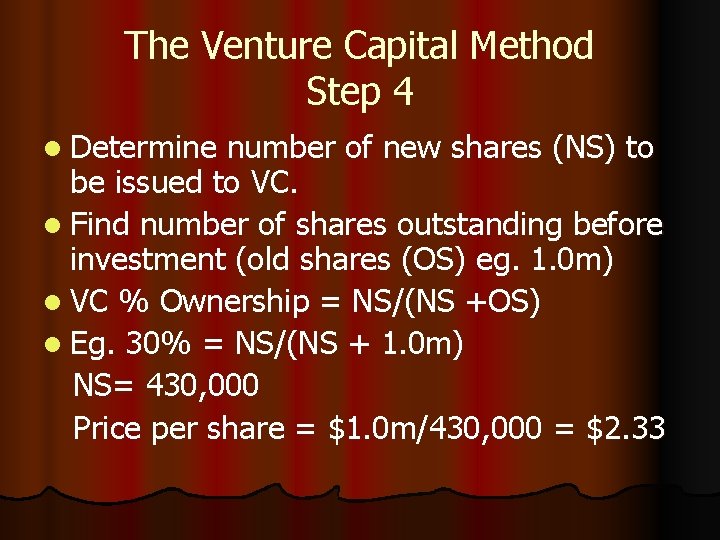
The Venture Capital Method Step 4 l Determine number of new shares (NS) to be issued to VC. l Find number of shares outstanding before investment (old shares (OS) eg. 1. 0 m) l VC % Ownership = NS/(NS +OS) l Eg. 30% = NS/(NS + 1. 0 m) NS= 430, 000 Price per share = $1. 0 m/430, 000 = $2. 33
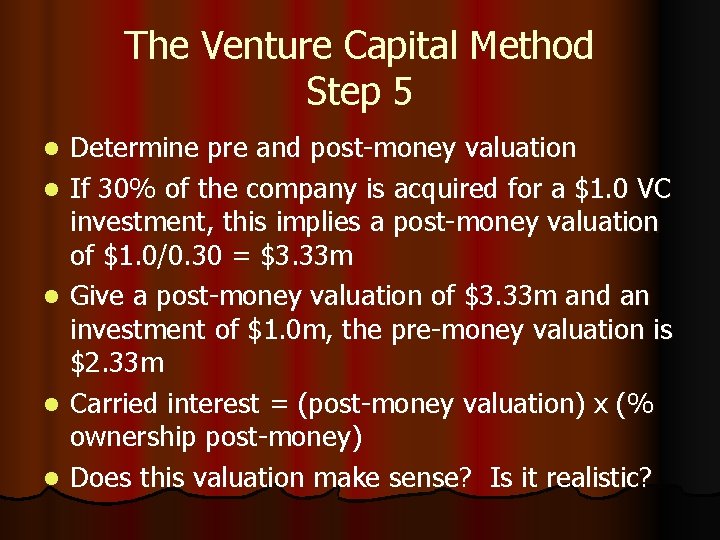
The Venture Capital Method Step 5 l l l Determine pre and post-money valuation If 30% of the company is acquired for a $1. 0 VC investment, this implies a post-money valuation of $1. 0/0. 30 = $3. 33 m Give a post-money valuation of $3. 33 m and an investment of $1. 0 m, the pre-money valuation is $2. 33 m Carried interest = (post-money valuation) x (% ownership post-money) Does this valuation make sense? Is it realistic?
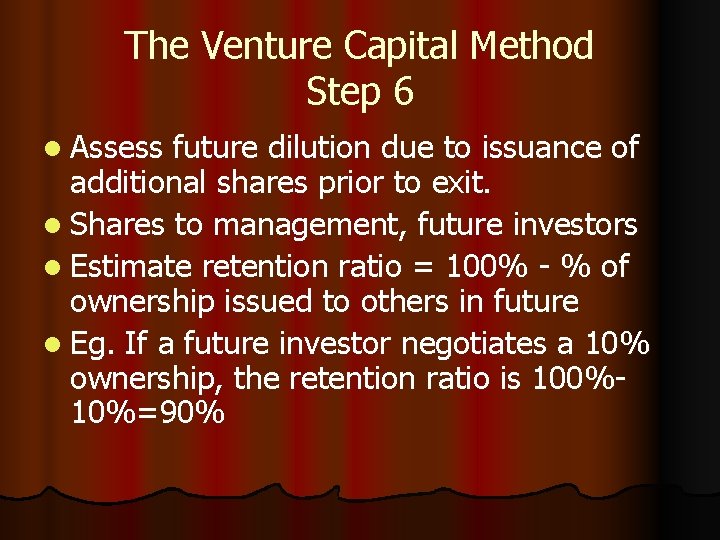
The Venture Capital Method Step 6 l Assess future dilution due to issuance of additional shares prior to exit. l Shares to management, future investors l Estimate retention ratio = 100% - % of ownership issued to others in future l Eg. If a future investor negotiates a 10% ownership, the retention ratio is 100%10%=90%
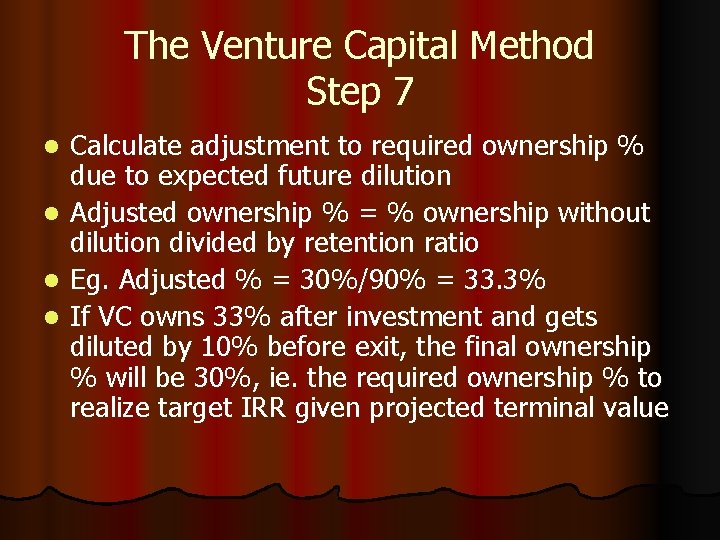
The Venture Capital Method Step 7 Calculate adjustment to required ownership % due to expected future dilution l Adjusted ownership % = % ownership without dilution divided by retention ratio l Eg. Adjusted % = 30%/90% = 33. 3% l If VC owns 33% after investment and gets diluted by 10% before exit, the final ownership % will be 30%, ie. the required ownership % to realize target IRR given projected terminal value l
Sensitivity Analysis Due Diligence l Terminal Value l l l Target IRR l l Future Earnings (Sales, Expenses, Profits) PER Risk Deal Structure Liquidity Dilution l l Future Rounds (Amounts, IRR, Horizon) Management incentives
Staging of Investment l All up front l Two or three tranches l Contingent on meeting milestones/targest l Option to abandon
Syndication l Sharing the deal with other VC firms l Diversify the risk l Broaden the network l Increase size of portfolio
- Slides: 19