
Ventricular Tachycardia and the Role of Ranolazine Pam

- Slides: 41
Ventricular Tachycardia and the Role of Ranolazine Pam Lyons Pharm. D Candidate 2014 Pharmacotherapy Scholars Program University of Pittsburgh School of Pharmacy
Objectives • Be able to explain the mechanism of action of ranolazine • Describe the role of ranolazine in ventricular tachycardia and ischemic heart disease • Understand the difference between premature ventricular beats and ventricular tachycardia • List the types of ventricular tachycardia 2
DN – Presentation 7/31/13 CC: “I don’t feel well” HPI: 61 yo male presented to ER with palpitations and lightheadedness that had been occurring for ~1 week, mild cough • Feels similar to how he usually feels when in VT. • No orthopnea, CP, LE edema, fever, chills, n/v/d • Claims compliance with all medications 3
DN - Earlier that Morning… • Saw his cardiologist the morning of 7/31/13 who recommended an ablation • 150 episodes of VT since 5/2013 – 10 episodes in the 24 hrs before appointment – ICD had not fired • In ER: Several runs of non-sustained VT – ICD did not fire 4
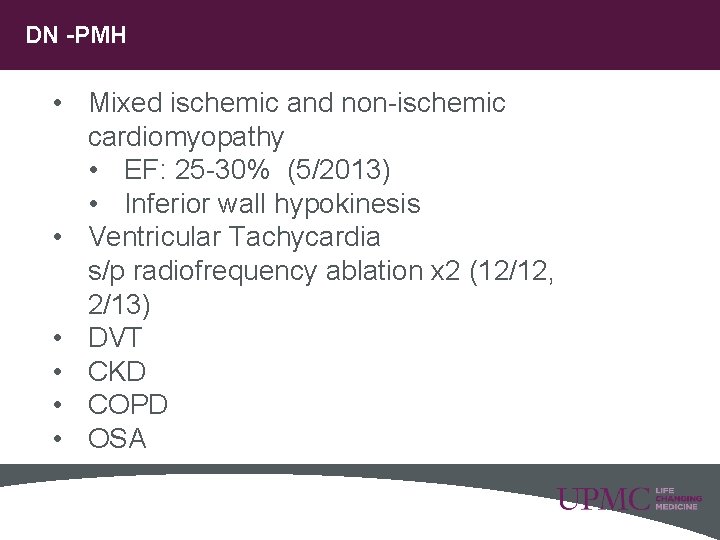
DN -PMH • Mixed ischemic and non-ischemic cardiomyopathy • EF: 25 -30% (5/2013) • Inferior wall hypokinesis • Ventricular Tachycardia s/p radiofrequency ablation x 2 (12/12, 2/13) • DVT • CKD • COPD • OSA 5
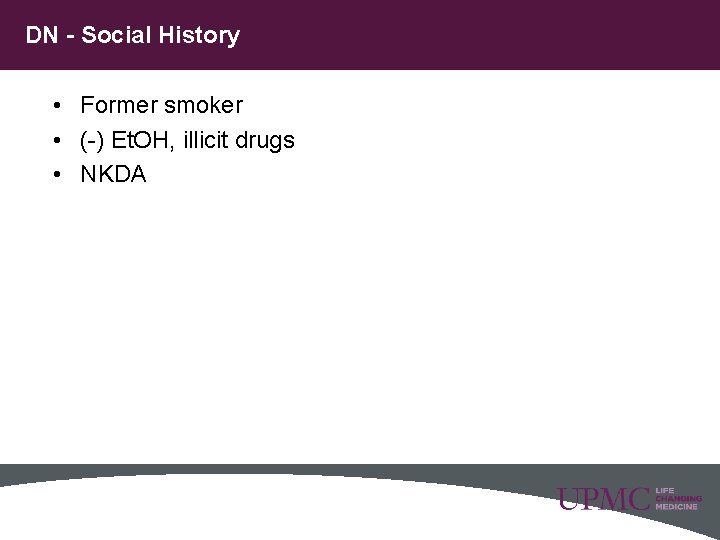
DN - Social History • Former smoker • (-) Et. OH, illicit drugs • NKDA 6
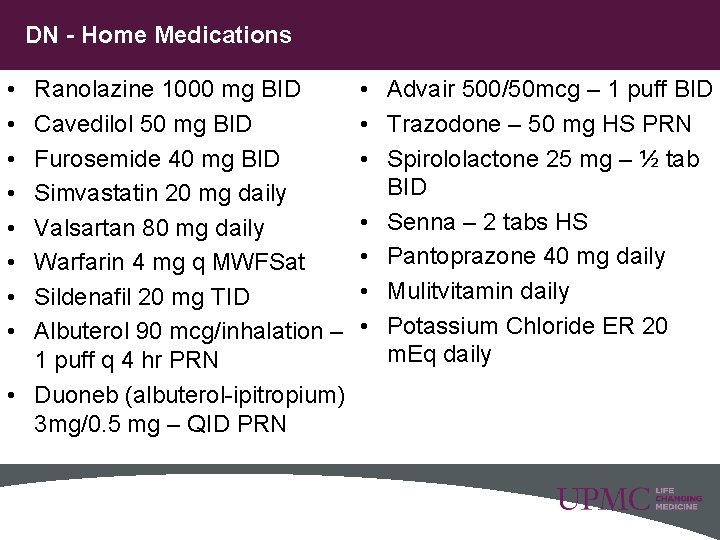
DN - Home Medications • • Ranolazine 1000 mg BID Cavedilol 50 mg BID Furosemide 40 mg BID Simvastatin 20 mg daily Valsartan 80 mg daily Warfarin 4 mg q MWFSat Sildenafil 20 mg TID Albuterol 90 mcg/inhalation – 1 puff q 4 hr PRN • Duoneb (albuterol-ipitropium) 3 mg/0. 5 mg – QID PRN 7 • Advair 500/50 mcg – 1 puff BID • Trazodone – 50 mg HS PRN • Spirololactone 25 mg – ½ tab BID • Senna – 2 tabs HS • Pantoprazone 40 mg daily • Mulitvitamin daily • Potassium Chloride ER 20 m. Eq daily
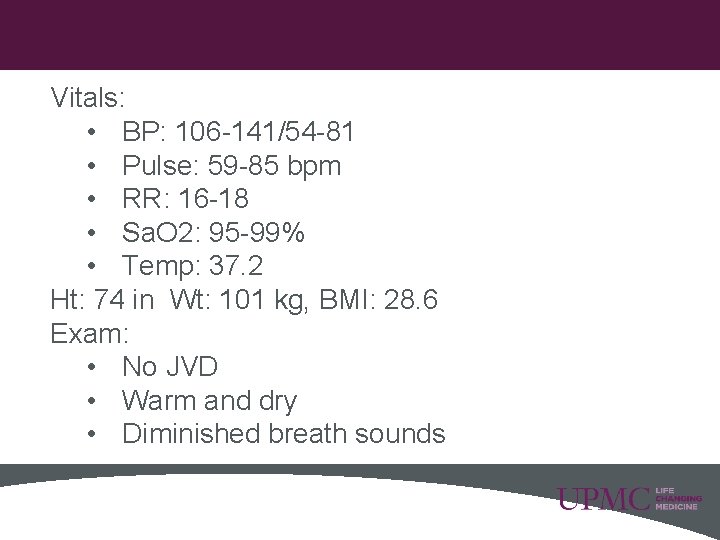
Vitals: • BP: 106 -141/54 -81 • Pulse: 59 -85 bpm • RR: 16 -18 • Sa. O 2: 95 -99% • Temp: 37. 2 Ht: 74 in Wt: 101 kg, BMI: 28. 6 Exam: • No JVD • Warm and dry • Diminished breath sounds 8
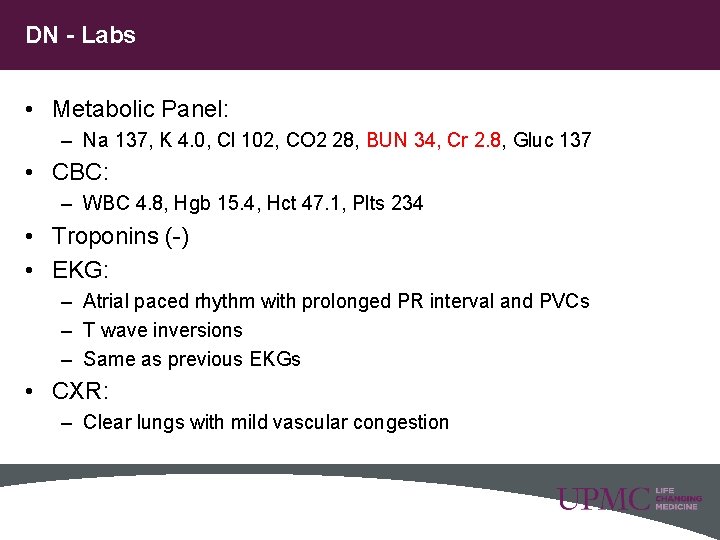
DN - Labs • Metabolic Panel: – Na 137, K 4. 0, Cl 102, CO 2 28, BUN 34, Cr 2. 8, Gluc 137 • CBC: – WBC 4. 8, Hgb 15. 4, Hct 47. 1, Plts 234 • Troponins (-) • EKG: – Atrial paced rhythm with prolonged PR interval and PVCs – T wave inversions – Same as previous EKGs • CXR: – Clear lungs with mild vascular congestion 9
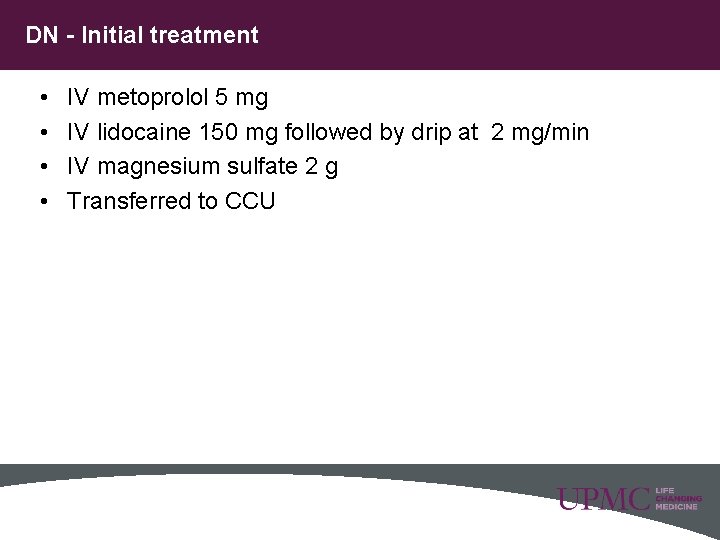
DN - Initial treatment • • IV metoprolol 5 mg IV lidocaine 150 mg followed by drip at 2 mg/min IV magnesium sulfate 2 g Transferred to CCU
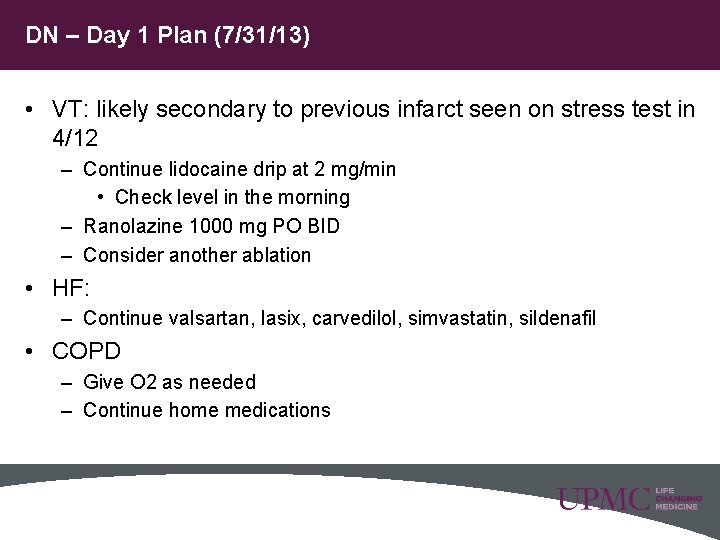
DN – Day 1 Plan (7/31/13) • VT: likely secondary to previous infarct seen on stress test in 4/12 – Continue lidocaine drip at 2 mg/min • Check level in the morning – Ranolazine 1000 mg PO BID – Consider another ablation • HF: – Continue valsartan, lasix, carvedilol, simvastatin, sildenafil • COPD – Give O 2 as needed – Continue home medications
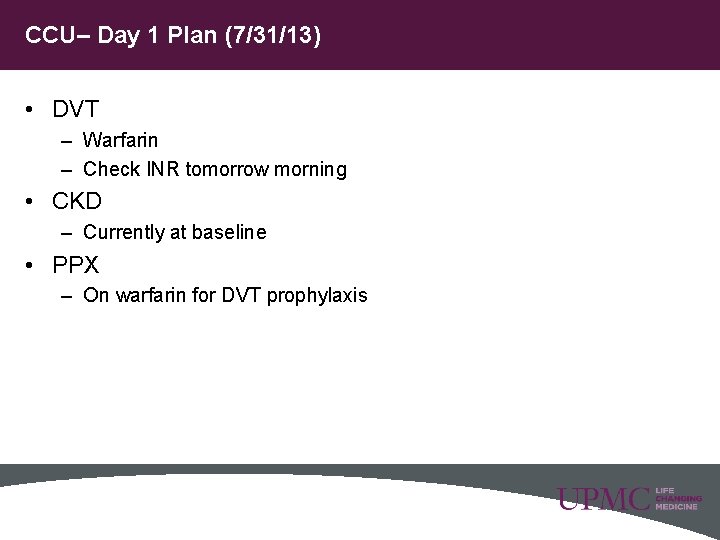
CCU– Day 1 Plan (7/31/13) • DVT – Warfarin – Check INR tomorrow morning • CKD – Currently at baseline • PPX – On warfarin for DVT prophylaxis 12
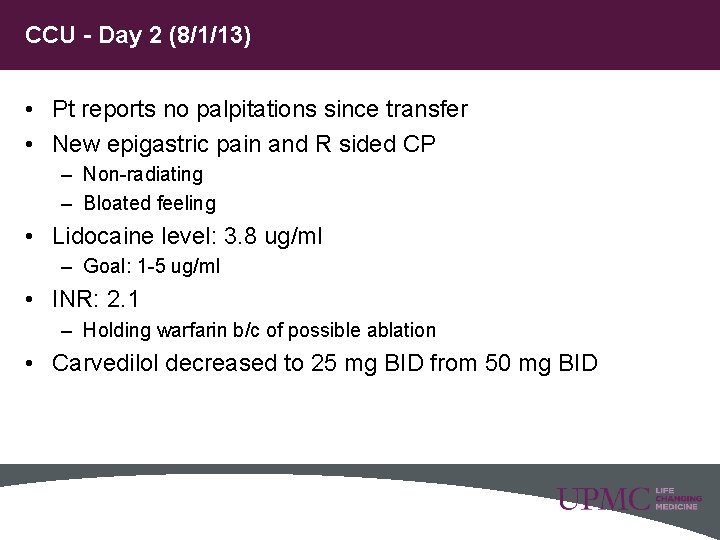
CCU - Day 2 (8/1/13) • Pt reports no palpitations since transfer • New epigastric pain and R sided CP – Non-radiating – Bloated feeling • Lidocaine level: 3. 8 ug/ml – Goal: 1 -5 ug/ml • INR: 2. 1 – Holding warfarin b/c of possible ablation • Carvedilol decreased to 25 mg BID from 50 mg BID 13
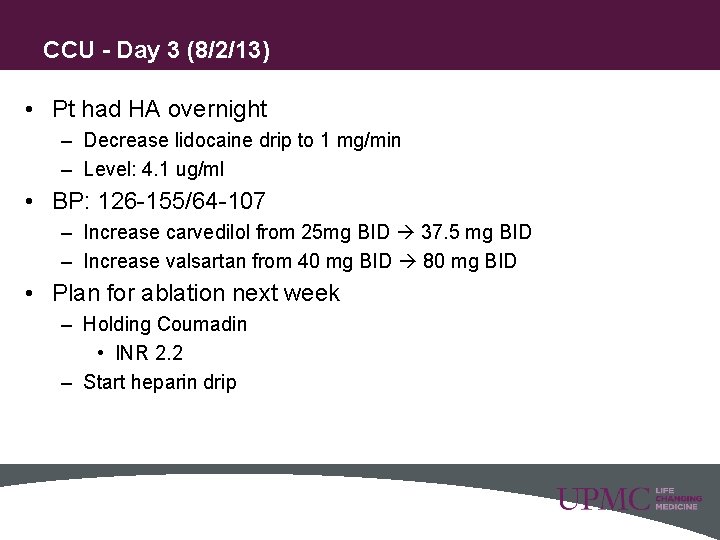
CCU - Day 3 (8/2/13) • Pt had HA overnight – Decrease lidocaine drip to 1 mg/min – Level: 4. 1 ug/ml • BP: 126 -155/64 -107 – Increase carvedilol from 25 mg BID 37. 5 mg BID – Increase valsartan from 40 mg BID 80 mg BID • Plan for ablation next week – Holding Coumadin • INR 2. 2 – Start heparin drip
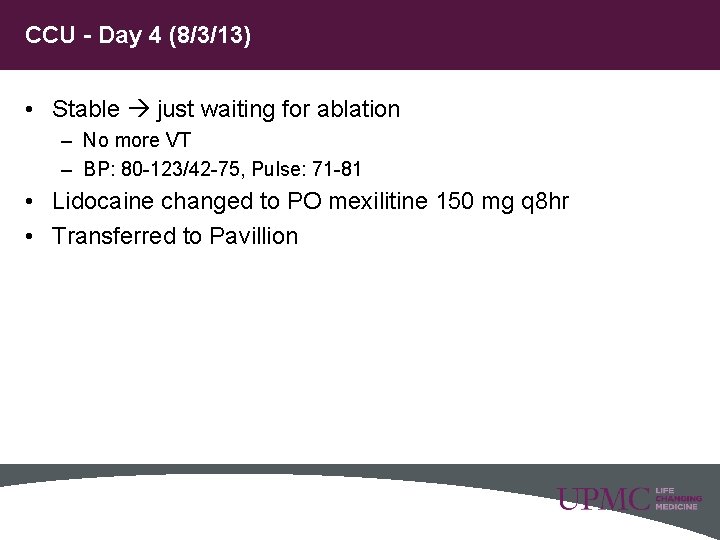
CCU - Day 4 (8/3/13) • Stable just waiting for ablation – No more VT – BP: 80 -123/42 -75, Pulse: 71 -81 • Lidocaine changed to PO mexilitine 150 mg q 8 hr • Transferred to Pavillion
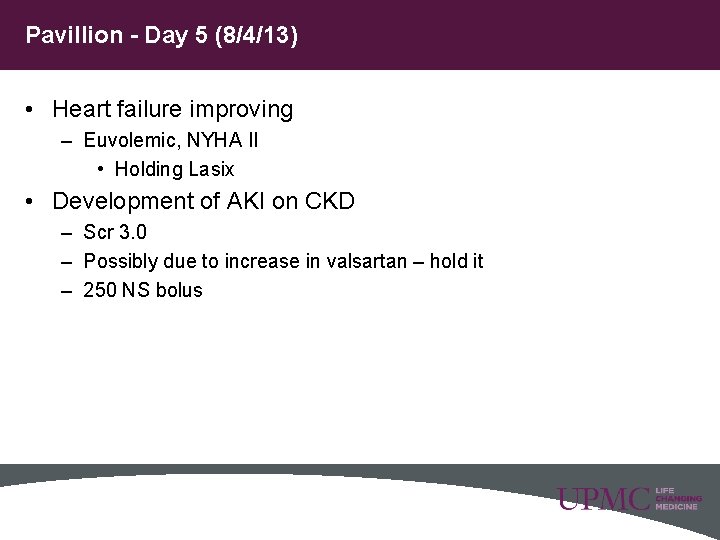
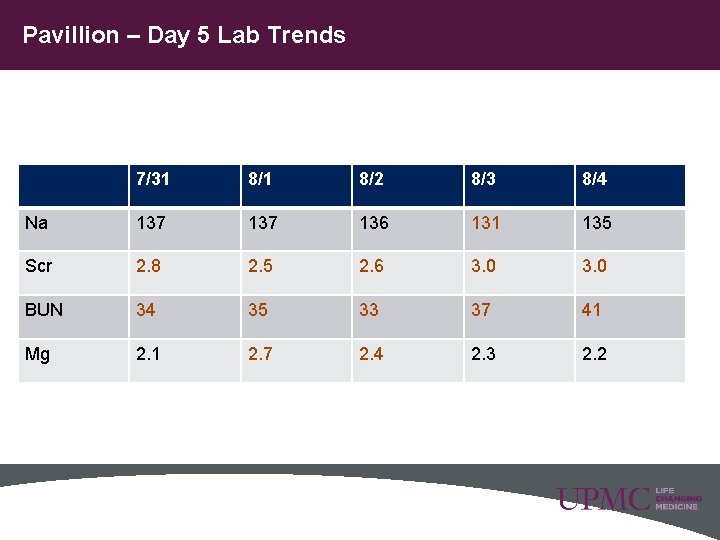
Pavillion - Day 5 (8/4/13) • Heart failure improving – Euvolemic, NYHA II • Holding Lasix • Development of AKI on CKD – Scr 3. 0 – Possibly due to increase in valsartan – hold it – 250 NS bolus 16
Pavillion – Day 5 Lab Trends 7/31 8/2 8/3 8/4 Na 137 136 131 135 Scr 2. 8 2. 5 2. 6 3. 0 BUN 34 35 33 37 41 Mg 2. 1 2. 7 2. 4 2. 3 2. 2 17
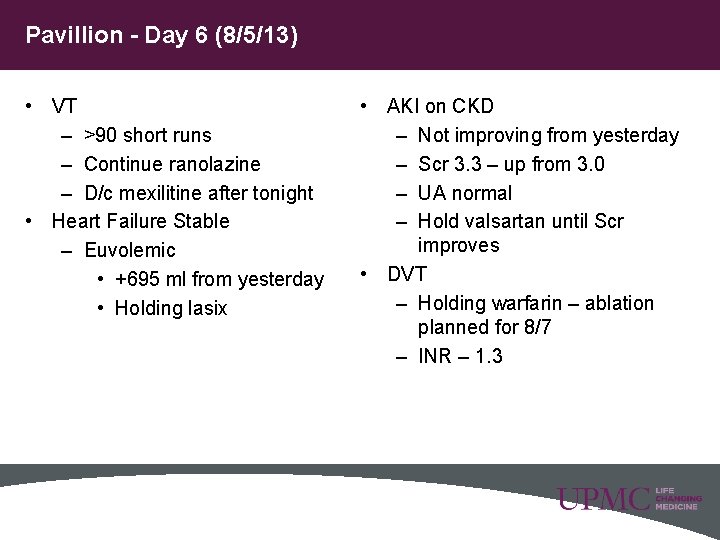
Pavillion - Day 6 (8/5/13) • VT – >90 short runs – Continue ranolazine – D/c mexilitine after tonight • Heart Failure Stable – Euvolemic • +695 ml from yesterday • Holding lasix 18 • AKI on CKD – Not improving from yesterday – Scr 3. 3 – up from 3. 0 – UA normal – Hold valsartan until Scr improves • DVT – Holding warfarin – ablation planned for 8/7 – INR – 1. 3
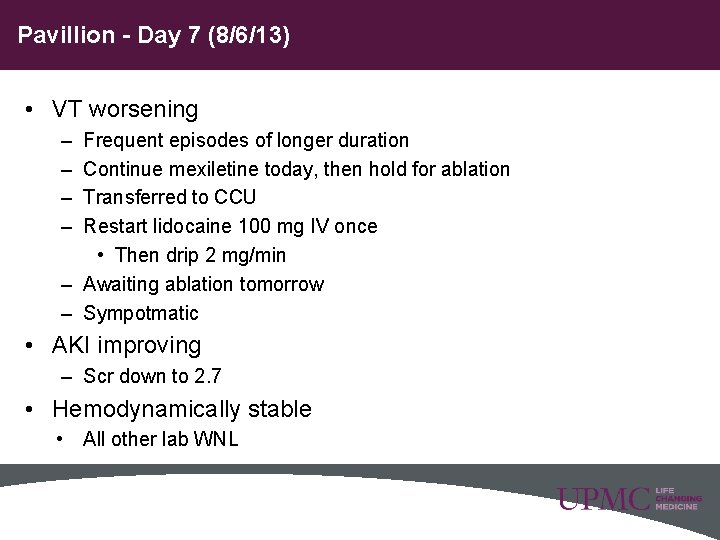
Pavillion - Day 7 (8/6/13) • VT worsening – – Frequent episodes of longer duration Continue mexiletine today, then hold for ablation Transferred to CCU Restart lidocaine 100 mg IV once • Then drip 2 mg/min – Awaiting ablation tomorrow – Sympotmatic • AKI improving – Scr down to 2. 7 • Hemodynamically stable • All other lab WNL 19
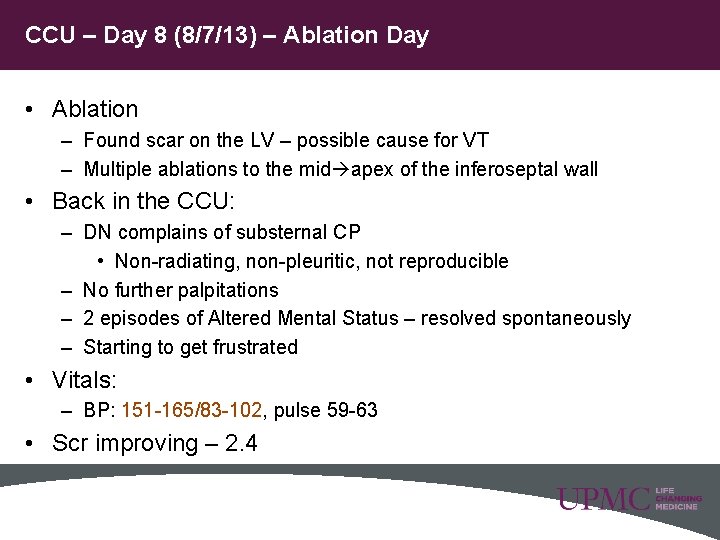
CCU – Day 8 (8/7/13) – Ablation Day • Ablation – Found scar on the LV – possible cause for VT – Multiple ablations to the mid apex of the inferoseptal wall • Back in the CCU: – DN complains of substernal CP • Non-radiating, non-pleuritic, not reproducible – No further palpitations – 2 episodes of Altered Mental Status – resolved spontaneously – Starting to get frustrated • Vitals: – BP: 151 -165/83 -102, pulse 59 -63 • Scr improving – 2. 4 20
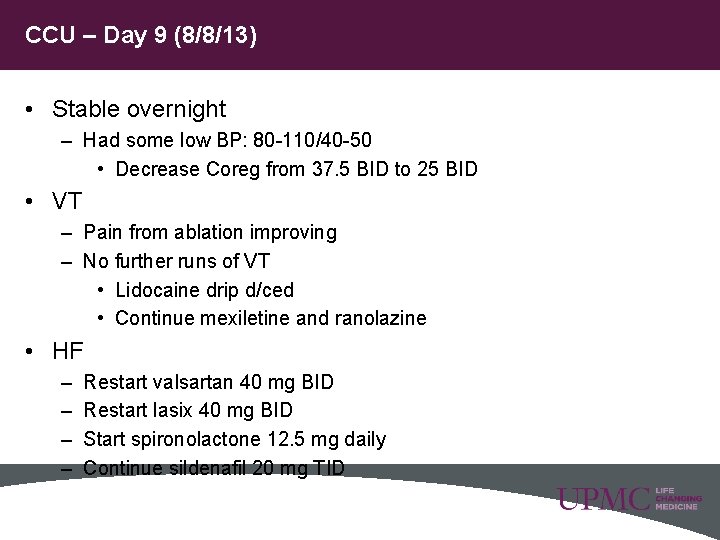
CCU – Day 9 (8/8/13) • Stable overnight – Had some low BP: 80 -110/40 -50 • Decrease Coreg from 37. 5 BID to 25 BID • VT – Pain from ablation improving – No further runs of VT • Lidocaine drip d/ced • Continue mexiletine and ranolazine • HF – – 21 Restart valsartan 40 mg BID Restart lasix 40 mg BID Start spironolactone 12. 5 mg daily Continue sildenafil 20 mg TID
CCU – Day 9 (8/8/13) • DVT – D/c warfarin completely • CKD – AKI improving – Scr = 2. 2 • At baseline – Monitor Scr closely 22
CCU - Day 10 (8/9/13) • Stable – only 1 run of VT overnight • New toe pain – Suspected gout – Avoiding colchicine b/c of CKD – Start prednisone 30 mg • Transferred to 4 D 23
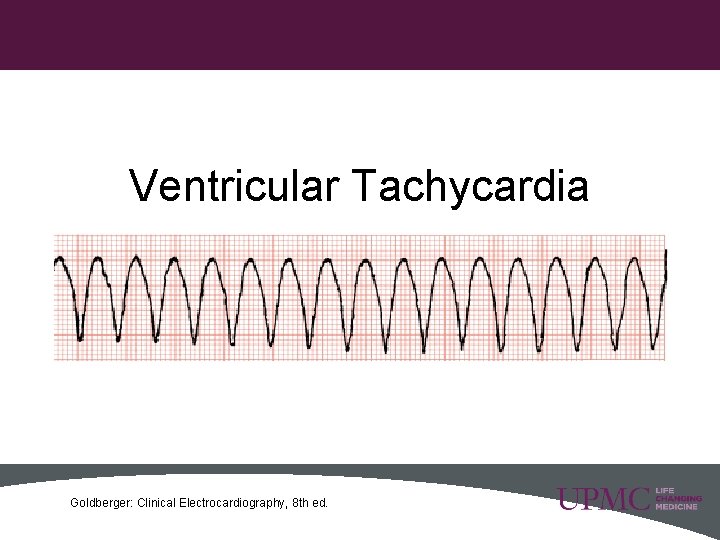
Ventricular Tachycardia 24 Goldberger: Clinical Electrocardiography, 8 th ed.
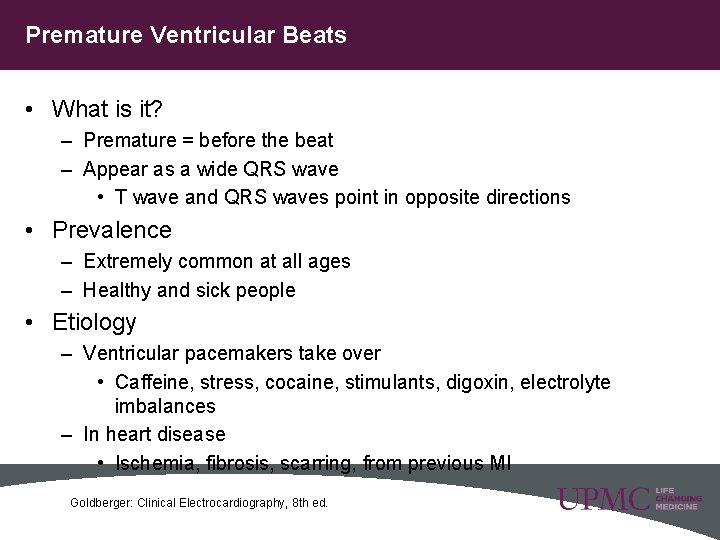
Premature Ventricular Beats • What is it? – Premature = before the beat – Appear as a wide QRS wave • T wave and QRS waves point in opposite directions • Prevalence – Extremely common at all ages – Healthy and sick people • Etiology – Ventricular pacemakers take over • Caffeine, stress, cocaine, stimulants, digoxin, electrolyte imbalances – In heart disease • Ischemia, fibrosis, scarring, from previous MI 25 Goldberger: Clinical Electrocardiography, 8 th ed.
Premature Ventricular Beats • Symptoms – Usually none – Severe palpitations • Treatment – None – Possibly Beta blockers for symtomatic PVB • Frequent VPB requires further workup 26 Goldberger: Clinical Electrocardiography, 8 th ed.
Ventricular Tachycardia • Three or more PVB in a row = Ventricular Tachycardia – Rate >100 BPM • Causes – Reentrant – Focal • Length of Arrhythmia – Sustained • >30 seconds or requiring defibrillation – Non-sustained • <30 sec • Appearance on EKG – Monomorphic – Polymorphic 27 Goldberger: Clinical Electrocardiography, 8 th ed. Krannert Institute for Cardiology. . Cardiol Clin 26. 2008: 459– 479
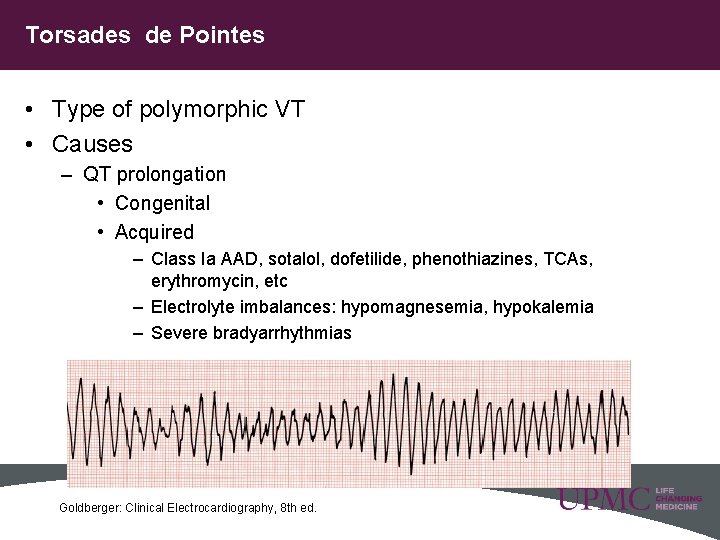
Torsades de Pointes • Type of polymorphic VT • Causes – QT prolongation • Congenital • Acquired – Class Ia AAD, sotalol, dofetilide, phenothiazines, TCAs, erythromycin, etc – Electrolyte imbalances: hypomagnesemia, hypokalemia – Severe bradyarrhythmias 28 Goldberger: Clinical Electrocardiography, 8 th ed.
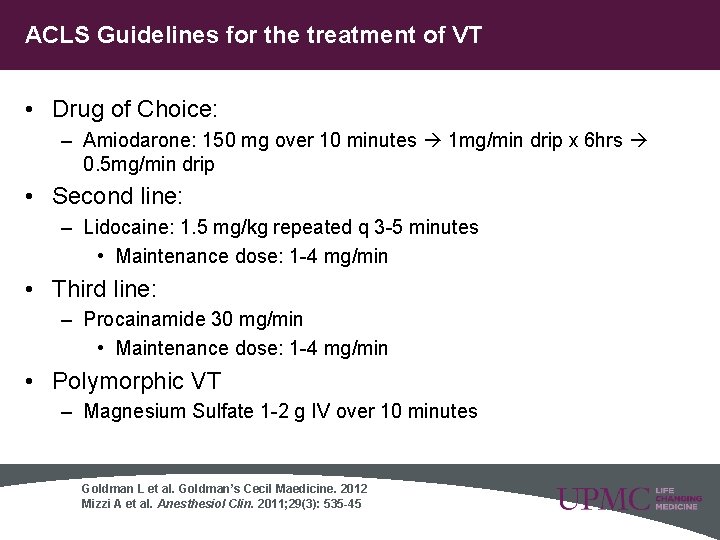
ACLS Guidelines for the treatment of VT • Drug of Choice: – Amiodarone: 150 mg over 10 minutes 1 mg/min drip x 6 hrs 0. 5 mg/min drip • Second line: – Lidocaine: 1. 5 mg/kg repeated q 3 -5 minutes • Maintenance dose: 1 -4 mg/min • Third line: – Procainamide 30 mg/min • Maintenance dose: 1 -4 mg/min • Polymorphic VT – Magnesium Sulfate 1 -2 g IV over 10 minutes 29 Goldman L et al. Goldman’s Cecil Maedicine. 2012 Mizzi A et al. Anesthesiol Clin. 2011; 29(3): 535 -45
Ranolazine: Place in Treatment 30
Ranolazine • Indication: – Chronic Stable Angina 31
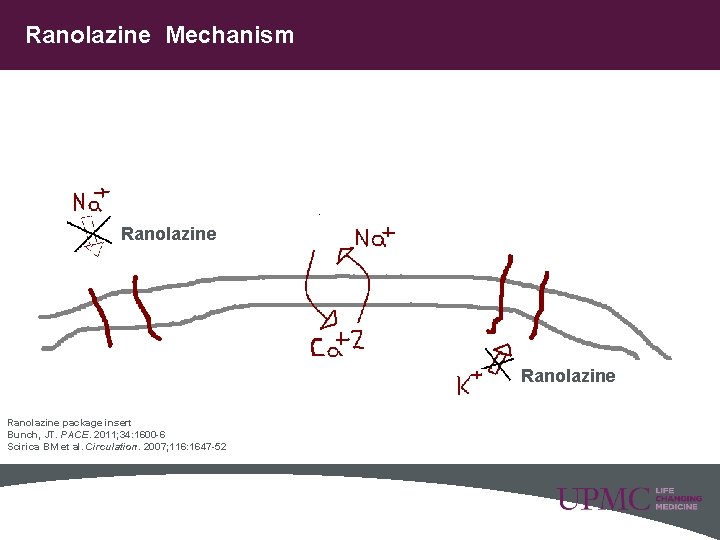
Ranolazine Mechanism Ranolazine package insert Bunch, JT. PACE. 2011; 34: 1600 -6 Scirica BM et al. Circulation. 2007; 116: 1647 -52 32
33
Role of Ranolazine in Ventricular Tachycardia 34
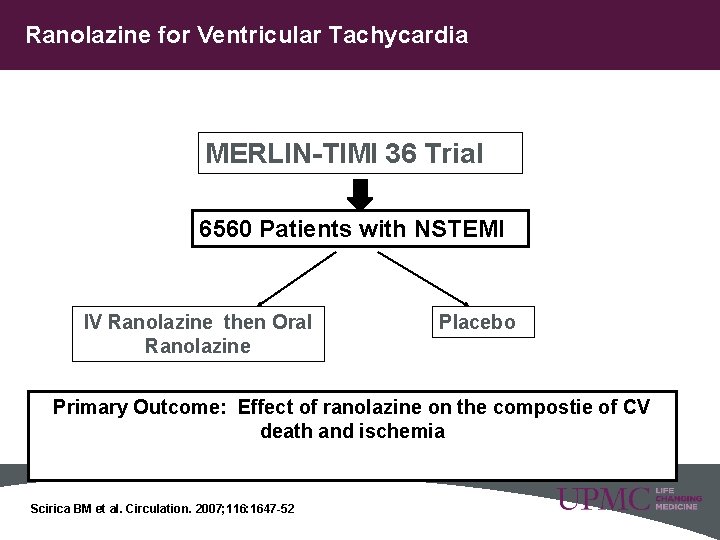
Ranolazine for Ventricular Tachycardia MERLIN-TIMI 36 Trial 6560 Patients with NSTEMI IV Ranolazine then Oral Ranolazine Placebo Primary Outcome: Effect of ranolazine on the compostie of CV death and ischemia Scirica BM et al. Circulation. 2007; 116: 1647 -52 35
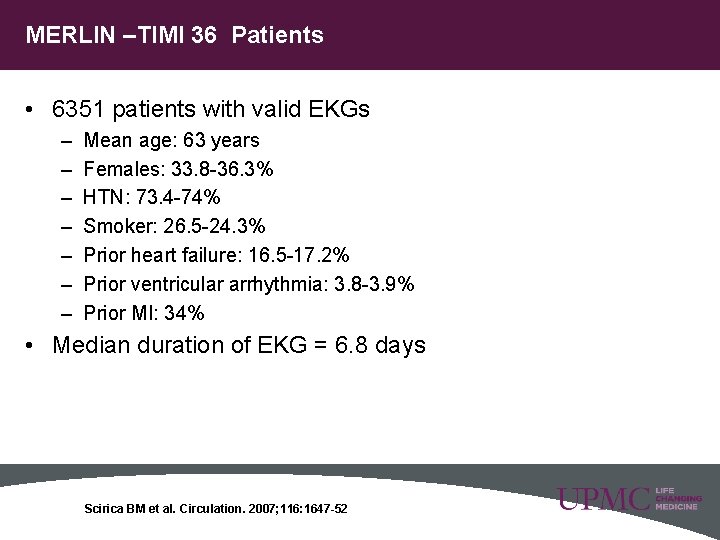
MERLIN –TIMI 36 Patients • 6351 patients with valid EKGs – – – – Mean age: 63 years Females: 33. 8 -36. 3% HTN: 73. 4 -74% Smoker: 26. 5 -24. 3% Prior heart failure: 16. 5 -17. 2% Prior ventricular arrhythmia: 3. 8 -3. 9% Prior MI: 34% • Median duration of EKG = 6. 8 days 36 Scirica BM et al. Circulation. 2007; 116: 1647 -52
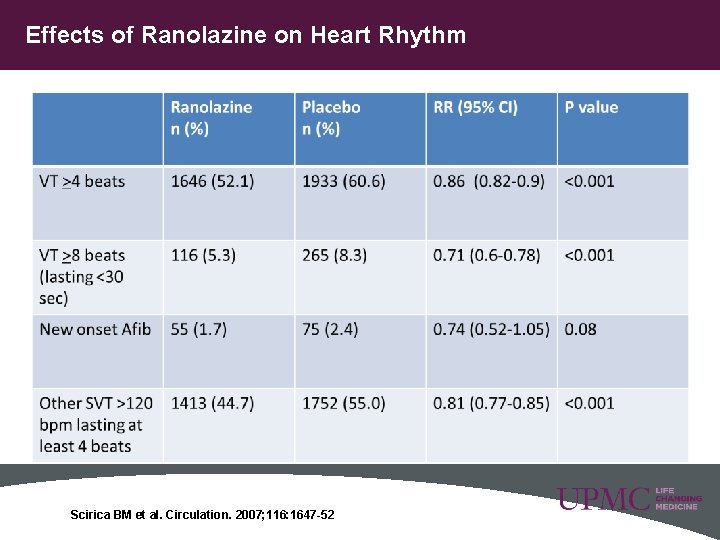
Effects of Ranolazine on Heart Rhythm 37 Scirica BM et al. Circulation. 2007; 116: 1647 -52
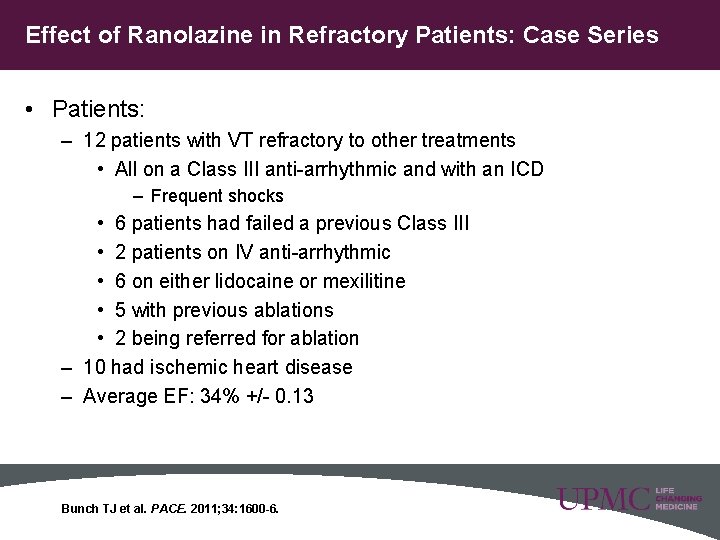
Effect of Ranolazine in Refractory Patients: Case Series • Patients: – 12 patients with VT refractory to other treatments • All on a Class III anti-arrhythmic and with an ICD – Frequent shocks • 6 patients had failed a previous Class III • 2 patients on IV anti-arrhythmic • 6 on either lidocaine or mexilitine • 5 with previous ablations • 2 being referred for ablation – 10 had ischemic heart disease – Average EF: 34% +/- 0. 13 38 Bunch TJ et al. PACE. 2011; 34: 1600 -6.
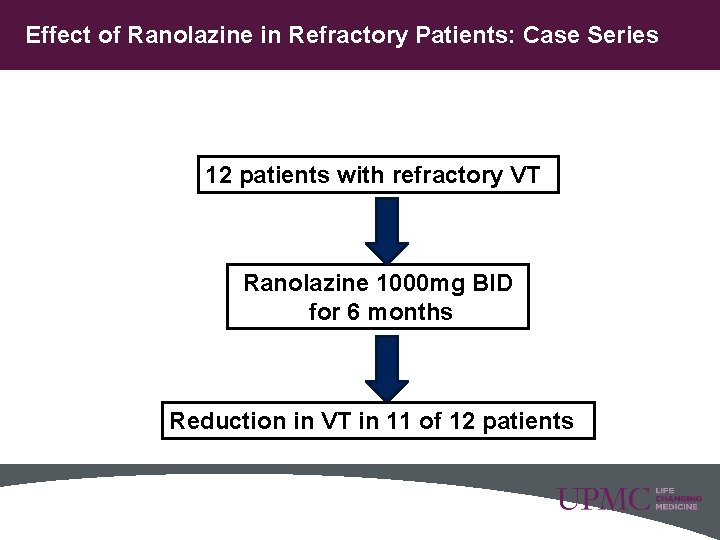
Effect of Ranolazine in Refractory Patients: Case Series 12 patients with refractory VT Ranolazine 1000 mg BID for 6 months Reduction in VT in 11 of 12 patients 39
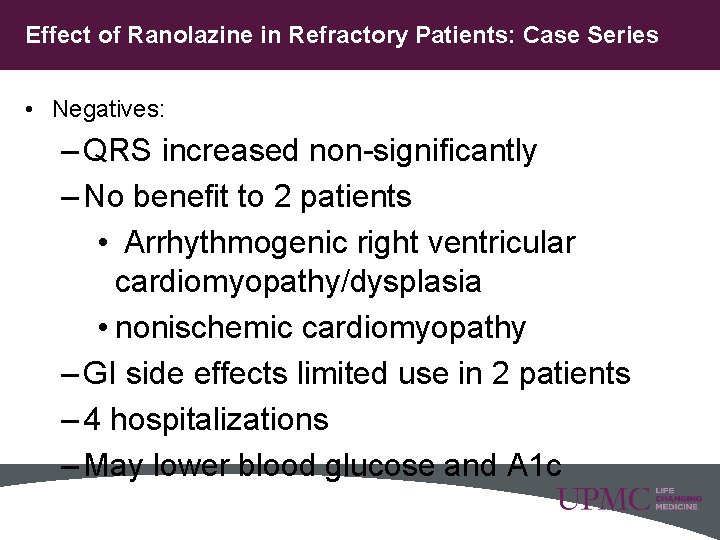
Effect of Ranolazine in Refractory Patients: Case Series • Negatives: – QRS increased non-significantly – No benefit to 2 patients • Arrhythmogenic right ventricular cardiomyopathy/dysplasia • nonischemic cardiomyopathy – GI side effects limited use in 2 patients – 4 hospitalizations – May lower blood glucose and A 1 c 40
Questions? 41