
Ventilation perfusionVQ Ratio Objectives By the end of
Ventilation perfusion(V/Q) Ratio
Objectives By the end of this lecture you will be able to § Recognize the high pressure and low pressure circulations supplying the lung. §Identify the meaning of the physiological shunt in the pulmonary circulation. §State the different lung zones according to the pulmonary blood flow. §Define the V/Q ratio and its regional variation. §Explain the clinical significance of the V/Q ratio § Describe the abnormal patterns of the V/Q ration vice, shunt and dead space patterns.
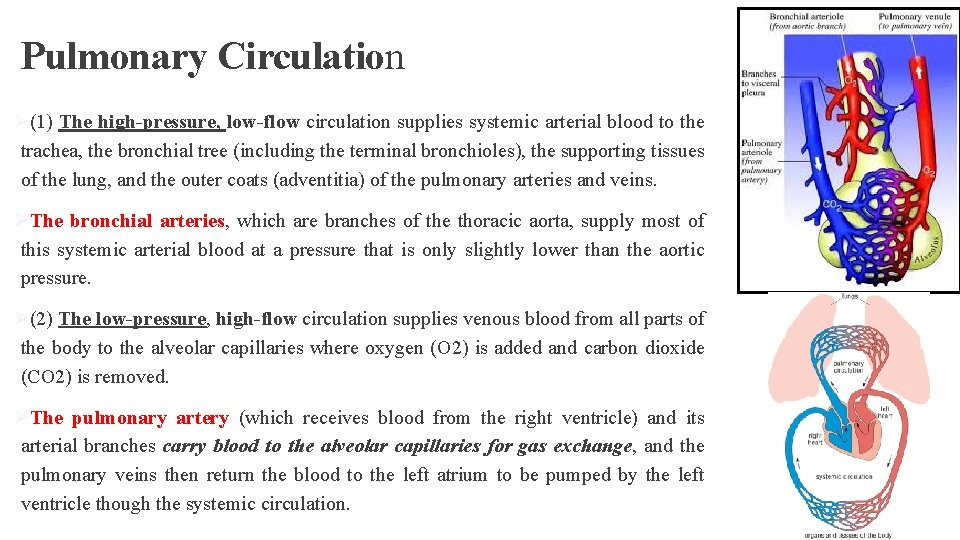
Pulmonary Circulation Ø(1) The high-pressure, low-flow circulation supplies systemic arterial blood to the trachea, the bronchial tree (including the terminal bronchioles), the supporting tissues of the lung, and the outer coats (adventitia) of the pulmonary arteries and veins. ØThe bronchial arteries, which are branches of the thoracic aorta, supply most of this systemic arterial blood at a pressure that is only slightly lower than the aortic pressure. Ø(2) The low-pressure, high-flow circulation supplies venous blood from all parts of the body to the alveolar capillaries where oxygen (O 2) is added and carbon dioxide (CO 2) is removed. ØThe pulmonary artery (which receives blood from the right ventricle) and its arterial branches carry blood to the alveolar capillaries for gas exchange, and the pulmonary veins then return the blood to the left atrium to be pumped by the left ventricle though the systemic circulation.
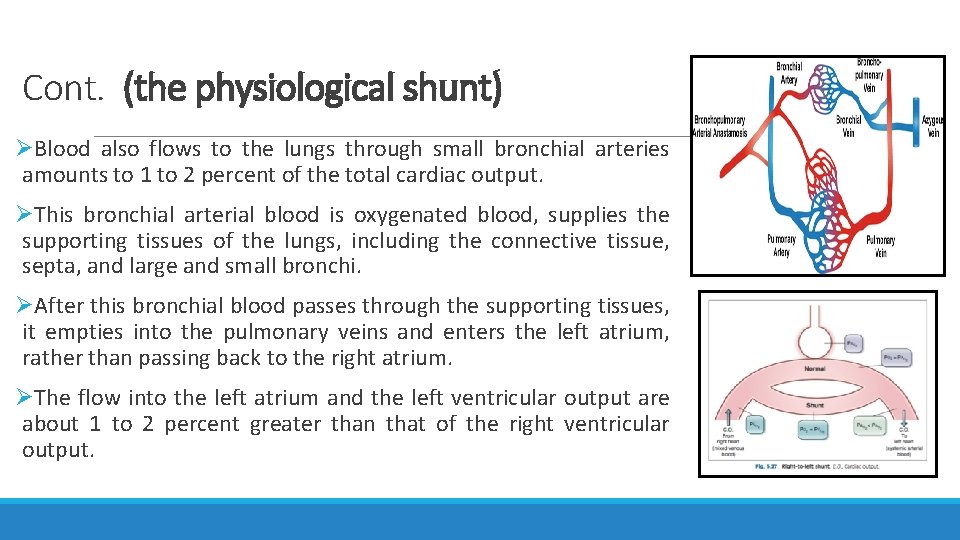
Cont. (the physiological shunt) ØBlood also flows to the lungs through small bronchial arteries amounts to 1 to 2 percent of the total cardiac output. ØThis bronchial arterial blood is oxygenated blood, supplies the supporting tissues of the lungs, including the connective tissue, septa, and large and small bronchi. ØAfter this bronchial blood passes through the supporting tissues, it empties into the pulmonary veins and enters the left atrium, rather than passing back to the right atrium. ØThe flow into the left atrium and the left ventricular output are about 1 to 2 percent greater than that of the right ventricular output.
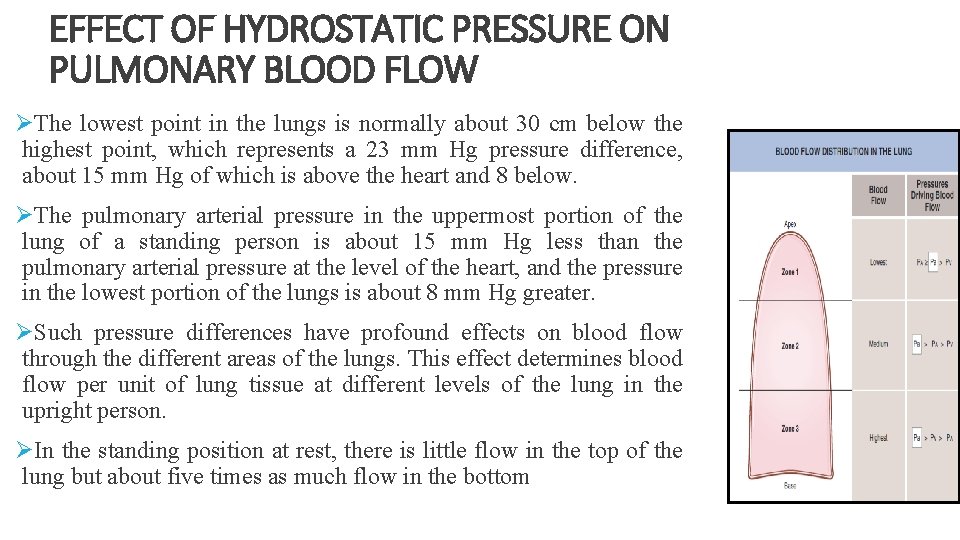
EFFECT OF HYDROSTATIC PRESSURE ON PULMONARY BLOOD FLOW ØThe lowest point in the lungs is normally about 30 cm below the highest point, which represents a 23 mm Hg pressure difference, about 15 mm Hg of which is above the heart and 8 below. ØThe pulmonary arterial pressure in the uppermost portion of the lung of a standing person is about 15 mm Hg less than the pulmonary arterial pressure at the level of the heart, and the pressure in the lowest portion of the lungs is about 8 mm Hg greater. ØSuch pressure differences have profound effects on blood flow through the different areas of the lungs. This effect determines blood flow per unit of lung tissue at different levels of the lung in the upright person. ØIn the standing position at rest, there is little flow in the top of the lung but about five times as much flow in the bottom
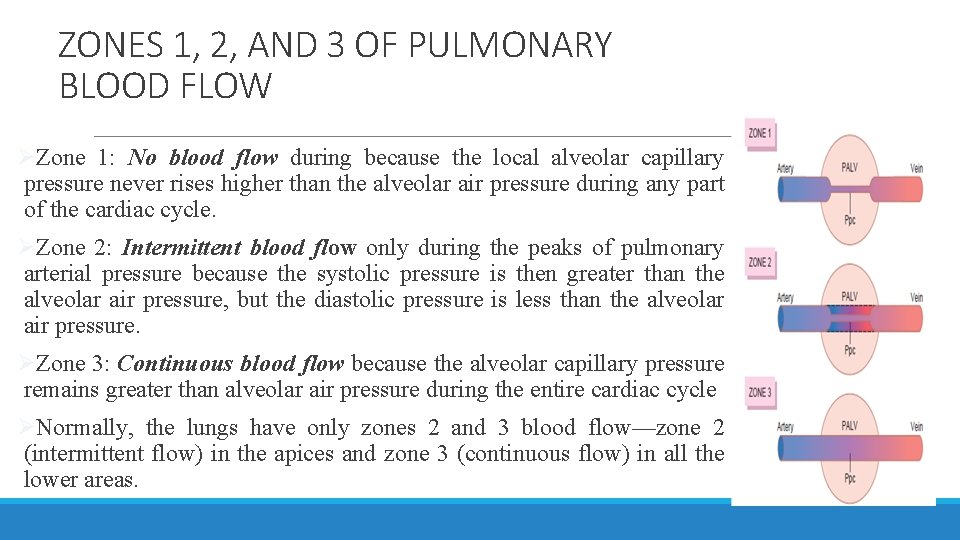
ZONES 1, 2, AND 3 OF PULMONARY BLOOD FLOW ØZone 1: No blood flow during because the local alveolar capillary pressure never rises higher than the alveolar air pressure during any part of the cardiac cycle. ØZone 2: Intermittent blood flow only during the peaks of pulmonary arterial pressure because the systolic pressure is then greater than the alveolar air pressure, but the diastolic pressure is less than the alveolar air pressure. ØZone 3: Continuous blood flow because the alveolar capillary pressure remains greater than alveolar air pressure during the entire cardiac cycle ØNormally, the lungs have only zones 2 and 3 blood flow—zone 2 (intermittent flow) in the apices and zone 3 (continuous flow) in all the lower areas.
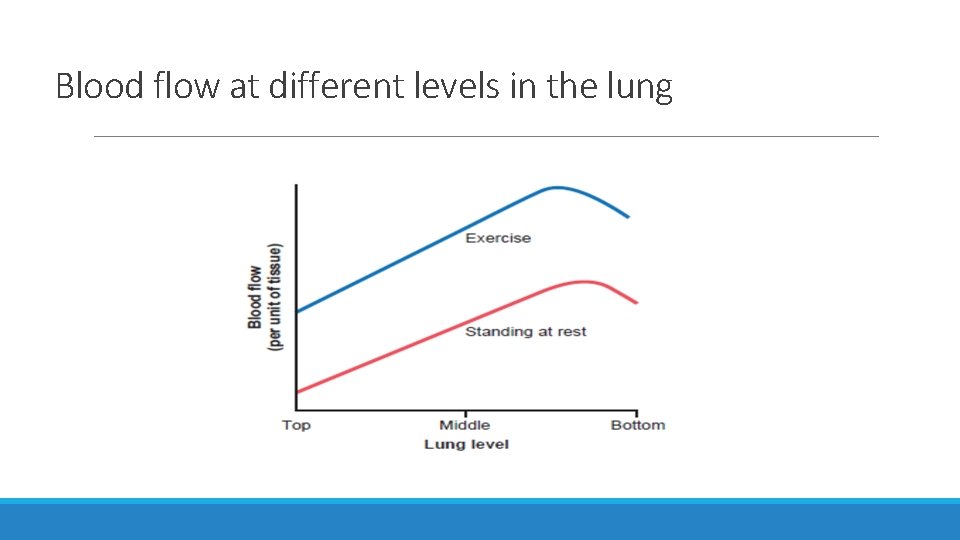
Blood flow at different levels in the lung

Ventilation –perfusion ratio (V/Q) It is the ratio of alveolar ventilation to pulmonary blood flow per minute. The alveolar ventilation at rest (4. 2 L/min) The pulmonary blood flow is equal to right ventricular output per minute (5 L/min) So V/Q ratio = 4. 2 = 0. 84 5 DR. AIDA KORISH 8
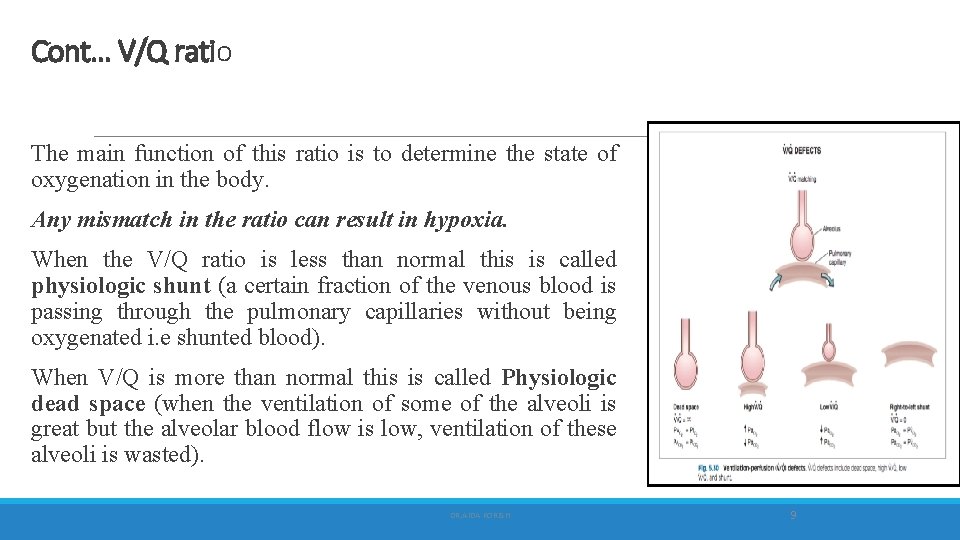
Cont… V/Q ratio The main function of this ratio is to determine the state of oxygenation in the body. Any mismatch in the ratio can result in hypoxia. When the V/Q ratio is less than normal this is called physiologic shunt (a certain fraction of the venous blood is passing through the pulmonary capillaries without being oxygenated i. e shunted blood). When V/Q is more than normal this is called Physiologic dead space (when the ventilation of some of the alveoli is great but the alveolar blood flow is low, ventilation of these alveoli is wasted). DR. AIDA KORISH 9

(V /Q ) in the zones of the lung Average V/Q ratio across the lung is 0. 8. At the apex V/Q ratio = 3 At the base V/Q ratio=0. 6 So the apex is more ventilated than perfused and the base is more perfused than ventilated. During exercise and lying flat in bed the V/Q ratio becomes more homogenous among different parts of the lung
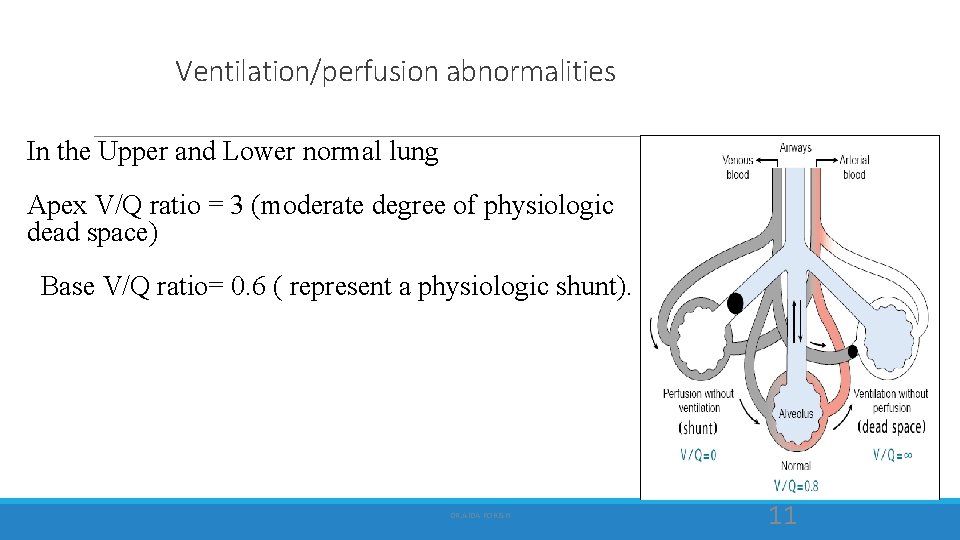
Ventilation/perfusion abnormalities In the Upper and Lower normal lung Apex V/Q ratio = 3 (moderate degree of physiologic dead space) Base V/Q ratio= 0. 6 ( represent a physiologic shunt). DR. AIDA KORISH 11
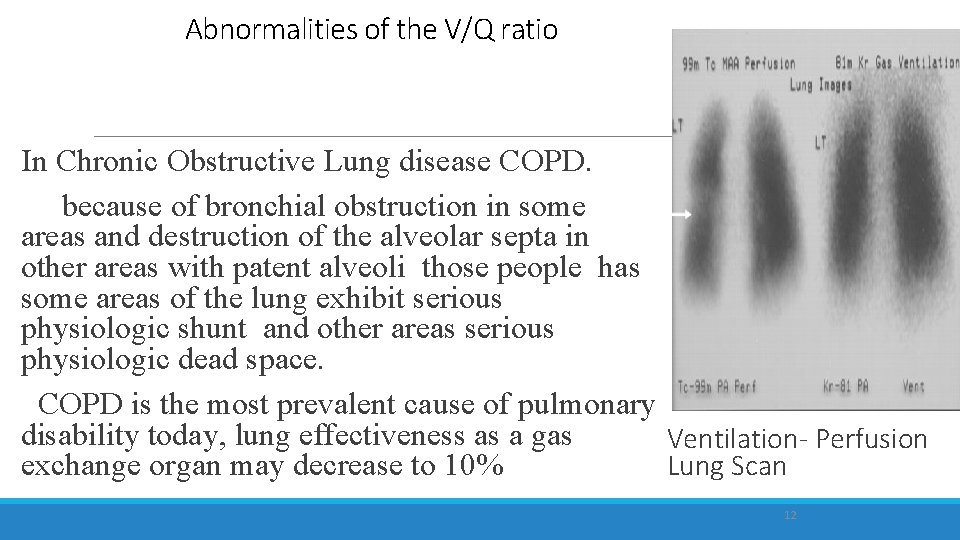
Abnormalities of the V/Q ratio In Chronic Obstructive Lung disease COPD. because of bronchial obstruction in some areas and destruction of the alveolar septa in other areas with patent alveoli those people has some areas of the lung exhibit serious physiologic shunt and other areas serious physiologic dead space. COPD is the most prevalent cause of pulmonary disability today, lung effectiveness as a gas Ventilation- Perfusion Lung Scan exchange organ may decrease to 10% 12
- Slides: 12