
Ventilation A presentation for Presented by Tim Kaye

Ventilation A presentation for Presented by Tim Kaye 14 th May 2015
Presentation Outline Airmaster – a recap… What’s it all about? Approaches to ventilation Regulation changes Next steps
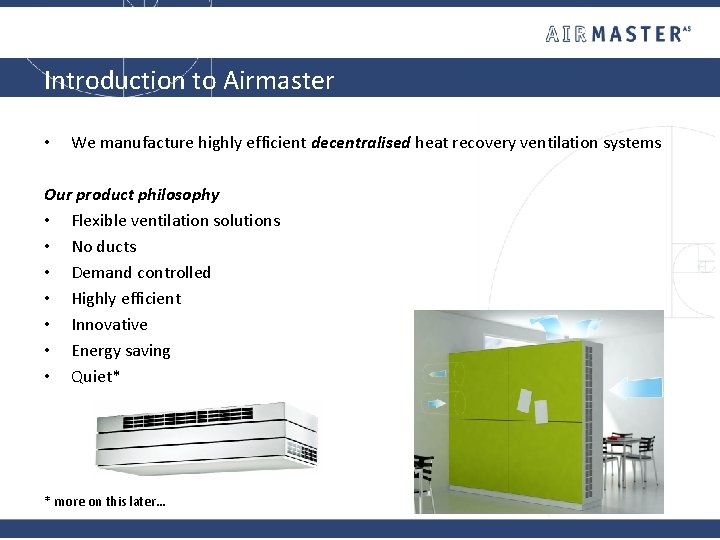
Introduction to Airmaster • We manufacture highly efficient decentralised heat recovery ventilation systems Our product philosophy • Flexible ventilation solutions • No ducts • Demand controlled • Highly efficient • Innovative • Energy saving • Quiet* * more on this later…

So what is “decentralised ventilation”? Localised ventilation – no ductwork • Ventilation units located in the rooms they are serving Traditional system • Central AHU • Ductwork throughout the building Decentralised system • Local AHUs • No Ductwork throughout the building • Intelligent demand controlled ventilation • Perfect for new build, simple to install for refurbishment projects
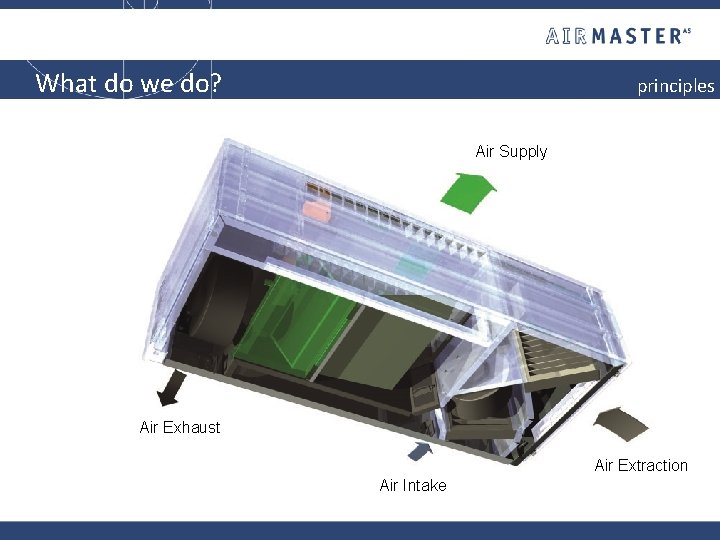
What do we do? principles Air Supply Air Exhaust Air Extraction Air Intake
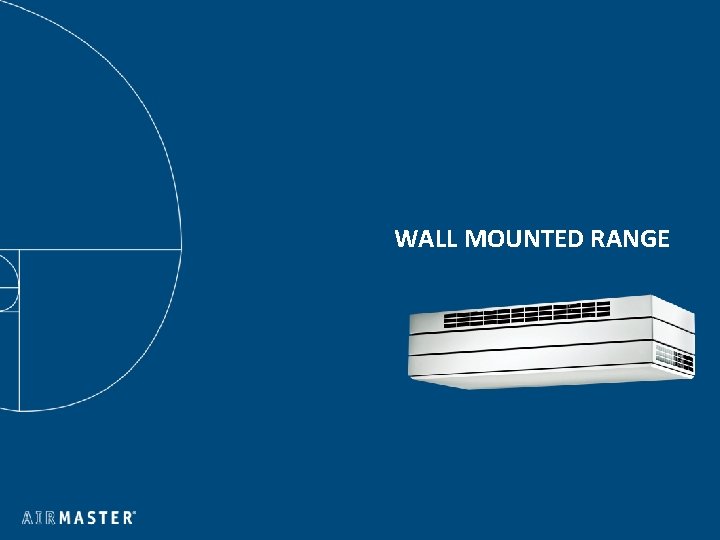
WALL MOUNTED RANGE
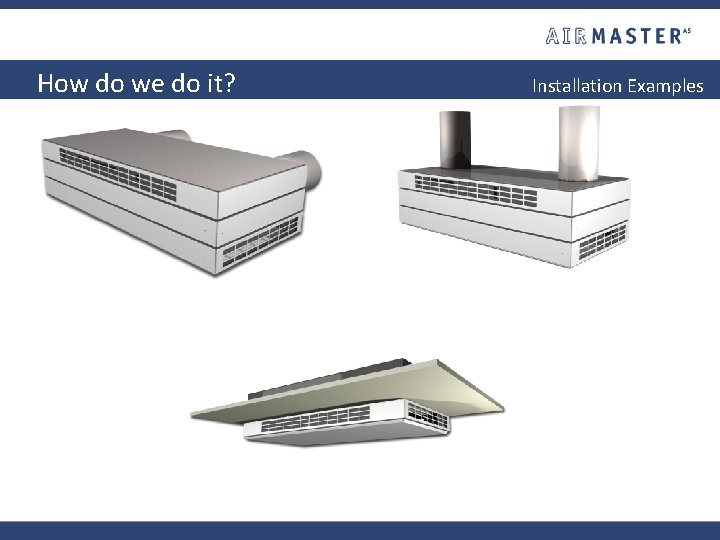
How do we do it? Installation Examples
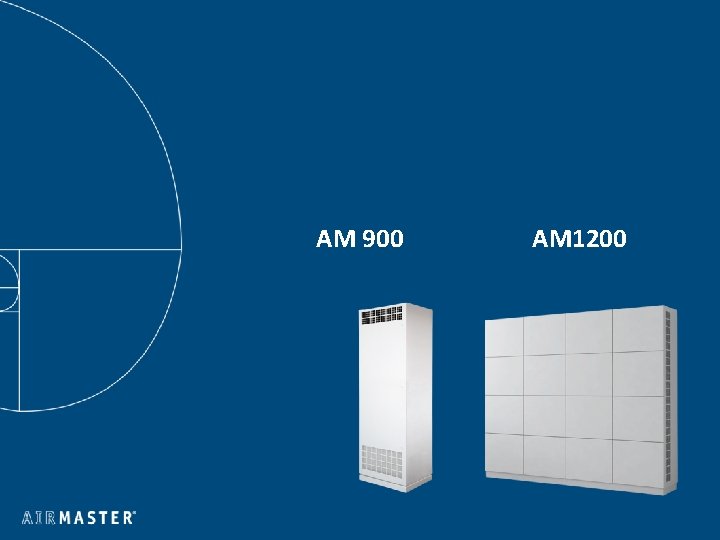
AM 900 AM 1200
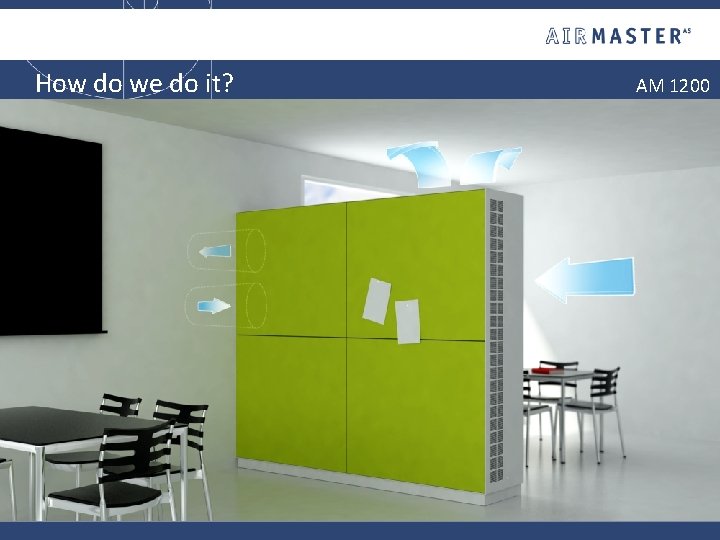
How do we do it? AM 1200
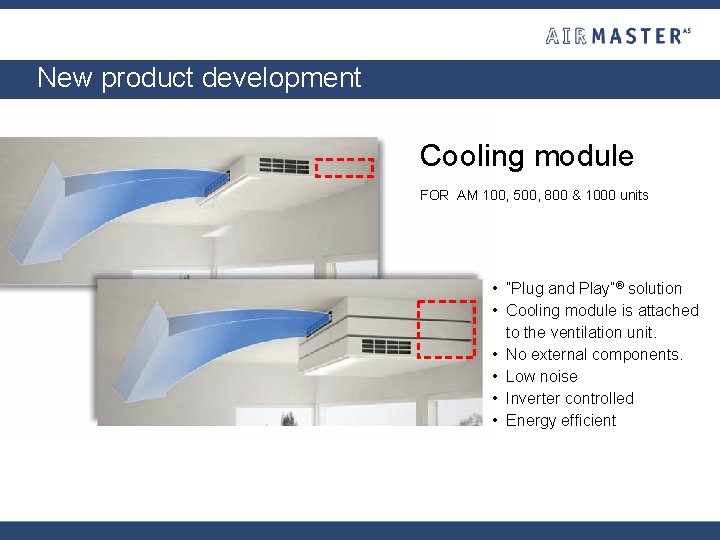
New product development Cooling module FOR AM 100, 500, 800 & 1000 units • ”Plug and Play”® solution • Cooling module is attached to the ventilation unit. • No external components. • Low noise • Inverter controlled • Energy efficient
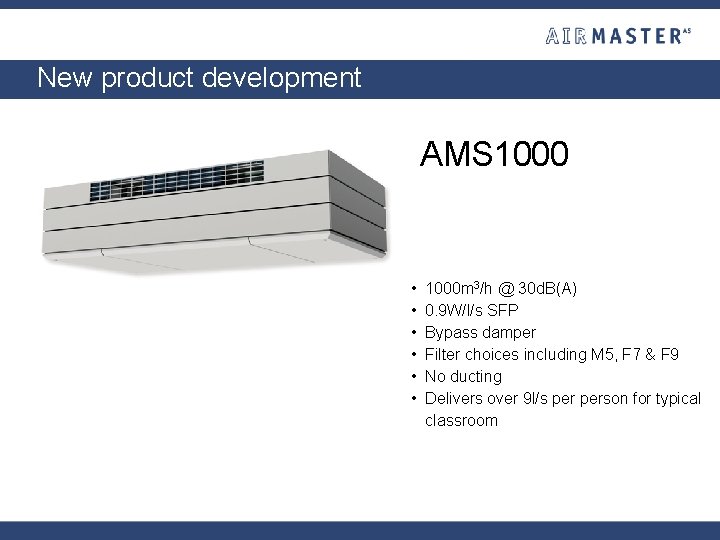
New product development AMS 1000 • • • 1000 m 3/h @ 30 d. B(A) 0. 9 W/l/s SFP Bypass damper Filter choices including M 5, F 7 & F 9 No ducting Delivers over 9 l/s person for typical classroom
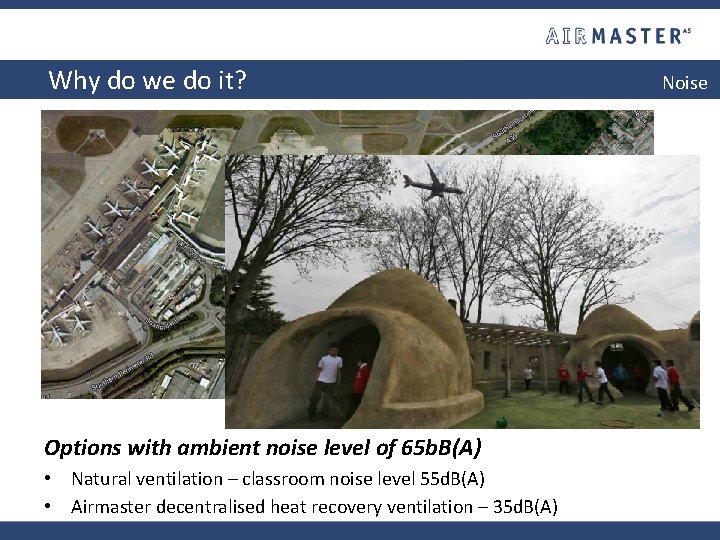
Why do we do it? Options with ambient noise level of 65 b. B(A) • Natural ventilation – classroom noise level 55 d. B(A) • Airmaster decentralised heat recovery ventilation – 35 d. B(A) Noise
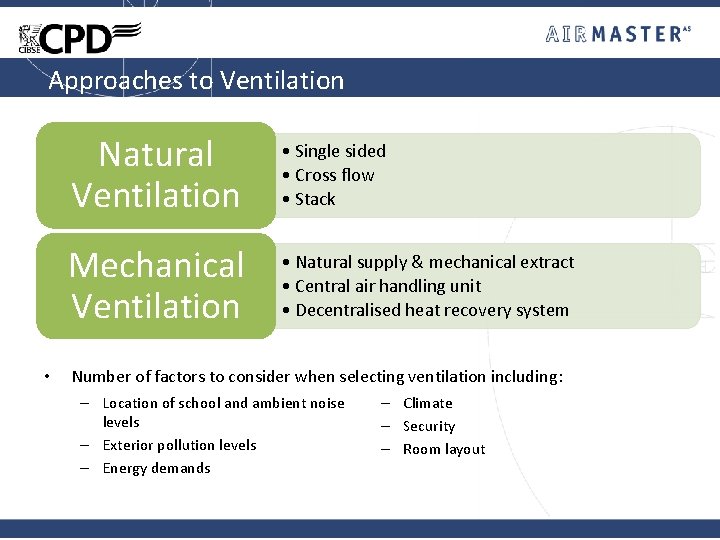
Approaches to Ventilation Natural Ventilation Mechanical Ventilation • • Single sided • Cross flow • Stack Founded in 1991 by Kim Jensen and Henrik Stæhr. Today we employ 78 colleagues in Denmark and manufacture in 3 premises. • Natural supply & mechanical extract We have 9 people in R & D. • Central air handling unit Airmaster A/S is represented in • Decentralised heat recovery system Several European countries, and has it‘s own sales companies in Number of factors to consider when selecting ventilation including: Sweden & the UK. – Location of school and ambient noise levels – Exterior pollution levels – Energy demands – Climate – Security – Room layout
Natural Ventilation Benefits • No energy used during operation • Can use windows as a method of ventilation • Uses natural cooling therefore removing the need for mechanical air conditioning • Reduces energy consumption required for cooling • Can use night time purging to cool thermal mass • No noise from mechanical fans or motors
Natural Ventilation Limitations • Uses 12 times more energy than high efficient heat recovery systems • No heat recovery • Limited or no controls available – often relies on manual operation • Inconsistent air volume compared to demanded rate • CIBSE suggest over 3, 000 climatic conditions which can affecting ventilation • Limits on room design and layout • Noise transfer through terminal/window • Draughts • No filtration of supply air • If windows used to provide ventilation, security issues need to be addressed
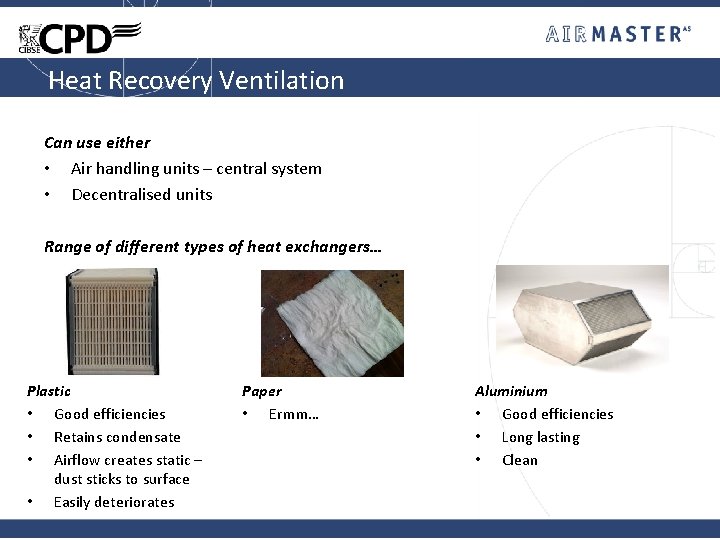
Heat Recovery Ventilation Can use either • Air handling units – central system • Decentralised units Range of different types of heat exchangers… Plastic • Good efficiencies • Retains condensate • Airflow creates static – dust sticks to surface • Easily deteriorates Paper • Ermm… Aluminium • Good efficiencies • Long lasting • Clean
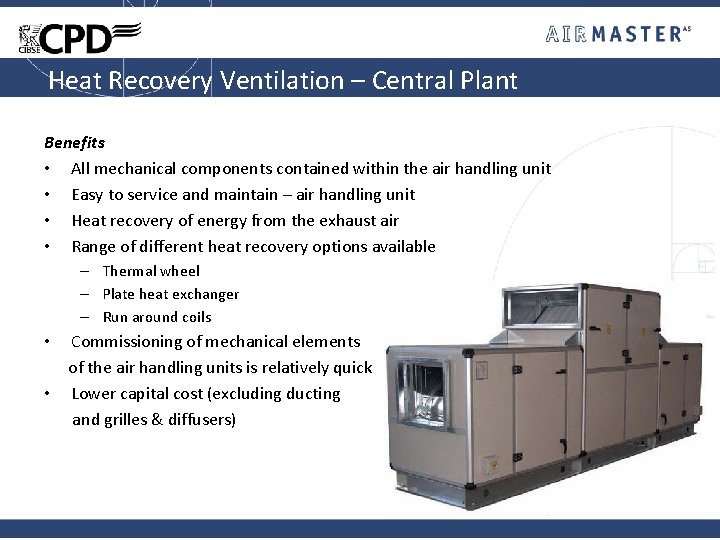
Heat Recovery Ventilation – Central Plant Benefits • All mechanical components contained within the air handling unit • Easy to service and maintain – air handling unit • Heat recovery of energy from the exhaust air • Range of different heat recovery options available – Thermal wheel – Plate heat exchanger – Run around coils Commissioning of mechanical elements of the air handling units is relatively quick • Lower capital cost (excluding ducting and grilles & diffusers) •
Heat Recovery Ventilation Limitations • Expensive installation cost • Need space for ductwork to run through the building • Difficult to retro fit • Air handling units sized for a particular application, difficult to extend onto the system when building’s requirement changes • “One size fits” all approach to air supply, conditioned at the air handling unit and supplied to all the rooms connected • Can provide demand controlled ventilation however very expensive solution with dampers to control air volume – need to be serviced annually in Denmark • Penetrates fire compartments throughout the building requiring additional intumescent measures (fire collars, fire dampers, duct wrap etc. ) • Attenuators required on ductwork to ensure transmitted noise is minimised
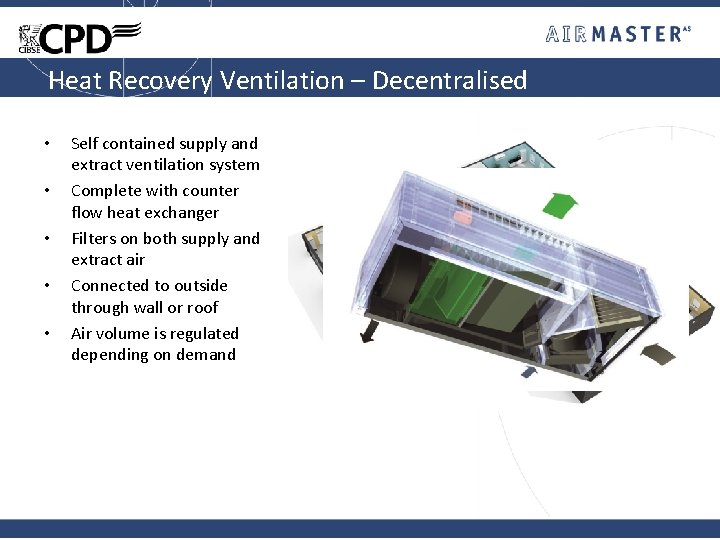
Heat Recovery Ventilation – Decentralised • • • Self contained supply and extract ventilation system Complete with counter flow heat exchanger Filters on both supply and extract air Connected to outside through wall or roof Air volume is regulated depending on demand
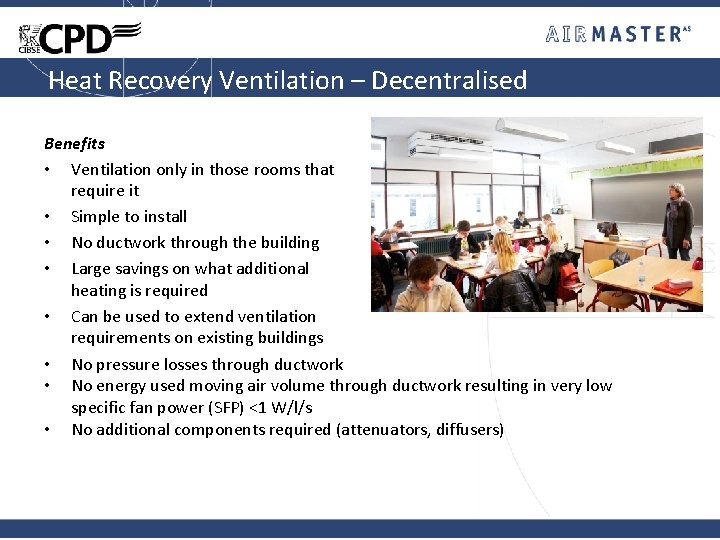
Heat Recovery Ventilation – Decentralised Benefits • Ventilation only in those rooms that require it • Simple to install • No ductwork through the building • Large savings on what additional heating is required • Can be used to extend ventilation requirements on existing buildings • No pressure losses through ductwork • No energy used moving air volume through ductwork resulting in very low specific fan power (SFP) <1 W/l/s • No additional components required (attenuators, diffusers)
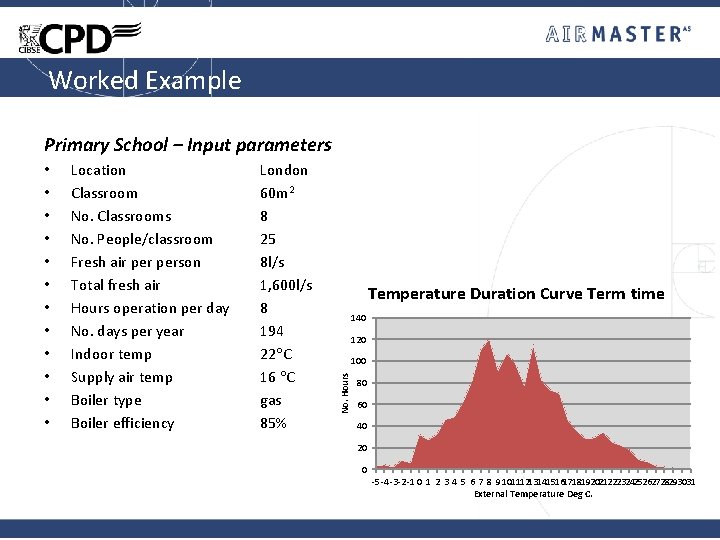
Worked Example Primary School – Input parameters Location Classroom No. Classrooms No. People/classroom Fresh air person Total fresh air Hours operation per day No. days per year Indoor temp Supply air temp Boiler type Boiler efficiency London 60 m 2 8 25 8 l/s 1, 600 l/s 8 194 22 C 16 C gas 85% Temperature Duration Curve Term time 140 120 100 No. Hours • • • 80 60 40 20 0 -5 -4 -3 -2 -1 0 1 2 3 4 5 6 7 8 9 10111213141516171819202122232425262728293031 External Temperature Deg C.
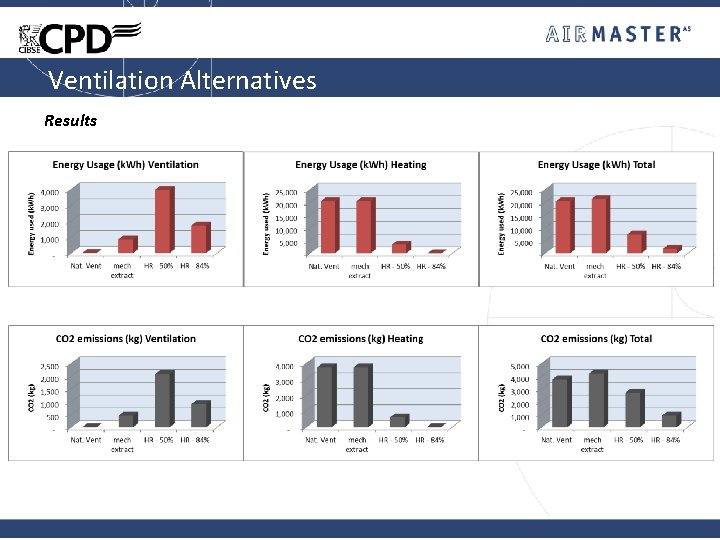
Ventilation Alternatives Results
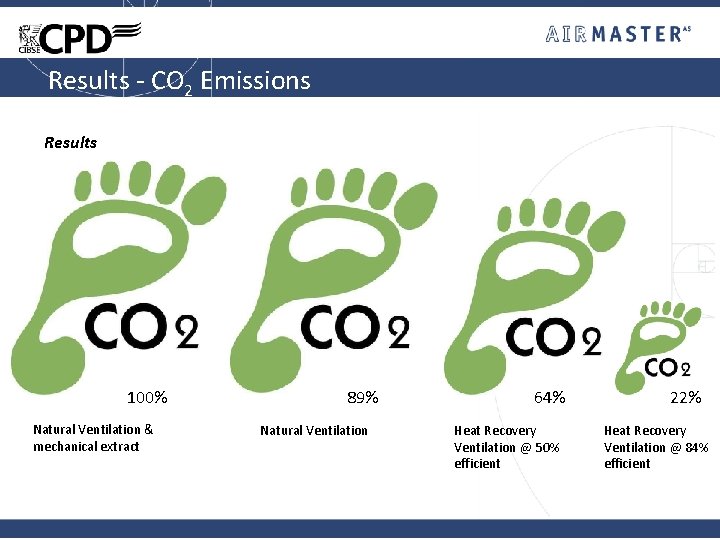
Results - CO 2 Emissions Results 100% Natural Ventilation & mechanical extract 89% Natural Ventilation 64% Heat Recovery Ventilation @ 50% efficient 22% Heat Recovery Ventilation @ 84% efficient
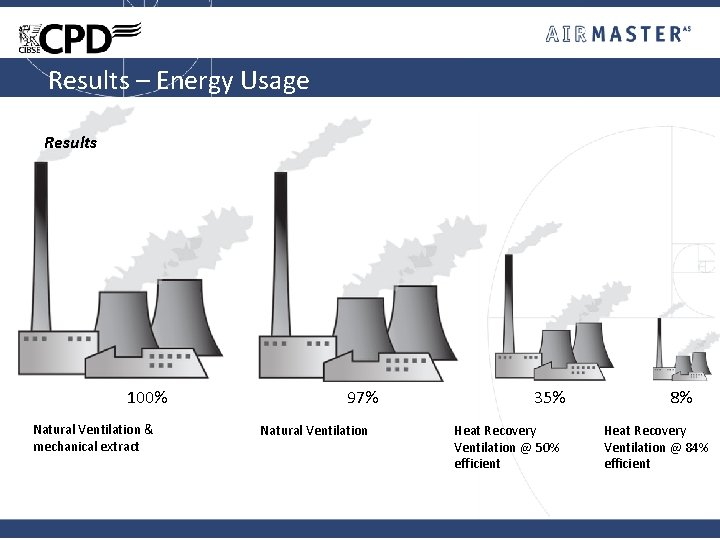
Results – Energy Usage Results 100% Natural Ventilation & mechanical extract 97% Natural Ventilation 35% Heat Recovery Ventilation @ 50% efficient 8% Heat Recovery Ventilation @ 84% efficient
Summary of ventilation options Best practice • Incorporate high efficient heat recovery exchanger • Incorporate energy efficient components wherever possible; – Low energy EC fans – Counterflow heat exchanger – Summer bypass damper • • • Incorporate night time cooling Ensure ambient noise transmission is reduced to minimum levels Ensure ventilation system can be simply serviced/maintained Key Figures • Natural ventilation uses 12 times more energy compared to high energy efficient heat recovery decentralised units • Natural ventilation produces over 4 times more carbon emissions • Airmaster can reduce ambient noise transmitted through the unit by over 54 d. B(A)
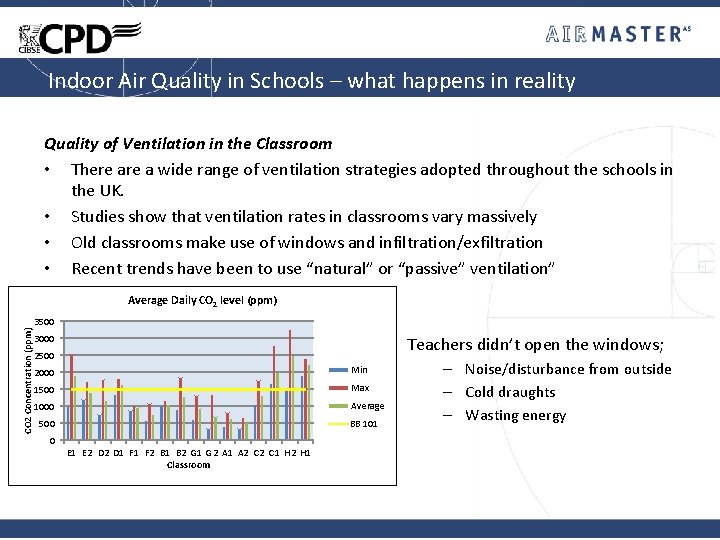
Indoor Air Quality in Schools – what happens in reality Quality of Ventilation in the Classroom Founded in 1991 by • There a wide range of ventilation strategies adopted throughout the schools in Kim Jensen and Henrik Stæhr. the UK. • Studies show that ventilation rates in classrooms massively Today wevary employ 78 colleagues in Denmark and manufacture in 3 premises. • Old classrooms make use of windows and infiltration/exfiltration We have 9 people in R & D. • Recent trends have been to use “natural” or “passive” ventilation” Average Daily CO 2 level (ppm) CO 2 Concentration (ppm) 3500 3000 2500 2000 Min 1500 Max 1000 Average 500 BB 101 0 E 1 E 2 D 1 F 2 B 1 B 2 G 1 G 2 A 1 A 2 C 1 H 2 H 1 Classroom Airmaster A/S is represented in Several European countries, Teachers open thecompanies windows; in and hasdidn’t it‘s own sales – Noise/disturbance from&outside Sweden the UK. – Cold draughts – Wasting energy
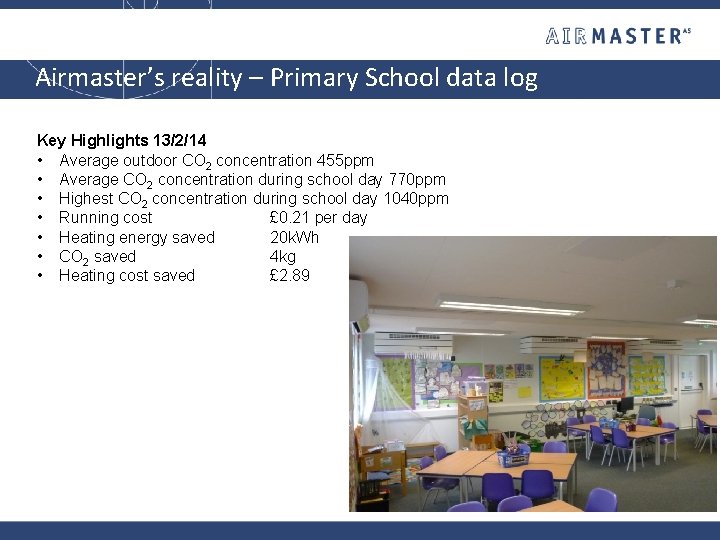
Airmaster’s reality – Primary School data log Key Highlights 13/2/14 • Average outdoor CO 2 concentration 455 ppm • Average CO 2 concentration during school day 770 ppm • Highest CO 2 concentration during school day 1040 ppm • Running cost £ 0. 21 per day • Heating energy saved 20 k. Wh • CO 2 saved 4 kg • Heating cost saved £ 2. 89
Changes to regulations • • • BB 93 updated last year BB 101 currently going through review Insight into my first meeting… • • Still heavily biased towards natural ventilation I have added an alternative voice for mechanical ventilation Want a level playing field Should be trying to create the best, healthiest learning environment for the children
Changes to regulations • • BB 101 due to be published end of this year Some key changes include; – – • No draughts – air needs to be mixed before entering occupied zone Can no longer “pre heat” air using radiators Air can’t be cooler than the room by more than 5⁰C Need to incorporate “night cooling” into any scheme Observations from Airmaster include; – – – Focus on overheating in summer time Focus on cooling classroom using thermal mass No recognition on heating requirement Difference between CO 2 concentration depending on ventilation systems Reference made to controls but appears to be reliance on teacher operation
Next steps Airmaster would like to; • Build on the relationships with the Modular Building companies • Understand your typical project type • Develop strong relationships with all key influencers including; – – Consultants Architects Contractors End users Why should we do this? • Move forward together to create healthy learning environments • Raise the energy issue • Provide simple to operate, quick to maintain solutions • Offer demand controlled ventilation – only ventilating when required
- Slides: 30