
Venous Thromboembolism Prophylaxis and Treatment in Patients with
Venous Thromboembolism Prophylaxis and Treatment in Patients with Cancer: ASCO Clinical Practice Guideline Update Key, et al. www. asco. org/supportive-care-guidelines ©American Society of Clinical Oncology 2019. All rights reserved.

Introduction § Comprehensive management of venous thromboembolism (VTE) in patients with cancer includes both the identification of patients who are most likely to benefit from pharmacologic prophylaxis, as well as effective treatment to reduce the risk of VTE recurrence and mortality. § VTE includes deep vein thrombosis (DVT) and pulmonary embolism (PE) § The current update revises several previous recommendations. Most notably, direct oral anticoagulants (DOAC) have been added as options for VTE prophylaxis and treatment. www. asco. org/supportive-care-guidelines ©American Society of Clinical Oncology 2019. All rights reserved.

ASCO Guideline Development Methodology The ASCO Clinical Practice Guidelines Committee guideline process includes: • a systematic literature review by ASCO guidelines staff • an expert panel provides critical review and evidence interpretation to inform guideline recommendations • final guideline approval by ASCO CPGC The full ASCO Guideline methodology supplement can be found at: www. asco. org/guideline-methodology www. asco. org/supportive-care-guidelines ©American Society of Clinical Oncology 2019. All rights reserved.
Clinical Questions This clinical practice guideline addresses six clinical questions: 1) Should hospitalized patients with cancer receive anticoagulation for VTE prophylaxis? 2) Should ambulatory patients with cancer receive anticoagulation for VTE prophylaxis during systemic chemotherapy? 3) Should patients with cancer undergoing surgery receive perioperative VTE prophylaxis? 4) What is the best method for treatment of patients with cancer with established VTE to prevent recurrence? 5) Should patients with cancer receive anticoagulants in the absence of established VTE to improve survival? 6) What is known about risk prediction and awareness of VTE among patients with www. asco. org/supportive-care-guidelines ©American Society of Clinical Oncology 2019. All rights reserved. cancer?
Target Population and Audience Target Population Adults with cancer Target Audience Oncologists, surgeons, oncology nurses, oncology pharmacists, other health care professionals who care for patients with cancer, patients, and caregivers. www. asco. org/supportive-care-guidelines ©American Society of Clinical Oncology 2019. All rights reserved.
Summary of Recommendations CLINICAL QUESTION 1 Should hospitalized patients with cancer receive anticoagulation for VTE prophylaxis? Recommendation 1. 1. Hospitalized patients who have active malignancy and acute medical illness or reduced mobility should be offered pharmacologic thromboprophylaxis in the absence of bleeding or other contraindications. (Type: Evidence based; Evidence quality: Intermediate; Strength of recommendation: Moderate) Recommendation 1. 2. Hospitalized patients who have active malignancy without additional risk factors may be offered pharmacologic thromboprophylaxis in the absence of bleeding or other contraindications. (Type: Evidence based; Evidence quality: Low; Strength of recommendation: Moderate) Recommendation 1. 3. Routine pharmacologic thromboprophylaxis should not be offered to patients admitted for the sole purpose of minor procedures or chemotherapy infusion, nor to patients undergoing stem-cell/bone marrow transplantation. (Type: Informal consensus; Evidence quality: Insufficient; Strength of recommendation: Moderate) www. asco. org/supportive-care-guidelines ©American Society of Clinical Oncology 2019. All rights reserved.
Summary of Recommendations CLINICAL QUESTION 2 Should ambulatory patients with cancer receive anticoagulation for VTE prophylaxis during systemic chemotherapy? Recommendation 2. 1. Routine pharmacologic thromboprophylaxis should not be offered to all cancer outpatients. (Type: Evidence based; Evidence quality: intermediate to high; Strength of recommendation: Strong) Recommendation 2. 2. High-risk outpatients with cancer (Khorana score of 2 or higher prior to starting a new systemic chemotherapy regimen) may be offered thromboprophylaxis with apixaban, rivaroxaban or lowmolecular-weight heparin (LMWH) provided there are no significant risk factors for bleeding and no drug interactions. Consideration of such therapy should be accompanied by a discussion with the patient about the relative benefits and harms, drug cost, and duration of prophylaxis in this setting. (Type: Evidence based; Evidence quality: intermediate to high for apixaban and rivaroxaban, intermediate for LMWH; Strength of recommendation: Moderate) Recommendation 2. 3. Patients with multiple myeloma receiving thalidomide- or lenalidomide-based regimens with chemotherapy and/or dexamethasone should be offered pharmacologic thromboprophylaxis with either aspirin or LMWH for lower-risk patients and LMWH for higher-risk patients. (Type: Evidence based; Evidence quality: Intermediate; Strength of recommendation: Strong) www. asco. org/supportive-care-guidelines ©American Society of Clinical Oncology 2019. All rights reserved.
Summary of Recommendations CLINICAL QUESTION 3 Should patients with cancer undergoing surgery receive peri-operative VTE prophylaxis? Recommendation 3. 1. All patients with malignant disease undergoing major surgical intervention should be offered pharmacologic thromboprophylaxis with either unfractionated heparin (UFH) or LMWH unless contraindicated because of active bleeding, or high bleeding risk, or other contraindications. (Type: Evidence based; Evidence quality: High; Strength of recommendation: Strong) Recommendation 3. 2. Prophylaxis should be commenced preoperatively. (Type: Evidence based; Evidence quality: intermediate; Strength of recommendation: www. asco. org/supportive-care-guidelines ©American Society of Clinical Oncology 2019. All rights reserved. Moderate)
Summary of Recommendations Recommendation 3. 3. Mechanical methods may be added to pharmacologic thromboprophylaxis but should not be used as monotherapy for VTE prevention unless pharmacologic methods are contraindicated because of active bleeding or high bleeding risk. (Type: Evidence based; Evidence quality: Intermediate; Strength of recommendation: Strong) Recommendation 3. 4. A combined regimen of pharmacologic and mechanical prophylaxis may improve efficacy, especially in the highest-risk patients. (Type: Evidence based; Evidence quality: Intermediate; Strength of recommendation: Moderate) Recommendation 3. 5. Pharmacologic thromboprophylaxis for patients undergoing major surgery for cancer should be continued for at least 7 to 10 days. Extended prophylaxis with LMWH for up to 4 weeks postoperatively is recommended for patients undergoing major open or laparoscopic abdominal or pelvic surgery for cancer who have high-risk features such as restricted mobility, obesity, history of VTE, or with additional risk factors. In lower-risk surgical settings, the decision on appropriate duration of thromboprophylaxis should be made on a caseby-case basis. (Type: Evidence based; Evidence quality: High; Strength of recommendation: Moderate to Strong) www. asco. org/supportive-care-guidelines ©American Society of Clinical Oncology 2019. All rights reserved.
Summary of Recommendations CLINICAL QUESTION 4 What is the best method for treatment of patients with cancer with established VTE to prevent recurrence? Recommendation 4. 1. Initial anticoagulation may involve LMWH, UFH, fondaparinux, or rivaroxaban. For patients initiating treatment with parenteral anticoagulation, LMWH is preferred over UFH for the initial 5 to 10 days of anticoagulation for the patient with cancer with newly diagnosed VTE who does not have severe renal impairment (defined as creatinine clearance < 30 m. L/min). (Type: Evidence based; Evidence quality: High; Strength of recommendation: Strong) Recommendation 4. 2. For long-term anticoagulation, LMWH, edoxaban, or rivaroxaban for at least 6 months are preferred because of improved efficacy over vitamin K antagonists (VKA). VKA are inferior, but may be utilized if LMWH or direct oral anticoagulants (DOAC) are not accessible. There is an increase in major bleeding risk with DOAC, particularly observed in GI and potentially GU malignancies. Caution with DOAC is also warranted in other settings with high risk for mucosal bleeding. Drug-drug interaction should be checked prior to using a DOAC. (Type: Evidence based; www. asco. org/supportive-care-guidelines ©American Society of Clinical Oncology 2019. All rights reserved. Evidence quality: High; Strength of recommendation: Strong)
Summary of Recommendations Recommendation 4. 3. Anticoagulation with LMWH, DOAC, or VKA beyond the initial 6 months should be offered to select patients with active cancer, such as those with metastatic disease or those receiving chemotherapy. Anticoagulation beyond 6 months needs to be assessed on an intermittent basis to ensure a continued favorable risk-benefit profile (Type: Informal consensus; Evidence quality: Low; Strength of recommendation: Weak to Moderate) Recommendation 4. 4. Based on expert opinion in the absence of randomized trial data, uncertain short-term benefit, and mounting evidence of long-term harm from filters, the insertion of a vena cava filter should not be offered to patients with established or chronic thrombosis (VTE diagnosis more than 4 weeks ago) nor to patients with temporary contraindications to anticoagulant therapy (e. g. surgery). There also is no role for filter insertion for primary prevention or prophylaxis of PE or DVT due to its long-term harm concerns. It may be offered to patients with absolute contraindications to anticoagulant therapy in the acute treatment setting (VTE diagnosis within the past 4 weeks) if the thrombus burden was considered life-threatening. Further research is needed. (Type: Informal consensus; Evidence quality: Low to Intermediate; Strength of recommendation: Moderate) www. asco. org/supportive-care-guidelines ©American Society of Clinical Oncology 2019. All rights reserved.
Summary of Recommendations Recommendation 4. 5. The insertion of a vena cava filter may be offered as an adjunct to anticoagulation in patients with progression of thrombosis (recurrent VTE or extension of existing thrombus) despite optimal anticoagulant therapy. This is based on the panel’s expert opinion given the absence of a survival improvement, a limited shortterm benefit, but mounting evidence of the long-term increased risk for VTE. (Type: Informal consensus; Evidence quality: Low to Intermediate; Strength of recommendation: Weak) Recommendation 4. 6. For patients with primary or metastatic central nervous system malignancies and established VTE, anticoagulation as described for other patients with cancer should be offered, although uncertainties remain about choice of agents and selection of patients most likely to benefit. (Type: informal consensus; Evidence quality: low; Strength of recommendation: moderate) www. asco. org/supportive-care-guidelines ©American Society of Clinical Oncology 2019. All rights reserved.
Summary of Recommendations Recommendation 4. 7. Incidental pulmonary embolism and deep vein thrombosis should be treated in the same manner as symptomatic VTE, given their similar clinical outcomes compared to cancer patients with symptomatic events. (Type: Informal consensus; Evidence quality: Low; Strength of recommendation: Moderate) Recommendation 4. 8. Treatment of isolated subsegmental pulmonary embolism or splanchnic or visceral vein thrombi diagnosed incidentally should be offered on a caseby-case basis, considering potential benefits and risks of anticoagulation. (Type: Informal consensus; Evidence quality: Insufficient; Strength of recommendation: Moderate) www. asco. org/supportive-care-guidelines ©American Society of Clinical Oncology 2019. All rights reserved.
Summary of Recommendations CLINICAL QUESTION 5 Should patients with cancer receive anticoagulants in the absence of established VTE to improve survival? Recommendation 5. Anticoagulant use is not recommended to improve survival in patients with cancer without VTE. (Type: Evidence based; Evidence quality: High; Strength of recommendation: Strong) www. asco. org/supportive-care-guidelines ©American Society of Clinical Oncology 2019. All rights reserved.
Summary of Recommendations CLINICAL QUESTION 6 What is known about risk prediction and awareness of VTE among patients with cancer? Recommendation 6. 1. There is substantial variation in risk of VTE between individual cancer patients and cancer settings. Patients with cancer should be assessed for VTE risk initially and periodically thereafter, particularly when starting systemic antineoplastic therapy or at the time of hospitalization. Individual risk factors, including biomarkers or cancer site, do not reliably identify patients with cancer at high risk of VTE. In the ambulatory setting among patients with solid tumors treated with systemic therapy, risk assessment can be conducted based on a validated risk assessment tool (Khorana score, Table 2). (Type: Evidence based; Evidence quality: Intermediate; Strength of recommendation: Strong) Recommendation 6. 2. Oncologists and members of the oncology team should educate patients regarding VTE, particularly in settings that increase risk such as major surgery, hospitalization, and while receiving systemic antineoplastic therapy. (Type: Informal consensus; www. asco. org/supportive-care-guidelines ©American Society of Clinical Oncology 2019. All rights reserved. Evidence quality: Insufficient; Strength of recommendation: Strong)
Cost Considerations § Table 4 in the full guideline provides estimated prices for the available treatment options addressed in this guideline. Of note, medication prices may vary markedly, depending on negotiated discounts and rebates. § Patient out-of-pocket costs may vary depending on insurance coverage. § Patients should be aware that different products may be preferred or covered by their particular insurance plan. § Even with the same insurance plan, the price may vary between different pharmacies. www. asco. org/supportive-care-guidelines ©American Society of Clinical Oncology 2019. All rights reserved.
Additional Resources More information, including a Data Supplement, slide sets, and clinical tools and resources, is available at www. asco. org/supportive-care-guidelines Patient information is available at www. cancer. net www. asco. org/supportive-care-guidelines ©American Society of Clinical Oncology 2019. All rights reserved.
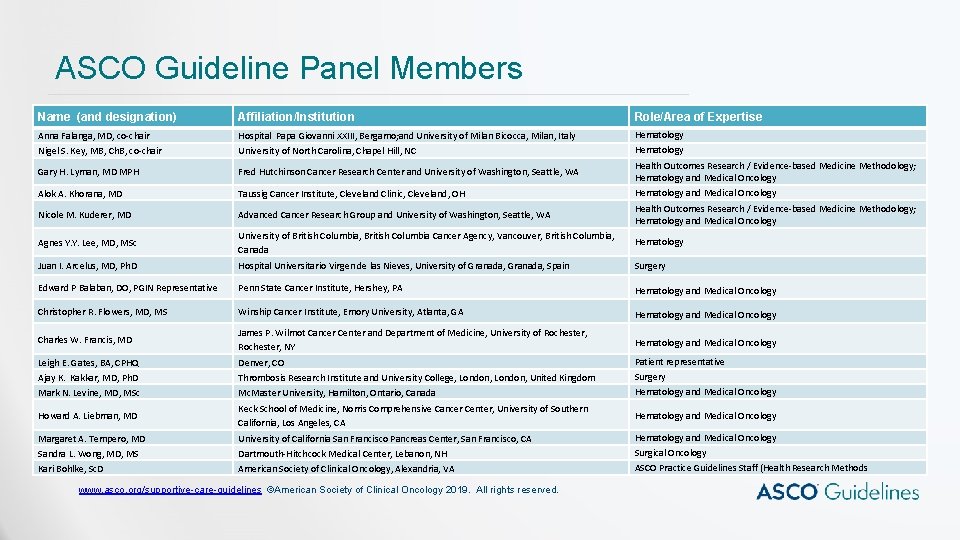
ASCO Guideline Panel Members Name (and designation) Affiliation/Institution Role/Area of Expertise Anna Falanga, MD, co-chair Nigel S. Key, MB, Ch. B, co-chair Hospital Papa Giovanni XXIII, Bergamo; and University of Milan Bicocca, Milan, Italy University of North Carolina, Chapel Hill, NC Hematology Gary H. Lyman, MD MPH Fred Hutchinson Cancer Research Center and University of Washington, Seattle, WA Health Outcomes Research / Evidence-based Medicine Methodology; Hematology and Medical Oncology Alok A. Khorana, MD Taussig Cancer Institute, Cleveland Clinic, Cleveland, OH Hematology and Medical Oncology Nicole M. Kuderer, MD Advanced Cancer Research Group and University of Washington, Seattle, WA Health Outcomes Research / Evidence-based Medicine Methodology; Hematology and Medical Oncology Agnes Y. Y. Lee, MD, MSc University of British Columbia, British Columbia Cancer Agency, Vancouver, British Columbia, Canada Hematology Juan I. Arcelus, MD, Ph. D Hospital Universitario Virgen de las Nieves, University of Granada, Spain Surgery Edward P Balaban, DO, PGIN Representative Penn State Cancer Institute, Hershey, PA Hematology and Medical Oncology Christopher R. Flowers, MD, MS Winship Cancer Institute, Emory University, Atlanta, GA Hematology and Medical Oncology Charles W. Francis, MD James P. Wilmot Cancer Center and Department of Medicine, University of Rochester, NY Hematology and Medical Oncology Leigh E. Gates, BA, CPHQ Ajay K. Kakkar, MD, Ph. D Mark N. Levine, MD, MSc Denver, CO Thrombosis Research Institute and University College, London, United Kingdom Mc. Master University, Hamilton, Ontario, Canada Patient representative Surgery Hematology and Medical Oncology Howard A. Liebman, MD Keck School of Medicine, Norris Comprehensive Cancer Center, University of Southern California, Los Angeles, CA Hematology and Medical Oncology Margaret A. Tempero, MD Sandra L. Wong, MD, MS Kari Bohlke, Sc. D University of California San Francisco Pancreas Center, San Francisco, CA Dartmouth-Hitchcock Medical Center, Lebanon, NH American Society of Clinical Oncology, Alexandria, VA Hematology and Medical Oncology Surgical Oncology ASCO Practice Guidelines Staff (Health Research Methods www. asco. org/supportive-care-guidelines ©American Society of Clinical Oncology 2019. All rights reserved.
Disclaimer The Clinical Practice Guidelines and other guidance published herein are provided by the American Society of Clinical Oncology, Inc. (ASCO) to assist providers in clinical decision making. The information herein should not be relied upon as being complete or accurate, nor should it be considered as inclusive of all proper treatments or methods of care or as a statement of the standard of care. With the rapid development of scientific knowledge, new evidence may emerge between the time information is developed and when it is published or read. The information is not continually updated and may not reflect the most recent evidence. The information addresses only the topics specifically identified therein and is not applicable to other interventions, diseases, or stages of diseases. This information does not mandate any particular course of medical care. Further, the information is not intended to substitute for the independent professional judgment of the treating provider, as the information does not account for individual variation among patients. Recommendations reflect high, moderate, or low confidence that the recommendation reflects the net effect of a given course of action. The use of words like “must, ” “must not, ” “should, ” and “should not” indicates that a course of action is recommended or not recommended for either most or many patients, but there is latitude for the treating physician to select other courses of action in individual cases. In all cases, the selected course of action should be considered by the treating provider in the context of treating the individual patient. Use of the information is voluntary. ASCO provides this information on an “as is” basis and makes no warranty, express or implied, regarding the information. ASCO specifically disclaims any warranties of merchantability or fitness for a particular use or purpose. ASCO assumes no responsibility for any injury or damage to persons or property arising out of or related to any use of this information, or for any errors or omissions. www. asco. org/supportive-care-guidelines ©American Society of Clinical Oncology 2019. All rights reserved.
- Slides: 19