
Vendor Management The Emerging Discipline for Contract Managers
- Slides: 17
Vendor Management (The Emerging Discipline for Contract Managers) Entrusted Strategic Sourcing & Management of Vendor Relationships So that: Investments in purchases are maximised with least risk to the business Robert Barker Dated 3 rd April 2012
Agenda • Objectives of Vendor Management • Business Observations & Issues • Evolution of Vendor Management • Vendor Management & Contract Management • Transparency • Business Discipline • Execution • Processes and Some Sample Tool Kits • Benefits of Vendor Management
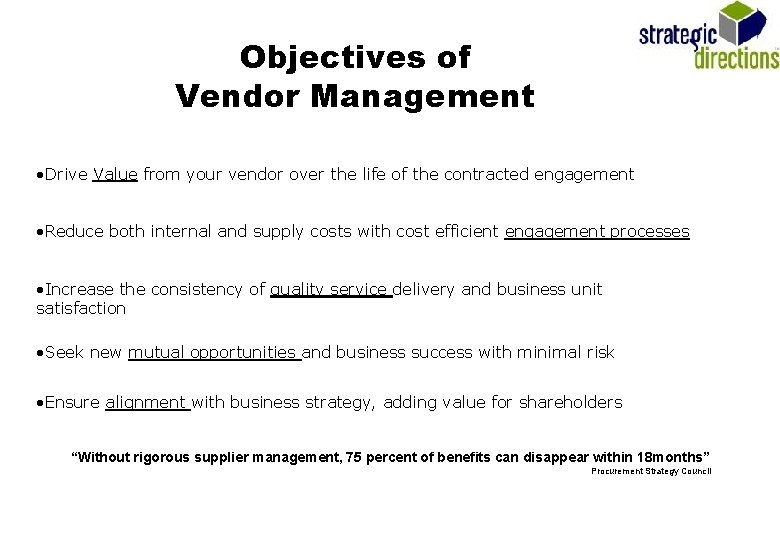
Objectives of Vendor Management • Drive Value from your vendor over the life of the contracted engagement • Reduce both internal and supply costs with cost efficient engagement processes • Increase the consistency of quality service delivery and business unit satisfaction • Seek new mutual opportunities and business success with minimal risk • Ensure alignment with business strategy, adding value for shareholders “Without rigorous supplier management, 75 percent of benefits can disappear within 18 months” Procurement Strategy Council
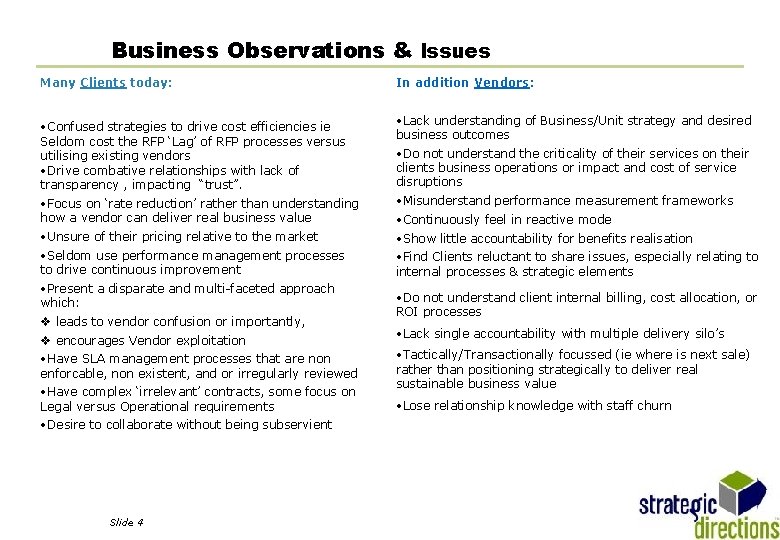
Business Observations & Issues Many Clients today: • Confused strategies to drive cost efficiencies ie Seldom cost the RFP ‘Lag’ of RFP processes versus utilising existing vendors • Drive combative relationships with lack of transparency , impacting “trust”. • Focus on ‘rate reduction’ rather than understanding how a vendor can deliver real business value • Unsure of their pricing relative to the market • Seldom use performance management processes to drive continuous improvement • Present a disparate and multi-faceted approach which: v leads to vendor confusion or importantly, v encourages Vendor exploitation • Have SLA management processes that are non enforcable, non existent, and or irregularly reviewed • Have complex ‘irrelevant’ contracts, some focus on Legal versus Operational requirements • Desire to collaborate without being subservient Slide 4 In addition Vendors: • Lack understanding of Business/Unit strategy and desired business outcomes • Do not understand the criticality of their services on their clients business operations or impact and cost of service disruptions • Misunderstand performance measurement frameworks • Continuously feel in reactive mode • Show little accountability for benefits realisation • Find Clients reluctant to share issues, especially relating to internal processes & strategic elements • Do not understand client internal billing, cost allocation, or ROI processes • Lack single accountability with multiple delivery silo’s • Tactically/Transactionally focussed (ie where is next sale) rather than positioning strategically to deliver real sustainable business value • Lose relationship knowledge with staff churn
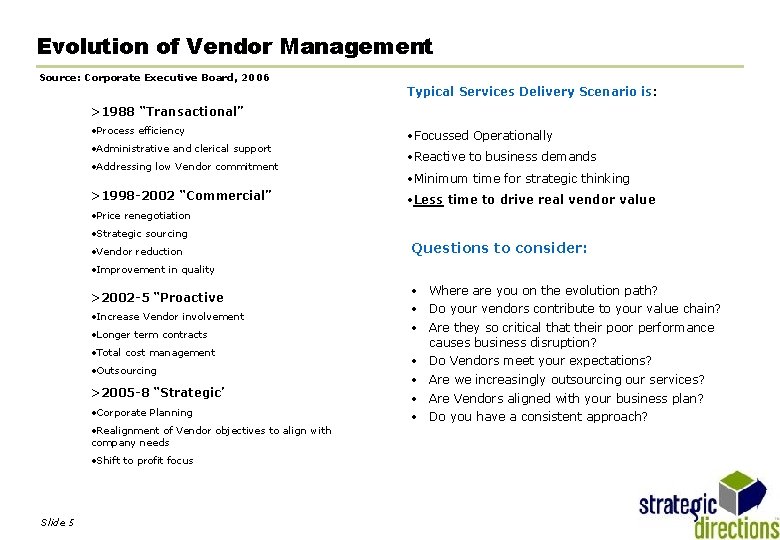
Evolution of Vendor Management Source: Corporate Executive Board, 2006 Typical Services Delivery Scenario is: >1988 “Transactional” • Process efficiency • Administrative and clerical support • Addressing low Vendor commitment >1998 -2002 “Commercial” • Focussed Operationally • Reactive to business demands • Minimum time for strategic thinking • Less time to drive real vendor value • Price renegotiation • Strategic sourcing • Vendor reduction Questions to consider: • Improvement in quality >2002 -5 “Proactive • Increase Vendor involvement • Longer term contracts • Total cost management • Outsourcing >2005 -8 “Strategic’ • Corporate Planning • Realignment of Vendor objectives to align with company needs • Shift to profit focus Slide 5 • Where are you on the evolution path? • Do your vendors contribute to your value chain? • Are they so critical that their poor performance causes business disruption? • Do Vendors meet your expectations? • Are we increasingly outsourcing our services? • Are Vendors aligned with your business plan? • Do you have a consistent approach?
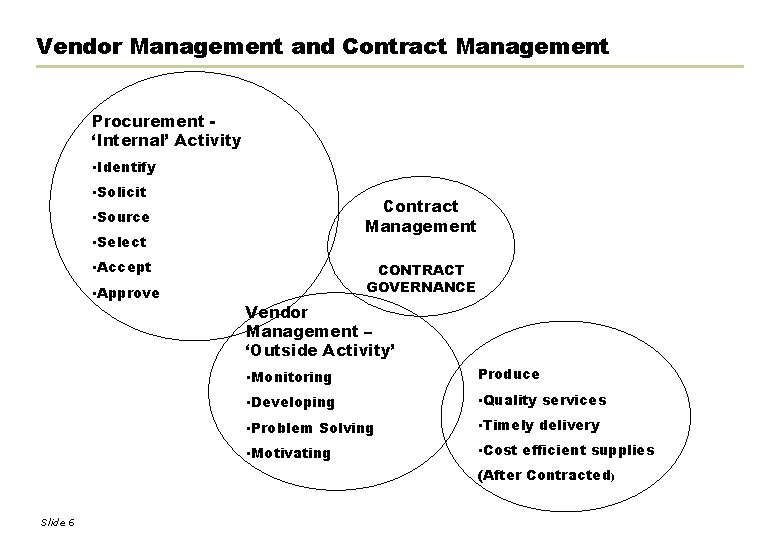
Vendor Management and Contract Management Procurement ‘Internal’ Activity • Identify • Solicit Contract Management • Source • Select • Accept • Approve CONTRACT GOVERNANCE Vendor Management – ‘Outside Activity’ • Monitoring Produce • Developing • Quality services • Problem Solving • Timely delivery • Motivating • Cost efficient supplies (After Contracted) Slide 6
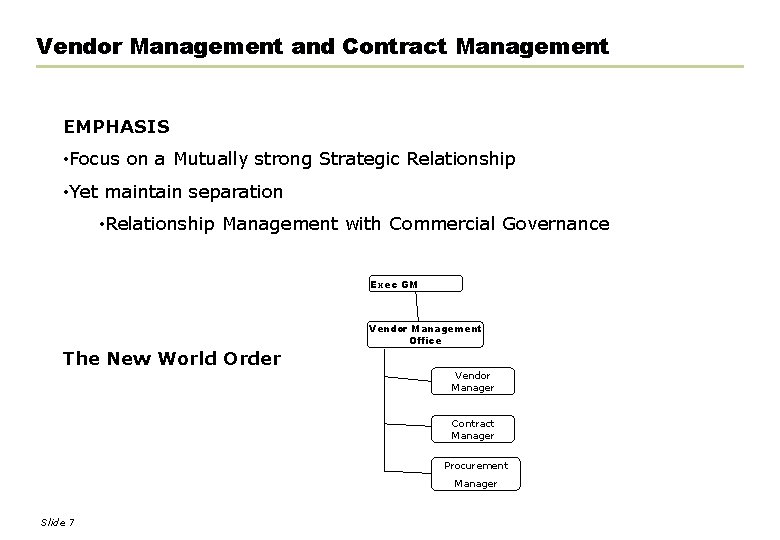
Vendor Management and Contract Management EMPHASIS • Focus on a Mutually strong Strategic Relationship • Yet maintain separation • Relationship Management with Commercial Governance Exec GM Vendor Management Office The New World Order Vendor Manager Contract Manager Procurement Manager Slide 7
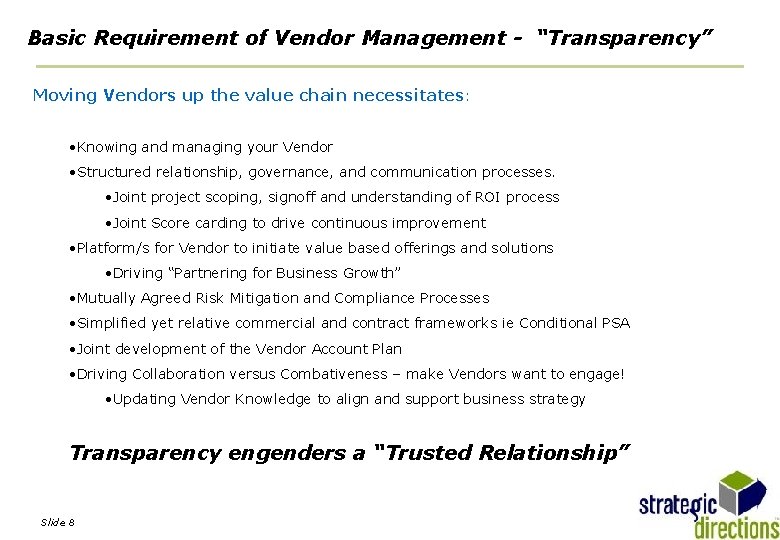
Basic Requirement of Vendor Management - “Transparency” Moving Vendors up the value chain necessitates: • Knowing and managing your Vendor • Structured relationship, governance, and communication processes. • Joint project scoping, signoff and understanding of ROI process • Joint Score carding to drive continuous improvement • Platform/s for Vendor to initiate value based offerings and solutions • Driving “Partnering for Business Growth” • Mutually Agreed Risk Mitigation and Compliance Processes • Simplified yet relative commercial and contract frameworks ie Conditional PSA • Joint development of the Vendor Account Plan • Driving Collaboration versus Combativeness – make Vendors want to engage! • Updating Vendor Knowledge to align and support business strategy Transparency engenders a “Trusted Relationship” Slide 8
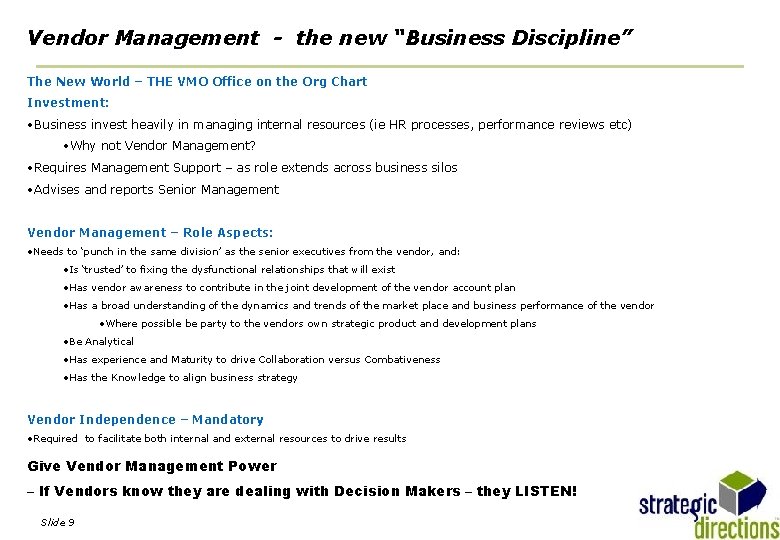
Vendor Management - the new “Business Discipline” The New World – THE VMO Office on the Org Chart Investment: • Business invest heavily in managing internal resources (ie HR processes, performance reviews etc) • Why not Vendor Management? • Requires Management Support – as role extends across business silos • Advises and reports Senior Management Vendor Management – Role Aspects: • Needs to ‘punch in the same division’ as the senior executives from the vendor, and: • Is ‘trusted’ to fixing the dysfunctional relationships that will exist • Has vendor awareness to contribute in the joint development of the vendor account plan • Has a broad understanding of the dynamics and trends of the market place and business performance of the vendor • Where possible be party to the vendors own strategic product and development plans • Be Analytical • Has experience and Maturity to drive Collaboration versus Combativeness • Has the Knowledge to align business strategy Vendor Independence – Mandatory • Required to facilitate both internal and external resources to drive results Give Vendor Management Power – If Vendors know they are dealing with Decision Makers – they LISTEN! Slide 9
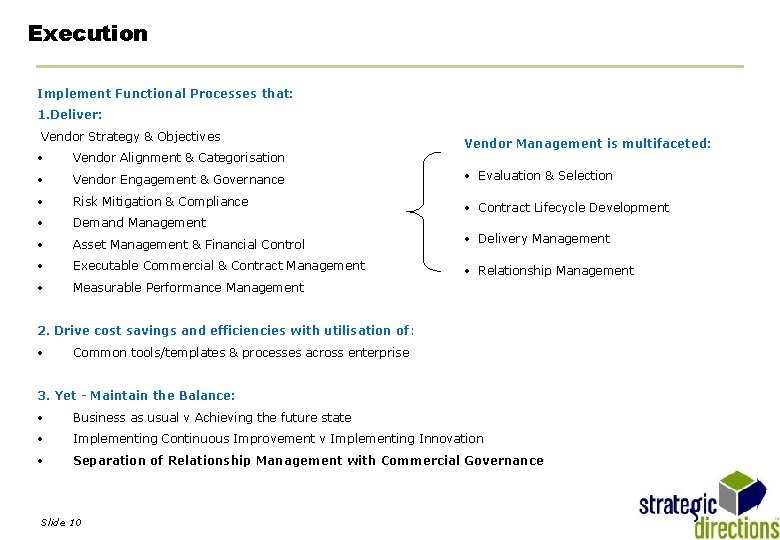
Execution Implement Functional Processes that: 1. Deliver: Vendor Strategy & Objectives Vendor Management is multifaceted: • Vendor Alignment & Categorisation • Vendor Engagement & Governance • Evaluation & Selection • Risk Mitigation & Compliance • Contract Lifecycle Development • Demand Management • Asset Management & Financial Control • Delivery Management • Executable Commercial & Contract Management • Relationship Management • Measurable Performance Management 2. Drive cost savings and efficiencies with utilisation of: • Common tools/templates & processes across enterprise 3. Yet - Maintain the Balance: • Business as usual v Achieving the future state • Implementing Continuous Improvement v Implementing Innovation • Separation of Relationship Management with Commercial Governance Slide 10
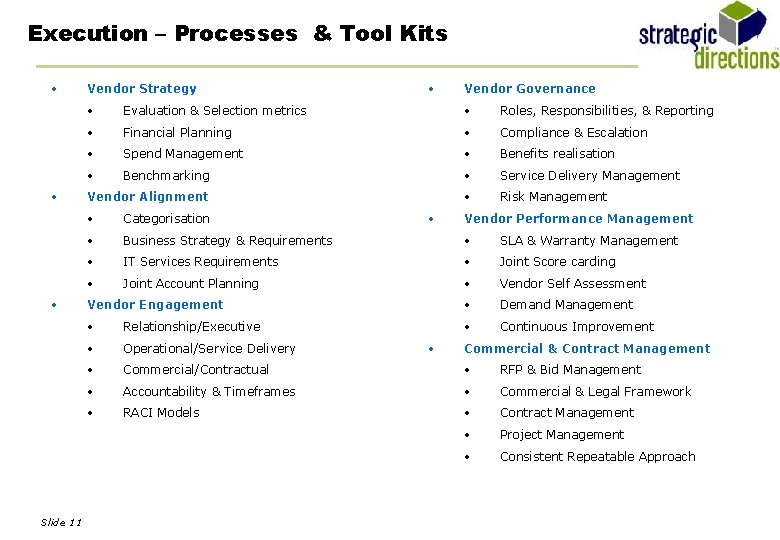
Execution – Processes & Tool Kits • • • Slide 11 Vendor Strategy • Vendor Governance • Evaluation & Selection metrics • Roles, Responsibilities, & Reporting • Financial Planning • Compliance & Escalation • Spend Management • Benefits realisation • Benchmarking • Service Delivery Management Vendor Alignment • Risk Management Business • Unit Vendor Performance Management • Categorisation • Business Strategy & Requirements • SLA & Warranty. Business Management • IT Services Requirements • Vendorcarding Joint Score • Joint Account Planning • Management Vendor Self Assessment Business Unit Vendor Engagement • • Relationship/Executive • • Operational/Service Delivery • Commercial/Contractual • RFP & Bid Management • Accountability & Timeframes • Commercial & Legal Framework • RACI Models • Contract Management • Project Management • Consistent Repeatable Approach • Business Demand Unit Management Unit Business Continuous Improvement Unit Commercial & Contract Management
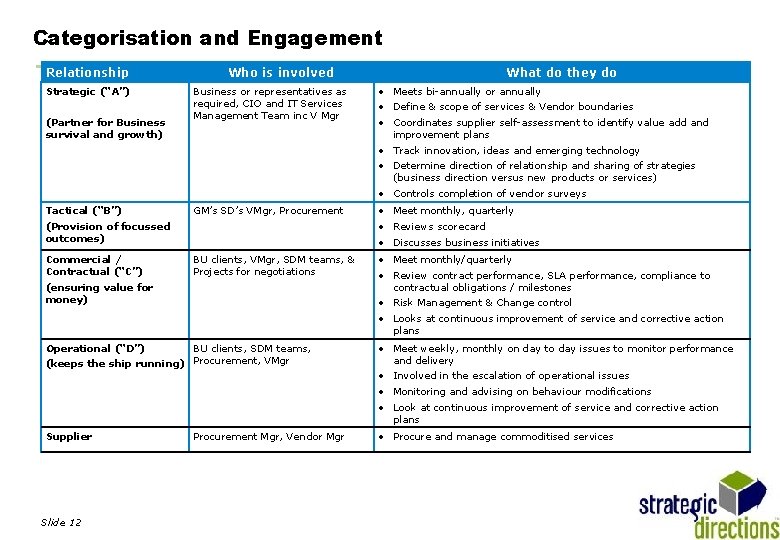
Categorisation and Engagement Relationship Strategic (“A”) (Partner for Business survival and growth) Tactical (“B”) Who is involved Business or representatives as required, CIO and IT Services Management Team inc V Mgr • Meets bi-annually or annually • Define & scope of services & Vendor boundaries • Coordinates supplier self-assessment to identify value add and improvement plans • Track innovation, ideas and emerging technology • Determine direction of relationship and sharing of strategies (business direction versus new products or services) • Controls completion of vendor surveys GM’s SD’s VMgr, Procurement • Meet monthly, quarterly • Reviews scorecard • Discusses business initiatives BU clients, VMgr, SDM teams, & Projects for negotiations • Meet monthly/quarterly • Review contract performance, SLA performance, compliance to contractual obligations / milestones • Risk Management & Change control • Looks at continuous improvement of service and corrective action plans (Provision of focussed outcomes) Commercial / Contractual (“C”) What do they do (ensuring value for money) BU clients, SDM teams, (keeps the ship running) Procurement, VMgr • Meet weekly, monthly on day to day issues to monitor performance and delivery • Involved in the escalation of operational issues • Monitoring and advising on behaviour modifications • Look at continuous improvement of service and corrective action plans Supplier • Procure and manage commoditised services Operational (“D”) Slide 12 Procurement Mgr, Vendor Mgr
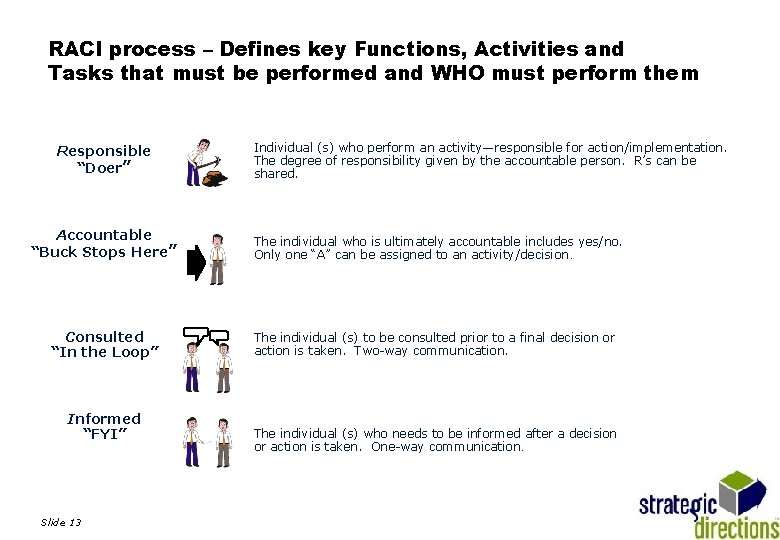
RACI process – Defines key Functions, Activities and Tasks that must be performed and WHO must perform them Responsible “Doer” Accountable “Buck Stops Here” Consulted “In the Loop” Informed “FYI” Slide 13 Individual (s) who perform an activity—responsible for action/implementation. The degree of responsibility given by the accountable person. R’s can be shared. The individual who is ultimately accountable includes yes/no. Only one “A” can be assigned to an activity/decision. The individual (s) to be consulted prior to a final decision or action is taken. Two-way communication. The individual (s) who needs to be informed after a decision or action is taken. One-way communication.
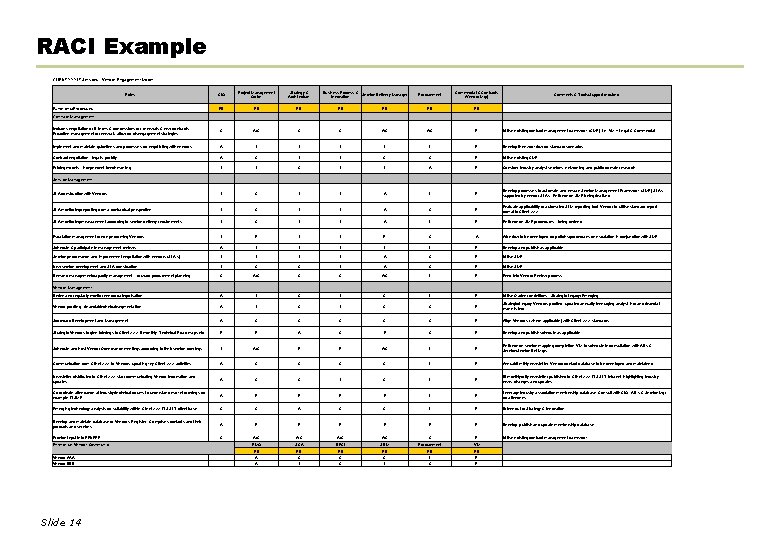
RACI Example CLIENT XXX IT Services - Vendor Engagement Model CIO Project Management Office Strategy & Architecture Functions/Processes RB RB Contract Management Includes negotiation of $, terms & concessions for renewals & new contracts. Proactive management of renewals allow for disengagement strategies C A/C C C A/C R Utilise existing contract management framework (CMF), i. e. VM + Legal & Commercial Implement and maintain guidelines and processes for negotiating with vendors A I I I R Develop then workflow for standard scenarios. Contract negotiation - legals, probity A C I I C C R Utilise existing CMF Pricing models - independent benchmarking I I C I I A R Consider industry analyst services, networking and public domain research Service Management SLA construction with Vendors I C I I A I R Develop processes to automate and ensure Service Management Framework (SMF) SLA's supported by vendor SLA's. Reliance on SMF being finalised SLA monitoring/reporting from a contractual perspective I C I I A C R Evaluate applicability of automated SLM reporting tool. Vendor to utilise standard report format to Client XXX. SLA monitoring/measurement according to service delivery requirements I C I I A I R Reliance on SMF procedures - being defined Escalation management of non-performing Vendors I R I I R C A Workflow to be developed for policies/procedures on escalation in conjunction with SMF Schedule & participate in management reviews A I I I R Develop and publish as applicable Service performance and improvement negotiation with vendors (SLA's) I I A C R Utilise SMF New service development and SLA construction I C C I A C R Utilise SMF Demand management/capacity management - forward procurement planning C A/C C C A/C I R Feed into Vendor Review process Vendor Management Define and regularly monitor vendor categorisation A I C I R Utilise Gartner definitions - Strategic/Legacy/Emerging Vendor profiling - financial/technical/segmentation A I C C R Strategic/Legacy Vendors profiled, updated annually leveraging analyst info and financial markets info Scorecard Development and Management A C C C R Align Vendor's (where applicable) with Client XXX standards Strategic Vendors to give briefings to Client XXX 6 monthly. Technical Road maps etc P P A C P C R Develop and publish schedule as applicable Schedule and host Vendor Governance meetings according to their service offerings I A/C P P A/C I R Reliance on service mapping completion. VM to schedule in consultation with AD's & Service/Service Del Mgrs. Communication from Client XXX to Vendors updating key Client XXX activities A C C I R Annual/6 mthly newsletter. Vendor contact database to be developed and maintained Newsletter distributed to Client XXX staff communicating Vendor information and updates A C C I R Bi-monthly/qtly newsletter published to Client XXX ITS SLT intranet, highlighting industry news, changes and updates Co-ordinate attendance at industry/technical forums to understand market offerings for example, ITSMF A P P I R Leverage industry association membership database. Consult with CIO, AD's & Service Mgr for attendees Emerging technology analysis for suitability within Client XXX ITS SLT client base C C A C C I R Driven out of Strategy & Innovation Roles Business Process & Service Delivery Manager Innovation Procurement Commercial & Contracts (Vendor Mgr) Comments & Tools/Support required Develop and maintain database of Vendor's Register. Comprises contacts and their products and services A P P P R Develop, publish and update membership database Provide Input into RFI/RFP C A/C A/C C R Utilise existing contract management framework Enterprise Vendor Ownership PMO S&A BP&I SDM Procurement VM RB RB RB Vendor AAA A C C C I R Vendor BBB A I C R Slide 14
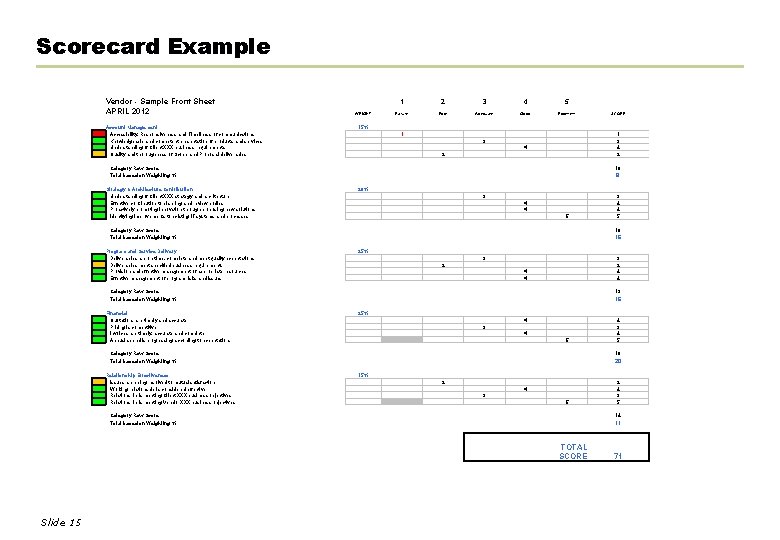
Scorecard Example Vendor - Sample Front Sheet APRIL 2012 Account Management Accessibility, Responsiveness and Timeliness of communications Knowledgeable and competent presentation of products and services Understanding of Client XXX business requirements Quality and thoroughness of Scope and Proposal deliverables 1 3 4 2 1 2 3 4 5 WEIGHT Failure Poor Adequate Good Excellent SCORE 15% 1 2 3 4 1 3 4 2 Category Raw Score 10 8 Total based on Weighting % Strategy & Architecture Contribution Understanding of Client XXX strategy and architecture Effective contribution to planning and review bodies Proactively promoting innovation through proposing new solutions Identifying improvements to existing IT systems and processes 3 4 4 5 20% 3 5 3 4 4 5 Category Raw Score 16 Total based on Weighting % 16 Program and Service Delivery Deliverables are on time, complete and meet quality expectations Deliverables meet specified business requirements Provision and effective management of appropriate resources Effective management of program risks and issues 3 2 4 4 25% 2 3 4 4 3 2 4 4 Category Raw Score 13 Total based on Weighting % 16 Financial Quotations are timely and accurate Pricing is competitive Invoices are timely, accurate and complete Annual spend is progressing according to expectations 4 3 4 5 25% 3 4 4 5 4 3 4 5 Category Raw Score 16 Total based on Weighting % 20 Relationship Effectiveness Issues are being resolved to mutual satisfaction Working relationship is considered effective Relationship is meeting Client XXX business objectives Relationship is meeting Vendor XXX business objectives 2 4 3 5 15% 2 3 4 5 2 4 3 5 Category Raw Score 14 Total based on Weighting % 11 Slide 15 4 4 TOTAL SCORE 71
Vendor Management – Benefits For Client: • Understand Vendor Capability & derive Value • Vendor Solution Options aligned to addressing Business Issues • Enables a preferred focus on Business Core Competencies • Strategy • Customer Delivery • Receive improved Quality of Service • Cost Effective Engagement with minimised Risk • Contract Value not diminished over life of contract Business Unit Business Vendor Management For Vendor: • Understand Clients Business & IT Strategies and Services • Delivers an engagement platform for architecting Solutions • Ensures a focus on Business Alignment • Provides feedback for improvement • Encourages Efficient Engagement • Increased Revenue Opportunities Slide 16 Business Unit
Questions? Business Unit Contact Details: Business Robert Barker, Practice Leader, Vendor Management Vendor • Email id: rbarker@strategicdirections. com. au • Mobile: 0400 506 136 Management Business Unit Slide 17 Unit