
Velocitytime Graphs Uniform and Nonuniform Motion PositionTime Graphs
- Slides: 12
Velocity-time Graphs: Uniform and Non-uniform Motion
Position-Time Graphs Straight line means uniform velocity n Straight line parallel to x-axis means zero velocity (no d) n Smooth curve means velocity is changing (accelerating or deceleration) n Positive slope, velocity in forward direction n Negative slope, velocity in backward direction n
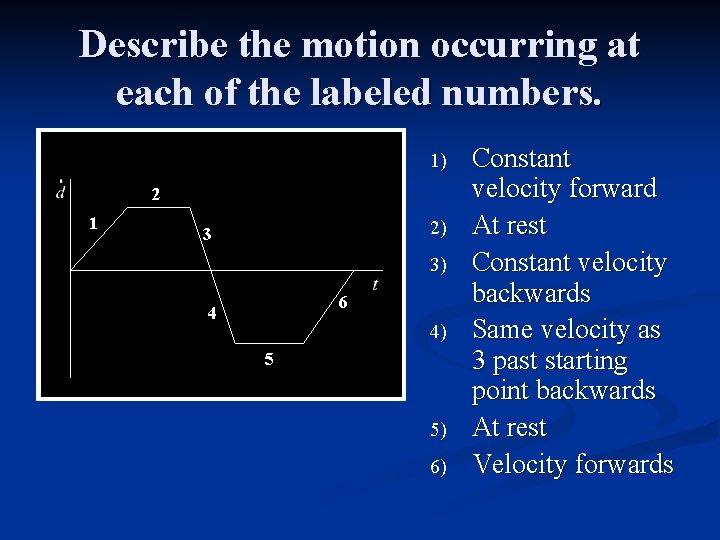
Describe the motion occurring at each of the labeled numbers. 1) 2 1 2) 3 3) 6 4 4) 5 5) 6) Constant velocity forward At rest Constant velocity backwards Same velocity as 3 past starting point backwards At rest Velocity forwards
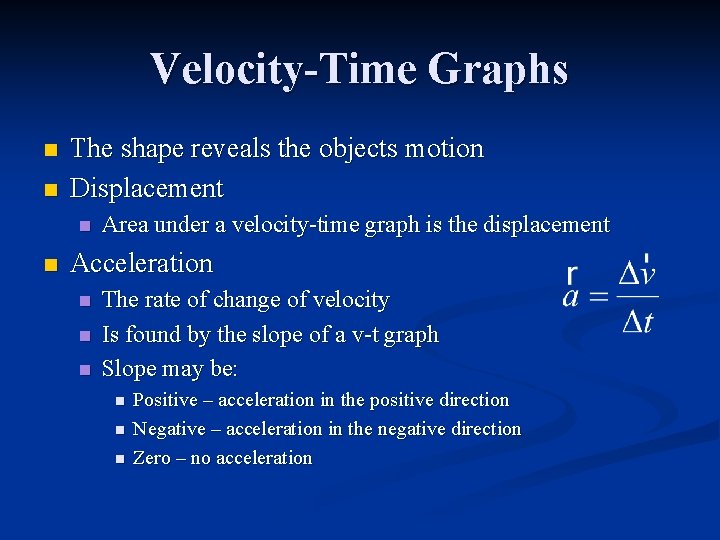
Velocity-Time Graphs n n The shape reveals the objects motion Displacement n n Area under a velocity-time graph is the displacement Acceleration n The rate of change of velocity Is found by the slope of a v-t graph Slope may be: n n n Positive – acceleration in the positive direction Negative – acceleration in the negative direction Zero – no acceleration
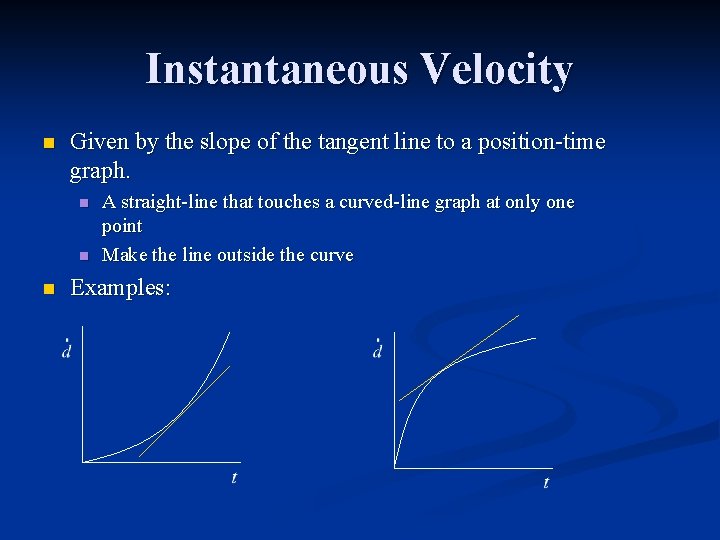
Instantaneous Velocity n Given by the slope of the tangent line to a position-time graph. n n n A straight-line that touches a curved-line graph at only one point Make the line outside the curve Examples:
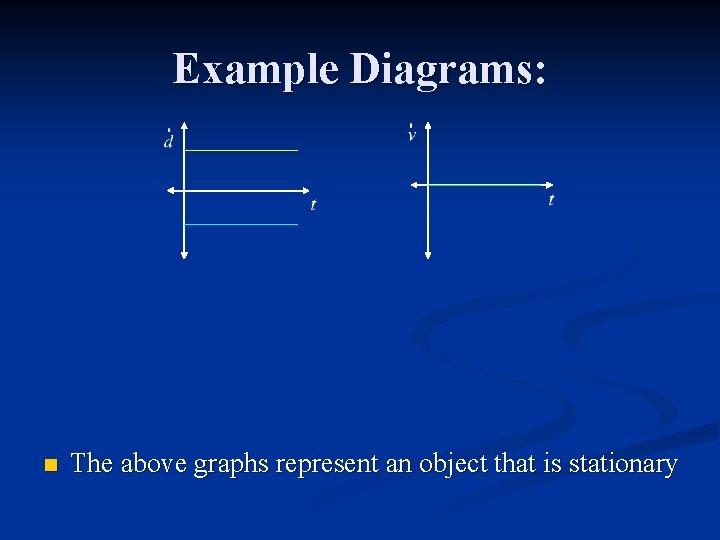
Example Diagrams: n The above graphs represent an object that is stationary
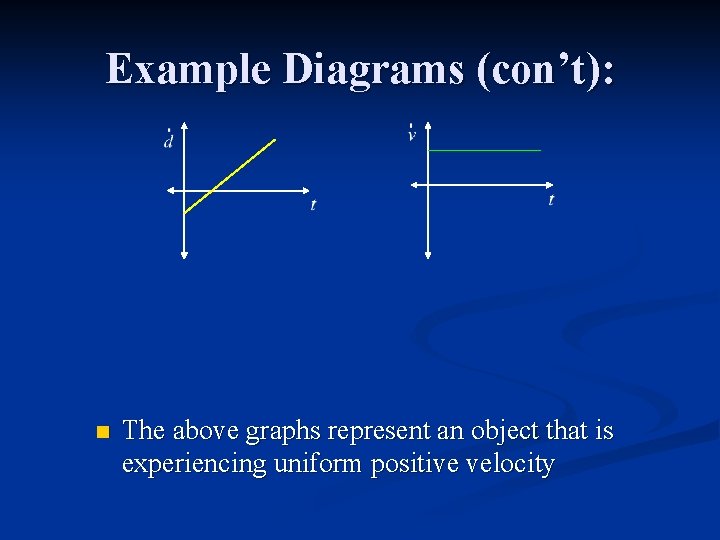
Example Diagrams (con’t): n The above graphs represent an object that is experiencing uniform positive velocity
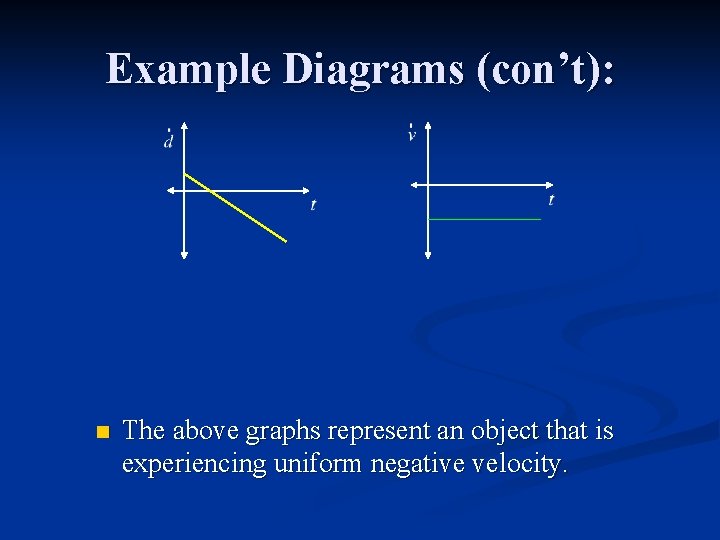
Example Diagrams (con’t): n The above graphs represent an object that is experiencing uniform negative velocity.
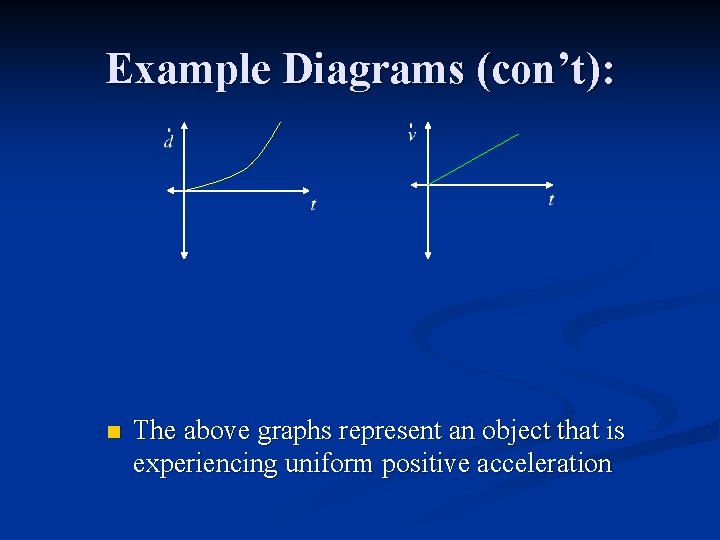
Example Diagrams (con’t): n The above graphs represent an object that is experiencing uniform positive acceleration
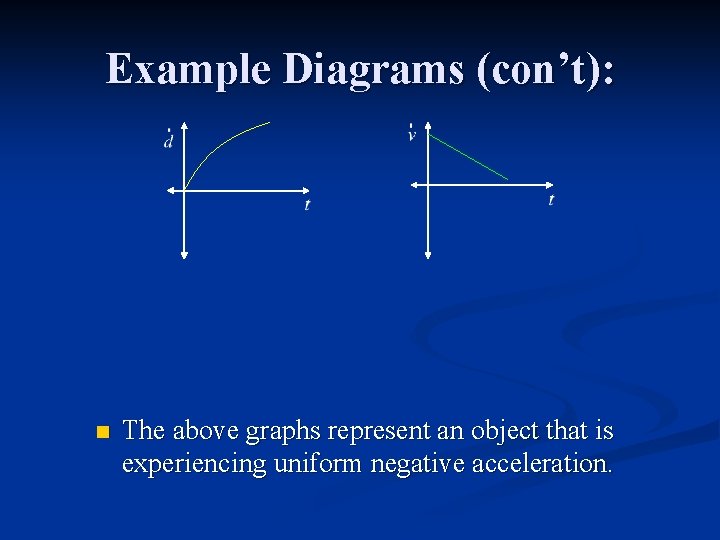
Example Diagrams (con’t): n The above graphs represent an object that is experiencing uniform negative acceleration.
Uniformly Accelerated Motion Constant rate of change of velocity n Horizontal line on a acceleration-time graph indicates uniform velocity. n When the directions of velocity and acceleration are the same, the object is speeding up. n When velocity and acceleration have opposite directions, the object slows down. n
Homework: n Page 20 #6, 7, 10 n Page 27 #1 -3 n Page 30 #1 -4