
Velocity Map Imaging Study of a MassSelected Ion
- Slides: 13
Velocity Map Imaging Study of a Mass-Selected Ion Beam: the Photoinitiated Charge-Transfer Dissociation of and Ag+(C 6 H 6) Jonathon A. Maner, Daniel T. Mauney and Michael A. Duncan ISMS 2015 RE 04
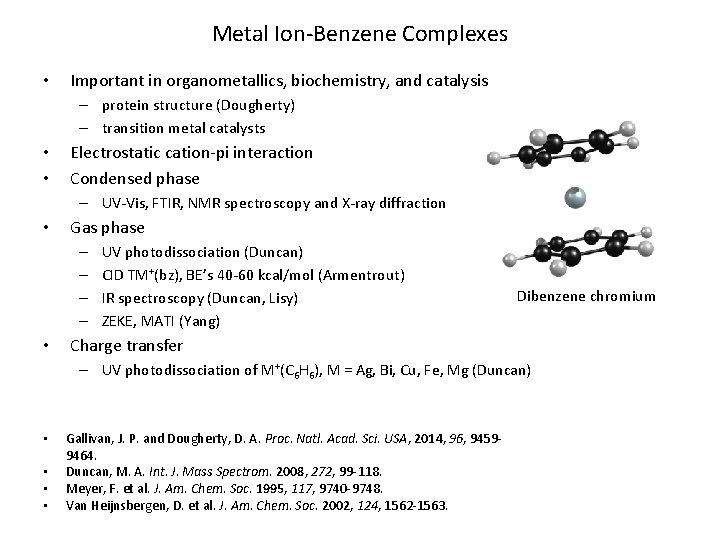
Metal Ion-Benzene Complexes • Important in organometallics, biochemistry, and catalysis – protein structure (Dougherty) – transition metal catalysts • • Electrostatic cation-pi interaction Condensed phase – UV-Vis, FTIR, NMR spectroscopy and X-ray diffraction • Gas phase – – • UV photodissociation (Duncan) CID TM+(bz), BE’s 40 -60 kcal/mol (Armentrout) IR spectroscopy (Duncan, Lisy) ZEKE, MATI (Yang) Dibenzene chromium Charge transfer – UV photodissociation of M+(C 6 H 6), M = Ag, Bi, Cu, Fe, Mg (Duncan) • • Gallivan, J. P. and Dougherty, D. A. Proc. Natl. Acad. Sci. USA, 2014, 96, 94599464. Duncan, M. A. Int. J. Mass Spectrom. 2008, 272, 99 -118. Meyer, F. et al. J. Am. Chem. Soc. 1995, 117, 9740 -9748. Van Heijnsbergen, D. et al. J. Am. Chem. Soc. 2002, 124, 1562 -1563.
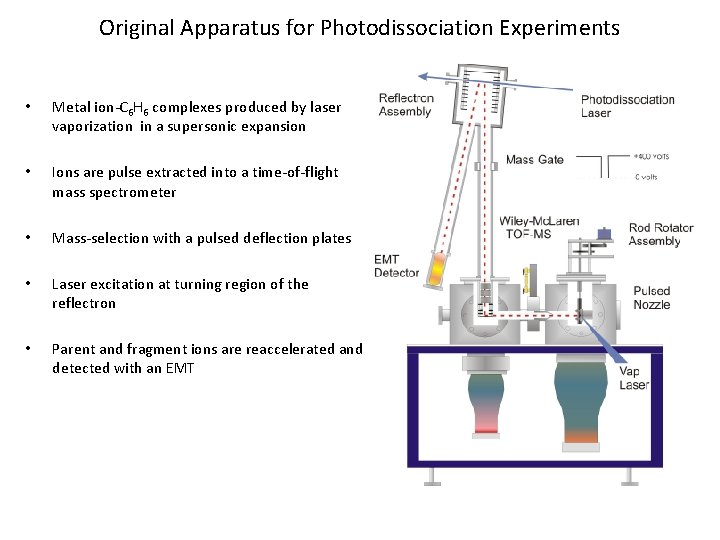
Original Apparatus for Photodissociation Experiments • Metal ion-C 6 H 6 complexes produced by laser vaporization in a supersonic expansion • Ions are pulse extracted into a time-of-flight mass spectrometer • Mass-selection with a pulsed deflection plates • Laser excitation at turning region of the reflectron • Parent and fragment ions are reaccelerated and detected with an EMT
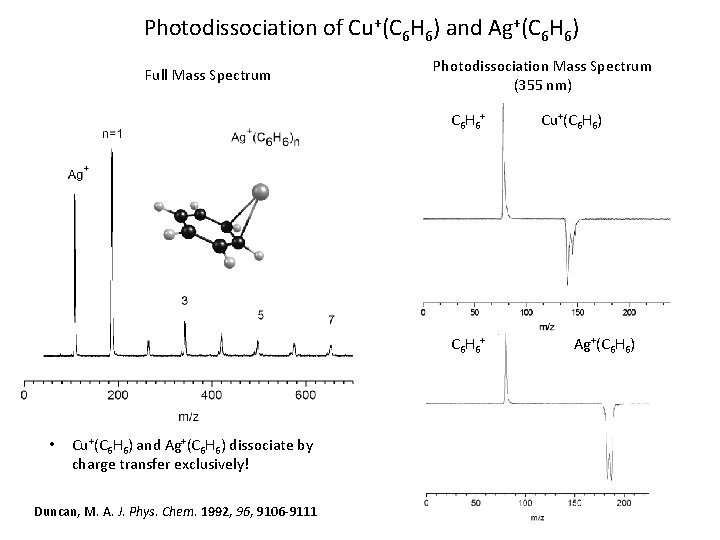
Photodissociation of Cu+(C 6 H 6) and Ag+(C 6 H 6) Full Mass Spectrum Photodissociation Mass Spectrum (355 nm) C 6 H 6 + • Cu+(C 6 H 6) and Ag+(C 6 H 6) dissociate by charge transfer exclusively! Duncan, M. A. J. Phys. Chem. 1992, 96, 9106 -9111 Cu+(C 6 H 6) Ag+(C 6 H 6)
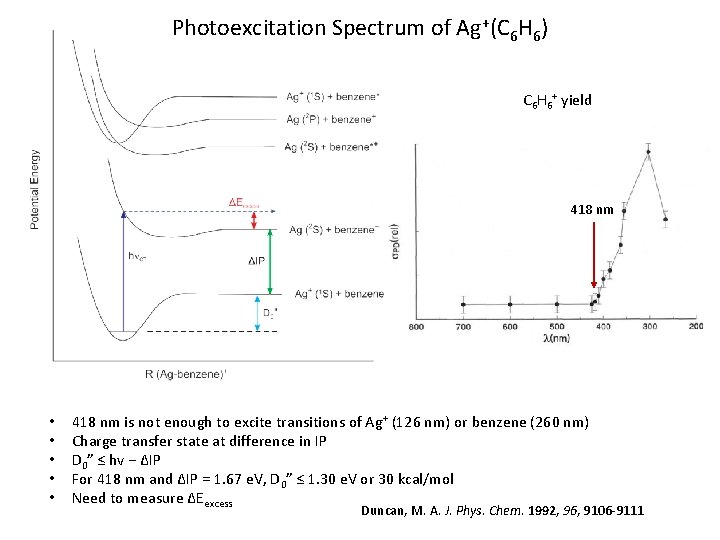
Photoexcitation Spectrum of Ag+(C 6 H 6) C 6 H 6+ yield 418 nm • • • 418 nm is not enough to excite transitions of Ag+ (126 nm) or benzene (260 nm) Charge transfer state at difference in IP D 0” ≤ hv − ∆IP For 418 nm and ∆IP = 1. 67 e. V, D 0” ≤ 1. 30 e. V or 30 kcal/mol Need to measure ∆Eexcess Duncan, M. A. J. Phys. Chem. 1992, 96, 9106 -9111
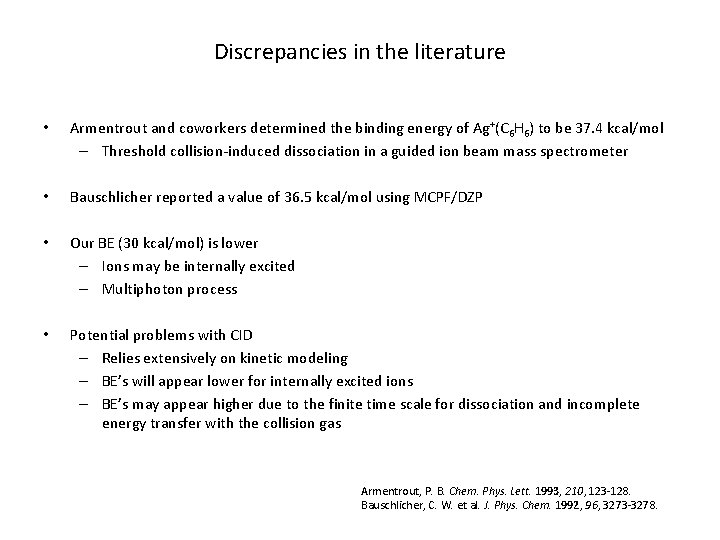
Discrepancies in the literature • Armentrout and coworkers determined the binding energy of Ag+(C 6 H 6) to be 37. 4 kcal/mol – Threshold collision-induced dissociation in a guided ion beam mass spectrometer • Bauschlicher reported a value of 36. 5 kcal/mol using MCPF/DZP • Our BE (30 kcal/mol) is lower – Ions may be internally excited – Multiphoton process • Potential problems with CID – Relies extensively on kinetic modeling – BE’s will appear lower for internally excited ions – BE’s may appear higher due to the finite time scale for dissociation and incomplete energy transfer with the collision gas Armentrout, P. B. Chem. Phys. Lett. 1993, 210, 123 -128. Bauschlicher, C. W. et al. J. Phys. Chem. 1992, 96, 3273 -3278.
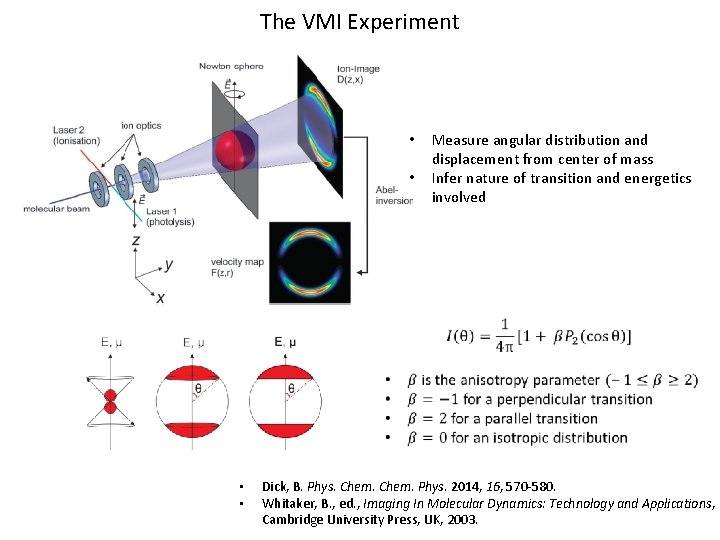
The VMI Experiment • • Measure angular distribution and displacement from center of mass Infer nature of transition and energetics involved • • Dick, B. Phys. Chem. Phys. 2014, 16, 570 -580. Whitaker, B. , ed. , Imaging In Molecular Dynamics: Technology and Applications, Cambridge University Press, UK, 2003.
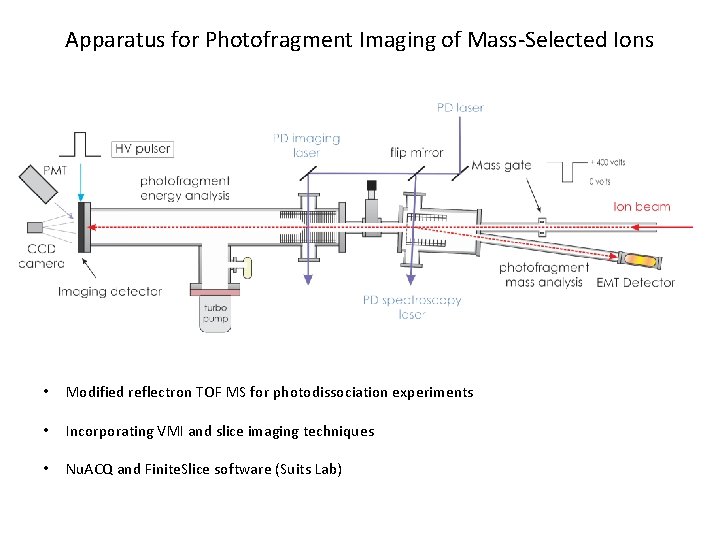
Apparatus for Photofragment Imaging of Mass-Selected Ions • Modified reflectron TOF MS for photodissociation experiments • Incorporating VMI and slice imaging techniques • Nu. ACQ and Finite. Slice software (Suits Lab)
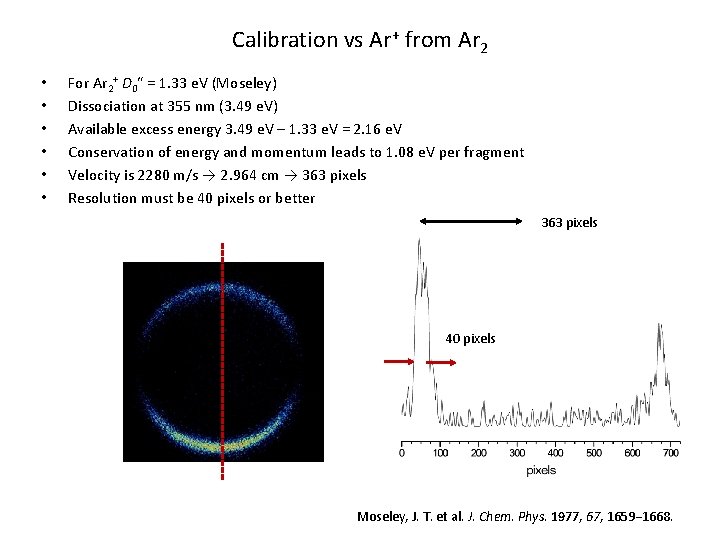
Calibration vs Ar+ from Ar 2 • • • For Ar 2+ D 0″ = 1. 33 e. V (Moseley) Dissociation at 355 nm (3. 49 e. V) Available excess energy 3. 49 e. V ‒ 1. 33 e. V = 2. 16 e. V Conservation of energy and momentum leads to 1. 08 e. V per fragment Velocity is 2280 m/s → 2. 964 cm → 363 pixels Resolution must be 40 pixels or better 363 pixels 40 pixels Moseley, J. T. et al. J. Chem. Phys. 1977, 67, 1659− 1668.
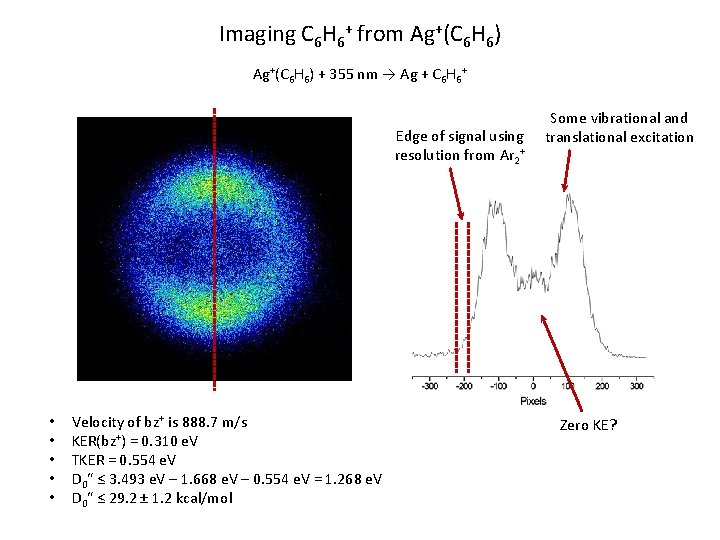
Imaging C 6 H 6+ from Ag+(C 6 H 6) + 355 nm → Ag + C 6 H 6+ Edge of signal using resolution from Ar 2+ • • • Velocity of bz+ is 888. 7 m/s KER(bz+) = 0. 310 e. V TKER = 0. 554 e. V D 0″ ≤ 3. 493 e. V – 1. 668 e. V – 0. 554 e. V = 1. 268 e. V D 0″ ≤ 29. 2 ± 1. 2 kcal/mol Some vibrational and translational excitation Zero KE?
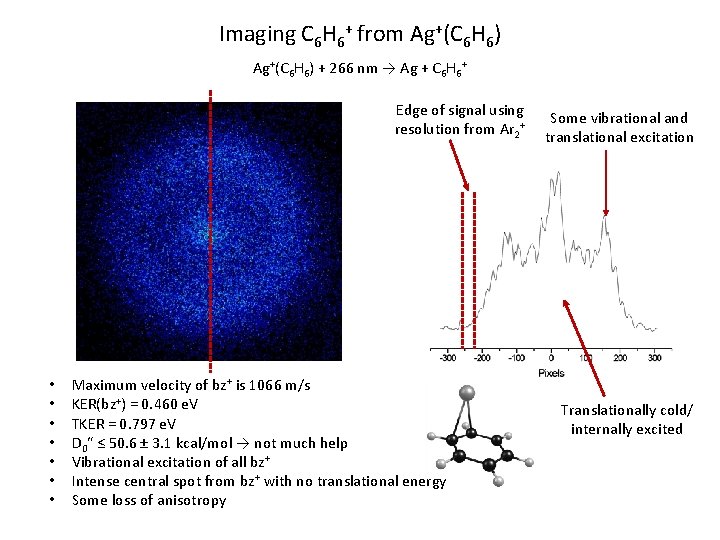
Imaging C 6 H 6+ from Ag+(C 6 H 6) + 266 nm → Ag + C 6 H 6+ Edge of signal using resolution from Ar 2+ • • Maximum velocity of bz+ is 1066 m/s KER(bz+) = 0. 460 e. V TKER = 0. 797 e. V D 0″ ≤ 50. 6 ± 3. 1 kcal/mol → not much help Vibrational excitation of all bz+ Intense central spot from bz+ with no translational energy Some loss of anisotropy Some vibrational and translational excitation Translationally cold/ internally excited
Conclusion • A new instrument for velocity map imaging of photofragments of a mass-selected ion beam has been constructed. • This apparatus provides new information previously inaccessible by photodissociation experiments. • We have used this apparatus to estimate the upper limit on the binding energy of Ag+(C 6 H 6) (29. 2 ± 1. 2 kcal/mol). • This new apparatus will allow us to study the photodissociation dynamics of many systems that can be generated by laser vaporization or electrical discharge.
Acknowledgments • • The Duncan Lab Arthur Suits Hannah Reisler DOE • maduncan@uga. edu • jomaner@uga. edu