
Vein Orientation and Structural Geology of the Boulder
Vein Orientation and Structural Geology of the Boulder Batholith, Mount Thompson Quadrangle, southwestern Montana Neal Mankins, John Dilles, Nansen Olsen, Michael Sepp, Jacob Blessing
Introduction Project Goals • Create an improved 1: 24, 000 scale map of the Mt. Thompson Quadrangle • Understand the nature of the veins, their orientations, and overall structural geology of the Mt. Thompson Quadrangle • Use field descriptions, hand samples, and thin sections to determine crosscutting relations, alteration types, and sulfide mineralization • Improve correlation of units within the Mt. Thompson Quadrangle and those of neighboring quadrangles
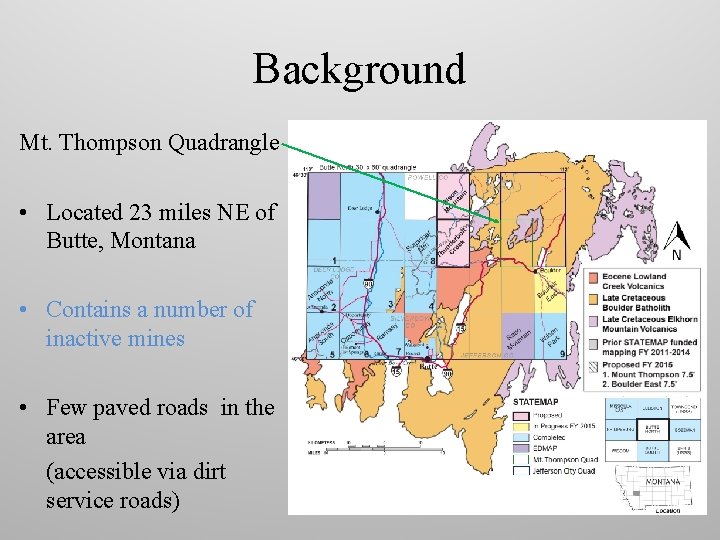
Background Mt. Thompson Quadrangle • Located 23 miles NE of Butte, Montana • Contains a number of inactive mines • Few paved roads in the area (accessible via dirt service roads)

Geologic Setting
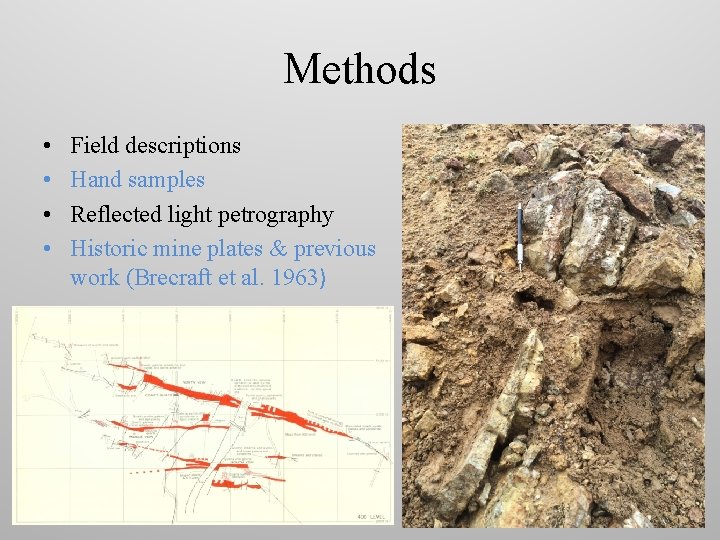
Methods • • Field descriptions Hand samples Reflected light petrography Historic mine plates & previous work (Brecraft et al. 1963)
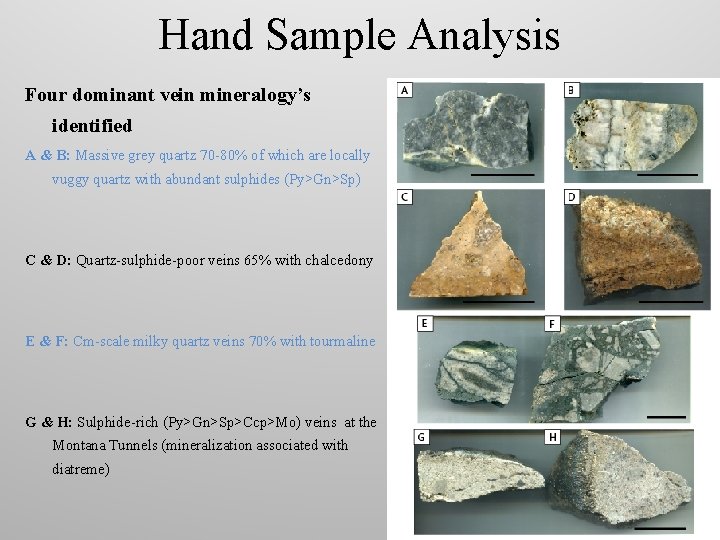
Hand Sample Analysis Four dominant vein mineralogy’s identified A & B: Massive grey quartz 70 -80% of which are locally vuggy quartz with abundant sulphides (Py>Gn>Sp) C & D: Quartz-sulphide-poor veins 65% with chalcedony E & F: Cm-scale milky quartz veins 70% with tourmaline G & H: Sulphide-rich (Py>Gn>Sp>Ccp>Mo) veins at the Montana Tunnels (mineralization associated with diatreme)
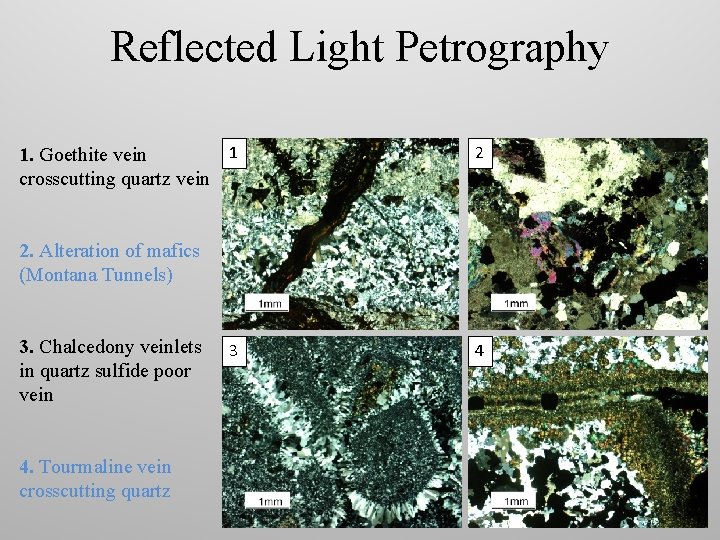
Reflected Light Petrography 1 1. Goethite vein crosscutting quartz vein 2 2. Alteration of mafics (Montana Tunnels) 3. Chalcedony veinlets in quartz sulfide poor vein 4. Tourmaline vein crosscutting quartz 3 4

Vein Characteristics

Vein Orientations Lower Hemisphere Equal Area Projections Massive milky-grey East-West 98˚ striking quartz veins with dip range of 73˚North-72˚South NE-SW (azimuth 157˚) striking quartz-chalcedony veins with dip range 65˚NW-76˚SE
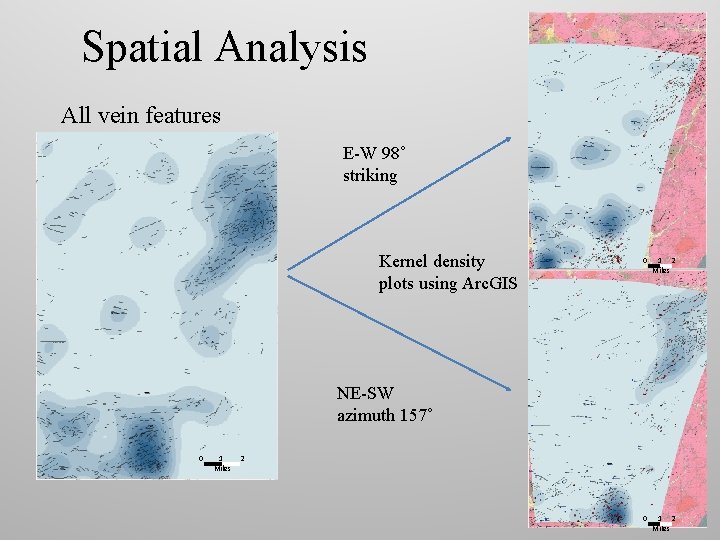
Spatial Analysis All vein features E-W 98˚ striking Kernel density plots using Arc. GIS 0 1 2 Miles NE-SW azimuth 157˚ 0 1 Miles 2
Conclusion • Veins of the Mt. Thompson quadrangle occupy E-W to NE-SW faults and shear zones • Alteration of vein features differ throughout the quadrangle and are related to hydrothermal fluids • Sulfide mineralization associated with shear zones (diatreme breccia at Montana Tunnels) • Zonation of minerals observed as a function of temperature related to heat centers

Questions?
- Slides: 12