
Vehicle Positioning Digital Maps and Integrated Services Lecture

![User priority (2/2) LLC MAC ACI = 3 AIFS[ACI] CW[ACI] TXOP[ACI] Transmit Queues Pre-queue](https://slidetodoc.com/presentation_image_h/94dd5de7b823e824b572101bf154dc1b/image-83.jpg "User priority (2/2) LLC MAC ACI = 3 AIFS[ACI] CW[ACI] TXOP[ACI] Transmit Queues Pre-queue")
- Slides: 86
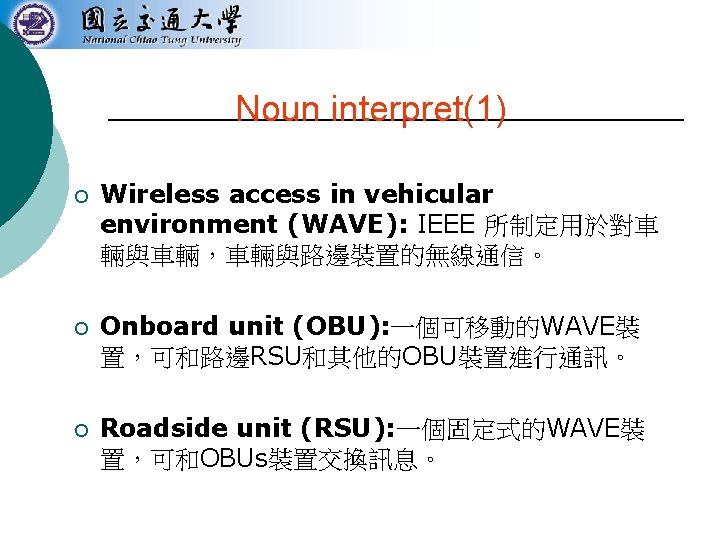
車輛定位與電子地圖整合服務 Vehicle Positioning, Digital Maps and Integrated Services Lecture 7 WAVE Protocols
Outline WAVE Introduction ¡ WAVE 1609. 1 ¡ WAVE 1609. 2 ¡ WAVE 1609. 3 ¡ WAVE 1609. 4 ¡ 各國發展現況 ¡
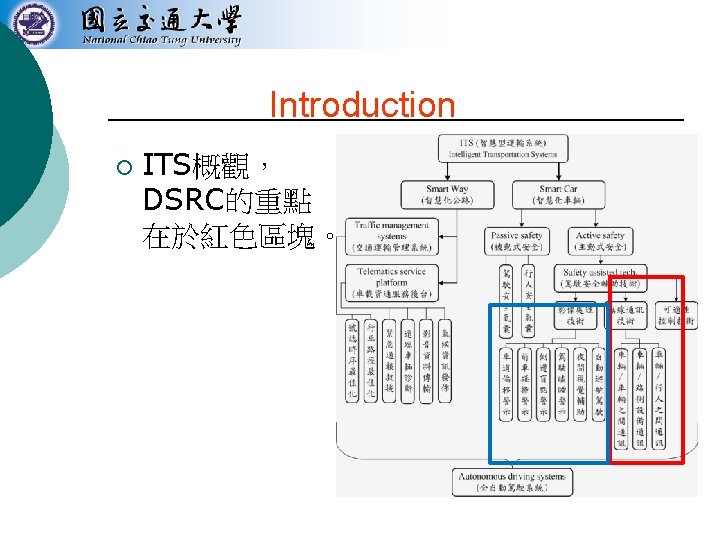
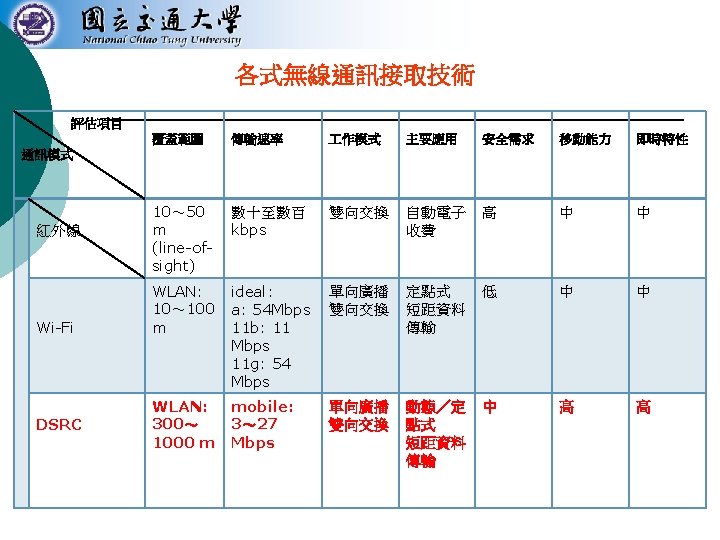
Introduction ¡ ¡ ¡ 車內通訊: Bluetooth (BT), Ultra-wideband (UWB) 車外通訊: 2 G, 2. 5 G, 3. 5 G (cellular systems), GPS, Wi. MAX 車路通訊: Microwave, Infrared, Dedicated Short Range Communications (DSRC), Wi. Fi
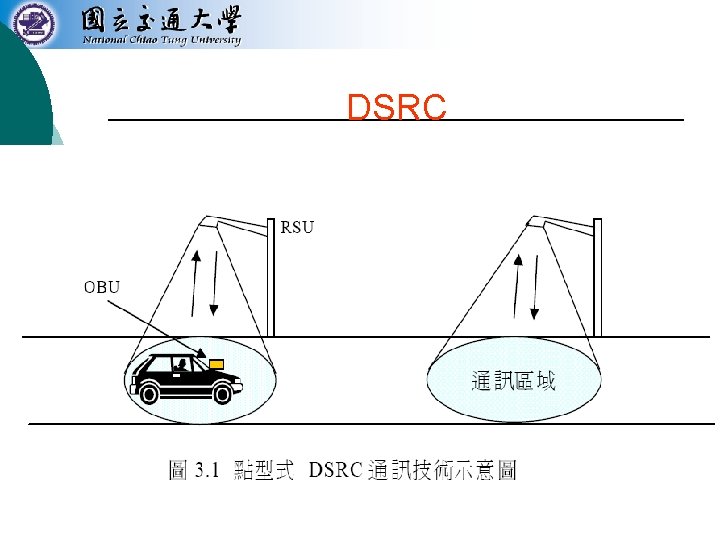
DSRC
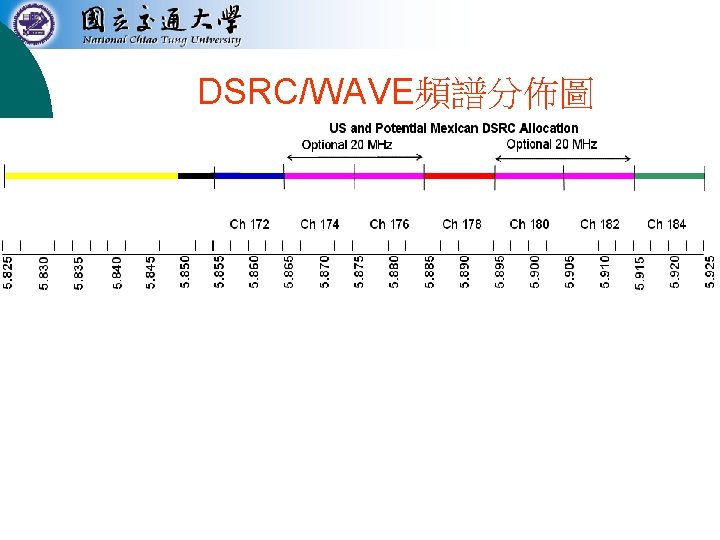
DSRC/WAVE頻譜分佈圖
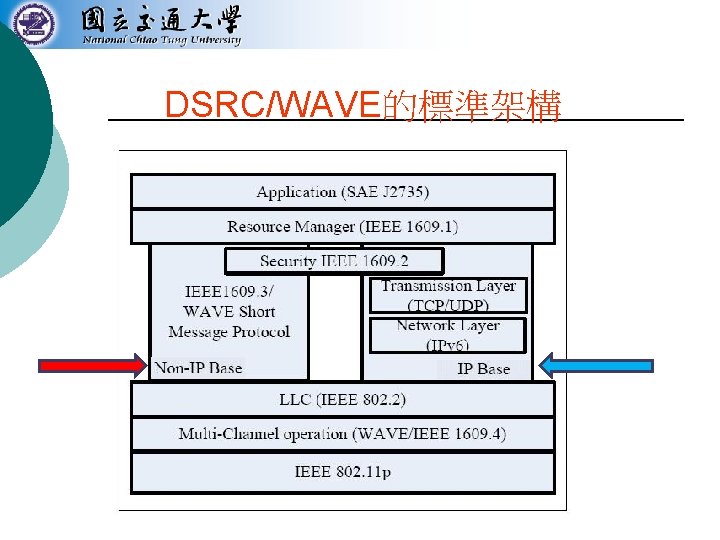
DSRC/WAVE的標準架構
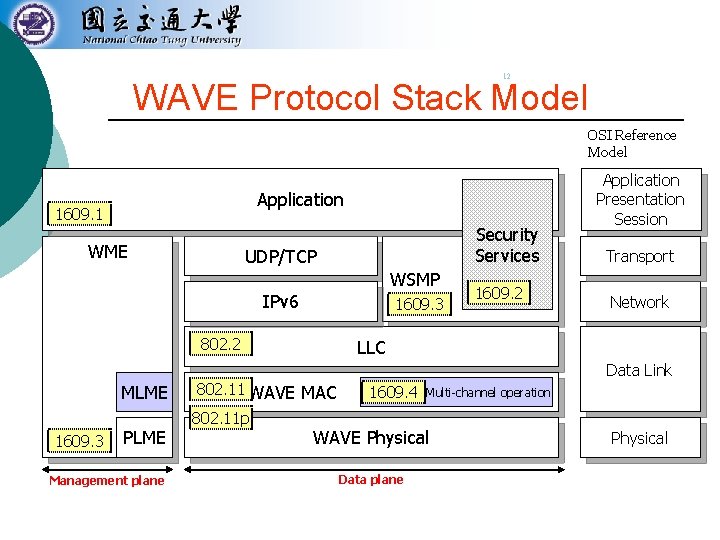
12 WAVE Protocol Stack Model OSI Reference Model Application 1609. 1 WME Security Services UDP/TCP WSMP IPv 6 1609. 3 802. 2 1609. 2 Application Presentation Session Transport Network LLC Data Link MLME 1609. 3 PLME Management plane 802. 11 WAVE MAC 802. 11 p 1609. 4 Multi-channel operation WAVE Physical Data plane Physical
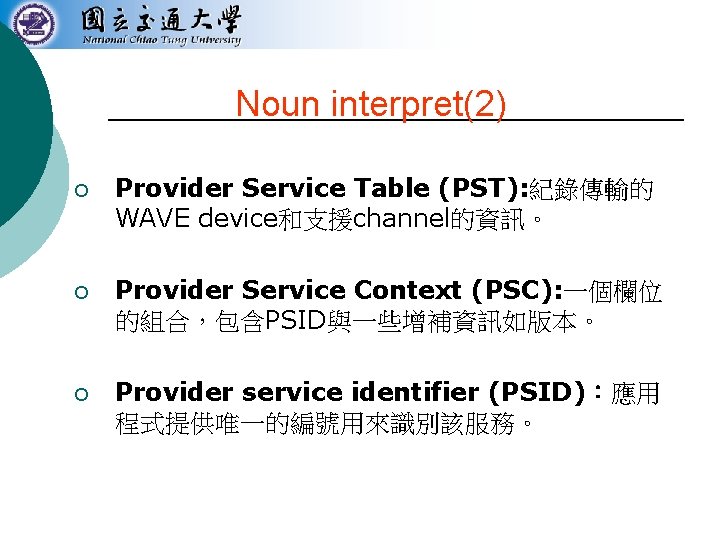
Noun interpret(2) ¡ Provider Service Table (PST): 紀錄傳輸的 WAVE device和支援channel的資訊。 ¡ Provider Service Context (PSC): 一個欄位 的組合,包含PSID與一些增補資訊如版本。 ¡ Provider service identifier (PSID):應用 程式提供唯一的編號用來識別該服務。
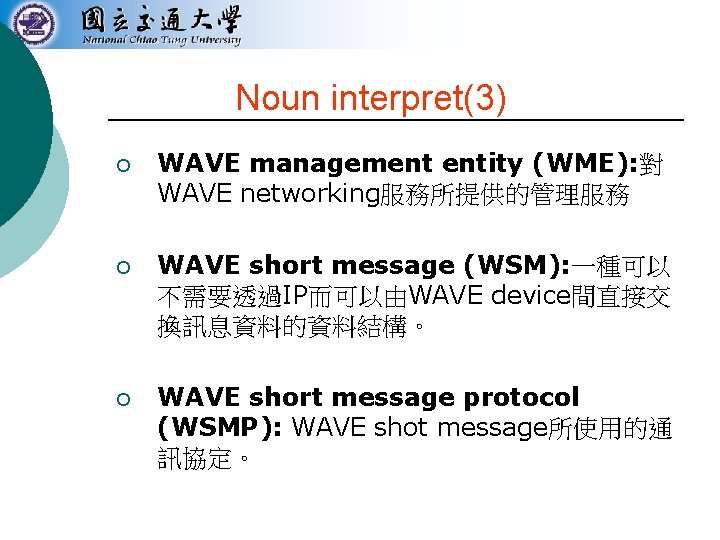
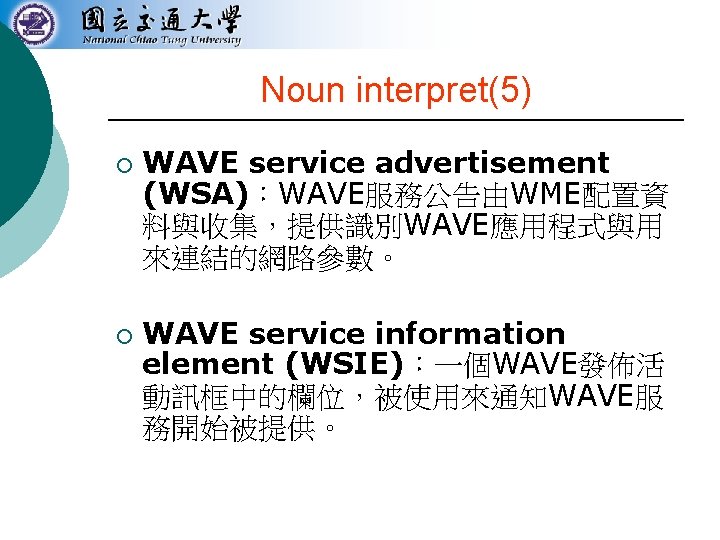
Noun interpret(3) ¡ WAVE management entity (WME): 對 WAVE networking服務所提供的管理服務 ¡ WAVE short message (WSM): 一種可以 不需要透過IP而可以由WAVE device間直接交 換訊息資料的資料結構。 ¡ WAVE short message protocol (WSMP): WAVE shot message所使用的通 訊協定。
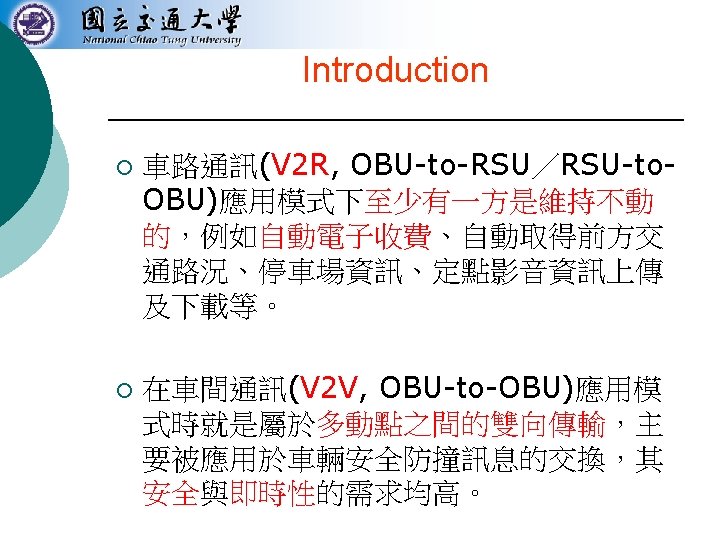
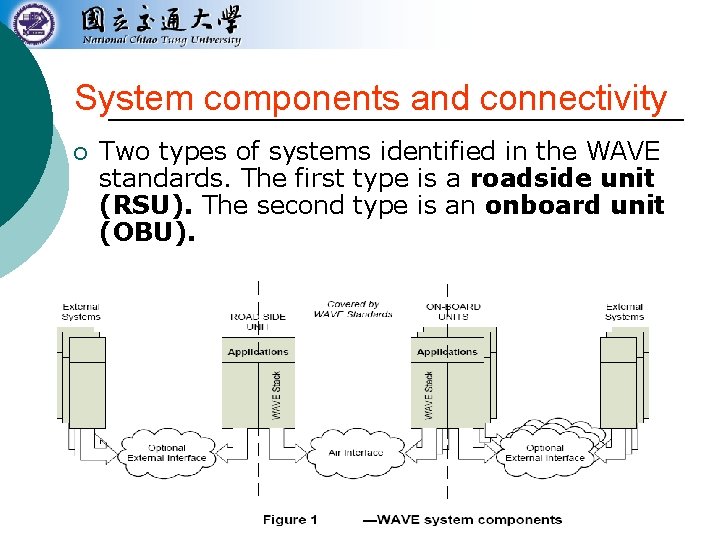
System components and connectivity ¡ Two types of systems identified in the WAVE standards. The first type is a roadside unit (RSU). The second type is an onboard unit (OBU).
Scope & purpose Define secure message formats, the processing of the secure messages within the DSRC/WAVE system ¡ Method for securing WAVE management messages and application messages excepting vehicle-originating safety messages ¡ Services used to protect messages from attacks ¡
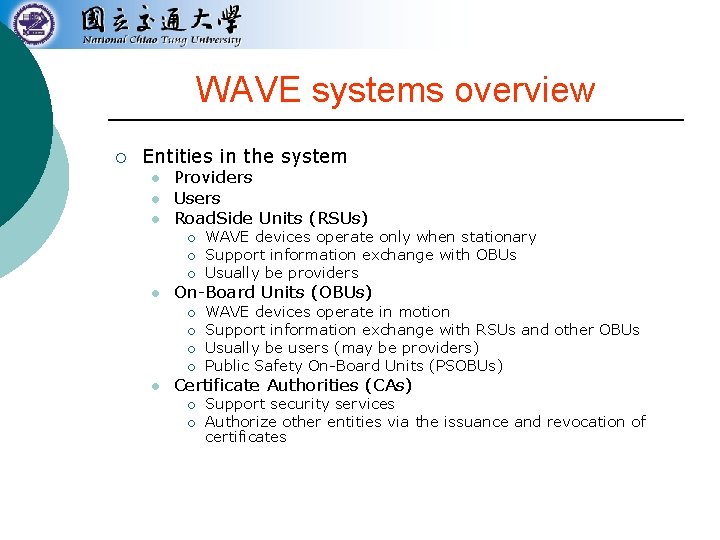
WAVE systems overview ¡ Entities in the system l l l Providers Users Road. Side Units (RSUs) ¡ ¡ ¡ l On-Board Units (OBUs) ¡ ¡ l WAVE devices operate only when stationary Support information exchange with OBUs Usually be providers WAVE devices operate in motion Support information exchange with RSUs and other OBUs Usually be users (may be providers) Public Safety On-Board Units (PSOBUs) Certificate Authorities (CAs) ¡ ¡ Support security services Authorize other entities via the issuance and revocation of certificates
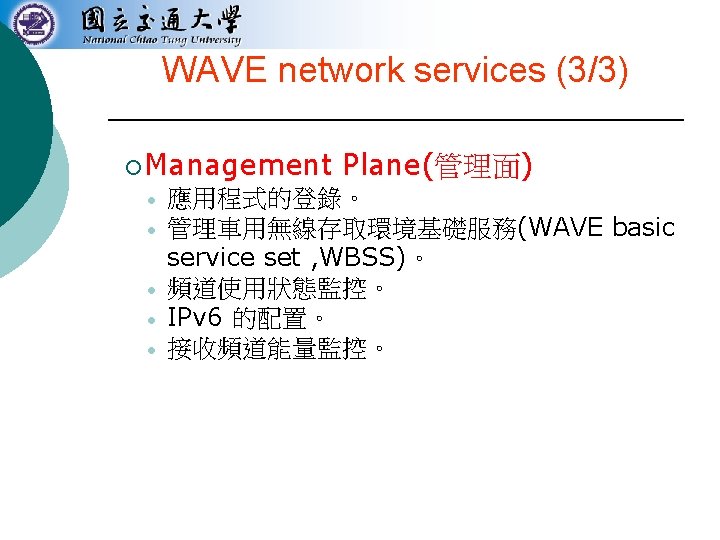
WAVE systems overview
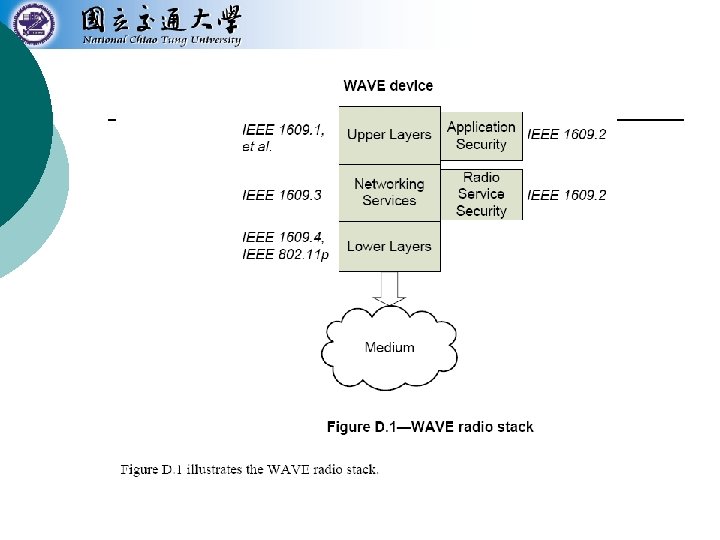
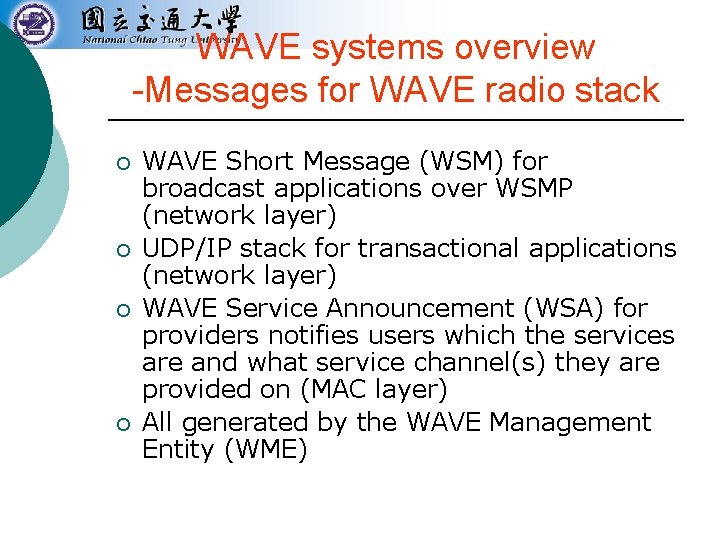
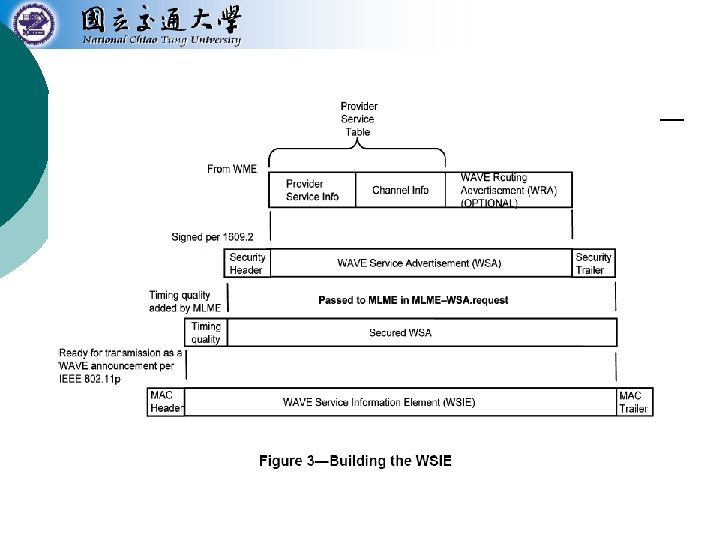
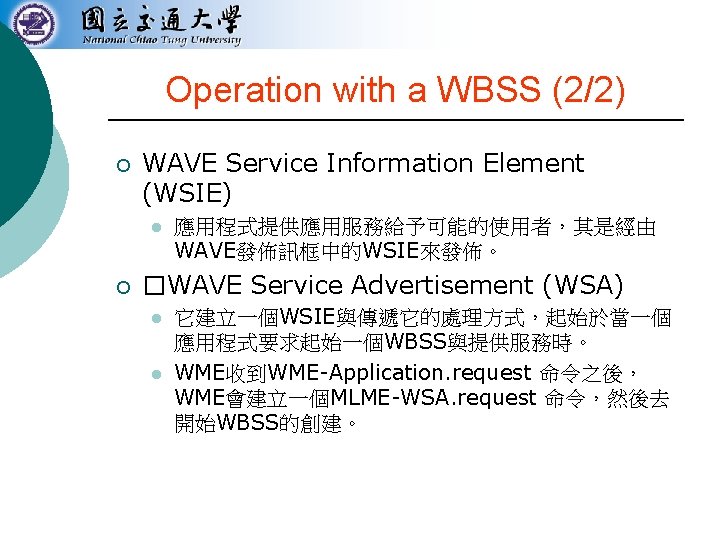
WAVE systems overview -Messages for WAVE radio stack ¡ ¡ WAVE Short Message (WSM) for broadcast applications over WSMP (network layer) UDP/IP stack for transactional applications (network layer) WAVE Service Announcement (WSA) for providers notifies users which the services are and what service channel(s) they are provided on (MAC layer) All generated by the WAVE Management Entity (WME)
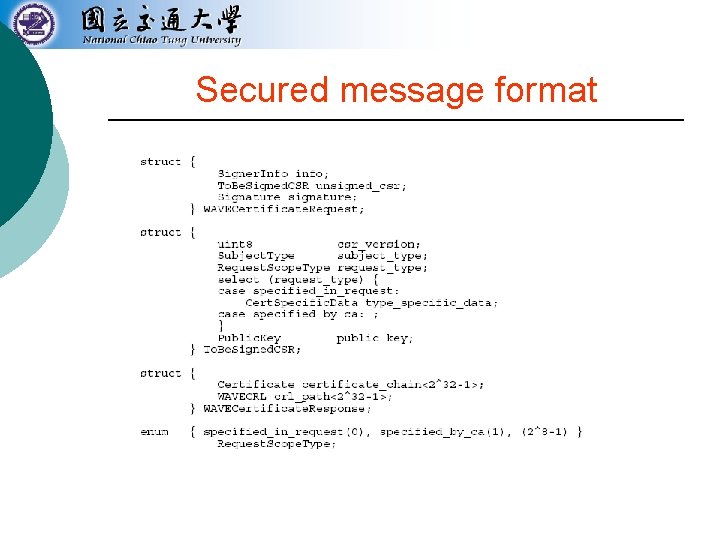
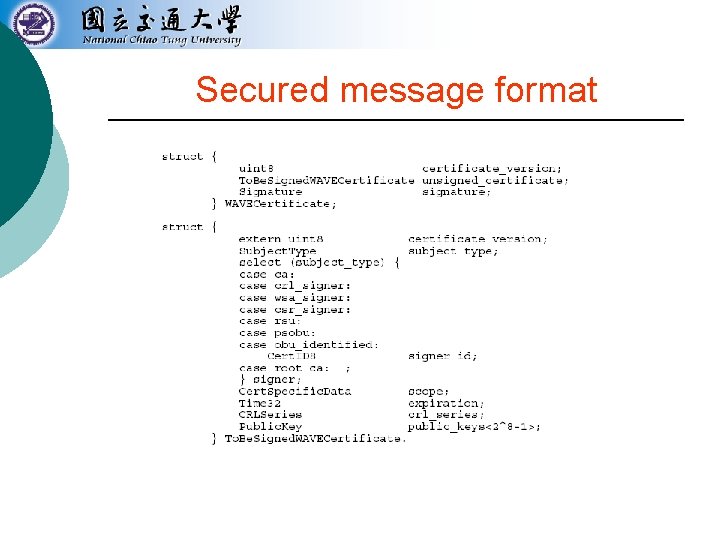
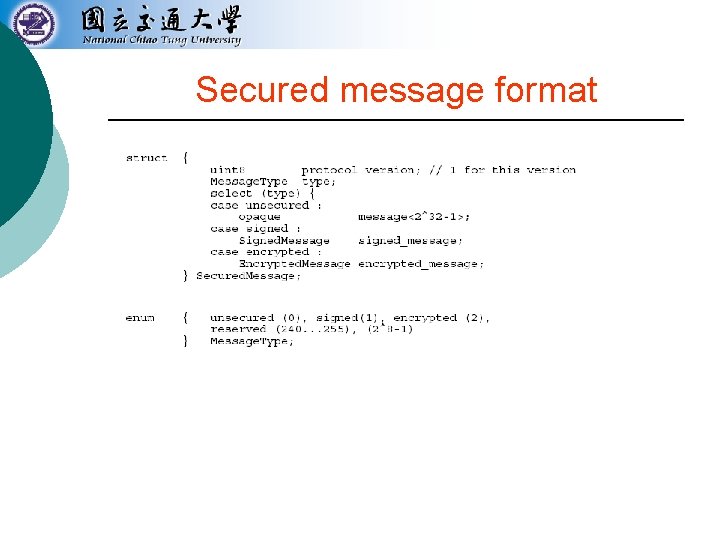
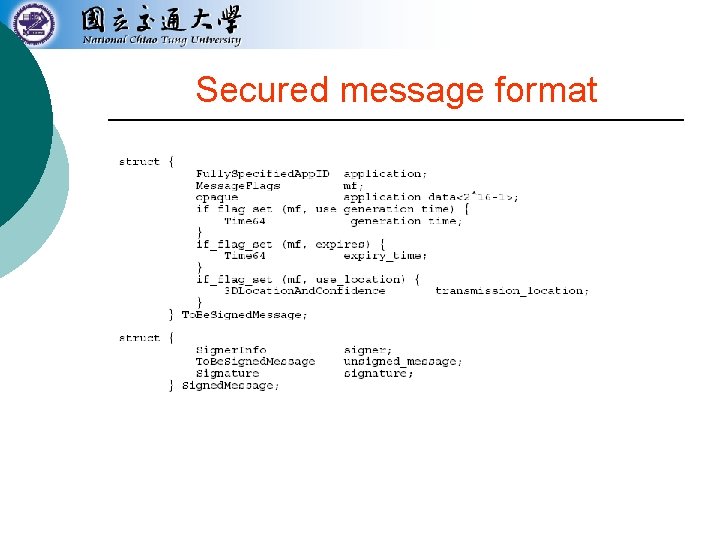
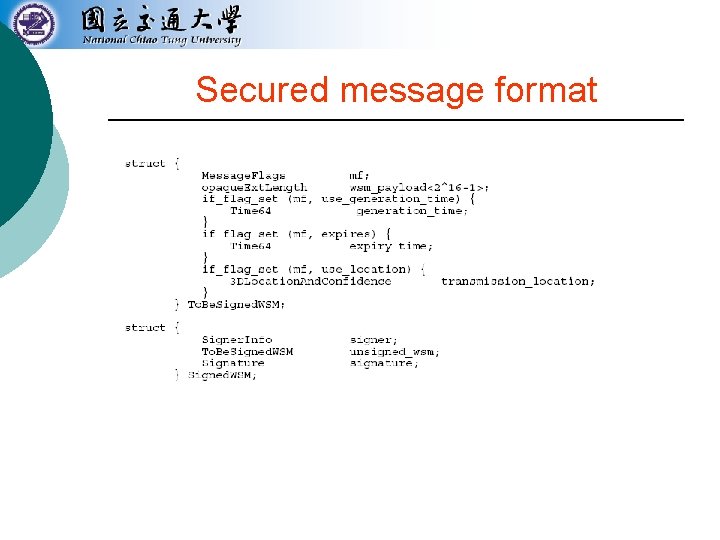
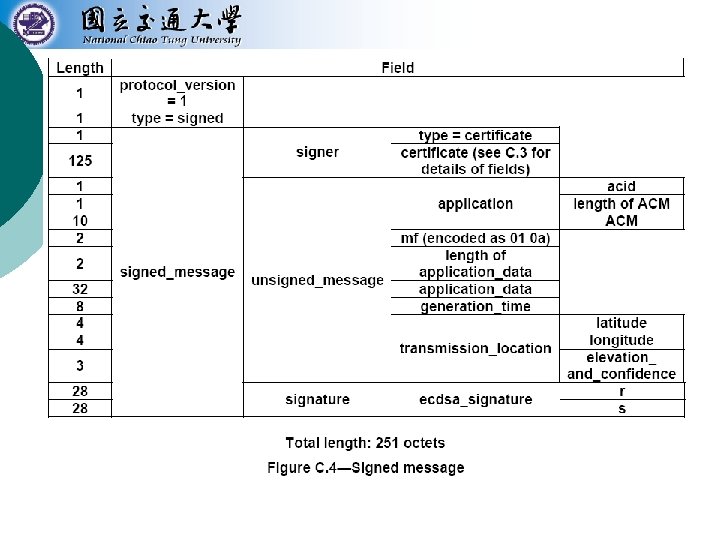
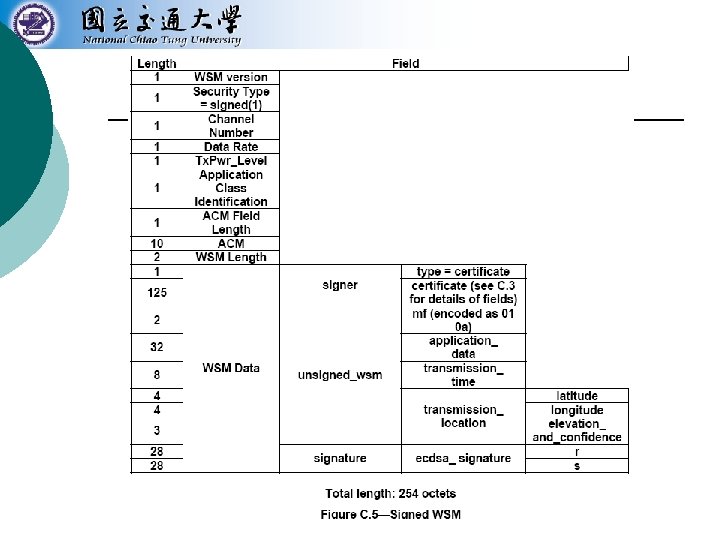
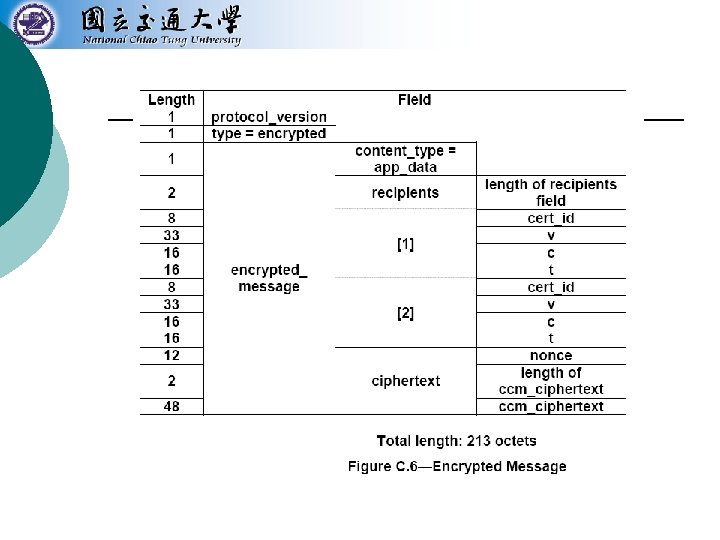
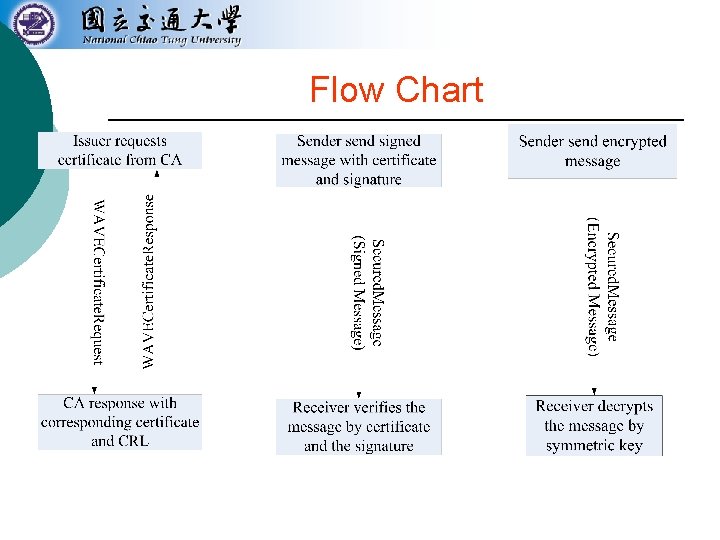
WAVE systems overview – Security services ¡ ¡ ¡ Applications over UDP use the secured message formats to protect application data (Encrypted Message) Application over WSMP use the secured message formats or the secured WSM types to protect application data (Signed Message) WME uses the secured WSIE type to preventing fake services (Signed Message)
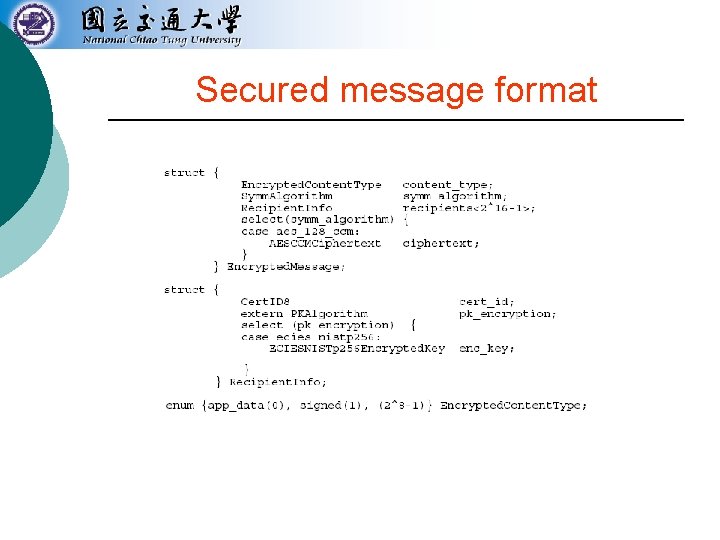
Secured message format
Secured message format
Secured message format
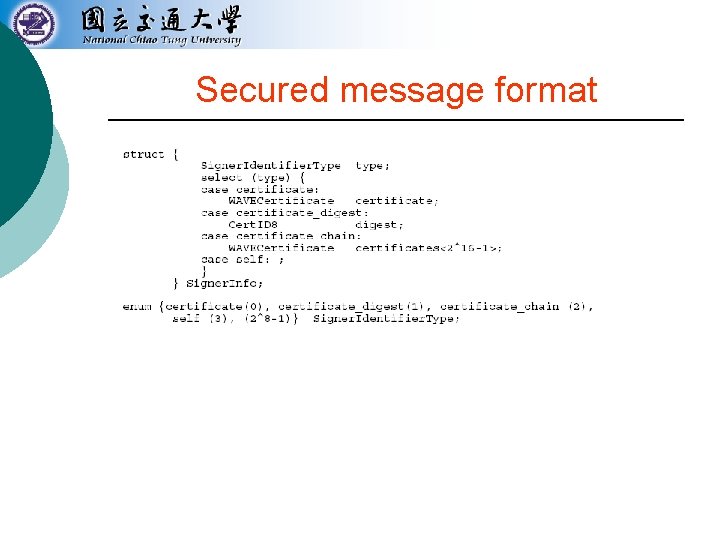
Secured message format
Secured message format
Secured message format
Secured message format
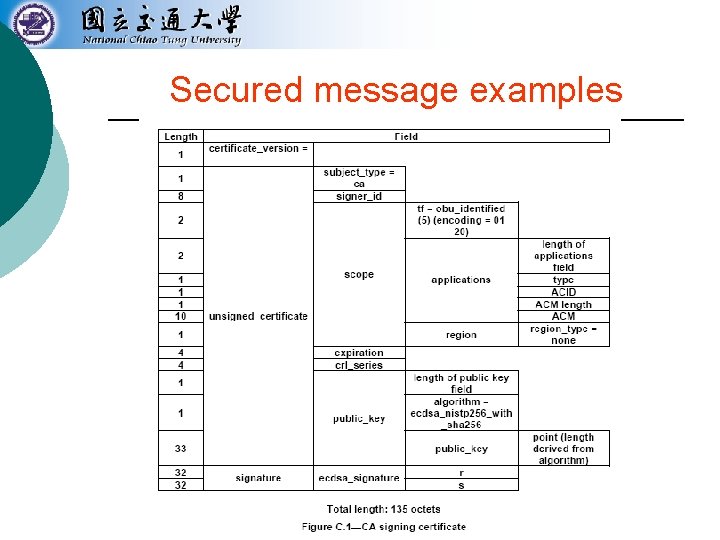
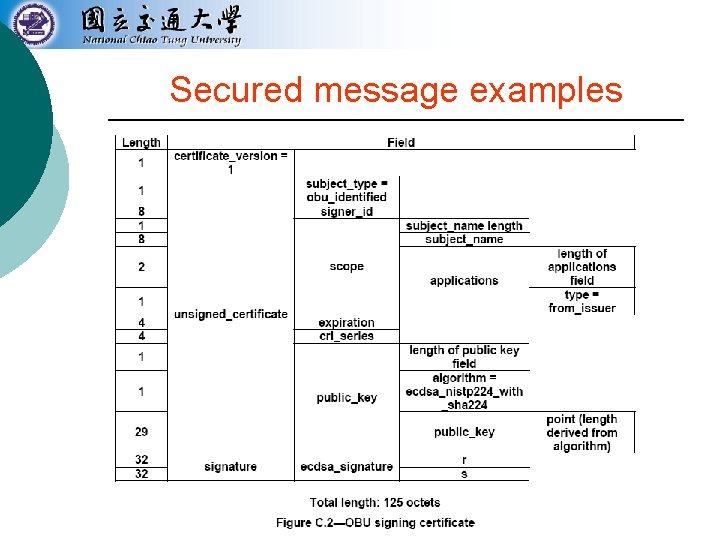
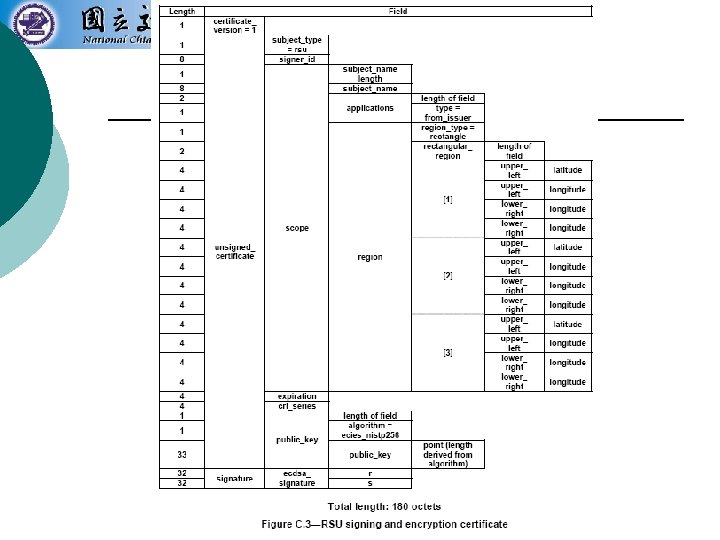
Secured message examples
Secured message examples
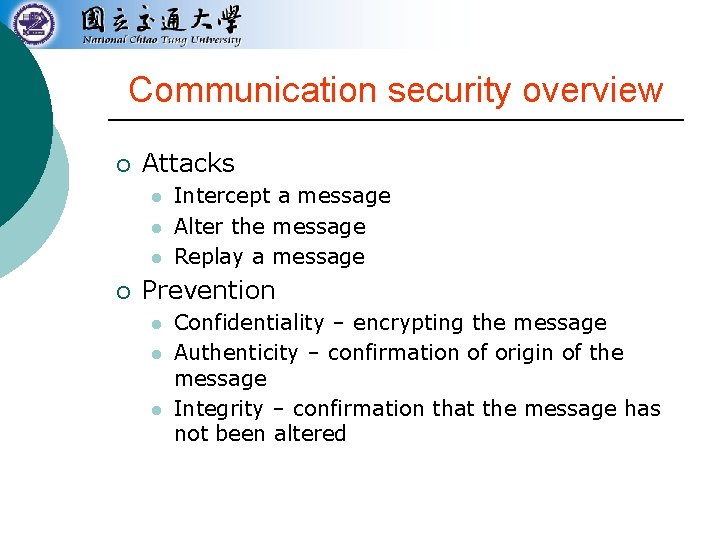
Communication security overview ¡ Attacks l l l ¡ Intercept a message Alter the message Replay a message Prevention l l l Confidentiality – encrypting the message Authenticity – confirmation of origin of the message Integrity – confirmation that the message has not been altered
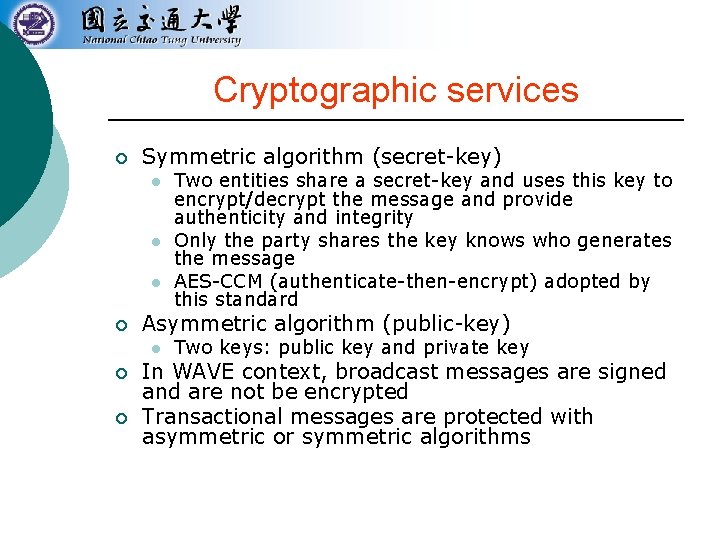
Cryptographic services ¡ Symmetric algorithm (secret-key) l l l ¡ Asymmetric algorithm (public-key) l ¡ ¡ Two entities share a secret-key and uses this key to encrypt/decrypt the message and provide authenticity and integrity Only the party shares the key knows who generates the message AES-CCM (authenticate-then-encrypt) adopted by this standard Two keys: public key and private key In WAVE context, broadcast messages are signed and are not be encrypted Transactional messages are protected with asymmetric or symmetric algorithms
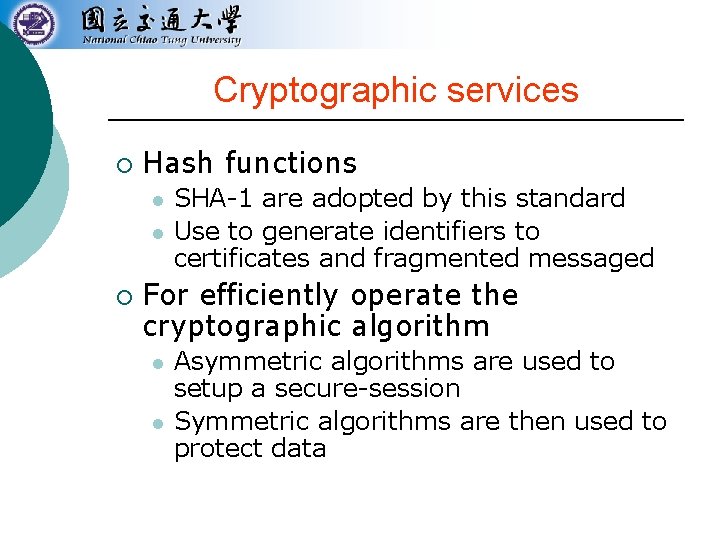
Cryptographic services ¡ Hash functions l l ¡ SHA-1 are adopted by this standard Use to generate identifiers to certificates and fragmented messaged For efficiently operate the cryptographic algorithm l l Asymmetric algorithms are used to setup a secure-session Symmetric algorithms are then used to protect data
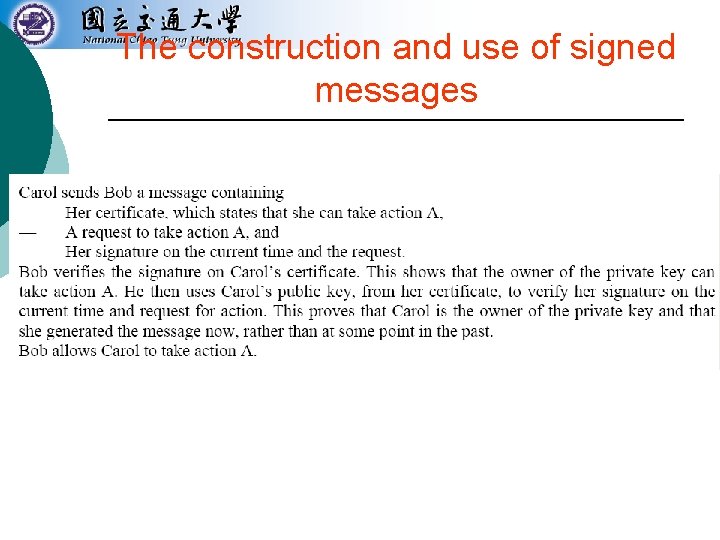
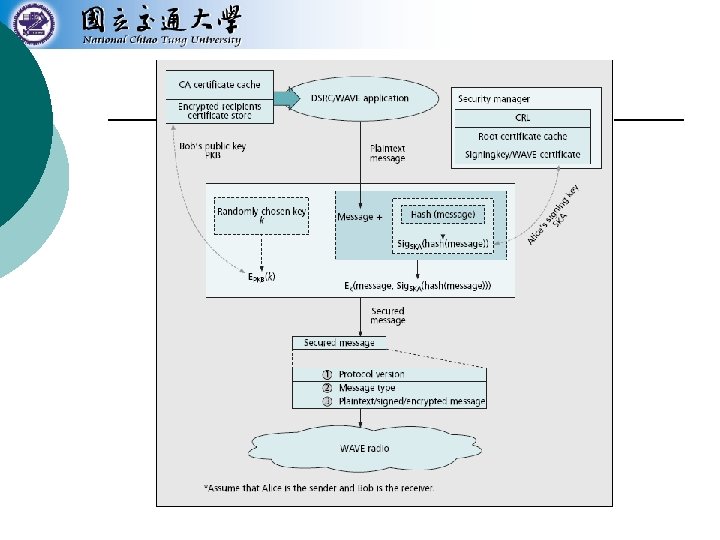
The construction and use of signed messages
Flow Chart
Summary of IEEE 1609. 2
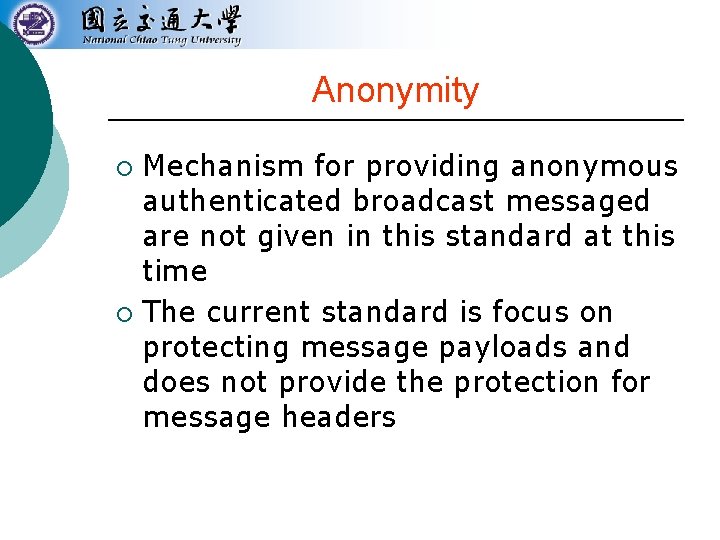
Anonymity Mechanism for providing anonymous authenticated broadcast messaged are not given in this standard at this time ¡ The current standard is focus on protecting message payloads and does not provide the protection for message headers ¡
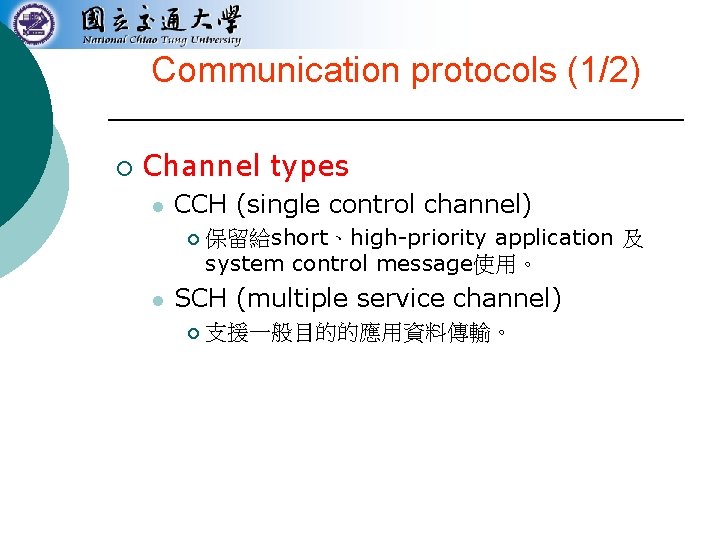
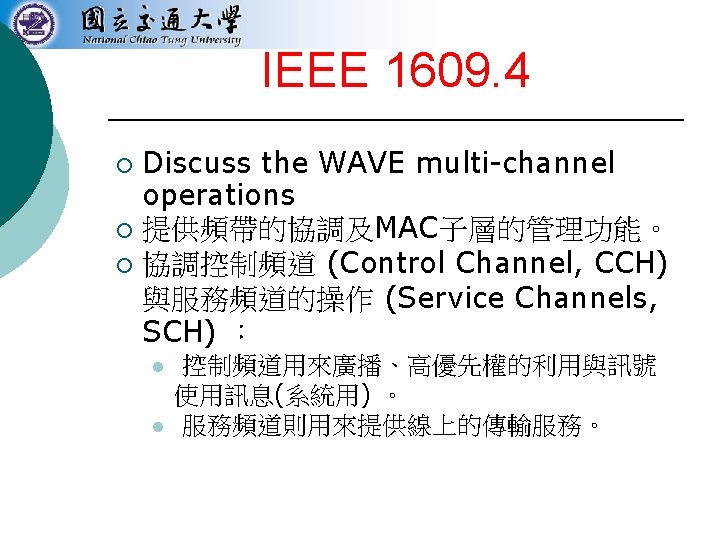
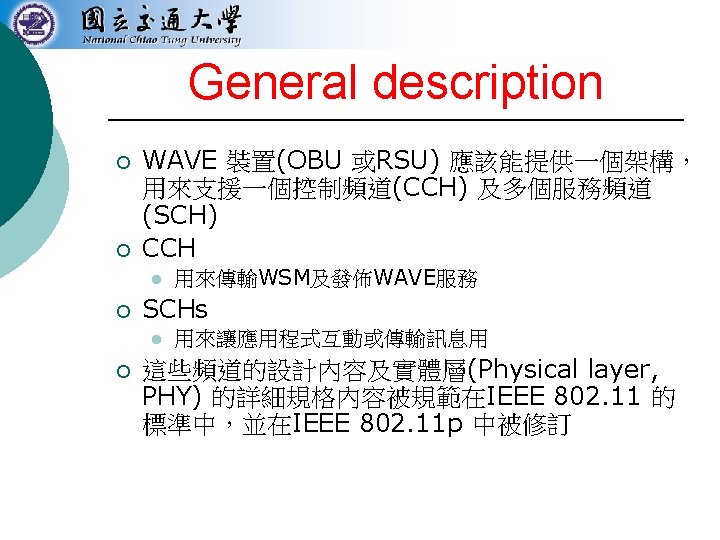
Communication protocols (1/2) ¡ Channel types l CCH (single control channel) ¡ l 保留給short、high-priority application 及 system control message使用。 SCH (multiple service channel) ¡ 支援一般目的的應用資料傳輸。
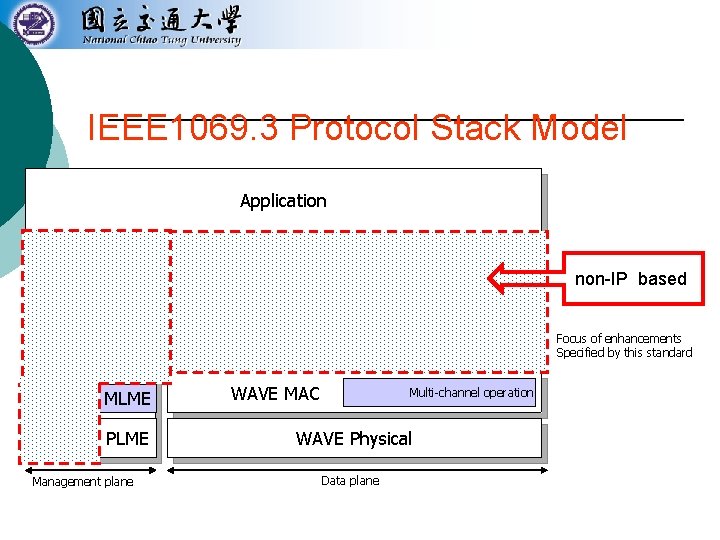
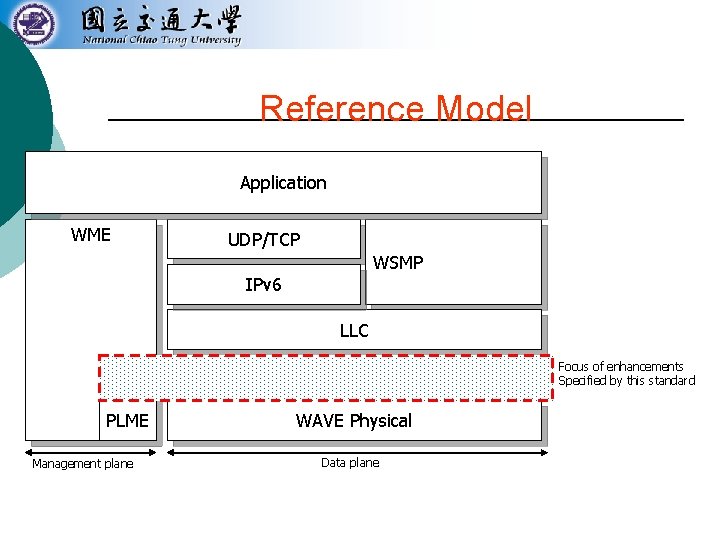
IEEE 1069. 3 Protocol Stack Model Application WME UDP/TCP WSMP non-IP based IPv 6 Focus of enhancements Specified by this standard LLC MLME PLME Management plane WAVE MAC Multi-channel operation WAVE Physical Data plane
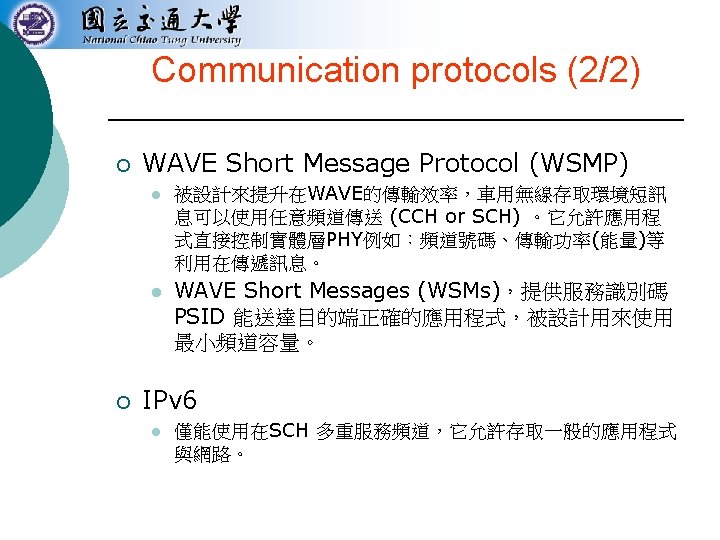
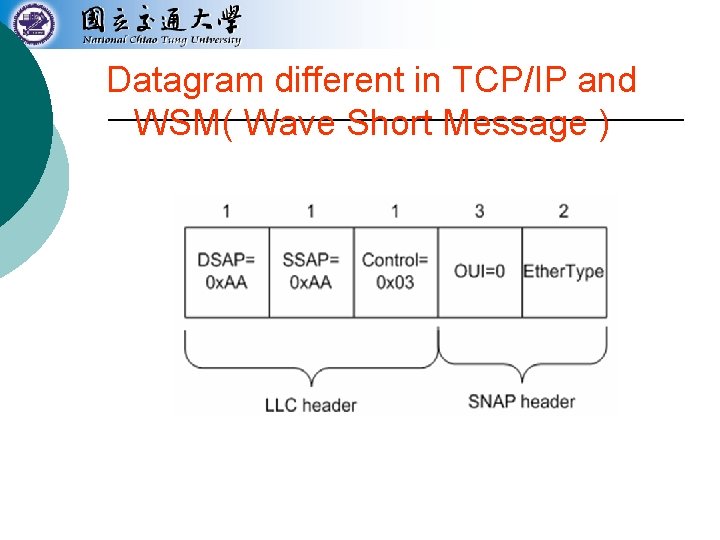
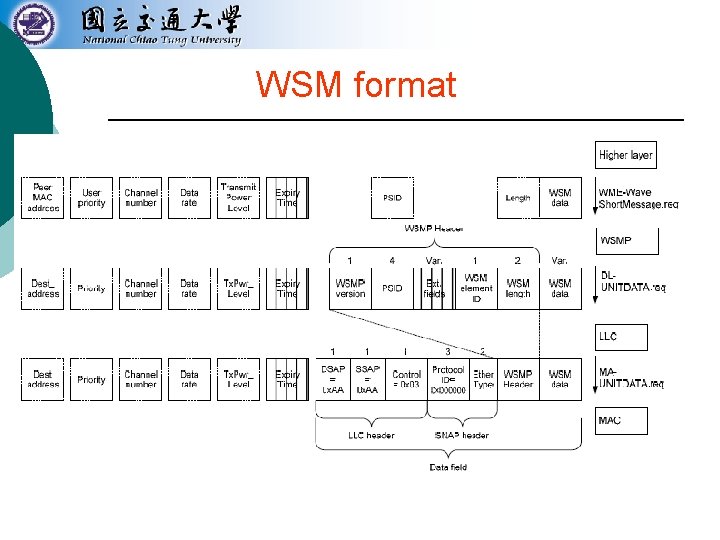
Datagram different in TCP/IP and WSM( Wave Short Message )
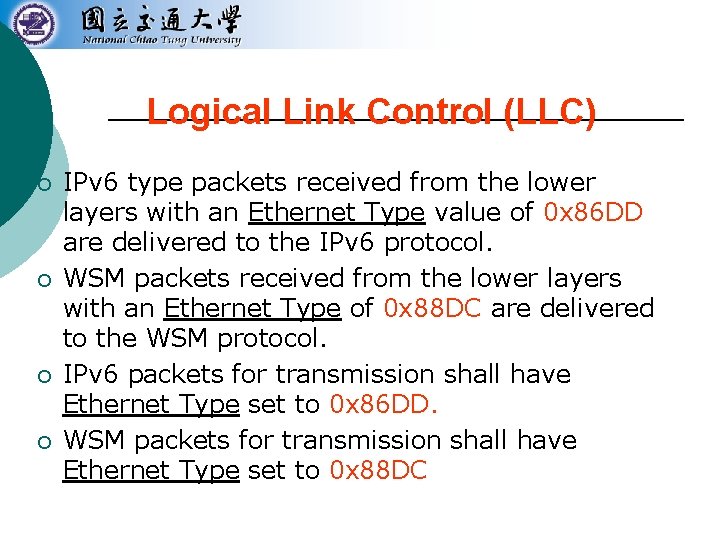
Logical Link Control (LLC) ¡ ¡ IPv 6 type packets received from the lower layers with an Ethernet Type value of 0 x 86 DD are delivered to the IPv 6 protocol. WSM packets received from the lower layers with an Ethernet Type of 0 x 88 DC are delivered to the WSM protocol. IPv 6 packets for transmission shall have Ethernet Type set to 0 x 86 DD. WSM packets for transmission shall have Ethernet Type set to 0 x 88 DC
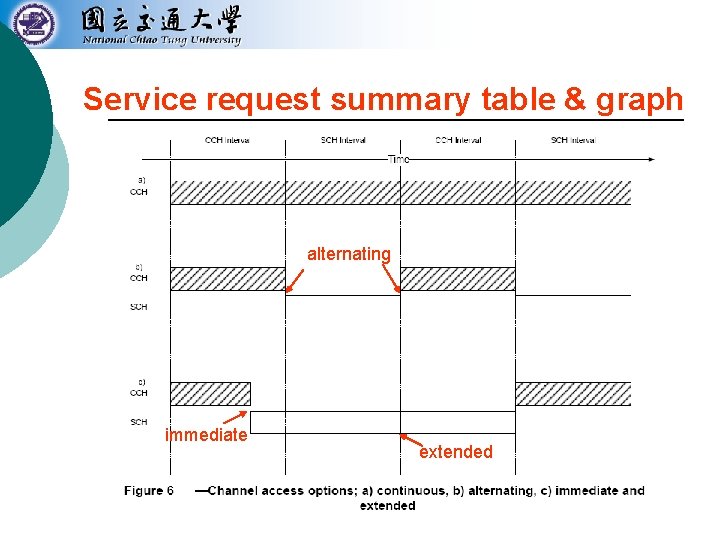
Service request summary table & graph alternating immediate extended
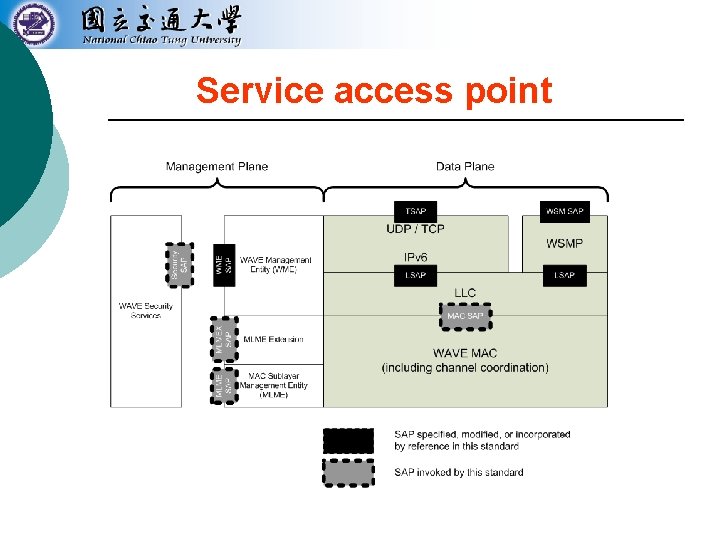
Service access point
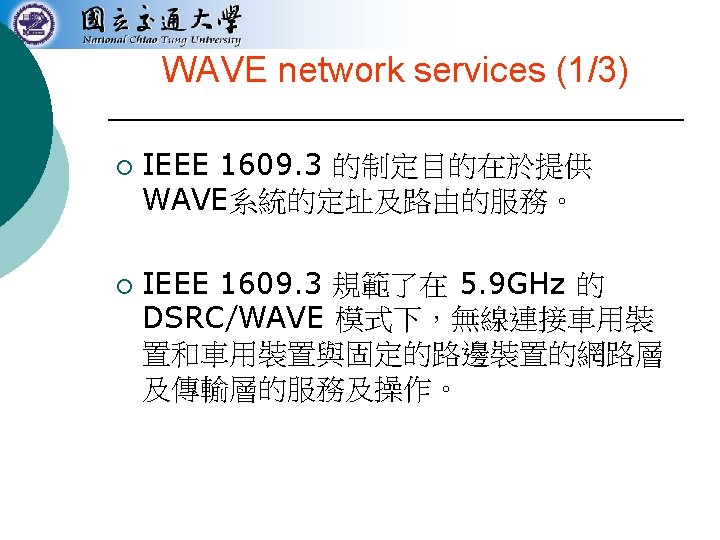
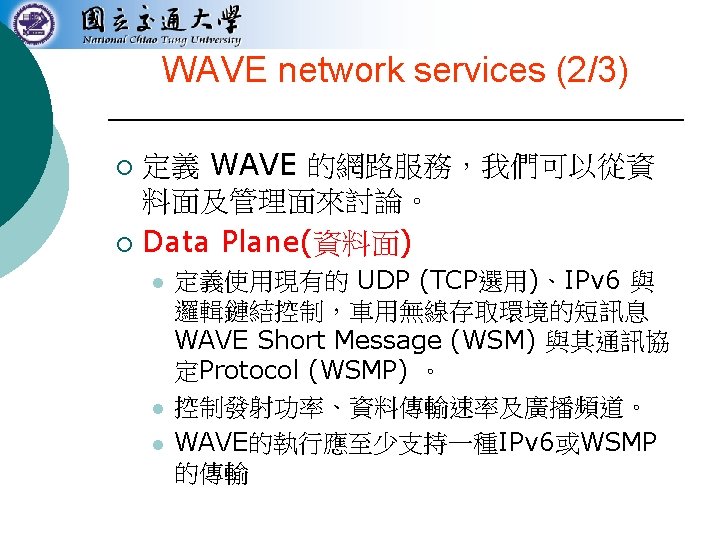
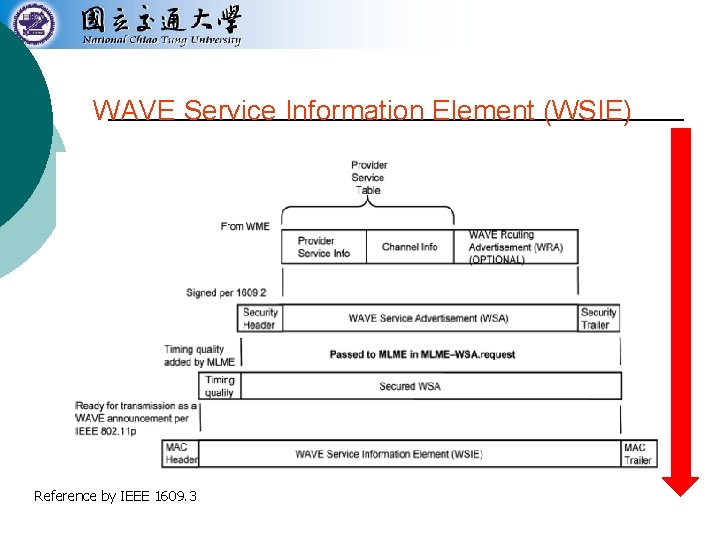
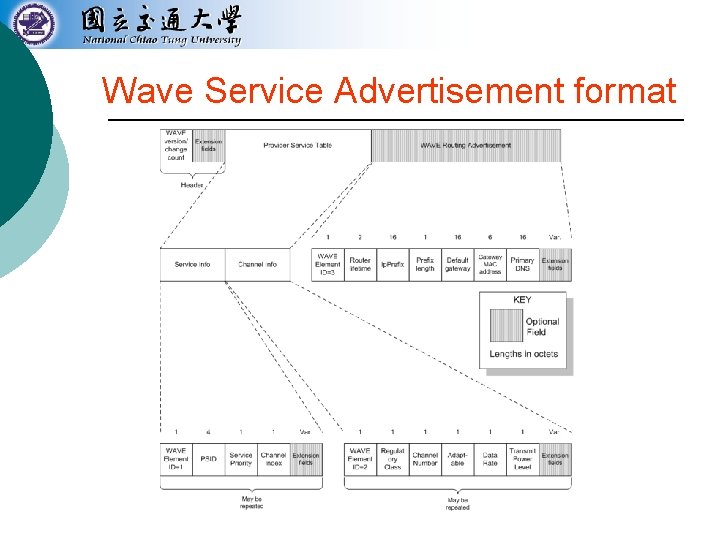
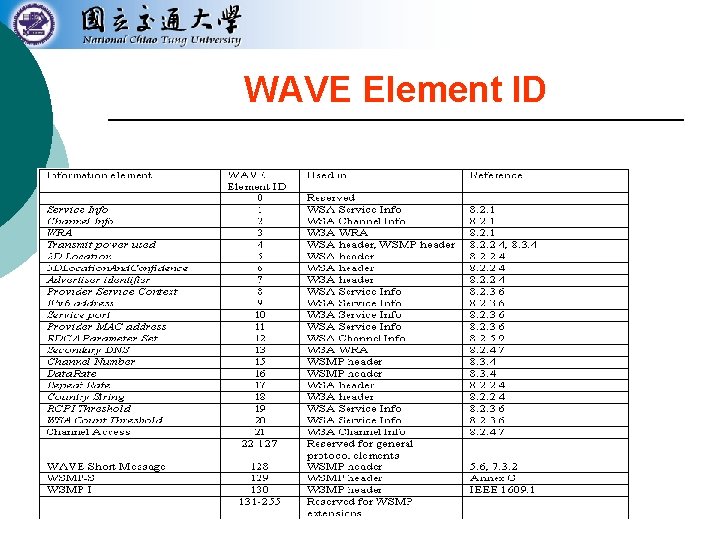
WAVE Service Information Element (WSIE) Reference by IEEE 1609. 3
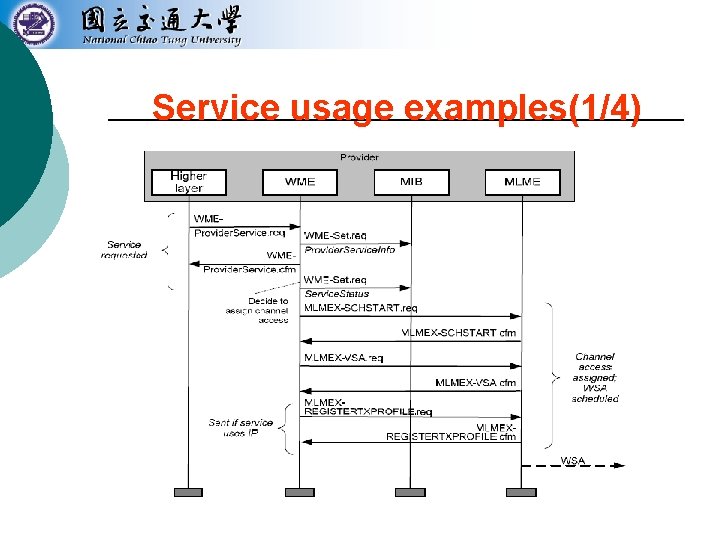
Service usage examples(1/4)
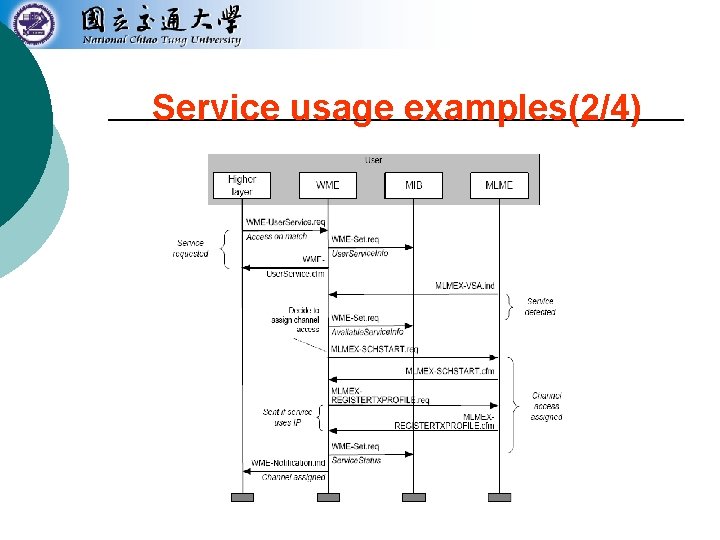
Service usage examples(2/4)
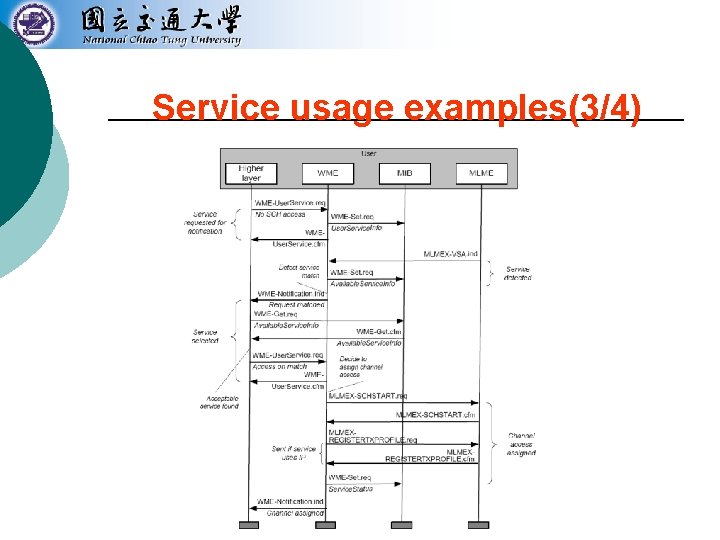
Service usage examples(3/4)
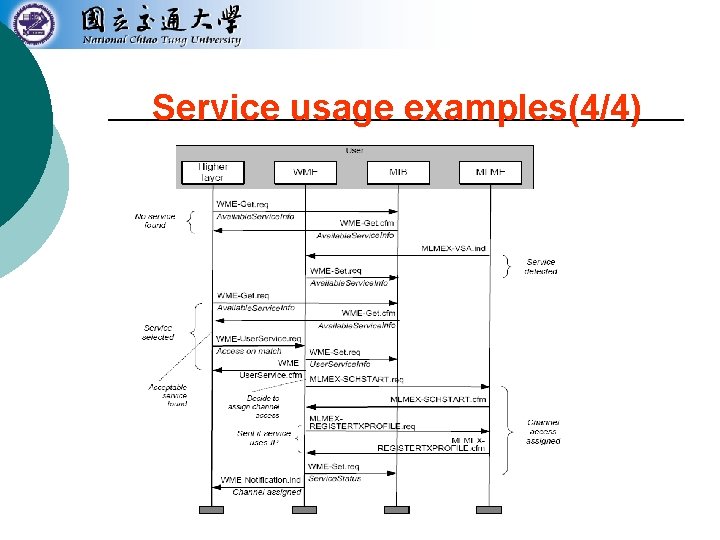
Service usage examples(4/4)
Wave Service Advertisement format
WSM format
WAVE Element ID
Reference Model Application WME UDP/TCP WSMP IPv 6 LLC MLME WAVE MAC with channel coordination PLME WAVE Physical Management plane Data plane Focus of enhancements Specified by this standard
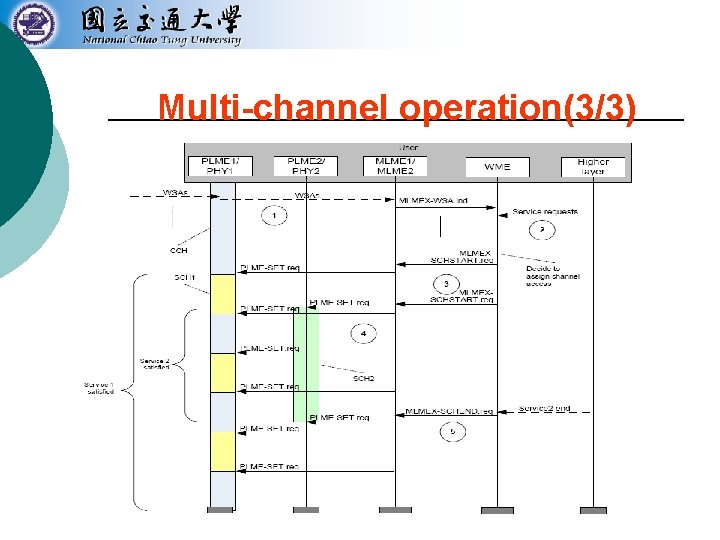
Multi-channel operation(1/3) ¡ ¡ ¡ (1) PHY is tuned to the CCH, and receives WSAs, which are in turn passed to MLME, and then WME. (2) WME accepts user service requests from higher layer entities. (3) WME matches available services with requested services and assigns channel access, sending SCH start commands to the MAC layer management entities associated with the two physical layers.
Multi-channel operation(2/3) ¡ ¡ (4) MLME controls the channel switching of the two PHYs. PHY 1 alternates between CCH and SCH 1 on channel interval boundaries; PHY 2 remains tunes to SCH 2 for the duration of its service. (5) On receipt of a subsequent request from the higher layer, WMEends the SCH 2 assignment and MLME in turn causes PHY 2 to return to its default state.
Multi-channel operation(3/3)
Provide Functions ¡ 頻道的路由(Channel routing) l l Routing for WSMP data Routing for IP datagram 使用者優先權(User priority, UP) ¡ 頻道協調(Channel coordination) ¡ MAC服務資料單元(MSDU) 的傳輸等 ¡
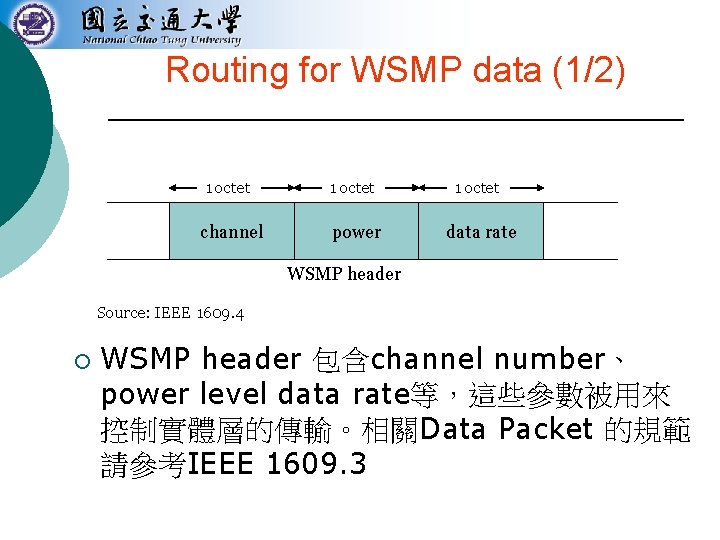
Routing for WSMP data (1/2) 1 octet channel power data rate WSMP header Source: IEEE 1609. 4 ¡ WSMP header 包含channel number、 power level data rate等,這些參數被用來 控制實體層的傳輸。相關Data Packet 的規範 請參考IEEE 1609. 3
Routing for WSMP data (2/2) ¡ Routing Script Scenario l l l 首先 WSMP data 從 LLC 層被傳送到 MAC 層。 接下來 MAC 會路由該封包到適當的 buffer 也就是在 WSMP header 中所指的channel number。 如果 WSMP header 中所指的 channel number 是無效的,則該封包會被摒棄,而 所謂無效的 channel number 是指它並非對 應到 CCH number 或目前的 SCH number。
User priority (2/2) LLC MAC ACI = 3 AIFS[ACI] CW[ACI] TXOP[ACI] Transmit Queues Pre-queue channel access functions AIFS[ACI] CW[ACI] TXOP[ACI] 圖中展示了在一個 Channel 的情況下,資 料封包於(MAC層)競爭 的概念圖。 ACI = 2 AIFS[ACI] CW[ACI] TXOP[ACI] ¡ ACI = 1 AIFS[ACI] CW[ACI] TXOP[ACI] ACI = 0 Internal Contention Medium Contention PHY Source : IEEE 1609. 4