
Vehicle Allocation Methodology VAM Presenters Gary Hatfield Mercury


- Slides: 20
Vehicle Allocation Methodology (VAM) Presenters Gary Hatfield, Mercury Associates William Gookin, Mercury Associates
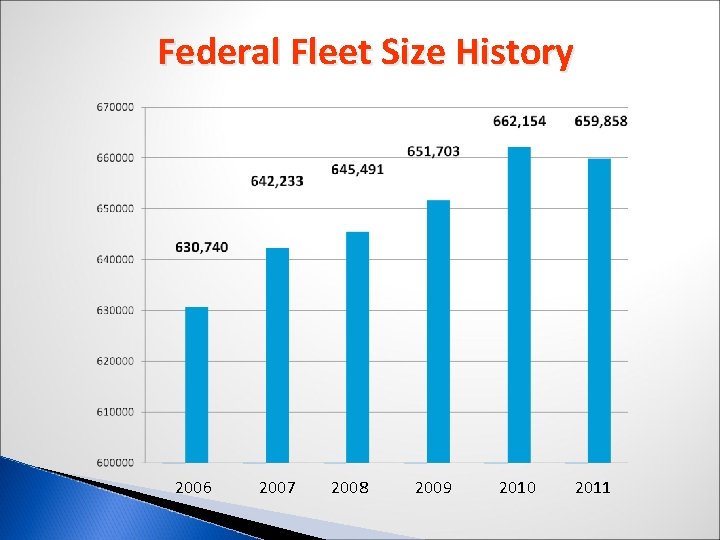
Federal Fleet Size History 2006 2007 2008 2009 2010 2011
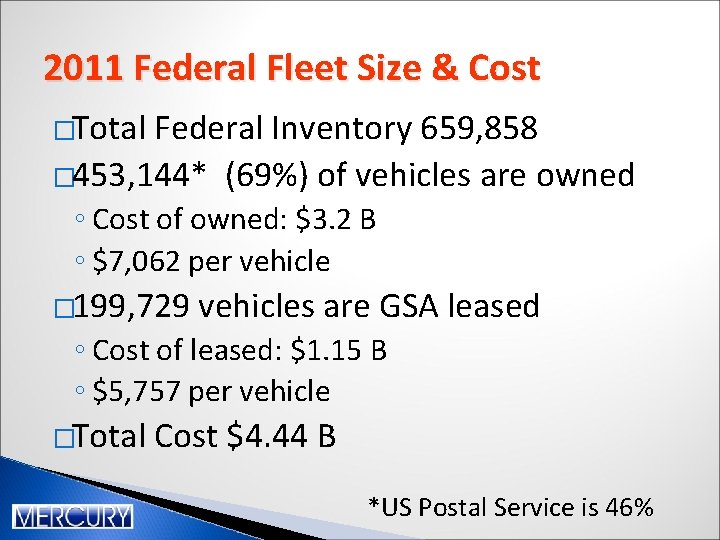
2011 Federal Fleet Size & Cost �Total Federal Inventory 659, 858 � 453, 144* (69%) of vehicles are owned ◦ Cost of owned: $3. 2 B ◦ $7, 062 per vehicle � 199, 729 vehicles are GSA leased ◦ Cost of leased: $1. 15 B ◦ $5, 757 per vehicle �Total Cost $4. 44 B *US Postal Service is 46%
If Management Asks, Could you Answer? �How many vehicles do we have in our fleet? �How many are owned? Leased? �What analysis are you doing to determine if purchasing a vehicle is the best way to go? �How many vehicles do we really need? �Do we know the full cost of our fleet? �How do we capture the total cost of our fleet? �How can we reduce cost? �Can we use more smaller/fuel efficient vehicles? �What is our ratio of vehicles to employees?
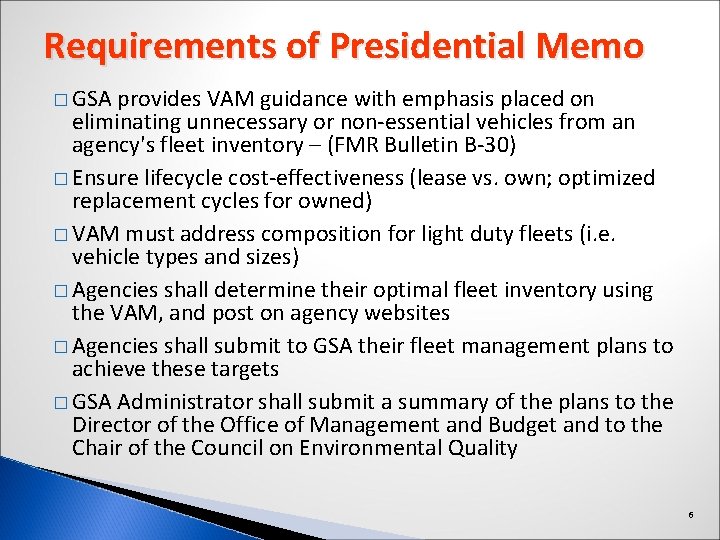
Requirements of Presidential Memo � GSA provides VAM guidance with emphasis placed on eliminating unnecessary or non-essential vehicles from an agency's fleet inventory – (FMR Bulletin B-30) � Ensure lifecycle cost-effectiveness (lease vs. own; optimized replacement cycles for owned) � VAM must address composition for light duty fleets (i. e. vehicle types and sizes) � Agencies shall determine their optimal fleet inventory using the VAM, and post on agency websites � Agencies shall submit to GSA their fleet management plans to achieve these targets � GSA Administrator shall submit a summary of the plans to the Director of the Office of Management and Budget and to the Chair of the Council on Environmental Quality 6
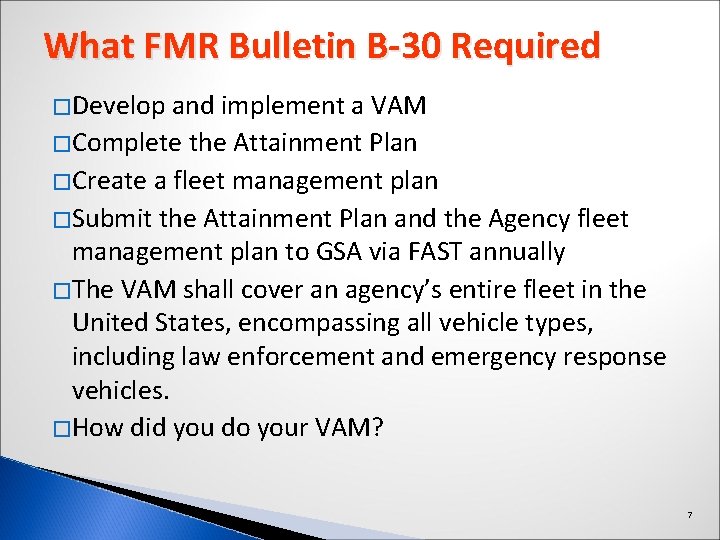
What FMR Bulletin B-30 Required �Develop and implement a VAM �Complete the Attainment Plan �Create a fleet management plan �Submit the Attainment Plan and the Agency fleet management plan to GSA via FAST annually �The VAM shall cover an agency’s entire fleet in the United States, encompassing all vehicle types, including law enforcement and emergency response vehicles. �How did you do your VAM? 7
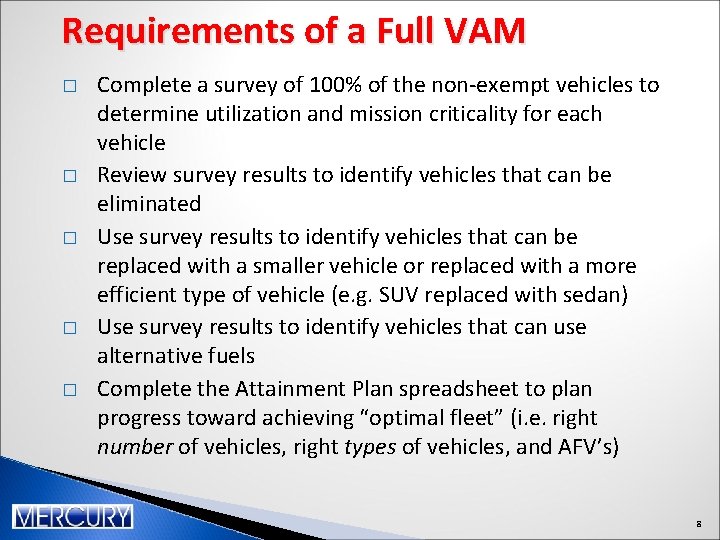
Requirements of a Full VAM � � � Complete a survey of 100% of the non-exempt vehicles to determine utilization and mission criticality for each vehicle Review survey results to identify vehicles that can be eliminated Use survey results to identify vehicles that can be replaced with a smaller vehicle or replaced with a more efficient type of vehicle (e. g. SUV replaced with sedan) Use survey results to identify vehicles that can use alternative fuels Complete the Attainment Plan spreadsheet to plan progress toward achieving “optimal fleet” (i. e. right number of vehicles, right types of vehicles, and AFV’s) 8
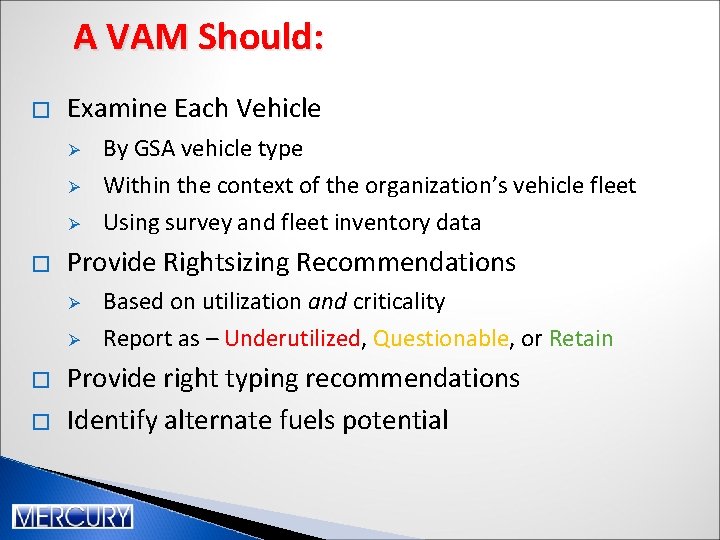
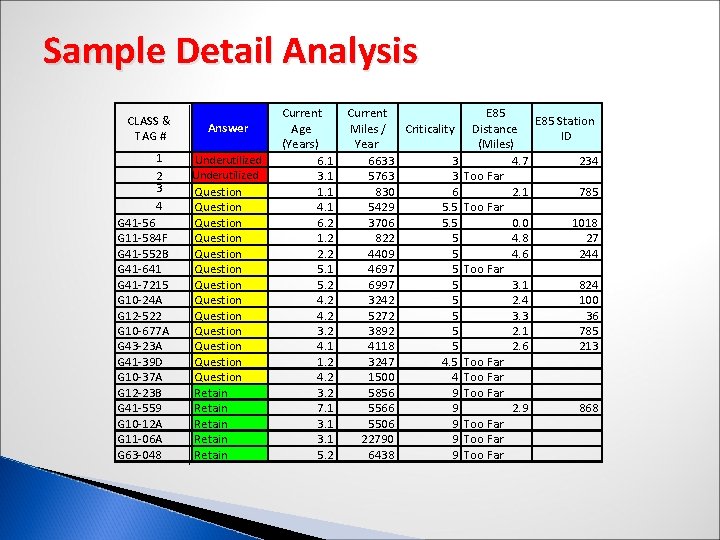
A VAM Should: � Examine Each Vehicle Ø Ø Ø � Provide Rightsizing Recommendations Ø Ø � � By GSA vehicle type Within the context of the organization’s vehicle fleet Using survey and fleet inventory data Based on utilization and criticality Report as – Underutilized, Questionable, or Retain Provide right typing recommendations Identify alternate fuels potential
VAM SURVEY SHOULD… � Be Completed For Each Vehicle � Collect Data On: Ø Utilization Ø Criticality Ø Right typing Ø Alternate fuels potential
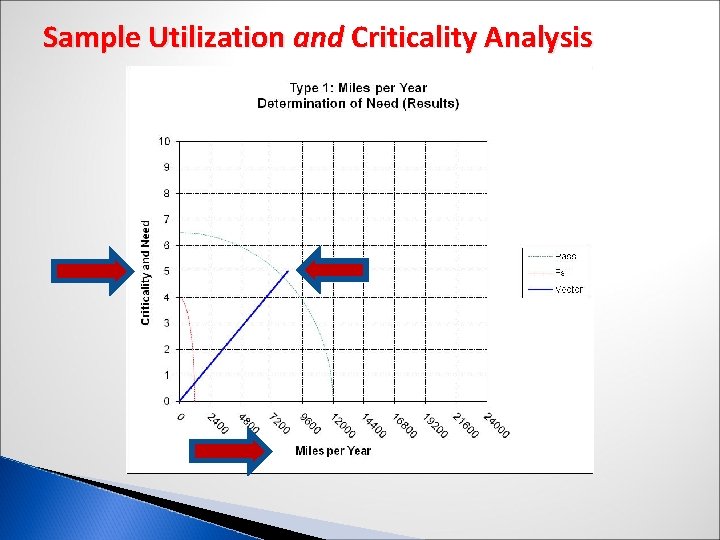
Sample Utilization and Criticality Analysis
Sample Detail Analysis CLASS & TAG # 1 2 3 4 G 41 -56 G 11 -584 F G 41 -552 B G 41 -641 G 41 -7215 G 10 -24 A G 12 -522 G 10 -677 A G 43 -23 A G 41 -39 D G 10 -37 A G 12 -23 B G 41 -559 G 10 -12 A G 11 -06 A G 63 -048 Answer Underutilized Question Question Question Question Retain Retain Current Age (Years) 6. 1 3. 1 1. 1 4. 1 6. 2 1. 2 2. 2 5. 1 5. 2 4. 2 3. 2 4. 1 1. 2 4. 2 3. 2 7. 1 3. 1 5. 2 Current E 85 Station Miles / Criticality Distance ID Year (Miles) 6633 3 4. 7 234 5763 3 Too Far 830 6 2. 1 785 5429 5. 5 Too Far 3706 5. 5 0. 0 1018 822 5 4. 8 27 4409 5 4. 6 244 4697 5 Too Far 6997 5 3. 1 824 3242 5 2. 4 100 5272 5 3. 3 36 3892 5 2. 1 785 4118 5 2. 6 213 3247 4. 5 Too Far 1500 4 Too Far 5856 9 Too Far 5566 9 2. 9 868 5506 9 Too Far 22790 9 Too Far 6438 9 Too Far
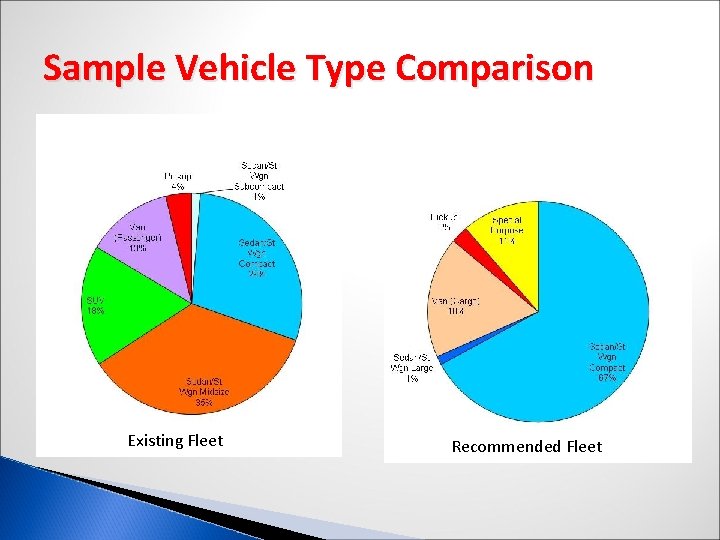
Sample Vehicle Type Comparison Existing Fleet Recommended Fleet
Agency fleet management plan must address the following: �Schedule to achieve optimal fleet inventory, including plans for acquiring all AFVs by December 31, 2015 �Plans and schedules for locating alternative fueled vehicles in proximity to AFV fueling stations �Vehicle sourcing decisions (lease vs. own analysis) �Fleet management plan must be incorporated into the Annual Strategic Sustainability Performance Plan 14
Concerns �If agencies (all) don’t voluntarily control/reduce fleet size adequately, Congress may take the “chain saw” approach �Leasing vs. Owning �Law Enforcement Vehicles (exempt? ) �Home to Work �Agency ability to fund vehicle replacements
Challenges �Poor inventory data on owned assets �Poor utilization data on owned assets �Belief of users that vehicles belong to them �Insufficient authority given to fleet managers to implement results of VAM �Inadequate training of field fleet staff �Not enough time/staff/expertise to execute
What’s Next? �Next VAM Cycle – due mid March 2013 �Adjusting goals based on mission requirements �Measuring progress toward fleet size goals �Increasing focus on GSA leasing vs. buying �Look for opportunities to use Shared Fleet-on. Demand Services* *For example, sharing vehicles with another department, bureau, or agency that is located nearby
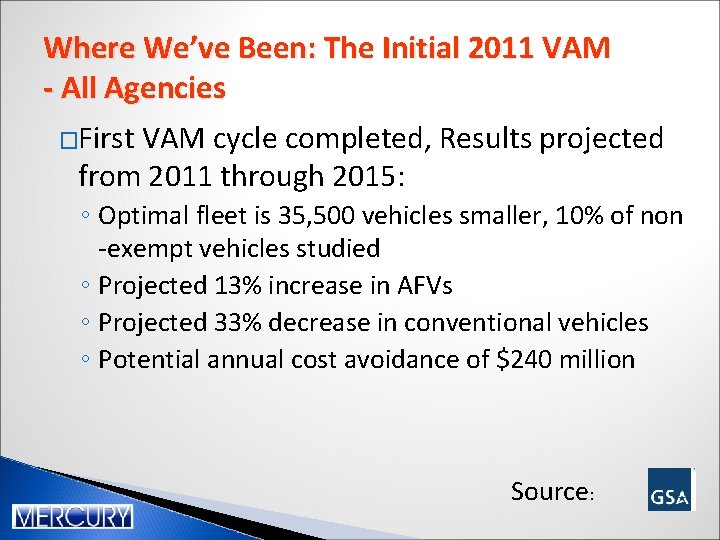
Where We’ve Been: The Initial 2011 VAM - All Agencies �First VAM cycle completed, Results projected from 2011 through 2015: ◦ Optimal fleet is 35, 500 vehicles smaller, 10% of non -exempt vehicles studied ◦ Projected 13% increase in AFVs ◦ Projected 33% decrease in conventional vehicles ◦ Potential annual cost avoidance of $240 million Source:
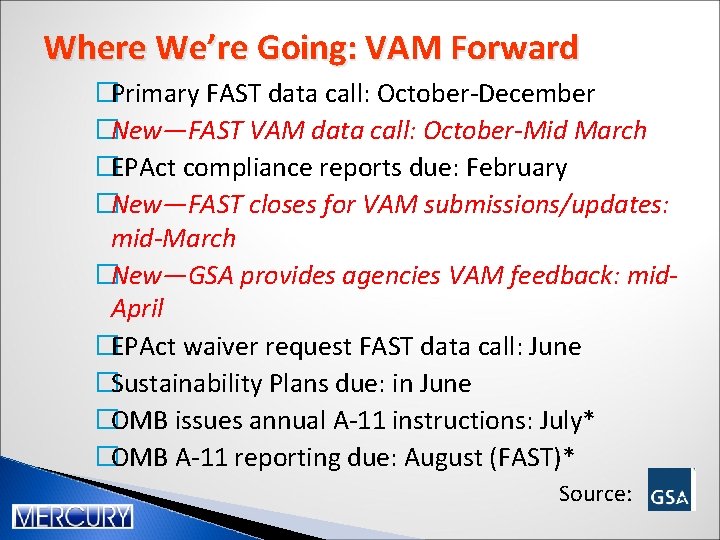
Where We’re Going: VAM Forward �Primary FAST data call: October-December �New—FAST VAM data call: October-Mid March �EPAct compliance reports due: February �New—FAST closes for VAM submissions/updates: mid-March �New—GSA provides agencies VAM feedback: mid. April �EPAct waiver request FAST data call: June �Sustainability Plans due: in June �OMB issues annual A-11 instructions: July* �OMB A-11 reporting due: August (FAST)* Source:
Questions? MERCURY ASSOCIATES, INC. “Specializing in the science of fleet management. ” For more information, contact: Gary Hatfield Director, Public Sector Fleet Consulting ghatfield@mercury-assoc. com 941 -685 -6907 (cell) William Gookin Director wgookin@mercury-assoc. com 540 -809 -3792 (cell) GSA Log. World Contract GS-10 F-0026 T