
Vegetative and Reproductive Growth Development Plant Science200 Chapter
![Germination involves six steps ] ] ] Water imbibition Enzyme activation Hydrolysis & catabolism](https://slidetodoc.com/presentation_image_h2/0e701b03739c6d188974ef47d72b838a/image-2.jpg "Germination involves six steps ] ] ] Water imbibition Enzyme activation Hydrolysis & catabolism")
![Seed Germination ] Water ] Heat ] Oxygen ] Light](https://slidetodoc.com/presentation_image_h2/0e701b03739c6d188974ef47d72b838a/image-3.jpg "Seed Germination ] Water ] Heat ] Oxygen ] Light")
![Seed Dormant Embryos ] Thick seed coat ] Thin seed coat ] Insufficient development](https://slidetodoc.com/presentation_image_h2/0e701b03739c6d188974ef47d72b838a/image-4.jpg "Seed Dormant Embryos ] Thick seed coat ] Thin seed coat ] Insufficient development")
![Seed Coat Dormancy ] Seed Coats or other tissues covering the embryo may be](https://slidetodoc.com/presentation_image_h2/0e701b03739c6d188974ef47d72b838a/image-5.jpg "Seed Coat Dormancy ] Seed Coats or other tissues covering the embryo may be")
![Breaking seed dormancy ] 1. Scarification: The surface of the seed is mechanically scratched](https://slidetodoc.com/presentation_image_h2/0e701b03739c6d188974ef47d72b838a/image-6.jpg "Breaking seed dormancy ] 1. Scarification: The surface of the seed is mechanically scratched")
![Viability Testing ] 1 - Cut Test: Cut the seed in half to see](https://slidetodoc.com/presentation_image_h2/0e701b03739c6d188974ef47d72b838a/image-7.jpg "Viability Testing ] 1 - Cut Test: Cut the seed in half to see")
![Germination Test ] Testing the % of seed that will germinate. Why is this](https://slidetodoc.com/presentation_image_h2/0e701b03739c6d188974ef47d72b838a/image-8.jpg "Germination Test ] Testing the % of seed that will germinate. Why is this")
![Roots and Shoots ] The root and shoot systems grow in a balanced pattern](https://slidetodoc.com/presentation_image_h2/0e701b03739c6d188974ef47d72b838a/image-9.jpg "Roots and Shoots ] The root and shoot systems grow in a balanced pattern")
![Definitions of Measurement ] Can be measured by: ] Fresh weight ] Volume ]](https://slidetodoc.com/presentation_image_h2/0e701b03739c6d188974ef47d72b838a/image-10.jpg "Definitions of Measurement ] Can be measured by: ] Fresh weight ] Volume ]")
![Types of Shoot growth ] Determinate-flower bud develop at terminal buds halting growth ]](https://slidetodoc.com/presentation_image_h2/0e701b03739c6d188974ef47d72b838a/image-11.jpg "Types of Shoot growth ] Determinate-flower bud develop at terminal buds halting growth ]")
![Shoot growth Patterns ] Annuals- Shoot growth commences after seed germination ceases sometime after](https://slidetodoc.com/presentation_image_h2/0e701b03739c6d188974ef47d72b838a/image-12.jpg "Shoot growth Patterns ] Annuals- Shoot growth commences after seed germination ceases sometime after")
![Factors Affecting Plant growth & Development ] ] ] ] Soil Conditions Water use](https://slidetodoc.com/presentation_image_h2/0e701b03739c6d188974ef47d72b838a/image-14.jpg "Factors Affecting Plant growth & Development ] ] ] ] Soil Conditions Water use")
![Photoperiodism ] Some plants needs a certain number of hours of day length to](https://slidetodoc.com/presentation_image_h2/0e701b03739c6d188974ef47d72b838a/image-15.jpg "Photoperiodism ] Some plants needs a certain number of hours of day length to")
![What is light? ] energy that travels in wavelengths ] short wavelengths = high](https://slidetodoc.com/presentation_image_h2/0e701b03739c6d188974ef47d72b838a/image-16.jpg "What is light? ] energy that travels in wavelengths ] short wavelengths = high")
![What is meant by light quality? ] amount of light of different colors ]](https://slidetodoc.com/presentation_image_h2/0e701b03739c6d188974ef47d72b838a/image-17.jpg "What is meant by light quality? ] amount of light of different colors ]")
![What is meant by light quantity? ] amount of light energy received ] measured](https://slidetodoc.com/presentation_image_h2/0e701b03739c6d188974ef47d72b838a/image-18.jpg "What is meant by light quantity? ] amount of light energy received ] measured")
![What is light duration? ] ] length of day Long Day Plants more than](https://slidetodoc.com/presentation_image_h2/0e701b03739c6d188974ef47d72b838a/image-19.jpg "What is light duration? ] ] length of day Long Day Plants more than")
![How does temperature influence crop selection? ] Warm Season Crops - soil temp higher](https://slidetodoc.com/presentation_image_h2/0e701b03739c6d188974ef47d72b838a/image-20.jpg "How does temperature influence crop selection? ] Warm Season Crops - soil temp higher")
![What are the Cardinal Temperatures? ] minimum, maximum, optimal temperatures for a crop ]](https://slidetodoc.com/presentation_image_h2/0e701b03739c6d188974ef47d72b838a/image-21.jpg "What are the Cardinal Temperatures? ] minimum, maximum, optimal temperatures for a crop ]")
![What is the Frost Free Period? ] the time from the last killing frost](https://slidetodoc.com/presentation_image_h2/0e701b03739c6d188974ef47d72b838a/image-22.jpg "What is the Frost Free Period? ] the time from the last killing frost")
![How does snow cover affect the temperature of the soil? ] snow cover insulates,](https://slidetodoc.com/presentation_image_h2/0e701b03739c6d188974ef47d72b838a/image-23.jpg "How does snow cover affect the temperature of the soil? ] snow cover insulates,")
![How can we keep a crop from freezing? (orchards etc. ) ] heaters, smudge](https://slidetodoc.com/presentation_image_h2/0e701b03739c6d188974ef47d72b838a/image-24.jpg "How can we keep a crop from freezing? (orchards etc. ) ] heaters, smudge")
![Water ] Corn plant may have up to 2 Liters of water ] Needed](https://slidetodoc.com/presentation_image_h2/0e701b03739c6d188974ef47d72b838a/image-25.jpg "Water ] Corn plant may have up to 2 Liters of water ] Needed")
![Gases ] The Primary gases are oxygen and Carbon dioxide ] Oxygen needed for](https://slidetodoc.com/presentation_image_h2/0e701b03739c6d188974ef47d72b838a/image-26.jpg "Gases ] The Primary gases are oxygen and Carbon dioxide ] Oxygen needed for")
![Phases changes ] Juvenile stage is different from mature stage due to inability to](https://slidetodoc.com/presentation_image_h2/0e701b03739c6d188974ef47d72b838a/image-27.jpg "Phases changes ] Juvenile stage is different from mature stage due to inability to")
![Flower Induction & Initiation ] Mature flowers can be induced ] Provide right conditions](https://slidetodoc.com/presentation_image_h2/0e701b03739c6d188974ef47d72b838a/image-28.jpg "Flower Induction & Initiation ] Mature flowers can be induced ] Provide right conditions")
![Fruit Set ] Certain hormones involved (auxin Gibberellin) ] Optimal fruit set ] Light](https://slidetodoc.com/presentation_image_h2/0e701b03739c6d188974ef47d72b838a/image-29.jpg "Fruit Set ] Certain hormones involved (auxin Gibberellin) ] Optimal fruit set ] Light")
![Fruit Growth and Development ] Movement of nutrients and plant chemicals to fruit](https://slidetodoc.com/presentation_image_h2/0e701b03739c6d188974ef47d72b838a/image-30.jpg "Fruit Growth and Development ] Movement of nutrients and plant chemicals to fruit")
![Senescence ] Terminal ] Annuals-entire plant ] Woody perennials- leaves ] Resins and Phenols](https://slidetodoc.com/presentation_image_h2/0e701b03739c6d188974ef47d72b838a/image-31.jpg "Senescence ] Terminal ] Annuals-entire plant ] Woody perennials- leaves ] Resins and Phenols")
- Slides: 31
Vegetative and Reproductive Growth & Development Plant Science-200 Chapter 14
Germination involves six steps ] ] ] Water imbibition Enzyme activation Hydrolysis & catabolism of storage compounds Initiation of embryo growth Anabolism & formation of new cell structures Emergence of seedling
Seed Germination ] Water ] Heat ] Oxygen ] Light
Seed Dormant Embryos ] Thick seed coat ] Thin seed coat ] Insufficient development ] Inhibitors
Seed Coat Dormancy ] Seed Coats or other tissues covering the embryo may be impermeable to water & gases, particularly oxygen. Thus we must use various artificial methods of softening seed coats.
Breaking seed dormancy ] 1. Scarification: The surface of the seed is mechanically scratched or ruptured. ] 2. Heat Treatment: Exposure to heat for a short period of time. ] 3. Acid Scarification: Soaking seeds in sulfuric acid.
Viability Testing ] 1 - Cut Test: Cut the seed in half to see whethere is an embryo inside. ] 2 - Float Test: Float the seed in water. Most often the floaters are empty seeds. ] 3 - X-ray: Essentially the same as a cut test. You are looking inside the seed for an embryo, but don’t kill it.
Germination Test ] Testing the % of seed that will germinate. Why is this important?
Roots and Shoots ] The root and shoot systems grow in a balanced pattern ] There are different methods of measuring growth
Definitions of Measurement ] Can be measured by: ] Fresh weight ] Volume ] Length ] Height ] Surface Area ] An increase in size by cell division and enlargement
Types of Shoot growth ] Determinate-flower bud develop at terminal buds halting growth ] Indeterminate-No flower bud develops
Shoot growth Patterns ] Annuals- Shoot growth commences after seed germination ceases sometime after flowering ] Biennials-requires two growing seasons. Needs chilling to trigger stem elongation. ] Perennials- Shoots and roots remain alive indefinitely.
Factors Affecting Plant growth & Development ] ] ] ] Soil Conditions Water use & requirements Nutrients Temperature Light Pests and Disease Plant growth regulators & Horomones
Photoperiodism ] Some plants needs a certain number of hours of day length to flower ] Short day plants (i. e. poinsettias, strawberries, mums) need long nights uninterrupted to flower ] Long Day plants (i. e. spinach sugar beets) need short nights ] Day neutral (i. e. tomatoes)
What is light? ] energy that travels in wavelengths ] short wavelengths = high energy (blue) ] long wavelengths = low energy (red) ] ultraviolet = invisible
What is meant by light quality? ] amount of light of different colors ] plants absorb red & blue, reflect green ] smoke filters blue, sun looks red ] glass & plastic filter light
What is meant by light quantity? ] amount of light energy received ] measured in foot candles – summer day = 10, 000 – living room = 20 ] ] ] crops need 100 -10, 000 if not enough light, grow tall (leggy, weak stems) weed control reduces competition for light planting rate & row spacing some plants need shade (tobacco), burlap, lathes, screens
What is light duration? ] ] length of day Long Day Plants more than 13 hours Short Day Plants less than 12 hours Day Neutral Plants = no response
How does temperature influence crop selection? ] Warm Season Crops - soil temp higher than 70 degrees (corn) ] Cool Season Crops - soil temp lower than 70 degrees (wheat)
What are the Cardinal Temperatures? ] minimum, maximum, optimal temperatures for a crop ] wheat min=40 max=90 (when flowering) ] crops generally don't grow in areas where average 24 hour temperature <50 or >130
What is the Frost Free Period? ] the time from the last killing frost until the first killing frost of summer ] at least 90 days ] plant spring wheat when average soil temperature is 37 degrees
How does snow cover affect the temperature of the soil? ] snow cover insulates, keeps warm
How can we keep a crop from freezing? (orchards etc. ) ] heaters, smudge pots, irrigation, fans
Water ] Corn plant may have up to 2 Liters of water ] Needed for metabolic functions ] Transpiration ] Evapotranspiration
Gases ] The Primary gases are oxygen and Carbon dioxide ] Oxygen needed for root function ] CO 2 is needed for stomatal opening
Phases changes ] Juvenile stage is different from mature stage due to inability to flower ] Epigenetic changes are cause of change ] Breeder want mature stock ] Propagators want juvenile stock
Flower Induction & Initiation ] Mature flowers can be induced ] Provide right conditions ] What brings it about? ] Photoperiodism ] Vernalization
Fruit Set ] Certain hormones involved (auxin Gibberellin) ] Optimal fruit set ] Light fruit set is unprofitable ] Heavy leads to small fruit poor quality ] Thinning by chemical, hand or mechanical means
Fruit Growth and Development ] Movement of nutrients and plant chemicals to fruit
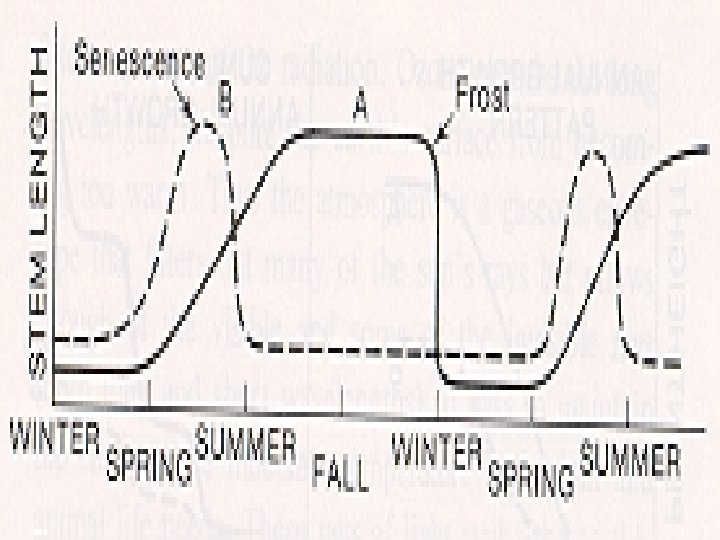
Senescence ] Terminal ] Annuals-entire plant ] Woody perennials- leaves ] Resins and Phenols resist decay ] Leaf: Root/shoot ratio decreases ] Decline in photosynthesis