
vegetables development Development Through Vegetable Research www avrdc
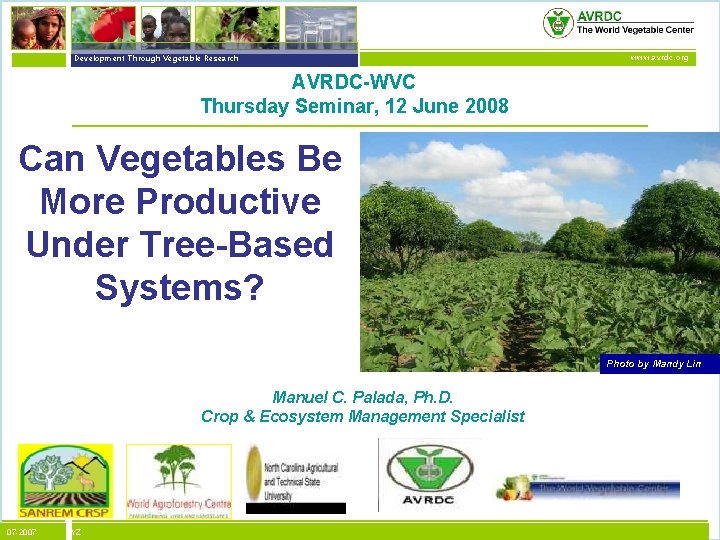
vegetables + development Development Through Vegetable Research www. avrdc. org AVRDC-WVC Thursday Seminar, 12 June 2008 Can Vegetables Be More Productive Under Tree-Based Systems? Photo by Mandy Lin Manuel C. Palada, Ph. D. Crop & Ecosystem Management Specialist 07 -2007 XYZ

vegetables + development Development Through Vegetable Research www. avrdc. org Outline • Overview of the SANREM CRSP Vegetable Agroforestry Project (VAF) • Early studies on VAF • Tree-vegetable crop interface/interactions • Performance of AVRDC-WVC vegetable varieties under VAF • Other results from the Philippines, Indonesia and Vietnam • Summary • VAF TMPEGS Team 07 -2007 XYZ

vegetables + development Development Through Vegetable Research SUSTAINABLE AGRICULTURE AND NATURAL RESOURCES MANAGEMENT COLLABORATIVE RESEARCH SUPPORT PROGRAM (SANREM CRSP) Agroforestry and Sustainable Vegetable Production in Southeast Asian Watersheds (2005 -2009) 07 -2007 XYZ www. avrdc. org

vegetables + development Development Through Vegetable Research www. avrdc. org Strong Partnership De La Salle NCA&T UC Berkeley 07 -2007 XYZ UPLB Don Bosco
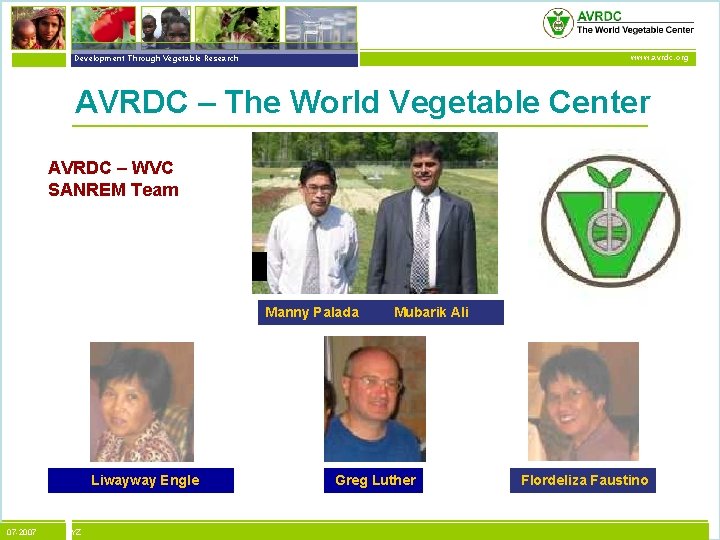
vegetables + development Development Through Vegetable Research www. avrdc. org AVRDC – The World Vegetable Center AVRDC – WVC SANREM Team Manny Palada Liwayway Engle 07 -2007 XYZ Mubarik Ali Greg Luther Flordeliza Faustino
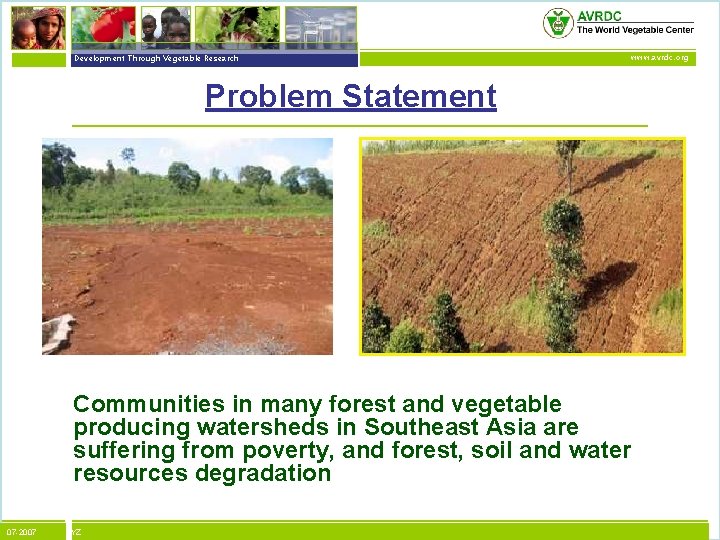
vegetables + development Development Through Vegetable Research www. avrdc. org Problem Statement Communities in many forest and vegetable producing watersheds in Southeast Asia are suffering from poverty, and forest, soil and water resources degradation 07 -2007 XYZ
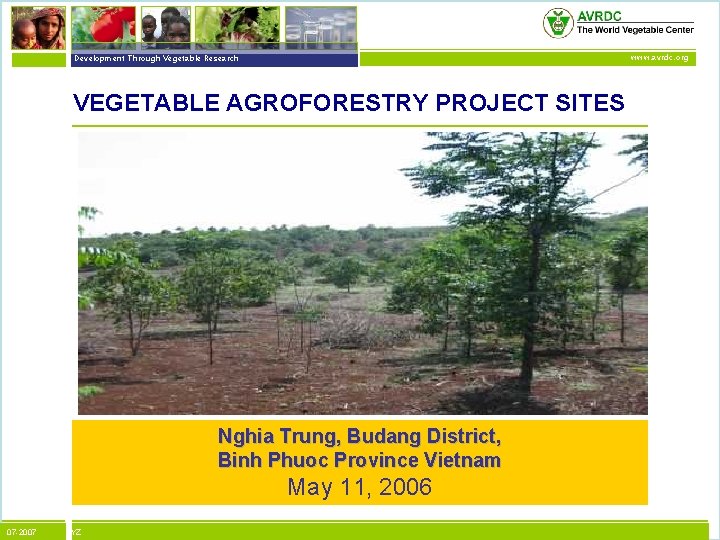
vegetables + development Development Through Vegetable Research www. avrdc. org VEGETABLE AGROFORESTRY PROJECT SITES Nghia Trung, Budang District, Binh Phuoc Province Vietnam May 11, 2006 07 -2007 XYZ
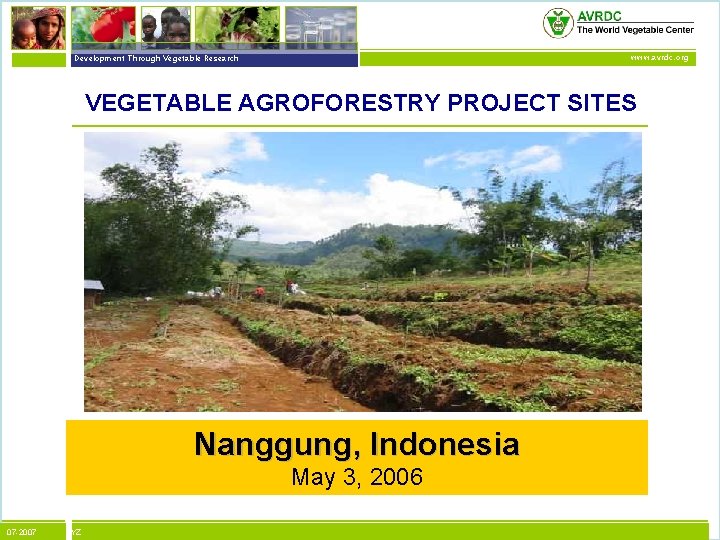
vegetables + development Development Through Vegetable Research www. avrdc. org VEGETABLE AGROFORESTRY PROJECT SITES Nanggung, Indonesia May 3, 2006 07 -2007 XYZ
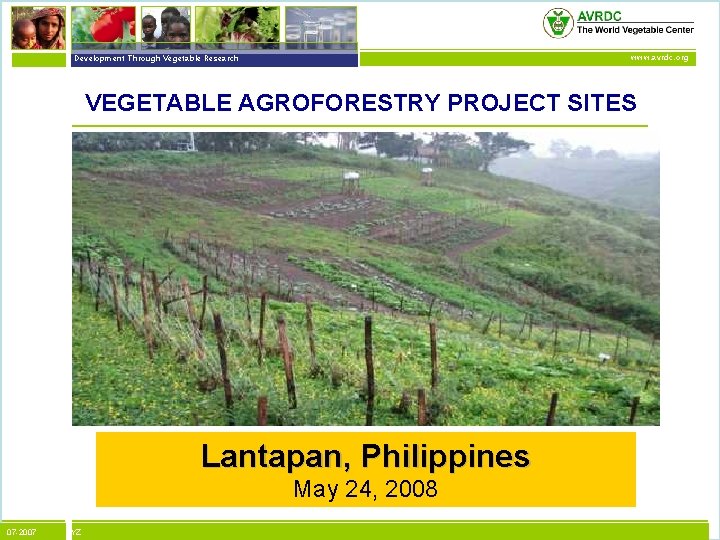
vegetables + development Development Through Vegetable Research www. avrdc. org VEGETABLE AGROFORESTRY PROJECT SITES Lantapan, Philippines May 24, 2008 07 -2007 XYZ
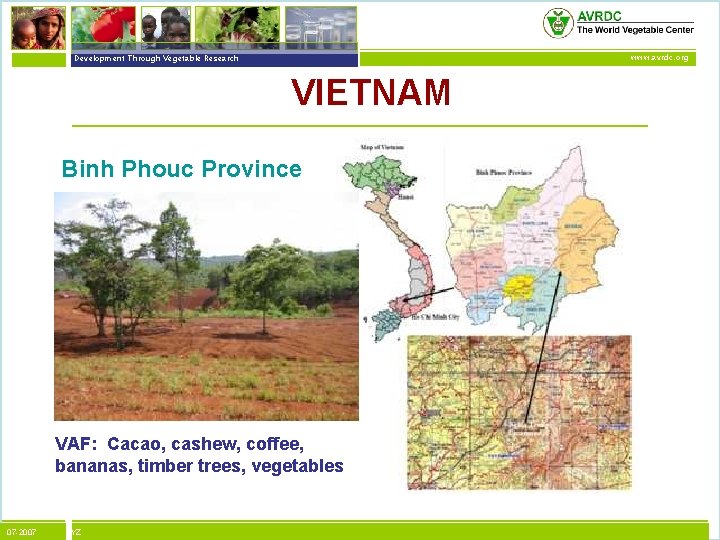
vegetables + development Development Through Vegetable Research www. avrdc. org VIETNAM Binh Phouc Province VAF: Cacao, cashew, coffee, bananas, timber trees, vegetables 07 -2007 XYZ
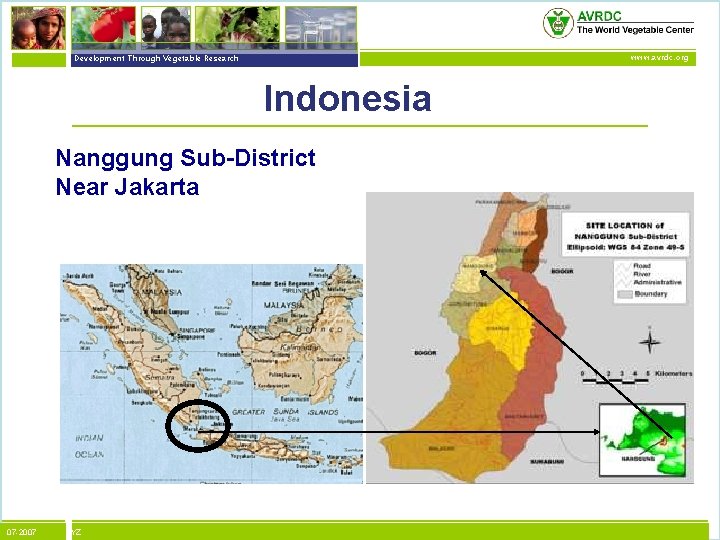
vegetables + development Development Through Vegetable Research www. avrdc. org Indonesia Nanggung Sub-District Near Jakarta 07 -2007 XYZ
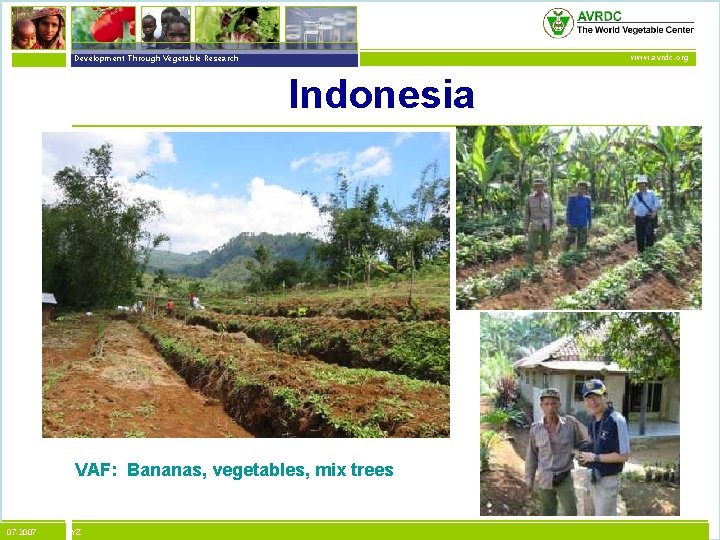
vegetables + development Development Through Vegetable Research www. avrdc. org Indonesia VAF: Bananas, vegetables, mix trees 07 -2007 XYZ
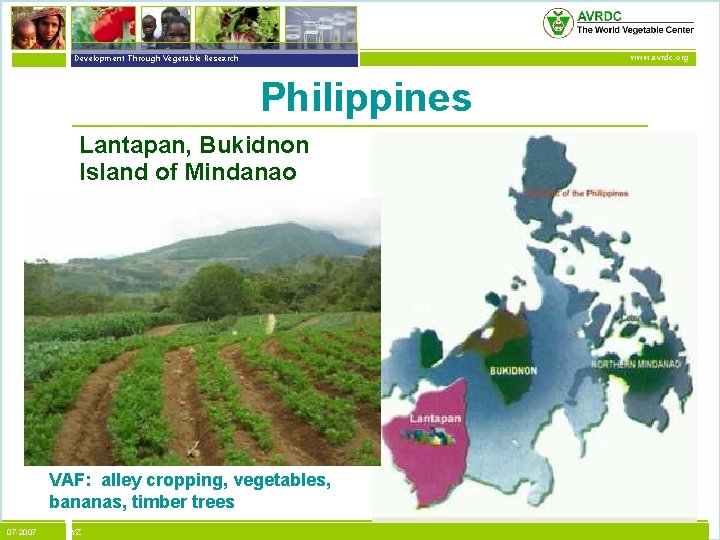
vegetables + development Development Through Vegetable Research www. avrdc. org Philippines Lantapan, Bukidnon Island of Mindanao VAF: alley cropping, vegetables, bananas, timber trees 07 -2007 XYZ
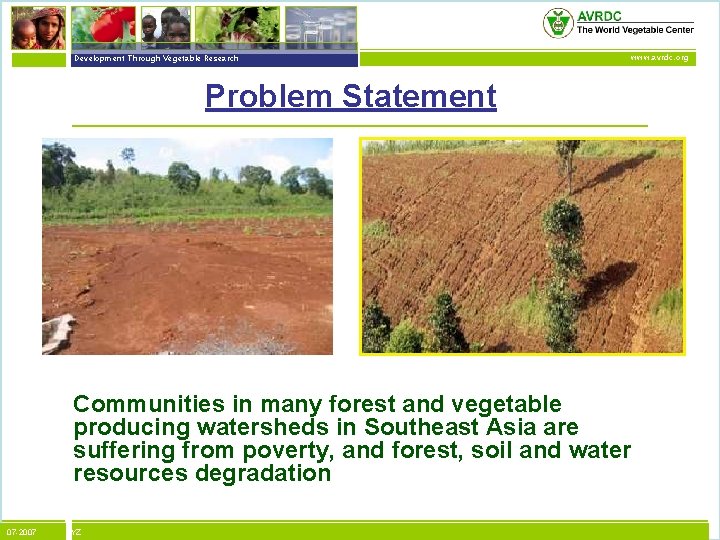
vegetables + development Development Through Vegetable Research www. avrdc. org Problem Statement Communities in many forest and vegetable producing watersheds in Southeast Asia are suffering from poverty, and forest, soil and water resources degradation 07 -2007 XYZ
vegetables + development Development Through Vegetable Research www. avrdc. org Response TMPEGS “Tea. MPEGS” 07 -2007 XYZ
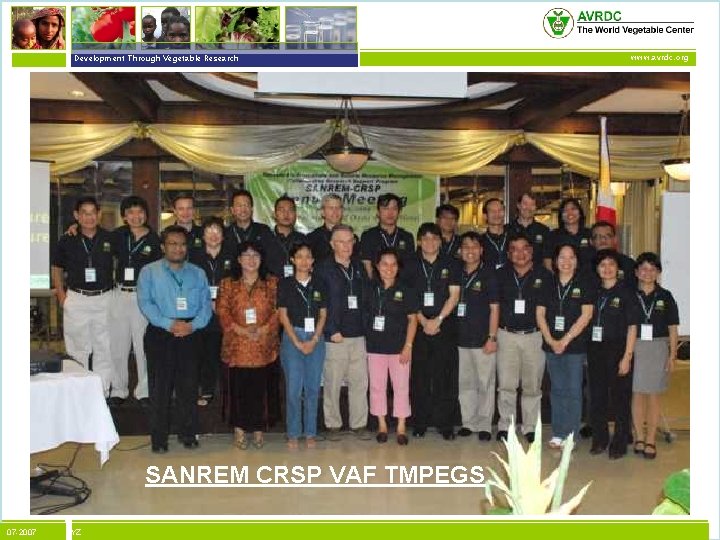
vegetables + development Development Through Vegetable Research SANREM CRSP VAF TMPEGS 07 -2007 XYZ www. avrdc. org
vegetables + development Development Through Vegetable Research www. avrdc. org Vegetable Agroforestry Systems in Southeast Asian Watersheds TMPEGS Stands for our Tea. M’s Philosophy 07 -2007 XYZ
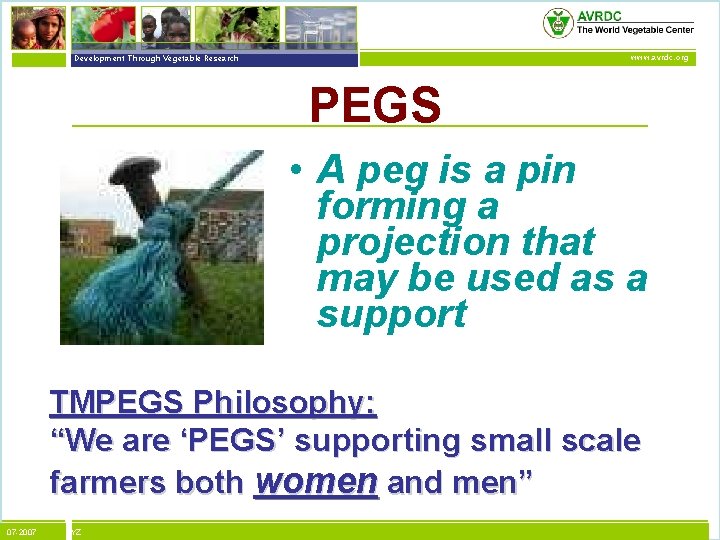
vegetables + development Development Through Vegetable Research www. avrdc. org PEGS • A peg is a pin forming a projection that may be used as a support TMPEGS Philosophy: “We are ‘PEGS’ supporting small scale farmers both women and men” 07 -2007 XYZ
vegetables + development Development Through Vegetable Research www. avrdc. org TMPEGS Technology ‘complementarity’ 07 -2007 XYZ
vegetables + development Development Through Vegetable Research www. avrdc. org TMPEGS Marketing ‘value chain’ 07 -2007 XYZ
vegetables + development Development Through Vegetable Research www. avrdc. org TMPEGS Policy ‘incentives’ 07 -2007 XYZ
vegetables + development Development Through Vegetable Research www. avrdc. org TMPEGS E 07 -2007 XYZ nvironmental & conomic-social impact ‘it works’
vegetables + development Development Through Vegetable Research www. avrdc. org TMPEGS Gender ‘equity’ 07 -2007 XYZ
vegetables + development Development Through Vegetable Research www. avrdc. org TMPEGS Scaling-up ‘contagiousness’ 07 -2007 XYZ
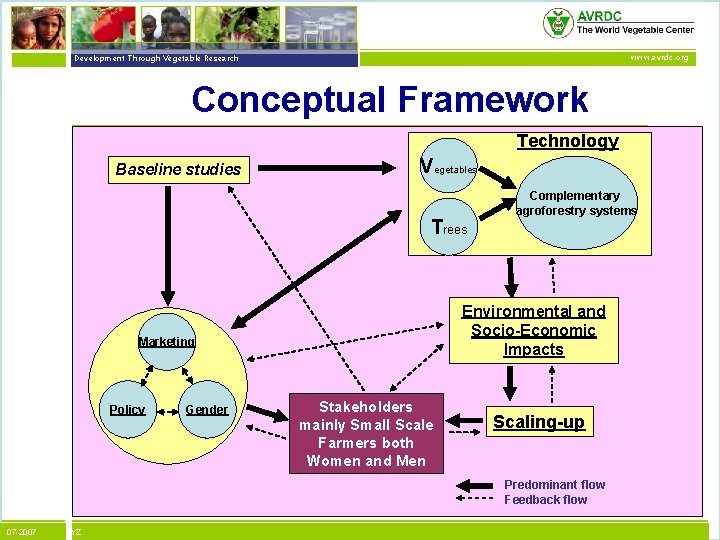
vegetables + development Development Through Vegetable Research www. avrdc. org Conceptual Framework Technology Baseline studies Vegetables Trees Environmental and Socio-Economic Impacts Marketing Policy Gender Complementary agroforestry systems Stakeholders mainly Small Scale Farmers both Women and Men Scaling-up Predominant flow Feedback flow 07 -2007 XYZ
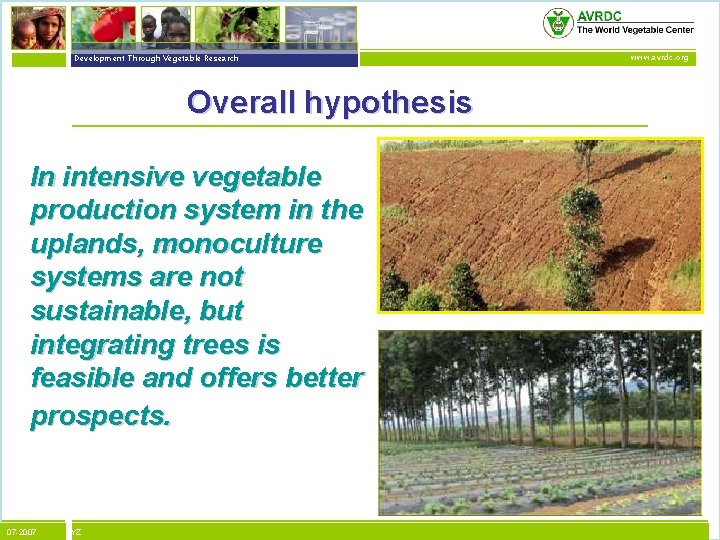
vegetables + development Development Through Vegetable Research Overall hypothesis In intensive vegetable production system in the uplands, monoculture systems are not sustainable, but integrating trees is feasible and offers better prospects. 07 -2007 XYZ www. avrdc. org
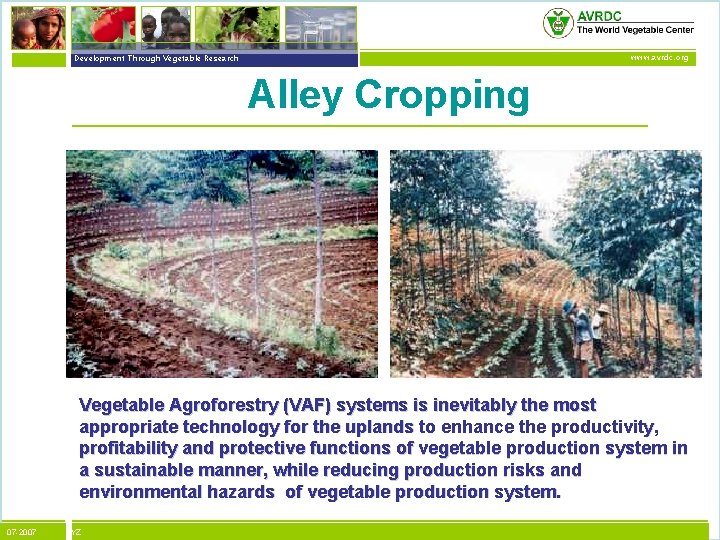
vegetables + development Development Through Vegetable Research www. avrdc. org Alley Cropping Vegetable Agroforestry (VAF) systems is inevitably the most appropriate technology for the uplands to enhance the productivity, profitability and protective functions of vegetable production system in a sustainable manner, while reducing production risks and environmental hazards of vegetable production system. 07 -2007 XYZ
vegetables + development Development Through Vegetable Research www. avrdc. org Vegetable Agroforestry Systems in Southeast Asian Watersheds Early Studies on Vegetable Agroforestry Systems • International Institute of Tropical Agriculture (IITA) Nigeria (1985 -90) • University of the U. S. Virgin Islands, St. Croix (1991 -2001) • Center for Subtropical Agroforestry, University of Florida (2002 -2005) 07 -2007 XYZ
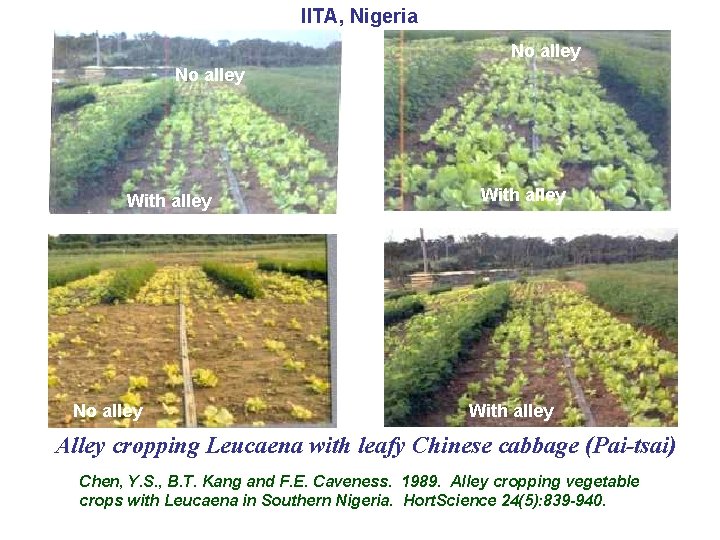
IITA, Nigeria No alley With alley Alley cropping Leucaena with leafy Chinese cabbage (Pai-tsai) Chen, Y. S. , B. T. Kang and F. E. Caveness. 1989. Alley cropping vegetable crops with Leucaena in Southern Nigeria. Hort. Science 24(5): 839 -940.
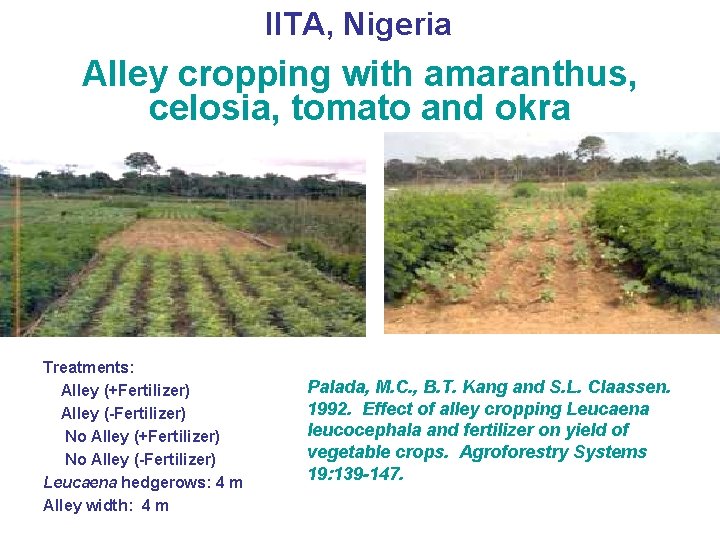
IITA, Nigeria Alley cropping with amaranthus, celosia, tomato and okra Treatments: Alley (+Fertilizer) Alley (-Fertilizer) No Alley (+Fertilizer) No Alley (-Fertilizer) Leucaena hedgerows: 4 m Alley width: 4 m Palada, M. C. , B. T. Kang and S. L. Claassen. 1992. Effect of alley cropping Leucaena leucocephala and fertilizer on yield of vegetable crops. Agroforestry Systems 19: 139 -147.
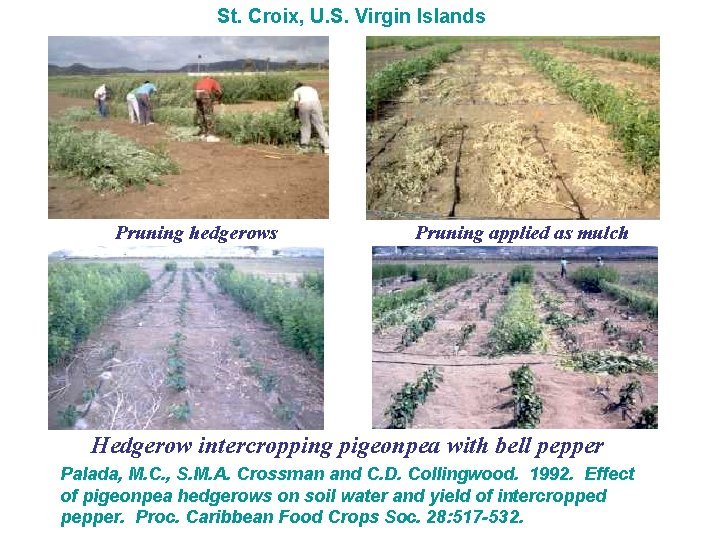
St. Croix, U. S. Virgin Islands Pruning hedgerows Pruning applied as mulch Hedgerow intercropping pigeonpea with bell pepper Palada, M. C. , S. M. A. Crossman and C. D. Collingwood. 1992. Effect of pigeonpea hedgerows on soil water and yield of intercropped pepper. Proc. Caribbean Food Crops Soc. 28: 517 -532.
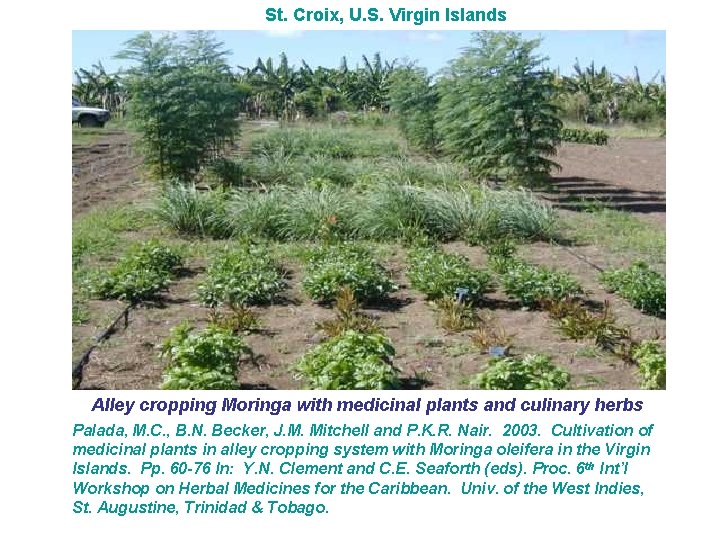
St. Croix, U. S. Virgin Islands Alley cropping Moringa with medicinal plants and culinary herbs Palada, M. C. , B. N. Becker, J. M. Mitchell and P. K. R. Nair. 2003. Cultivation of medicinal plants in alley cropping system with Moringa oleifera in the Virgin Islands. Pp. 60 -76 In: Y. N. Clement and C. E. Seaforth (eds). Proc. 6 th Int’l Workshop on Herbal Medicines for the Caribbean. Univ. of the West Indies, St. Augustine, Trinidad & Tobago.
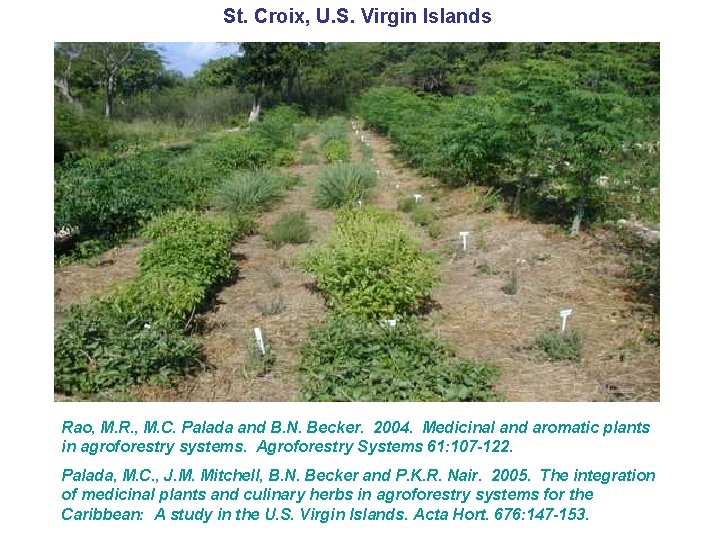
St. Croix, U. S. Virgin Islands Rao, M. R. , M. C. Palada and B. N. Becker. 2004. Medicinal and aromatic plants in agroforestry systems. Agroforestry Systems 61: 107 -122. Palada, M. C. , J. M. Mitchell, B. N. Becker and P. K. R. Nair. 2005. The integration of medicinal plants and culinary herbs in agroforestry systems for the Caribbean: A study in the U. S. Virgin Islands. Acta Hort. 676: 147 -153.
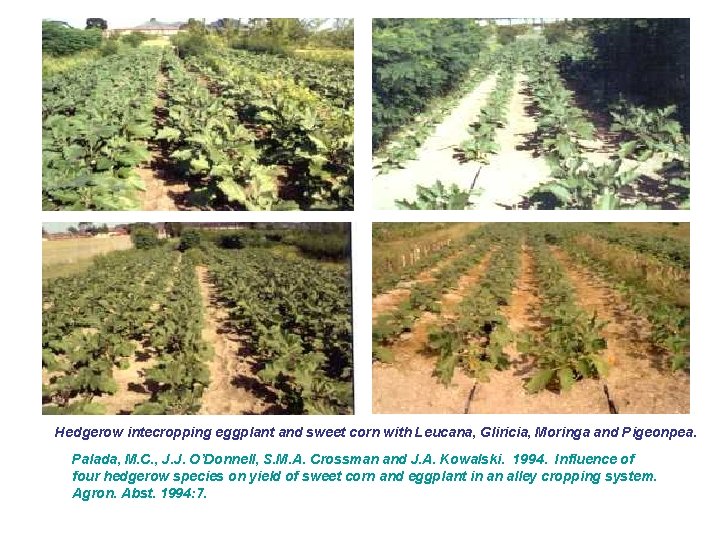
Hedgerow intecropping eggplant and sweet corn with Leucana, Gliricia, Moringa and Pigeonpea. Palada, M. C. , J. J. O’Donnell, S. M. A. Crossman and J. A. Kowalski. 1994. Influence of four hedgerow species on yield of sweet corn and eggplant in an alley cropping system. Agron. Abst. 1994: 7.
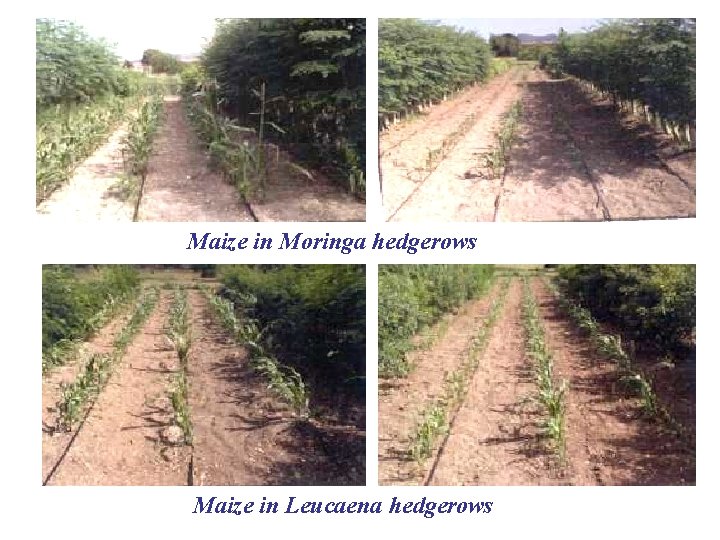
Maize in Moringa hedgerows Maize in Leucaena hedgerows
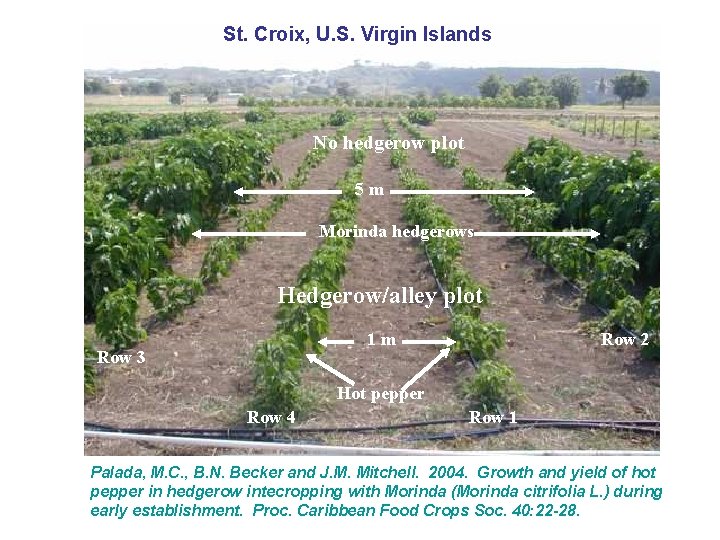
St. Croix, U. S. Virgin Islands No hedgerow plot 5 m Morinda hedgerows Hedgerow/alley plot 1 m Row 3 Row 2 Hot pepper Row 4 Row 1 Palada, M. C. , B. N. Becker and J. M. Mitchell. 2004. Growth and yield of hot pepper in hedgerow intecropping with Morinda (Morinda citrifolia L. ) during early establishment. Proc. Caribbean Food Crops Soc. 40: 22 -28.
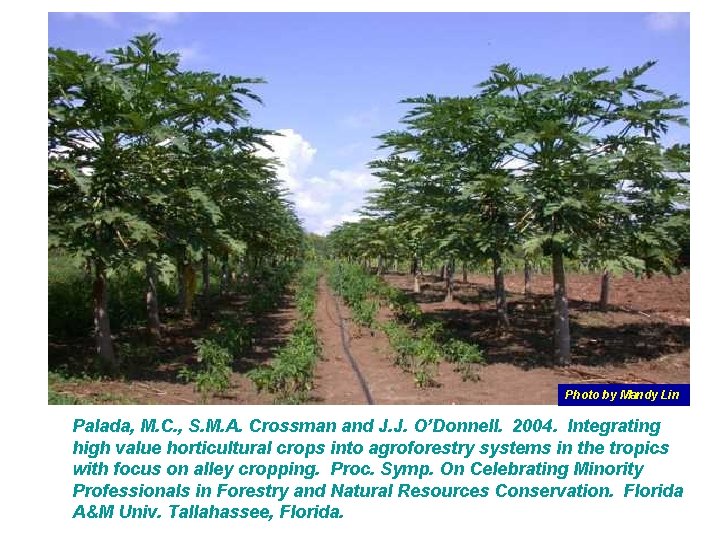
Photo by Mandy Lin Palada, M. C. , S. M. A. Crossman and J. J. O’Donnell. 2004. Integrating high value horticultural crops into agroforestry systems in the tropics with focus on alley cropping. Proc. Symp. On Celebrating Minority Professionals in Forestry and Natural Resources Conservation. Florida A&M Univ. Tallahassee, Florida.
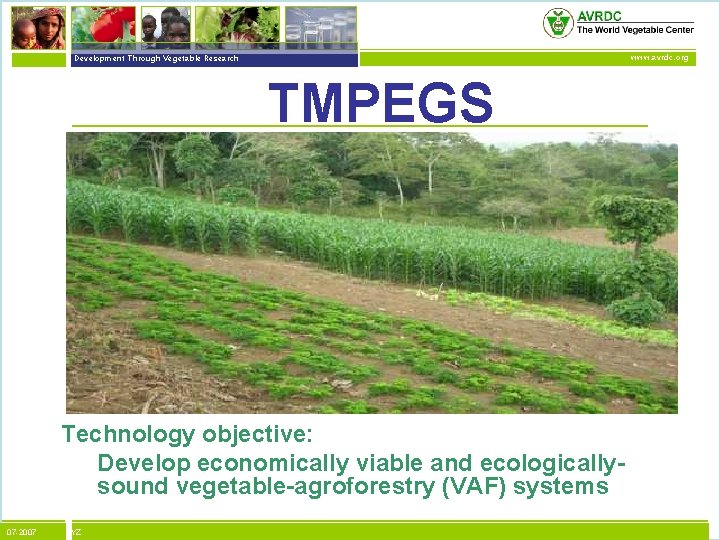
vegetables + development Development Through Vegetable Research www. avrdc. org TMPEGS Technology objective: Develop economically viable and ecologicallysound vegetable-agroforestry (VAF) systems 07 -2007 XYZ
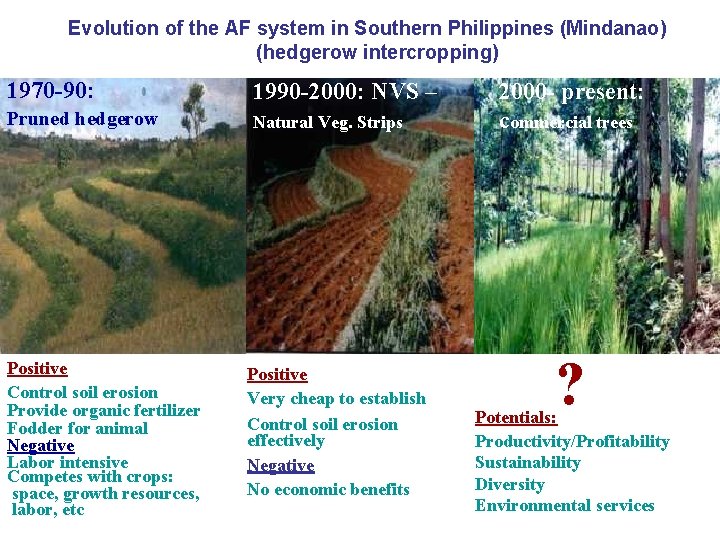
Evolution of the AF system in Southern Philippines (Mindanao) (hedgerow intercropping) 1970 -90: 1990 -2000: NVS – Pruned hedgerow Natural Veg. Strips Positive Control soil erosion Provide organic fertilizer Fodder for animal Negative Labor intensive Competes with crops: space, growth resources, labor, etc Positive Very cheap to establish Control soil erosion effectively Negative No economic benefits 2000 - present: commercial trees ? Potentials: Productivity/Profitability Sustainability Diversity Environmental services
vegetables + development Development Through Vegetable Research www. avrdc. org Environmental services Reduction of soil loss. . 07 -2007 XYZ
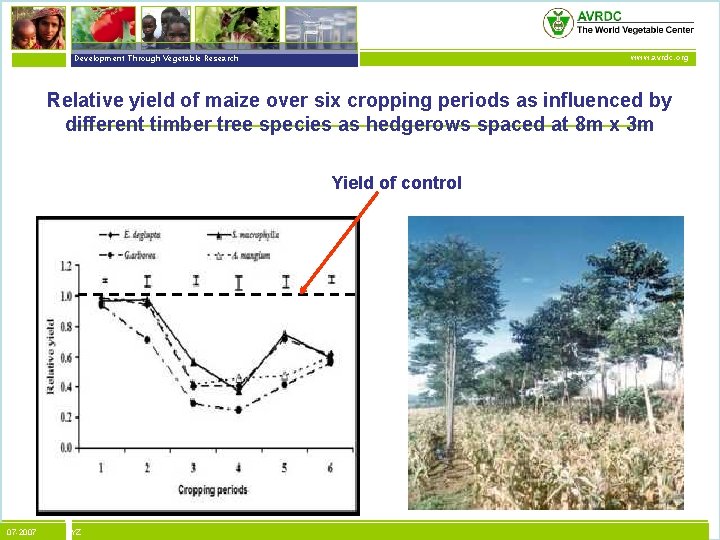
vegetables + development Development Through Vegetable Research www. avrdc. org Relative yield of maize over six cropping periods as influenced by different timber tree species as hedgerows spaced at 8 m x 3 m Yield of control 07 -2007 XYZ
vegetables + development Development Through Vegetable Research Vegetable Agroforestry Systems in Southeast Asian Watersheds Tree-Crop Interaction in Hedgerow Intercropping 07 -2007 XYZ www. avrdc. org




vegetables + development Development Through Vegetable Research www. avrdc. org Vegetable Agroforestry System Research Goal: Tree-vegetable integration on farm with minimal negative interaction but optimal positive interaction, thus increasing productivity, economic profitability, nutrient use efficiency and environmental services 07 -2007 XYZ
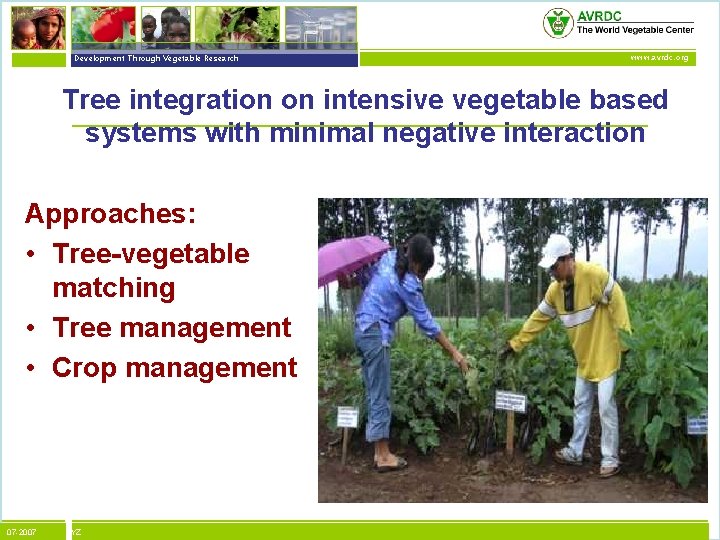
vegetables + development Development Through Vegetable Research www. avrdc. org Tree integration on intensive vegetable based systems with minimal negative interaction Approaches: • Tree-vegetable matching • Tree management • Crop management 07 -2007 XYZ
vegetables + development Development Through Vegetable Research www. avrdc. org Methodology 1. Assessment of existing VAF systems covering 21 farms, 2 AF systems, 6 tree species, 8 vegetables, 4 aspects. Data collected were tree parameters (stem diameter, tree height, canopy height and width), spatial performance of vegetables (height, stem diameter, crown width, biomass), spatial light transmission (fish eye photography/quantum light meter) 2. Focus group discussion with 15 VAF farmers on various ways of integrating trees on vegetable farms and their practices and experiences on tree and vegetable management addressing tree-vegetable competition and complementarity 3. Evaluation of 5 commercial, 20 indigenous, and 5 tree vegetables under tree-based system. 07 -2007 XYZ
vegetables + development Development Through Vegetable Research www. avrdc. org Eucalyptus- tomato interaction under boundary planting system Average height at neutral zone (m) 07 -2007 XYZ
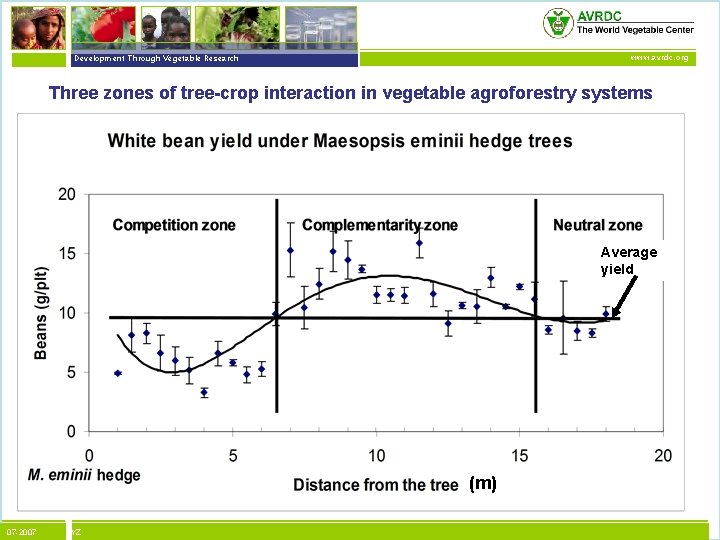
vegetables + development Development Through Vegetable Research www. avrdc. org Three zones of tree-crop interaction in vegetable agroforestry systems Average yield (m) 07 -2007 XYZ
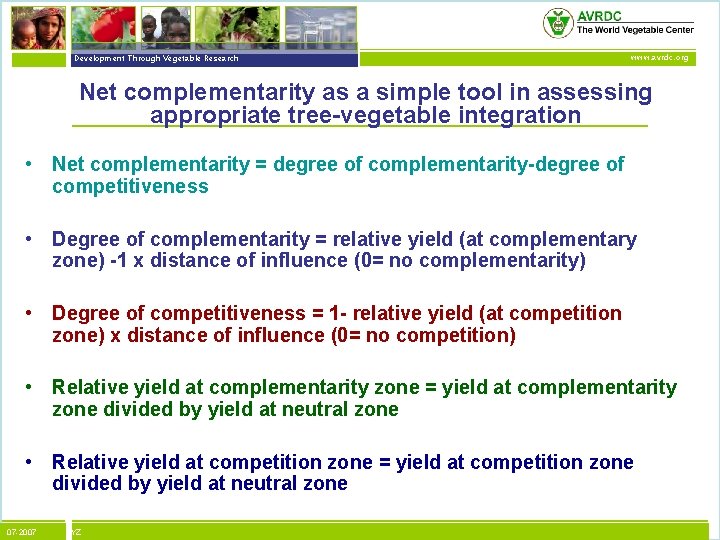
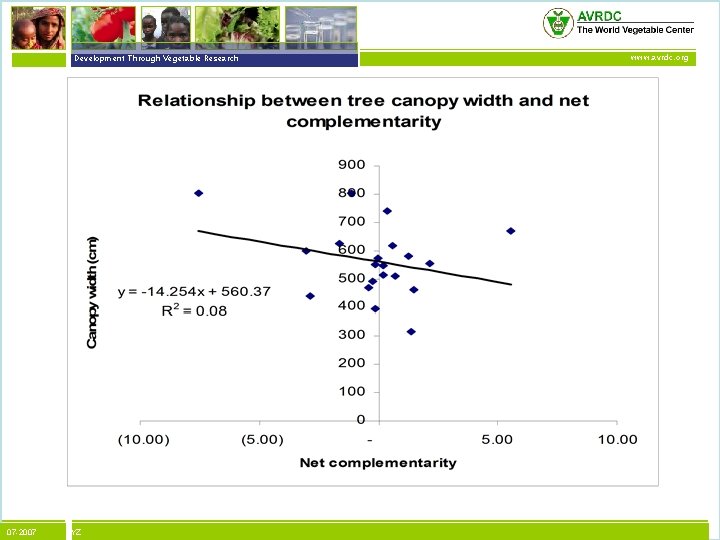
vegetables + development Development Through Vegetable Research www. avrdc. org Net complementarity as a simple tool in assessing appropriate tree-vegetable integration • Net complementarity = degree of complementarity-degree of competitiveness • Degree of complementarity = relative yield (at complementary zone) -1 x distance of influence (0= no complementarity) • Degree of competitiveness = 1 - relative yield (at competition zone) x distance of influence (0= no competition) • Relative yield at complementarity zone = yield at complementarity zone divided by yield at neutral zone • Relative yield at competition zone = yield at competition zone divided by yield at neutral zone 07 -2007 XYZ
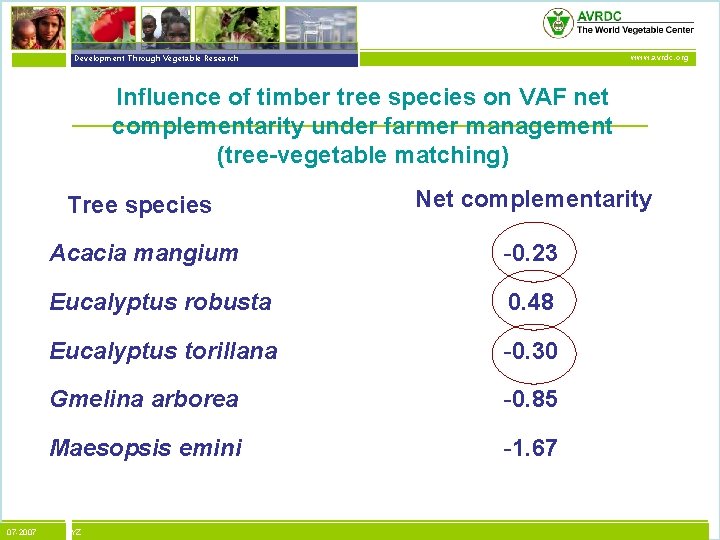
vegetables + development Development Through Vegetable Research www. avrdc. org Influence of timber tree species on VAF net complementarity under farmer management (tree-vegetable matching) 07 -2007 Tree species Net complementarity Acacia mangium -0. 23 Eucalyptus robusta 0. 48 Eucalyptus torillana -0. 30 Gmelina arborea -0. 85 Maesopsis emini -1. 67 XYZ
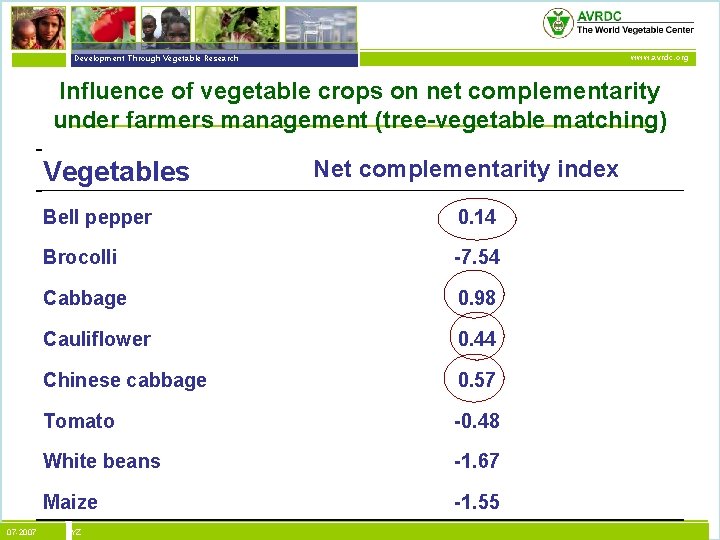
vegetables + development Development Through Vegetable Research www. avrdc. org Influence of vegetable crops on net complementarity under farmers management (tree-vegetable matching) Vegetables 07 -2007 Net complementarity index Bell pepper 0. 14 Brocolli -7. 54 Cabbage 0. 98 Cauliflower 0. 44 Chinese cabbage 0. 57 Tomato -0. 48 White beans -1. 67 Maize -1. 55 XYZ
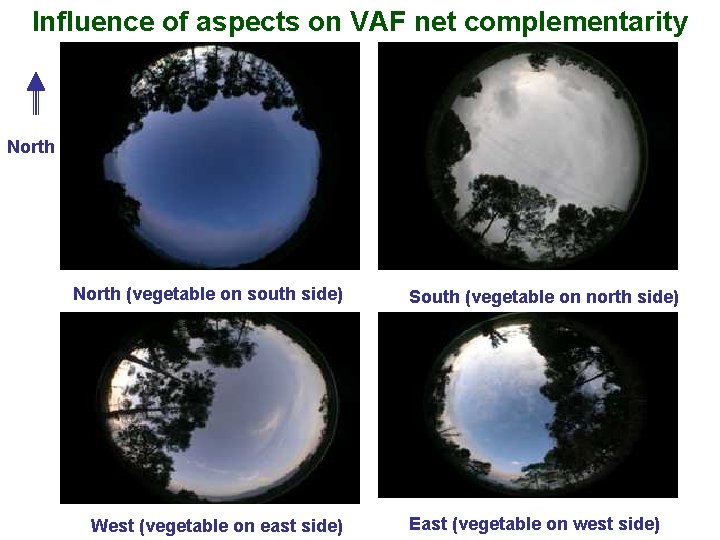
Influence of aspects on VAF net complementarity North (vegetable on south side) West (vegetable on east side) South (vegetable on north side) East (vegetable on west side)
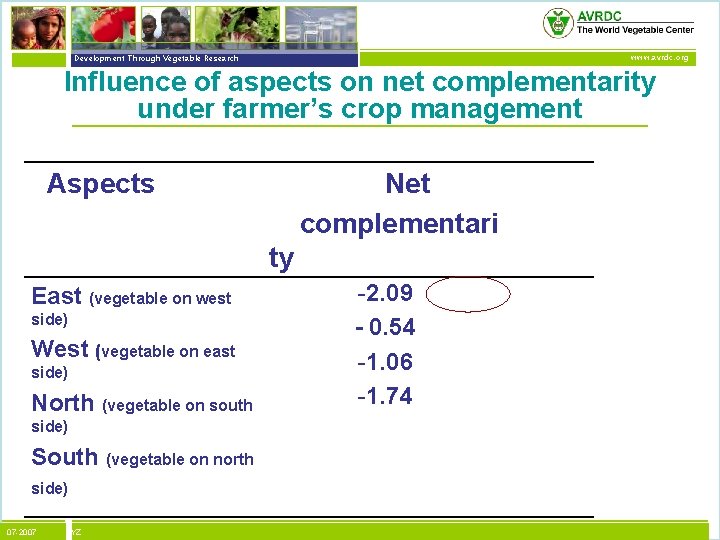
vegetables + development Development Through Vegetable Research www. avrdc. org Influence of aspects on net complementarity under farmer’s crop management Aspects Net complementari ty East (vegetable on west side) West (vegetable on east side) North (vegetable on south side) South (vegetable on north side) 07 -2007 XYZ -2. 09 - 0. 54 -1. 06 -1. 74
vegetables + development Development Through Vegetable Research 07 -2007 XYZ www. avrdc. org
vegetables + development Development Through Vegetable Research 07 -2007 XYZ www. avrdc. org
vegetables + development Development Through Vegetable Research 07 -2007 XYZ www. avrdc. org
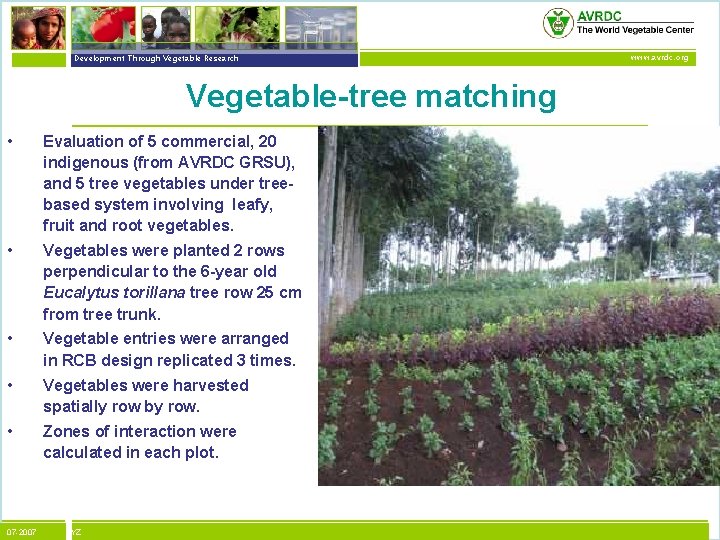
vegetables + development Development Through Vegetable Research Vegetable-tree matching • Evaluation of 5 commercial, 20 indigenous (from AVRDC GRSU), and 5 tree vegetables under treebased system involving leafy, fruit and root vegetables. • Vegetables were planted 2 rows perpendicular to the 6 -year old Eucalytus torillana tree row 25 cm from tree trunk. • Vegetable entries were arranged in RCB design replicated 3 times. • Vegetables were harvested spatially row by row. • Zones of interaction were calculated in each plot. 07 -2007 XYZ www. avrdc. org
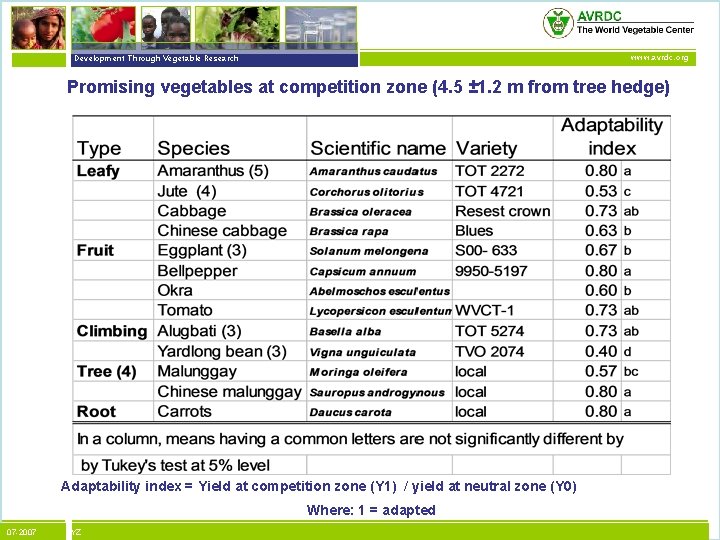
vegetables + development Development Through Vegetable Research www. avrdc. org Promising vegetables at competition zone (4. 5 ± 1. 2 m from tree hedge) Adaptability index = Yield at competition zone (Y 1) / yield at neutral zone (Y 0) Where: 1 = adapted 07 -2007 XYZ
vegetables + development Development Through Vegetable Research www. avrdc. org Promising vegetables at complementarity zone (from 5 – 15 (± 2) m from tree hedge) Complementarity index = Yield at complementarity (Y 2) / yield at neutral zone (Y 0) Where: 1= no complementarity effect 07 -2007 XYZ
vegetables + development Development Through Vegetable Research www. avrdc. org Net complementarity indices of selected vegetables planted perpendicular to the tree line (researcher-managed) Net complementarity index = Y 2 -Y 1 Where: 0 = no benefit 07 -2007 XYZ
vegetables + development Development Through Vegetable Research Vegetable Agroforestry Systems in Southeast Asian Watersheds INDONESIA • Effect of shading on yields of vegetables under mixedtree species 07 -2007 XYZ www. avrdc. org
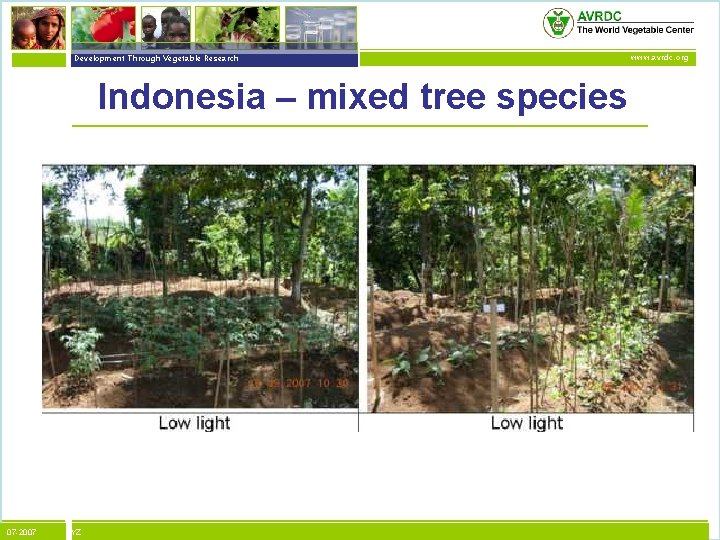
vegetables + development Development Through Vegetable Research Indonesia – mixed tree species 07 -2007 XYZ www. avrdc. org
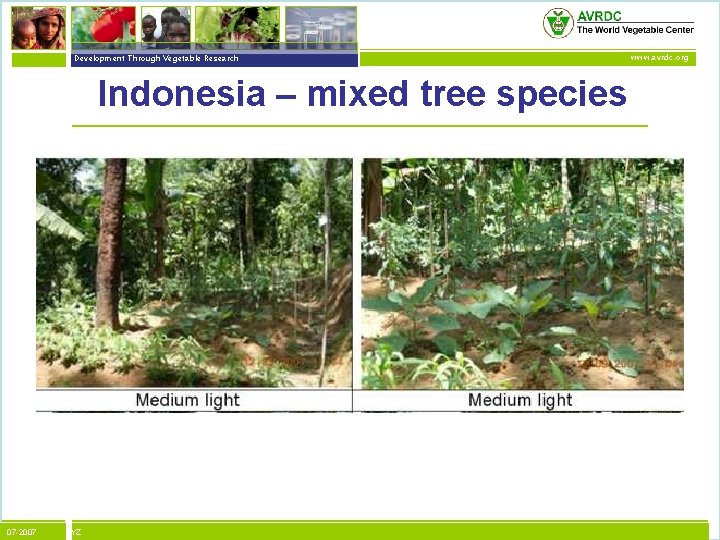
vegetables + development Development Through Vegetable Research Indonesia – mixed tree species 07 -2007 XYZ www. avrdc. org
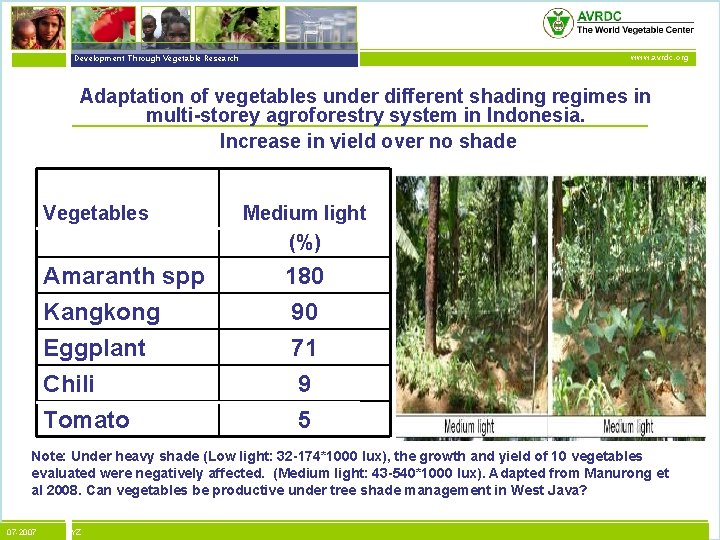
vegetables + development Development Through Vegetable Research www. avrdc. org Adaptation of vegetables under different shading regimes in multi-storey agroforestry system in Indonesia. Increase in yield over no shade Vegetables Amaranth spp Kangkong Eggplant Chili Tomato Medium light (%) 180 90 71 9 5 Note: Under heavy shade (Low light: 32 -174*1000 lux), the growth and yield of 10 vegetables evaluated were negatively affected. (Medium light: 43 -540*1000 lux). Adapted from Manurong et al 2008. Can vegetables be productive under tree shade management in West Java? 07 -2007 XYZ
vegetables + development Development Through Vegetable Research www. avrdc. org Vegetable Agroforestry Systems in Southeast Asian Watersheds VIETNAM • Shading effect on yield of vegetables • Termite Biocontrol on Cacao Seedlings: Vetiver Grass Application 07 -2007 XYZ
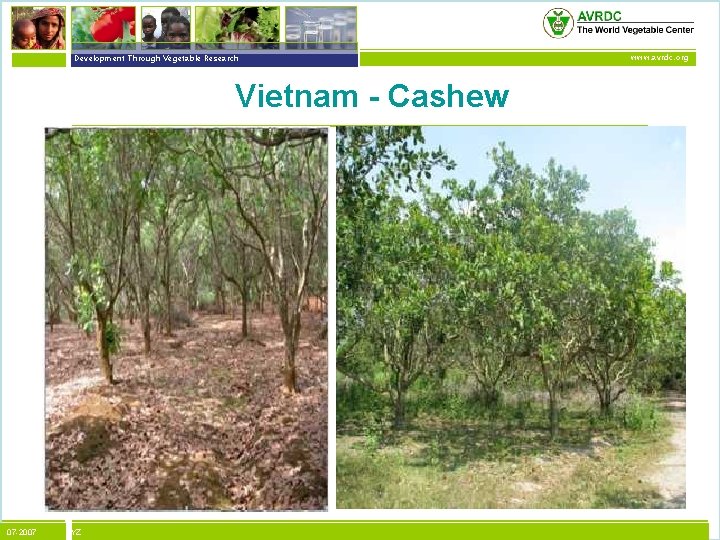
vegetables + development Development Through Vegetable Research Vietnam - Cashew 07 -2007 XYZ www. avrdc. org
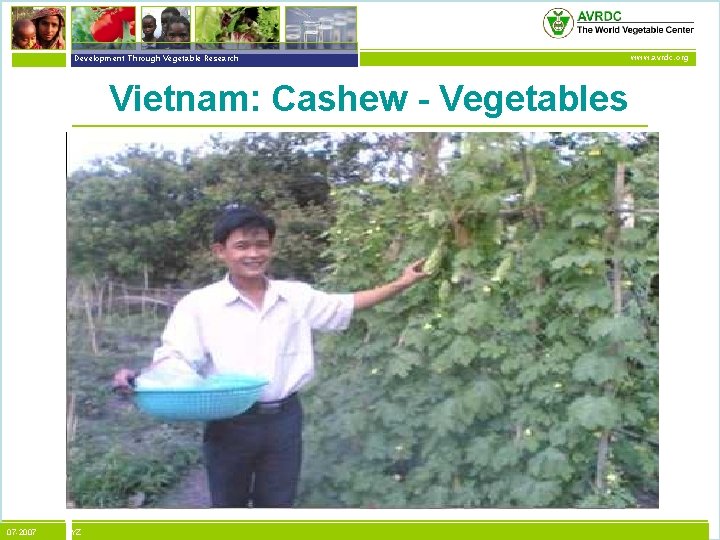
vegetables + development Development Through Vegetable Research Vietnam: Cashew - Vegetables 07 -2007 XYZ www. avrdc. org
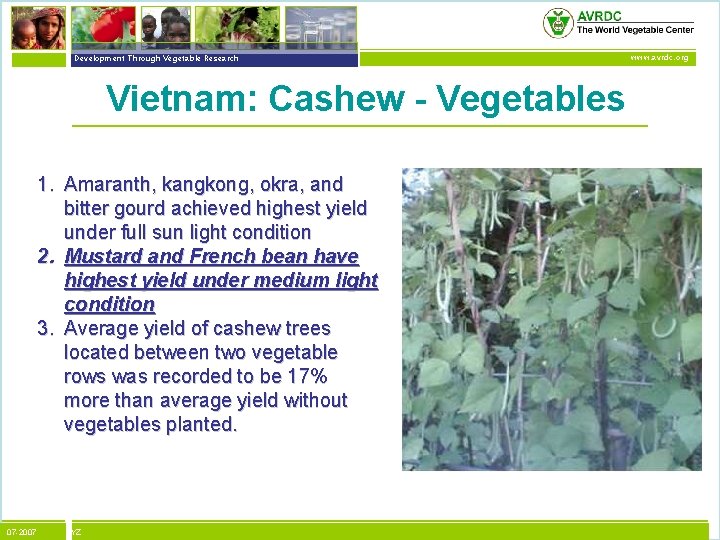
vegetables + development Development Through Vegetable Research Vietnam: Cashew - Vegetables 1. Amaranth, kangkong, okra, and bitter gourd achieved highest yield under full sun light condition 2. Mustard and French bean have highest yield under medium light condition 3. Average yield of cashew trees located between two vegetable rows was recorded to be 17% more than average yield without vegetables planted. 07 -2007 XYZ www. avrdc. org
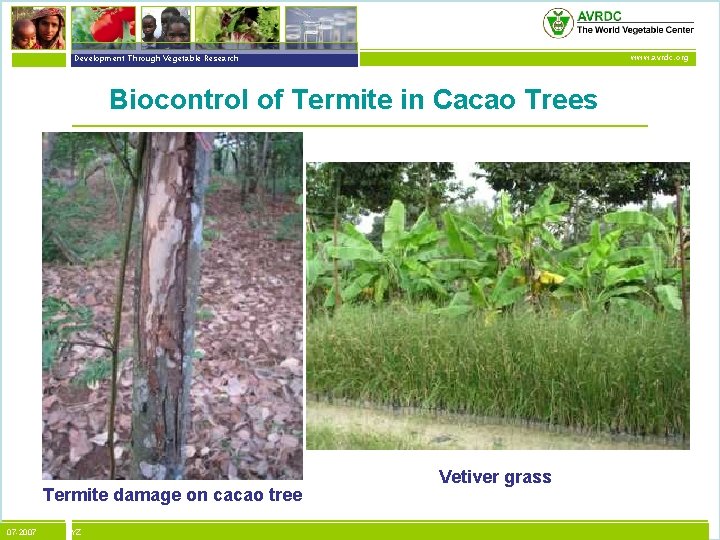
vegetables + development Development Through Vegetable Research www. avrdc. org Biocontrol of Termite in Cacao Trees Termite damage on cacao tree 07 -2007 XYZ Vetiver grass
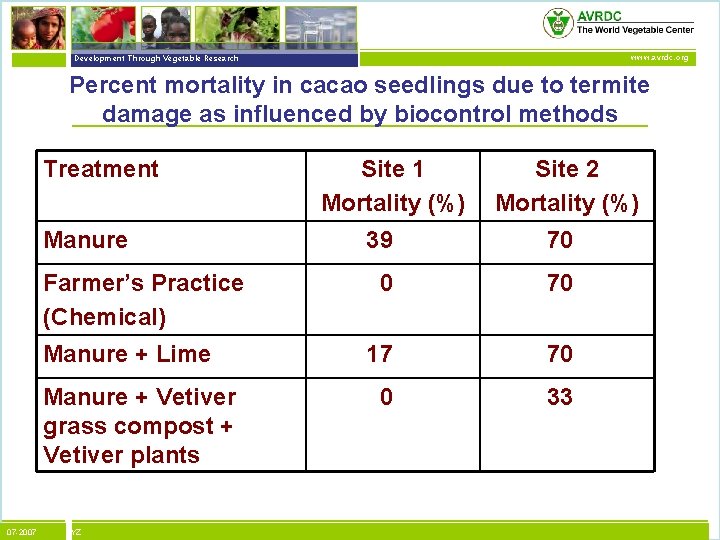
vegetables + development Development Through Vegetable Research www. avrdc. org Percent mortality in cacao seedlings due to termite damage as influenced by biocontrol methods Treatment Manure Farmer’s Practice (Chemical) Manure + Lime Manure + Vetiver grass compost + Vetiver plants 07 -2007 XYZ Site 1 Mortality (%) Site 2 Mortality (%) 39 70 0 70 17 70 0 33
vegetables + development Development Through Vegetable Research Vegetable Agroforestry Systems in Southeast Asian Watersheds PHILIPPINES • Vegetable variety trials • Drip irrigation • Minimum tillage – cover crop 07 -2007 XYZ www. avrdc. org
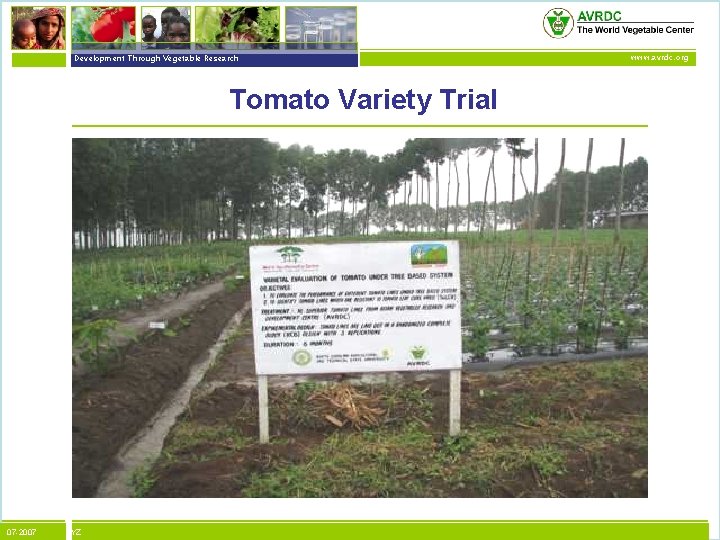
vegetables + development Development Through Vegetable Research Tomato Variety Trial 07 -2007 XYZ www. avrdc. org
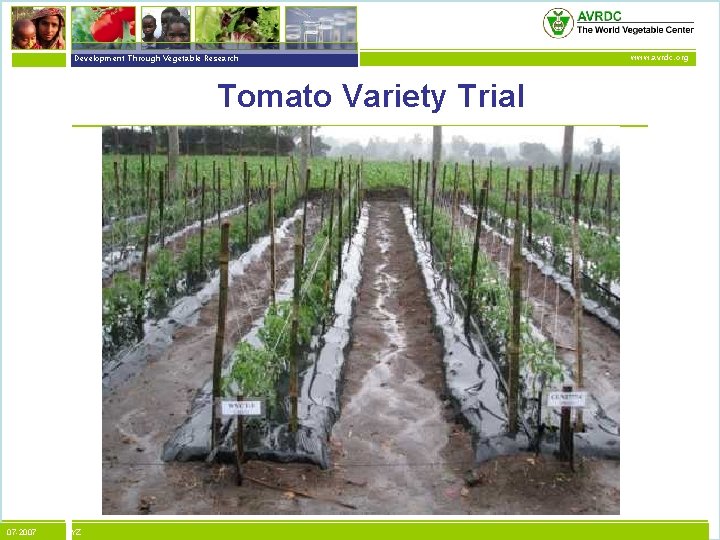
vegetables + development Development Through Vegetable Research Tomato Variety Trial 07 -2007 XYZ www. avrdc. org
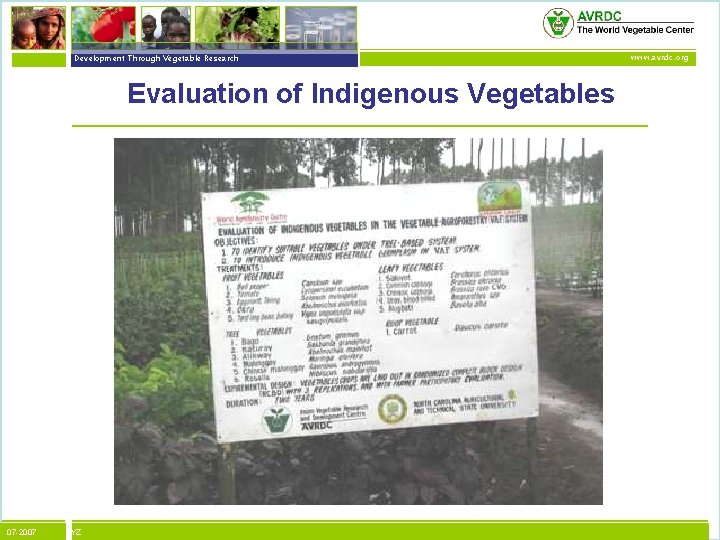
vegetables + development Development Through Vegetable Research Evaluation of Indigenous Vegetables 07 -2007 XYZ www. avrdc. org
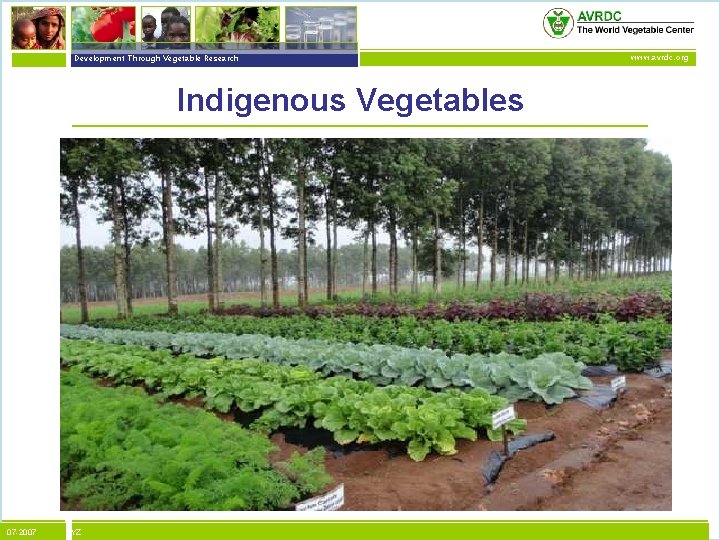
vegetables + development Development Through Vegetable Research Indigenous Vegetables 07 -2007 XYZ www. avrdc. org
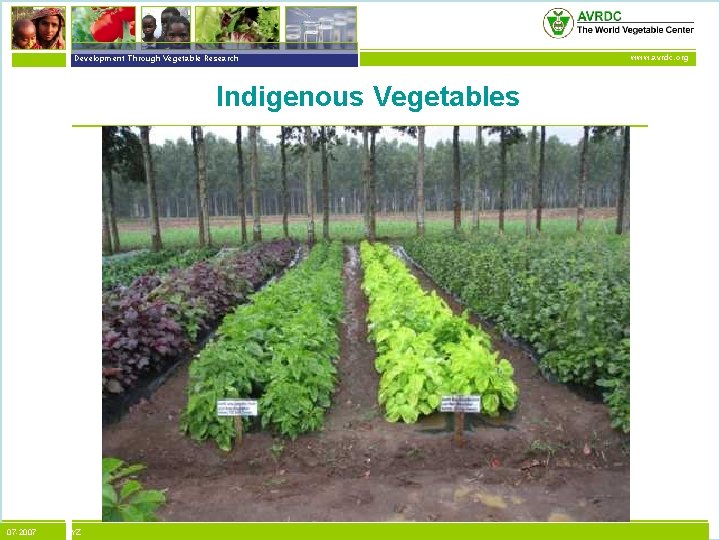
vegetables + development Development Through Vegetable Research Indigenous Vegetables 07 -2007 XYZ www. avrdc. org
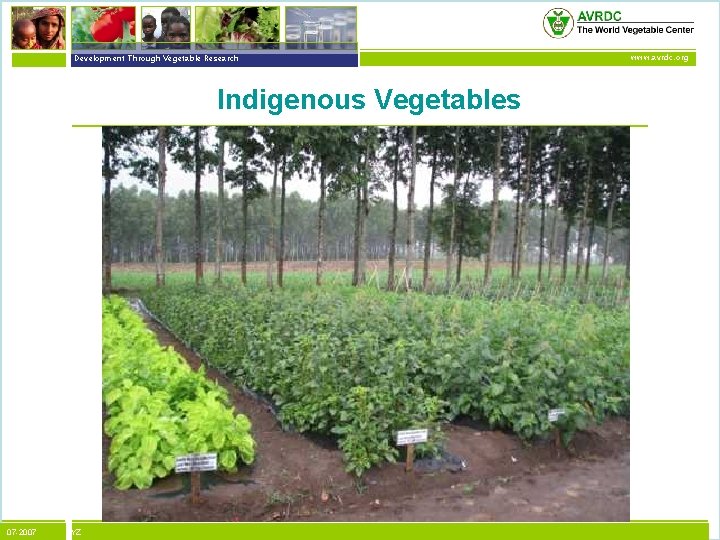
vegetables + development Development Through Vegetable Research Indigenous Vegetables 07 -2007 XYZ www. avrdc. org
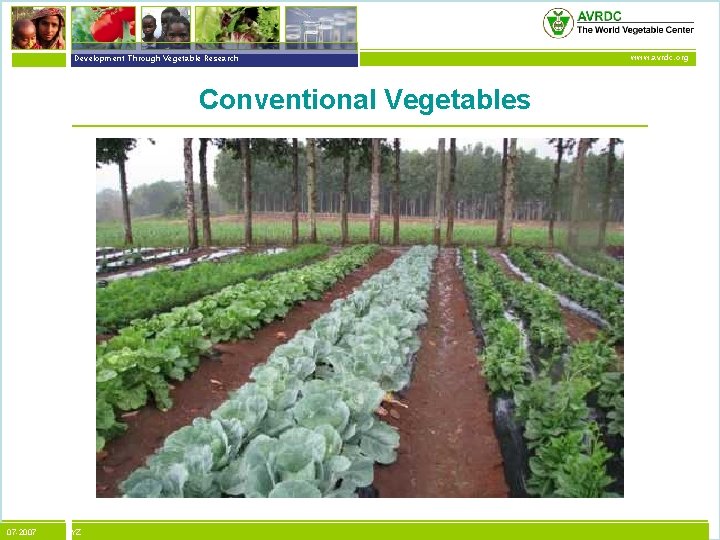
vegetables + development Development Through Vegetable Research Conventional Vegetables 07 -2007 XYZ www. avrdc. org
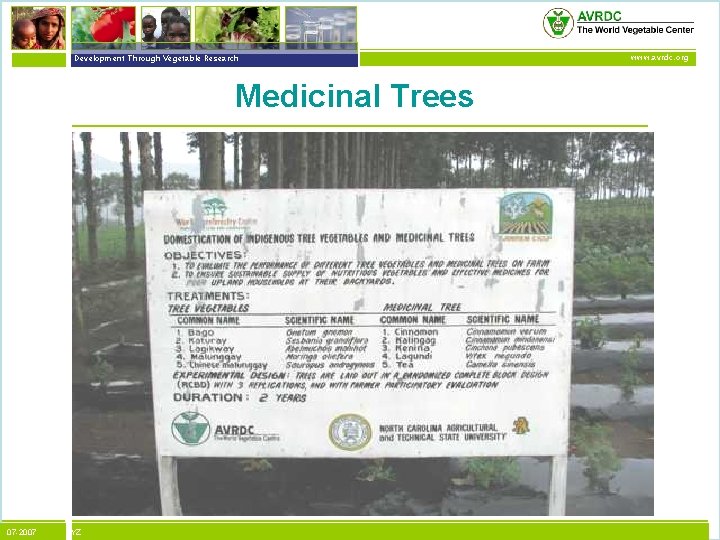
vegetables + development Development Through Vegetable Research Medicinal Trees 07 -2007 XYZ www. avrdc. org
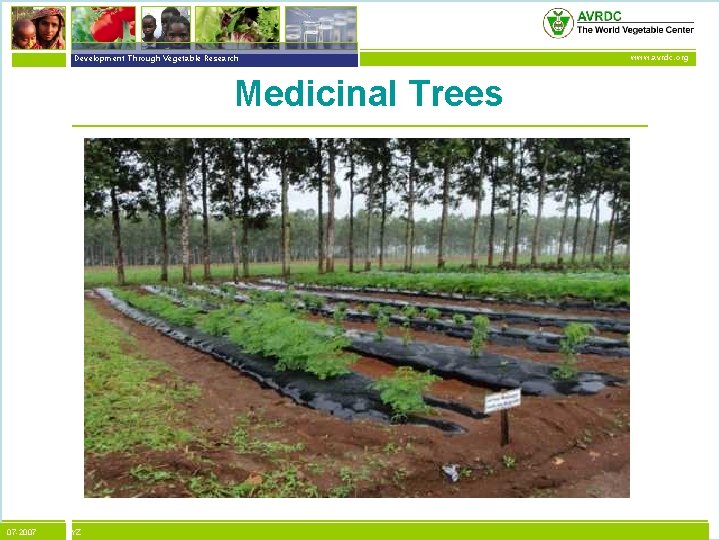
vegetables + development Development Through Vegetable Research Medicinal Trees 07 -2007 XYZ www. avrdc. org
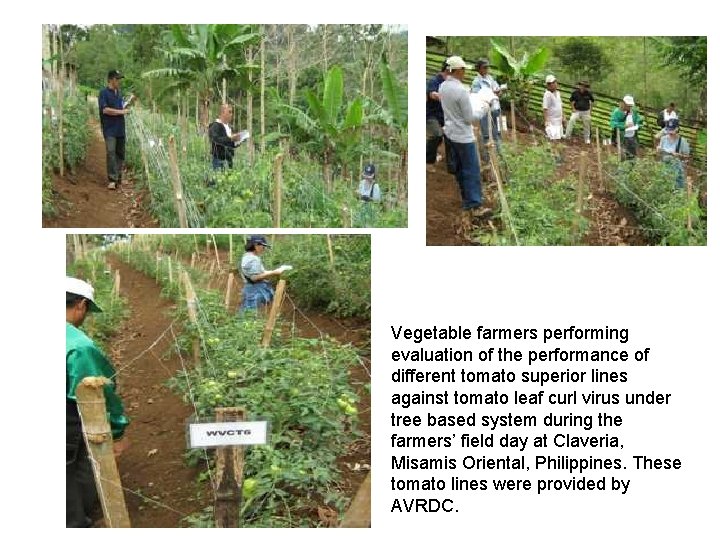
Vegetable farmers performing evaluation of the performance of different tomato superior lines against tomato leaf curl virus under tree based system during the farmers’ field day at Claveria, Misamis Oriental, Philippines. These tomato lines were provided by AVRDC.
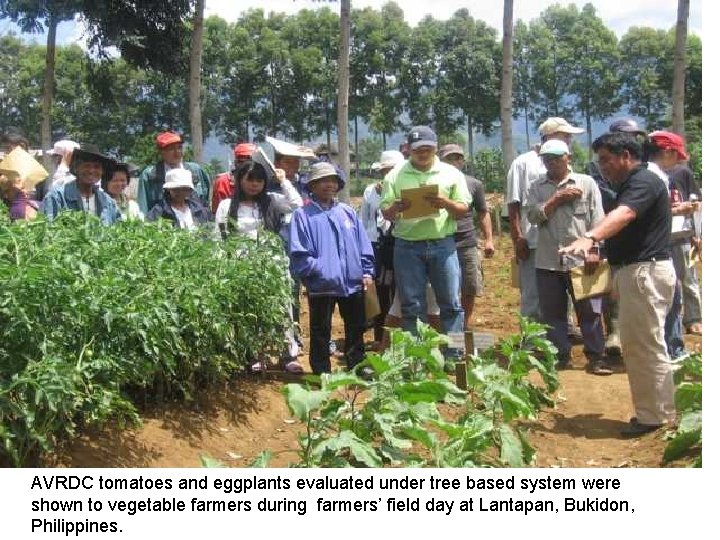
AVRDC tomatoes and eggplants evaluated under tree based system were shown to vegetable farmers during farmers’ field day at Lantapan, Bukidon, Philippines.
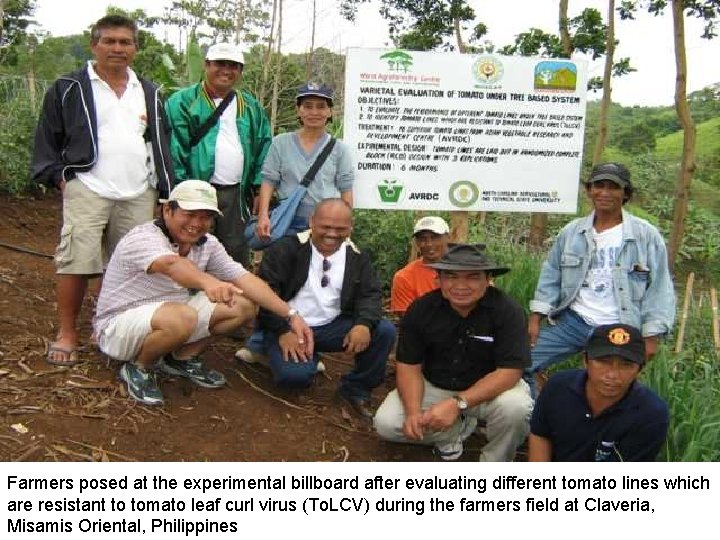
Farmers posed at the experimental billboard after evaluating different tomato lines which are resistant to tomato leaf curl virus (To. LCV) during the farmers field at Claveria, Misamis Oriental, Philippines
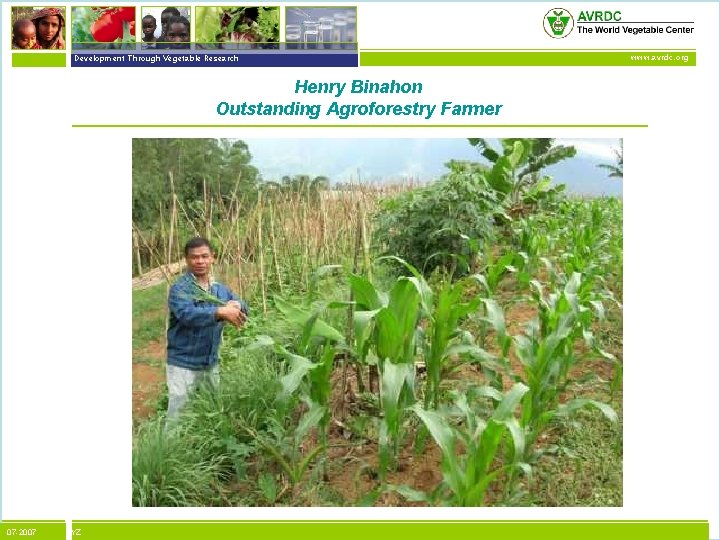
vegetables + development Development Through Vegetable Research Henry Binahon Outstanding Agroforestry Farmer 07 -2007 XYZ www. avrdc. org
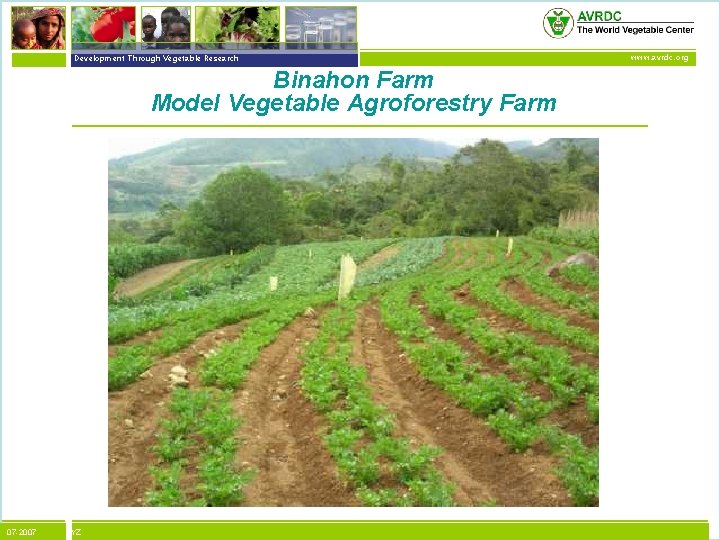
vegetables + development Development Through Vegetable Research Binahon Farm Model Vegetable Agroforestry Farm 07 -2007 XYZ www. avrdc. org
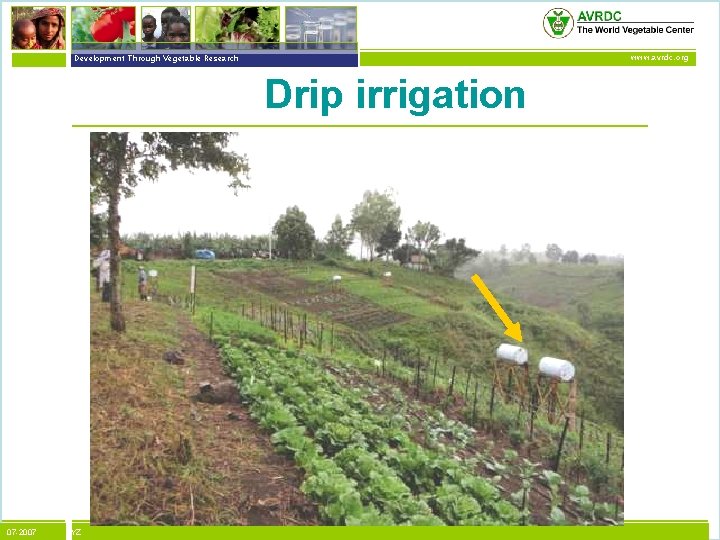
vegetables + development Development Through Vegetable Research www. avrdc. org Drip irrigation 07 -2007 XYZ
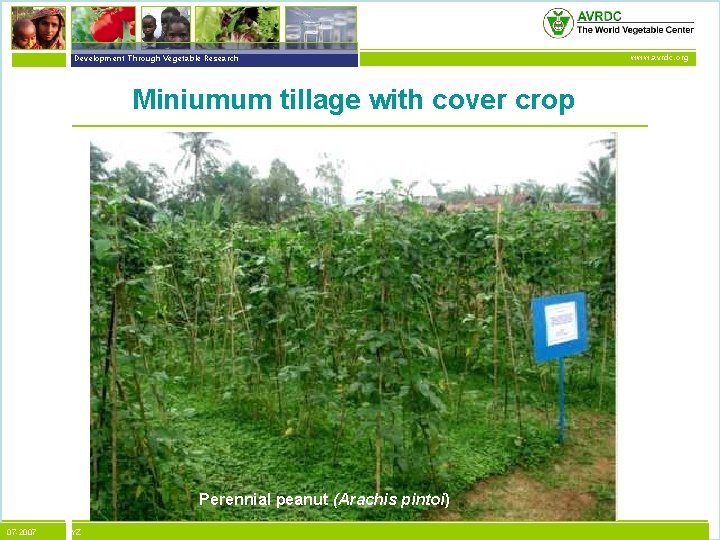
vegetables + development Development Through Vegetable Research Miniumum tillage with cover crop Perennial peanut (Arachis pintoi) 07 -2007 XYZ www. avrdc. org
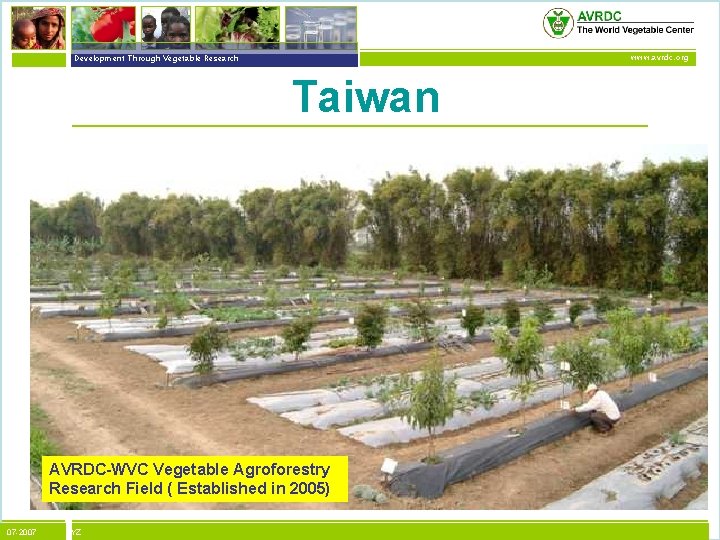
vegetables + development Development Through Vegetable Research www. avrdc. org Taiwan AVRDC-WVC Vegetable Agroforestry Research Field ( Established in 2005) 07 -2007 XYZ
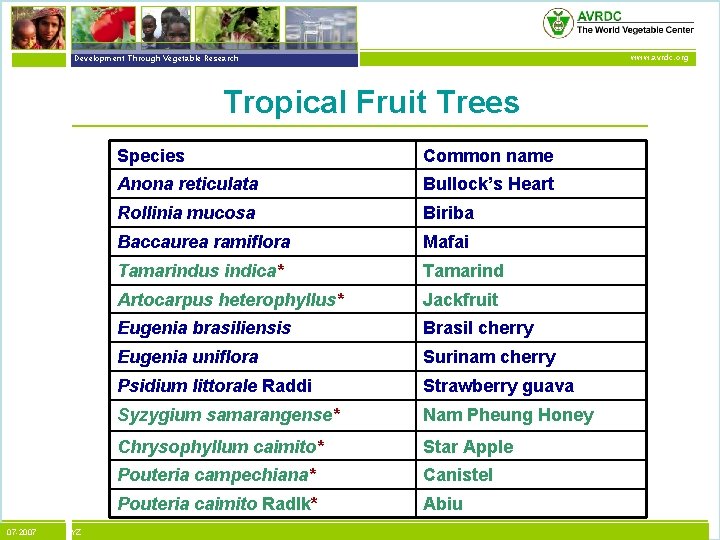
vegetables + development Development Through Vegetable Research www. avrdc. org Tropical Fruit Trees 07 -2007 XYZ Species Common name Anona reticulata Bullock’s Heart Rollinia mucosa Biriba Baccaurea ramiflora Mafai Tamarindus indica* Tamarind Artocarpus heterophyllus* Jackfruit Eugenia brasiliensis Brasil cherry Eugenia uniflora Surinam cherry Psidium littorale Raddi Strawberry guava Syzygium samarangense* Nam Pheung Honey Chrysophyllum caimito* Star Apple Pouteria campechiana* Canistel Pouteria caimito Radlk* Abiu
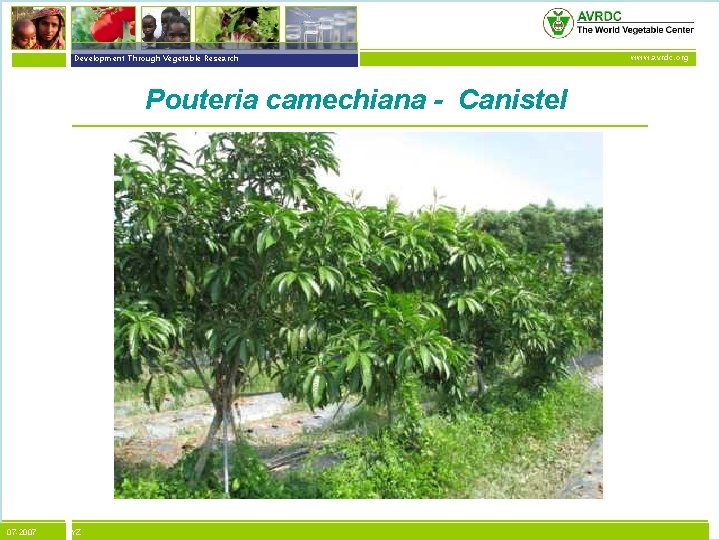
vegetables + development Development Through Vegetable Research Pouteria camechiana - Canistel 07 -2007 XYZ www. avrdc. org
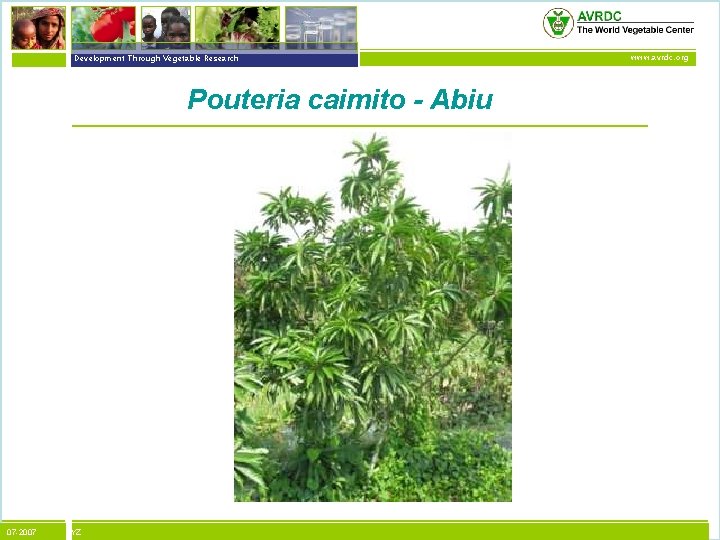
vegetables + development Development Through Vegetable Research Pouteria caimito - Abiu 07 -2007 XYZ www. avrdc. org
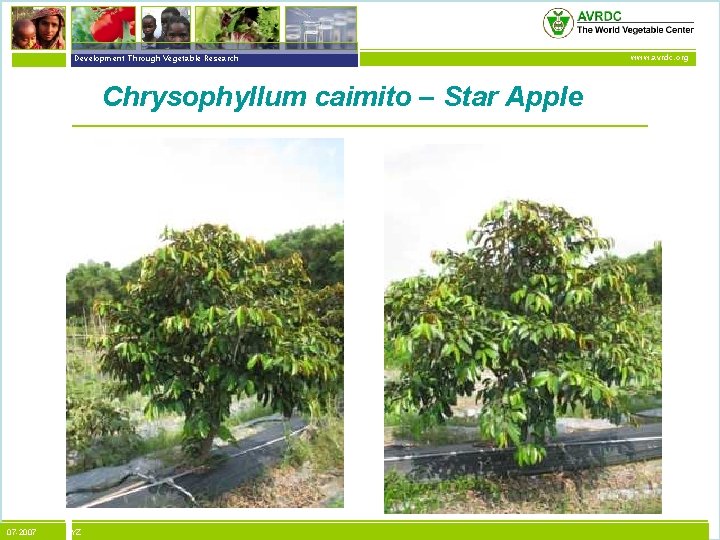
vegetables + development Development Through Vegetable Research Chrysophyllum caimito – Star Apple 07 -2007 XYZ www. avrdc. org
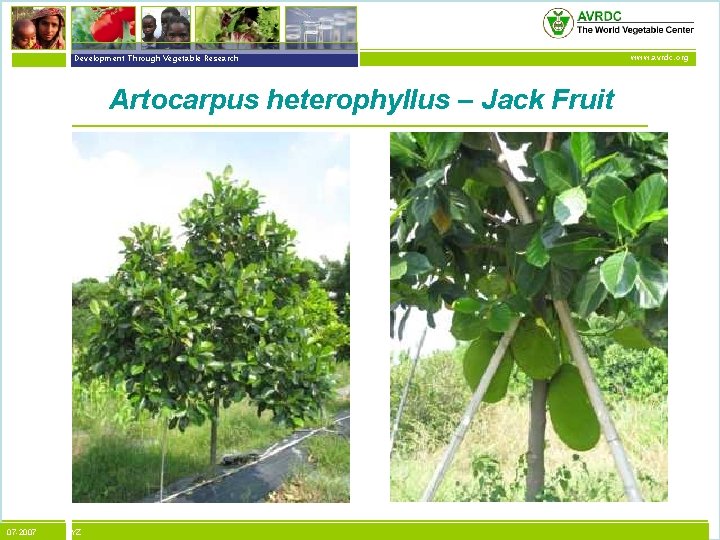
vegetables + development Development Through Vegetable Research Artocarpus heterophyllus – Jack Fruit 07 -2007 XYZ www. avrdc. org
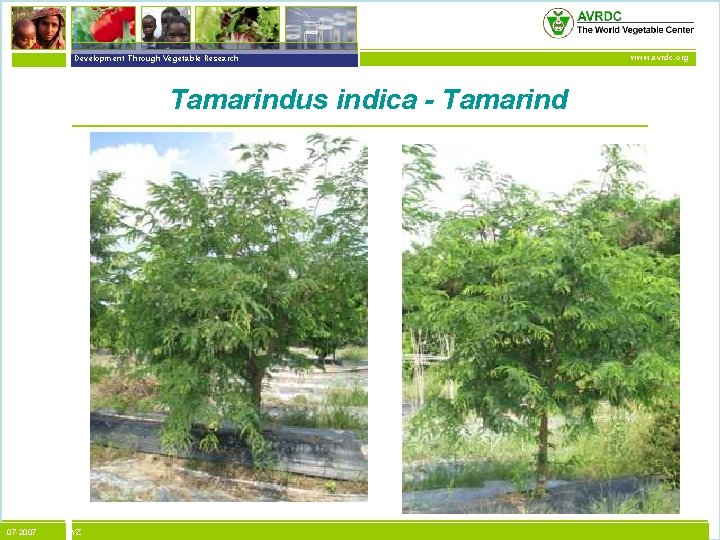
vegetables + development Development Through Vegetable Research Tamarindus indica - Tamarind 07 -2007 XYZ www. avrdc. org
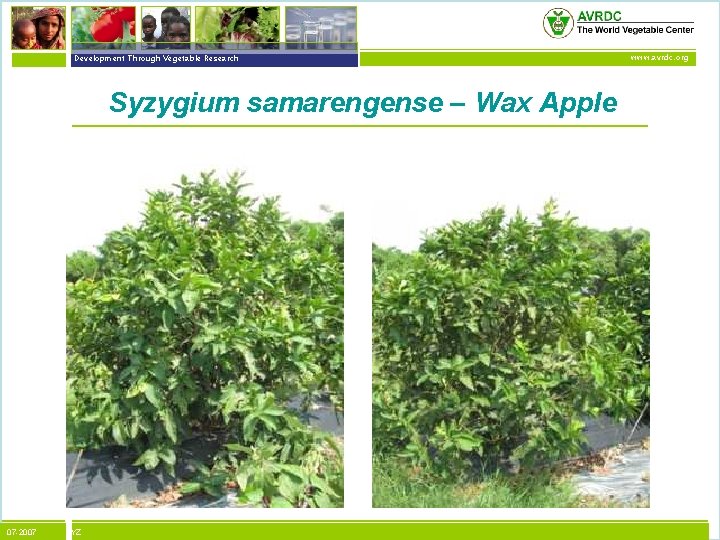
vegetables + development Development Through Vegetable Research Syzygium samarengense – Wax Apple 07 -2007 XYZ www. avrdc. org
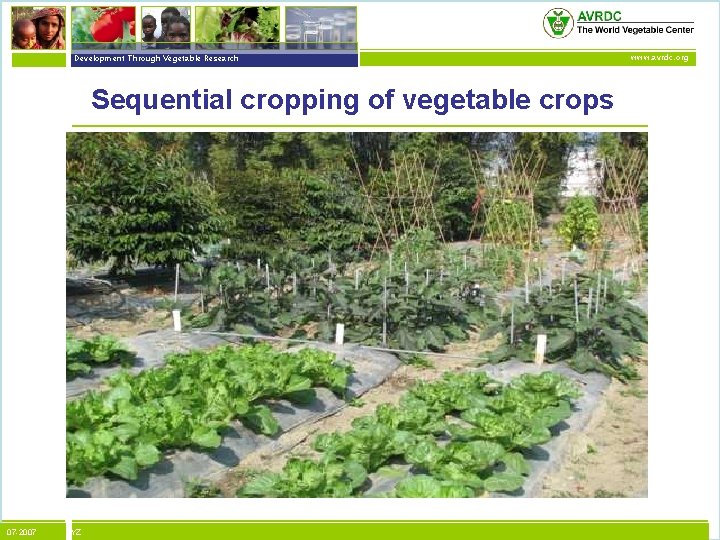
vegetables + development Development Through Vegetable Research Sequential cropping of vegetable crops 07 -2007 XYZ www. avrdc. org
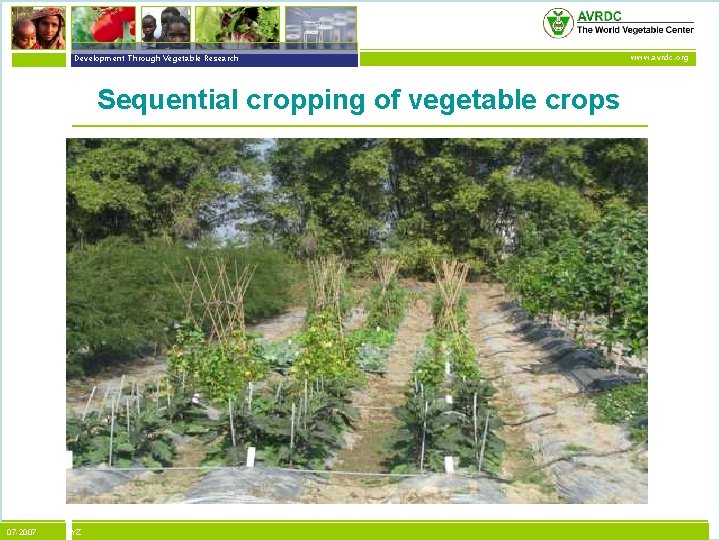
vegetables + development Development Through Vegetable Research Sequential cropping of vegetable crops 07 -2007 XYZ www. avrdc. org
vegetables + development Development Through Vegetable Research www. avrdc. org Question Can Vegetables Be More Productive Under Tree-Based Systems? 07 -2007 XYZ
vegetables + development Development Through Vegetable Research www. avrdc. org Answer Of course, the answer is YES! 07 -2007 XYZ
vegetables + development Development Through Vegetable Research www. avrdc. org Summary and Recommendations Can Vegetables Be More Productive Under Tree Based Systems? Yes! 3 ways of improving economic viability of vegetable agroforestry systems 07 -2007 1. Reduce competition between trees and vegetables (Y 1) by: • - Using vegetables that have high adaptability indices, adapted • to low light environment, at competition zone (up to 4. 5 m from tree line) - Using trees which are less competitive - Employing tree root pruning and root barrier (chili yield was significantly higher in with root barrier treatment) XYZ
vegetables + development Development Through Vegetable Research www. avrdc. org 3 ways of improving economic viability of vegetable agroforestry systems 2. Increase tree-vegetable complementarity (Y 2) -Using vegetables with high complementarity response indices at complementarity zone (4. 6 – 15 m away from the tree line) - Employing appropriate pruning regime, leaving 40 - 60% of the tree canopy- favorable for both trees and crops - Using optimum tree lines/hedges spacing, 25 -30 meters apart and 3 meters between trees, having approximately 110 - 130 trees per hectare 3. Use valuable trees (T) - Premium timber trees (indigenous species) - Adapted fruit trees (Taiwan) - Rubber trees 07 -2007 XYZ
vegetables + development Development Through Vegetable Research www. avrdc. org Acknowledgement This study was funded and supported by the Sustainable Agriculture and Natural Resources Management – Collaborative Research Support Program (SANREM-CRSP) under U. S. Agency for International Development (USAID). 07 -2007 XYZ
vegetables + development Development Through Vegetable Research www. avrdc. org TMPEGS VAF Collaborators • • • 07 -2007 Agustin Mercado, Jr. Caroline Duque Manuel Palada – Liwayway Engle Flordeliza Faustino Gregory Luther Gerhard Manurong James Roshetko Bambang Purwoko Anas Susila Try Van My Manuel Reyes XYZ World Agroforestry entre World Agroforestry Centre World Vegetable Centre World Agroforestry Centre Bogor Agricultural University Nong Lam University, Vietnam North Carolina A&T State University
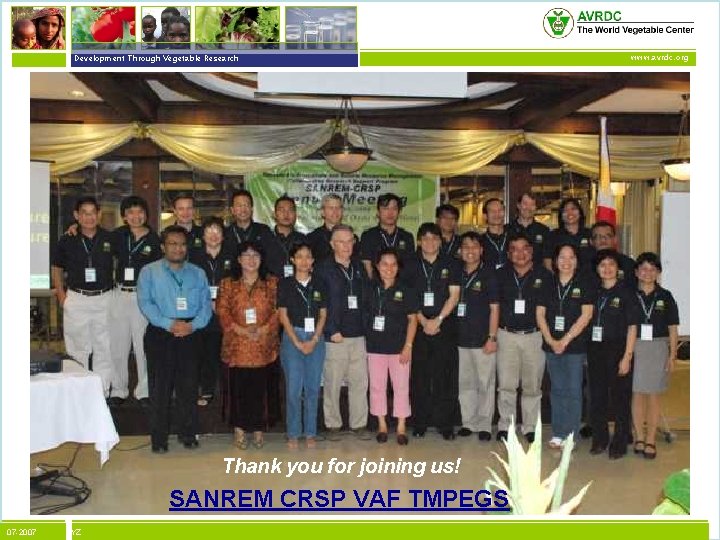
vegetables + development Development Through Vegetable Research Thank you for joining us! SANREM CRSP VAF TMPEGS 07 -2007 XYZ www. avrdc. org
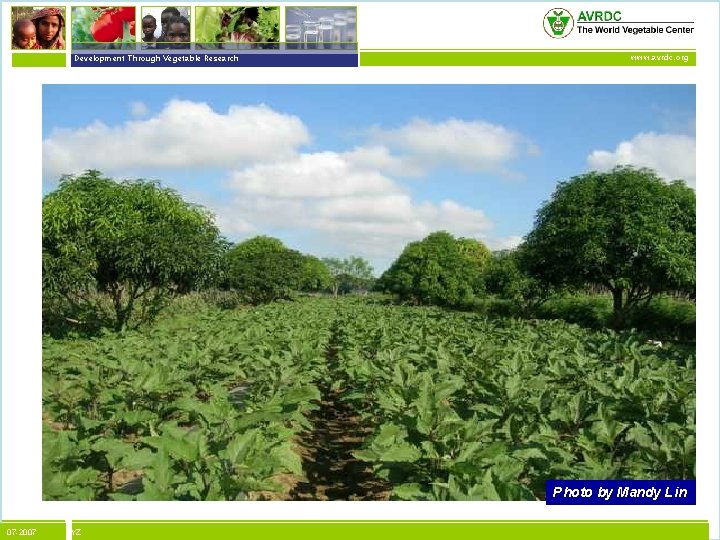
vegetables + development Development Through Vegetable Research www. avrdc. org Photo by Mandy Lin 07 -2007 XYZ
- Slides: 108