
VECTORS VECTOR ANY QUANTITY THAT IS DEFINED BY
VECTORS VECTOR – ANY QUANTITY THAT IS DEFINED BY A MAGNITUDE (SIZE) AND A DIRECTION.
Vector!

Things you should know about vectors: 1. Vector quantities are represented graphically by an arrow. TIP 2. A vector can be moved anywhere without changing the vector as long as the vector has the same magnitude and direction. 3. The negative of a MAGNITUDE vector simply reverses its direction TAIL 180. DIRECTION 4. When adding vectors graphically remember: = -A = “Draw to scale, ‘TIP-ON-TAIL’!”
RESULTANT - A single vector that can replace all others and give the same result. The resultant is always drawn from the tail of the first vector to and toward the tip of the last.
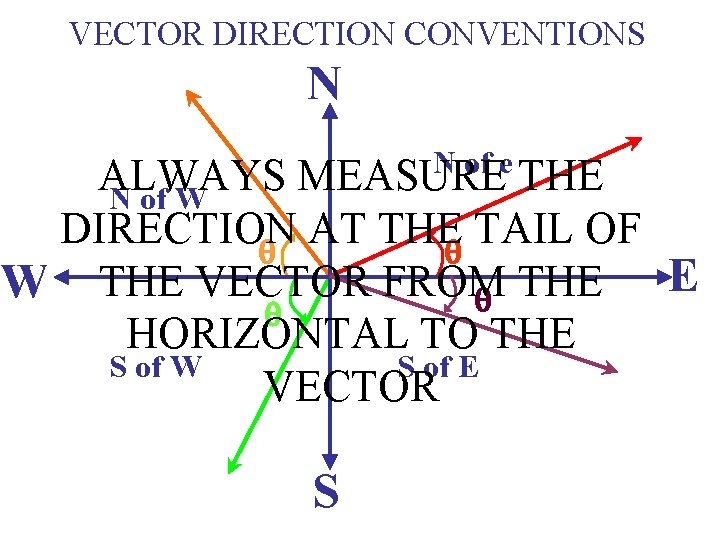
VECTOR DIRECTION CONVENTIONS N N of e ALWAYS MEASURE THE N of W DIRECTION AT THE TAIL OF E THE W THE VECTOR FROM HORIZONTAL TO THE S of W S of E VECTOR S
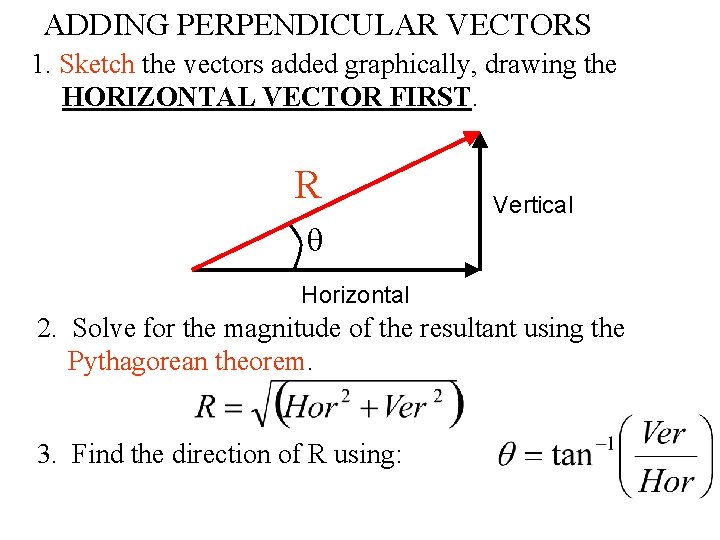
ADDING PERPENDICULAR VECTORS 1. Sketch the vectors added graphically, drawing the HORIZONTAL VECTOR FIRST. R Vertical Horizontal 2. Solve for the magnitude of the resultant using the Pythagorean theorem. 3. Find the direction of R using:
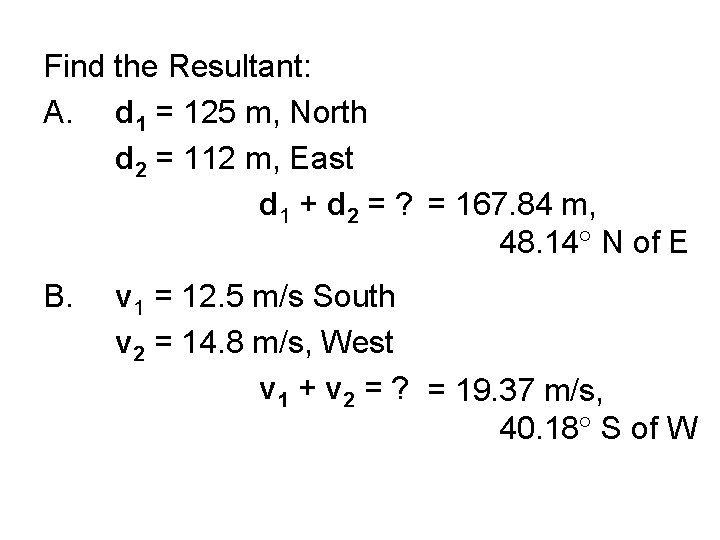
Find the Resultant: A. d 1 = 125 m, North d 2 = 112 m, East d 1 + d 2 = ? = 167. 84 m, 48. 14 N of E B. v 1 = 12. 5 m/s South v 2 = 14. 8 m/s, West v 1 + v 2 = ? = 19. 37 m/s, 40. 18 S of W
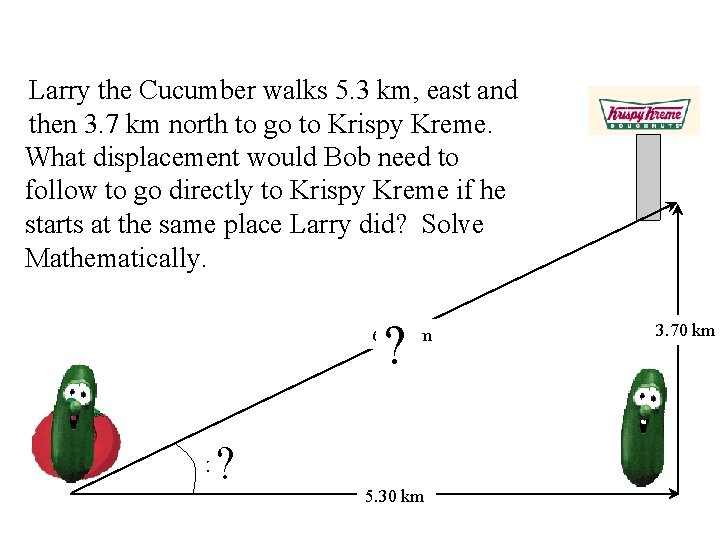
Larry the Cucumber walks 5. 3 km, east and then 3. 7 km north to go to Krispy Kreme. What displacement would Bob need to follow to go directly to Krispy Kreme if he starts at the same place Larry did? Solve Mathematically. ? 6. 46 km ? 34. 92 5. 30 km 3. 70 km
- Slides: 8