
Vectors Scalar Terms Magnitude only Magnitudequantitave measure or

- Slides: 19
Vectors
Scalar Terms • ( Magnitude only) – Magnitude=quantitave measure or in simple terms, a number. – Time – Distance – Speed – Mass
Vector Terms • • (Magnitude and Direction) Displacement Velocity Acceleration
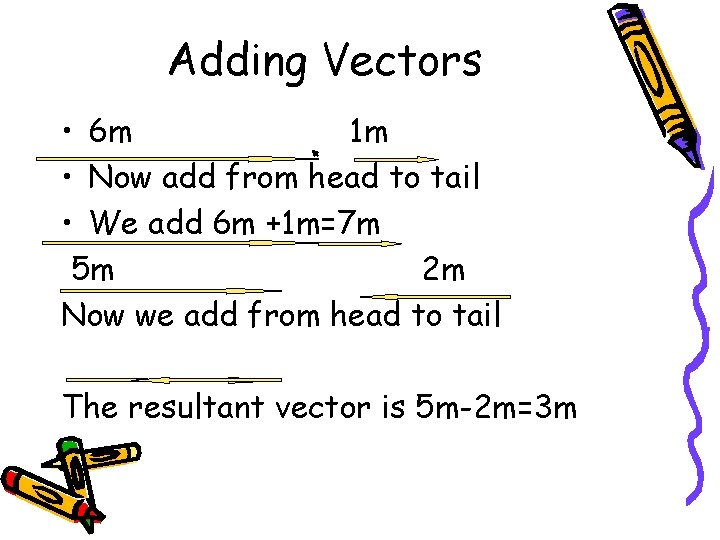
Adding Vectors • Vectors are represented by arrows • The size of the vector tells you about the amount of the quantity • Always add head to tail • Resultant- the vector that represents the sum of two or more vectors
Adding Vectors • 6 m 1 m • Now add from head to tail • We add 6 m +1 m=7 m 5 m 2 m Now we add from head to tail The resultant vector is 5 m-2 m=3 m
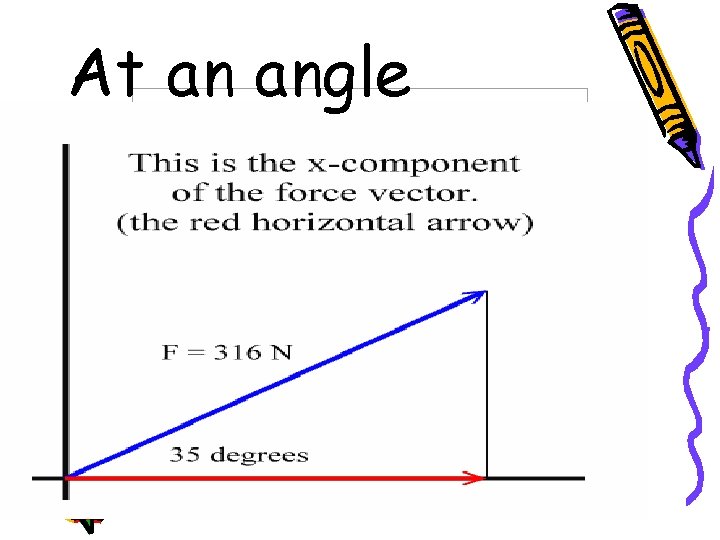
At an angle
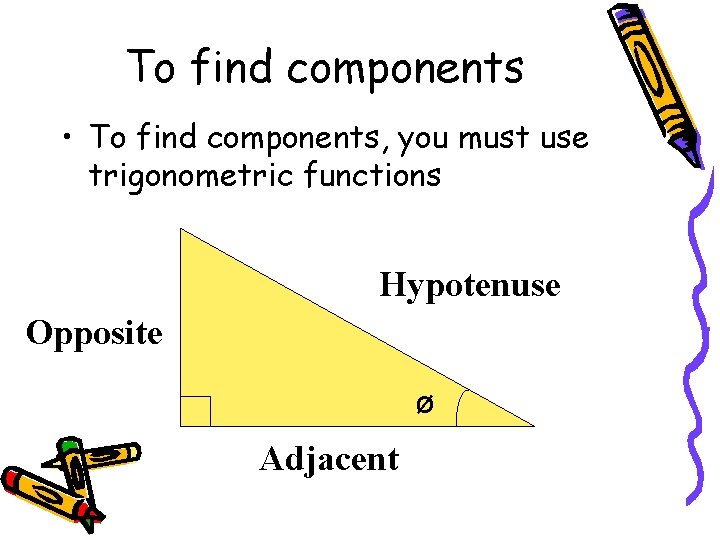
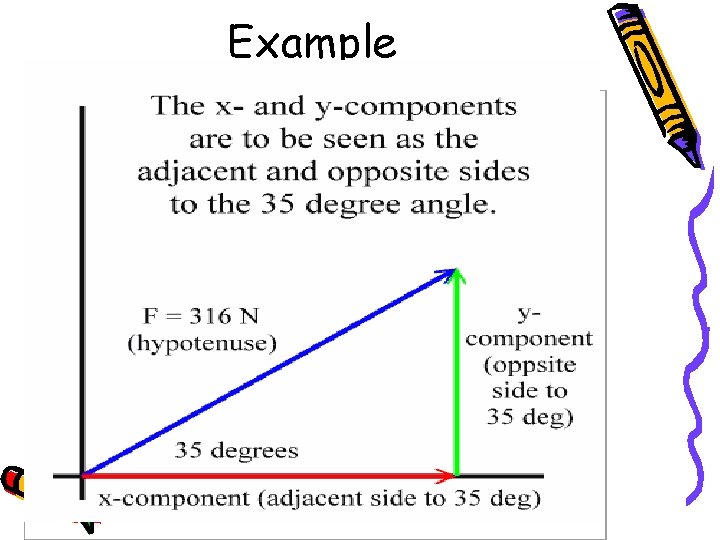
To find components • To find components, you must use trigonometric functions Hypotenuse Opposite ø Adjacent
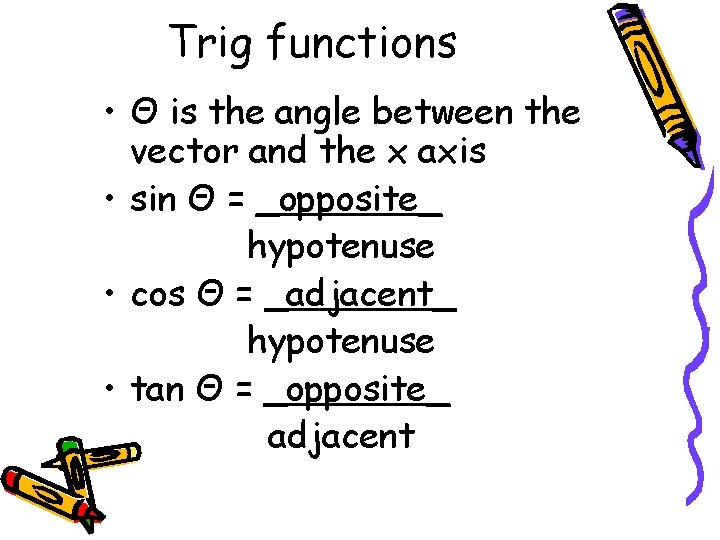
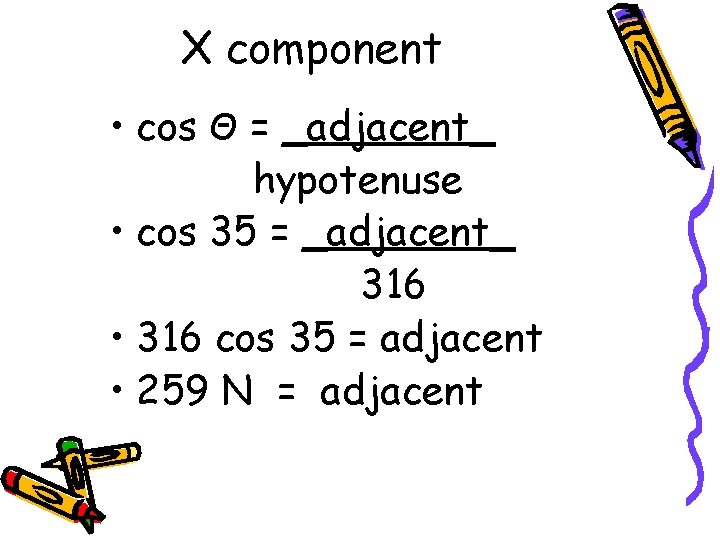
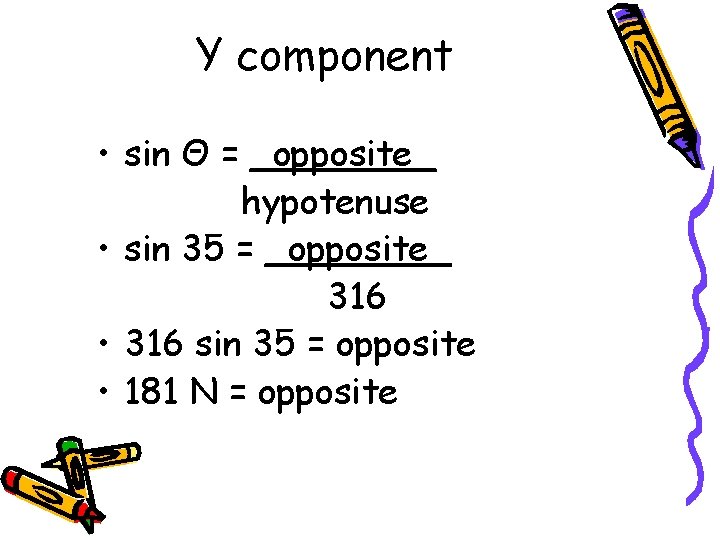
Trig functions • Θ is the angle between the vector and the x axis • sin Θ = _opposite_ hypotenuse • cos Θ = _adjacent_ hypotenuse • tan Θ = _opposite_ adjacent
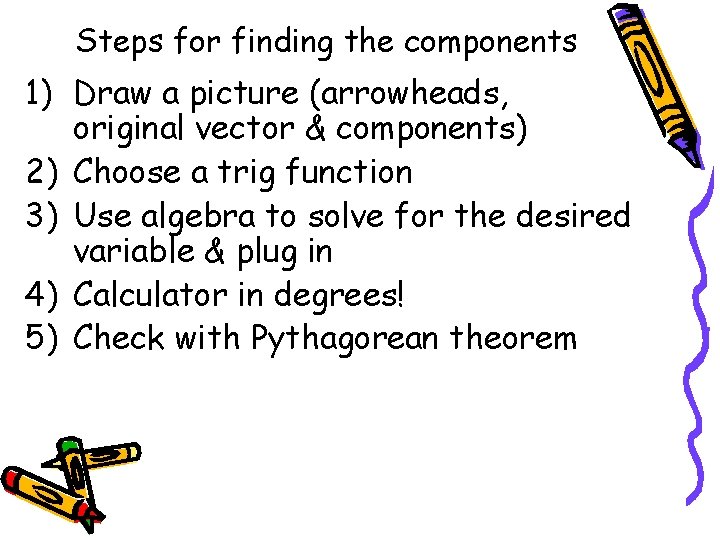
Steps for finding the components 1) Draw a picture (arrowheads, original vector & components) 2) Choose a trig function 3) Use algebra to solve for the desired variable & plug in 4) Calculator in degrees! 5) Check with Pythagorean theorem
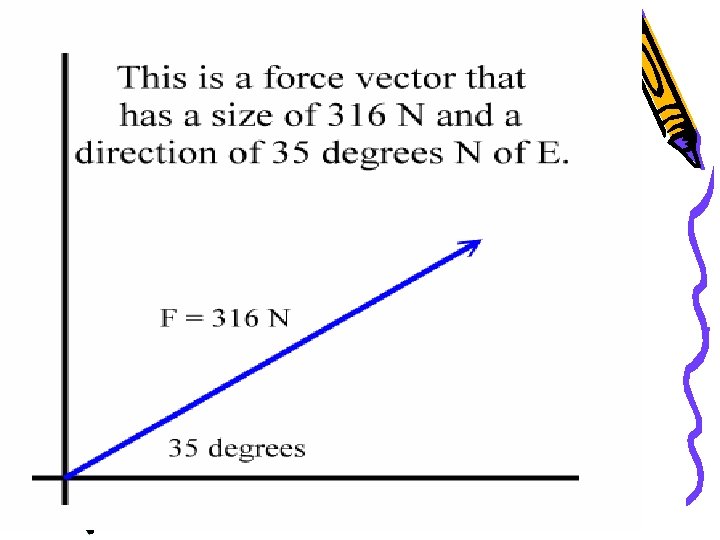
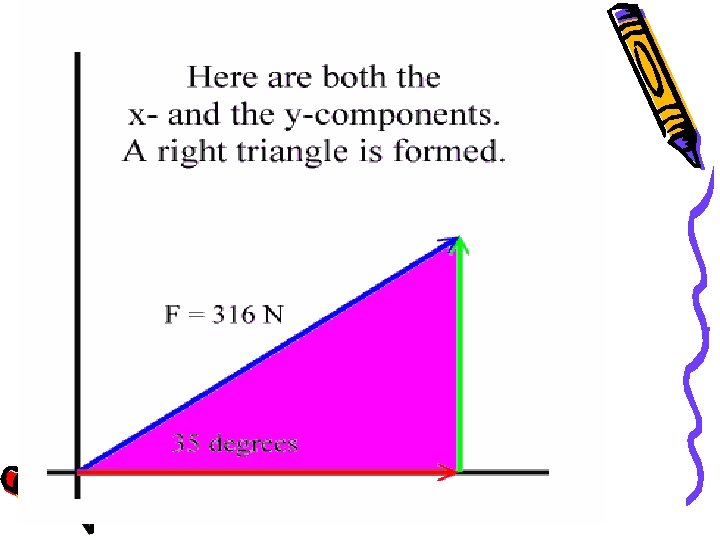
Example •
X component • cos Θ = _adjacent_ hypotenuse • cos 35 = _adjacent_ 316 • 316 cos 35 = adjacent • 259 N = adjacent
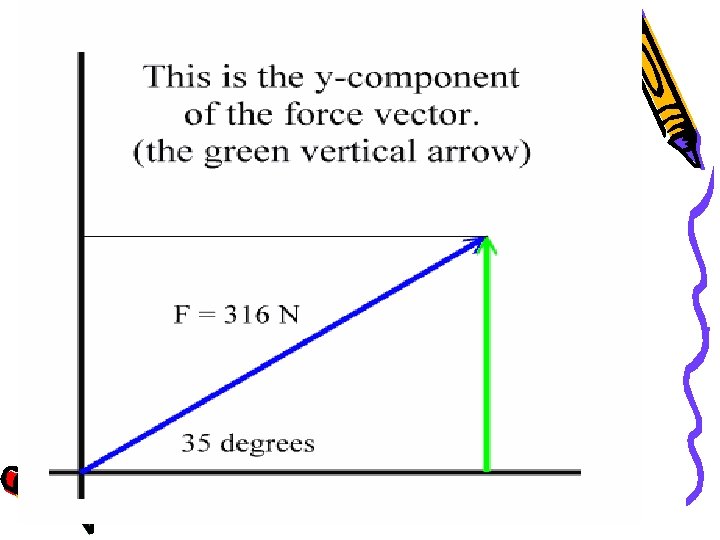
Y component • sin Θ = _opposite_ hypotenuse • sin 35 = _opposite_ 316 • 316 sin 35 = opposite • 181 N = opposite
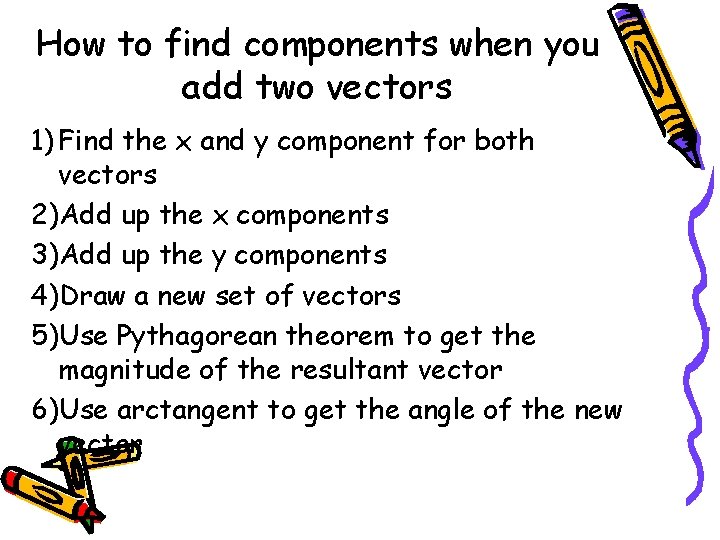
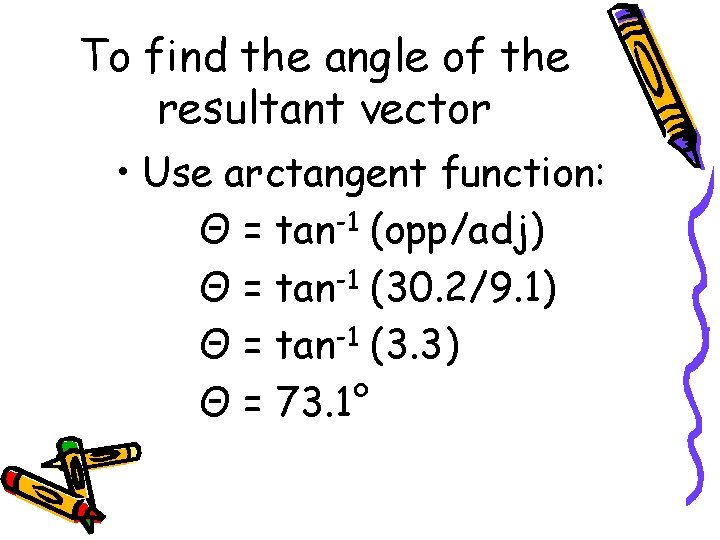
How to find components when you add two vectors 1) Find the x and y component for both vectors 2)Add up the x components 3)Add up the y components 4)Draw a new set of vectors 5)Use Pythagorean theorem to get the magnitude of the resultant vector 6)Use arctangent to get the angle of the new vector
To find the angle of the resultant vector • Use arctangent function: Θ = tan-1 (opp/adj) Θ = tan-1 (30. 2/9. 1) Θ = tan-1 (3. 3) Θ = 73. 1°
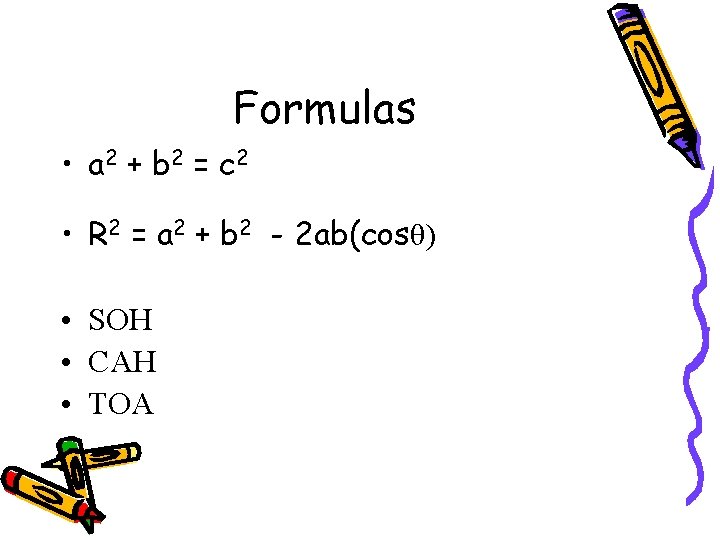
Formulas • a 2 + b 2 = c 2 • R 2 = a 2 + b 2 - 2 ab(cosθ) • SOH • CAH • TOA