
Vectors Physics is the Science of Measurement Length
- Slides: 56
Vectors
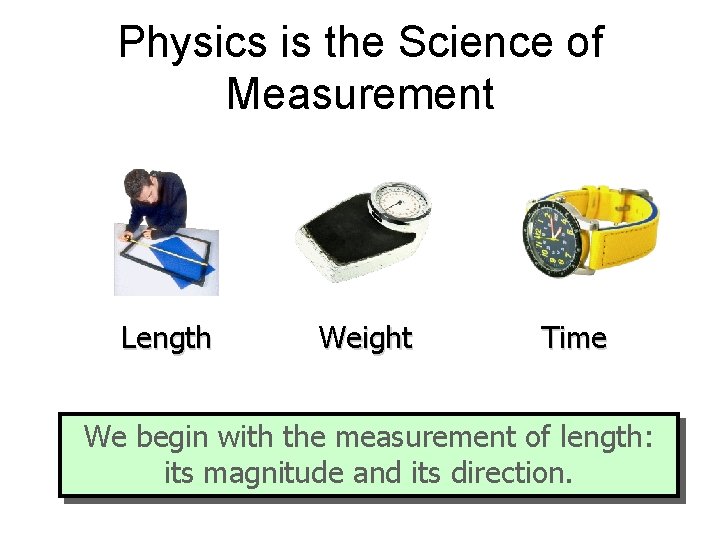
Physics is the Science of Measurement Length Weight Time We begin with the measurement of length: its magnitude and its direction.
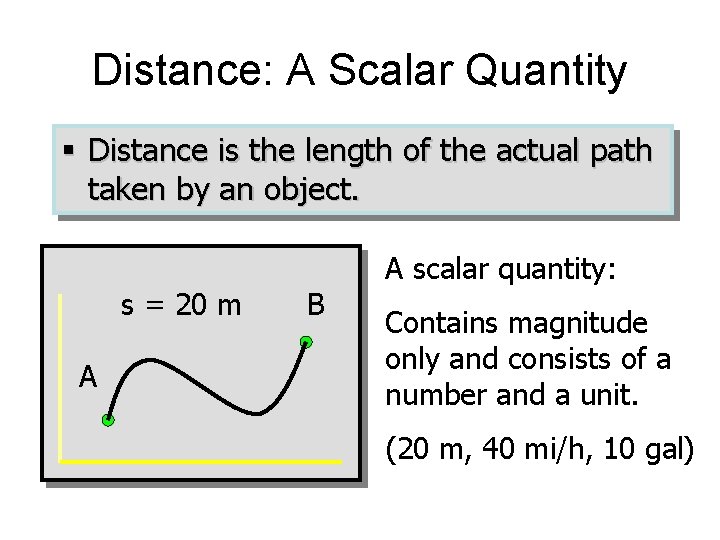
Distance: A Scalar Quantity § Distance is the length of the actual path taken by an object. s = 20 m A B A scalar quantity: Contains magnitude only and consists of a number and a unit. (20 m, 40 mi/h, 10 gal)
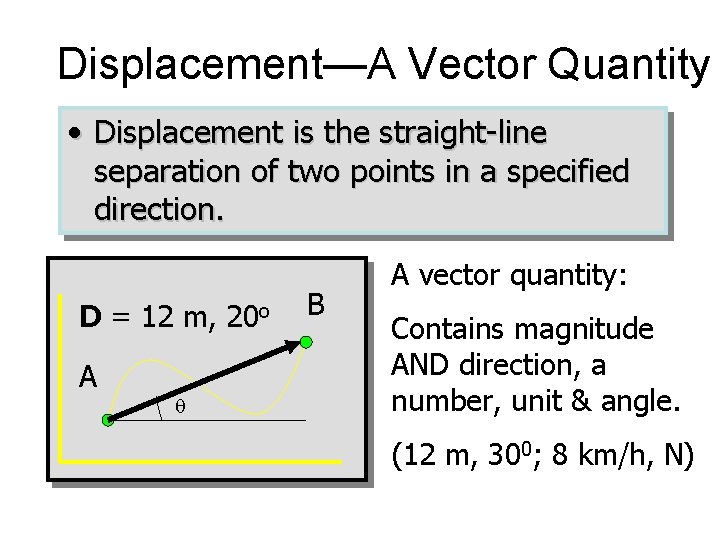
Displacement—A Vector Quantity • Displacement is the straight-line separation of two points in a specified direction. D = 12 m, 20 o A B A vector quantity: Contains magnitude AND direction, a number, unit & angle. (12 m, 300; 8 km/h, N)
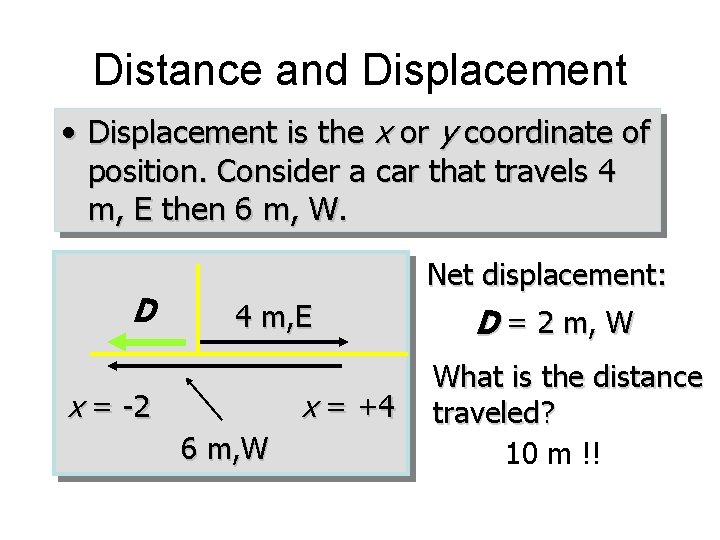
Distance and Displacement • Displacement is the x or y coordinate of position. Consider a car that travels 4 m, E then 6 m, W. D Net displacement: 4 m, E x = -2 x = +4 6 m, W D = 2 m, W What is the distance traveled? 10 m !!
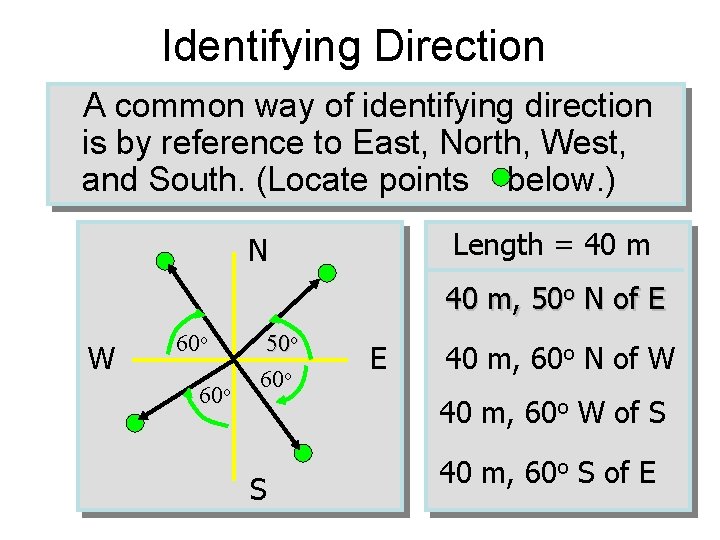
Identifying Direction A common way of identifying direction is by reference to East, North, West, and South. (Locate points below. ) Length = 40 m N 40 m, 50 o N of E W 60 o 50 o 60 o E 40 m, 60 o N of W 40 m, 60 o W of S S 40 m, 60 o S of E
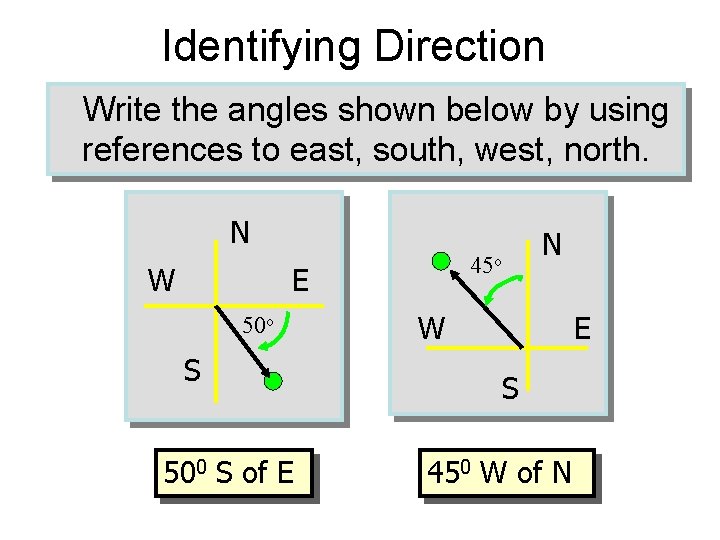
Identifying Direction Write the angles shown below by using references to east, south, west, north. N W 45 o E 50 o S 500 S of E N W E S 450 W of N
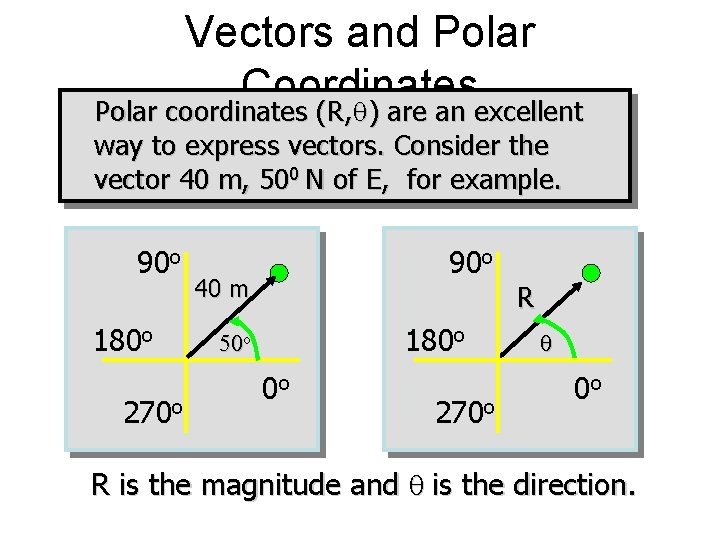
Vectors and Polar Coordinates Polar coordinates (R, ) are an excellent way to express vectors. Consider the vector 40 m, 500 N of E, for example. 90 o 180 o 270 o 90 o 40 m 180 o 50 o 0 o 270 o R is the magnitude and is the direction.
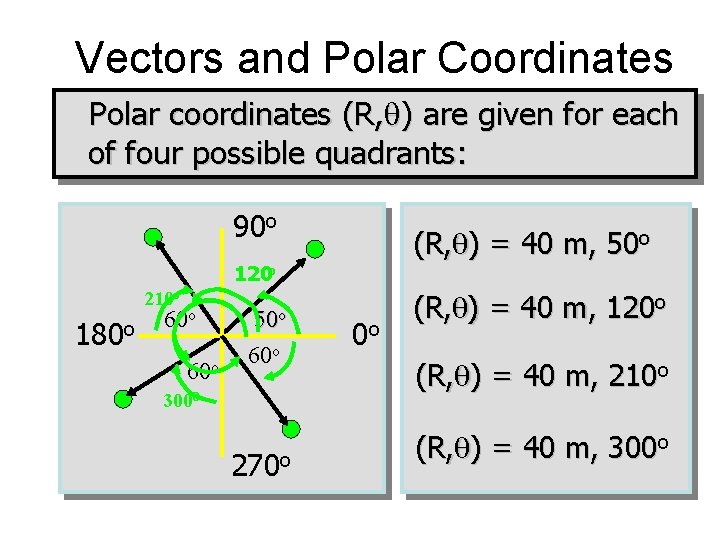
Vectors and Polar Coordinates Polar coordinates (R, ) are given for each of four possible quadrants: 90 o (R, ) = 40 m, 50 o 120 o 210 o 180 o 60 o 50 o 60 o 3000 270 o 0 o (R, ) = 40 m, 120 o (R, ) = 40 m, 210 o (R, ) = 40 m, 300 o
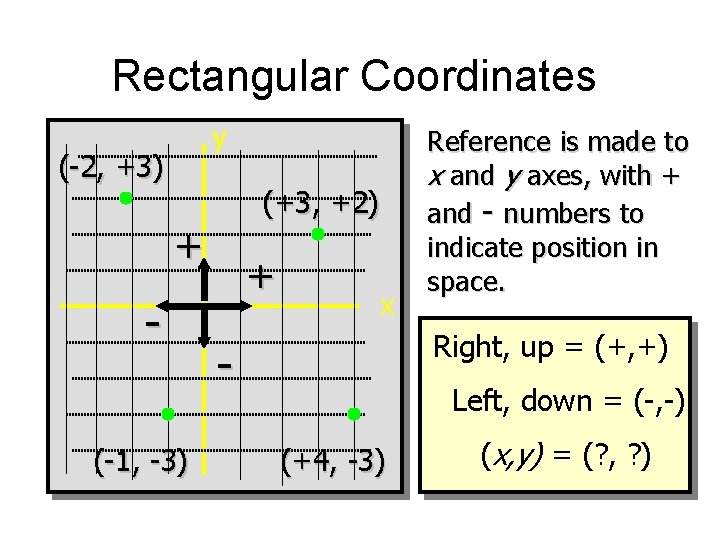
Rectangular Coordinates y (-2, +3) (+3, +2) + (-1, -3) + x Reference is made to x and y axes, with + and - numbers to indicate position in space. Right, up = (+, +) - Left, down = (-, -) (+4, -3) (x, y) = (? , ? )
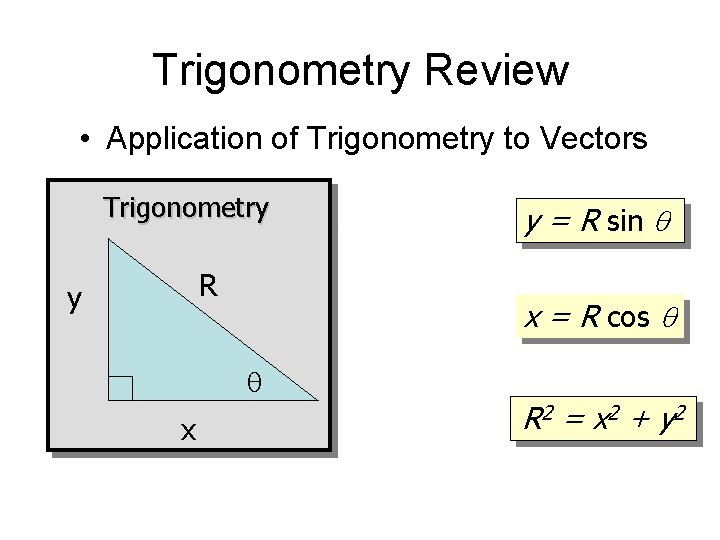
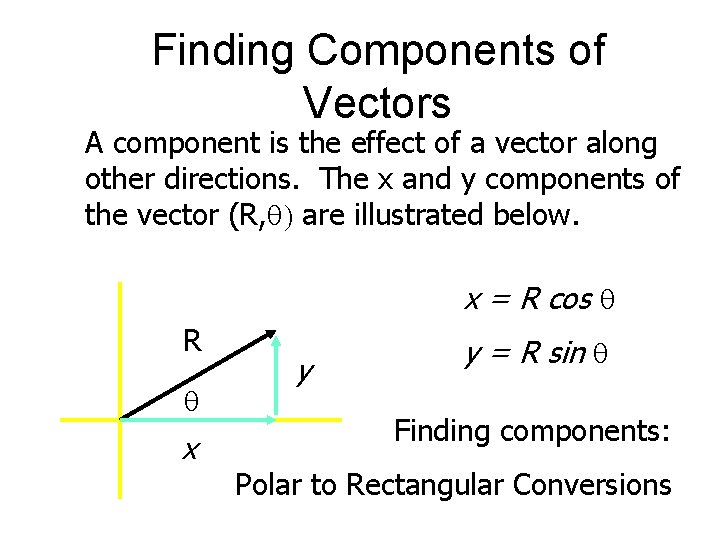
Trigonometry Review • Application of Trigonometry to Vectors Trigonometry R y x = R cos q x y = R sin q R 2 = x 2 + y 2
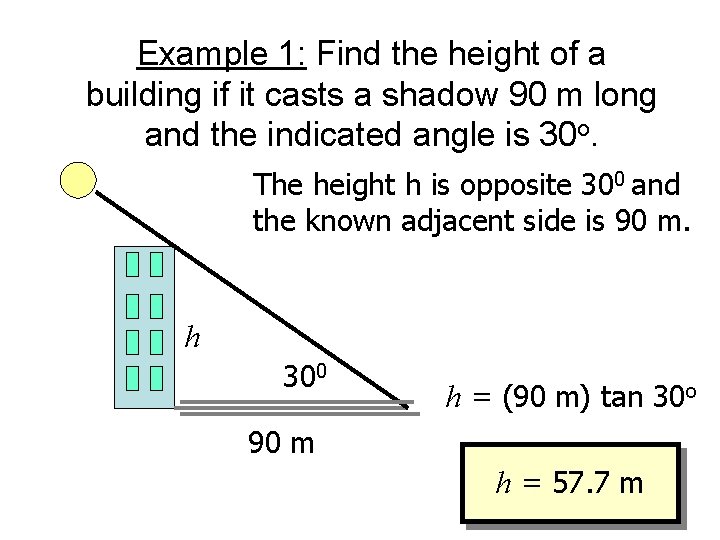
Example 1: Find the height of a building if it casts a shadow 90 m long and the indicated angle is 30 o. The height h is opposite 300 and the known adjacent side is 90 m. h 300 h = (90 m) tan 30 o 90 m h = 57. 7 m
Finding Components of Vectors A component is the effect of a vector along other directions. The x and y components of the vector (R, ) are illustrated below. x = R cos R x y y = R sin Finding components: Polar to Rectangular Conversions
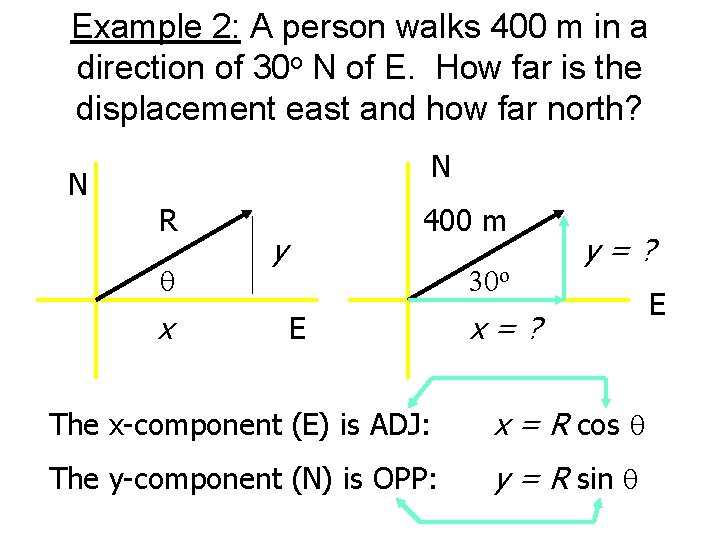
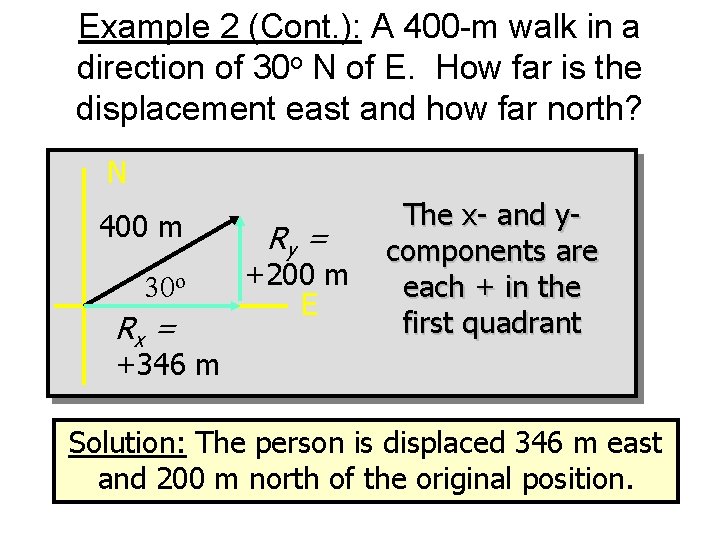
Example 2: A person walks 400 m in a direction of 30 o N of E. How far is the displacement east and how far north? N N R x 400 m y 30 o E y=? x=? The x-component (E) is ADJ: x = R cos The y-component (N) is OPP: y = R sin E
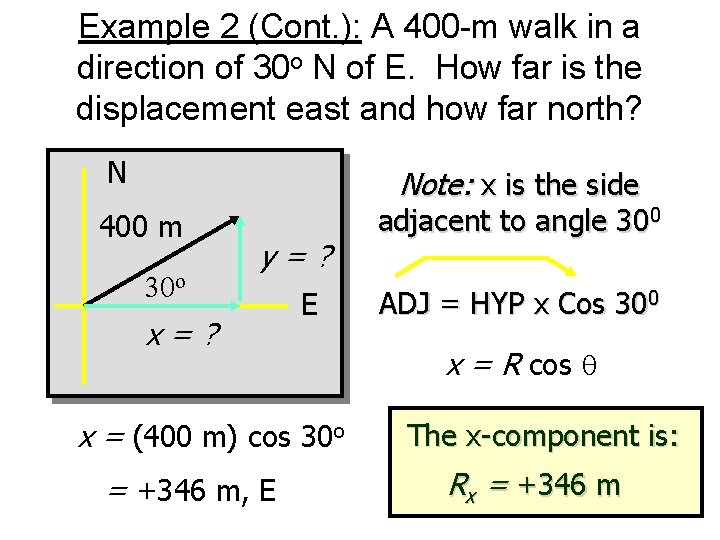
Example 2 (Cont. ): A 400 -m walk in a direction of 30 o N of E. How far is the displacement east and how far north? N Note: x is the side 400 m 30 o y=? x=? E x = (400 m) cos 30 o = +346 m, E adjacent to angle 300 ADJ = HYP x Cos 300 x = R cos The x-component is: Rx = +346 m
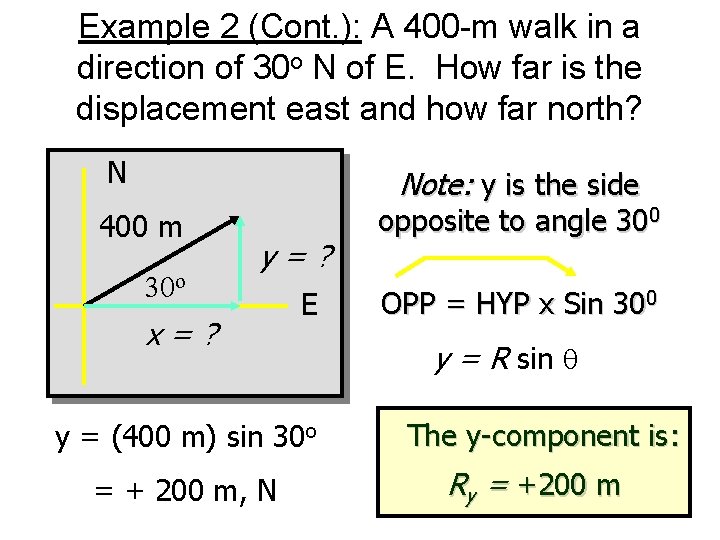
Example 2 (Cont. ): A 400 -m walk in a direction of 30 o N of E. How far is the displacement east and how far north? N Note: y is the side 400 m 30 o y=? x=? E opposite to angle 300 OPP = HYP x Sin 300 y = R sin y = (400 m) sin 30 o The y-component is: = + 200 m, N Ry = +200 m
Example 2 (Cont. ): A 400 -m walk in a direction of 30 o N of E. How far is the displacement east and how far north? N 400 m 30 o Rx = Ry = +200 m E The x- and ycomponents are each + in the first quadrant +346 m Solution: The person is displaced 346 m east and 200 m north of the original position.
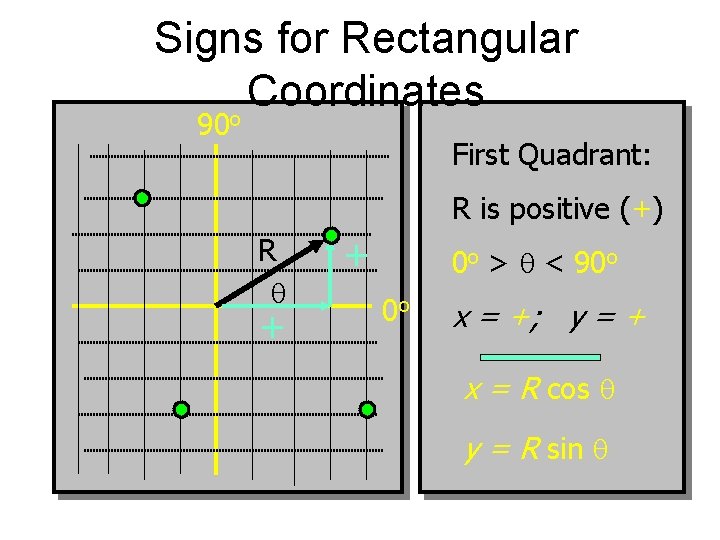
Signs for Rectangular Coordinates o 90 First Quadrant: R is positive (+) R + + 0 o > < 90 o 0 o x = +; y = + x = R cos y = R sin
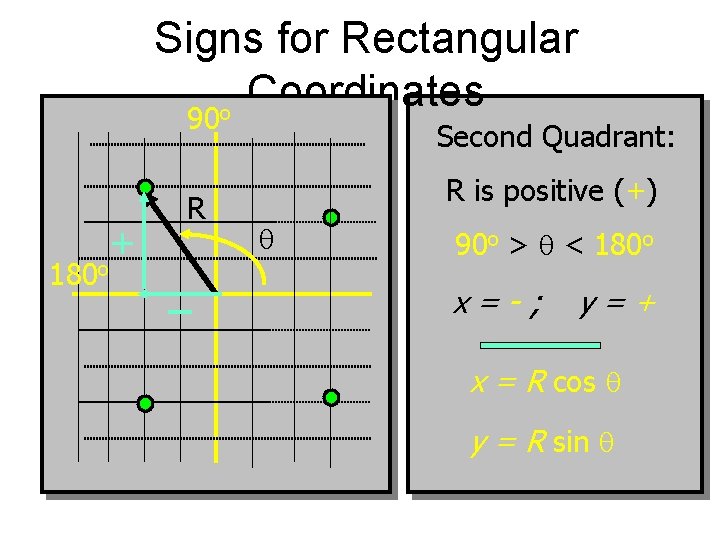
Signs for Rectangular Coordinates o 90 180 o + R Second Quadrant: R is positive (+) 90 o > < 180 o x=-; y=+ x = R cos y = R sin
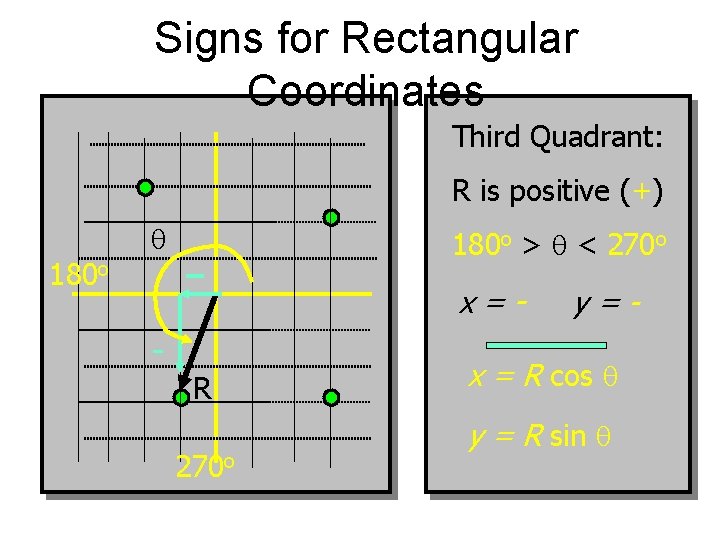
Signs for Rectangular Coordinates Third Quadrant: R is positive (+) 180 o > < 270 o x=- - R 270 o y=- x = R cos y = R sin
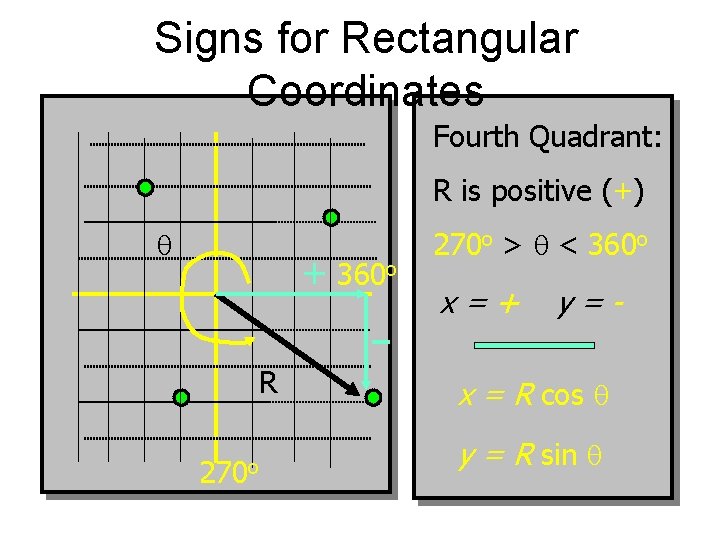
Signs for Rectangular Coordinates Fourth Quadrant: R is positive (+) + 360 o R 270 o > < 360 o x=+ y=- x = R cos y = R sin
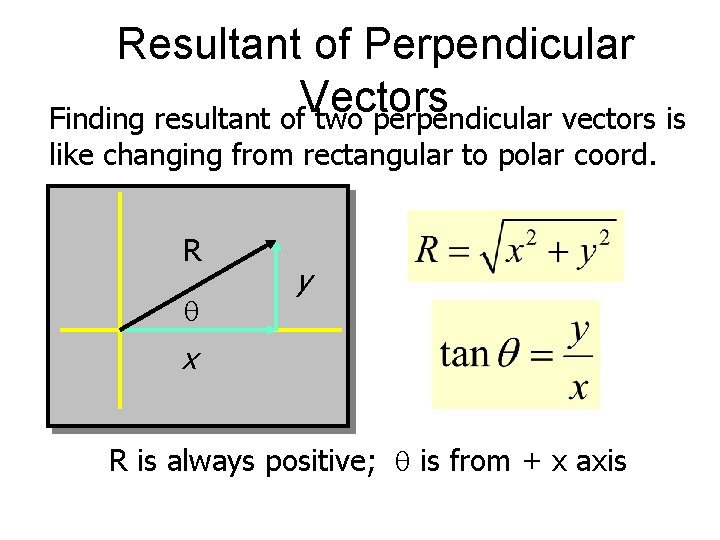
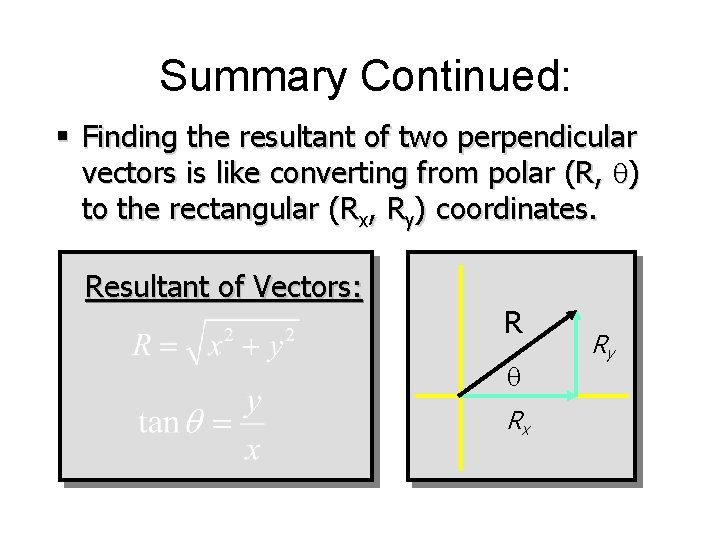
Resultant of Perpendicular Vectors Finding resultant of two perpendicular vectors is like changing from rectangular to polar coord. R y x R is always positive; is from + x axis
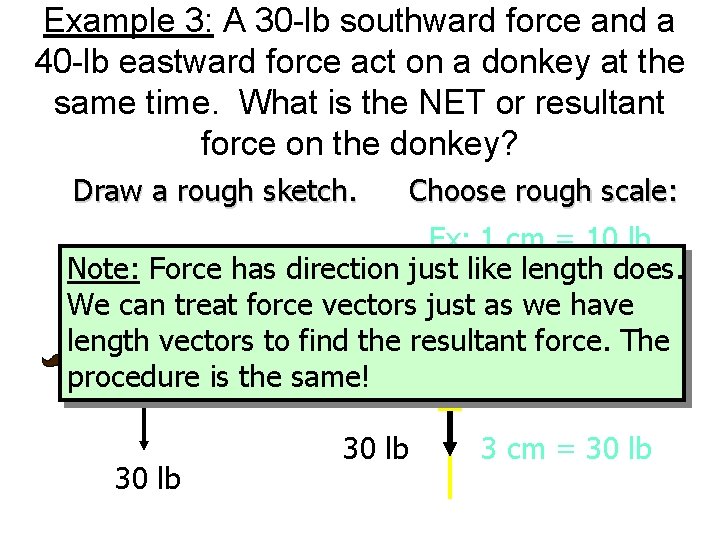
Example 3: A 30 -lb southward force and a 40 -lb eastward force act on a donkey at the same time. What is the NET or resultant force on the donkey? Draw a rough sketch. Choose rough scale: Ex: 1 cm = 10 lb Note: Force has 40 direction just like length does. lb 40 lb We can treat force vectors just as we have length vectors to find the resultant force. The procedure is the same! 4 cm = 40 lb 30 lb 3 cm = 30 lb
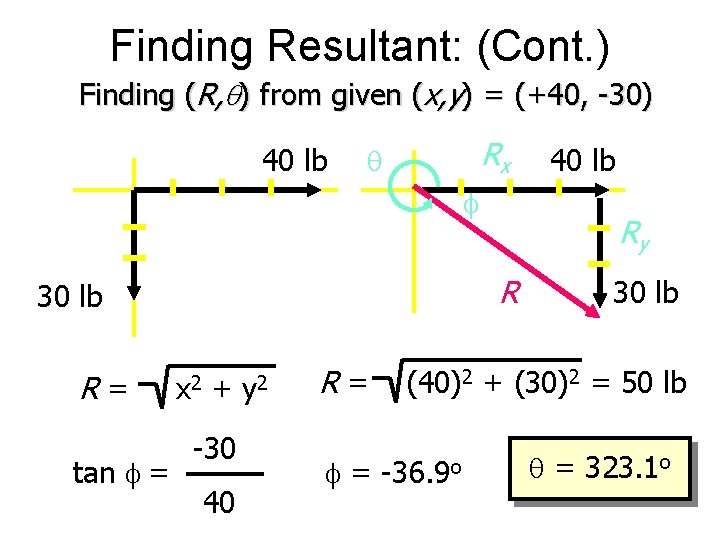
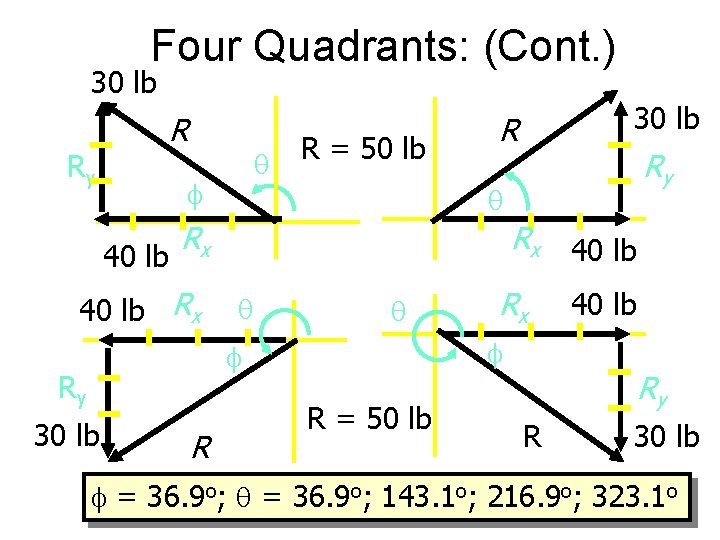
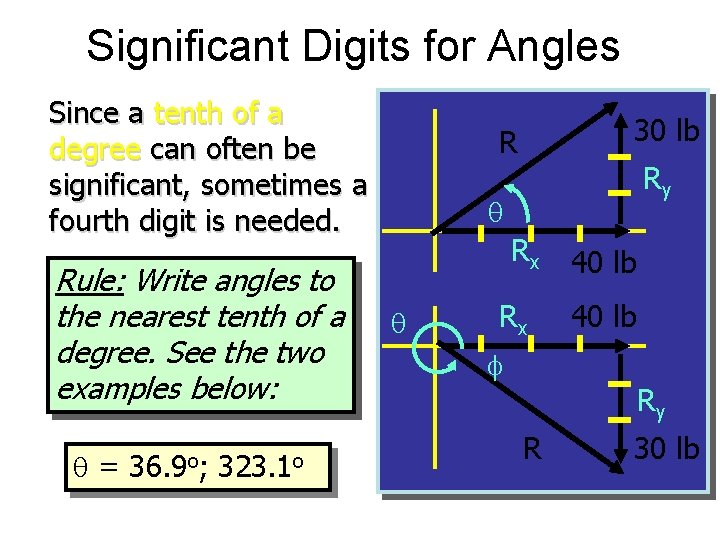
Finding Resultant: (Cont. ) Finding (R, q) from given (x, y) = (+40, -30) 40 lb Rx R= tan = Ry R 30 lb x 2 + y 2 -30 40 R= 40 lb 30 lb (40)2 + (30)2 = 50 lb = -36. 9 o = 323. 1 o
Four Quadrants: (Cont. ) 30 lb Ry 40 lb R = 50 lb Rx 40 lb Rx 30 lb R Ry Rx 40 lb Rx Ry 30 lb R R R = 50 lb 40 lb Ry R 30 lb = 36. 9 o; 143. 1 o; 216. 9 o; 323. 1 o
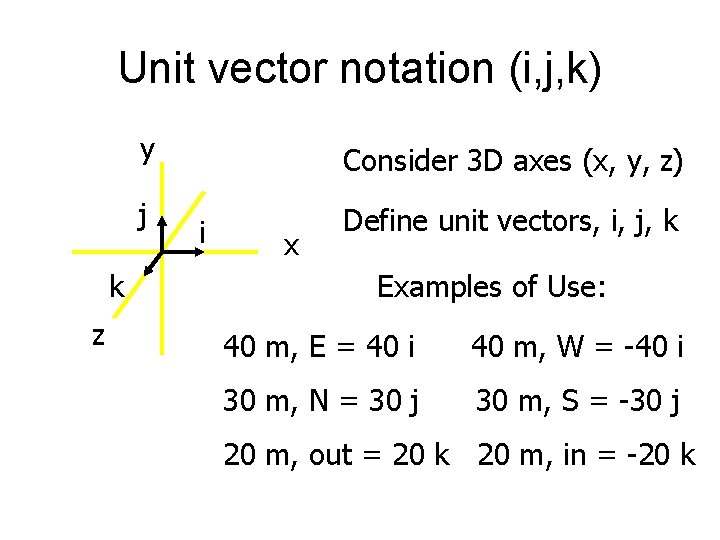
Unit vector notation (i, j, k) y j k z Consider 3 D axes (x, y, z) i x Define unit vectors, i, j, k Examples of Use: 40 m, E = 40 i 40 m, W = -40 i 30 m, N = 30 j 30 m, S = -30 j 20 m, out = 20 k 20 m, in = -20 k
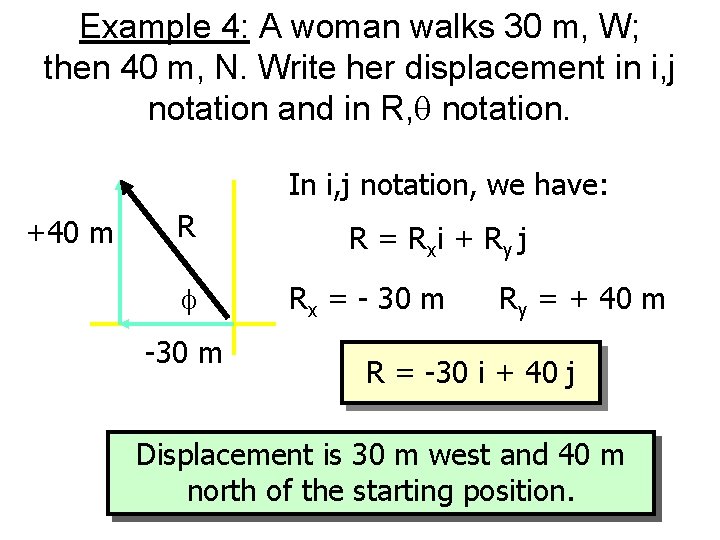
Example 4: A woman walks 30 m, W; then 40 m, N. Write her displacement in i, j notation and in R, notation. In i, j notation, we have: +40 m R -30 m R = R xi + R y j Rx = - 30 m Ry = + 40 m R = -30 i + 40 j Displacement is 30 m west and 40 m north of the starting position.
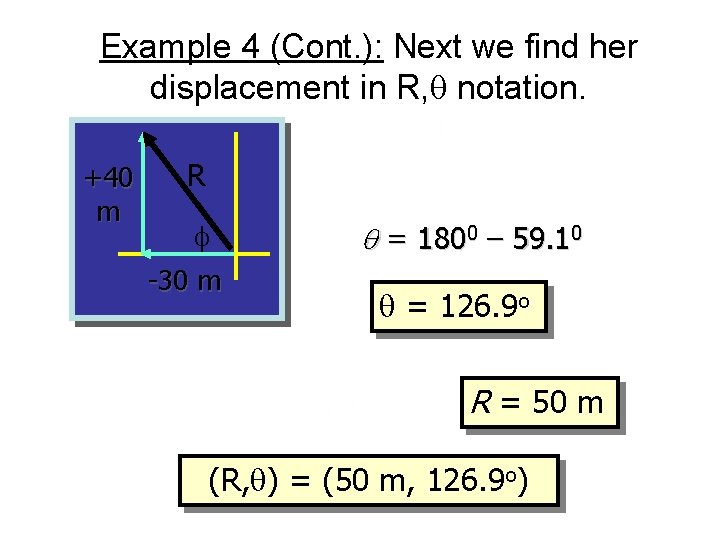
Example 4 (Cont. ): Next we find her displacement in R, notation. +40 m R -30 m q = 1800 – 59. 10 = 126. 9 o R = 50 m (R, ) = (50 m, 126. 9 o)
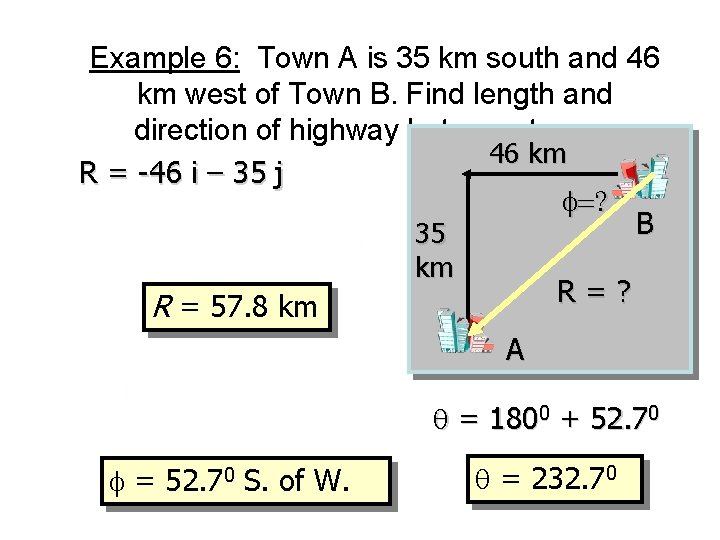
Example 6: Town A is 35 km south and 46 km west of Town B. Find length and direction of highway between towns. 46 km R = -46 i – 35 j =? B 35 km R=? R = 57. 8 km A = 1800 + 52. 70 = 52. 70 S. of W. = 232. 70
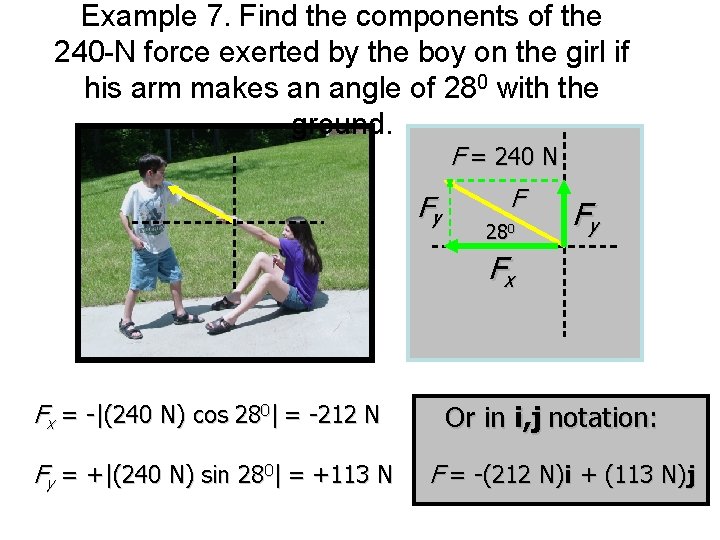
Example 7. Find the components of the 240 -N force exerted by the boy on the girl if his arm makes an angle of 280 with the ground. F = 240 N Fy F 280 Fy Fx Fx = -|(240 N) cos 280| = -212 N Fy = +|(240 N) sin 280| = +113 N Or in i, j notation: F = -(212 N)i + (113 N)j
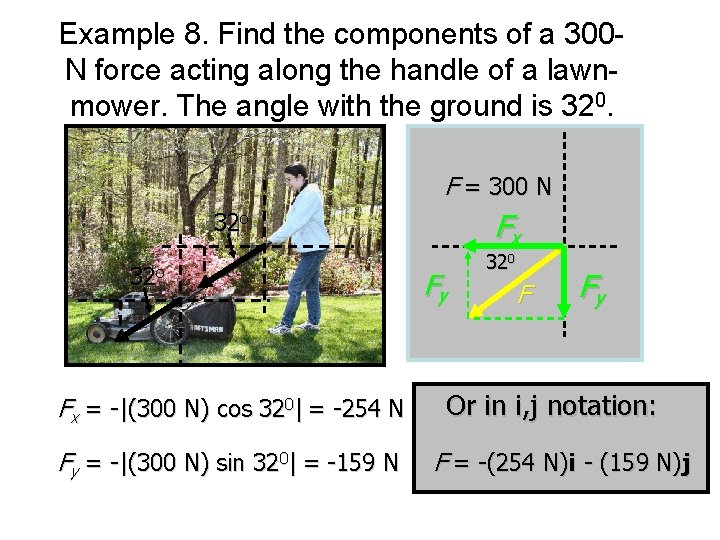
Example 8. Find the components of a 300 N force acting along the handle of a lawnmower. The angle with the ground is 320. F = 300 N Fx 32 o Fx = -|(300 N) cos 320| = -254 N Fy = -|(300 N) sin 320| = -159 N Fy 320 F Fy Or in i, j notation: F = -(254 N)i - (159 N)j
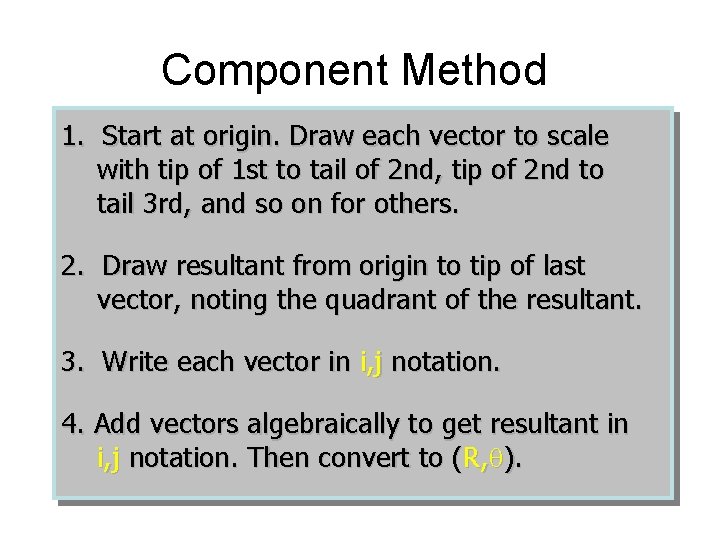
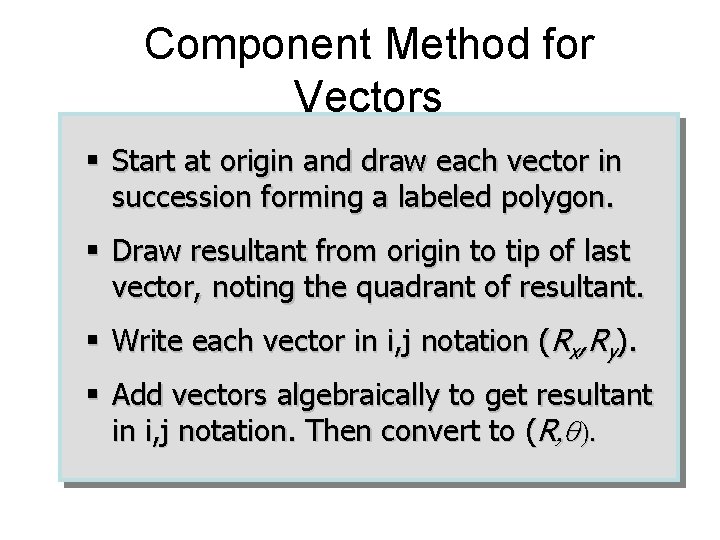
Component Method 1. Start at origin. Draw each vector to scale with tip of 1 st to tail of 2 nd, tip of 2 nd to tail 3 rd, and so on for others. 2. Draw resultant from origin to tip of last vector, noting the quadrant of the resultant. 3. Write each vector in i, j notation. 4. Add vectors algebraically to get resultant in i, j notation. Then convert to (R, ).
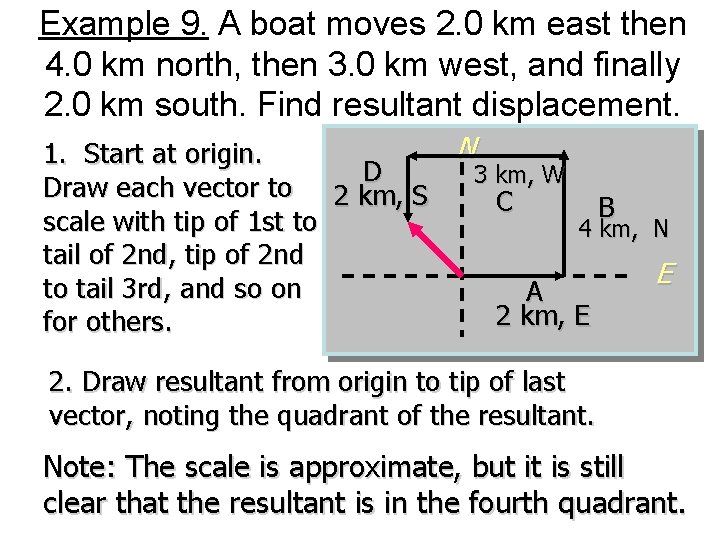
Example 9. A boat moves 2. 0 km east then 4. 0 km north, then 3. 0 km west, and finally 2. 0 km south. Find resultant displacement. N 1. Start at origin. D 3 km, W Draw each vector to 2 km, S C B scale with tip of 1 st to 4 km, N tail of 2 nd, tip of 2 nd E to tail 3 rd, and so on A 2 km, E for others. 2. Draw resultant from origin to tip of last vector, noting the quadrant of the resultant. Note: The scale is approximate, but it is still clear that the resultant is in the fourth quadrant.
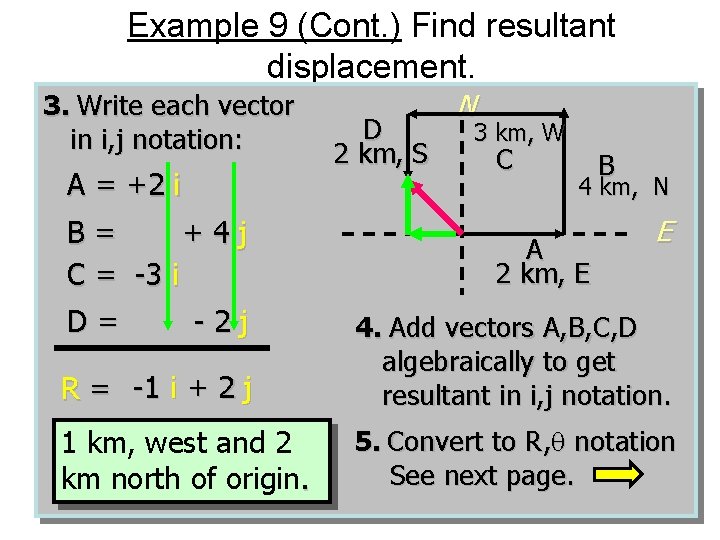
Example 9 (Cont. ) Find resultant displacement. 3. Write each vector in i, j notation: A = +2 i B= +4 j C = -3 i D= -2 j D 2 km, S N 3 km, W C B 4 km, N A 2 km, E E R = -1 i + 2 j 4. Add vectors A, B, C, D algebraically to get resultant in i, j notation. 1 km, west and 2 km north of origin. 5. Convert to R, notation See next page.
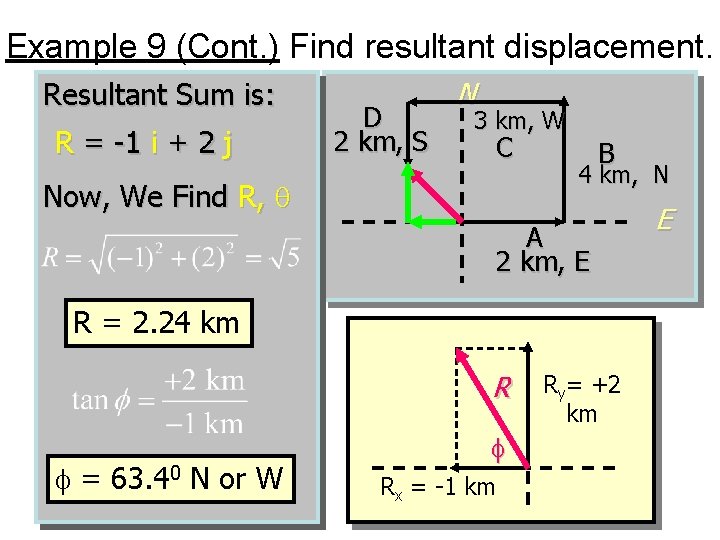
Example 9 (Cont. ) Find resultant displacement. Resultant Sum is: R = -1 i + 2 j D 2 km, S N 3 km, W C Now, We Find R, B 4 km, N A 2 km, E R = 2. 24 km R = 63. 40 N or W Rx = -1 km Ry= +2 km E
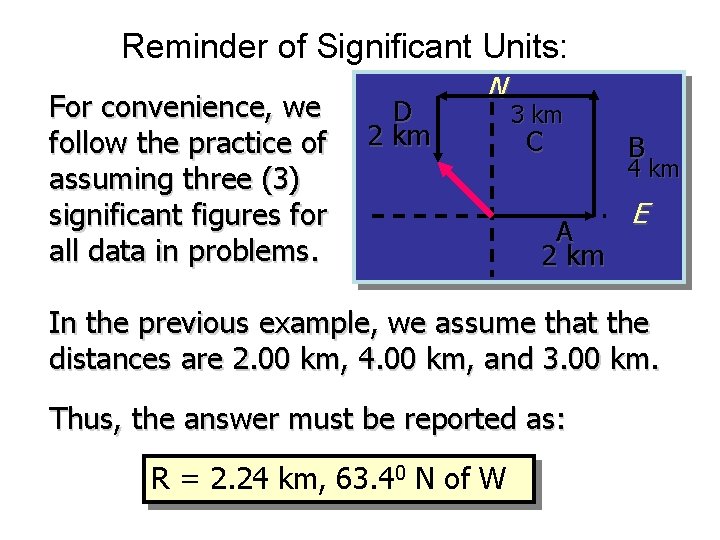
Reminder of Significant Units: For convenience, we follow the practice of assuming three (3) significant figures for all data in problems. D 2 km N 3 km C A 2 km B 4 km E In the previous example, we assume that the distances are 2. 00 km, 4. 00 km, and 3. 00 km. Thus, the answer must be reported as: R = 2. 24 km, 63. 40 N of W
Significant Digits for Angles Since a tenth of a degree can often be significant, sometimes a fourth digit is needed. = 36. 9 o; 323. 1 o Rule: Write angles to the nearest tenth of a degree. See the two examples below: 30 lb R Ry Rx Rx 40 lb Ry R 30 lb
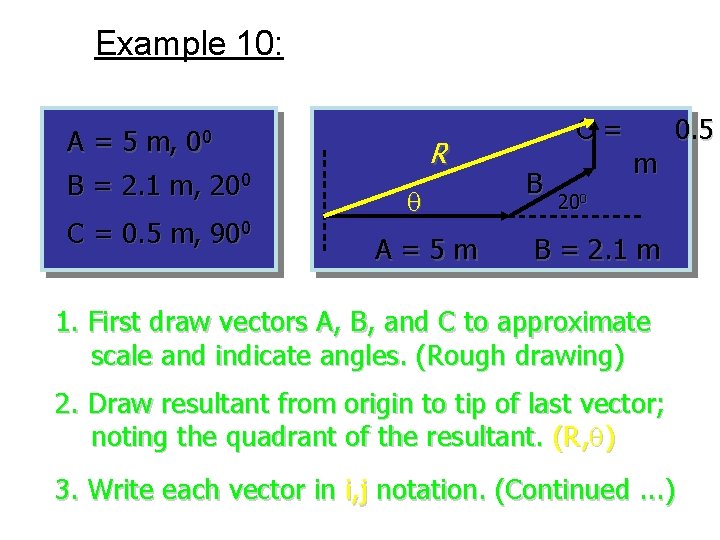
Example 10: Find R, for the three vector displacements below: A = 5 m, 00 B = 2. 1 m, 200 C = 0. 5 m, 900 R A=5 m C= B m 0. 5 200 B = 2. 1 m 1. First draw vectors A, B, and C to approximate scale and indicate angles. (Rough drawing) 2. Draw resultant from origin to tip of last vector; noting the quadrant of the resultant. (R, ) 3. Write each vector in i, j notation. (Continued. . . )
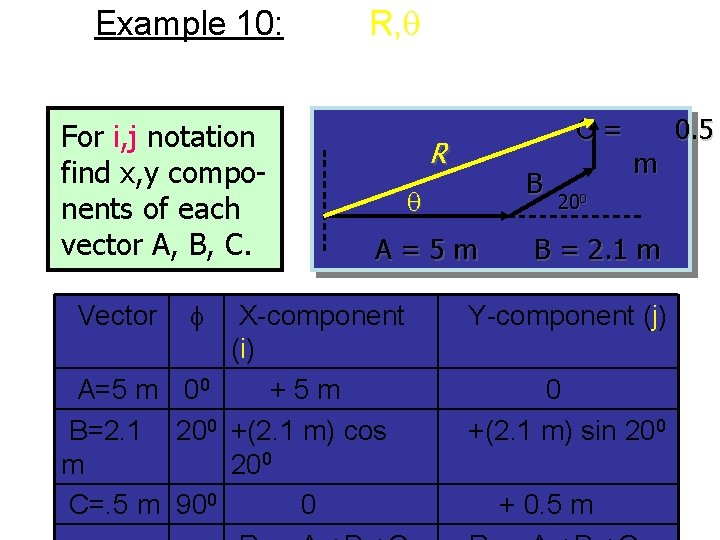
Example 10: Find R, for the three vector displacements below: (A table may help. ) For i, j notation find x, y components of each vector A, B, C. Vector C= R B A=5 m X-component (i) A=5 m 00 +5 m B=2. 1 200 +(2. 1 m) cos m 200 C=. 5 m 900 0 m 200 B = 2. 1 m Y-component (j) 0 +(2. 1 m) sin 200 + 0. 5 m 0. 5
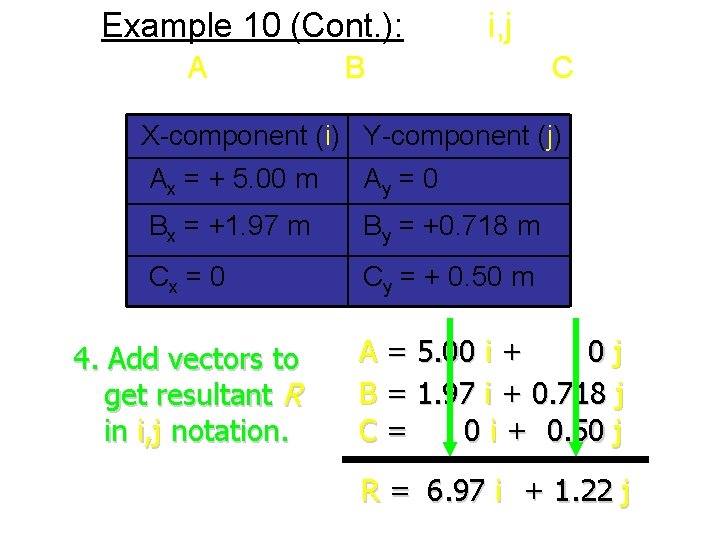
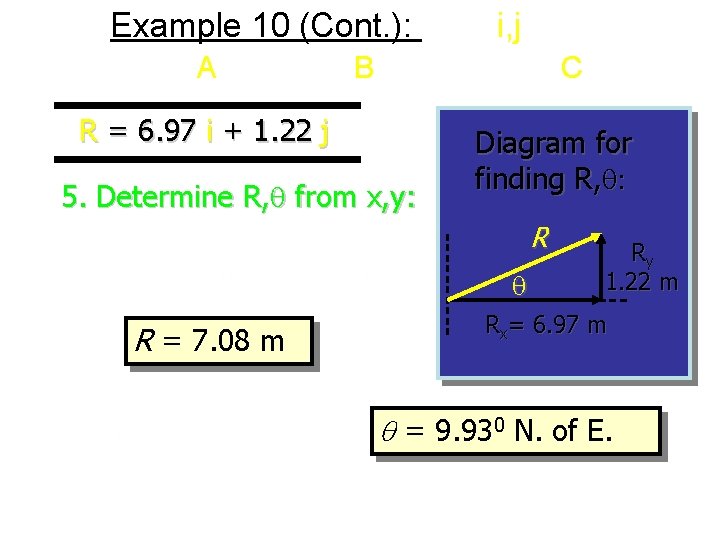
Example 10 (Cont. ): Find i, j for three vectors: A = 5 m, 00; B = 2. 1 m, 200; C = 0. 5 m, 900. X-component (i) Y-component (j) Ax = + 5. 00 m Ay = 0 Bx = +1. 97 m By = +0. 718 m Cx = 0 Cy = + 0. 50 m 4. Add vectors to get resultant R in i, j notation. A = 5. 00 i + 0 j B = 1. 97 i + 0. 718 j C= 0 i + 0. 50 j R = 6. 97 i + 1. 22 j
Example 10 (Cont. ): Find i, j for three vectors: A = 5 m, 00; B = 2. 1 m, 200; C = 0. 5 m, R = 6. 97 i + 1. 22 j 900. 5. Determine R, from x, y: Diagram for finding R, : R R = 7. 08 m Ry 1. 22 m Rx= 6. 97 m q = 9. 930 N. of E.
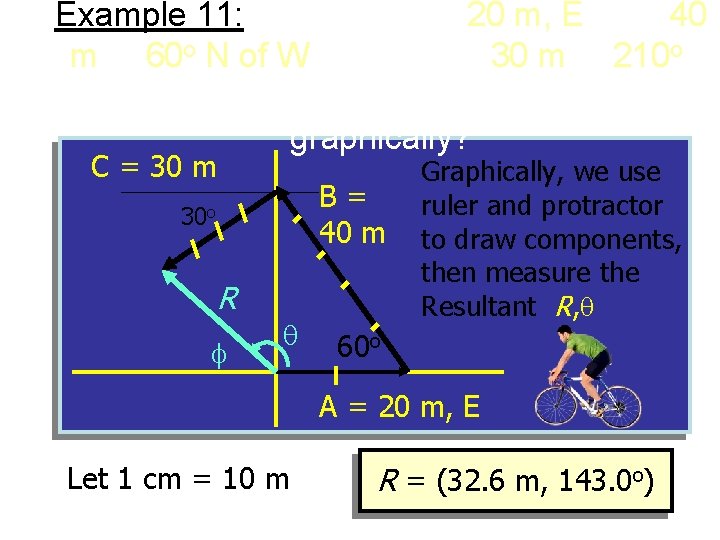
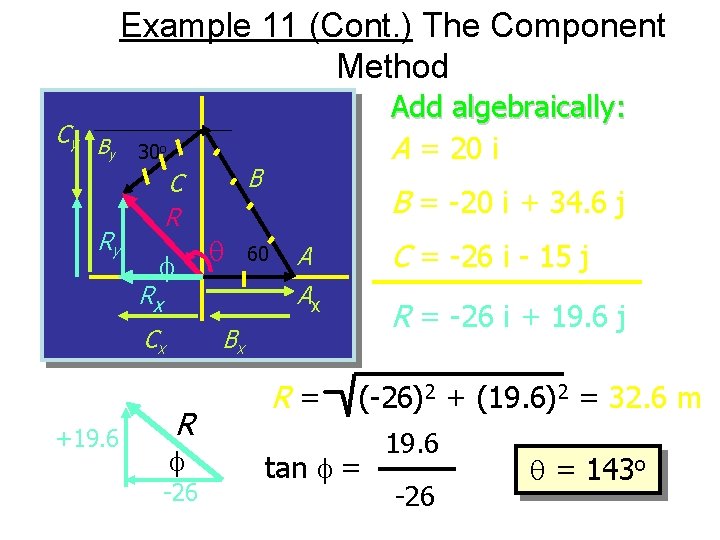
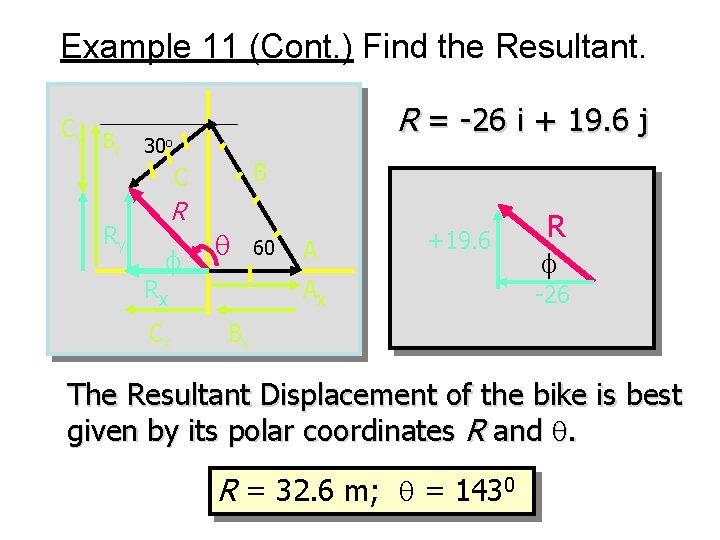
Example 11: A bike travels 20 m, E then 40 m at 60 o N of W, and finally 30 m at 210 o. What is the resultant displacement graphically? C = 30 m B= 40 m 30 o R Graphically, we use ruler and protractor to draw components, then measure the Resultant R, 60 o A = 20 m, E Let 1 cm = 10 m R = (32. 6 m, 143. 0 o)
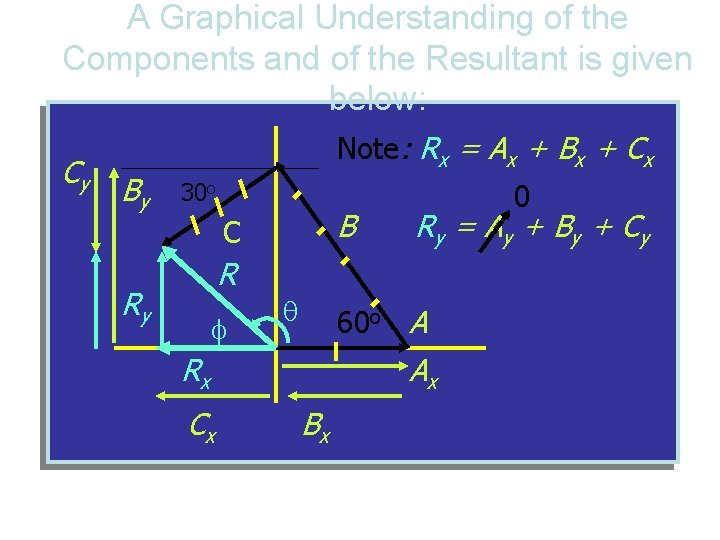
A Graphical Understanding of the Components and of the Resultant is given below: Cy By Note: Rx = Ax + Bx + Cx 30 o B C R Ry = A y + B y + C y 60 o A Rx Cx 0 Ax Bx
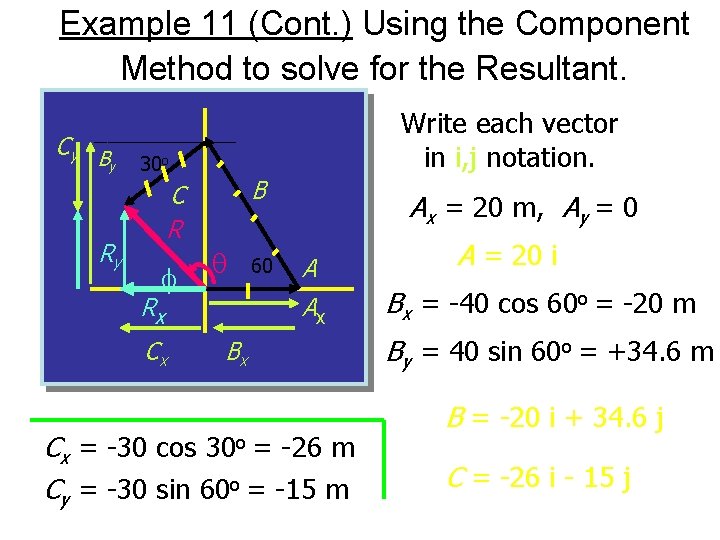
Example 11 (Cont. ) Using the Component Method to solve for the Resultant. Cy B y Ry Write each vector in i, j notation. 30 o C R B Rx Cx 60 Ax = 20 m, Ay = 0 A Ax Bx Cx = -30 cos 30 o = -26 m Cy = -30 sin 60 o = -15 m A = 20 i Bx = -40 cos 60 o = -20 m By = 40 sin 60 o = +34. 6 m B = -20 i + 34. 6 j C = -26 i - 15 j
Example 11 (Cont. ) The Component Method Cy B y Ry 30 o C R B Rx B = -20 i + 34. 6 j 60 C = -26 i - 15 j A Ax Cx +19. 6 Add algebraically: A = 20 i R = -26 i + 19. 6 j Bx R -26 R= (-26)2 + (19. 6)2 = 32. 6 m tan = 19. 6 -26 = 143 o
Example 11 (Cont. ) Find the Resultant. R = -26 i + 19. 6 j Cy B 30 o y B C Ry R Rx Cx 60 A +19. 6 Ax R -26 Bx The Resultant Displacement of the bike is best given by its polar coordinates R and . R = 32. 6 m; = 1430
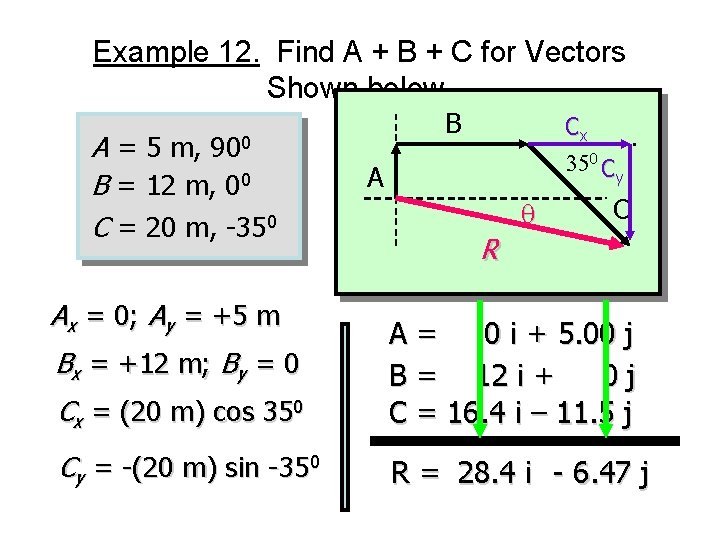
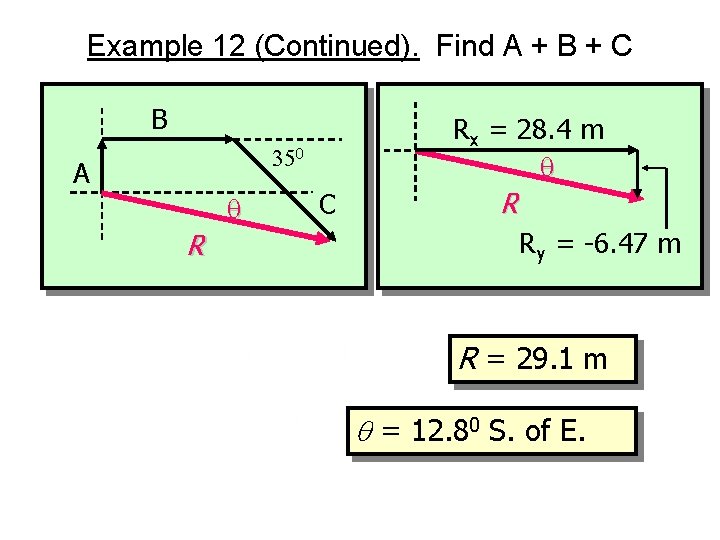
Example 12. Find A + B + C for Vectors Shown below. A = 5 m, 900 B = 12 m, 00 C = 20 m, -350 Ax = 0; Ay = +5 m B Cx 350 C A y R C Cx = (20 m) cos 350 A= 0 i + 5. 00 j B = 12 i + 0 j C = 16. 4 i – 11. 5 j Cy = -(20 m) sin -350 R = 28. 4 i - 6. 47 j Bx = +12 m; By = 0
Example 12 (Continued). Find A + B + C B Rx = 28. 4 m 350 A R C R Ry = -6. 47 m R = 29. 1 m q = 12. 80 S. of E.
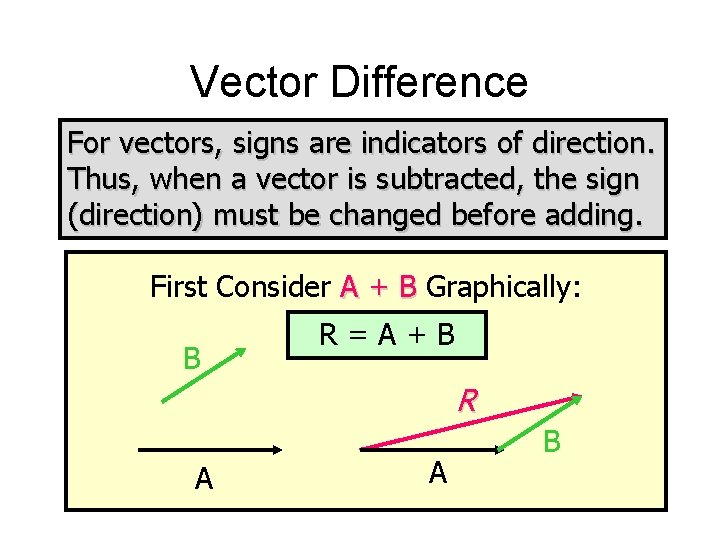
Vector Difference For vectors, signs are indicators of direction. Thus, when a vector is subtracted, the sign (direction) must be changed before adding. First Consider A + B Graphically: B R=A+B R A A B
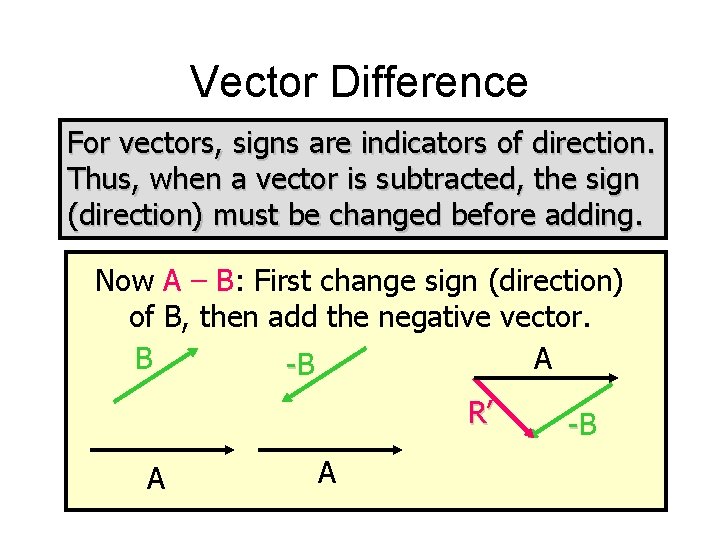
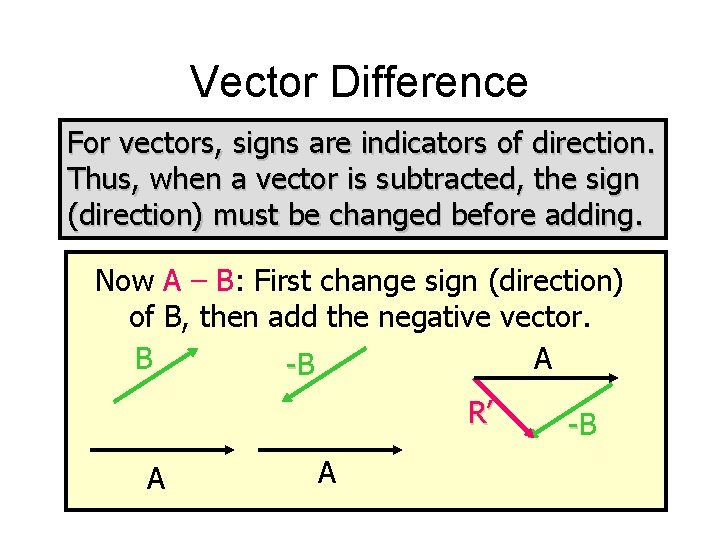
Vector Difference For vectors, signs are indicators of direction. Thus, when a vector is subtracted, the sign (direction) must be changed before adding. Now A – B: First change sign (direction) of B, then add the negative vector. B A -B R’ A A -B
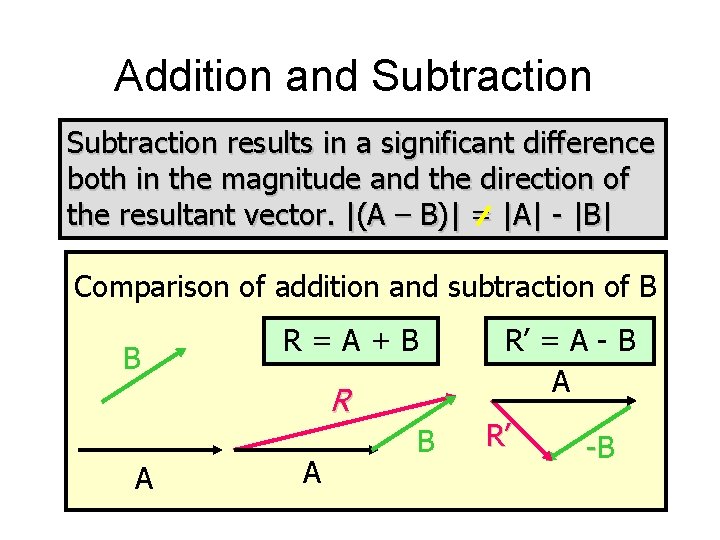
Addition and Subtraction results in a significant difference both in the magnitude and the direction of the resultant vector. |(A – B)| = |A| - |B| Comparison of addition and subtraction of B B R=A+B R A A B R’ = A - B A R’ -B
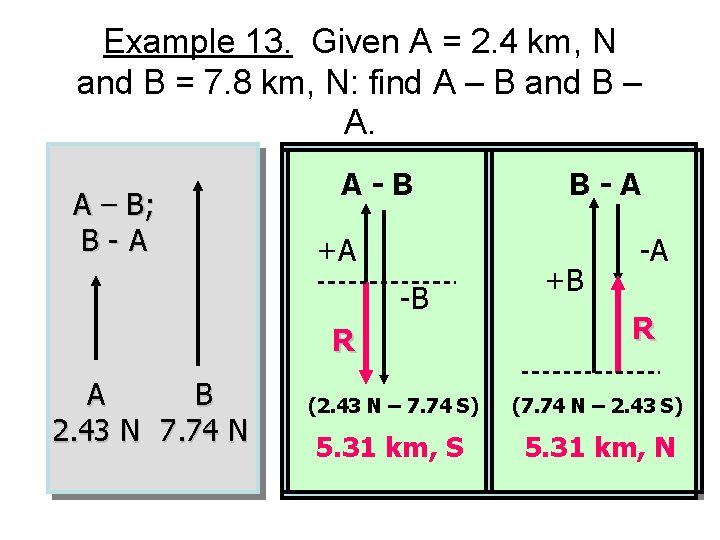
Example 13. Given A = 2. 4 km, N and B = 7. 8 km, N: find A – B and B – A. A – B; B-A A-B +A -B R A B 2. 43 N 7. 74 N B-A +B -A R (2. 43 N – 7. 74 S) (7. 74 N – 2. 43 S) 5. 31 km, S 5. 31 km, N
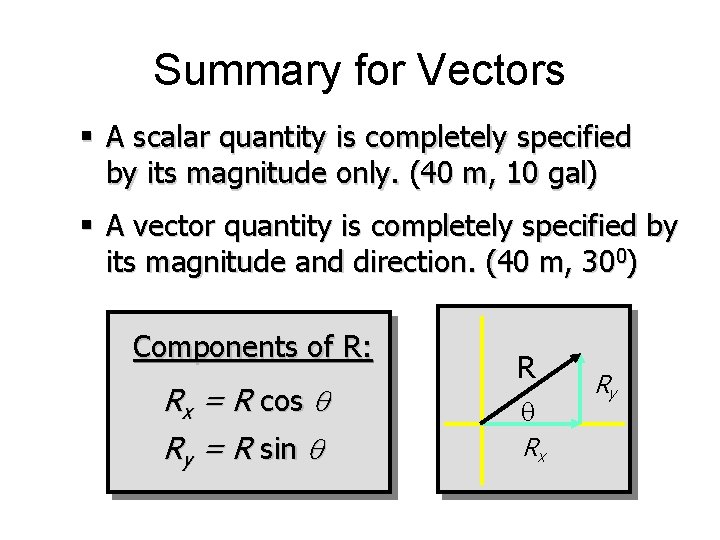
Summary for Vectors § A scalar quantity is completely specified by its magnitude only. (40 m, 10 gal) § A vector quantity is completely specified by its magnitude and direction. (40 m, 300) Components of R: Rx = R cos q Ry = R sin q R Rx Ry
Summary Continued: § Finding the resultant of two perpendicular vectors is like converting from polar (R, ) to the rectangular (Rx, Ry) coordinates. Resultant of Vectors: R Rx Ry
Component Method for Vectors § Start at origin and draw each vector in succession forming a labeled polygon. § Draw resultant from origin to tip of last vector, noting the quadrant of resultant. § Write each vector in i, j notation (Rx, Ry). § Add vectors algebraically to get resultant in i, j notation. Then convert to (R, q).
Vector Difference For vectors, signs are indicators of direction. Thus, when a vector is subtracted, the sign (direction) must be changed before adding. Now A – B: First change sign (direction) of B, then add the negative vector. B A -B R’ A A -B