
Vectors Finding Distances r a b What would
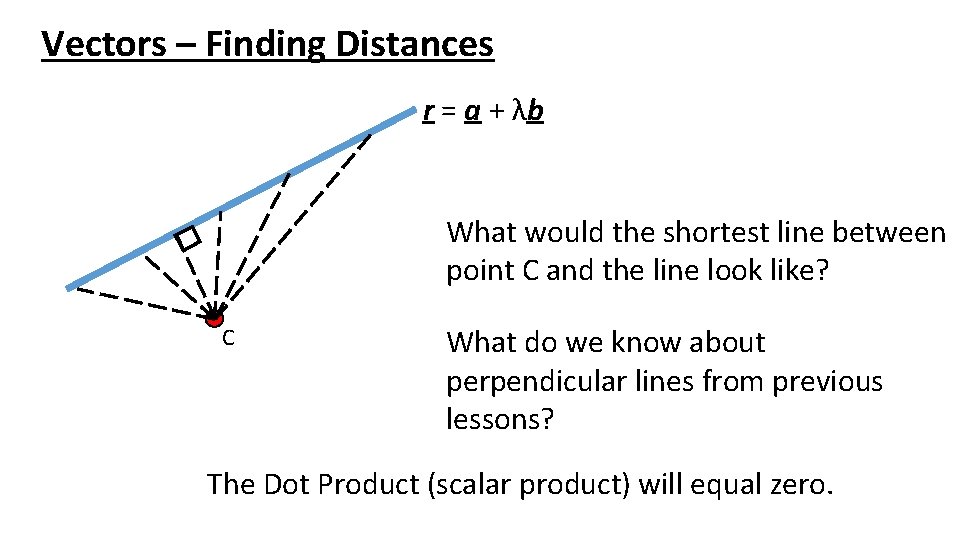
Vectors – Finding Distances r = a + λb What would the shortest line between point C and the line look like? C What do we know about perpendicular lines from previous lessons? The Dot Product (scalar product) will equal zero.
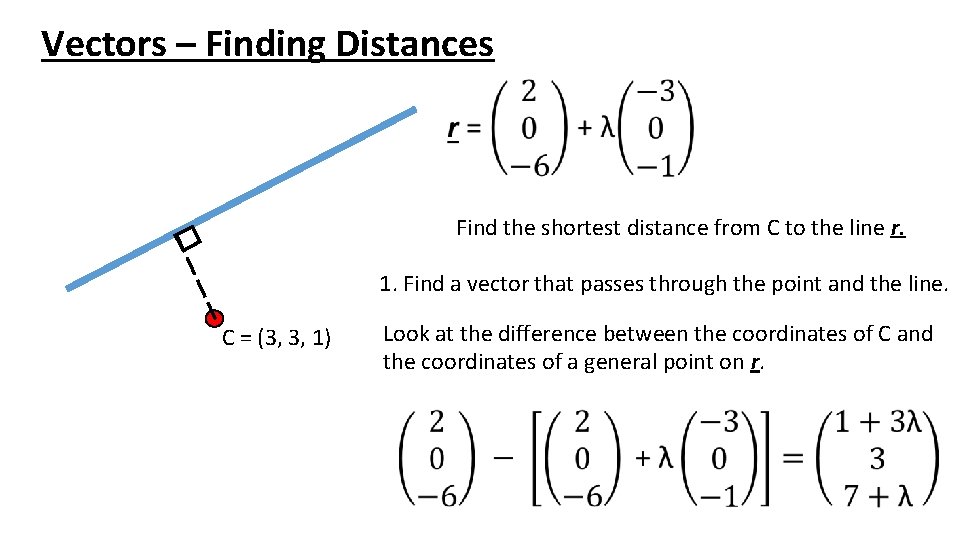
Vectors – Finding Distances Find the shortest distance from C to the line r. 1. Find a vector that passes through the point and the line. C = (3, 3, 1) Look at the difference between the coordinates of C and the coordinates of a general point on r.
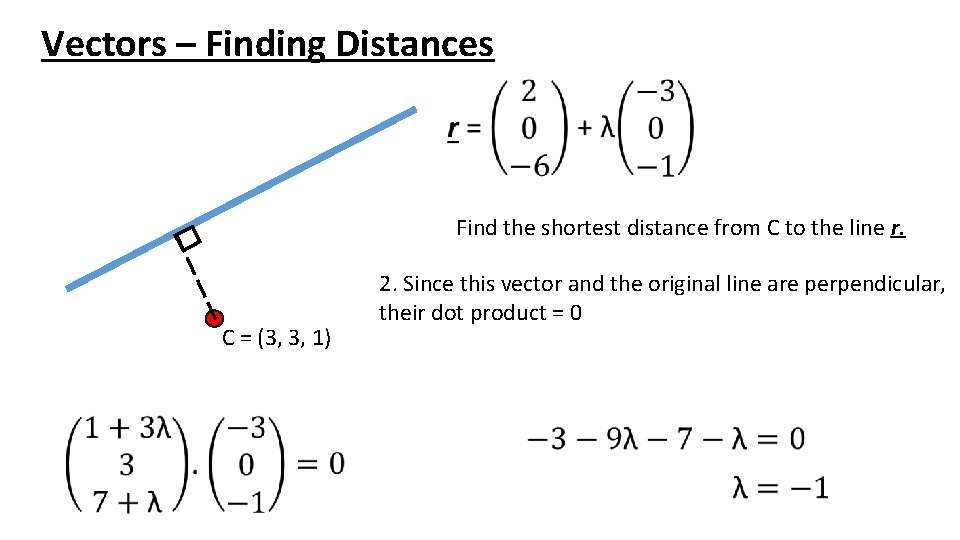
Vectors – Finding Distances Find the shortest distance from C to the line r. C = (3, 3, 1) 2. Since this vector and the original line are perpendicular, their dot product = 0
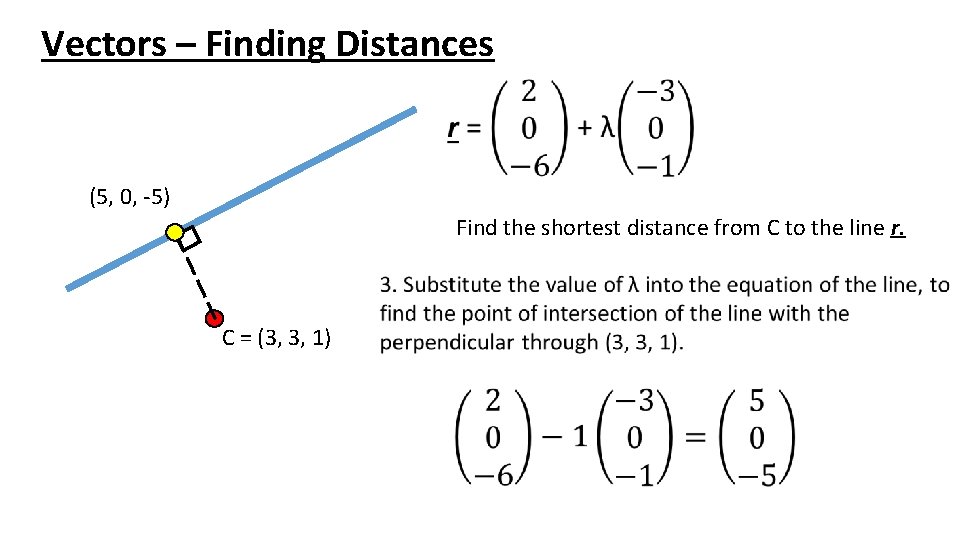
Vectors – Finding Distances (5, 0, -5) Find the shortest distance from C to the line r. C = (3, 3, 1)
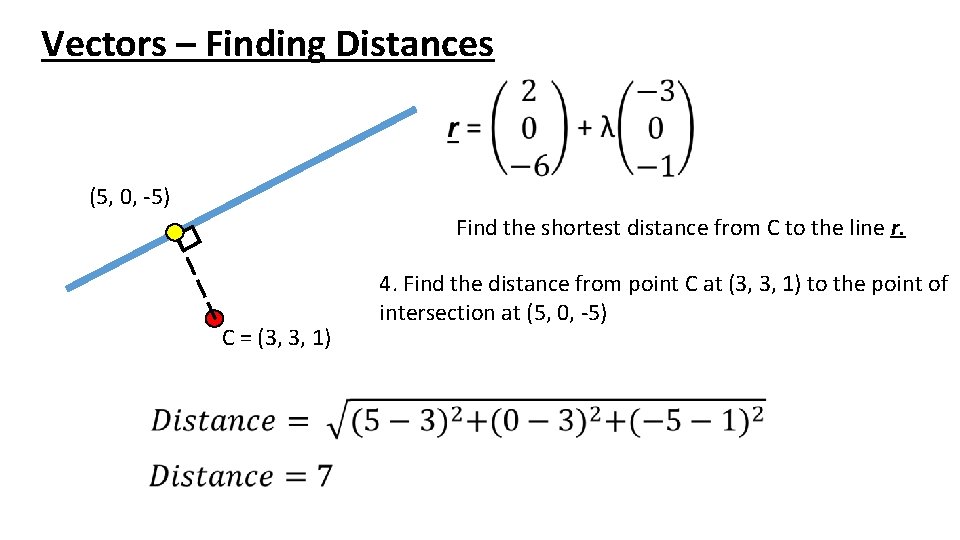
Vectors – Finding Distances (5, 0, -5) Find the shortest distance from C to the line r. C = (3, 3, 1) 4. Find the distance from point C at (3, 3, 1) to the point of intersection at (5, 0, -5)

Vectors – Finding Distances r = a + λb r = c + μb If two lines do not intersect then we have two cases to consider: the lines are parallel or they are skew. If two lines are parallel, since their separation is the same all the way along the line, we can choose any point on either line and use the previous method to find the distance from the point to the other line.

Vectors – Finding Distances r = a + λb P r = c + μb Q If two lines are skew, there will be particular points on each line which gives the minimum distance. What can we say about the vector between these points?
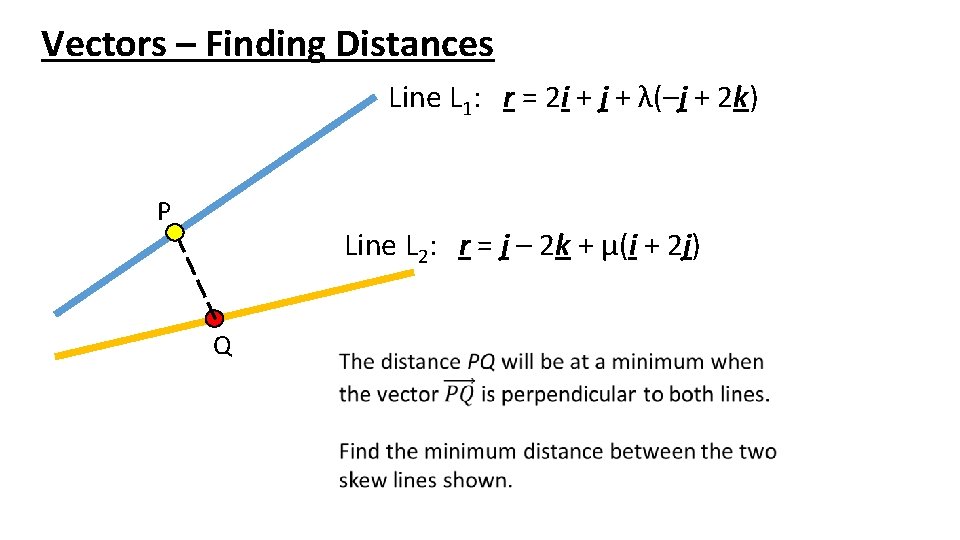
Vectors – Finding Distances Line L 1: r = 2 i + j + λ(–j + 2 k) P Line L 2: r = j – 2 k + μ(i + 2 j) Q
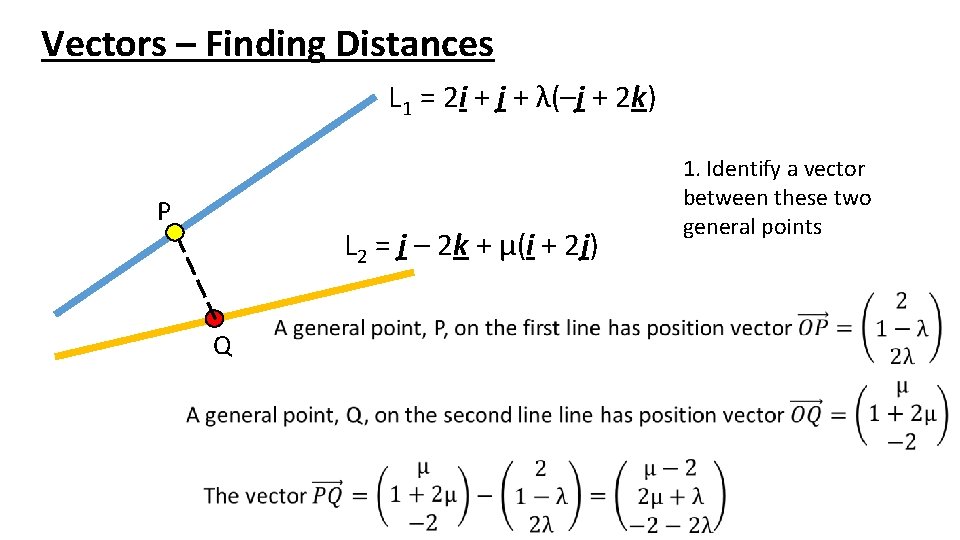
Vectors – Finding Distances L 1 = 2 i + j + λ(–j + 2 k) P L 2 = j – 2 k + μ(i + 2 j) Q 1. Identify a vector between these two general points
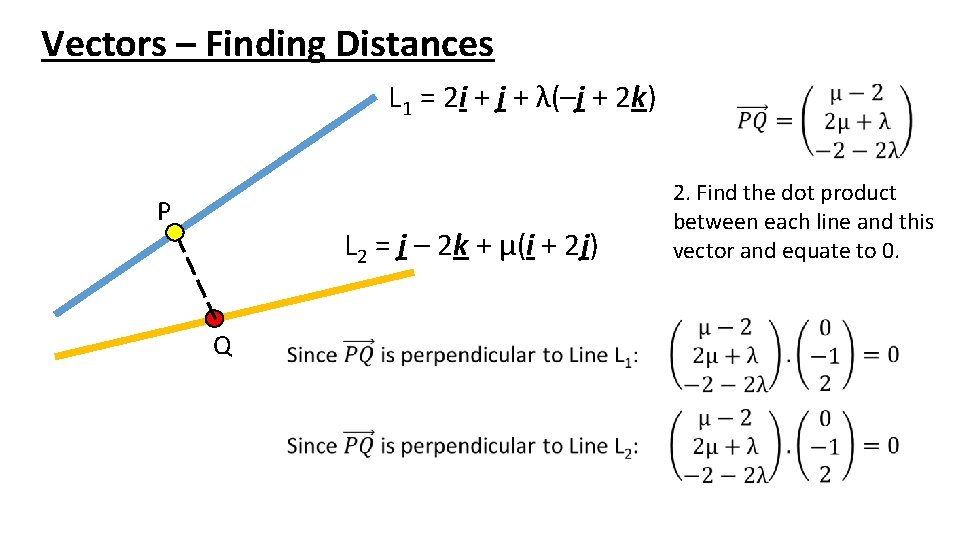
Vectors – Finding Distances L 1 = 2 i + j + λ(–j + 2 k) P L 2 = j – 2 k + μ(i + 2 j) Q 2. Find the dot product between each line and this vector and equate to 0.
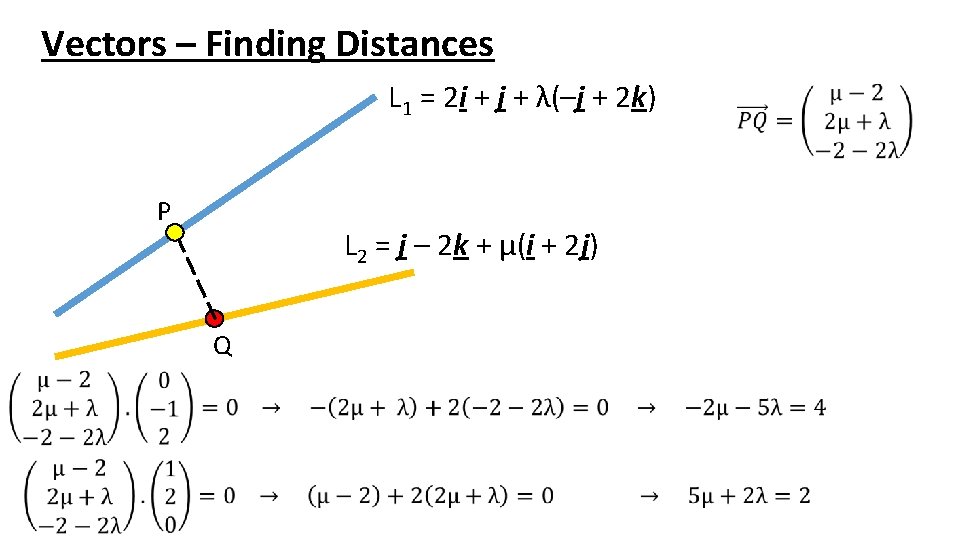
Vectors – Finding Distances L 1 = 2 i + j + λ(–j + 2 k) P L 2 = j – 2 k + μ(i + 2 j) Q
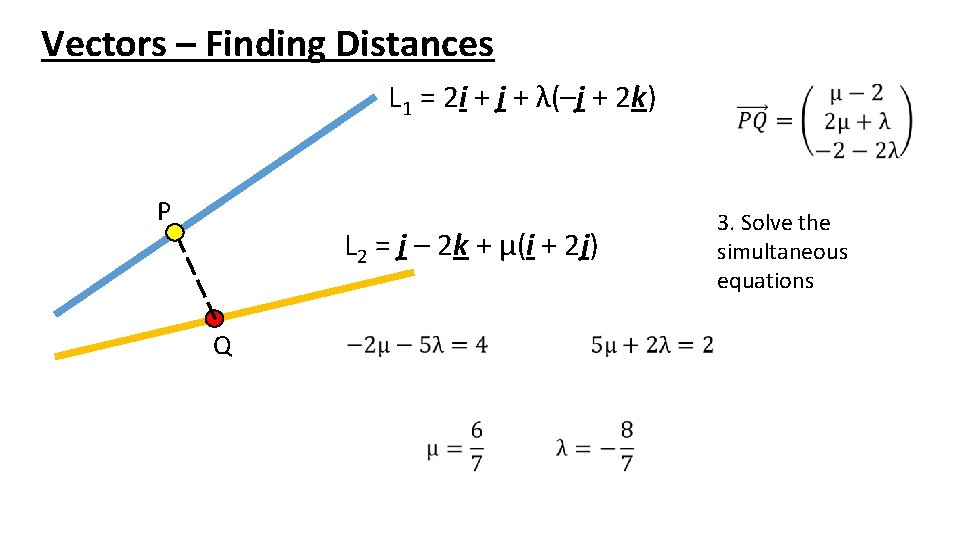
Vectors – Finding Distances L 1 = 2 i + j + λ(–j + 2 k) P L 2 = j – 2 k + μ(i + 2 j) Q 3. Solve the simultaneous equations
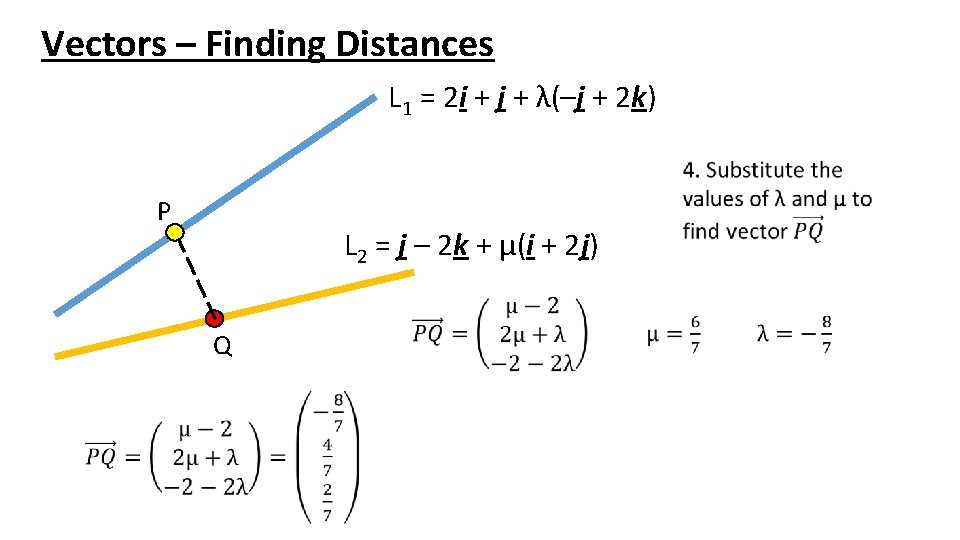
Vectors – Finding Distances L 1 = 2 i + j + λ(–j + 2 k) P L 2 = j – 2 k + μ(i + 2 j) Q
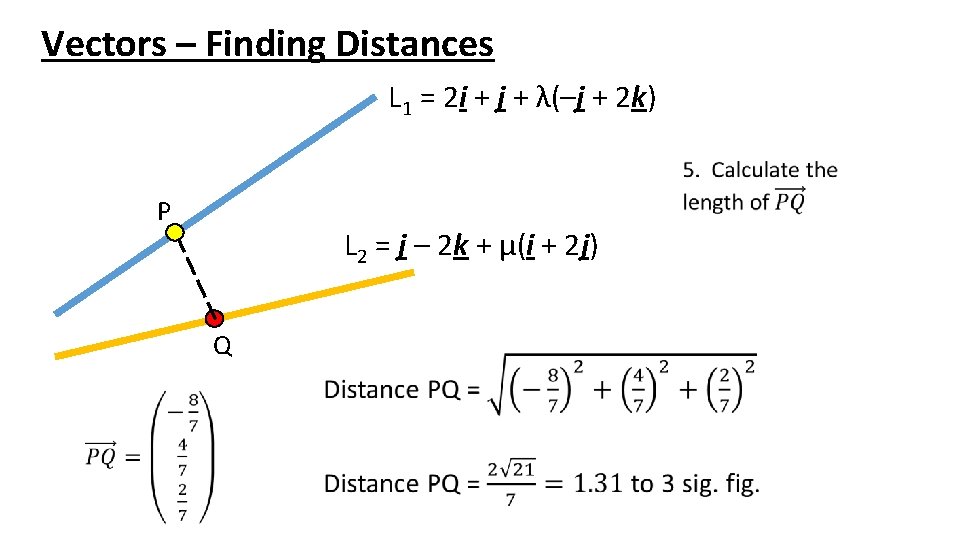
Vectors – Finding Distances L 1 = 2 i + j + λ(–j + 2 k) P L 2 = j – 2 k + μ(i + 2 j) Q
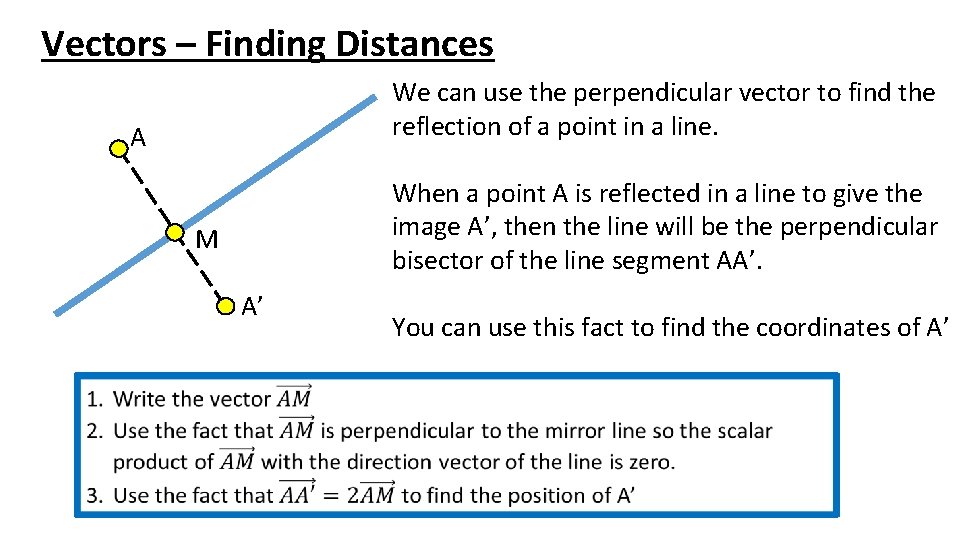
Vectors – Finding Distances We can use the perpendicular vector to find the reflection of a point in a line. A When a point A is reflected in a line to give the image A’, then the line will be the perpendicular bisector of the line segment AA’. M A’ You can use this fact to find the coordinates of A’
- Slides: 15