
Vectors 2 3 Dot Products and Vector Projections
















- Slides: 40
Vectors 2 – 3 Dot Products and Vector Projections
Then & Now: Then: Now: Found magnitudes of and operated with algebraic vectors. 1. Find the dot product of two vectors. 2. Find the projection of one vector onto another.
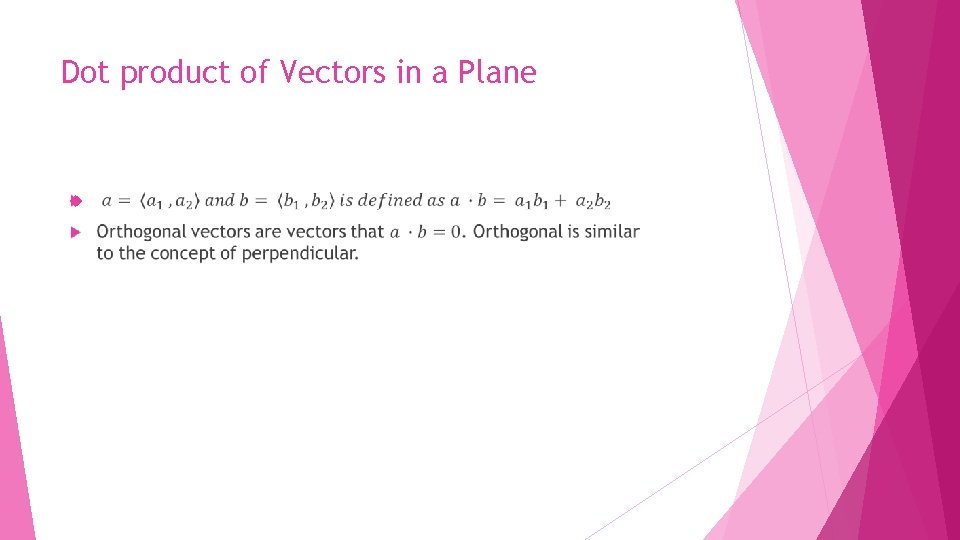
Dot product of Vectors in a Plane
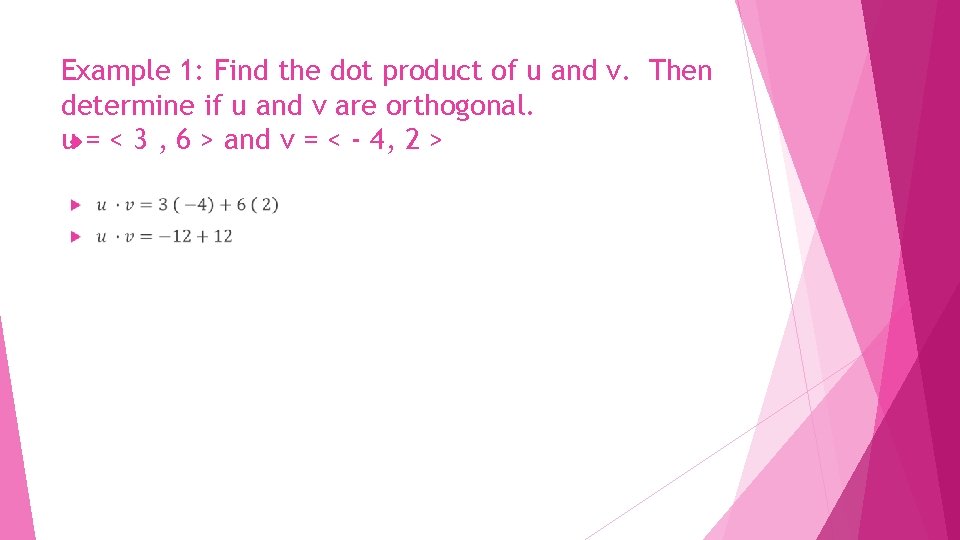
Example 1: Find the dot product of u and v. Then determine if u and v are orthogonal. u = < 3 , 6 > and v = < - 4, 2 >
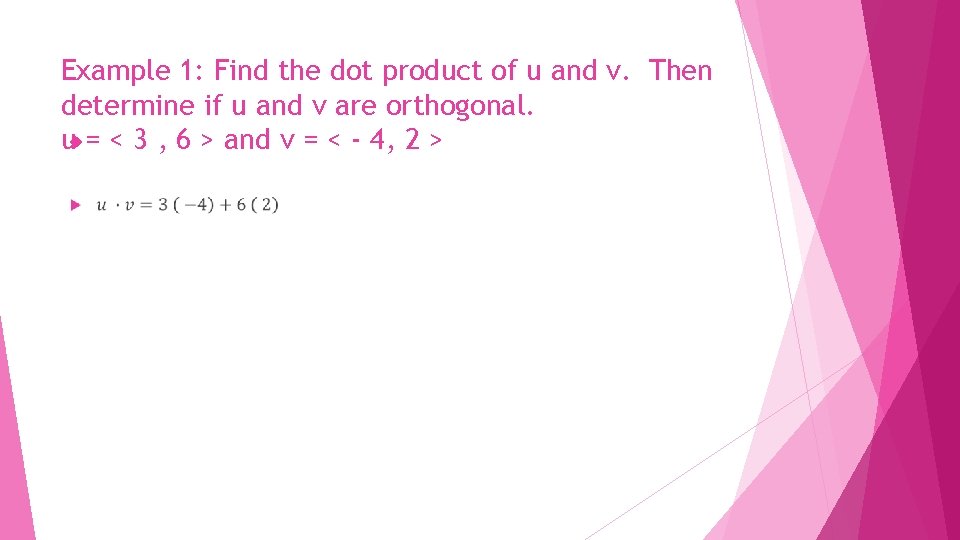
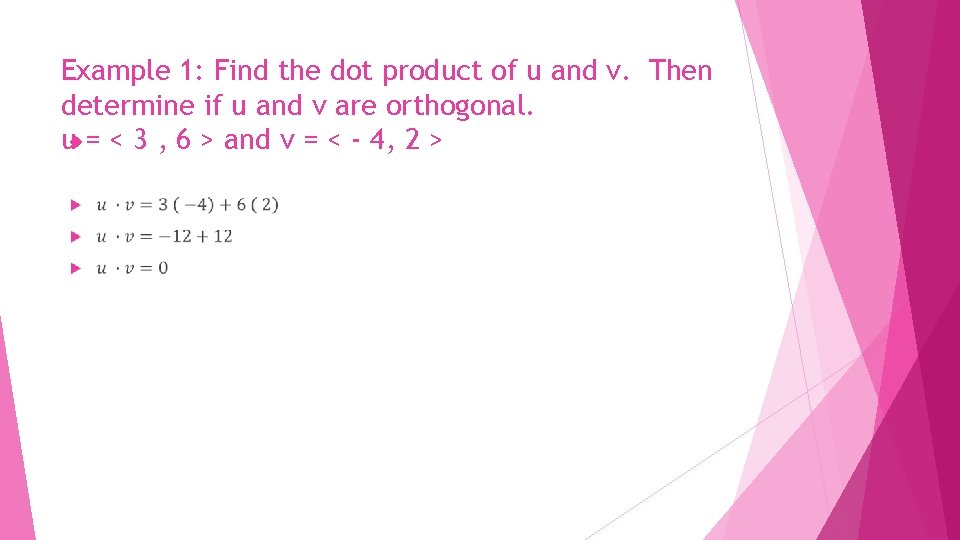
Example 1: Find the dot product of u and v. Then determine if u and v are orthogonal. u = < 3 , 6 > and v = < - 4, 2 >
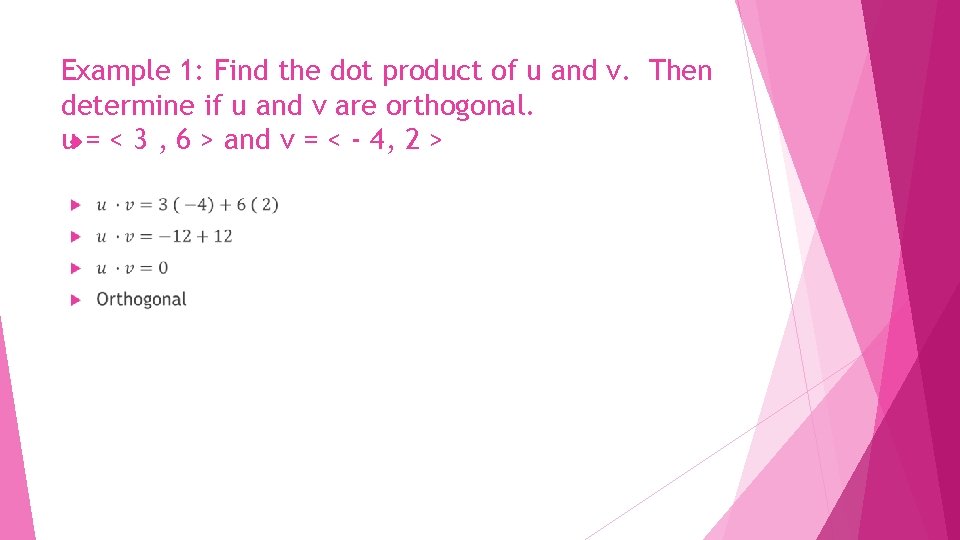
Example 1: Find the dot product of u and v. Then determine if u and v are orthogonal. u = < 3 , 6 > and v = < - 4, 2 >
Example 1: Find the dot product of u and v. Then determine if u and v are orthogonal. u = < 3 , 6 > and v = < - 4, 2 >
Example 1: Find the dot product of u and v. Then determine if u and v are orthogonal. u = < 3 , 6 > and v = < - 4, 2 >
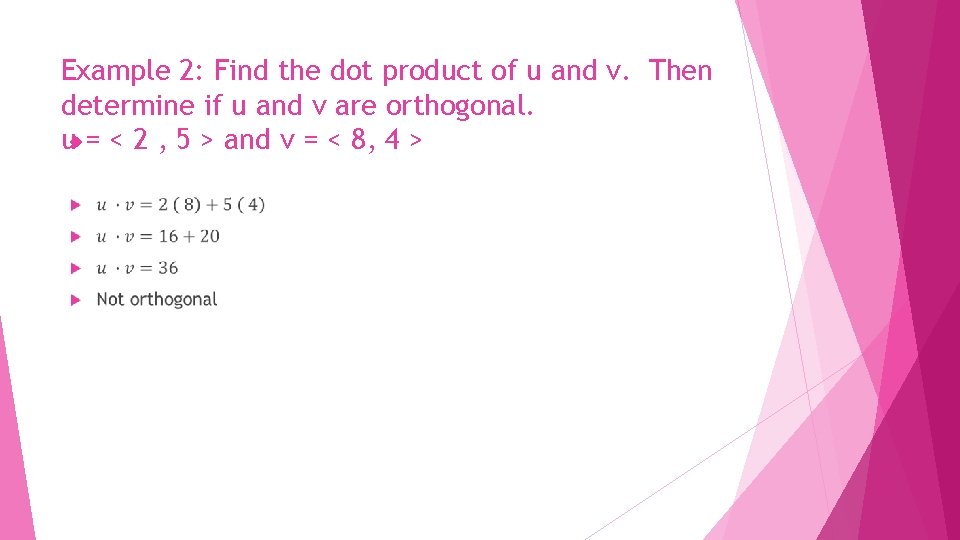
Example 2: Find the dot product of u and v. Then determine if u and v are orthogonal. u = < 2 , 5 > and v = < 8, 4 >
Example 2: Find the dot product of u and v. Then determine if u and v are orthogonal. u = < 2 , 5 > and v = < 8, 4 >
Example 3: Find the dot product of u and v. Then determine if u and v are orthogonal. u = < 3 , - 2> and v = < - 5, 1 >
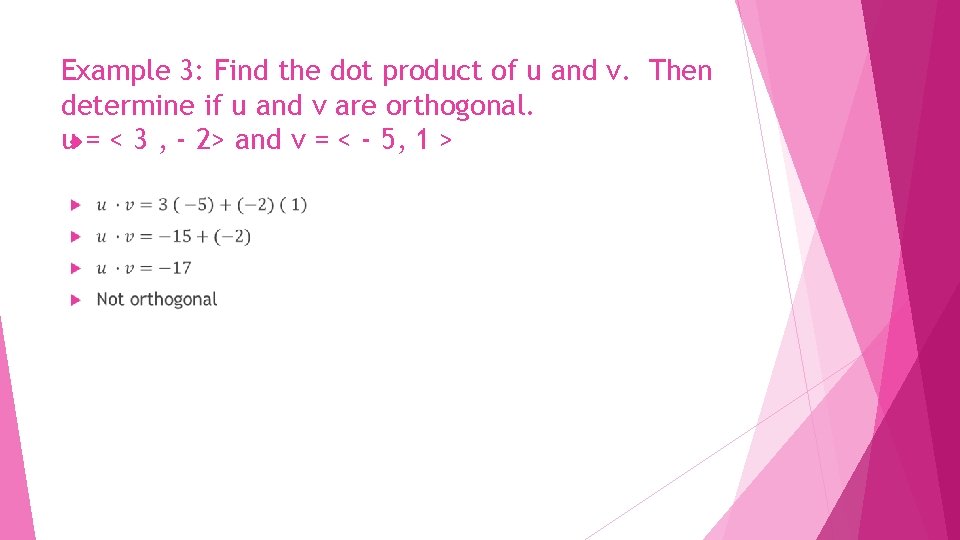
Example 3: Find the dot product of u and v. Then determine if u and v are orthogonal. u = < 3 , - 2> and v = < - 5, 1 >
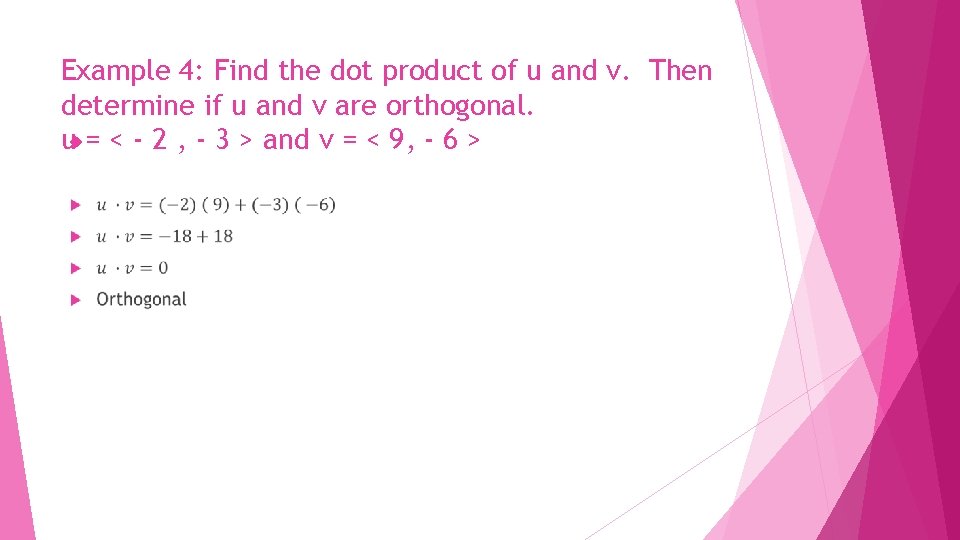
Example 4: Find the dot product of u and v. Then determine if u and v are orthogonal. u = < - 2 , - 3 > and v = < 9, - 6 >
Example 4: Find the dot product of u and v. Then determine if u and v are orthogonal. u = < - 2 , - 3 > and v = < 9, - 6 >
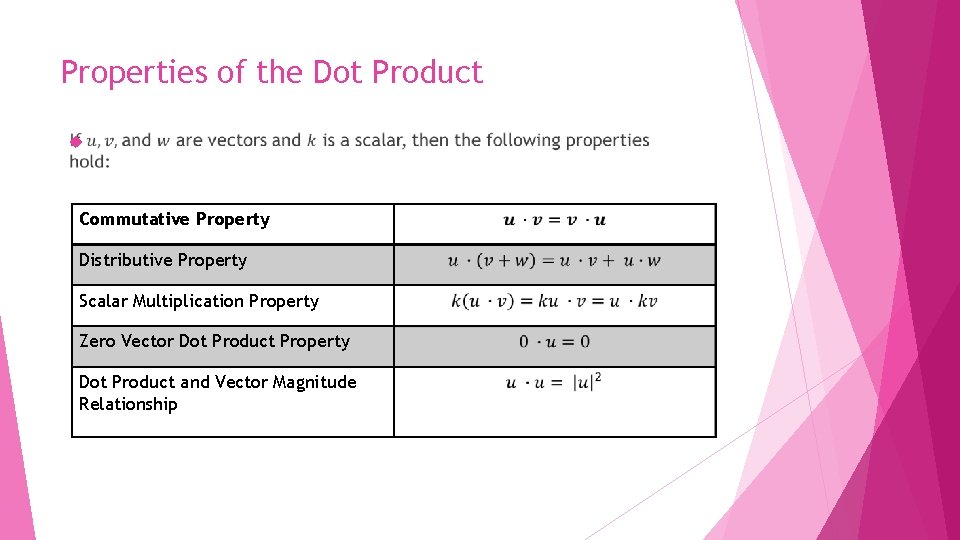
Properties of the Dot Product Commutative Property Distributive Property Scalar Multiplication Property Zero Vector Dot Product Property Dot Product and Vector Magnitude Relationship
Example 5: Use the dot product to find the magnitude of a = < - 5, 12 >.
Example 5: Use the dot product to find the magnitude of a = < - 5, 12 >.
Example 5: Use the dot product to find the magnitude of a = < - 5, 12 >.
Example 5: Use the dot product to find the magnitude of a = < - 5, 12 >.
Example 5: Use the dot product to find the magnitude of a = < - 5, 12 >.
Example 5: Use the dot product to find the magnitude of a = < - 5, 12 >.
Example 6: Use the dot product to find the magnitude of a = < 12, 16 >.
Example 6: Use the dot product to find the magnitude of a = < 12, 16 >.
Example 7: Use the dot product to find the magnitude of a = < - 1, - 7 >.
Example 7: Use the dot product to find the magnitude of a = < - 1, - 7 >.
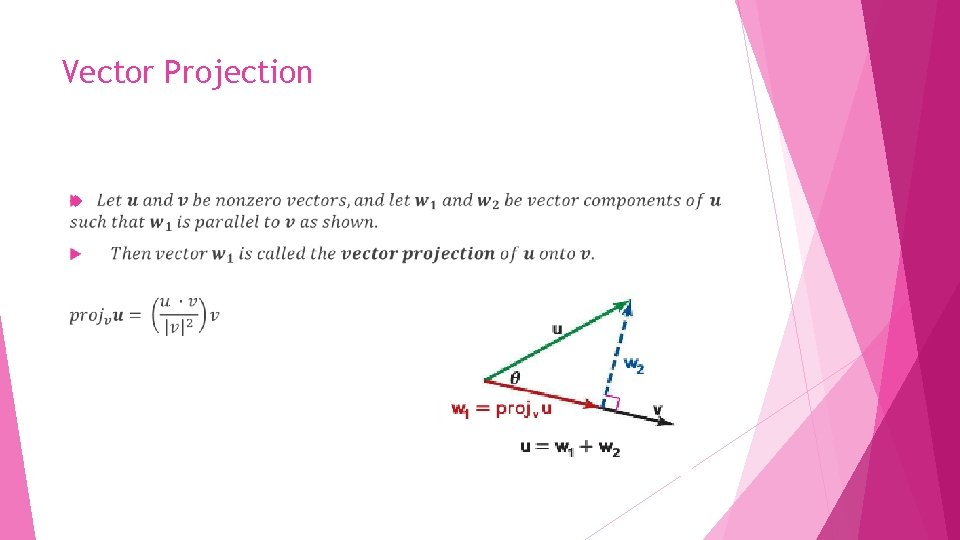
Vector Projection
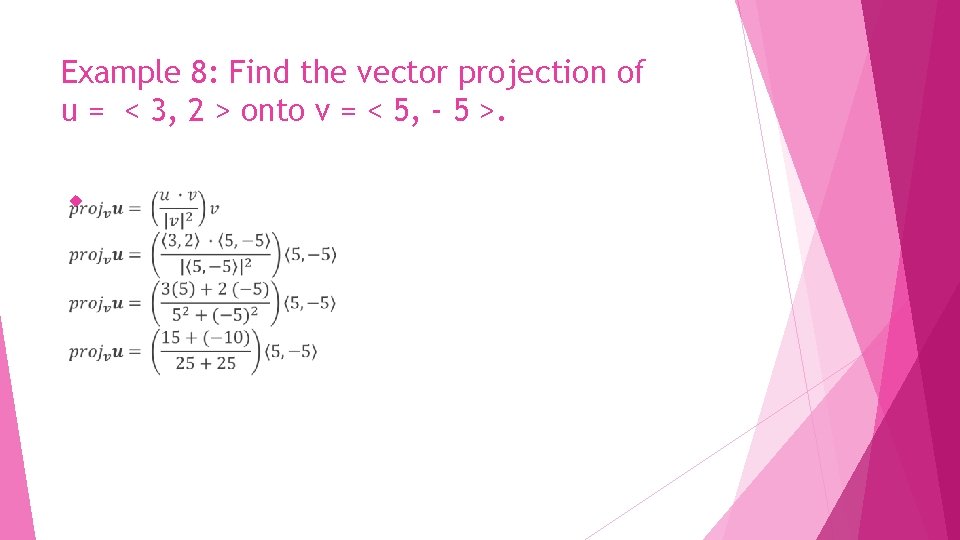
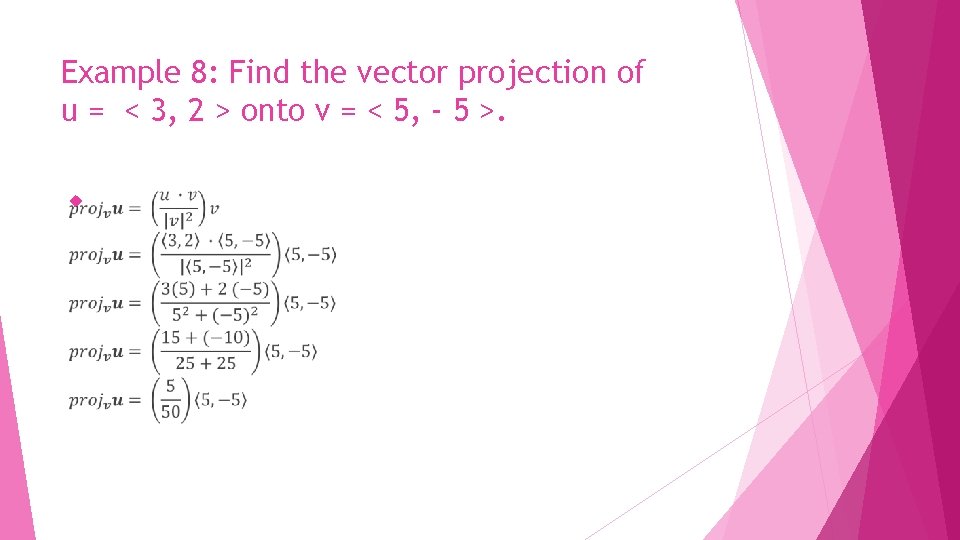
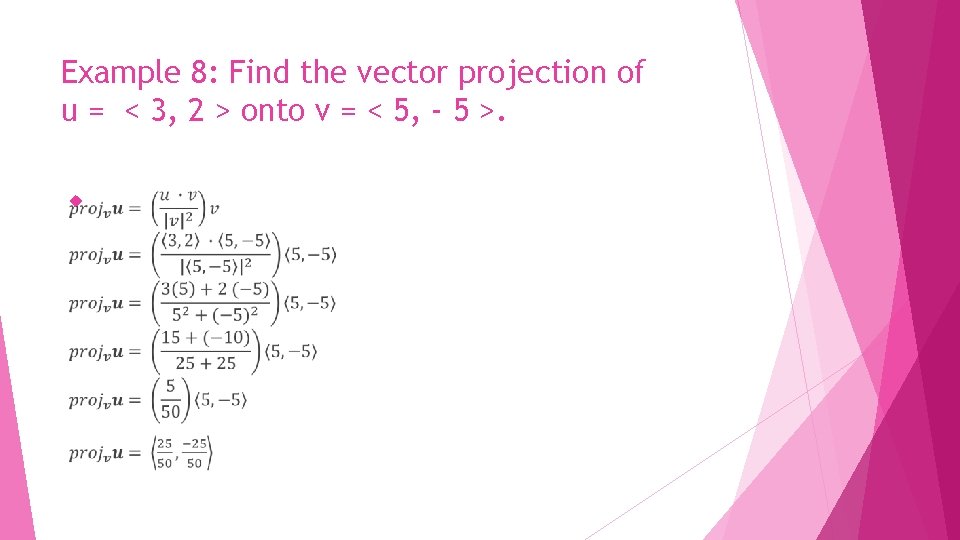
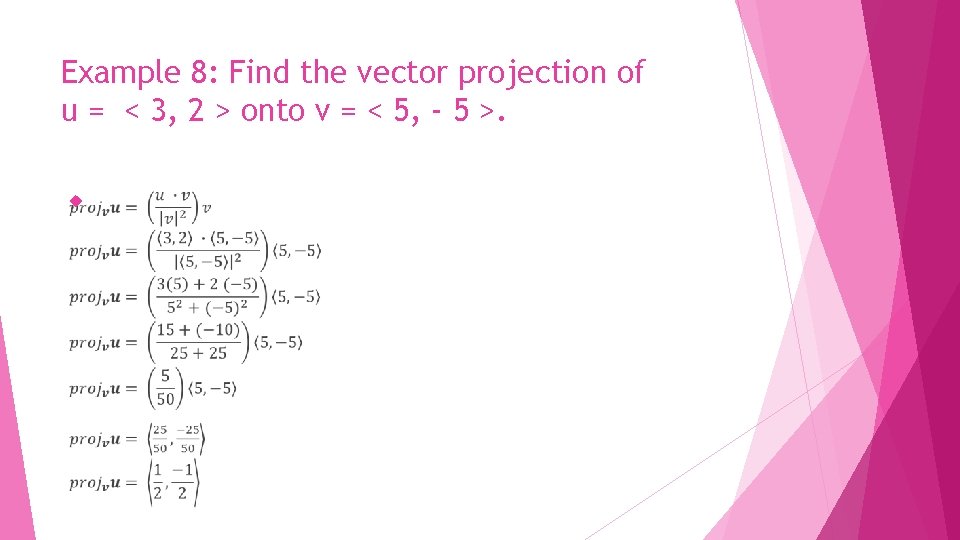
Example 8: Find the vector projection of u = < 3, 2 > onto v = < 5, - 5 >.
Example 8: Find the vector projection of u = < 3, 2 > onto v = < 5, - 5 >.
Example 8: Find the vector projection of u = < 3, 2 > onto v = < 5, - 5 >.
Example 8: Find the vector projection of u = < 3, 2 > onto v = < 5, - 5 >.
Example 8: Find the vector projection of u = < 3, 2 > onto v = < 5, - 5 >.
Example 8: Find the vector projection of u = < 3, 2 > onto v = < 5, - 5 >.
Example 8: Find the vector projection of u = < 3, 2 > onto v = < 5, - 5 >.
Example 8: Find the vector projection of u = < 3, 2 > onto v = < 5, - 5 >.
Example 9: Find the vector projection of u = < 1, 2 > onto v = < 8, 5 >.
Example 9: Find the vector projection of u = < 1, 2 > onto v = < 8, 5 >.
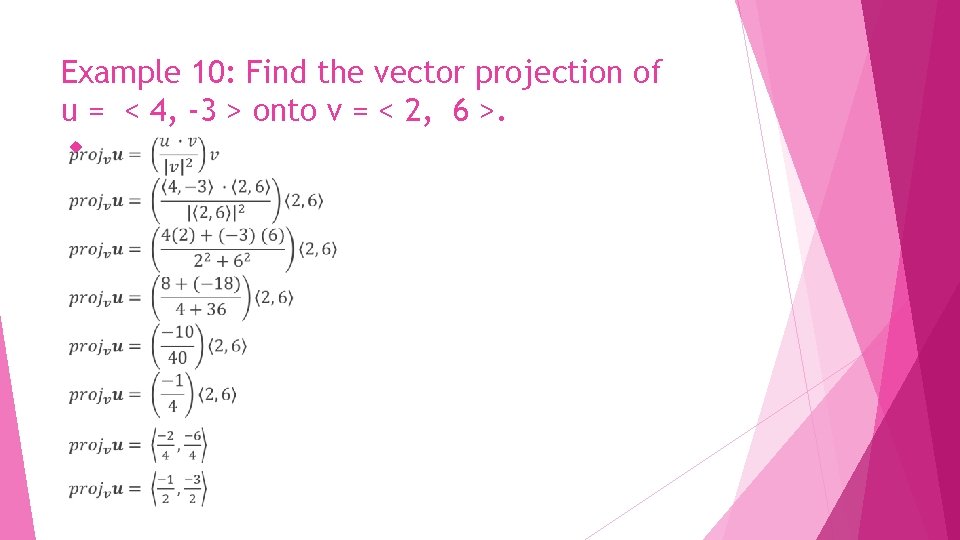
Example 10: Find the vector projection of u = < 4, -3 > onto v = < 2, 6 >.
Example 10: Find the vector projection of u = < 4, -3 > onto v = < 2, 6 >.
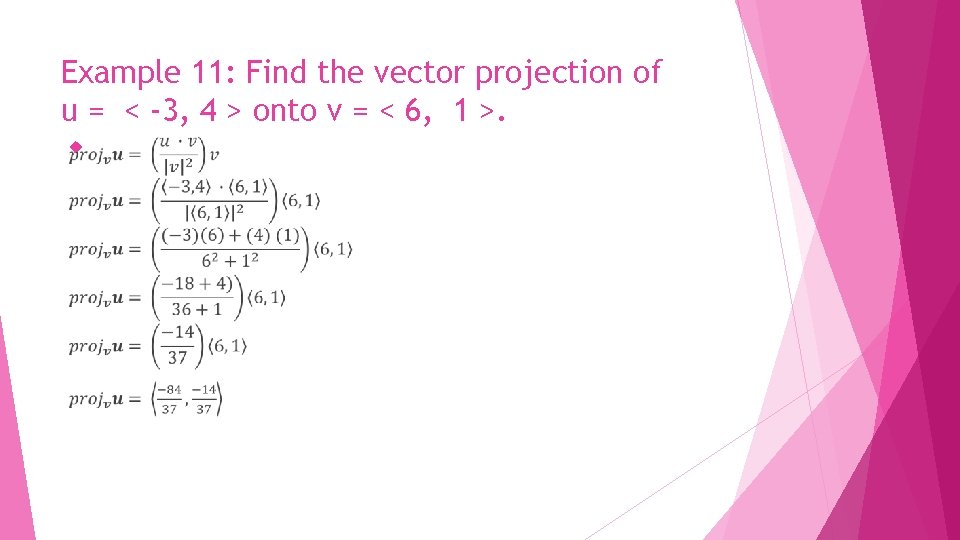
Example 11: Find the vector projection of u = < -3, 4 > onto v = < 6, 1 >.
Example 11: Find the vector projection of u = < -3, 4 > onto v = < 6, 1 >.