
Vectorizing the detector geometry to optimize particle transport

- Slides: 23
Vectorizing the detector geometry to optimize particle transport J. Apostolakis, R. Brun, F. Carminati, A. Gheata, S. Wenzel CHEP 2013, Amsterdam
Motivation Explore possibilities to recast particle simulation so that it takes advantage from all performance dimensions/technologies • Geometry navigation takes a large part of the particle transport budget (4060% in ALICE) Dimension 1 (“sharing data”) : multithreading/multicore In HEP, mainly to reduce memory footprint Dimension 2 (“troughput increase”) : in-core instruction-level parallelism and vectorization Currently not exploited because requires “parallel data” to work on Research projects (GPU prototype and Simulation Vector Prototype) have started targeting beyond dimension 1: parallel data (“baskets”) = particles from different events grouped by logical volumes
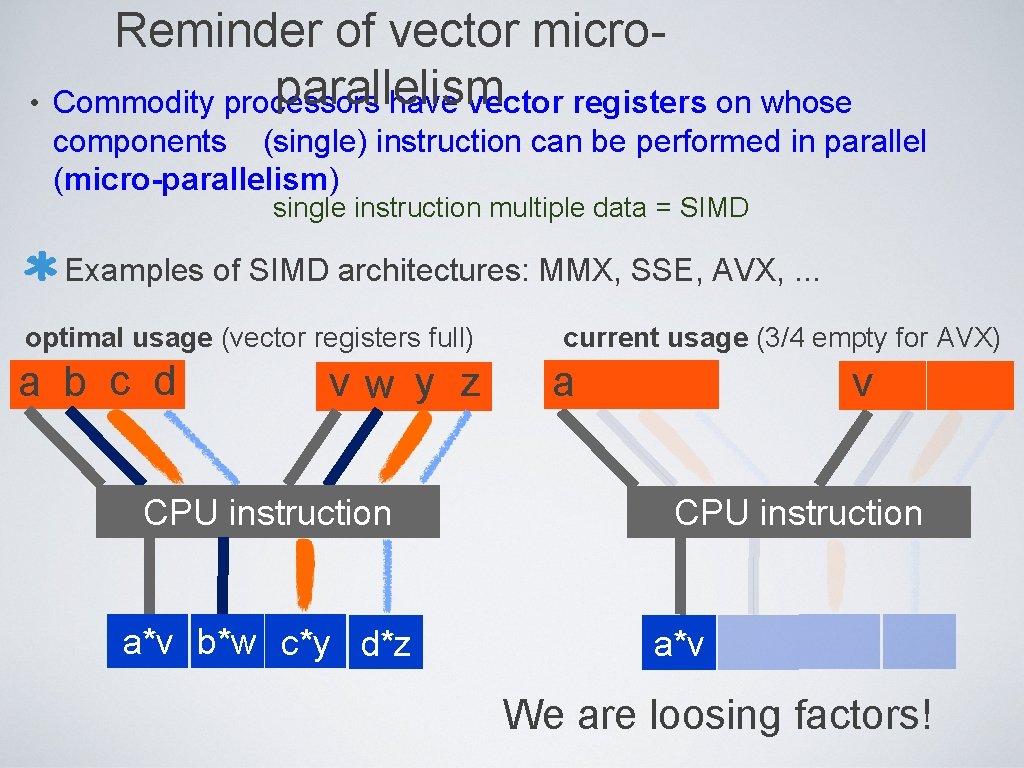
Reminder of vector microparallelism • Commodity processors have vector registers on whose components (single) instruction can be performed in parallel (micro-parallelism) single instruction multiple data = SIMD Examples of SIMD architectures: MMX, SSE, AVX, . . . optimal usage (vector registers full) a b c d vw y z CPU instruction a*v b*w c*y d*z current usage (3/4 empty for AVX) v a CPU instruction a*v We are loosing factors!
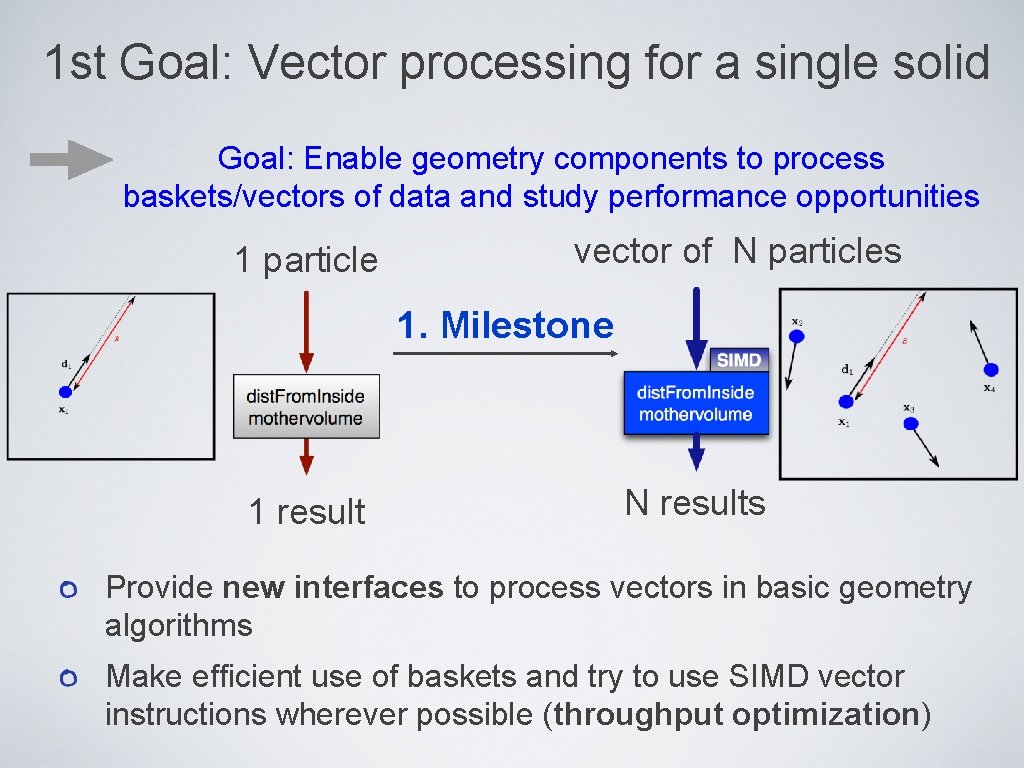
1 st Goal: Vector processing for a single solid Goal: Enable geometry components to process baskets/vectors of data and study performance opportunities 1 particle vector of N particles 1. Milestone 1 result N results Provide new interfaces to process vectors in basic geometry algorithms Make efficient use of baskets and try to use SIMD vector instructions wherever possible (throughput optimization)
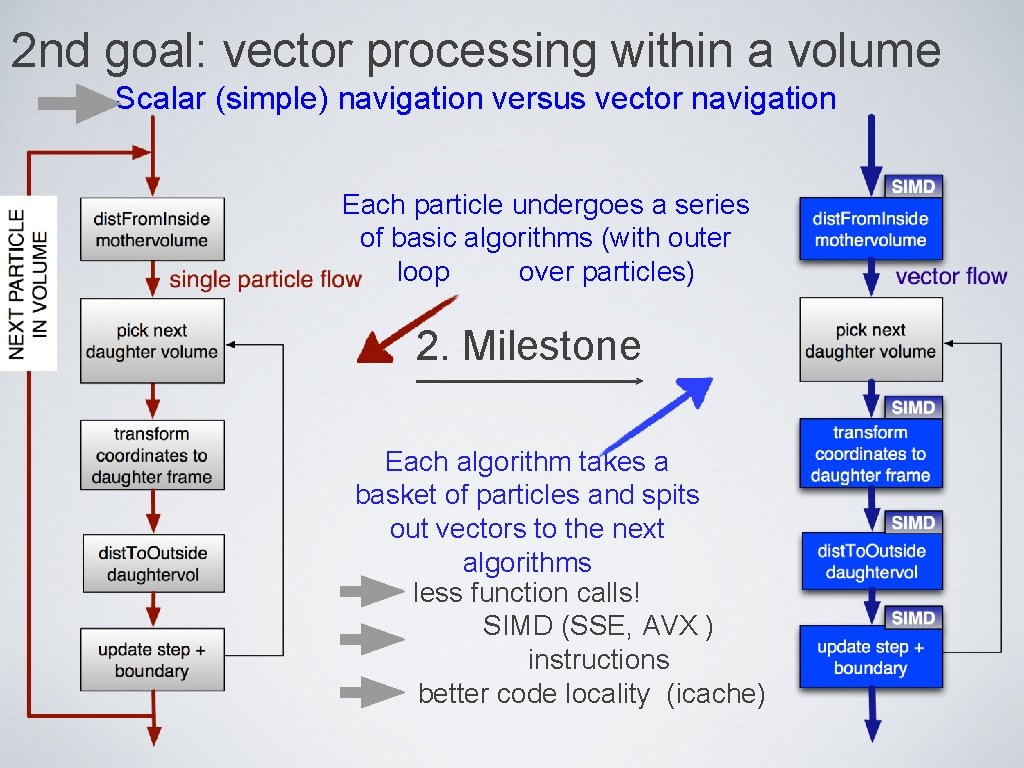
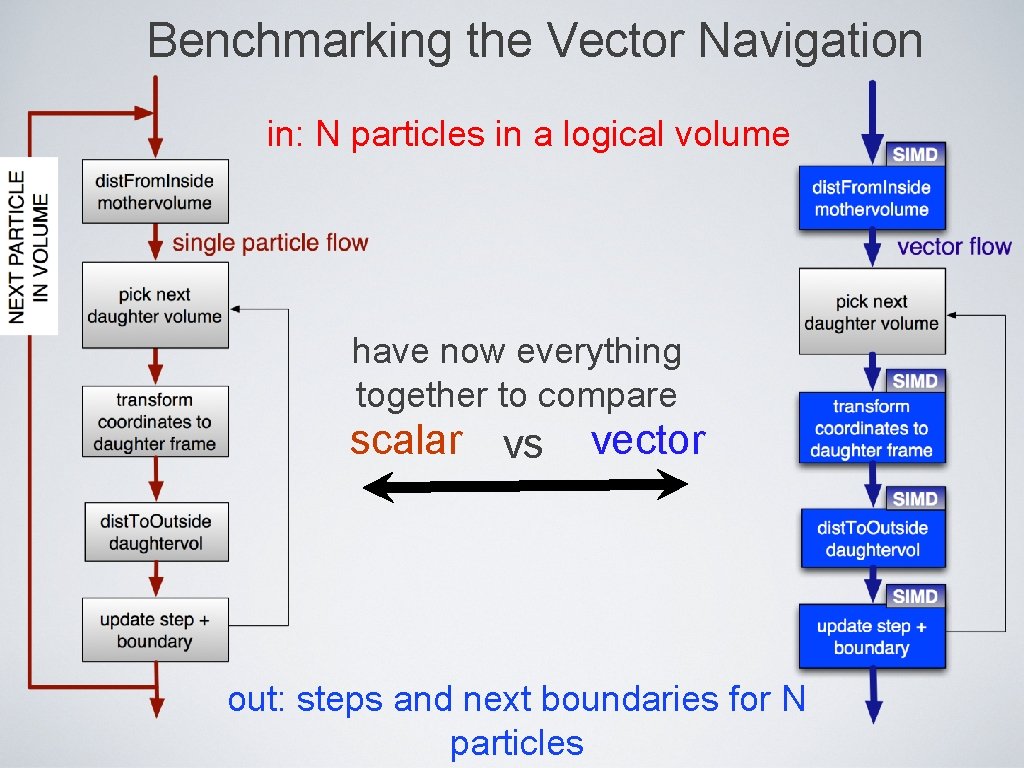
2 nd goal: vector processing within a volume Scalar (simple) navigation versus vector navigation Each particle undergoes a series of basic algorithms (with outer loop over particles) 2. Milestone Each algorithm takes a basket of particles and spits out vectors to the next algorithms less function calls! SIMD (SSE, AVX ) instructions better code locality (icache)
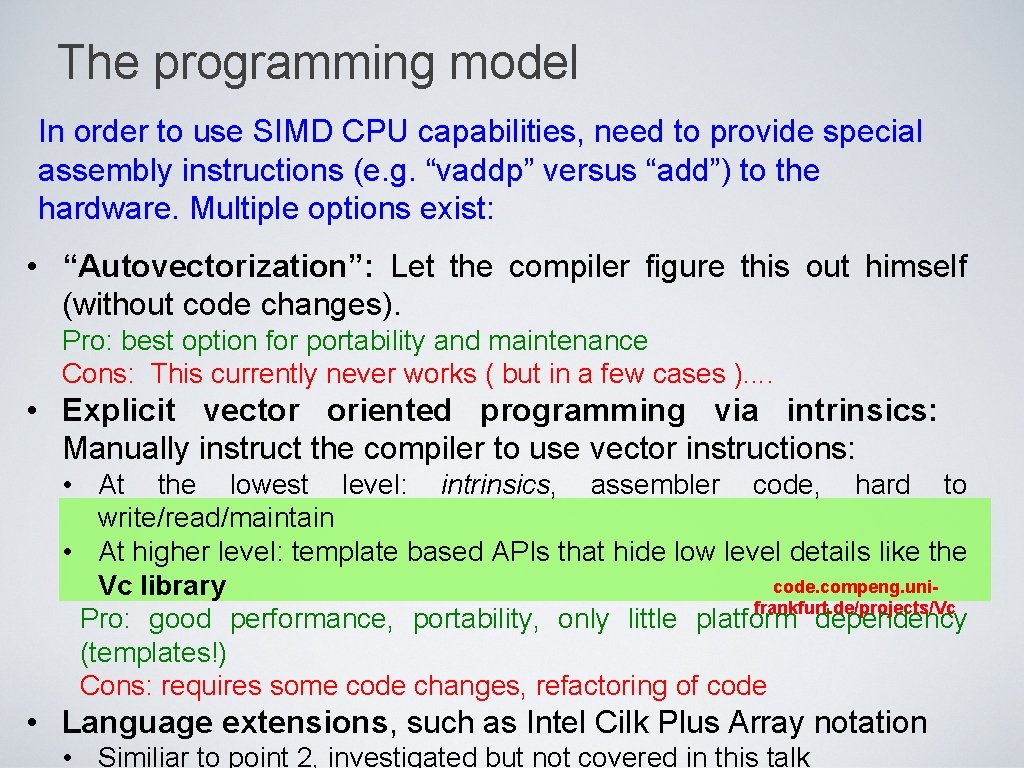
The programming model In order to use SIMD CPU capabilities, need to provide special assembly instructions (e. g. “vaddp” versus “add”) to the hardware. Multiple options exist: • “Autovectorization”: Let the compiler figure this out himself (without code changes). Pro: best option for portability and maintenance Cons: This currently never works ( but in a few cases ). . • Explicit vector oriented programming via intrinsics: Manually instruct the compiler to use vector instructions: • At the lowest level: intrinsics, assembler code, hard to write/read/maintain • At higher level: template based APIs that hide low level details like the code. compeng. uni. Vc library frankfurt. de/projects/Vc Pro: good performance, portability, only little platform dependency (templates!) Cons: requires some code changes, refactoring of code • Language extensions, such as Intel Cilk Plus Array notation • Similiar to point 2, investigated but not covered in this talk
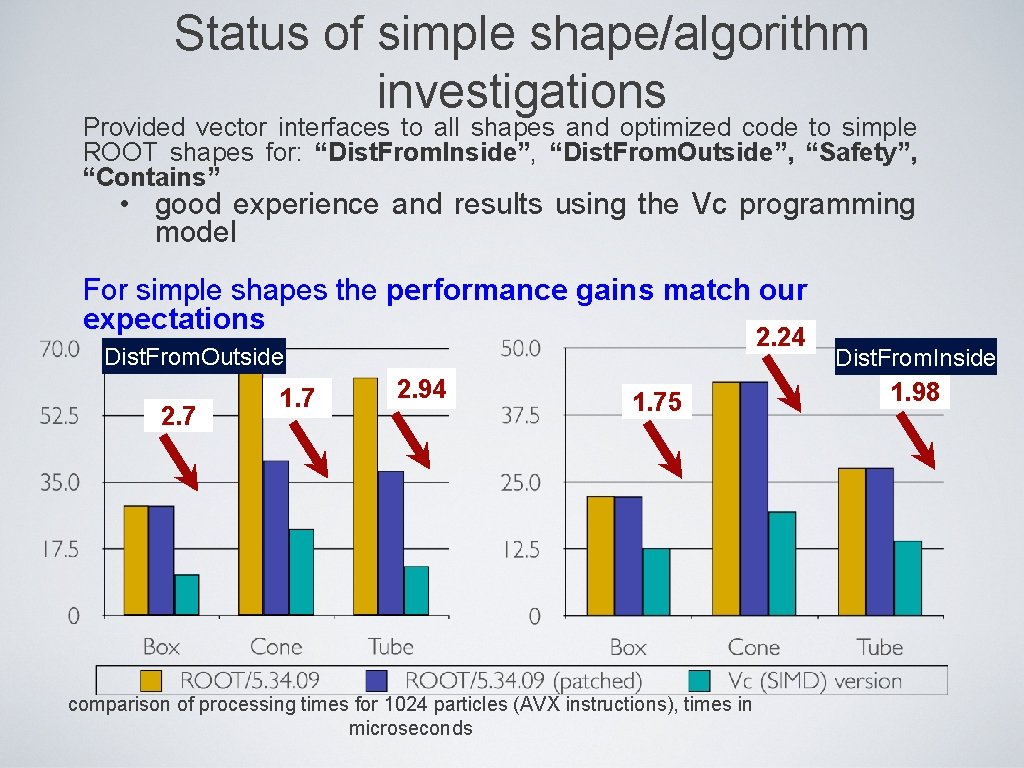
Status of simple shape/algorithm investigations Provided vector interfaces to all shapes and optimized code to simple ROOT shapes for: “Dist. From. Inside”, “Dist. From. Outside”, “Safety”, “Contains” • good experience and results using the Vc programming model For simple shapes the performance gains match our expectations 2. 24 Dist. From. Outside 2. 7 1. 7 2. 94 1. 75 comparison of processing times for 1024 particles (AVX instructions), times in microseconds Dist. From. Inside 1. 98
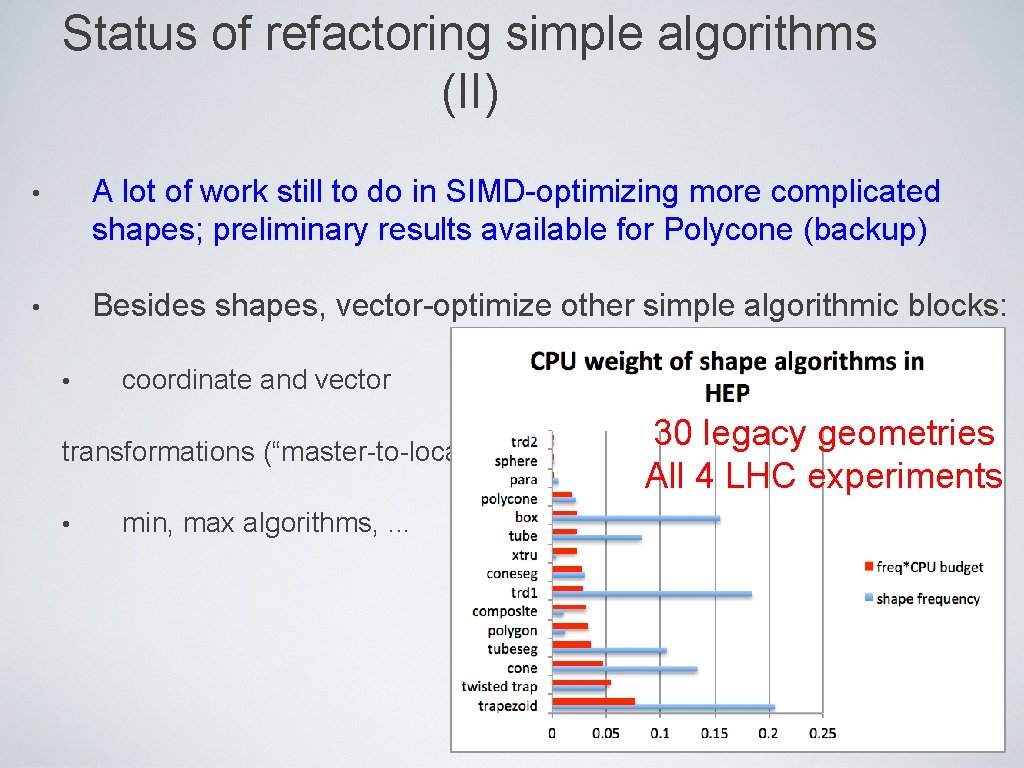
Status of refactoring simple algorithms (II) • A lot of work still to do in SIMD-optimizing more complicated shapes; preliminary results available for Polycone (backup) • Besides shapes, vector-optimize other simple algorithmic blocks: • coordinate and vector transformations (“master-to-local”) • min, max algorithms, . . . 30 legacy geometries All 4 LHC experiments
Benchmarking the Vector Navigation in: N particles in a logical volume have now everything together to compare scalar vs vector out: steps and next boundaries for N particles
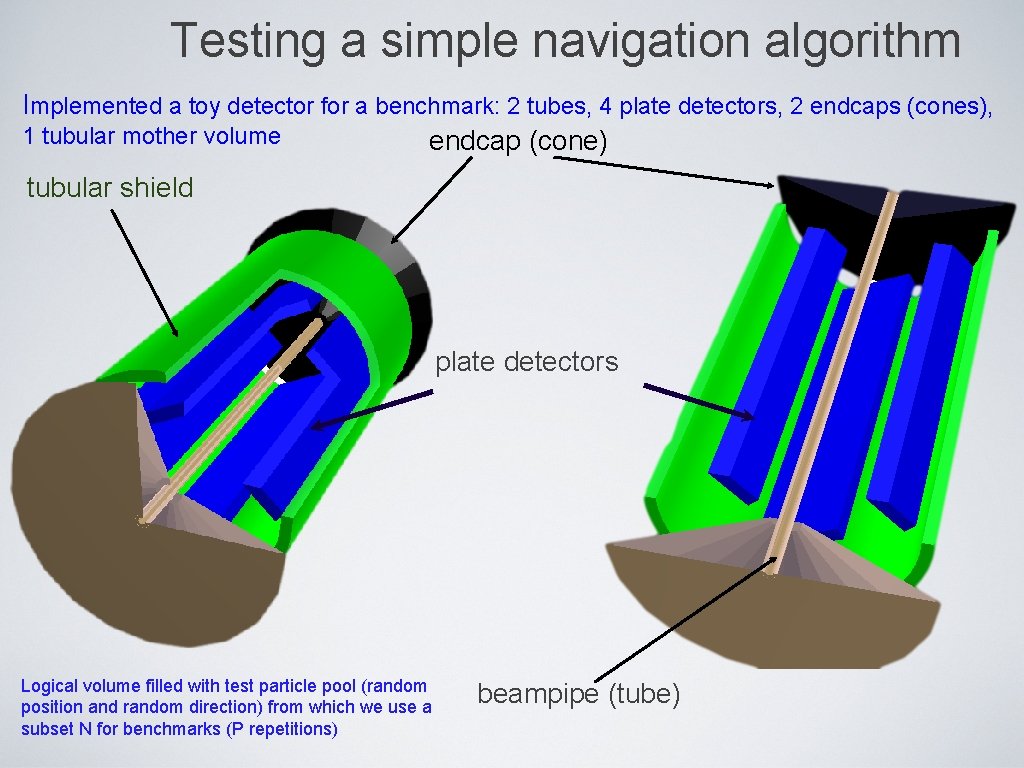
Testing a simple navigation algorithm Implemented a toy detector for a benchmark: 2 tubes, 4 plate detectors, 2 endcaps (cones), 1 tubular mother volume endcap (cone) tubular shield plate detectors Logical volume filled with test particle pool (random position and random direction) from which we use a subset N for benchmarks (P repetitions) beampipe (tube)
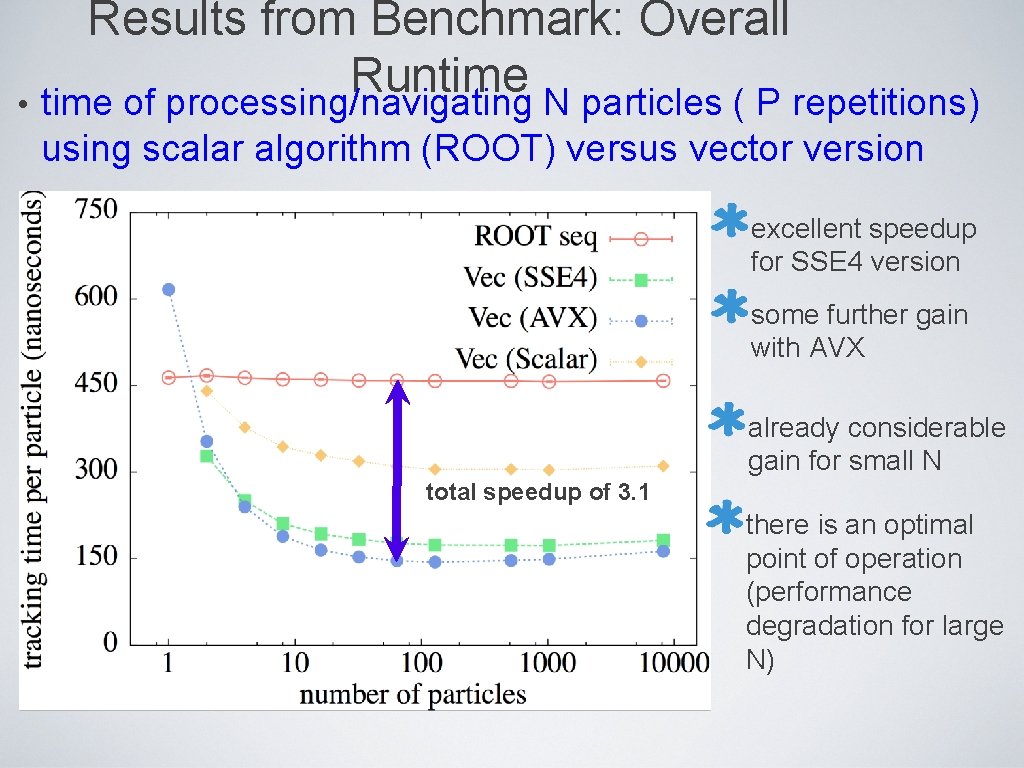
Results from Benchmark: Overall Runtime • time of processing/navigating N particles ( P repetitions) using scalar algorithm (ROOT) versus vector version excellent speedup for SSE 4 version some further gain with AVX already considerable gain for small N total speedup of 3. 1 there is an optimal point of operation (performance degradation for large N)
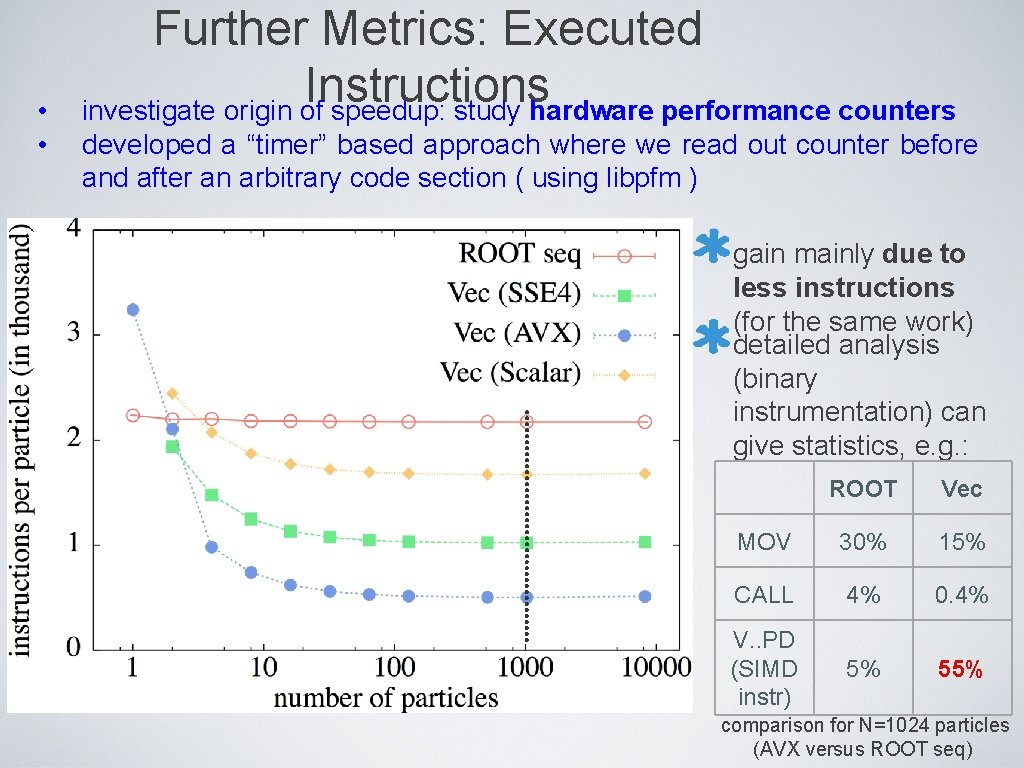
• • Further Metrics: Executed Instructions investigate origin of speedup: study hardware performance counters developed a “timer” based approach where we read out counter before and after an arbitrary code section ( using libpfm ) gain mainly due to less instructions (for the same work) detailed analysis (binary instrumentation) can give statistics, e. g. : ROOT Vec MOV 30% 15% CALL 4% 0. 4% V. . PD (SIMD instr) 5% 55% comparison for N=1024 particles (AVX versus ROOT seq)
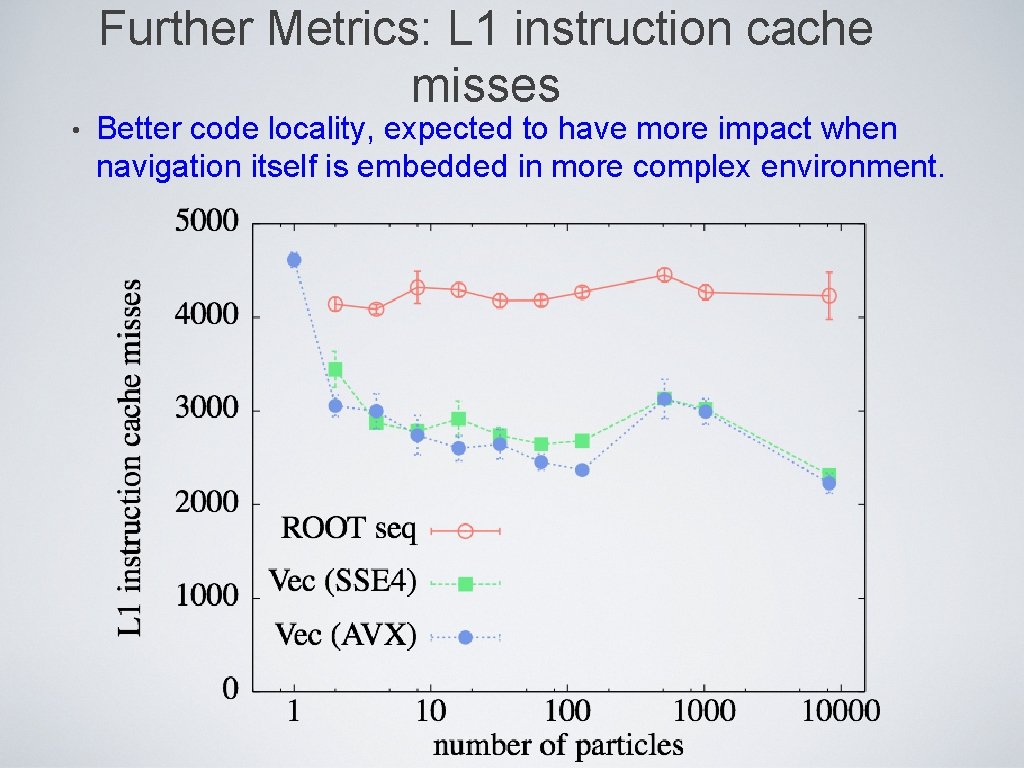
Further Metrics: L 1 instruction cache misses • Better code locality, expected to have more impact when navigation itself is embedded in more complex environment.
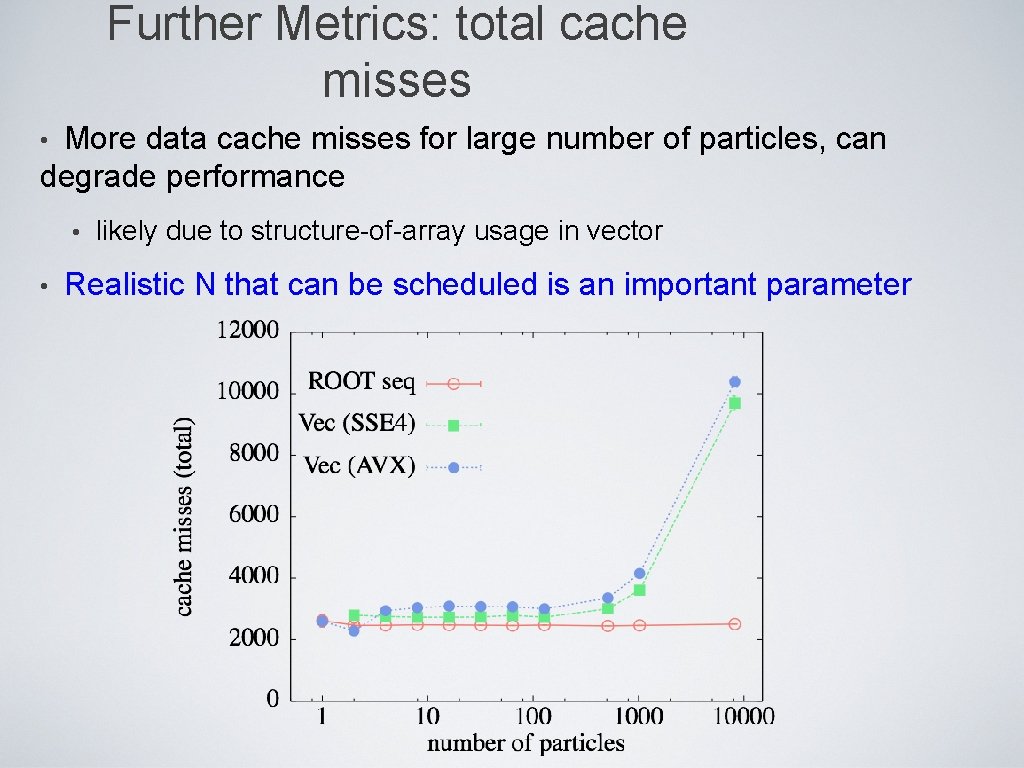
Further Metrics: total cache misses More data cache misses for large number of particles, can degrade performance • • • likely due to structure-of-array usage in vector Realistic N that can be scheduled is an important parameter
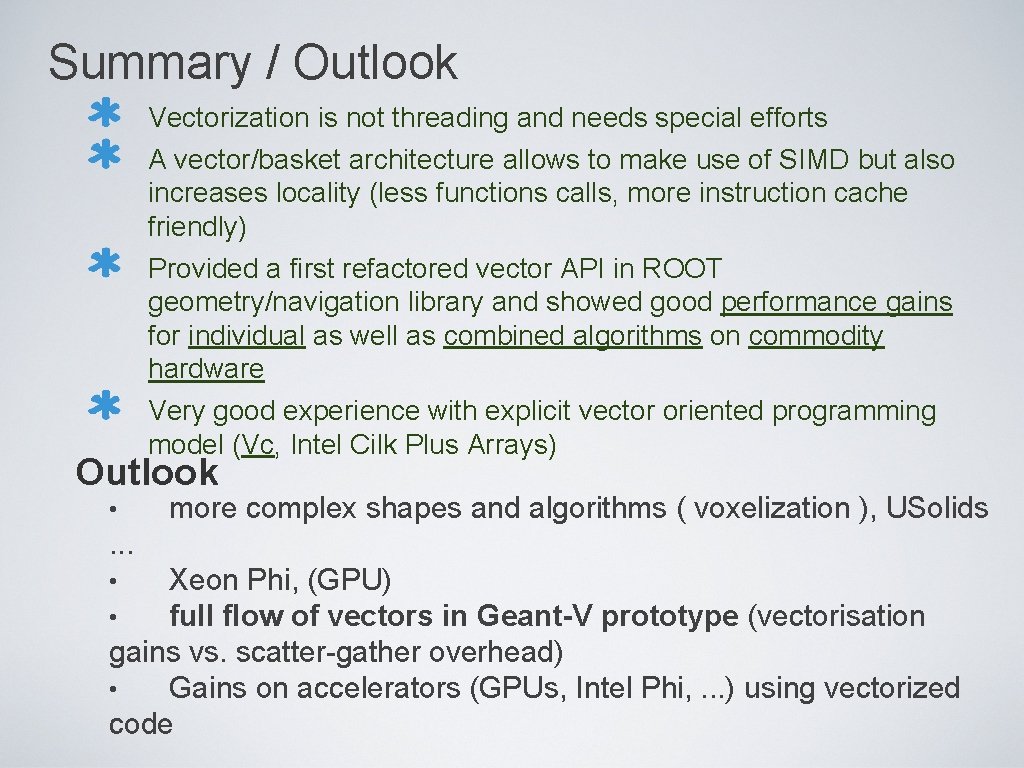
Summary / Outlook Vectorization is not threading and needs special efforts A vector/basket architecture allows to make use of SIMD but also increases locality (less functions calls, more instruction cache friendly) Provided a first refactored vector API in ROOT geometry/navigation library and showed good performance gains for individual as well as combined algorithms on commodity hardware Very good experience with explicit vector oriented programming model (Vc, Intel Cilk Plus Arrays) Outlook • more complex shapes and algorithms ( voxelization ), USolids . . . Xeon Phi, (GPU) full flow of vectors in Geant-V prototype (vectorisation gains vs. scatter-gather overhead) • Gains on accelerators (GPUs, Intel Phi, . . . ) using vectorized code • •
Acknowledgements contributors to basic Vc coding: Juan Valles (CERN summer student) Marilena Bandieramonte (University of Catania, Italy) Raman Sehgal (BARC, India) help performance analysis /investigation of Intel Cilk Plus Array Notation: Laurent Duhem (Intel) CERN Openlab
Backup slides
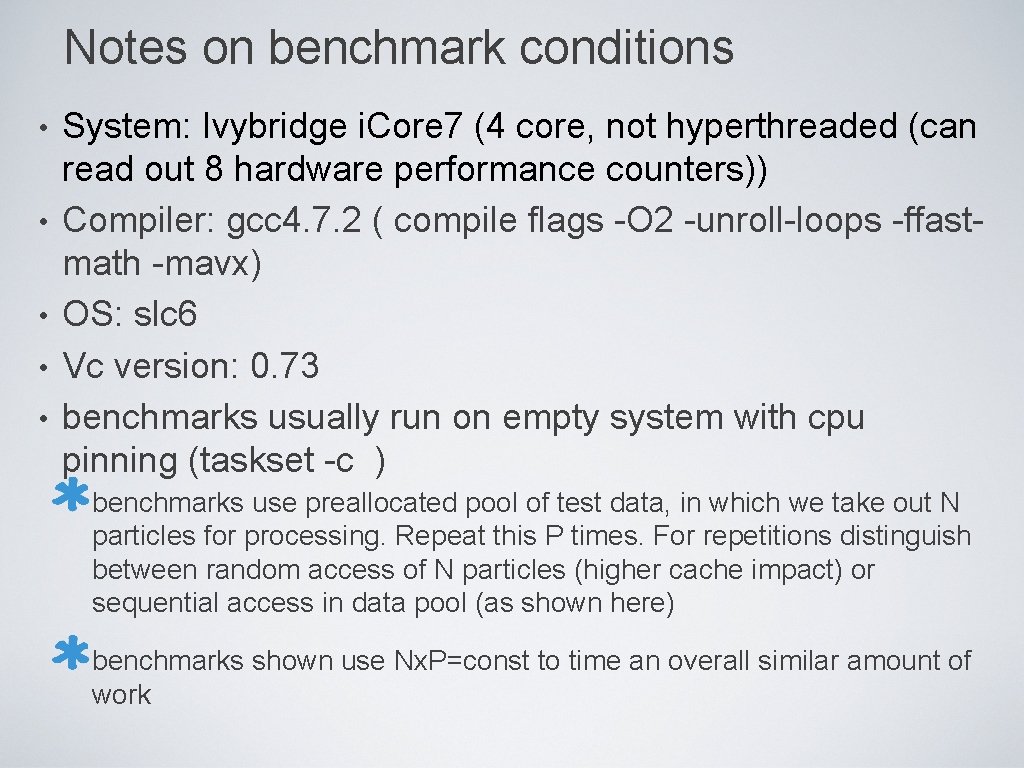
Notes on benchmark conditions • • • System: Ivybridge i. Core 7 (4 core, not hyperthreaded (can read out 8 hardware performance counters)) Compiler: gcc 4. 7. 2 ( compile flags -O 2 -unroll-loops -ffastmath -mavx) OS: slc 6 Vc version: 0. 73 benchmarks usually run on empty system with cpu pinning (taskset -c ) benchmarks use preallocated pool of test data, in which we take out N particles for processing. Repeat this P times. For repetitions distinguish between random access of N particles (higher cache impact) or sequential access in data pool (as shown here) benchmarks shown use Nx. P=const to time an overall similar amount of work
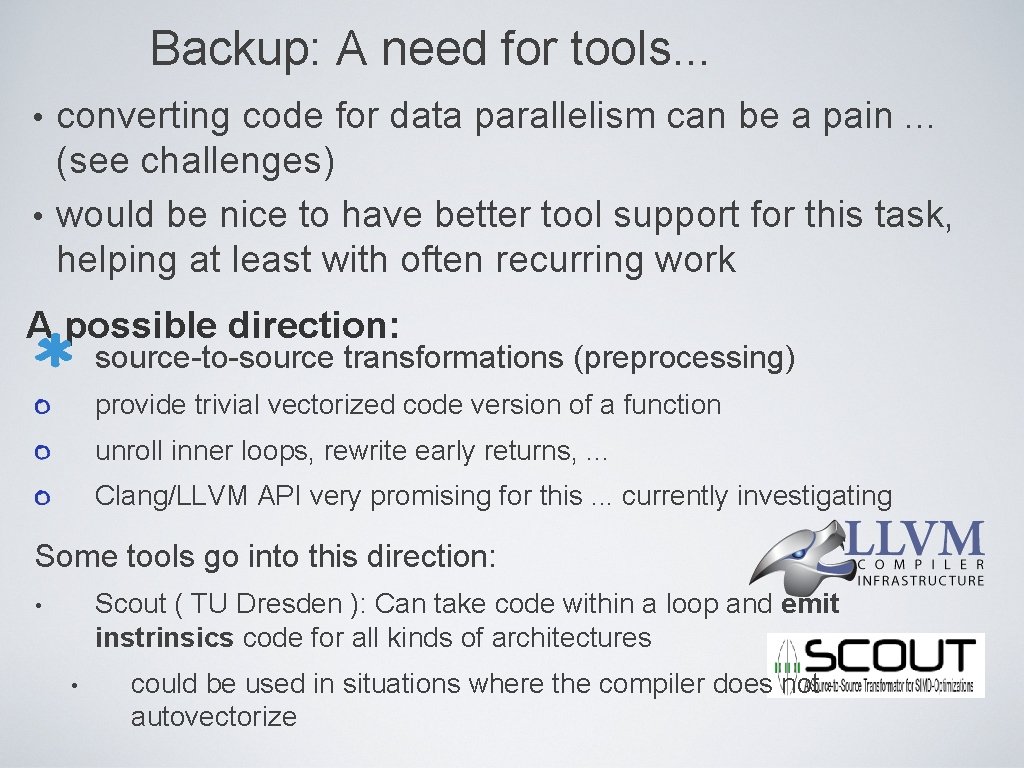
Backup: A need for tools. . . converting code for data parallelism can be a pain. . . (see challenges) • would be nice to have better tool support for this task, helping at least with often recurring work • A possible direction: source-to-source transformations (preprocessing) provide trivial vectorized code version of a function unroll inner loops, rewrite early returns, . . . Clang/LLVM API very promising for this. . . currently investigating Some tools go into this direction: Scout ( TU Dresden ): Can take code within a loop and emit instrinsics code for all kinds of architectures • • could be used in situations where the compiler does not autovectorize
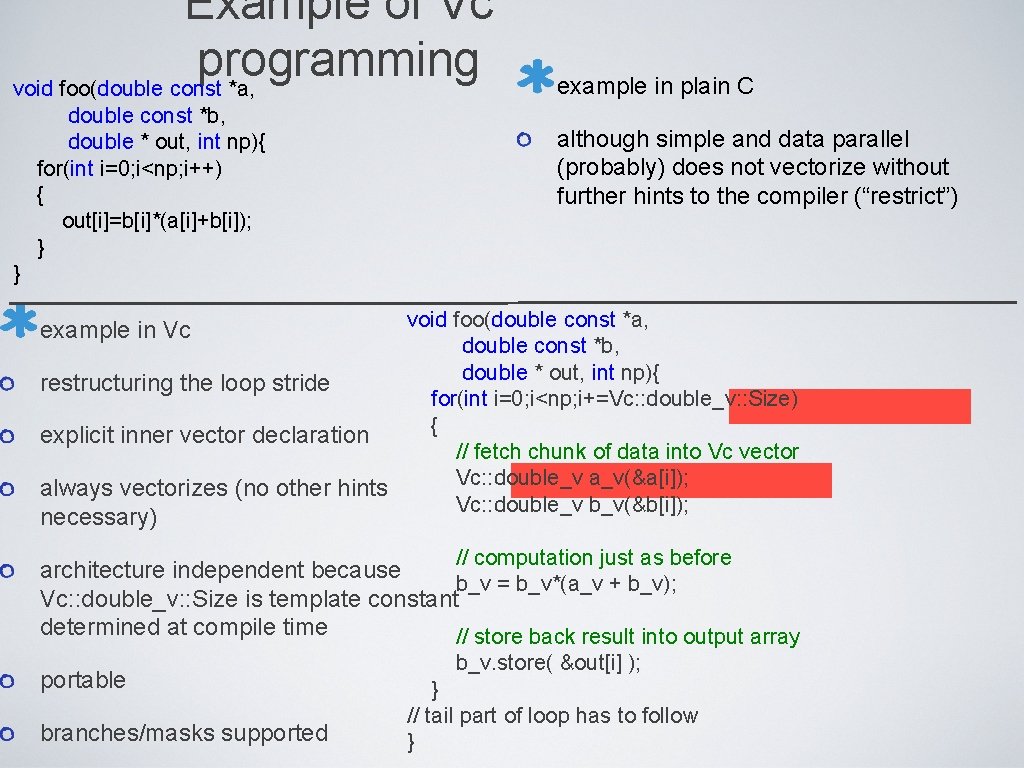
Example of Vc programming void foo(double const *a, double const *b, double * out, int np){ for(int i=0; i<np; i++) { out[i]=b[i]*(a[i]+b[i]); } example in plain C although simple and data parallel (probably) does not vectorize without further hints to the compiler (“restrict”) } void foo(double const *a, double const *b, double * out, int np){ restructuring the loop stride for(int i=0; i<np; i+=Vc: : double_v: : Size) { explicit inner vector declaration // fetch chunk of data into Vc vector Vc: : double_v a_v(&a[i]); always vectorizes (no other hints Vc: : double_v b_v(&b[i]); example in Vc necessary) // computation just as before architecture independent because b_v = b_v*(a_v + b_v); Vc: : double_v: : Size is template constant determined at compile time // store back result into output array portable branches/masks supported b_v. store( &out[i] ); } // tail part of loop has to follow }
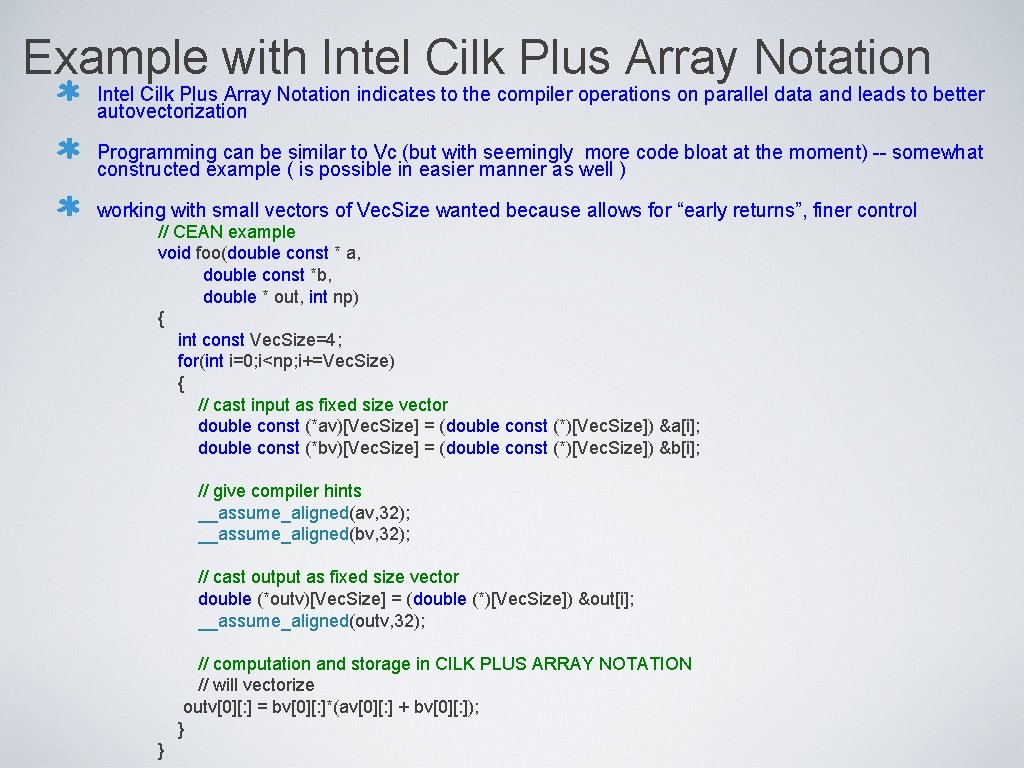
Example with Intel Cilk Plus Array Notation indicates to the compiler operations on parallel data and leads to better autovectorization Programming can be similar to Vc (but with seemingly more code bloat at the moment) -- somewhat constructed example ( is possible in easier manner as well ) working with small vectors of Vec. Size wanted because allows for “early returns”, finer control // CEAN example void foo(double const * a, double const *b, double * out, int np) { int const Vec. Size=4; for(int i=0; i<np; i+=Vec. Size) { // cast input as fixed size vector double const (*av)[Vec. Size] = (double const (*)[Vec. Size]) &a[i]; double const (*bv)[Vec. Size] = (double const (*)[Vec. Size]) &b[i]; // give compiler hints __assume_aligned(av, 32); __assume_aligned(bv, 32); // cast output as fixed size vector double (*outv)[Vec. Size] = (double (*)[Vec. Size]) &out[i]; __assume_aligned(outv, 32); // computation and storage in CILK PLUS ARRAY NOTATION // will vectorize outv[0][: ] = bv[0][: ]*(av[0][: ] + bv[0][: ]); } }
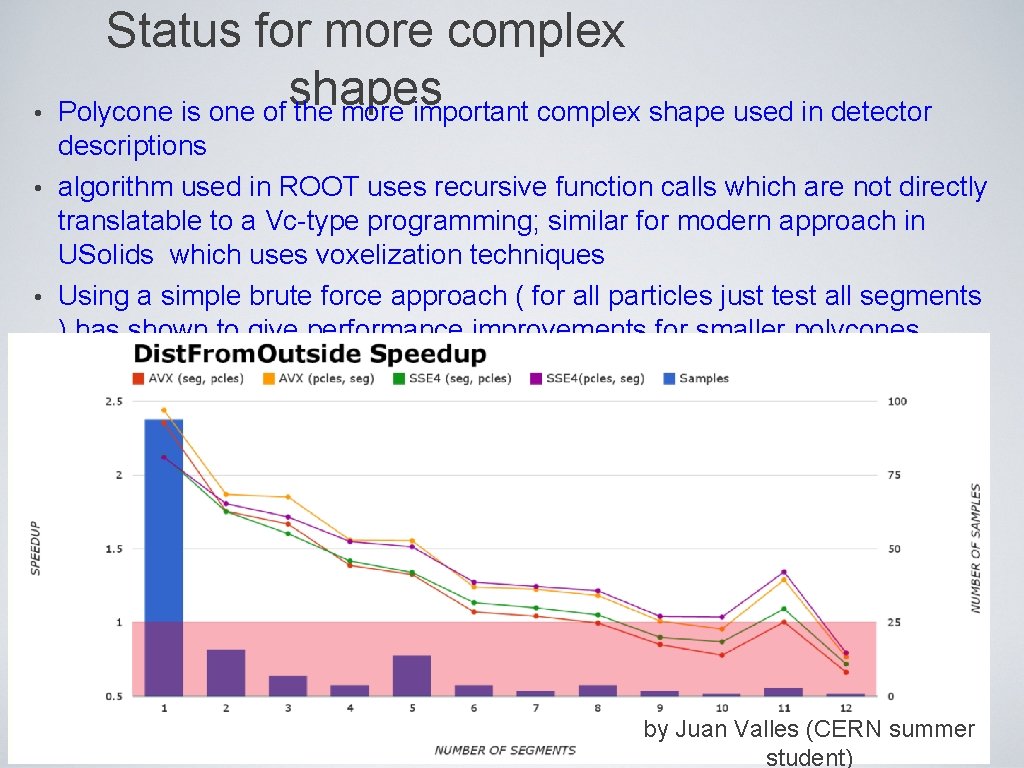
• Status for more complex shapes Polycone is one of the more important complex shape used in detector descriptions • algorithm used in ROOT uses recursive function calls which are not directly translatable to a Vc-type programming; similar for modern approach in USolids which uses voxelization techniques • Using a simple brute force approach ( for all particles just test all segments ) has shown to give performance improvements for smaller polycones by Juan Valles (CERN summer student)
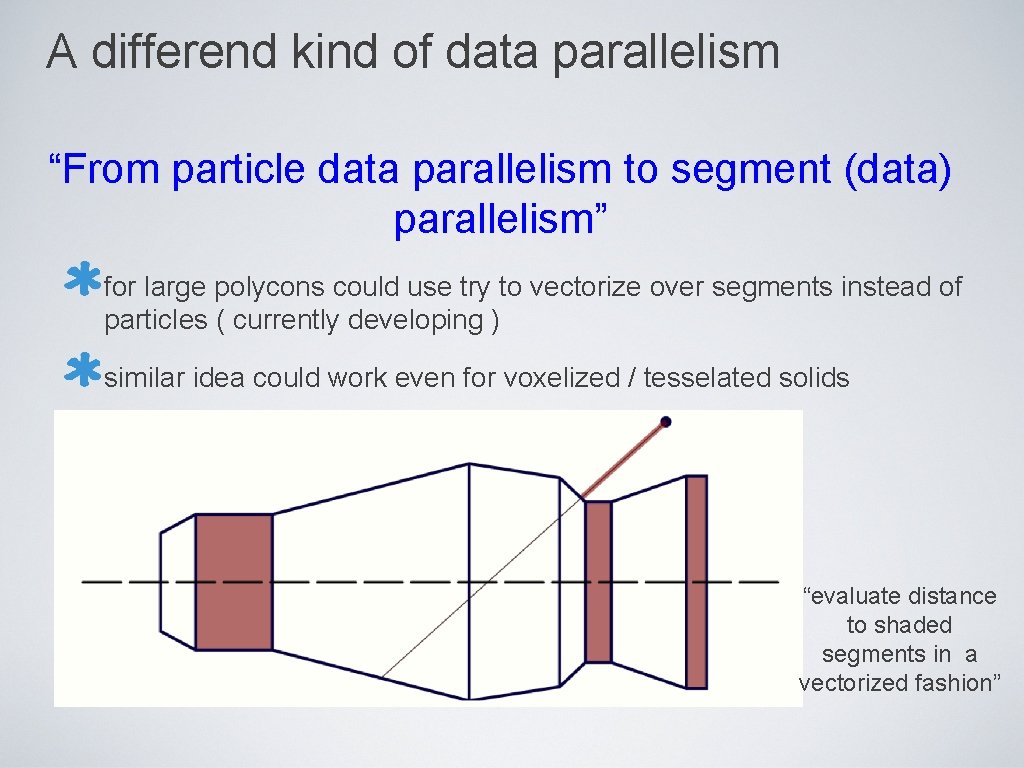
A differend kind of data parallelism “From particle data parallelism to segment (data) parallelism” for large polycons could use try to vectorize over segments instead of particles ( currently developing ) similar idea could work even for voxelized / tesselated solids “evaluate distance to shaded segments in a vectorized fashion”