
Vector and Axial Form Factors and Inelastic Structure

- Slides: 66
Vector and Axial Form Factors and Inelastic Structure Functions Arie Bodek University of Rochester http: //www. pas. rochester. edu/~bodek/CTEQ 04. ppt Lecture Given in CTEQ 04 Summer School, Madison Wed. June 23, 2004 (4 pm-5 pm) Plus Three Problems for Students to work out together as a team. Email solution -bodek@pas. rocherster. edu end of week
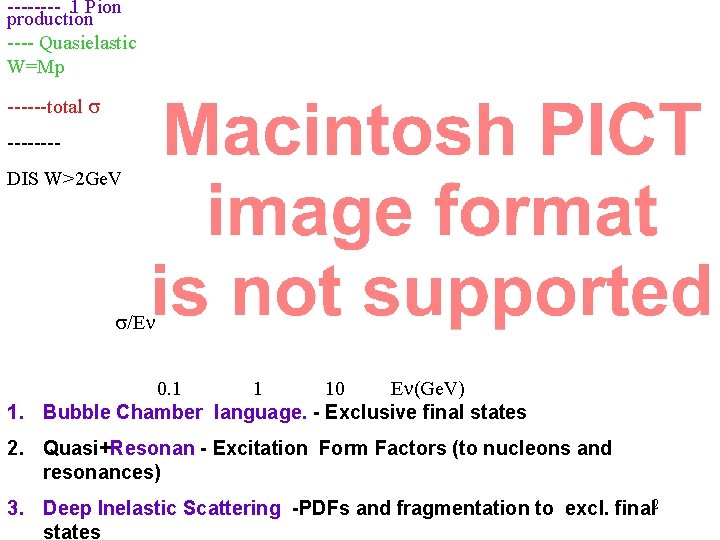
---- 1 Pion production ---- Quasielastic W=Mp ------total -------DIS W>2 Ge. V /E 0. 1 1 10 E (Ge. V) 1. Bubble Chamber language. - Exclusive final states 2. Quasi+Resonan - Excitation Form Factors (to nucleons and resonances) 3. Deep Inelastic Scattering -PDFs and fragmentation to excl. final 2 states
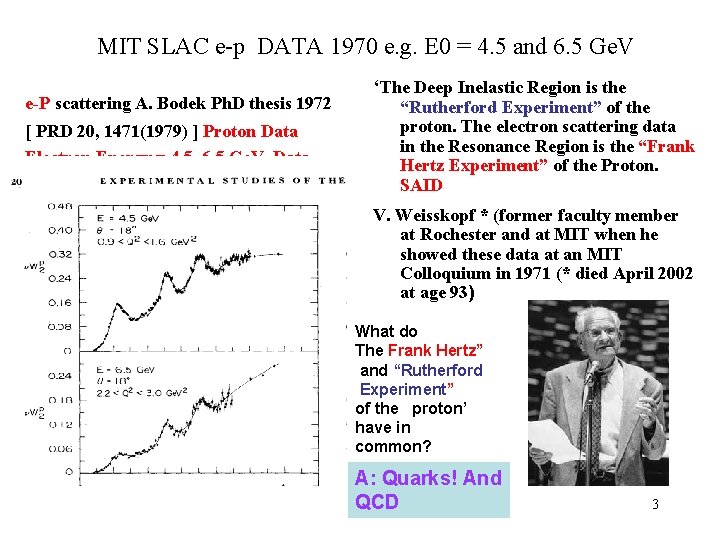
MIT SLAC e-p DATA 1970 e. g. E 0 = 4. 5 and 6. 5 Ge. V e-P scattering A. Bodek Ph. D thesis 1972 [ PRD 20, 1471(1979) ] Proton Data Electron Energy = 4. 5, 6. 5 Ge. V Data ‘The Deep Inelastic Region is the “Rutherford Experiment” of the proton. The electron scattering data in the Resonance Region is the “Frank Hertz Experiment” of the Proton. SAID V. Weisskopf * (former faculty member at Rochester and at MIT when he showed these data at an MIT Colloquium in 1971 (* died April 2002 at age 93) What do The Frank Hertz” and “Rutherford Experiment” of the proton’ have in common? A: Quarks! And QCD 3
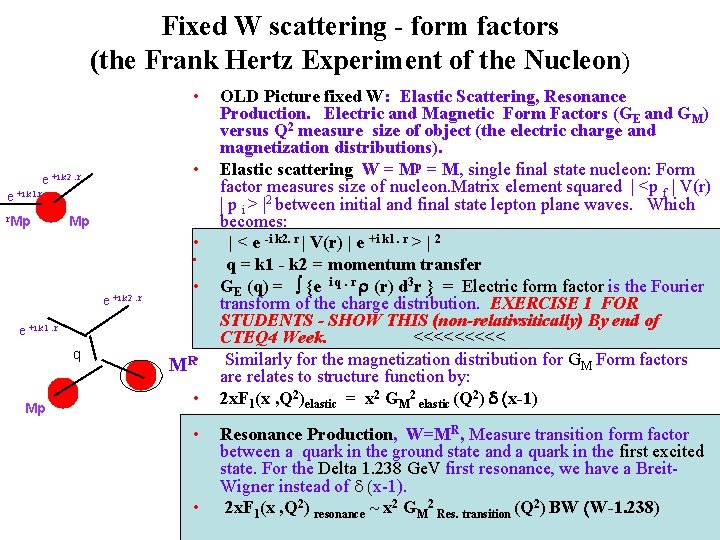
Fixed W scattering - form factors (the Frank Hertz Experiment of the Nucleon) • • e +i k 2. r e +i k 1. r r. Mp Mp • • e +i k 2. r • e +i k 1. r q Mp MR • • OLD Picture fixed W: Elastic Scattering, Resonance Production. Electric and Magnetic Form Factors (GE and GM) versus Q 2 measure size of object (the electric charge and magnetization distributions). Elastic scattering W = Mp = M, single final state nucleon: Form factor measures size of nucleon. Matrix element squared | <p f | V(r) | p i > |2 between initial and final state lepton plane waves. Which becomes: | < e -i k 2. r | V(r) | e +i k 1. r > | 2 q = k 1 - k 2 = momentum transfer GE (q) = {e i q. r r (r) d 3 r } = Electric form factor is the Fourier transform of the charge distribution. EXERCISE 1 FOR STUDENTS - SHOW THIS (non-relativsitically) By end of CTEQ 4 Week. <<<<< Similarly for the magnetization distribution for GM Form factors are relates to structure function by: 2 x. F 1(x , Q 2)elastic = x 2 GM 2 elastic (Q 2) d (x-1) Resonance Production, W=MR, Measure transition form factor between a quark in the ground state and a quark in the first excited state. For the Delta 1. 238 Ge. V first resonance, we have a Breit. Wigner instead of d (x-1). 2 x. F 1(x , Q 2) resonance ~ x 2 GM 2 Res. transition (Q 2) BW (W-1. 238)
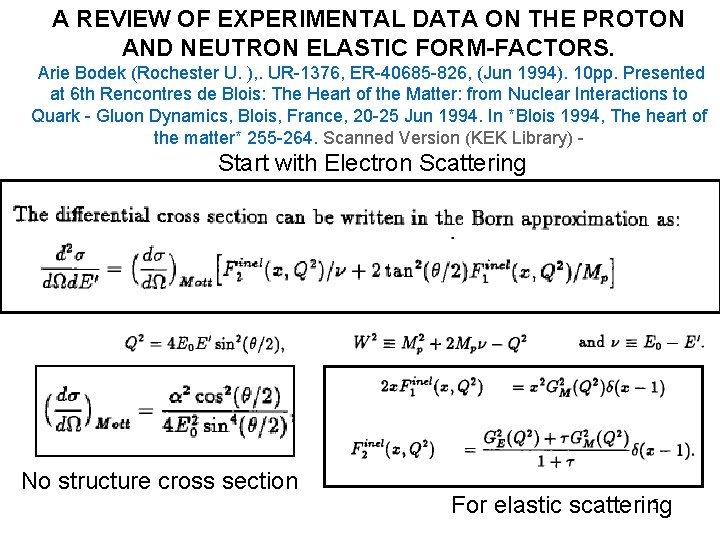
A REVIEW OF EXPERIMENTAL DATA ON THE PROTON AND NEUTRON ELASTIC FORM-FACTORS. Arie Bodek (Rochester U. ), . UR-1376, ER-40685 -826, (Jun 1994). 10 pp. Presented at 6 th Rencontres de Blois: The Heart of the Matter: from Nuclear Interactions to Quark - Gluon Dynamics, Blois, France, 20 -25 Jun 1994. In *Blois 1994, The heart of the matter* 255 -264. Scanned Version (KEK Library) - Start with Electron Scattering No structure cross section 5 For elastic scattering
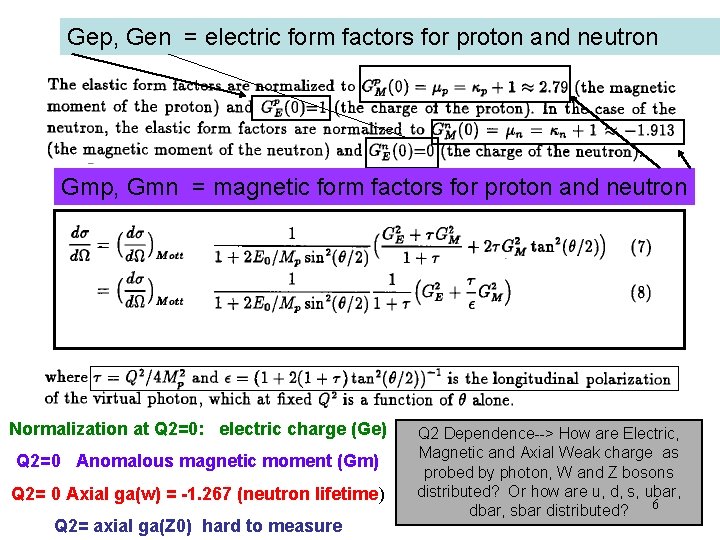
Gep, Gen = electric form factors for proton and neutron Gmp, Gmn = magnetic form factors for proton and neutron Normalization at Q 2=0: electric charge (Ge) Q 2=0 Anomalous magnetic moment (Gm) Q 2= 0 Axial ga(w) = -1. 267 (neutron lifetime) Q 2= axial ga(Z 0) hard to measure Q 2 Dependence--> How are Electric, Magnetic and Axial Weak charge as probed by photon, W and Z bosons distributed? Or how are u, d, s, ubar, dbar, sbar distributed? 6
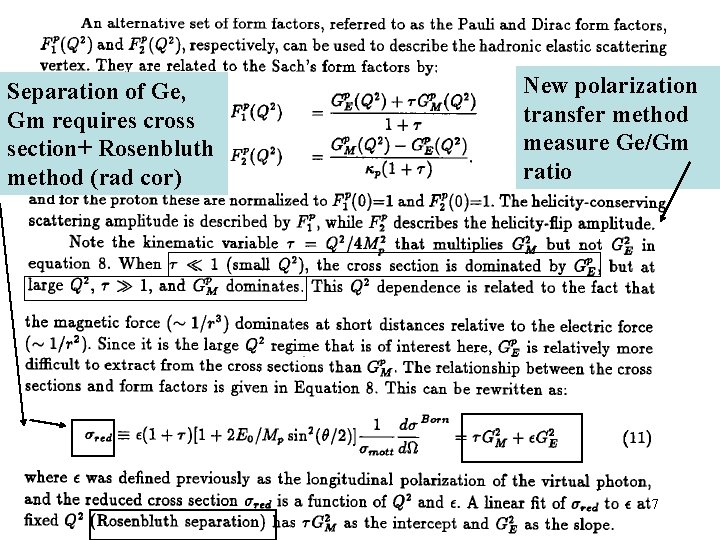
Separation of Ge, Gm requires cross section+ Rosenbluth method (rad cor) New polarization transfer method measure Ge/Gm ratio 7
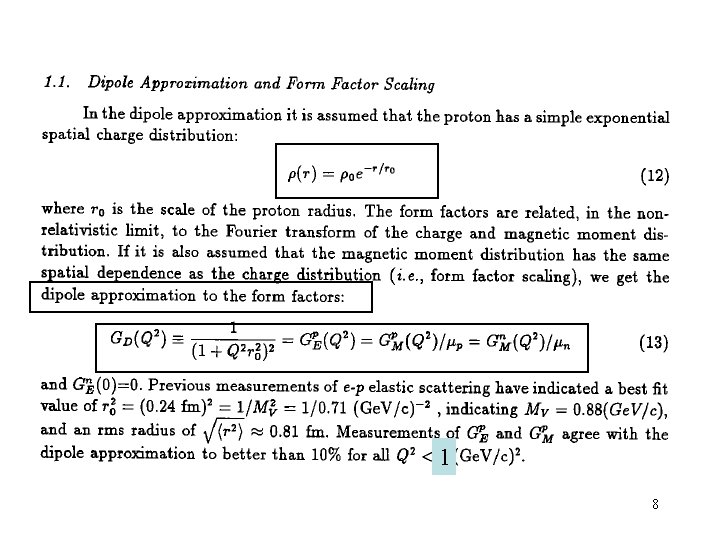
1 8
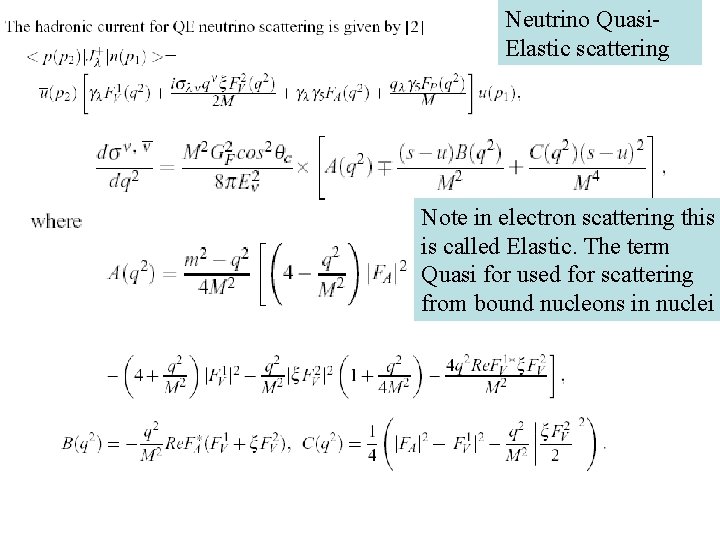
Neutrino Quasi. Elastic scattering Note in electron scattering this is called Elastic. The term Quasi for used for scattering from bound nucleons in nuclei
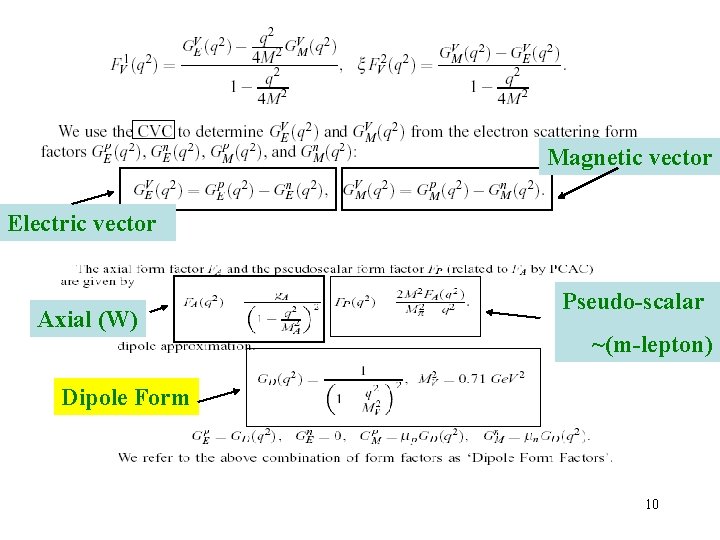
Magnetic vector Electric vector Axial (W) Pseudo-scalar ~(m-lepton) Dipole Form 10
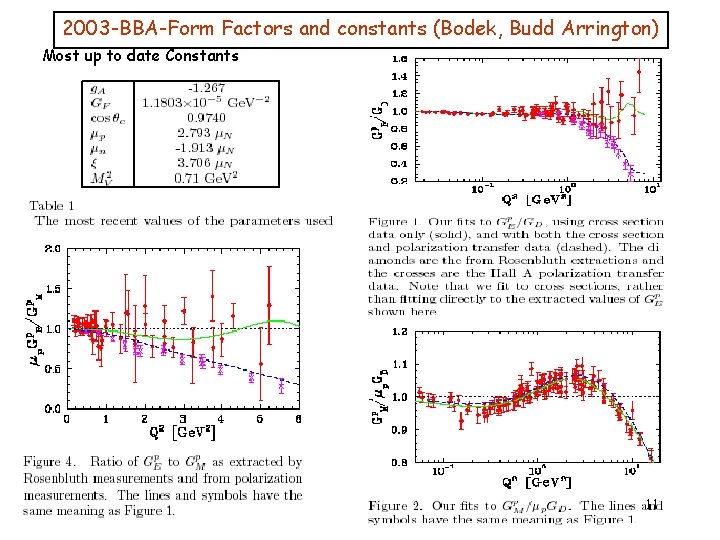
2003 -BBA-Form Factors and constants (Bodek, Budd Arrington) Most up to date Constants 11
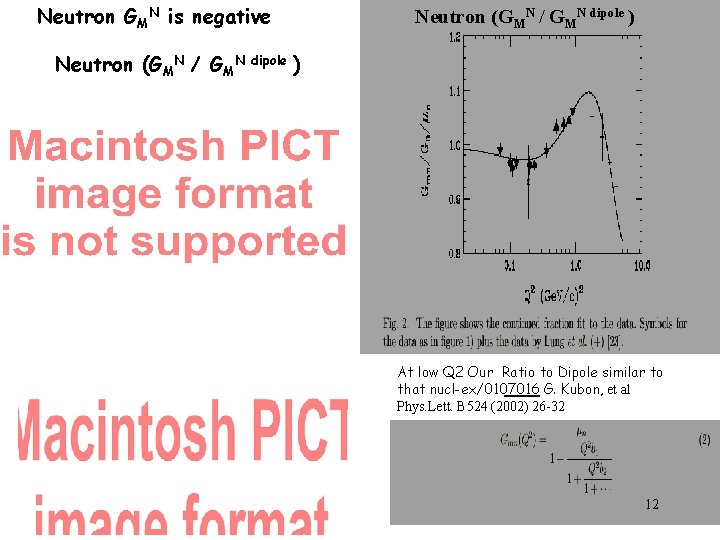
Neutron GMN is negative Neutron (GMN / GMN dipole ) At low Q 2 Our Ratio to Dipole similar to that nucl-ex/0107016 G. Kubon, et al Phys. Lett. B 524 (2002) 26 -32 12
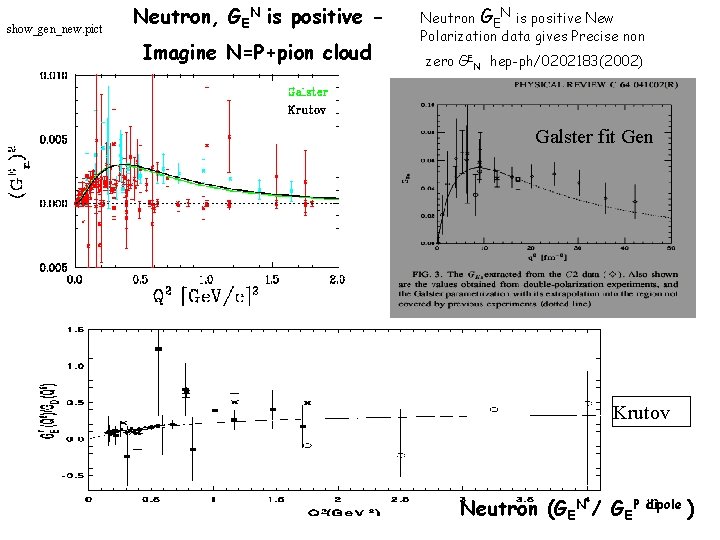
show_gen_new. pict Neutron, GEN is positive Imagine N=P+pion cloud (GEN)2 Neutron GEN is positive New Polarization data gives Precise non zero GEN hep-ph/0202183(2002) Galster fit Gen Krutov dipole ) Neutron (GEN / GEP 13
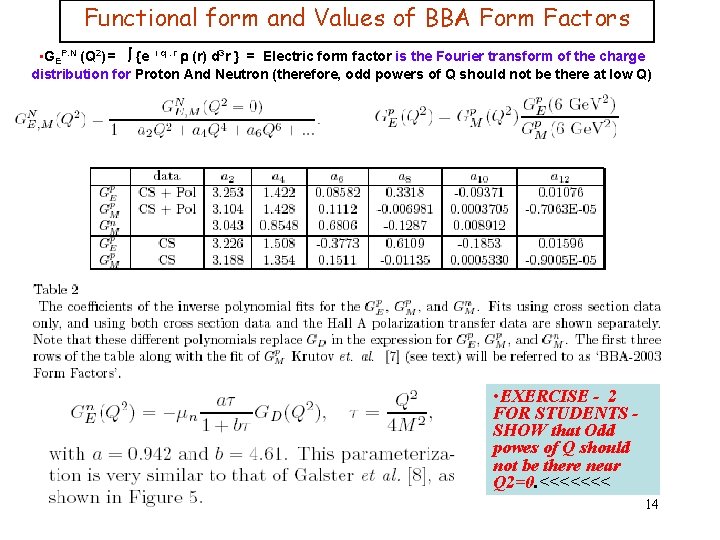
Functional form and Values of BBA Form Factors • GEP. N (Q 2) = {e i q. r r (r) d 3 r } = Electric form factor is the Fourier transform of the charge distribution for Proton And Neutron (therefore, odd powers of Q should not be there at low Q) • EXERCISE - 2 FOR STUDENTS SHOW that Odd powes of Q should not be there near Q 2=0. <<<<<<< 14
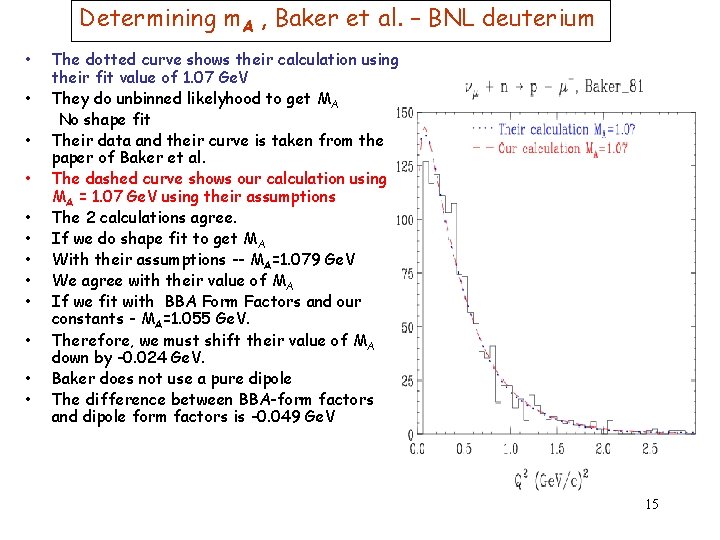
Determining m. A , Baker et al. – BNL deuterium • • • The dotted curve shows their calculation using their fit value of 1. 07 Ge. V They do unbinned likelyhood to get MA No shape fit Their data and their curve is taken from the paper of Baker et al. The dashed curve shows our calculation using MA = 1. 07 Ge. V using their assumptions The 2 calculations agree. If we do shape fit to get MA With their assumptions -- MA=1. 079 Ge. V We agree with their value of MA If we fit with BBA Form Factors and our constants - MA=1. 055 Ge. V. Therefore, we must shift their value of MA down by -0. 024 Ge. V. Baker does not use a pure dipole The difference between BBA-form factors and dipole form factors is -0. 049 Ge. V 15
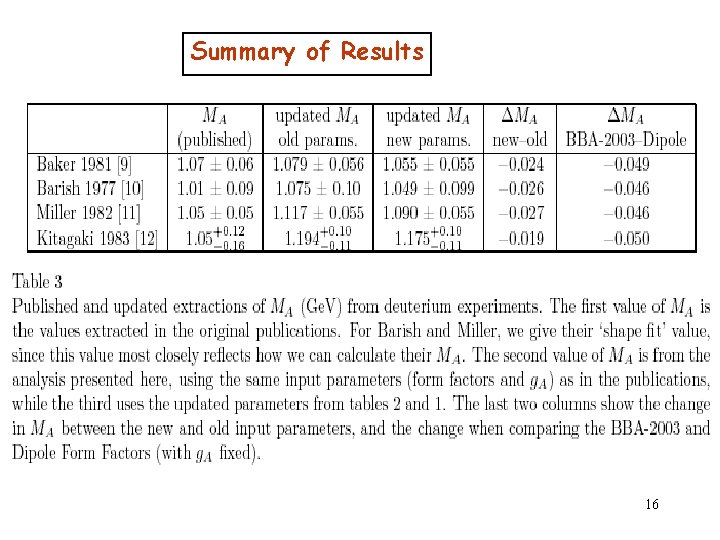
Summary of Results 16
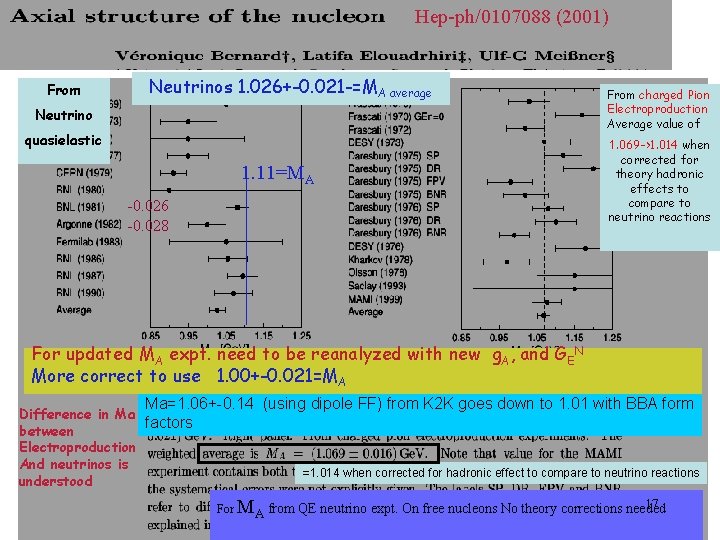
Hep-ph/0107088 (2001) From Neutrinos 1. 026+-0. 021 -=MA average Neutrino quasielastic 1. 11=MA -0. 026 -0. 028 From charged Pion Electroproduction Average value of 1. 069 ->1. 014 when corrected for theory hadronic effects to compare to neutrino reactions For updated MA expt. need to be reanalyzed with new g. A, and GEN More correct to use 1. 00+-0. 021=MA Ma=1. 06+-0. 14 (using dipole FF) from K 2 K goes down to 1. 01 with BBA form Difference in Ma factors between Electroproduction And neutrinos is understood =1. 014 when corrected for hadronic effect to compare to neutrino reactions For 17 MA from QE neutrino expt. On free nucleons No theory corrections needed
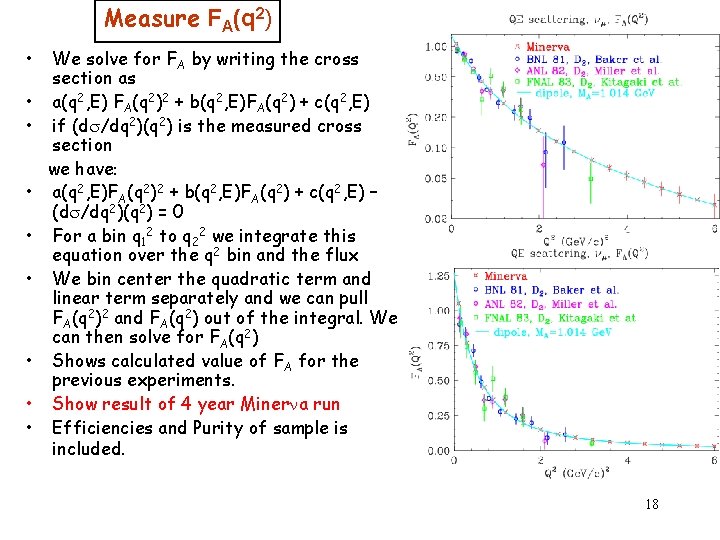
Measure FA(q 2) • • • We solve for FA by writing the cross section as a(q 2, E) FA(q 2)2 + b(q 2, E)FA(q 2) + c(q 2, E) if (d /dq 2)(q 2) is the measured cross section we have: a(q 2, E)FA(q 2)2 + b(q 2, E)FA(q 2) + c(q 2, E) – (d /dq 2)(q 2) = 0 For a bin q 12 to q 22 we integrate this equation over the q 2 bin and the flux We bin center the quadratic term and linear term separately and we can pull FA(q 2)2 and FA(q 2) out of the integral. We can then solve for FA(q 2) Shows calculated value of FA for the previous experiments. Show result of 4 year Miner a run Efficiencies and Purity of sample is included. 18
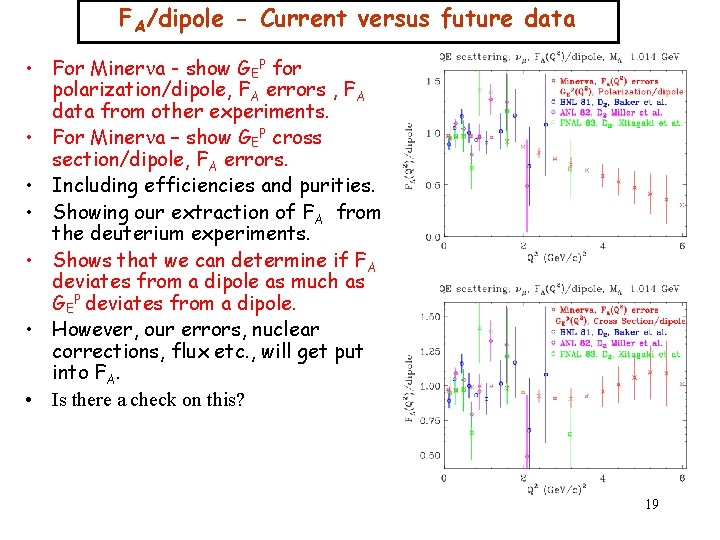
FA/dipole - Current versus future data • For Miner a - show GEP for polarization/dipole, FA errors , FA data from other experiments. • For Miner a – show GEP cross section/dipole, FA errors. • Including efficiencies and purities. • Showing our extraction of FA from the deuterium experiments. • Shows that we can determine if FA deviates from a dipole as much as GEP deviates from a dipole. • However, our errors, nuclear corrections, flux etc. , will get put into FA. • Is there a check on this? 19
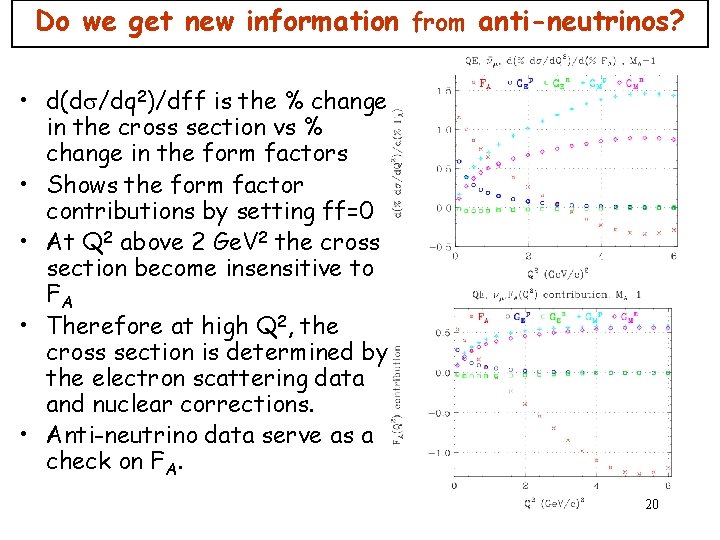
Do we get new information from anti-neutrinos? • d(d /dq 2)/dff is the % change in the cross section vs % change in the form factors • Shows the form factor contributions by setting ff=0 • At Q 2 above 2 Ge. V 2 the cross section become insensitive to FA • Therefore at high Q 2, the cross section is determined by the electron scattering data and nuclear corrections. • Anti-neutrino data serve as a check on FA. 20
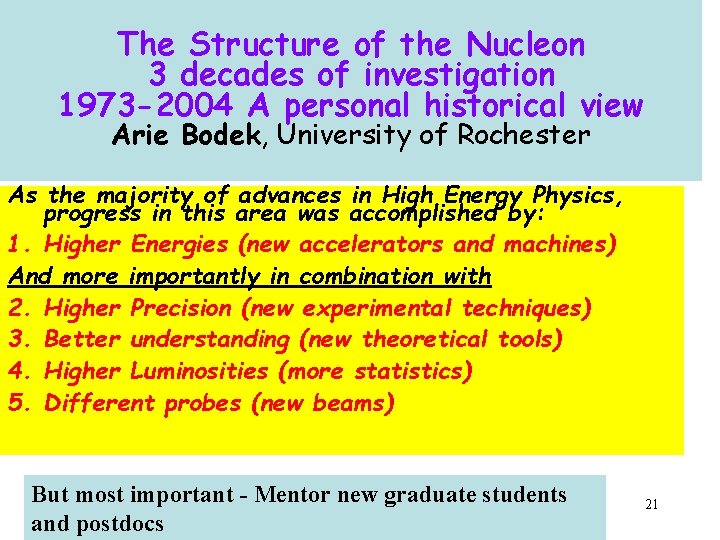
The Structure of the Nucleon 3 decades of investigation 1973 -2004 A personal historical view Arie Bodek, University of Rochester As the majority of advances in High Energy Physics, progress in this area was accomplished by: 1. Higher Energies (new accelerators and machines) And more importantly in combination with 2. Higher Precision (new experimental techniques) 3. Better understanding (new theoretical tools) 4. Higher Luminosities (more statistics) 5. Different probes (new beams) But most important - Mentor new graduate students and postdocs 21
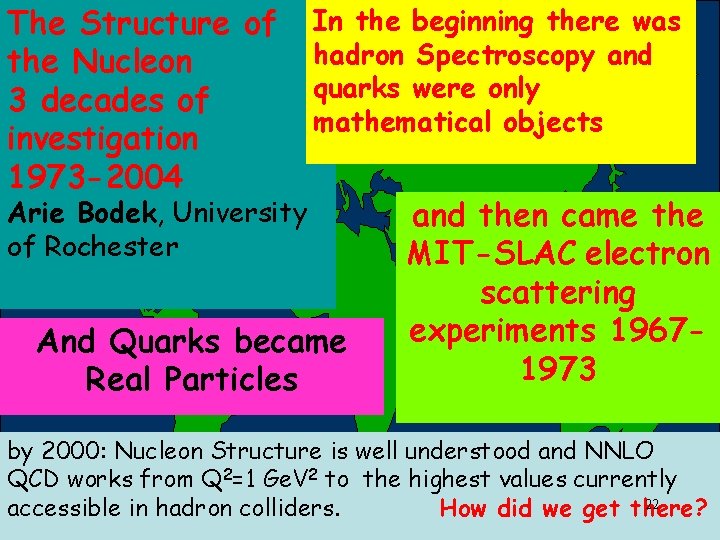
The Structure of the Nucleon 3 decades of investigation 1973 -2004 In the beginning there was hadron Spectroscopy and quarks were only mathematical objects Arie Bodek, University of Rochester And Quarks became Real Particles and then came the MIT-SLAC electron scattering experiments 19671973 by 2000: Nucleon Structure is well understood and NNLO QCD works from Q 2=1 Ge. V 2 to the highest values currently 22 accessible in hadron colliders. How did we get there?
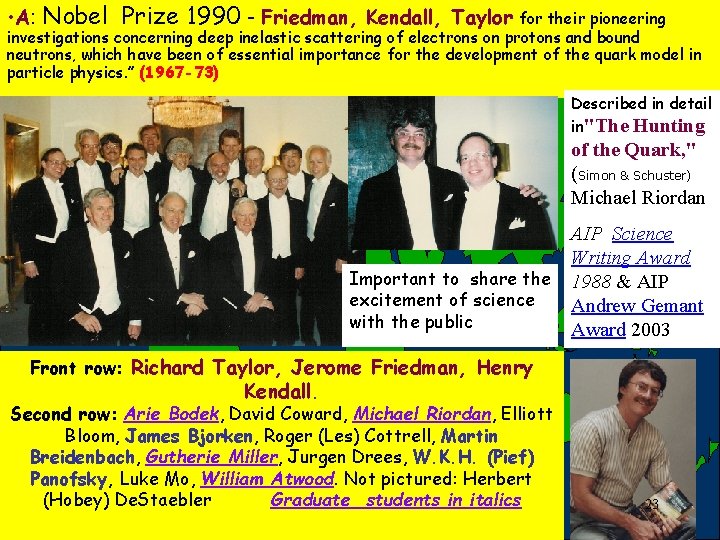
• A: Nobel Prize 1990 - Friedman, Kendall, Taylor for their pioneering investigations concerning deep inelastic scattering of electrons on protons and bound neutrons, which have been of essential importance for the development of the quark model in particle physics. ” (1967 -73) Described in detail in"The Hunting of the Quark, " (Simon & Schuster) Michael Riordan Important to share the excitement of science with the public Front row: Richard Taylor, Jerome Friedman, Henry Kendall. Second row: Arie Bodek, David Coward, Michael Riordan, Elliott Bloom, James Bjorken, Roger (Les) Cottrell, Martin Breidenbach, Gutherie Miller, Jurgen Drees, W. K. H. (Pief) Panofsky, Luke Mo, William Atwood. Not pictured: Herbert (Hobey) De. Staebler Graduate students in italics AIP Science Writing Award 1988 & AIP Andrew Gemant Award 2003 23
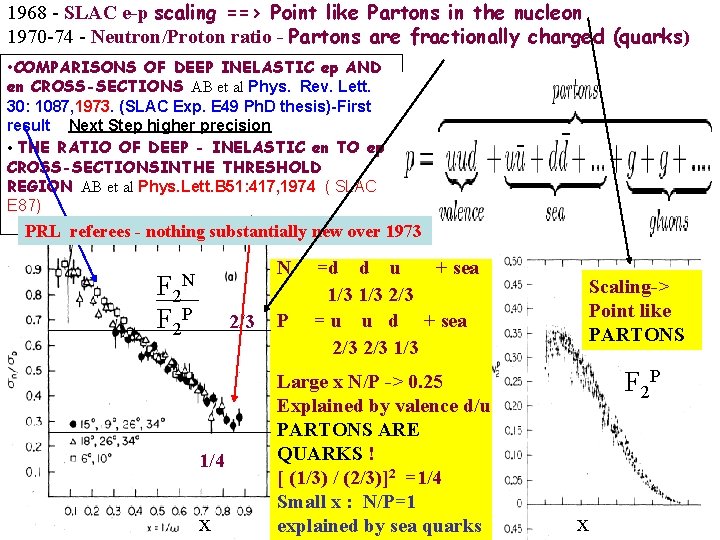
1968 - SLAC e-p scaling ==> Point like Partons in the nucleon 1970 -74 - Neutron/Proton ratio - Partons are fractionally charged (quarks) • COMPARISONS OF DEEP INELASTIC ep AND en CROSS-SECTIONS AB et al Phys. Rev. Lett. 30: 1087, 1973. (SLAC Exp. E 49 Ph. D thesis)-First result Next Step higher precision • THE RATIO OF DEEP - INELASTIC en TO ep CROSS-SECTIONSINTHE THRESHOLD REGION AB et al Phys. Lett. B 51: 417, 1974 ( SLAC E 87) PRL referees - nothing substantially new over 1973 N F 2 P 2/3 1/4 x P =d d u + sea 1/3 2/3 = u u d + sea 2/3 1/3 Large x N/P -> 0. 25 Explained by valence d/u PARTONS ARE QUARKS ! [ (1/3) / (2/3)]2 =1/4 Small x : N/P=1 explained by sea quarks Scaling-> Point like PARTONS F 2 P x
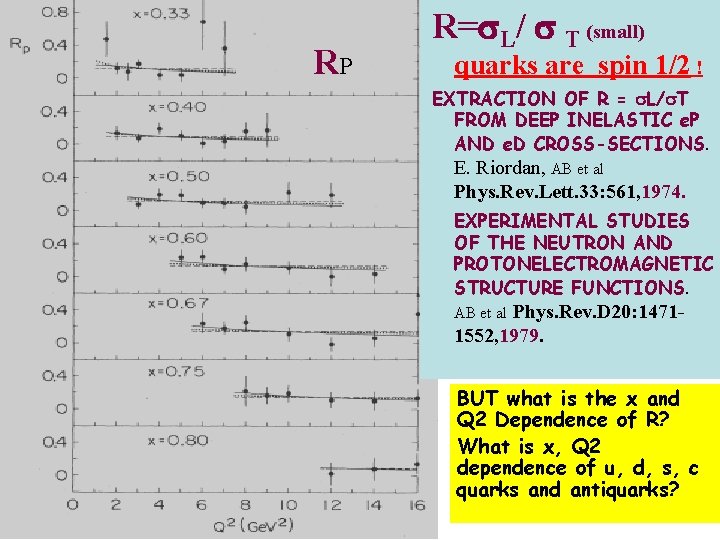
RP R= L/ T (small) quarks are spin 1/2 ! EXTRACTION OF R = L/ T FROM DEEP INELASTIC e. P AND e. D CROSS-SECTIONS. E. Riordan, AB et al Phys. Rev. Lett. 33: 561, 1974. EXPERIMENTAL STUDIES OF THE NEUTRON AND PROTONELECTROMAGNETIC STRUCTURE FUNCTIONS. Phys. Rev. D 20: 14711552, 1979. AB et al BUT what is the x and Q 2 Dependence of R? What is x, Q 2 dependence of u, d, s, c quarks and antiquarks?
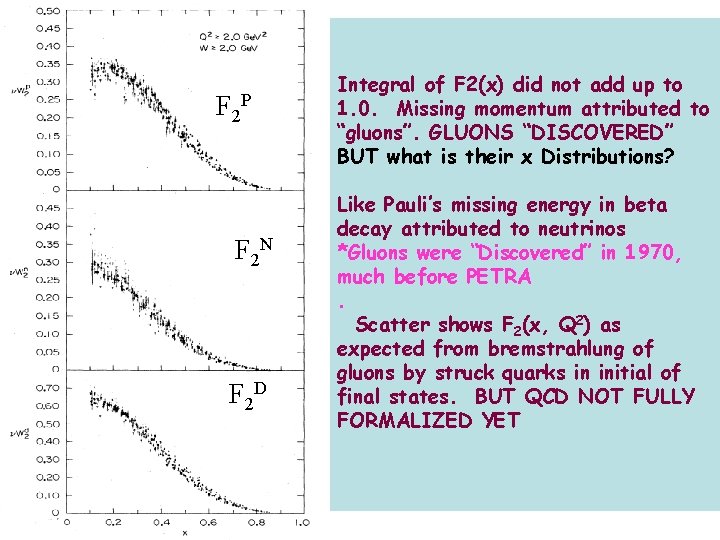
F 2 P F 2 N F 2 D Integral of F 2(x) did not add up to 1. 0. Missing momentum attributed to “gluons”. GLUONS “DISCOVERED” BUT what is their x Distributions? Like Pauli’s missing energy in beta decay attributed to neutrinos *Gluons were “Discovered” in 1970, much before PETRA. Scatter shows F 2(x, Q 2) as expected from bremstrahlung of gluons by struck quarks in initial of final states. BUT QCD NOT FULLY FORMALIZED YET
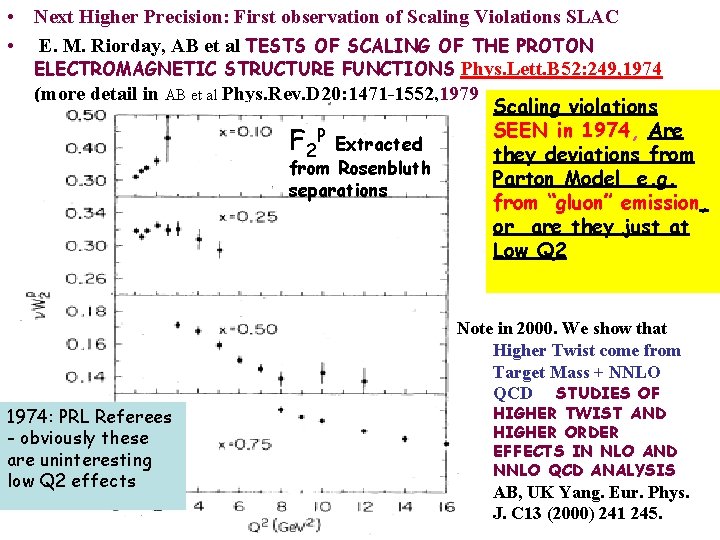
• Next Higher Precision: First observation of Scaling Violations SLAC • E. M. Riorday, AB et al TESTS OF SCALING OF THE PROTON ELECTROMAGNETIC STRUCTURE FUNCTIONS Phys. Lett. B 52: 249, 1974 (more detail in AB et al Phys. Rev. D 20: 1471 -1552, 1979 Scaling violations SEEN in 1974, Are F 2 P Extracted they deviations from Rosenbluth Parton Model e. g. separations from “gluon” emission, or are they just at Low Q 2 1974: PRL Referees - obviously these are uninteresting low Q 2 effects Note in 2000. We show that Higher Twist come from Target Mass + NNLO QCD STUDIES OF HIGHER TWIST AND HIGHER ORDER EFFECTS IN NLO AND NNLO QCD ANALYSIS AB, UK Yang. Eur. Phys. J. C 13 (2000) 241 245.
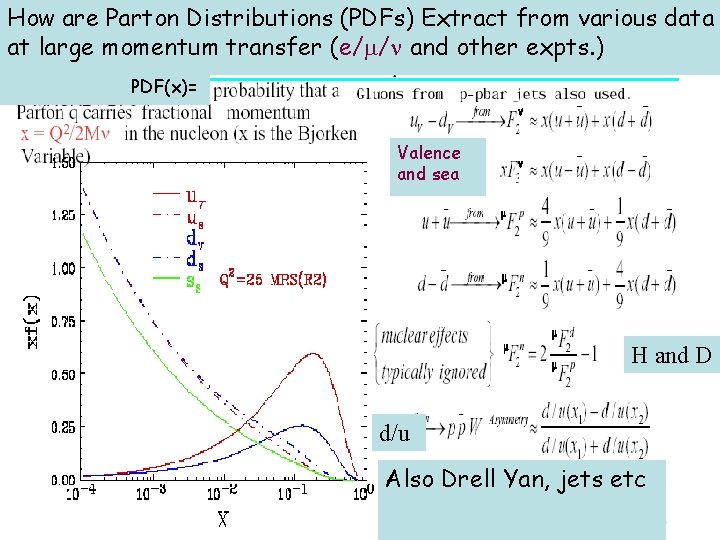
How are Parton Distributions (PDFs) Extract from various data at large momentum transfer (e/ / and other expts. ) PDF(x)= Valence and sea H and D d/u Also Drell Yan, jets etc
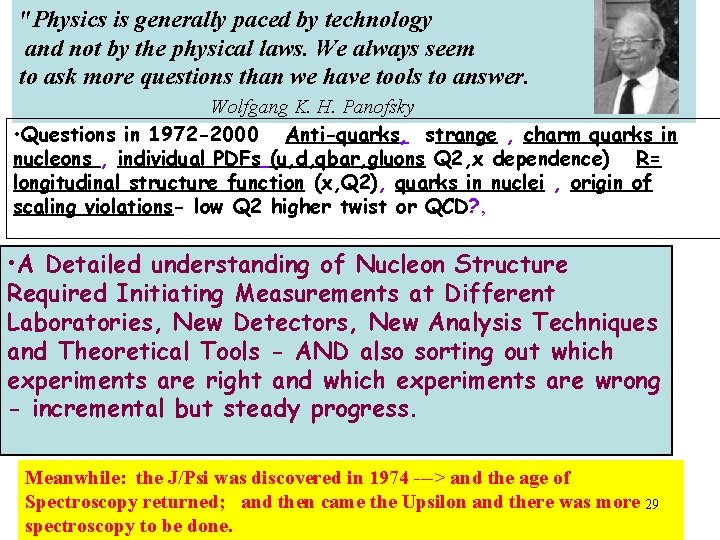
"Physics is generally paced by technology and not by the physical laws. We always seem to ask more questions than we have tools to answer. Wolfgang K. H. Panofsky • Questions in 1972 -2000 Anti-quarks, strange , charm quarks in nucleons , individual PDFs (u, d, qbar, gluons Q 2, x dependence) R= longitudinal structure function (x, Q 2), quarks in nuclei , origin of scaling violations- low Q 2 higher twist or QCD? , • A Detailed understanding of Nucleon Structure Required Initiating Measurements at Different Laboratories, New Detectors, New Analysis Techniques and Theoretical Tools - AND also sorting out which experiments are right and which experiments are wrong - incremental but steady progress. Meanwhile: the J/Psi was discovered in 1974 ---> and the age of Spectroscopy returned; and then came the Upsilon and there was more 29 spectroscopy to be done.
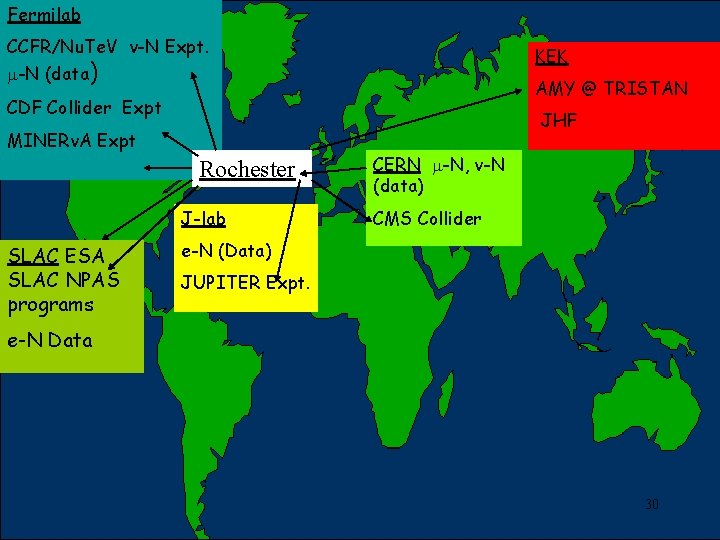
Fermilab CCFR/Nu. Te. V v-N Expt. -N (data) CDF Collider Expt Conclusion AMY @ TRISTAN JHF MINERv. A Expt Rochester J-lab SLAC ESA SLAC NPAS programs KEK CERN -N, v-N (data) CMS Collider e-N (Data) JUPITER Expt. e-N Data 30
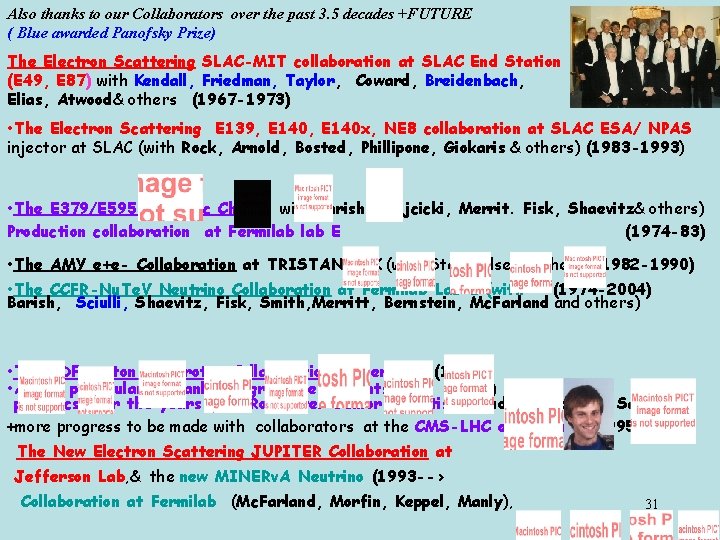
Also thanks to our Collaborators over the past 3. 5 decades +FUTURE ( Blue awarded Panofsky Prize) The Electron Scattering SLAC-MIT collaboration at SLAC End Station (E 49, E 87) with Kendall, Friedman, Taylor, Coward, Breidenbach, Elias, Atwood& others (1967 -1973) A Riordan, • The Electron Scattering E 139, E 140 x, NE 8 collaboration at SLAC ESA/ NPAS injector at SLAC (with Rock, Arnold, Bosted, Phillipone, Giokaris & others) (1983 -1993) • The E 379/E 595 Hadronic Charm: with Barish, Wojcicki, Merrit. Fisk, Shaevitz& others) Production collaboration at Fermilab E (1974 -83) • The AMY e+e- Collaboration at TRISTAN/KEK (with Steve Olsen& others) (1982 -1990) • The CCFR-Nu. Te. V Neutrino Collaboration at Fermilab Lab E (with (1974 -2004) Barish, Sciulli, Shaevitz, Fisk, Smith, Merritt, Bernstein, Mc. Farland others) • The CDF proton-antiproton Collaboration at Fermilab (1988 • And in particular I thank the graduate students and 2004) postdocs over the years, and Rochester Senior Scientists Budd, de. Barbaro Sakumoto. +more progress to be made with collaborators at the CMS-LHC experiment, (1995 -->) The New Electron Scattering JUPITER Collaboration at Jefferson Lab, & the new MINERv. A Neutrino (1993 --> Collaboration at Fermilab (Mc. Farland, Morfin, Keppel, Manly), 31
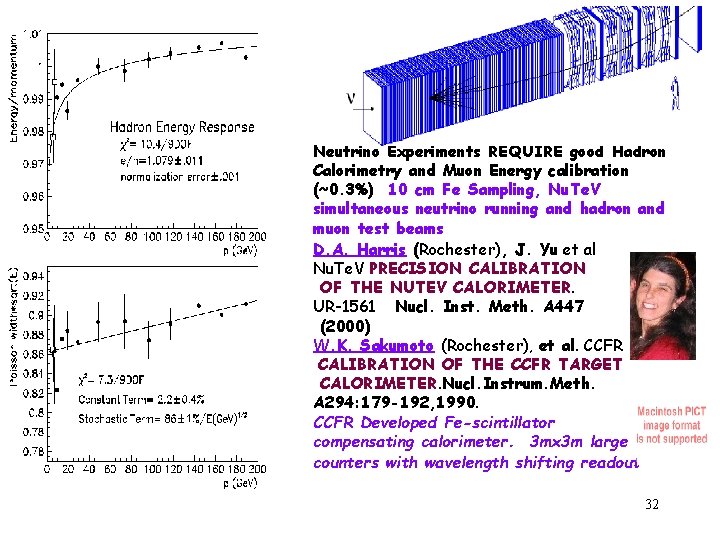
Neutrino Experiments REQUIRE good Hadron Calorimetry and Muon Energy calibration (~0. 3%) 10 cm Fe Sampling, Nu. Te. V simultaneous neutrino running and hadron and muon test beams D. A. Harris (Rochester), J. Yu et al Nu. Te. V PRECISION CALIBRATION OF THE NUTEV CALORIMETER. UR-1561 Nucl. Inst. Meth. A 447 (2000) W. K. Sakumoto (Rochester), et al. CCFR CALIBRATION OF THE CCFR TARGET CALORIMETER. Nucl. Instrum. Meth. A 294: 179 -192, 1990. CCFR Developed Fe-scintillator compensating calorimeter. 3 mx 3 m large counters with wavelength shifting readout 32
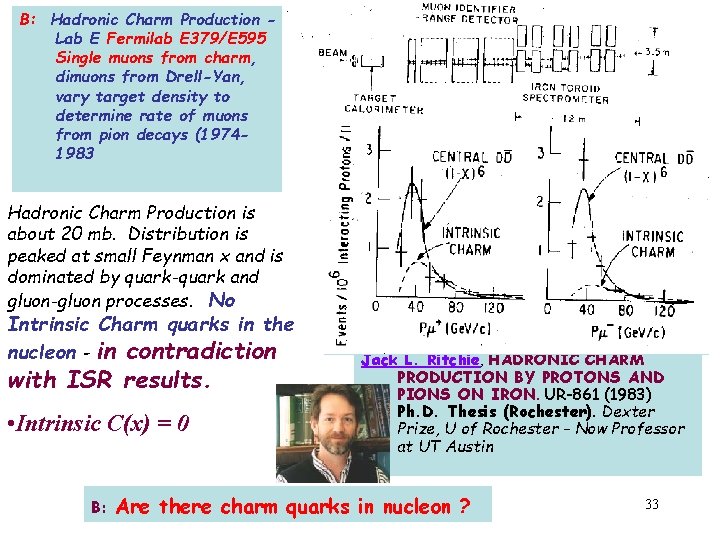
B: Hadronic Charm Production Lab E Fermilab E 379/E 595 Single muons from charm, dimuons from Drell-Yan, vary target density to determine rate of muons from pion decays (19741983 Hadronic Charm Production is about 20 mb. Distribution is peaked at small Feynman x and is dominated by quark-quark and gluon-gluon processes. No Intrinsic Charm quarks in the nucleon - in contradiction with ISR results. • Intrinsic C(x) = 0 B: Jack L. Ritchie, HADRONIC CHARM PRODUCTION BY PROTONS AND PIONS ON IRON. UR-861 (1983) Ph. D. Thesis (Rochester). Dexter Prize, U of Rochester - Now Professor at UT Austin Are there charm quarks in nucleon ? 33
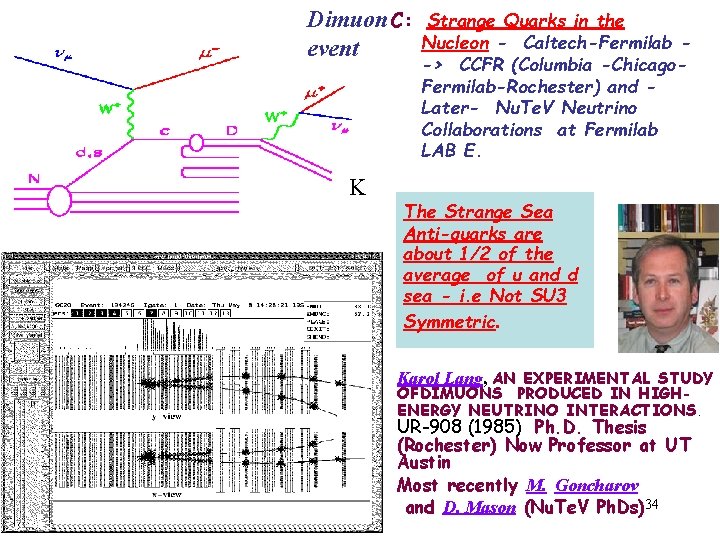
Dimuon C: event K Strange Quarks in the Nucleon - Caltech-Fermilab -> CCFR (Columbia -Chicago. Fermilab-Rochester) and Later- Nu. Te. V Neutrino Collaborations at Fermilab LAB E. The Strange Sea Anti-quarks are about 1/2 of the average of u and d sea - i. e Not SU 3 Symmetric. Karol Lang, AN EXPERIMENTAL STUDY OFDIMUONS PRODUCED IN HIGHENERGY NEUTRINO INTERACTIONS. UR-908 (1985) Ph. D. Thesis (Rochester) Now Professor at UT Austin Most recently M. Goncharov and D. Mason (Nu. Te. V Ph. Ds)34
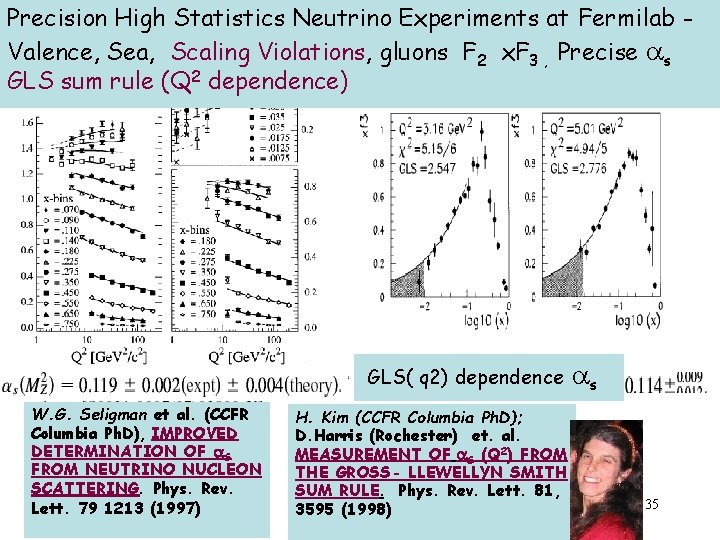
Precision High Statistics Neutrino Experiments at Fermilab Valence, Sea, Scaling Violations, gluons F 2 x. F 3 , Precise s GLS sum rule (Q 2 dependence) GLS( q 2) dependence W. G. Seligman et al. (CCFR Columbia Ph. D), IMPROVED DETERMINATION OF S FROM NEUTRINO NUCLEON SCATTERING. Phys. Rev. Lett. 79 1213 (1997) H. Kim (CCFR Columbia Ph. D); D. Harris (Rochester) et. al. MEASUREMENT OF S (Q 2) FROM THE GROSS- LLEWELLYN SMITH SUM RULE. Phys. Rev. Lett. 81, 3595 (1998) s 35
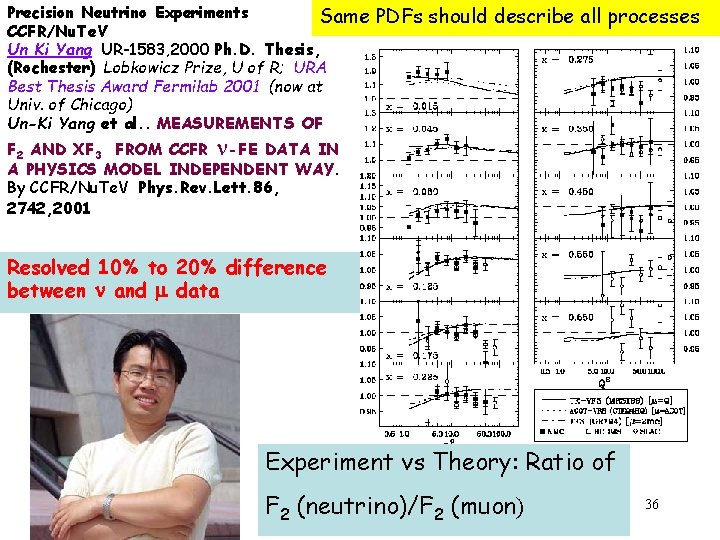
Precision Neutrino Experiments Same CCFR/Nu. Te. V Un Ki Yang UR-1583, 2000 Ph. D. Thesis, (Rochester) Lobkowicz Prize, U of R; URA Best Thesis Award Fermilab 2001 (now at Univ. of Chicago) Un-Ki Yang et al. . MEASUREMENTS OF PDFs should describe all processes F 2 AND XF 3 FROM CCFR -FE DATA IN A PHYSICS MODEL INDEPENDENT WAY. By CCFR/Nu. Te. V Phys. Rev. Lett. 86, 2742, 2001 Resolved 10% to 20% difference between and data Experiment vs Theory: Ratio of F 2 (neutrino)/F 2 (muon) 36
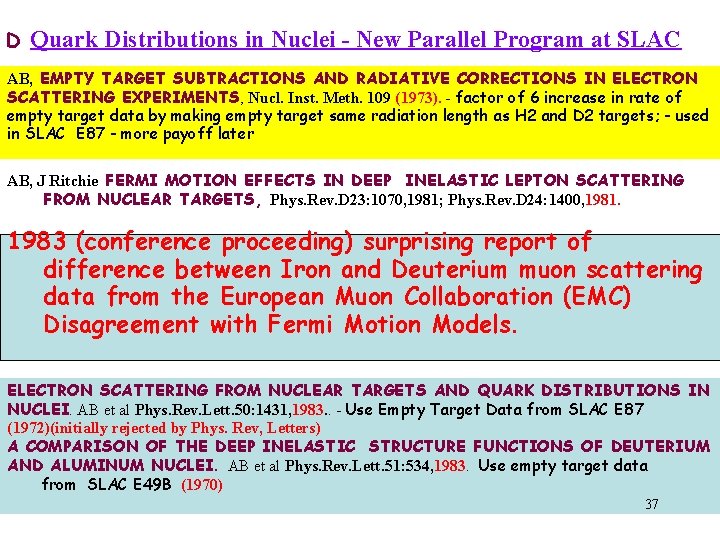
D Quark Distributions in Nuclei - New Parallel Program at SLAC AB, EMPTY TARGET SUBTRACTIONS AND RADIATIVE CORRECTIONS IN ELECTRON SCATTERING EXPERIMENTS, Nucl. Inst. Meth. 109 (1973). - factor of 6 increase in rate of empty target data by making empty target same radiation length as H 2 and D 2 targets; - used in SLAC E 87 - more payoff later AB, J Ritchie FERMI MOTION EFFECTS IN DEEP INELASTIC LEPTON SCATTERING FROM NUCLEAR TARGETS, Phys. Rev. D 23: 1070, 1981; Phys. Rev. D 24: 1400, 1981. 1983 (conference proceeding) surprising report of difference between Iron and Deuterium muon scattering data from the European Muon Collaboration (EMC) Disagreement with Fermi Motion Models. ELECTRON SCATTERING FROM NUCLEAR TARGETS AND QUARK DISTRIBUTIONS IN NUCLEI. AB et al Phys. Rev. Lett. 50: 1431, 1983. . - Use Empty Target Data from SLAC E 87 (1972)(initially rejected by Phys. Rev, Letters) A COMPARISON OF THE DEEP INELASTIC STRUCTURE FUNCTIONS OF DEUTERIUM AND ALUMINUM NUCLEI. AB et al Phys. Rev. Lett. 51: 534, 1983. Use empty target data from SLAC E 49 B (1970) 37
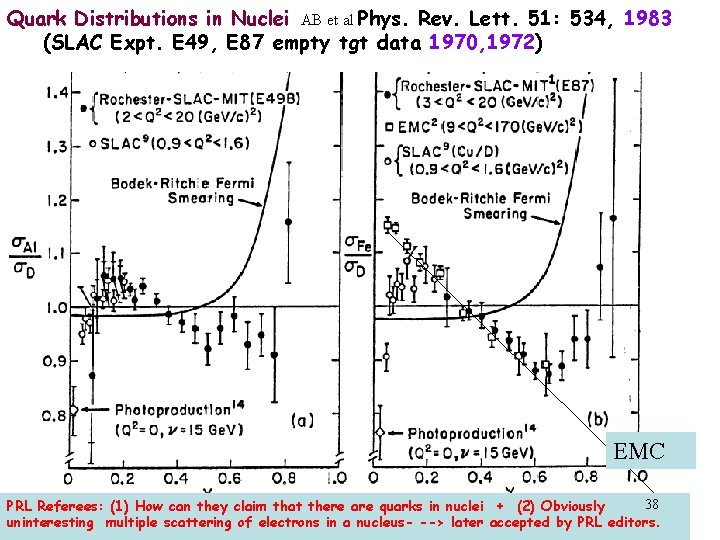
Quark Distributions in Nuclei AB et al Phys. Rev. Lett. 51: 534, 1983 (SLAC Expt. E 49, E 87 empty tgt data 1970, 1972) EMC 38 PRL Referees: (1) How can they claim that there are quarks in nuclei + (2) Obviously uninteresting multiple scattering of electrons in a nucleus- --> later accepted by PRL editors.
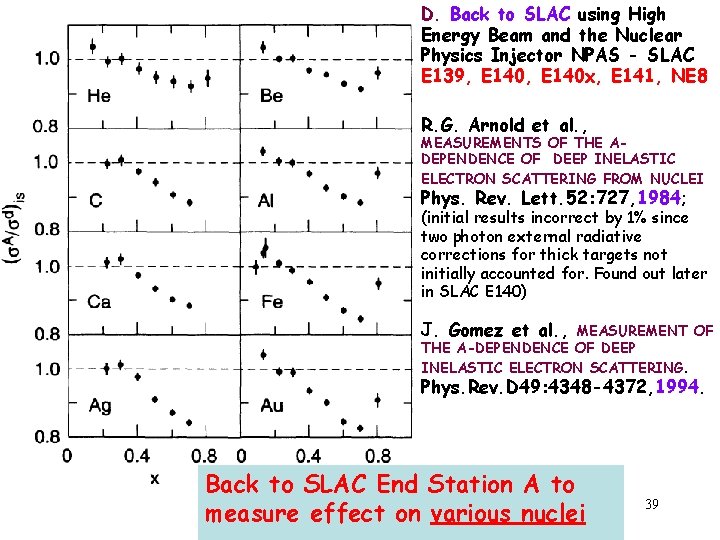
D. Back to SLAC using High Energy Beam and the Nuclear Physics Injector NPAS - SLAC E 139, E 140 x, E 141, NE 8 R. G. Arnold et al. , MEASUREMENTS OF THE ADEPENDENCE OF DEEP INELASTIC ELECTRON SCATTERING FROM NUCLEI Phys. Rev. Lett. 52: 727, 1984; (initial results incorrect by 1% since two photon external radiative corrections for thick targets not initially accounted for. Found out later in SLAC E 140) J. Gomez et al. , MEASUREMENT OF THE A-DEPENDENCE OF DEEP INELASTIC ELECTRON SCATTERING. Phys. Rev. D 49: 4348 -4372, 1994. Back to SLAC End Station A to measure effect on various nuclei 39
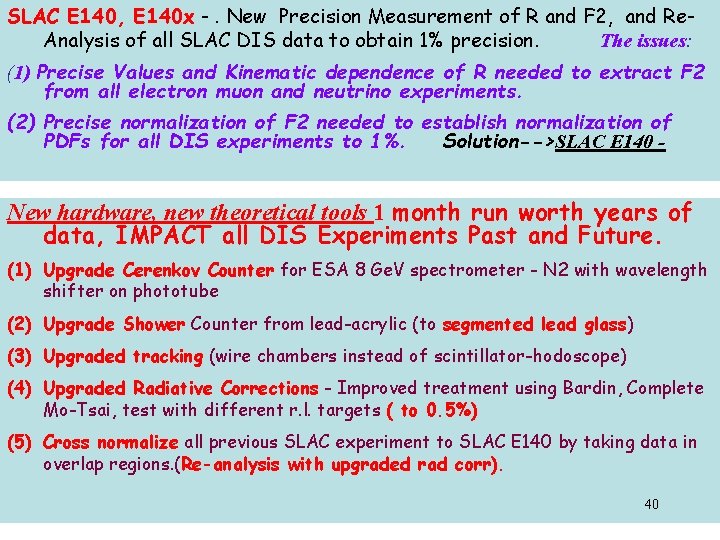
SLAC E 140, E 140 x -. New Precision Measurement of R and F 2, and Re. Analysis of all SLAC DIS data to obtain 1% precision. The issues: (1) Precise Values and Kinematic dependence of R needed to extract F 2 from all electron muon and neutrino experiments. (2) Precise normalization of F 2 needed to establish normalization of PDFs for all DIS experiments to 1%. Solution-->SLAC E 140 - New hardware, new theoretical tools 1 month run worth years of data, IMPACT all DIS Experiments Past and Future. (1) Upgrade Cerenkov Counter for ESA 8 Ge. V spectrometer - N 2 with wavelength shifter on phototube (2) Upgrade Shower Counter from lead-acrylic (to segmented lead glass) (3) Upgraded tracking (wire chambers instead of scintillator-hodoscope) (4) Upgraded Radiative Corrections - Improved treatment using Bardin, Complete Mo-Tsai, test with different r. l. targets ( to 0. 5%) (5) Cross normalize all previous SLAC experiment to SLAC E 140 by taking data in overlap regions. (Re-analysis with upgraded rad corr). 40
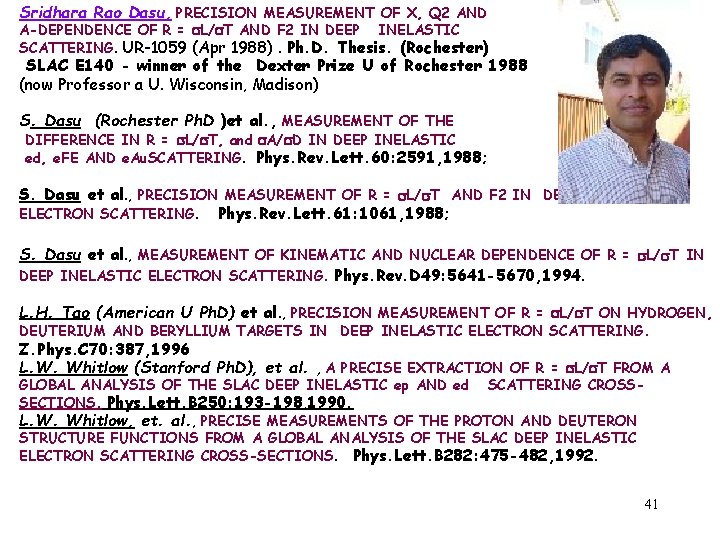
Sridhara Rao Dasu, PRECISION MEASUREMENT OF X, Q 2 AND A-DEPENDENCE OF R = L/ T AND F 2 IN DEEP INELASTIC SCATTERING. UR-1059 (Apr 1988). Ph. D. Thesis. (Rochester) SLAC E 140 - winner of the Dexter Prize U of Rochester 1988 (now Professor a U. Wisconsin, Madison) S. Dasu (Rochester Ph. D )et al. , MEASUREMENT OF THE DIFFERENCE IN R = L/ T, and A/ D IN DEEP INELASTIC ed, e. FE AND e. Au. SCATTERING. Phys. Rev. Lett. 60: 2591, 1988; S. Dasu et al. , PRECISION MEASUREMENT OF R = L/ T AND F 2 IN DEEP INELASTIC ELECTRON SCATTERING. Phys. Rev. Lett. 61: 1061, 1988; S. Dasu et al. , MEASUREMENT OF KINEMATIC AND NUCLEAR DEPENDENCE OF R = L/ T IN DEEP INELASTIC ELECTRON SCATTERING. Phys. Rev. D 49: 5641 -5670, 1994. L. H. Tao (American U Ph. D) et al. , PRECISION MEASUREMENT OF R = L/ T ON HYDROGEN, DEUTERIUM AND BERYLLIUM TARGETS IN DEEP INELASTIC ELECTRON SCATTERING. Z. Phys. C 70: 387, 1996 L. W. Whitlow (Stanford Ph. D), et al. , A PRECISE EXTRACTION OF R = L/ T FROM A GLOBAL ANALYSIS OF THE SLAC DEEP INELASTIC ep AND ed SCATTERING CROSSSECTIONS. Phys. Lett. B 250: 193 -198, 1990. L. W. Whitlow, et. al. , PRECISE MEASUREMENTS OF THE PROTON AND DEUTERON STRUCTURE FUNCTIONS FROM A GLOBAL ANALYSIS OF THE SLAC DEEP INELASTIC ELECTRON SCATTERING CROSS-SECTIONS. Phys. Lett. B 282: 475 -482, 1992. 41
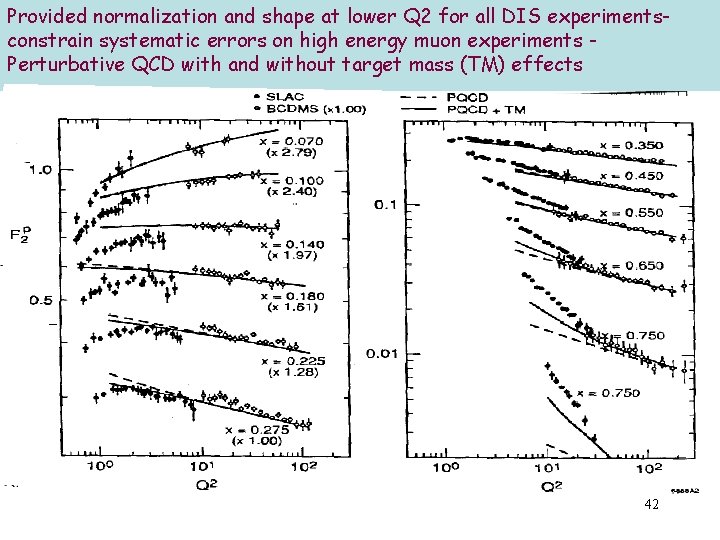
Provided normalization and shape at lower Q 2 for all DIS experimentsconstrain systematic errors on high energy muon experiments Perturbative QCD with and without target mass (TM) effects 42
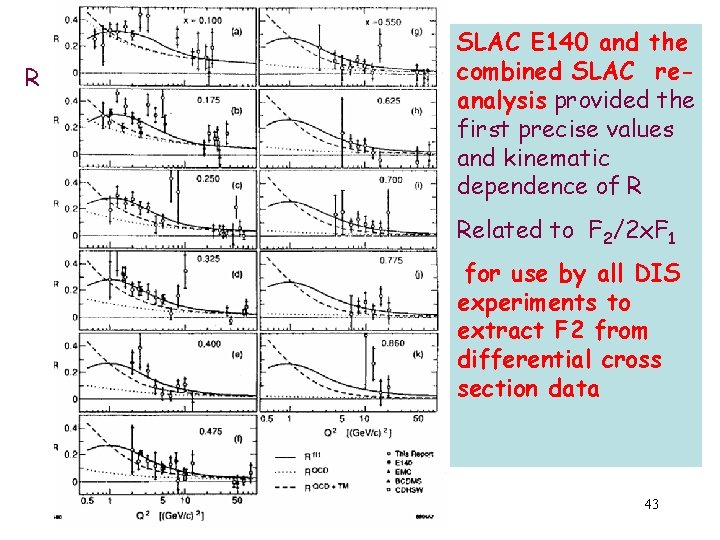
R SLAC E 140 and the combined SLAC reanalysis provided the first precise values and kinematic dependence of R Related to F 2/2 x. F 1 for use by all DIS experiments to extract F 2 from differential cross section data 43
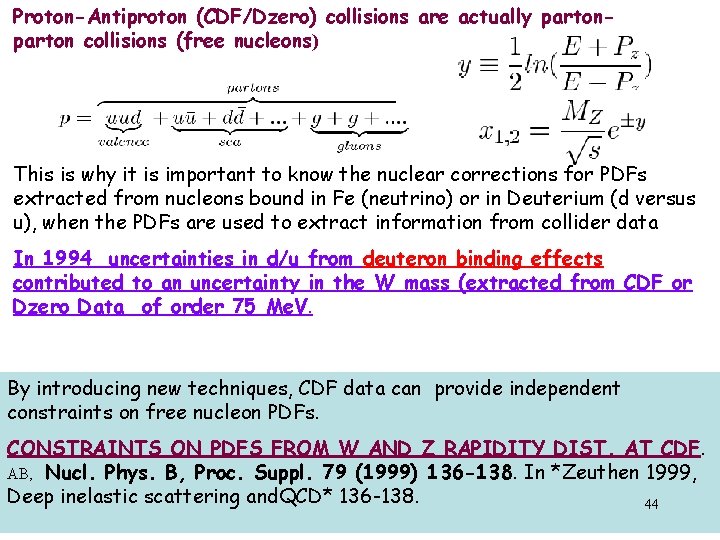
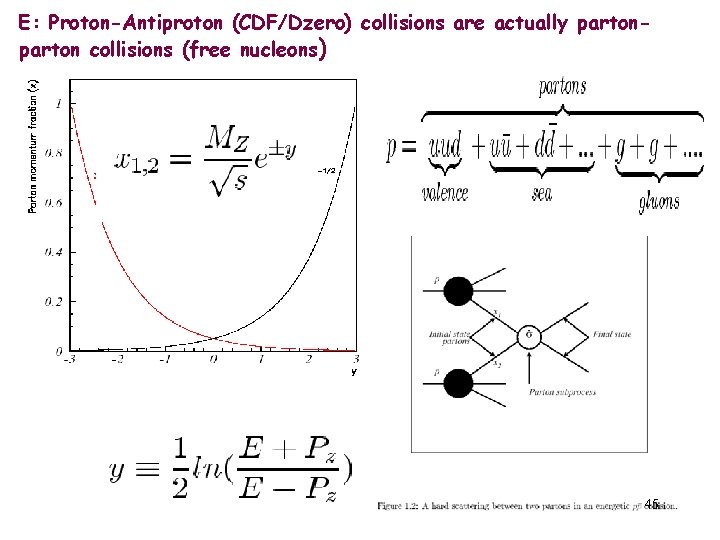
Proton-Antiproton (CDF/Dzero) collisions are actually parton collisions (free nucleons) This is why it is important to know the nuclear corrections for PDFs extracted from nucleons bound in Fe (neutrino) or in Deuterium (d versus u), when the PDFs are used to extract information from collider data In 1994 uncertainties in d/u from deuteron binding effects contributed to an uncertainty in the W mass (extracted from CDF or Dzero Data of order 75 Me. V. By introducing new techniques, CDF data can provide independent constraints on free nucleon PDFs. CONSTRAINTS ON PDFS FROM W AND Z RAPIDITY DIST. AT CDF. AB, Nucl. Phys. B, Proc. Suppl. 79 (1999) 136 -138. In *Zeuthen 1999, Deep inelastic scattering and. QCD* 136 -138. 44
E: Proton-Antiproton (CDF/Dzero) collisions are actually parton collisions (free nucleons) 45
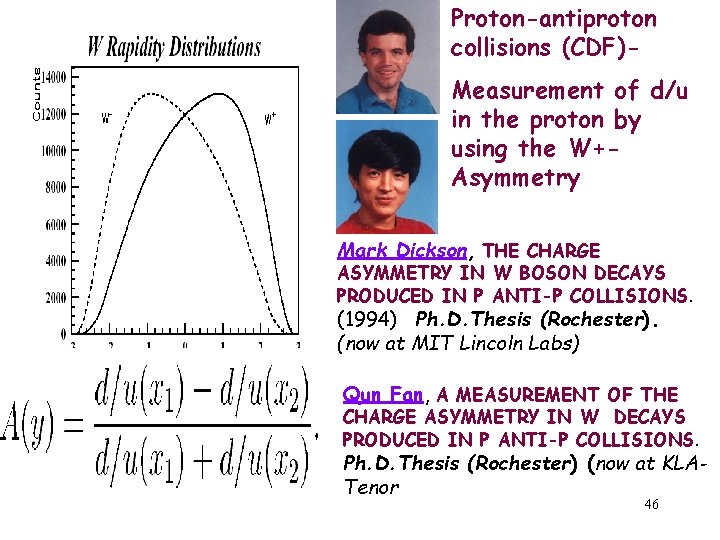
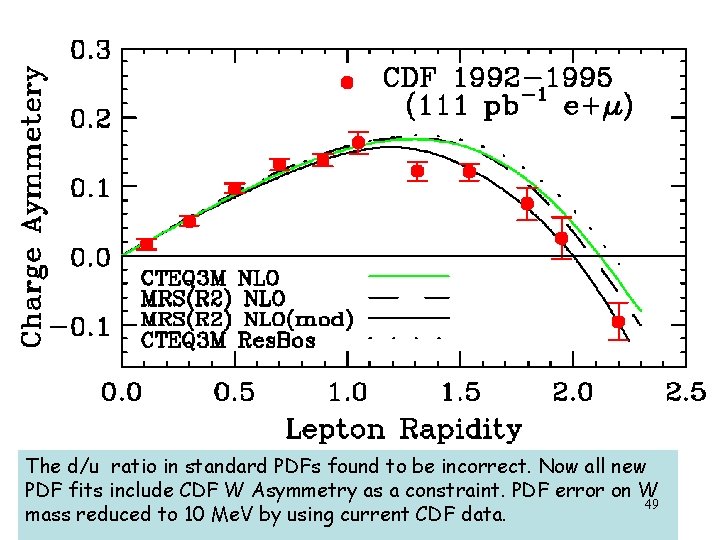
Proton-antiproton collisions (CDF)Measurement of d/u in the proton by using the W+Asymmetry Mark Dickson, THE CHARGE ASYMMETRY IN W BOSON DECAYS PRODUCED IN P ANTI-P COLLISIONS. (1994) Ph. D. Thesis (Rochester). (now at MIT Lincoln Labs) Qun Fan, A MEASUREMENT OF THE CHARGE ASYMMETRY IN W DECAYS PRODUCED IN P ANTI-P COLLISIONS. Ph. D. Thesis (Rochester) (now at KLATenor 46
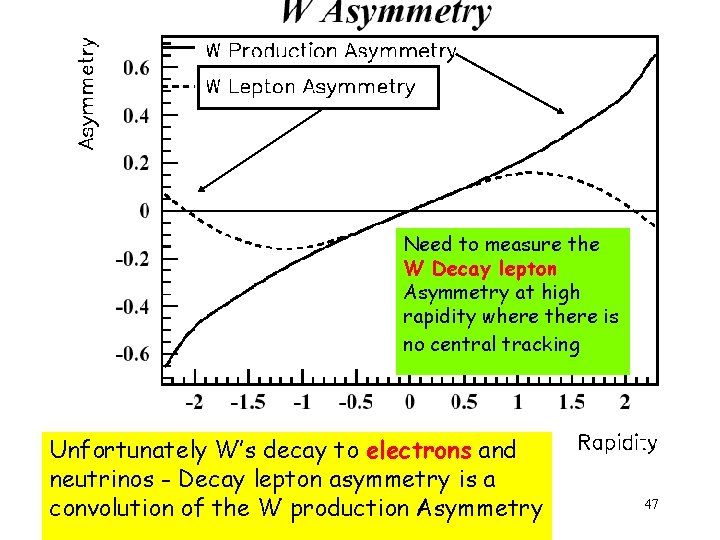
Need to measure the W Decay lepton Asymmetry at high rapidity where there is no central tracking Unfortunately W’s decay to electrons and neutrinos - Decay lepton asymmetry is a convolution of the W production Asymmetry 47
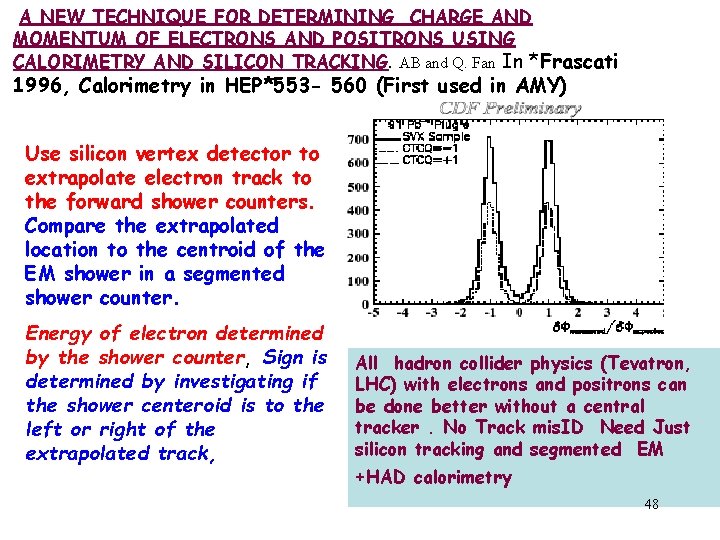
A NEW TECHNIQUE FOR DETERMINING CHARGE AND MOMENTUM OF ELECTRONS AND POSITRONS USING CALORIMETRY AND SILICON TRACKING. AB and Q. Fan In *Frascati 1996, Calorimetry in HEP*553 - 560 (First used in AMY) Use silicon vertex detector to extrapolate electron track to the forward shower counters. Compare the extrapolated location to the centroid of the EM shower in a segmented shower counter. Energy of electron determined by the shower counter, Sign is determined by investigating if the shower centeroid is to the left or right of the extrapolated track, All hadron collider physics (Tevatron, LHC) with electrons and positrons can be done better without a central tracker. No Track mis. ID Need Just silicon tracking and segmented EM +HAD calorimetry 48
The d/u ratio in standard PDFs found to be incorrect. Now all new PDF fits include CDF W Asymmetry as a constraint. PDF error on W 49 mass reduced to 10 Me. V by using current CDF data.
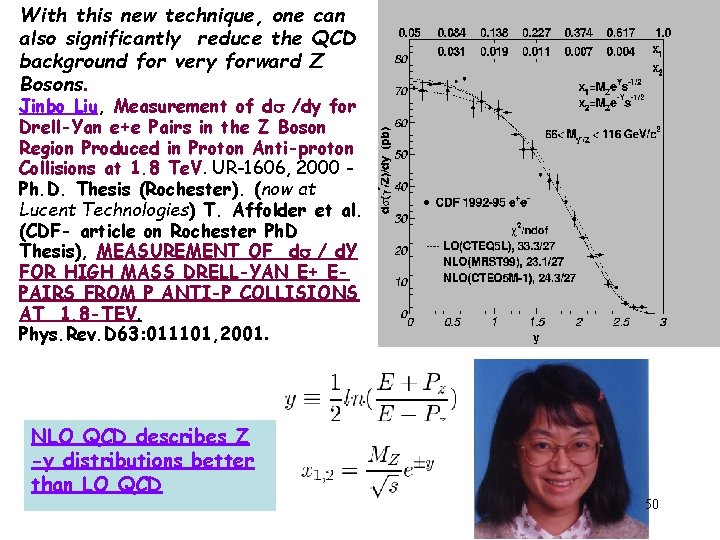
With this new technique, one can also significantly reduce the QCD background for very forward Z Bosons. Jinbo Liu, Measurement of d /dy for Drell-Yan e+e Pairs in the Z Boson Region Produced in Proton Anti-proton Collisions at 1. 8 Te. V. UR-1606, 2000 Ph. D. Thesis (Rochester). (now at Lucent Technologies) T. Affolder et al. (CDF- article on Rochester Ph. D Thesis), MEASUREMENT OF d / d. Y FOR HIGH MASS DRELL-YAN E+ EPAIRS FROM P ANTI-P COLLISIONS AT 1. 8 -TEV. Phys. Rev. D 63: 011101, 2001. NLO QCD describes Z -y distributions better than LO QCD 50
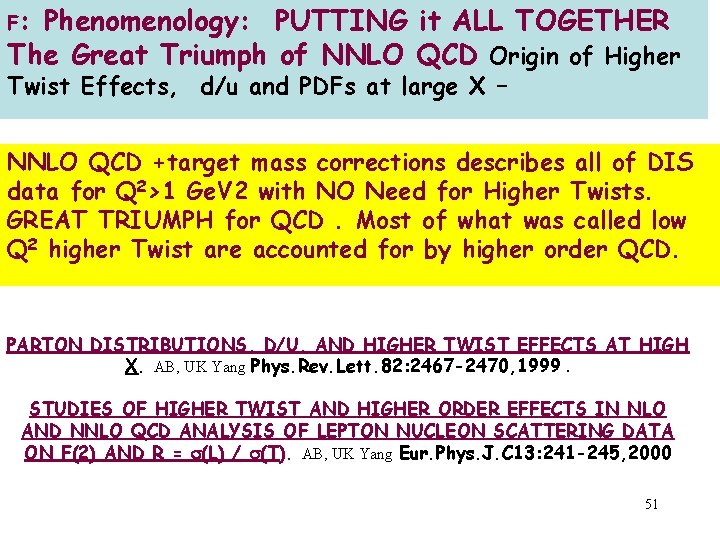
F: Phenomenology: PUTTING it ALL TOGETHER The Great Triumph of NNLO QCD Origin of Higher Twist Effects, d/u and PDFs at large X – NNLO QCD +target mass corrections describes all of DIS data for Q 2>1 Ge. V 2 with NO Need for Higher Twists. GREAT TRIUMPH for QCD. Most of what was called low Q 2 higher Twist are accounted for by higher order QCD. PARTON DISTRIBUTIONS, D/U, AND HIGHER TWIST EFFECTS AT HIGH X. AB, UK Yang Phys. Rev. Lett. 82: 2467 -2470, 1999. STUDIES OF HIGHER TWIST AND HIGHER ORDER EFFECTS IN NLO AND NNLO QCD ANALYSIS OF LEPTON NUCLEON SCATTERING DATA ON F(2) AND R = (L) / (T). AB, UK Yang Eur. Phys. J. C 13: 241 -245, 2000 51
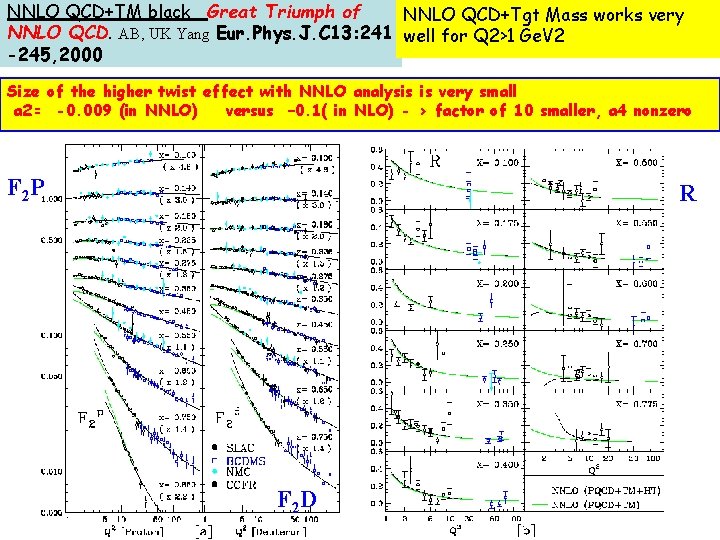
NNLO QCD+TM black Great Triumph of NNLO QCD+Tgt Mass works very NNLO QCD. AB, UK Yang Eur. Phys. J. C 13: 241 well for Q 2>1 Ge. V 2 -245, 2000 Size of the higher twist effect with NNLO analysis is very small a 2= -0. 009 (in NNLO) versus – 0. 1( in NLO) - > factor of 10 smaller, a 4 nonzero F 2 P R F 2 D
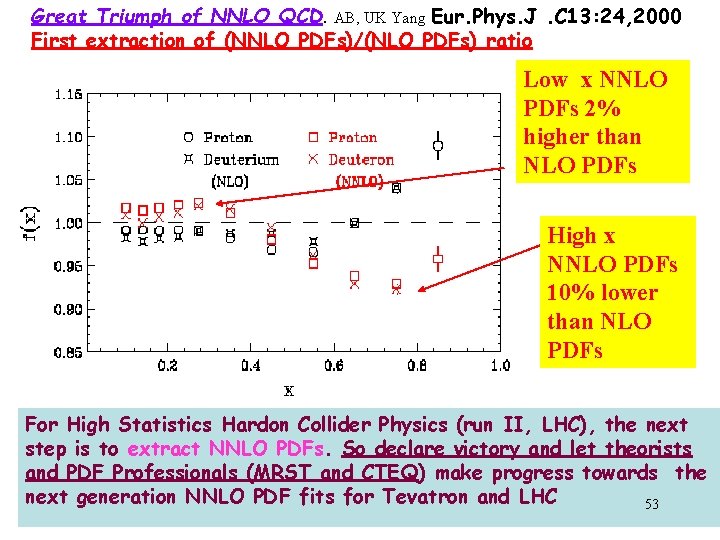
Great Triumph of NNLO QCD. AB, UK Yang Eur. Phys. J. C 13: 24, 2000 First extraction of (NNLO PDFs)/(NLO PDFs) ratio Low x NNLO PDFs 2% higher than NLO PDFs High x NNLO PDFs 10% lower than NLO PDFs For High Statistics Hardon Collider Physics (run II, LHC), the next step is to extract NNLO PDFs. So declare victory and let theorists and PDF Professionals (MRST and CTEQ) make progress towards the next generation NNLO PDF fits for Tevatron and LHC 53
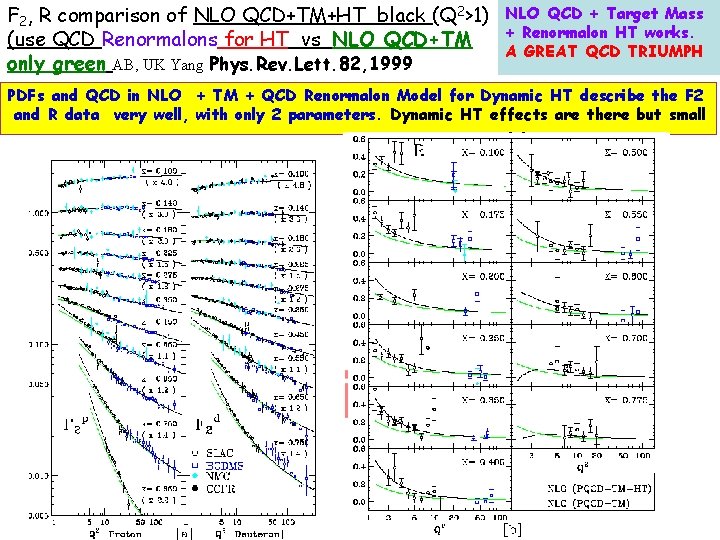
F 2, R comparison of NLO QCD+TM+HT black (Q 2>1) (use QCD Renormalons for HT vs NLO QCD+TM only green AB, UK Yang Phys. Rev. Lett. 82, 1999 NLO QCD + Target Mass + Renormalon HT works. A GREAT QCD TRIUMPH PDFs and QCD in NLO + TM + QCD Renormalon Model for Dynamic HT describe the F 2 and R data very well, with only 2 parameters. Dynamic HT effects are there but small
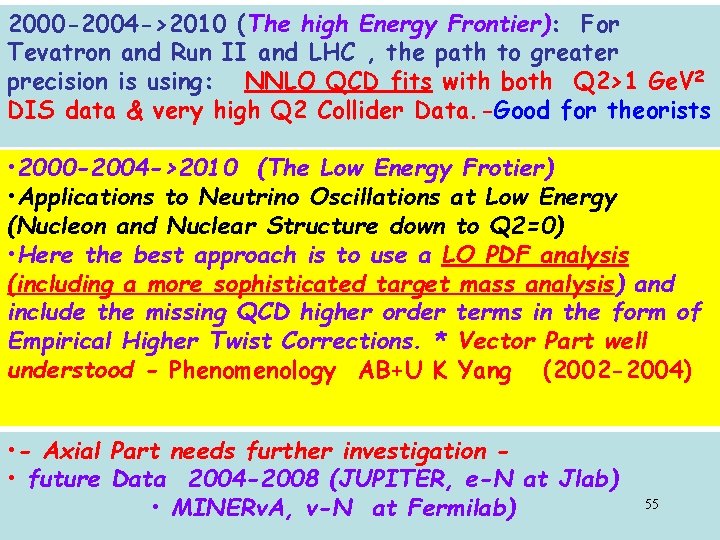
2000 -2004 ->2010 (The high Energy Frontier): For Tevatron and Run II and LHC , the path to greater precision is using: NNLO QCD fits with both Q 2>1 Ge. V 2 DIS data & very high Q 2 Collider Data. -Good for theorists • 2000 -2004 ->2010 (The Low Energy Frotier) • Applications to Neutrino Oscillations at Low Energy (Nucleon and Nuclear Structure down to Q 2=0) • Here the best approach is to use a LO PDF analysis (including a more sophisticated target mass analysis) and include the missing QCD higher order terms in the form of Empirical Higher Twist Corrections. * Vector Part well understood - Phenomenology AB+U K Yang (2002 -2004) • - Axial Part needs further investigation • future Data 2004 -2008 (JUPITER, e-N at Jlab) • MINERv. A, v-N at Fermilab) 55
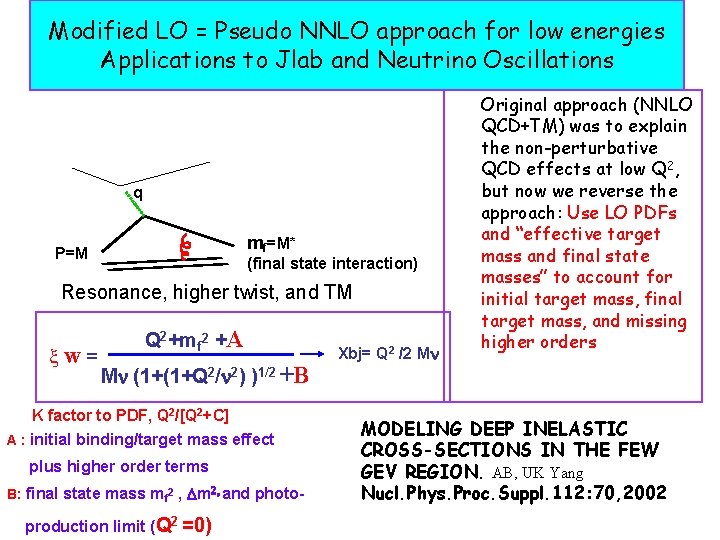
Modified LO = Pseudo NNLO approach for low energies Applications to Jlab and Neutrino Oscillations q mf=M* P=M (final state interaction) Resonance, higher twist, and TM x w = Q 2+mf 2 +A M (1+(1+Q 2/ 2) )1/2 +B K factor to PDF, Q 2/[Q 2+C] A : initial binding/target mass effect plus higher order terms B: final state mass mf 2 , m 2, and photo- production limit (Q 2 =0) Xbj= Q 2 /2 M Original approach (NNLO QCD+TM) was to explain the non-perturbative QCD effects at low Q 2, but now we reverse the approach: Use LO PDFs and “effective target mass and final state masses” to account for initial target mass, final target mass, and missing higher orders MODELING DEEP INELASTIC CROSS-SECTIONS IN THE FEW GEV REGION. AB, UK Yang Nucl. Phys. Proc. Suppl. 112: 70, 2002
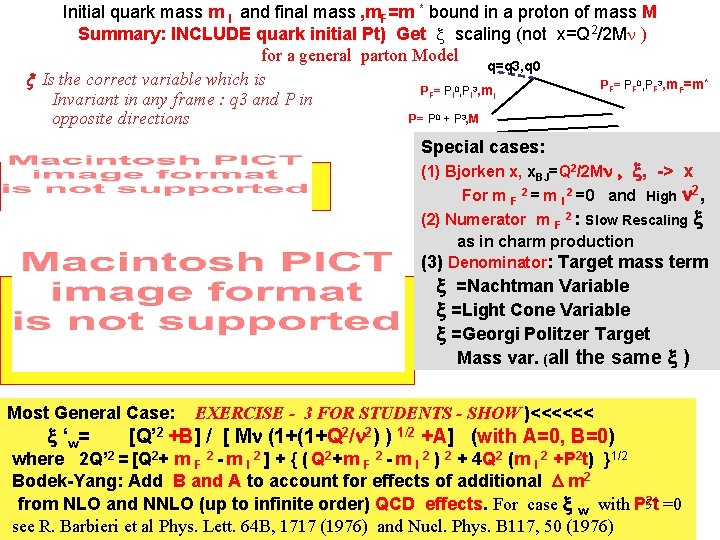
Initial quark mass m I and final mass , m. F=m * bound in a proton of mass M Summary: INCLUDE quark initial Pt) Get x scaling (not x=Q 2/2 M ) for a general parton Model q=q 3, q 0 x Is the correct variable which is PF= PF 0, PF 3, m. F=m* PF= PI 0, PI 3, m. I Invariant in any frame : q 3 and P in P= P 0 + P 3, M opposite directions Special cases: (1) Bjorken x, x. BJ=Q 2/2 M , x, -> x For m F 2 = m I 2 =0 and High 2, (2) Numerator m F 2 : Slow Rescaling x as in charm production (3) Denominator: Target mass term x =Nachtman Variable x =Light Cone Variable x =Georgi Politzer Target Mass var. (all the same x ) Most General Case: x ‘w= EXERCISE - 3 FOR STUDENTS - SHOW )<<<<<< [Q’ 2 +B] / [ M (1+(1+Q 2/ 2) ) 1/2 +A] (with A=0, B=0) where 2 Q’ 2 = [Q 2+ m F 2 - m I 2 ] + { ( Q 2+m F 2 - m I 2 ) 2 + 4 Q 2 (m I 2 +P 2 t) }1/2 Bodek-Yang: Add B and A to account for effects of additional m 2 from NLO and NNLO (up to infinite order) QCD effects. For case x 2 w with P 57 t =0 see R. Barbieri et al Phys. Lett. 64 B, 1717 (1976) and Nucl. Phys. B 117, 50 (1976)
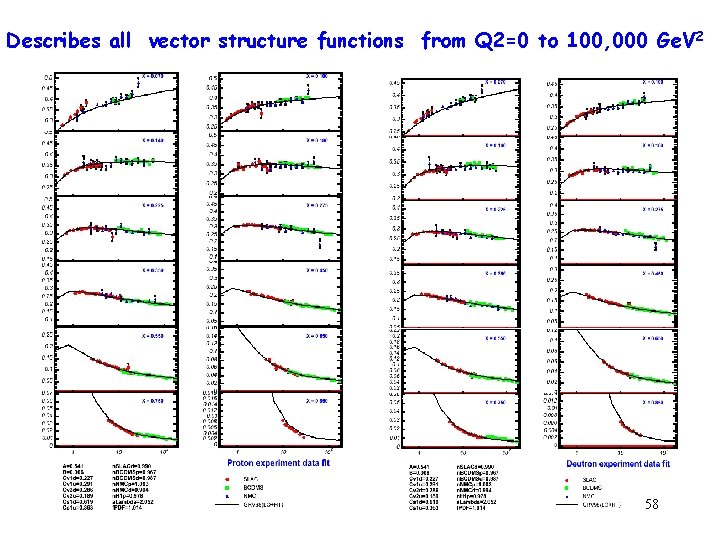
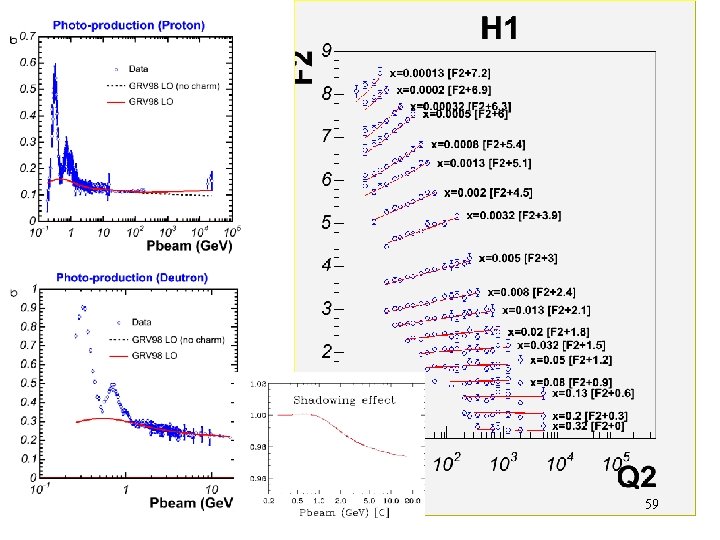
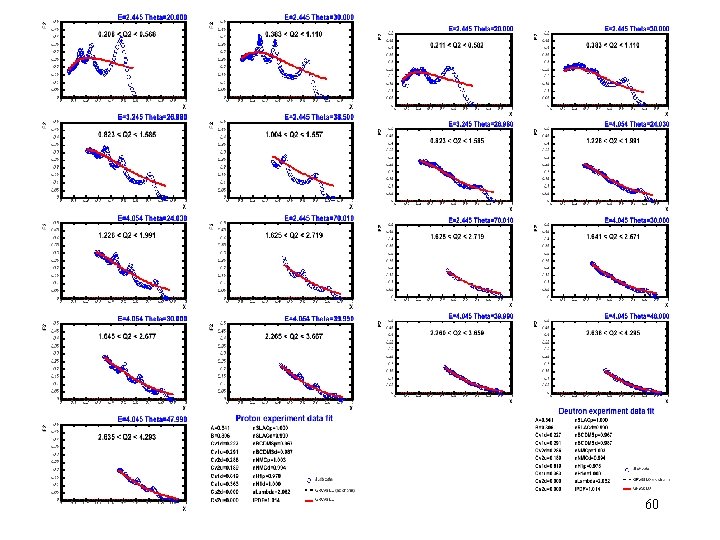
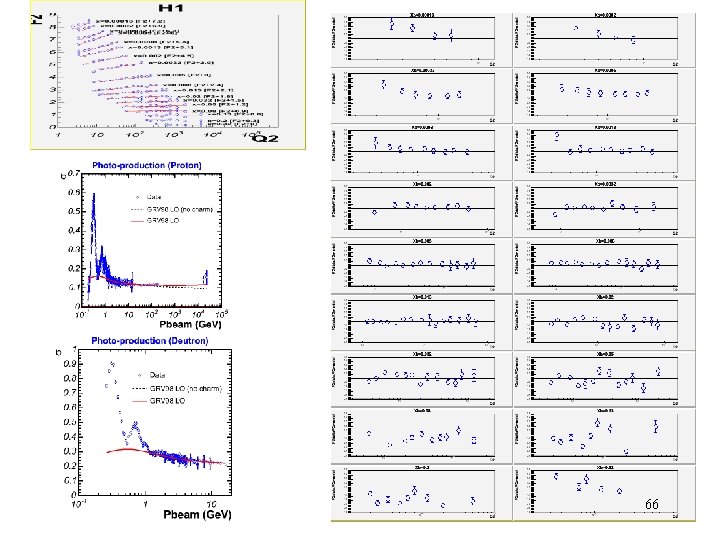
Describes all vector structure functions from Q 2=0 to 100, 000 Ge. V 2 58
59
60
Applications to Neutrino Oscillations at Low Energy MODELING DEEP INELASTIC CROSS-SECTIONS IN THE FEW GEV REGION. A. Bodek , U. K. Yang Presented at 1 st Workshop on Neutrino - Nucleus Interactions in the Few Ge. V Region (Nu. Int 01), Tsukuba, Japan, 13 -16 Dec 2001. Nucl. Phys. Proc. Suppl. 112: 70 -76, 2002 e: hep-ex/0203009 HIGHER TWIST, XI(OMEGA) SCALING, AND EFFECTIVE LO PDFS FOR LEPTON SCATTERING IN THE FEW GEV REGION. A Bodek, U. K. Yang Proceedings of 4 th International Nu. Fact '02 Workshop (Neutrino Factories Workshop on Neutrino Factories, London, England, 1 -6 Jul 2002. J. Phys. G 29: 1899 -1906, 2003 MODELING NEUTRINO AND ELECTRON SCATTERING INELASTIC CROSSSECTIONS IN THE FEW GEV REGION WITH EFFECTIVE LO PDFS IN LEADING ORDER. A. Bodek, U. K. Yang. 2 nd International Workshop on Neutrino Nucleus Interactions in the Few Ge. V Region (NUINT 02), Irvine, California, 12 -15 Dec 2002. Nucl. Phys. Proc. Suppl. hep-ex/0308007 Invited Article to be published in Annual Review of Particle and Nuclear Science 2005 61
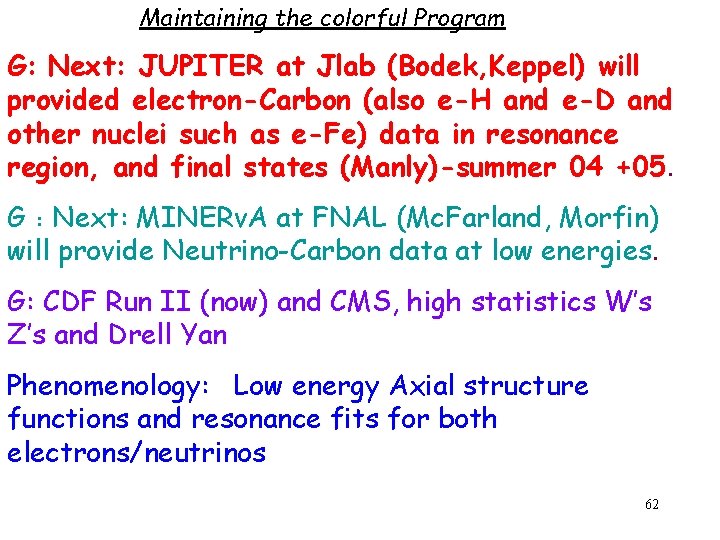
Maintaining the colorful Program G: Next: JUPITER at Jlab (Bodek, Keppel) will provided electron-Carbon (also e-H and e-D and other nuclei such as e-Fe) data in resonance region, and final states (Manly)-summer 04 +05. G : Next: MINERv. A at FNAL (Mc. Farland, Morfin) will provide Neutrino-Carbon data at low energies. G: CDF Run II (now) and CMS, high statistics W’s Z’s and Drell Yan Phenomenology: Low energy Axial structure functions and resonance fits for both electrons/neutrinos 62
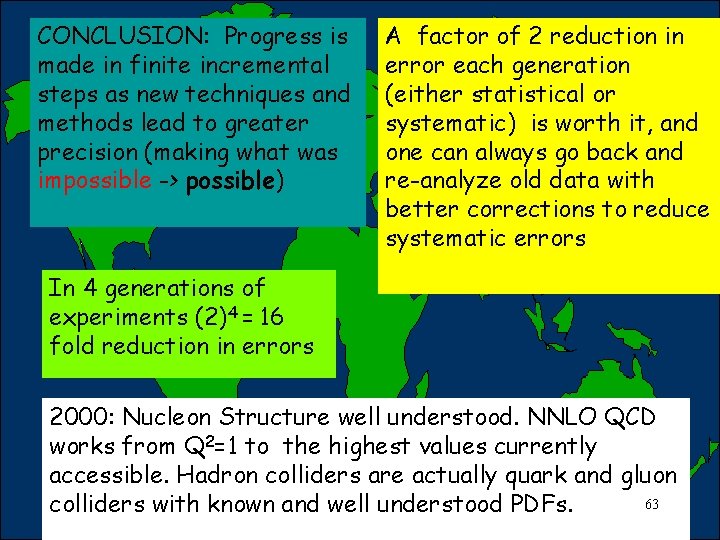
CONCLUSION: Progress is made in finite incremental steps as new techniques and methods lead to greater precision (making what was impossible -> possible) A factor of 2 reduction in error each generation (either statistical or systematic) is worth it, and one can always go back and re-analyze old data with better corrections to reduce systematic errors In 4 generations of experiments (2)4 = 16 fold reduction in errors 2000: Nucleon Structure well understood. NNLO QCD works from Q 2=1 to the highest values currently accessible. Hadron colliders are actually quark and gluon 63 colliders with known and well understood PDFs.
64
65
66