
Vector Analysis A Mathematical Approach Vector Components V
![Resultant Vector Calculation Vx VR= Vx + Vy 2 2]1/2 R= tan-1 ( Vy](https://slidetodoc.com/presentation_image_h2/6175bcd2eee669632f532897878b3617/image-8.jpg "Resultant Vector Calculation Vx VR= Vx + Vy 2 2]1/2 R= tan-1 ( Vy")
- Slides: 9
Vector Analysis A Mathematical Approach
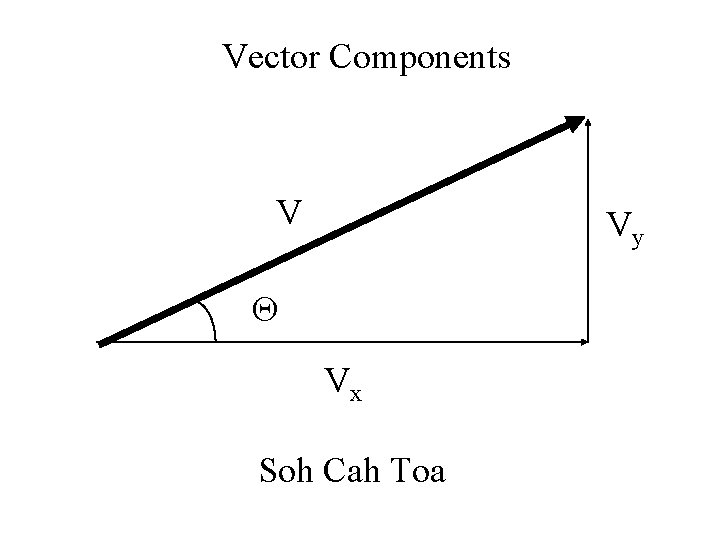
Vector Components V Vy Vx Soh Cah Toa
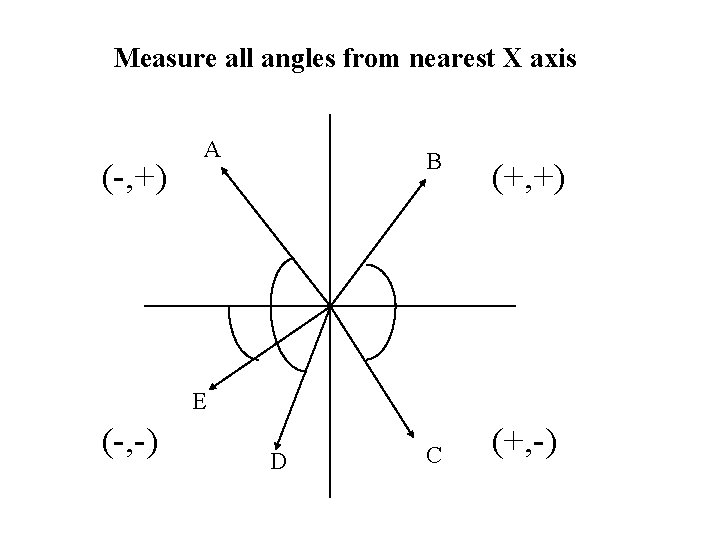
Measure all angles from nearest X axis (-, +) A B (+, +) E (-, -) D C (+, -)
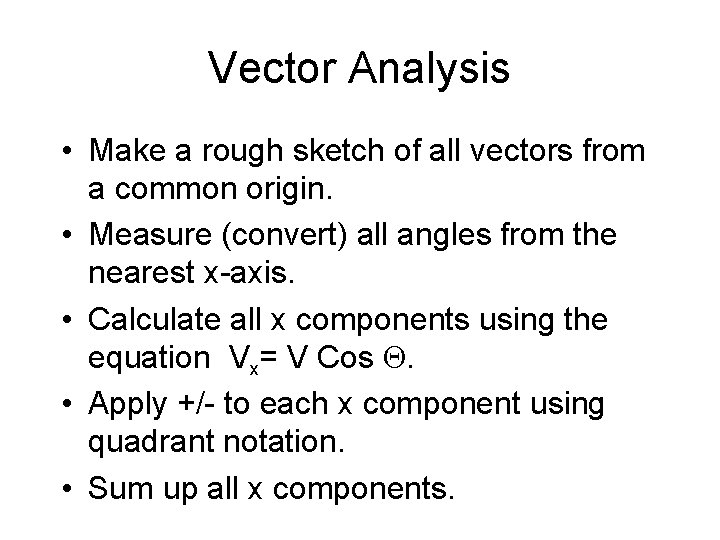
Vector Analysis • Make a rough sketch of all vectors from a common origin. • Measure (convert) all angles from the nearest x-axis. • Calculate all x components using the equation Vx= V Cos • Apply +/- to each x component using quadrant notation. • Sum up all x components.
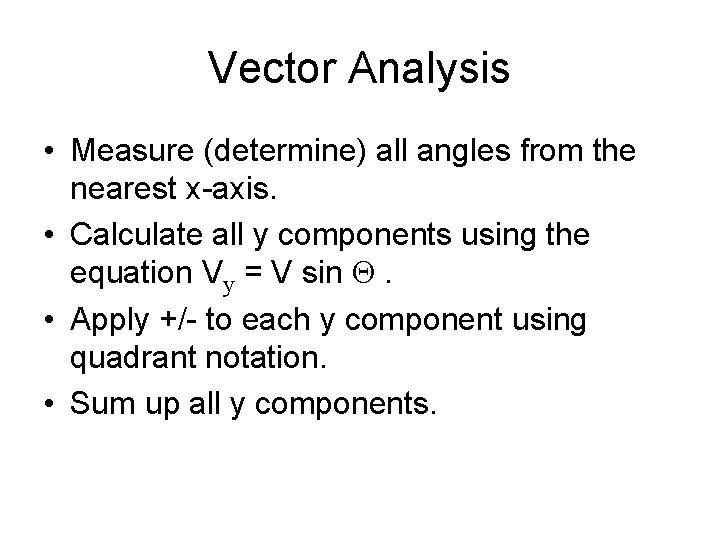
Vector Analysis • Measure (determine) all angles from the nearest x-axis. • Calculate all y components using the equation Vy = V sin . • Apply +/- to each y component using quadrant notation. • Sum up all y components.
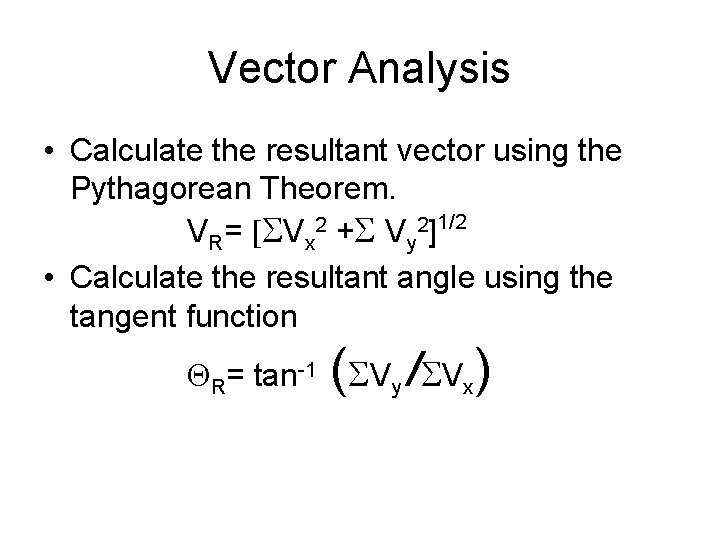
Vector Analysis • Calculate the resultant vector using the Pythagorean Theorem. VR= Vx 2 + Vy 2]1/2 • Calculate the resultant angle using the tangent function ( ) R= tan-1 Vy / Vx
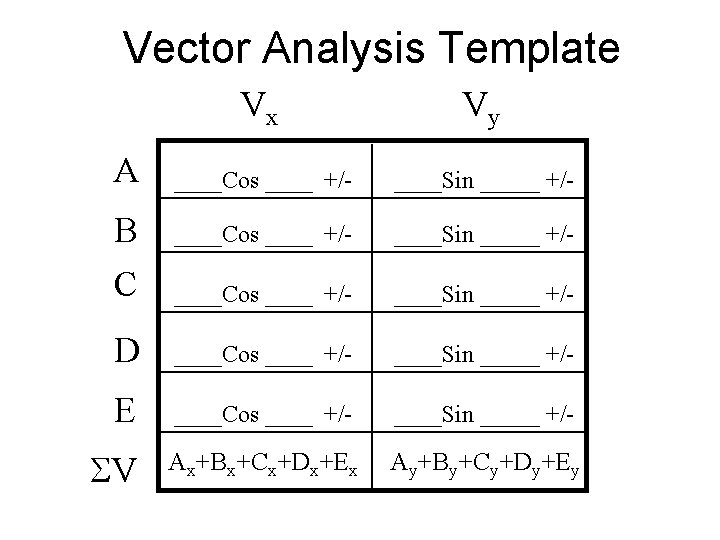
Vector Analysis Template Vx Vy ____Cos ____ +/- ____Sin _____ +/- B C ____Cos ____ +/- ____Sin _____ +/- D ____Cos ____ +/- ____Sin _____ +/- E ____Cos ____ +/- ____Sin _____ +/- V Ax+Bx+Cx+Dx+Ex Ay+By+Cy+Dy+Ey A
Resultant Vector Calculation Vx VR= Vx + Vy 2 2]1/2 R= tan-1 ( Vy / Vx) R VR Vy
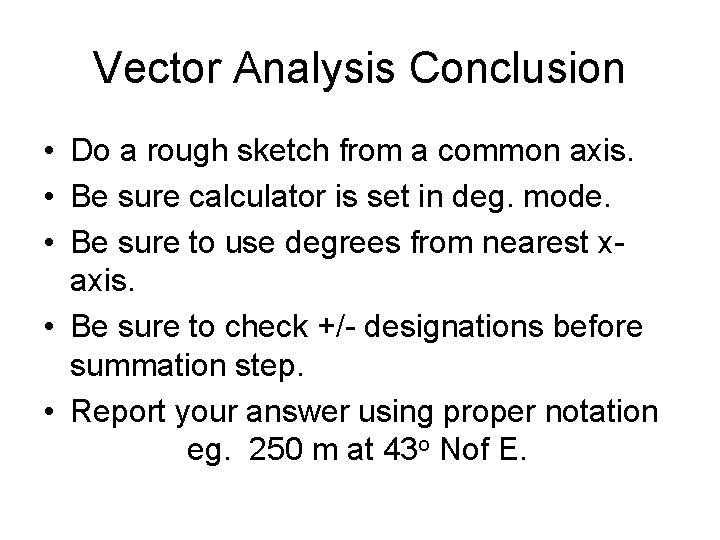
Vector Analysis Conclusion • Do a rough sketch from a common axis. • Be sure calculator is set in deg. mode. • Be sure to use degrees from nearest xaxis. • Be sure to check +/- designations before summation step. • Report your answer using proper notation eg. 250 m at 43 o Nof E.