
VCE History Units 3 and 4 Ancient History

- Slides: 30
VCE History Units 3 and 4 Ancient History Implementation Workshop
Acknowledgment of Country I would like to acknowledge the traditional custodians of the many lands across Victoria on which each of you are living, learning and working from today. For myself and those of us in the Melbourne metropolitan area, we acknowledge the traditional custodians of the Kulin Nations. When acknowledging country, we recognise Aboriginal and Torres Strait Islander peoples’ spiritual and cultural connection to country and acknowledge their continued care of the lands and waterways over generations, while celebrating the continuation of a living culture that has a unique role in this region. I would like to pay my respects to Elders past, present and emerging, for they hold the memories, traditions, culture and hopes of all Aboriginal and Torres Strait Islander peoples across the nation, and hope they will walk with us on our journey. 2
Outline • • • At a glance Features of Units 3 and 4 Ancient History Overview of the areas of study Teaching ideas Questions 3
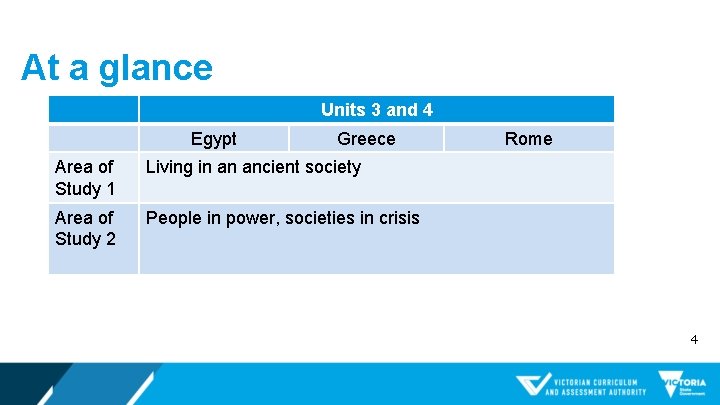
At a glance Units 3 and 4 Egypt Greece Area of Study 1 Living in an ancient society Area of Study 2 People in power, societies in crisis Rome 4
Changes to Units 3 and 4 • Area of Study 1 – Living in an ancient society • Each Key knowledge organised by each feature - social, political and economic – gives a focus to the organisation of knowledge 5
Changes to Units 3 and 4 • Area of Study 2 – People in power; societies in crisis • Reorganise the key knowledge to ‒ the causes of the (Crisis)… ‒ the causes, course and consequences of key developments in the crisis, including… ‒ the role, motives and influence of the following individuals: … • Added and additional figure to each society 6
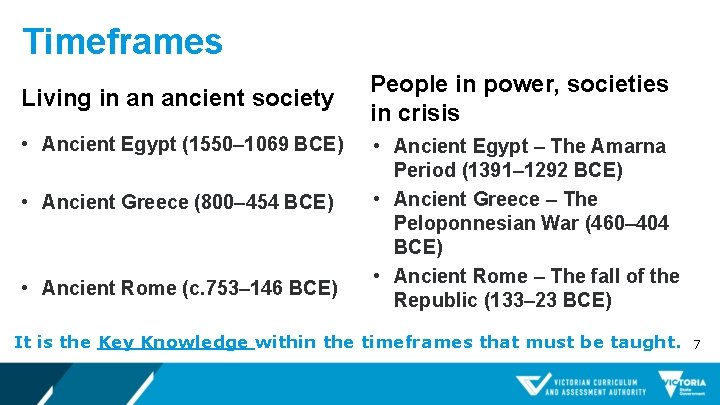
Timeframes Living in an ancient society • Ancient Egypt (1550– 1069 BCE) • Ancient Greece (800– 454 BCE) • Ancient Rome (c. 753– 146 BCE) People in power, societies in crisis • Ancient Egypt – The Amarna Period (1391– 1292 BCE) • Ancient Greece – The Peloponnesian War (460– 404 BCE) • Ancient Rome – The fall of the Republic (133– 23 BCE) It is the Key Knowledge within the timeframes that must be taught. 7
Selecting ancient societies for study • Select any two of Egypt, Greece and Rome • One for Unit 3, another for Unit 4 • When deciding which societies to select, take into account the following: ‒ ‒ ‒ Topics studied in Units 1 and 2 Teacher expertise Student interest Ties to your school community Available resources (library and online) 8
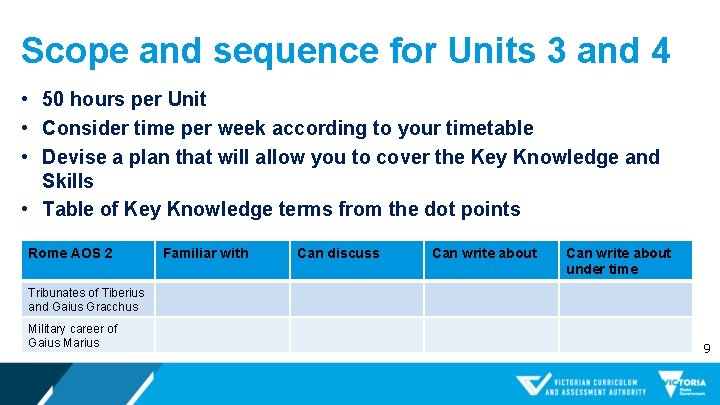
Scope and sequence for Units 3 and 4 • 50 hours per Unit • Consider time per week according to your timetable • Devise a plan that will allow you to cover the Key Knowledge and Skills • Table of Key Knowledge terms from the dot points Rome AOS 2 Familiar with Can discuss Can write about under time Tribunates of Tiberius and Gaius Gracchus Military career of Gaius Marius 9
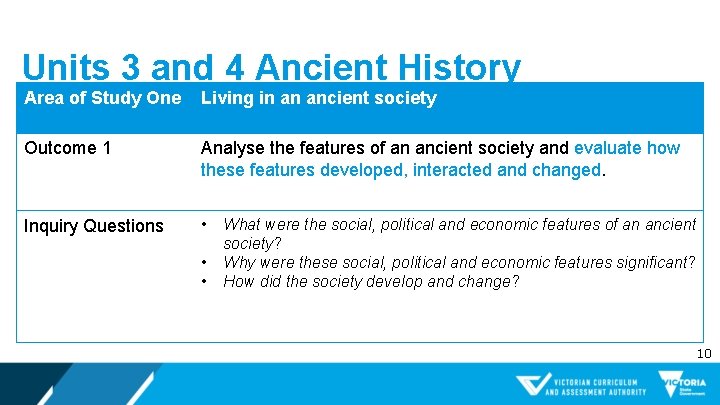
Units 3 and 4 Ancient History Area of Study One Living in an ancient society Outcome 1 Analyse the features of an ancient society and evaluate how these features developed, interacted and changed. Inquiry Questions • • • What were the social, political and economic features of an ancient society? Why were these social, political and economic features significant? How did the society develop and change? 10
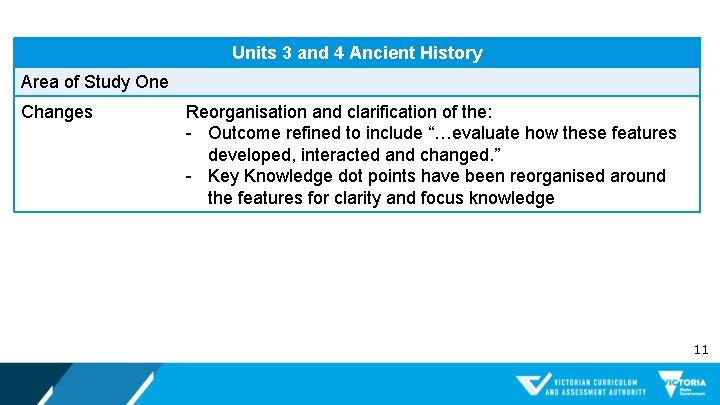
Units 3 and 4 Ancient History Area of Study One Changes Reorganisation and clarification of the: - Outcome refined to include “…evaluate how these features developed, interacted and changed. ” - Key Knowledge dot points have been reorganised around the features for clarity and focus knowledge 11
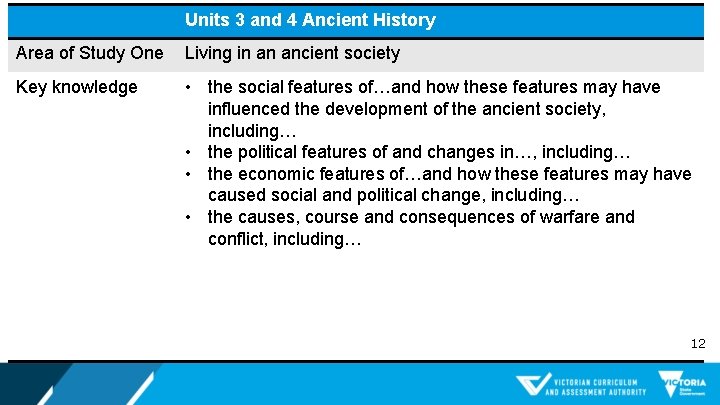
Units 3 and 4 Ancient History Area of Study One Living in an ancient society Key knowledge • the social features of…and how these features may have influenced the development of the ancient society, including… • the political features of and changes in…, including… • the economic features of…and how these features may have caused social and political change, including… • the causes, course and consequences of warfare and conflict, including… 12
Key Knowledge for Area of Study 1 • The role of women in New Kingdom Egypt ‒ A table with columns for men and women ‒ Roles in daily life, public functions 13
Key Knowledge for Area of Study 1 • The political systems of Ancient Greece ‒ Pyramid diagrams of the reforms of Solon and Cleisthenes ‒ The Spartan system of government for comparison 14
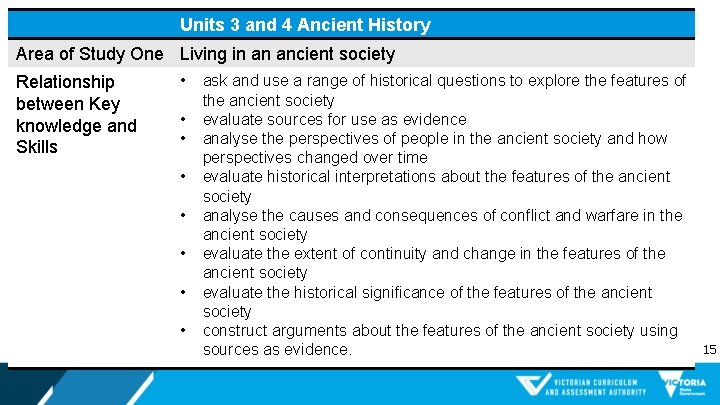
Units 3 and 4 Ancient History Area of Study One Living in an ancient society Relationship between Key knowledge and Skills • • ask and use a range of historical questions to explore the features of the ancient society evaluate sources for use as evidence analyse the perspectives of people in the ancient society and how perspectives changed over time evaluate historical interpretations about the features of the ancient society analyse the causes and consequences of conflict and warfare in the ancient society evaluate the extent of continuity and change in the features of the ancient society evaluate the historical significance of the features of the ancient society construct arguments about the features of the ancient society using sources as evidence. 15
Key Skills for Area of Study 1 • Provide opportunities to practise and demonstrate the attainment of the Key Skills • Teach skills in conjunction with appropriate Key Knowledge points 16
Key Skills for Area of Study 1 • For example: ‒ A timeline for the impact of Rome’s expansion in Italy on the broadening of political rights to demonstrate cause and consequence ‒ Analysis and evaluation of contemporary depictions of pharaohs (such as Thutmose III and Rameses II) and their role in creating and consolidating the Egyptian empire. 17
Units 3 and 4 Ancient History Area of Study Two People in power, societies in crisis Outcome 2 Evaluate the significance of a crisis in an ancient society and evaluate the role, motives and influence of key individuals involved in the crisis. Inquiry Questions • What were the causes of the crisis in the ancient society? • How did the consequences of the crisis change ancient societies? • What were the roles, motives and influences of significant individuals in contributing to the crisis? • What are the different historical interpretations of the crisis? 18
Units 3 and 4 Area of Study Two Changes Reorganisation and clarification of the: - Outcome- refined “…evaluate the role, motives and influence of key individuals involved in the crisis - Key Knowledge – refined and reorganised 19
Units 3 and 4 Area of Study Two People in power, societies in crisis Key knowledge • the causes of the (crisis) in the…, including • the causes, course and consequences of key developments in the crisis, including… • the role, motives and influence of the following individuals: • (4 Individuals) 20
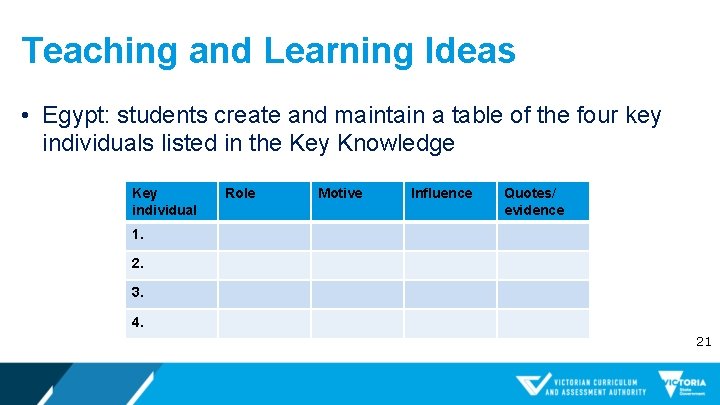
Teaching and Learning Ideas • Egypt: students create and maintain a table of the four key individuals listed in the Key Knowledge Key individual Role Motive Influence Quotes/ evidence 1. 2. 3. 4. 21
Teaching and Learning Ideas • Greece: Use ancient and modern sources to consider the impact of the plague on Athens’ capacity to wage war and the role it played in their eventual defeat • Rome: compare and contrast the political and military careers of Marius and Sulla, and evaluate which had a more destructive impact on the fall of the republic 22
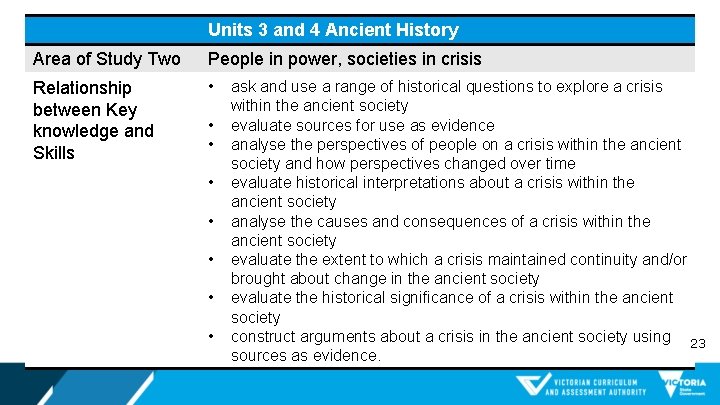
Units 3 and 4 Ancient History Area of Study Two People in power, societies in crisis Relationship between Key knowledge and Skills • • ask and use a range of historical questions to explore a crisis within the ancient society evaluate sources for use as evidence analyse the perspectives of people on a crisis within the ancient society and how perspectives changed over time evaluate historical interpretations about a crisis within the ancient society analyse the causes and consequences of a crisis within the ancient society evaluate the extent to which a crisis maintained continuity and/or brought about change in the ancient society evaluate the historical significance of a crisis within the ancient society construct arguments about a crisis in the ancient society using 23 sources as evidence.
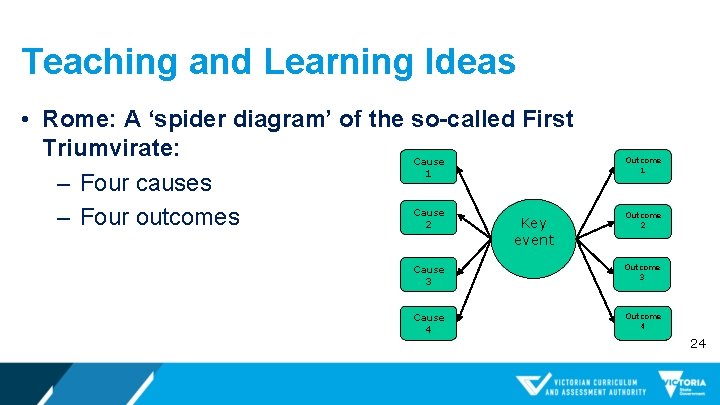
Teaching and Learning Ideas • Rome: A ‘spider diagram’ of the so-called First Triumvirate: Cause 1 ‒ Four causes Cause ‒ Four outcomes 2 Key Outcome 1 Outcome 2 event Cause 3 Outcome 3 Cause 4 Outcome 4 24
Teaching and Learning Ideas • Greece: A flow chart outlining risings tensions between Athens and Sparta from 460 BCE (and earlier) to 431 BCE in order to construct an argument about the origin of the crisis • Egypt: Analysing changes in sculpture and engravings during the Armana period of New Kingdom Egypt to explore the impact of Ahkenaten’s monotheistic reign 25
Assessment Ideas Suitable tasks for assessment in these units may be selected from the following: • a historical inquiry • an essay • evaluation of historical sources • extended responses 26
Assessment Ideas Extended responses • • An extended response is NOT an essay Short & focused on a particular element of the ancient society More expository than argumentative Example: Explain the impact of the military campaigns of Thutmoses III on the economic system of New Kingdom Egypt. Use evidence to support your response. • Relevant points clearly delineated with signposting • Use a wealth of evidence such as dates and key individuals • Ancient and modern sources 27
Assessment Ideas Evaluation of historical sources • Provide students with two or more extracts from ancient and/or modern sources on the role played by Persia in the eventual outcome of the Peloponnesian War • Ancient sources include Xenophon and Plutarch • Devise a range of questions that enable students to access and comprehend the information and viewpoints present in the documents • Move on to more challenging questions which encourage students to critically analyse assumptions and arguments based on evidence • Where relevant, challenge or broaden the viewpoint of the sources provided 28
Assessment Ideas A historical inquiry • Students select one of the social groups or relationships listed (eg women, slaves, the patron-client relationship) • Formulate inquiry question: ‒ “To what extent could women participate meaningfully in politics and public life in ancient Rome? ” ‒ “Who gained the most in the patron-client relationship in Rome of the early republic? ” • Provide students with time to locate and evaluate relevant resources • Students prepare their notes based on evidence (including ancient and modern sources) • Students write up their investigation under time using their research notes as a guide 29
QUESTIONS