
VBM Susie Henley and Stefan Klppel Based on

VBM Susie Henley and Stefan Klöppel Based on slides by John Ashburner

Overview * Voxel-based Morphometry * Problems with VBM * Alternative Approaches
VBM (voxel-based morphometry) VBM: whole-brain analysis, does not require a priori assumptions about ROIs; unbiased way of localising structural changes Does a voxel by voxel comparison of local tissue volume.
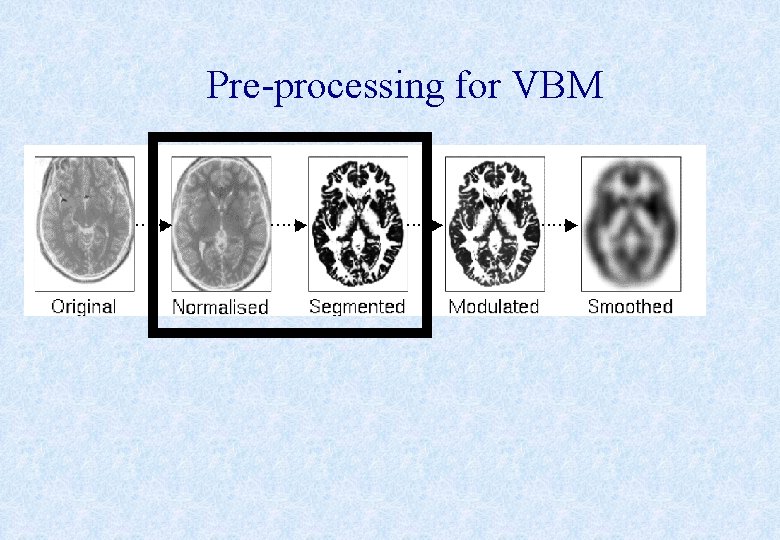
Pre-processing for VBM
VBM Preprocessing in SPM 5 It uses a generative model, which involves: • Segmentation into tissue types • GM, WM and CSF • Bias Correction • Corrects intensity inhomogeneities in images • Normalisation • Aligns images, puts them into the same (standard) space • These steps are cycled through until normalisation and segmentation criteria are met
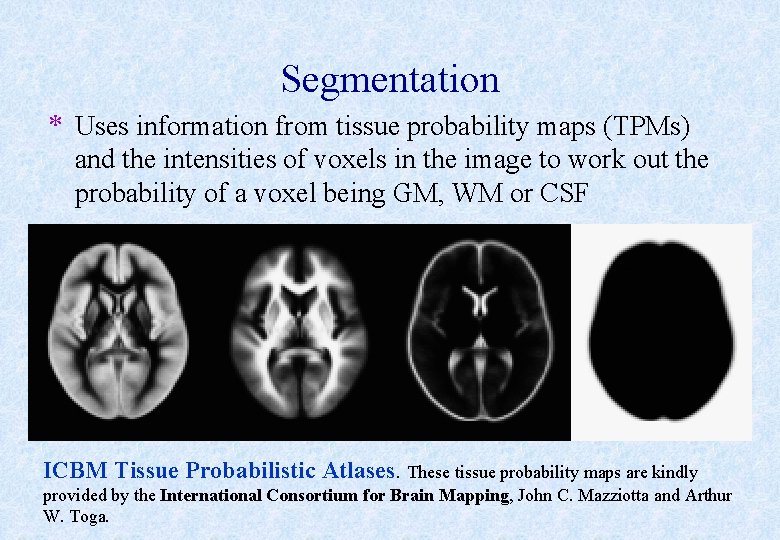
Segmentation * Uses information from tissue probability maps (TPMs) and the intensities of voxels in the image to work out the probability of a voxel being GM, WM or CSF ICBM Tissue Probabilistic Atlases. These tissue probability maps are kindly provided by the International Consortium for Brain Mapping, John C. Mazziotta and Arthur W. Toga.
Bias correction * Estimates a function to correct for bias in the image and applies it Warping * The tissue probability maps (which are in standard space) are warped to match the image * this gives parameters for registering the image into standard space later
The generative model * Keeps doing these steps iteratively until the objective function is minimised * Results in images that are segmented, bias-corrected, and registered into standard space
![Modulation Vox[i, v] normalisation Vox[i, v*δV] modulation Vox[i/δV, v*δV] * During modulation voxel intensities](http://slidetodoc.com/presentation_image_h2/055ed273986ae2501f36eb30c2a0b204/image-9.jpg "Modulation Vox[i, v] normalisation Vox[i, v*δV] modulation Vox[i/δV, v*δV] * During modulation voxel intensities")
Modulation Vox[i, v] normalisation Vox[i, v*δV] modulation Vox[i/δV, v*δV] * During modulation voxel intensities are multiplied by the local value in the deformation field from normalisation, so that total GM/WM signal remains the same * Change of intensity now represents volume relative to template
How optional is modulation ? * Unmodulated data: compares “the proportion of grey or white matter to all tissue types within a region” * Hard to interpret * Therefore not very useful for looking at e. g. the effects of degenerative disease * Modulated data: compares volumes * Unmodulated data may be useful for highlighting areas of poor registration (perfectly registered unmodulated data should show no differences between groups)
Smoothing * Reasons: * Each voxel becomes weighted average of surrounding ones * Data are more normally distributed * Smooth out incorrect normalisation * Most studies use a kernel between 8 and 14 mm. depending on the size of the expected effect.
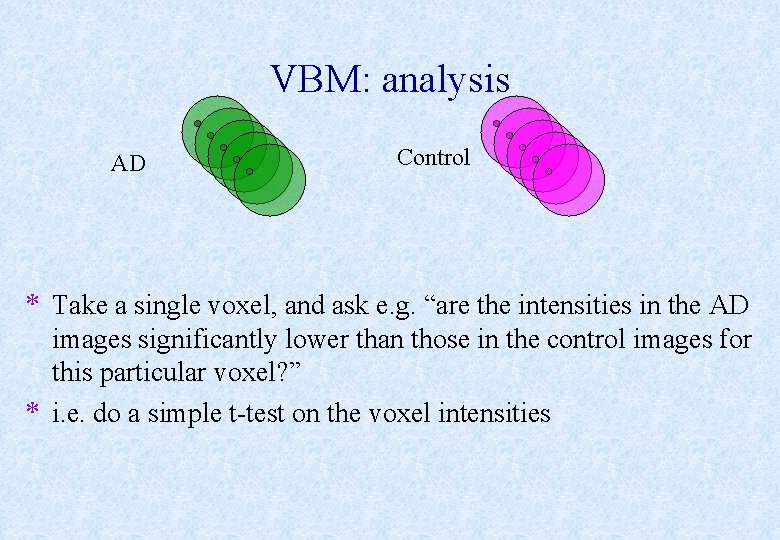
VBM: analysis AD Control * Take a single voxel, and ask e. g. “are the intensities in the AD images significantly lower than those in the control images for this particular voxel? ” * i. e. do a simple t-test on the voxel intensities
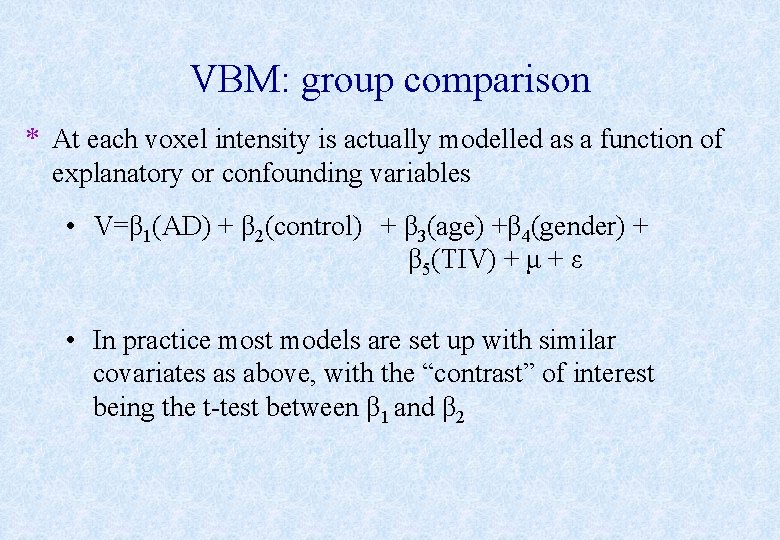
VBM: group comparison * At each voxel intensity is actually modelled as a function of explanatory or confounding variables • V=β 1(AD) + β 2(control) + β 3(age) +β 4(gender) + β 5(TIV) + μ + ε • In practice most models are set up with similar covariates as above, with the “contrast” of interest being the t-test between β 1 and β 2
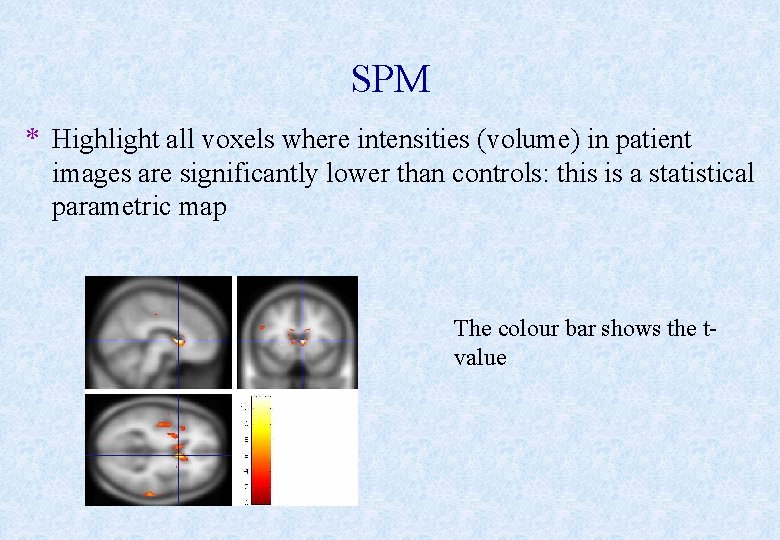
SPM * Highlight all voxels where intensities (volume) in patient images are significantly lower than controls: this is a statistical parametric map The colour bar shows the tvalue
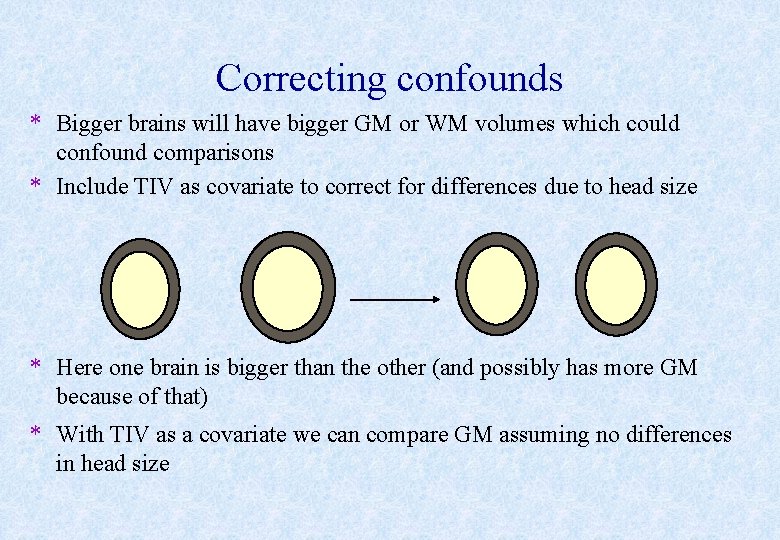
Correcting confounds * Bigger brains will have bigger GM or WM volumes which could confound comparisons * Include TIV as covariate to correct for differences due to head size * Here one brain is bigger than the other (and possibly has more GM because of that) * With TIV as a covariate we can compare GM assuming no differences in head size
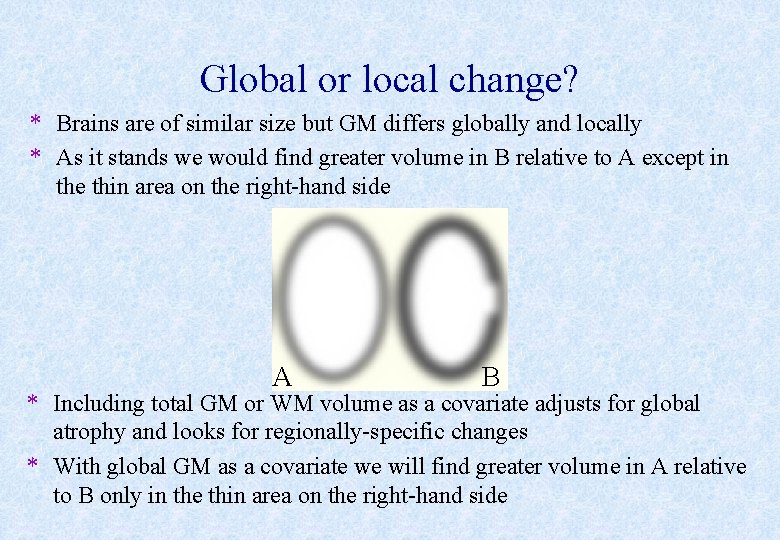
Global or local change? * Brains are of similar size but GM differs globally and locally * As it stands we would find greater volume in B relative to A except in the thin area on the right-hand side A B * Including total GM or WM volume as a covariate adjusts for global atrophy and looks for regionally-specific changes * With global GM as a covariate we will find greater volume in A relative to B only in the thin area on the right-hand side
Which to use? * Comparisons should usually be adjusted for head size (TIV) * Inferences may then be based on global differences * e. g. what’s the global effect of disease X? * Alternatively you may wish to look at regionally specific changes * e. g. having adjusted for overall atrophy, are there any regions which still show relative sparing or loss of tissue?
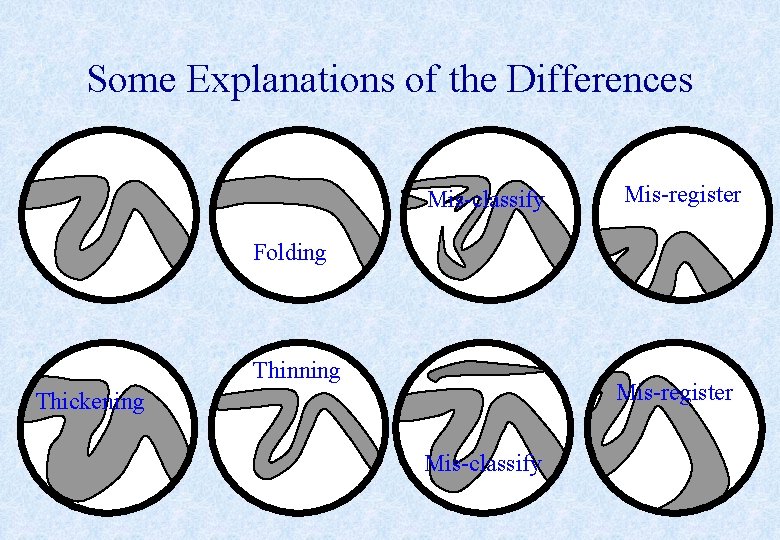
Some Explanations of the Differences Mis-classify Mis-register Folding Thinning Mis-register Thickening Mis-classify
Validity of the statistical tests in SPM * Errors (residuals) need to be normally distributed throughout brain for stats to be valid * After smoothing this is usually true BUT * Invalidates experiments that compare one subject with a group * Correction for multiple comparisons * Valid for corrections based on peak heights (voxel-wise) * Not valid for corrections based on cluster extents * This requires smoothness of residuals to be uniformly distributed but it’s not in VBM because of the non-stationary nature of underlying neuroanatomy * Bigger blobs expected in smoother regions, purely by chance
Alternatives * Improve normalisation * use multivariate approaches Lao: ‘Morphological classification of brains via highdimensional shape transformations and machine learning methods‘ (2004) Neuro. Image.
Multivariate Approaches * An alternative to mass-univariate testing (SPMs) * Shape is multivariate * Generate a description of how to separate groups of subjects * Use training data to develop a classifier * Use the classifier to diagnose test data
Points to think about * What do results mean? * VBM generally * Limitations of spatial normalisation for aligning small-volume structures (e. g. hippo, caudate) * VBM in degenerative brain diseases: * Spatial normalisation of atrophied scans * Optimal segmentation of atrophied scans * Optimal smoothing width for expected volume loss
Useful refs * Ashburner & Friston. VBM – the Methods. Neuroimage. 2000 Jun; 11(6 Pt 1): 805 -21 * Good et al. A Voxel-based morphometric study of ageing in 465 normal adult human brains. Neuroimage. 2001 Jul; 14(1 Pt 1): 21 -36 * * http: //www. fil. ion. ucl. ac. uk/spm/ http: //en. wikibooks. org/wiki/SPM http: //www. mrc-cbu. cam. ac. uk/Imaging/Common/spm. shtml http: //en. wikibooks. org/wiki/SPM-VBM
- Slides: 23