
Vascularized Composite Allograft Transplantation S V Mc Diarmid
- Slides: 46
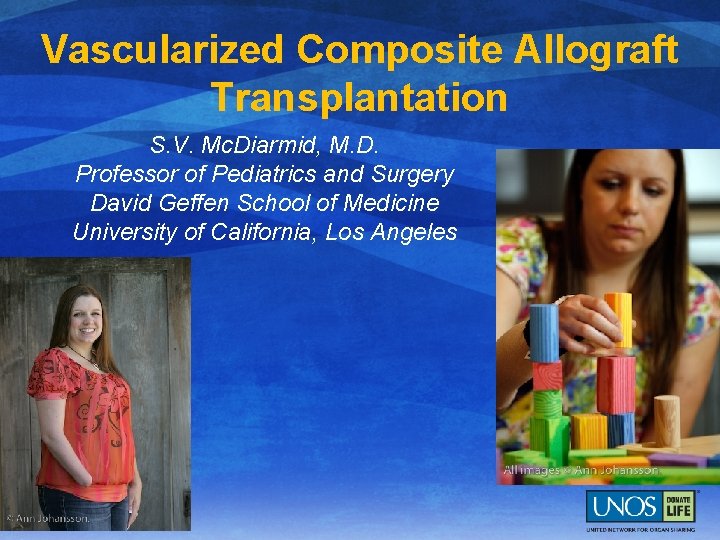
Vascularized Composite Allograft Transplantation S. V. Mc. Diarmid, M. D. Professor of Pediatrics and Surgery David Geffen School of Medicine University of California, Los Angeles
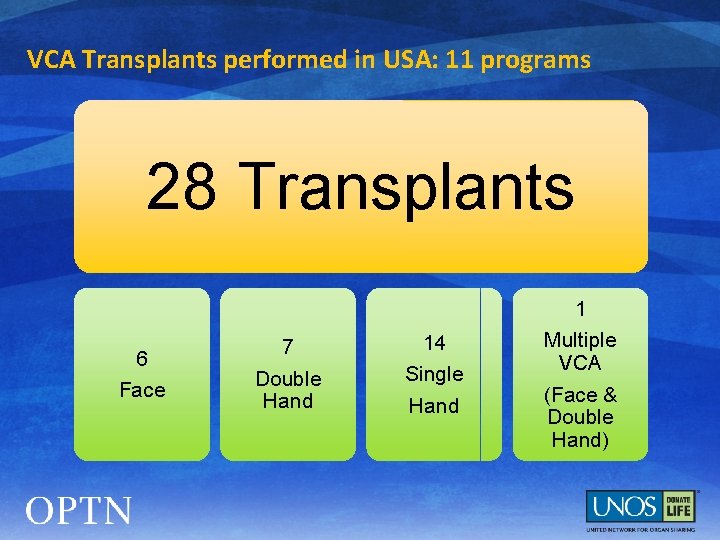
VCA Transplants performed in USA: 11 programs 28 Transplants 6 Face 7 14 Double Hand Single Hand 1 Multiple VCA (Face & Double Hand)
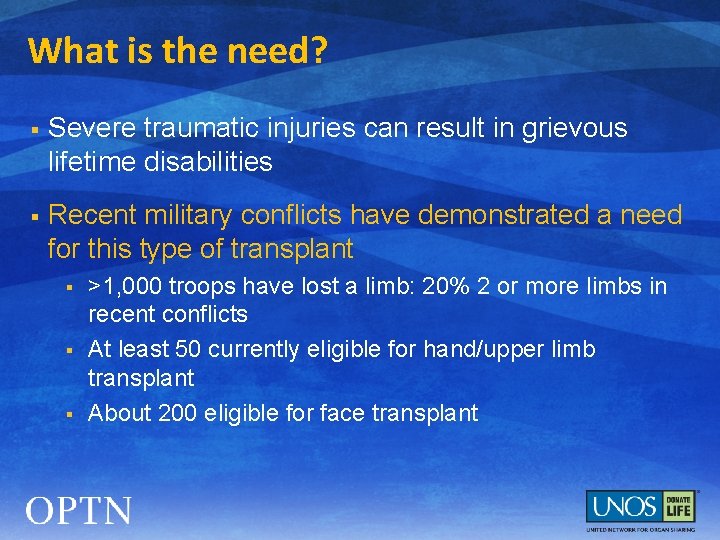
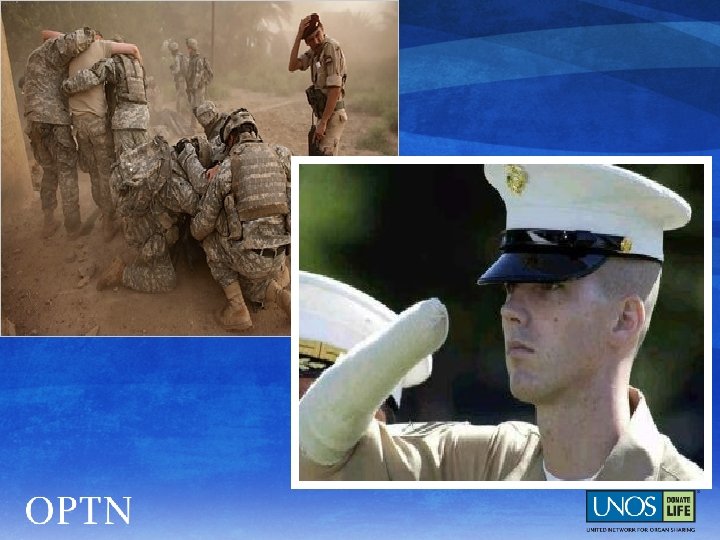
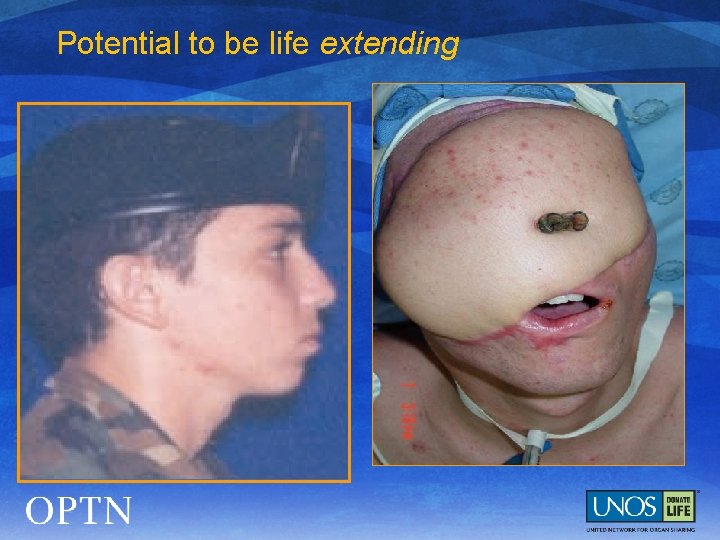
What is the need? § Severe traumatic injuries can result in grievous lifetime disabilities § Recent military conflicts have demonstrated a need for this type of transplant § § § >1, 000 troops have lost a limb: 20% 2 or more limbs in recent conflicts At least 50 currently eligible for hand/upper limb transplant About 200 eligible for face transplant
Potential to be life extending
VCA and the OPTN § The VCA community’s position was that oversight should fall under the OPTN § 42 CFR Part 121 Final Rule: July 2013
Proposal to Implement the OPTN’s Oversight of VCA Vascularized Composite Allograft Transplantation Committee
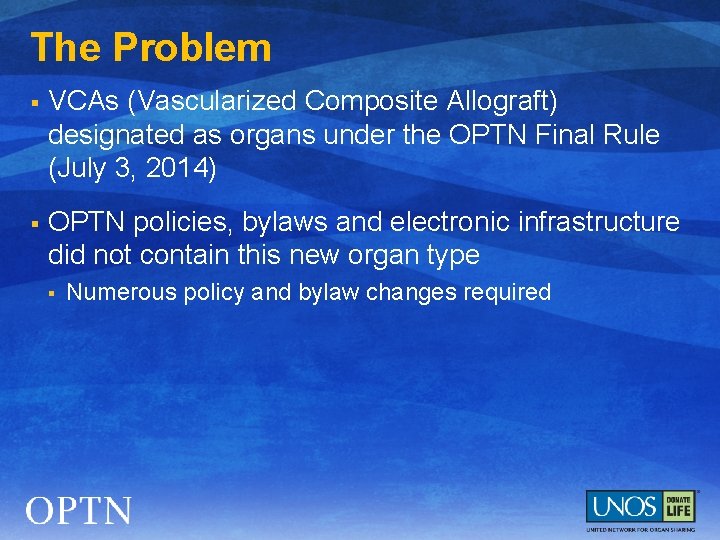
The Problem § VCAs (Vascularized Composite Allograft) designated as organs under the OPTN Final Rule (July 3, 2014) § OPTN policies, bylaws and electronic infrastructure did not contain this new organ type § Numerous policy and bylaw changes required
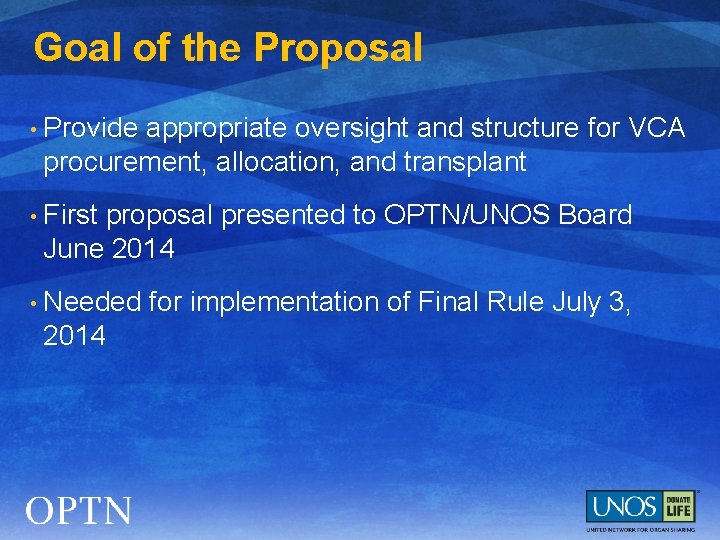
Goal of the Proposal • Provide appropriate oversight and structure for VCA procurement, allocation, and transplant • First proposal presented to OPTN/UNOS Board June 2014 • Needed for implementation of Final Rule July 3, 2014
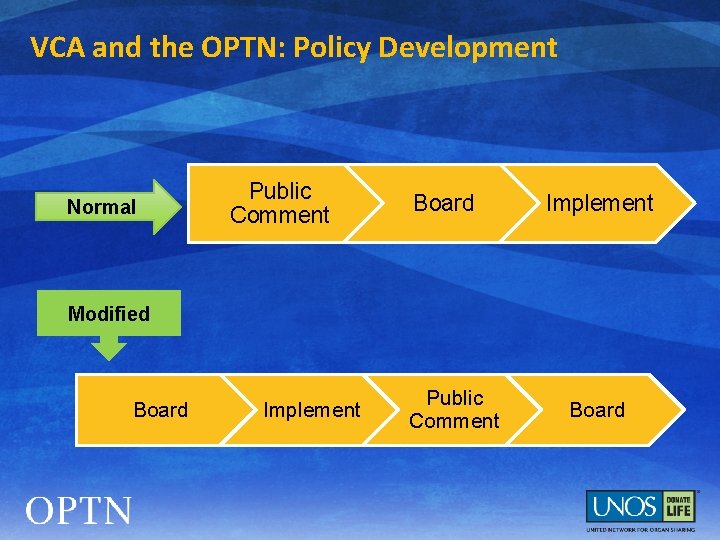
VCA and the OPTN: Policy Development Normal Public Comment Board Implement Modified Board Implement Public Comment Board
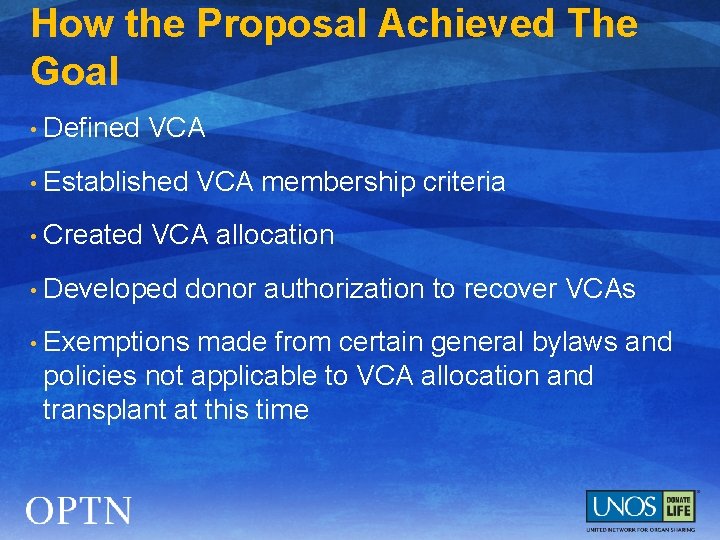
How the Proposal Achieved The Goal • Defined VCA • Established VCA membership criteria • Created VCA allocation • Developed donor authorization to recover VCAs • Exemptions made from certain general bylaws and policies not applicable to VCA allocation and transplant at this time
Definition of a VCA 1. That is vascularized and requires blood flow by surgical connection of blood vessels to function after transplantation; 2. Containing multiple tissue types; 3. Recovered from a human donor as an anatomical/structural unit; 4. Transplanted into a human recipient as an anatomical/structural unit; 5. Minimally manipulated (i. e. , processing that does not alter the original relevant characteristics of the organ relating to the organ's utility for reconstruction, repair, or replacement);
Definition of a VCA 6. For homologous use (the replacement or supplementation of a recipient's organ with an organ that performs the same basic function or functions in the recipient as in the donor); 7. Not combined with another article such as a device; 8. Susceptible to ischemia and, therefore, only stored temporarily and not cryopreserved; and 9. Susceptible to allograft rejection, generally requiring immunosuppression that may increase infectious disease risk to the recipient.
VCA Policy Applicability § New VCA policies apply to both deceased and living VCA donors § Cases of living VCA donors internationally, including the U. S. § Secretary of HHS responded to question of living donors in amendment to the Final Rule § Intentionally did not prohibit the possibility of living VCA donation
VCA Membership Criteria § Hospital must have at least one OPTN-approved transplant program § Letter of intent to the OPTN: § § Local OPO to provide VCA organs Identify surgical, medical, and administrative directors who are responsible for the VCA program Signed by surgical and medical directors, and Chief Administrative Officer of the institution, i. e. : CEO or COO MPSC reviews letter
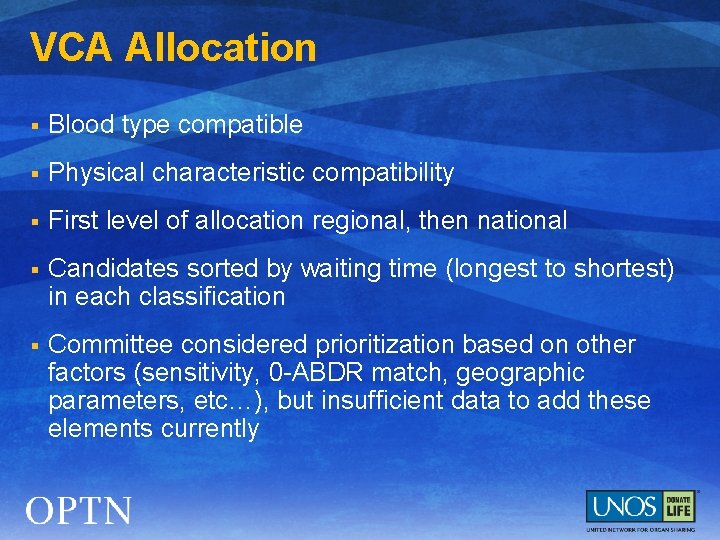
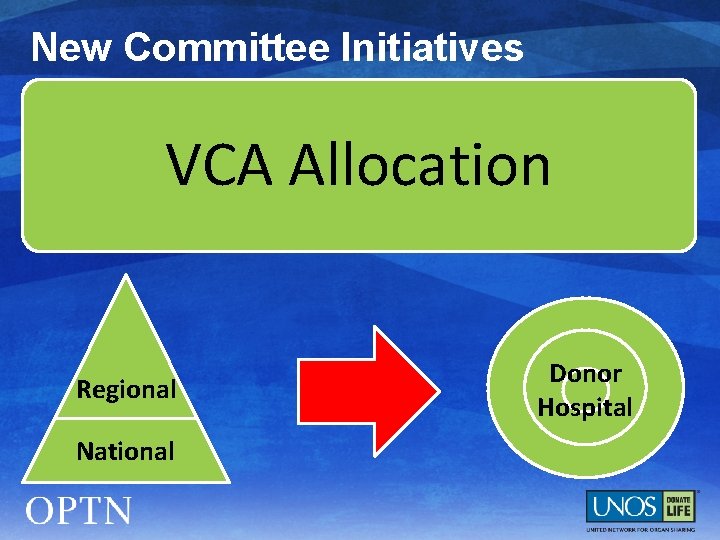
VCA Allocation § Blood type compatible § Physical characteristic compatibility § First level of allocation regional, then national § Candidates sorted by waiting time (longest to shortest) in each classification § Committee considered prioritization based on other factors (sensitivity, 0 -ABDR match, geographic parameters, etc…), but insufficient data to add these elements currently
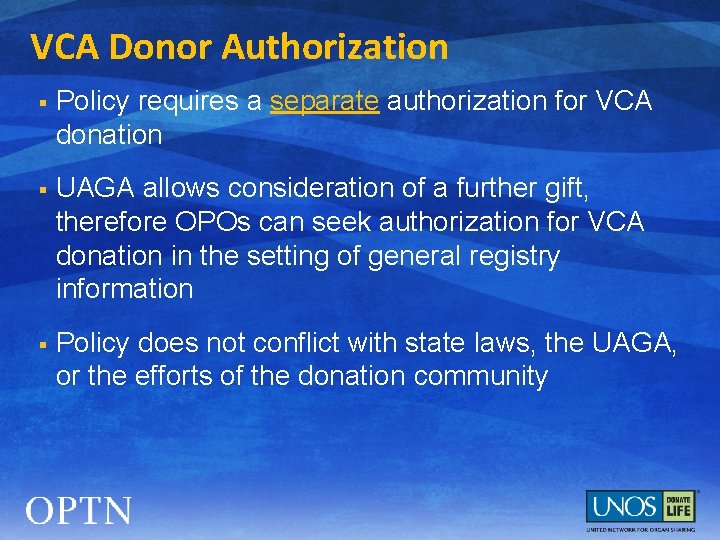
VCA Donor Authorization § Policy requires a separate authorization for VCA donation § UAGA allows consideration of a further gift, therefore OPOs can seek authorization for VCA donation in the setting of general registry information § Policy does not conflict with state laws, the UAGA, or the efforts of the donation community
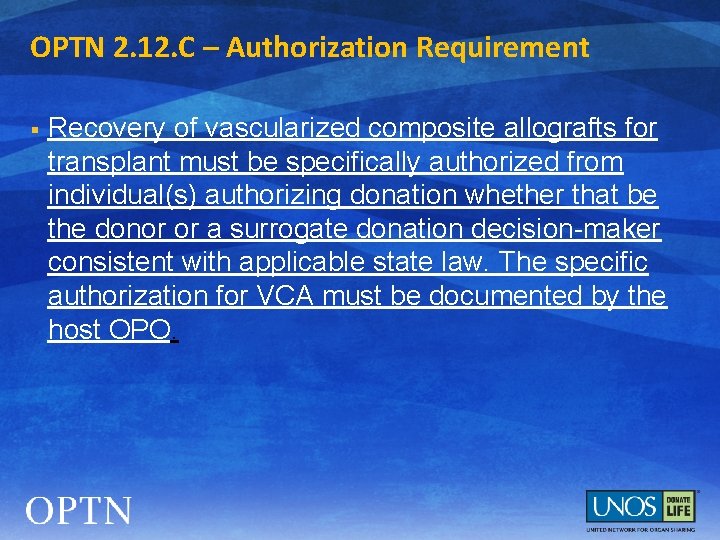
OPTN 2. 12. C – Authorization Requirement § Recovery of vascularized composite allografts for transplant must be specifically authorized from individual(s) authorizing donation whether that be the donor or a surrogate donation decision-maker consistent with applicable state law. The specific authorization for VCA must be documented by the host OPO.
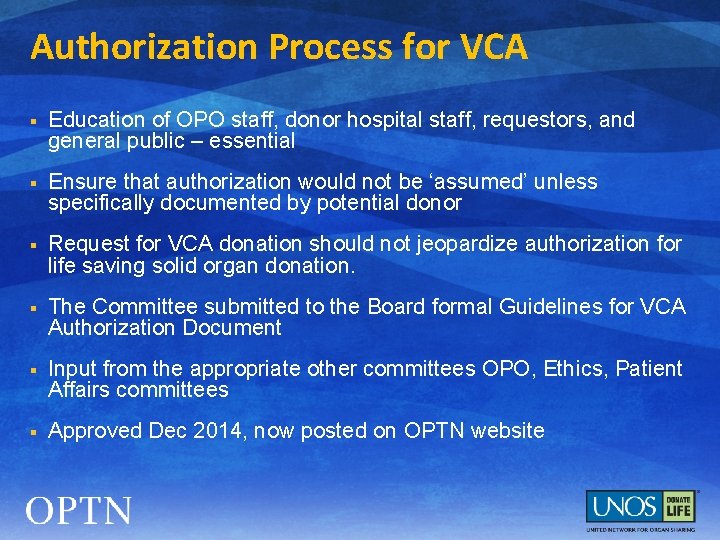
Authorization Process for VCA § Education of OPO staff, donor hospital staff, requestors, and general public – essential § Ensure that authorization would not be ‘assumed’ unless specifically documented by potential donor § Request for VCA donation should not jeopardize authorization for life saving solid organ donation. § The Committee submitted to the Board formal Guidelines for VCA Authorization Document § Input from the appropriate other committees OPO, Ethics, Patient Affairs committees § Approved Dec 2014, now posted on OPTN website
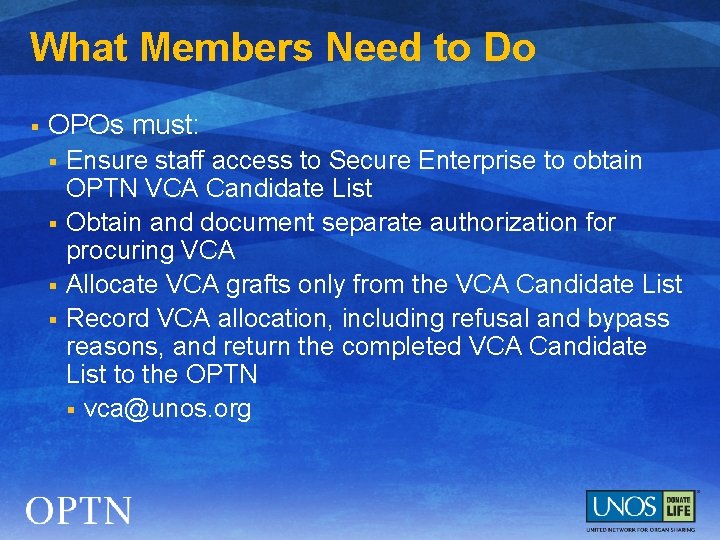
What Members Need to Do § OPOs must: § § Ensure staff access to Secure Enterprise to obtain OPTN VCA Candidate List Obtain and document separate authorization for procuring VCA Allocate VCA grafts only from the VCA Candidate List Record VCA allocation, including refusal and bypass reasons, and return the completed VCA Candidate List to the OPTN § vca@unos. org
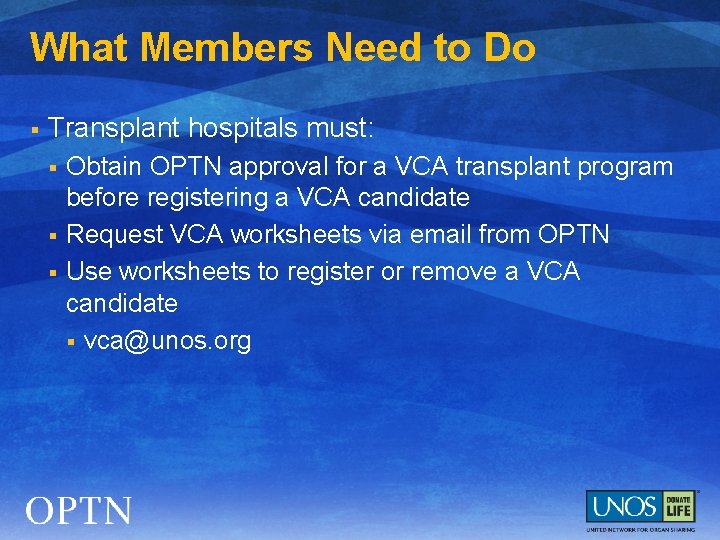
What Members Need to Do § Transplant hospitals must: § § § Obtain OPTN approval for a VCA transplant program before registering a VCA candidate Request VCA worksheets via email from OPTN Use worksheets to register or remove a VCA candidate § vca@unos. org
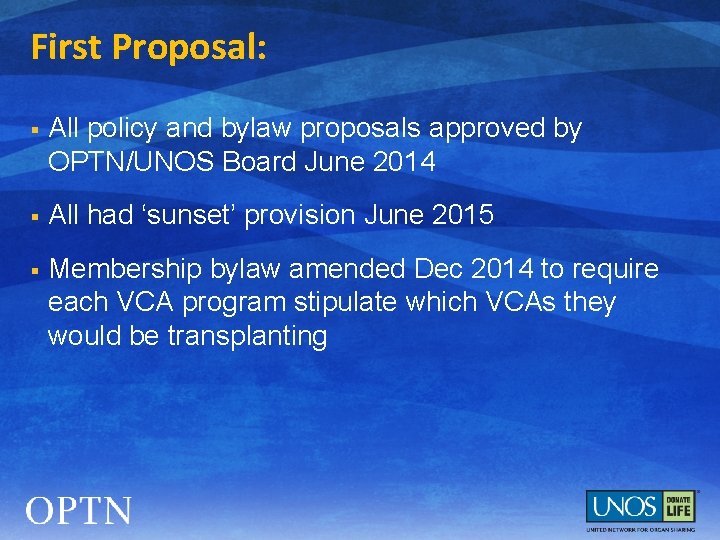
First Proposal: § All policy and bylaw proposals approved by OPTN/UNOS Board June 2014 § All had ‘sunset’ provision June 2015 § Membership bylaw amended Dec 2014 to require each VCA program stipulate which VCAs they would be transplanting
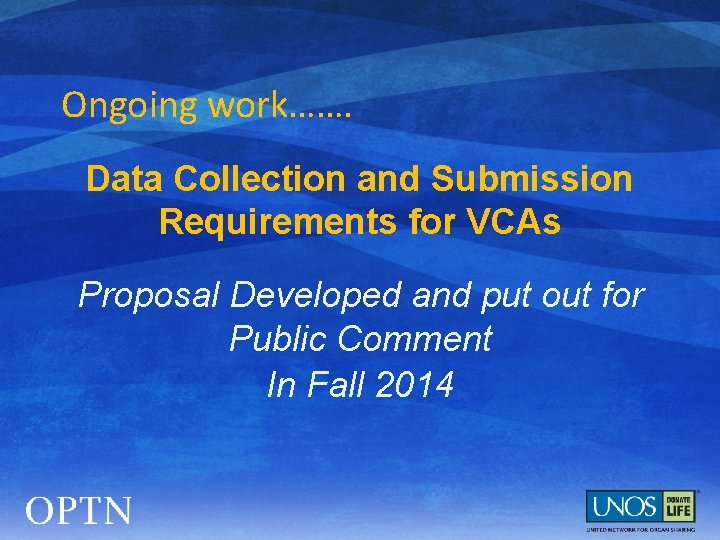
Ongoing work……. Data Collection and Submission Requirements for VCAs Proposal Developed and put out for Public Comment In Fall 2014
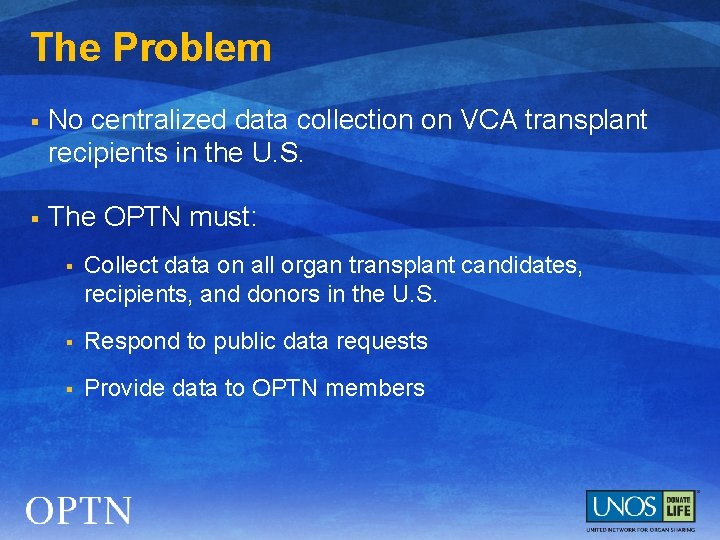
The Problem § No centralized data collection on VCA transplant recipients in the U. S. § The OPTN must: § Collect data on all organ transplant candidates, recipients, and donors in the U. S. § Respond to public data requests § Provide data to OPTN members
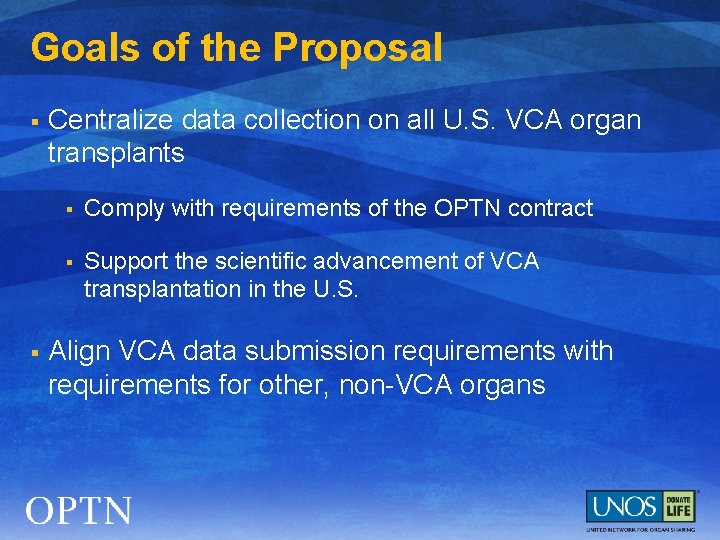
Goals of the Proposal § § Centralize data collection on all U. S. VCA organ transplants § Comply with requirements of the OPTN contract § Support the scientific advancement of VCA transplantation in the U. S. Align VCA data submission requirements with requirements for other, non-VCA organs
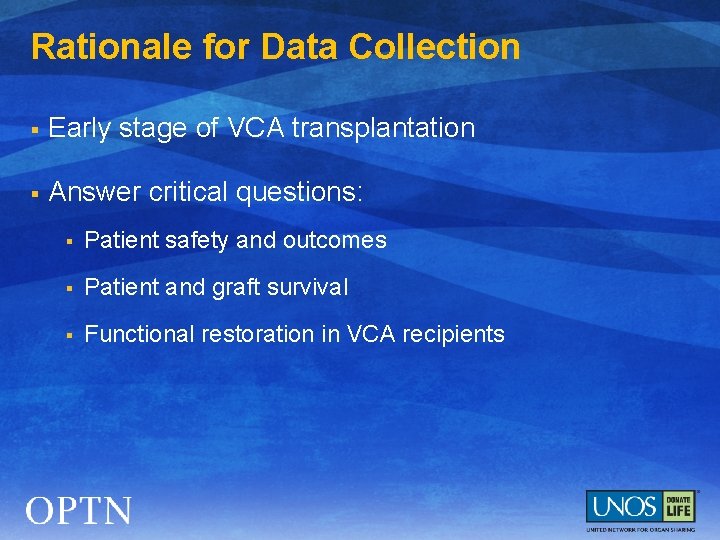
Rationale for Data Collection § Early stage of VCA transplantation § Answer critical questions: § Patient safety and outcomes § Patient and graft survival § Functional restoration in VCA recipients
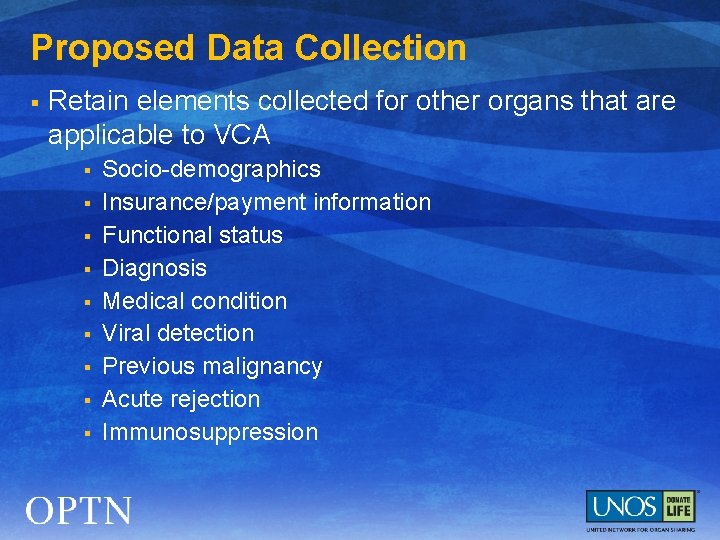
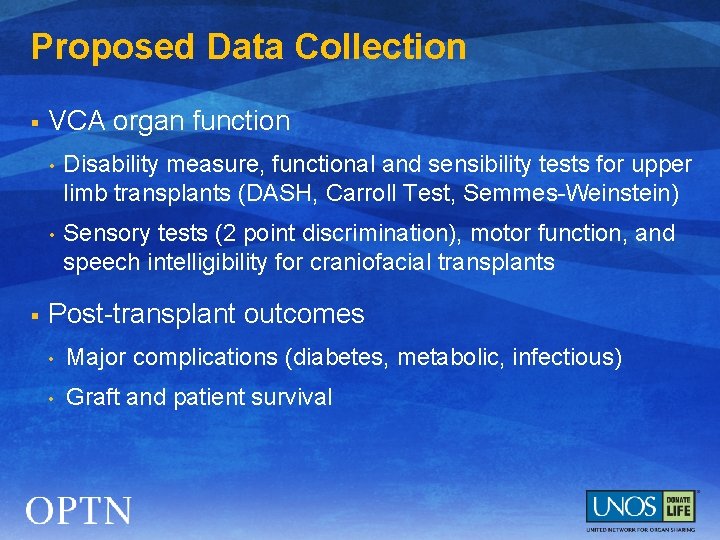
Proposed Data Collection § Retain elements collected for other organs that are applicable to VCA § § § § § Socio-demographics Insurance/payment information Functional status Diagnosis Medical condition Viral detection Previous malignancy Acute rejection Immunosuppression
Proposed Data Collection § § VCA organ function • Disability measure, functional and sensibility tests for upper limb transplants (DASH, Carroll Test, Semmes-Weinstein) • Sensory tests (2 point discrimination), motor function, and speech intelligibility for craniofacial transplants Post-transplant outcomes • Major complications (diabetes, metabolic, infectious) • Graft and patient survival
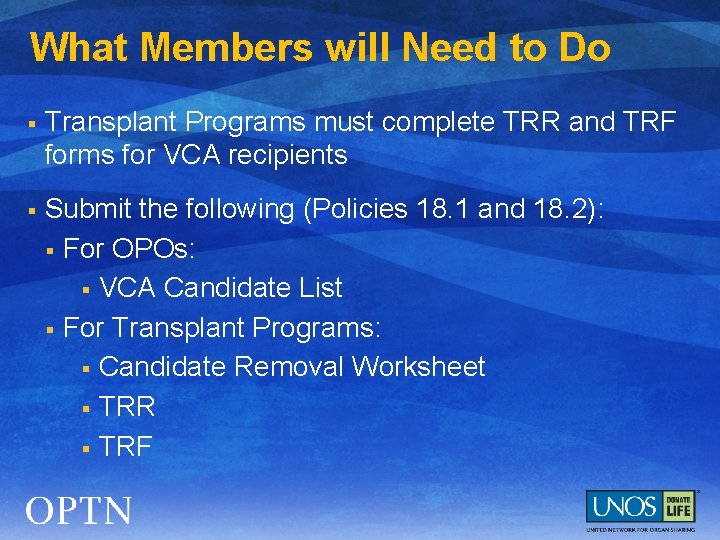
What Members will Need to Do § Transplant Programs must complete TRR and TRF forms for VCA recipients § Submit the following (Policies 18. 1 and 18. 2): § For OPOs: § VCA Candidate List § For Transplant Programs: § Candidate Removal Worksheet § TRR § TRF
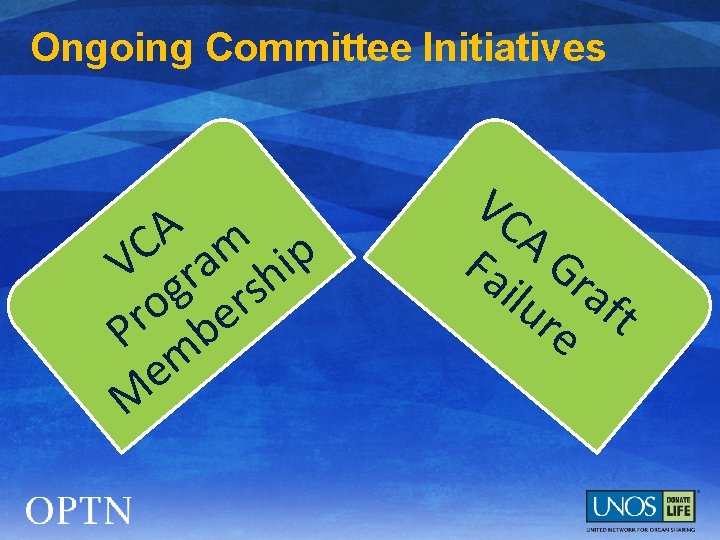
Ongoing Committee Initiatives A C m V ra hip g s r o e r P b m e M VC A Fa Gr ilu af re t
On going work…………… Membership Requirements for VCA Transplant Programs Proposal out for Public Comment Spring 2015
Goal of the Proposal • Establish objective credentialing, training, and experience requirements for medical and surgical leaders involved in VCA transplantation • Promote patient safety by ensuring medical and surgical leaders meet minimum requirements • Enhance accountability to the OPTN
How the Proposal will Achieve its Goal VCA program must: § Complete an application for: § § § Upper Limb Head and Neck Abdominal Wall Other VCAs not commonly performed Identify the following key personnel: § § § Program Director Primary Transplant Physician Primary Transplant Surgeon
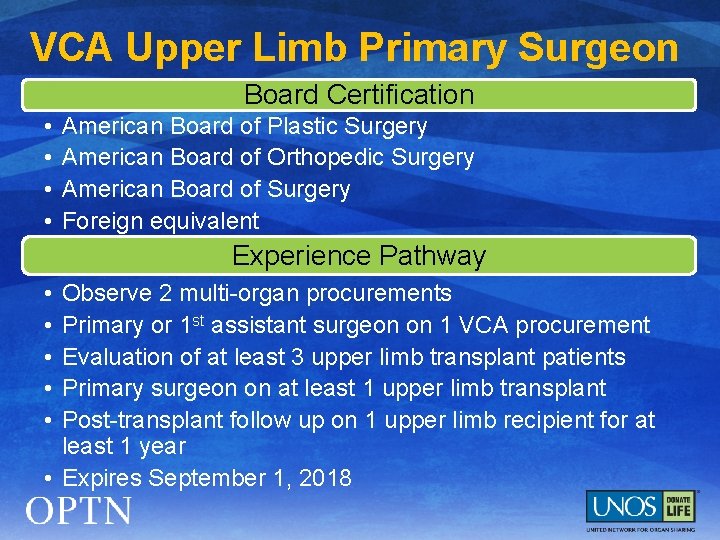
VCA Upper Limb Primary Surgeon Board Certification • • American Board of Plastic Surgery American Board of Orthopedic Surgery American Board of Surgery Foreign equivalent Experience Pathway • • • Observe 2 multi-organ procurements Primary or 1 st assistant surgeon on 1 VCA procurement Evaluation of at least 3 upper limb transplant patients Primary surgeon on at least 1 upper limb transplant Post-transplant follow up on 1 upper limb recipient for at least 1 year • Expires September 1, 2018
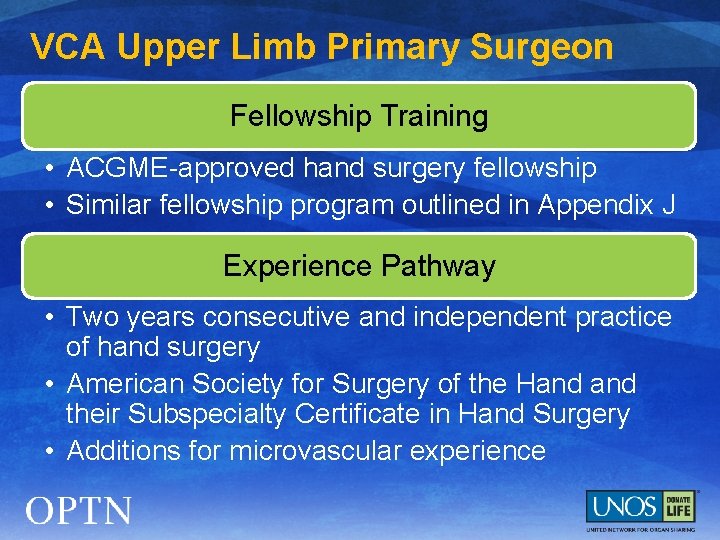
VCA Upper Limb Primary Surgeon Fellowship Training • ACGME-approved hand surgery fellowship • Similar fellowship program outlined in Appendix J Experience Pathway • Two years consecutive and independent practice of hand surgery • American Society for Surgery of the Hand their Subspecialty Certificate in Hand Surgery • Additions for microvascular experience
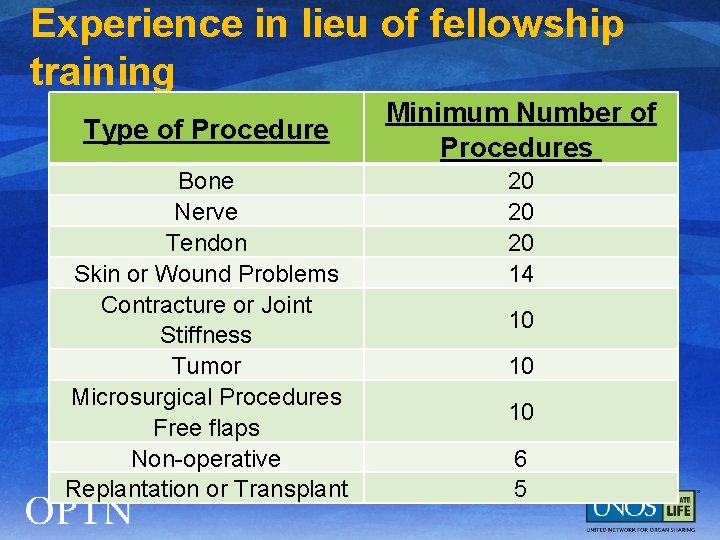
Experience in lieu of fellowship training Type of Procedure Bone Nerve Tendon Skin or Wound Problems Contracture or Joint Stiffness Tumor Microsurgical Procedures Free flaps Non-operative Replantation or Transplant Minimum Number of Procedures 20 20 20 14 10 10 10 6 5
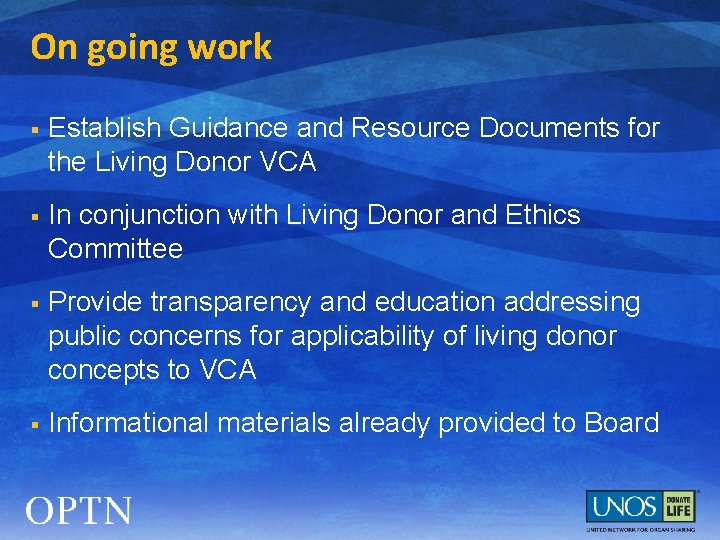
On going work § Establish Guidance and Resource Documents for the Living Donor VCA § In conjunction with Living Donor and Ethics Committee § Provide transparency and education addressing public concerns for applicability of living donor concepts to VCA § Informational materials already provided to Board
New Committee Initiatives VCA Allocation Regional National Donor Hospital
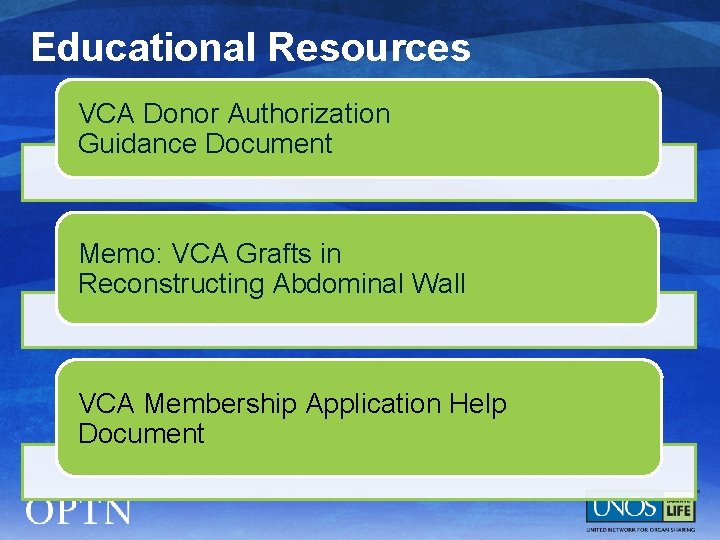
Educational Resources VCA Donor Authorization Guidance Document Memo: VCA Grafts in Reconstructing Abdominal Wall VCA Membership Application Help Document
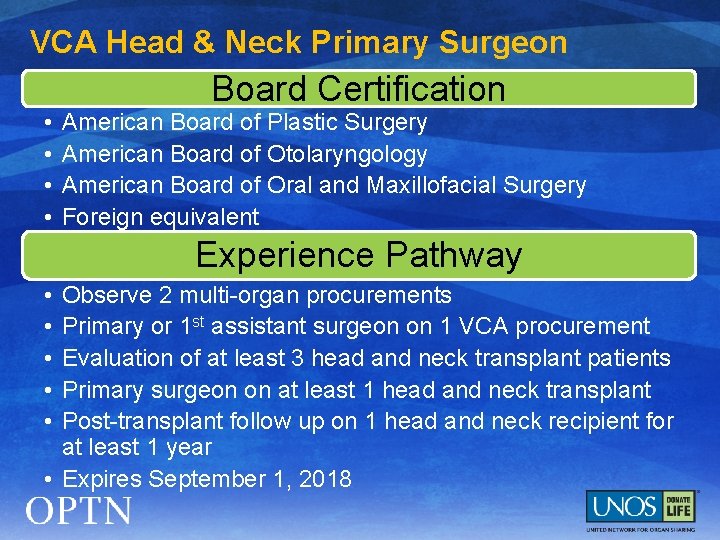
VCA Head & Neck Primary Surgeon • • Board Certification American Board of Plastic Surgery American Board of Otolaryngology American Board of Oral and Maxillofacial Surgery Foreign equivalent Experience Pathway • • • Observe 2 multi-organ procurements Primary or 1 st assistant surgeon on 1 VCA procurement Evaluation of at least 3 head and neck transplant patients Primary surgeon on at least 1 head and neck transplant Post-transplant follow up on 1 head and neck recipient for at least 1 year • Expires September 1, 2018
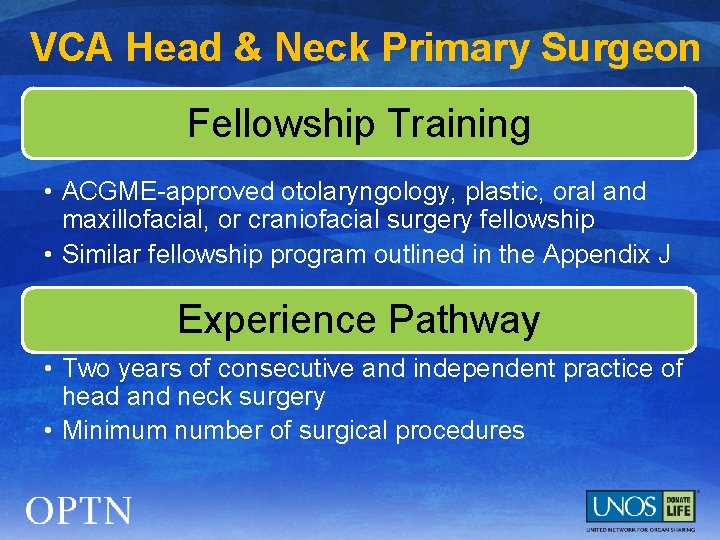
VCA Head & Neck Primary Surgeon Fellowship Training • ACGME-approved otolaryngology, plastic, oral and maxillofacial, or craniofacial surgery fellowship • Similar fellowship program outlined in the Appendix J Experience Pathway • Two years of consecutive and independent practice of head and neck surgery • Minimum number of surgical procedures
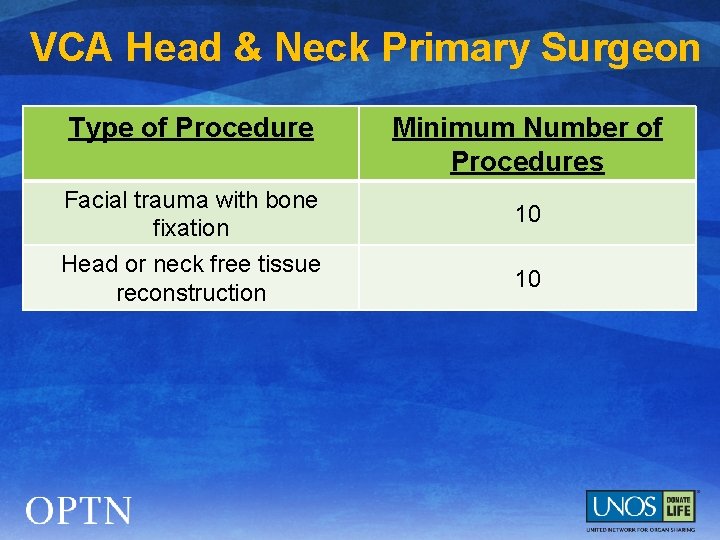
VCA Head & Neck Primary Surgeon Type of Procedure Minimum Number of Procedures Facial trauma with bone fixation 10 Head or neck free tissue reconstruction 10
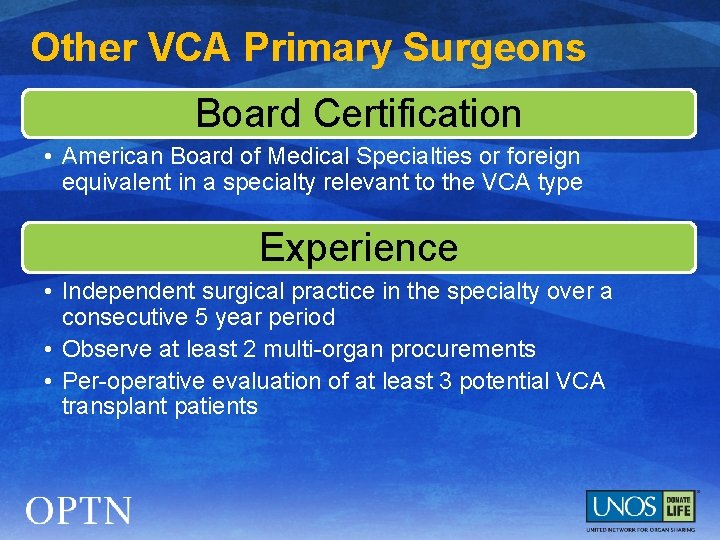
Other VCA Primary Surgeons Board Certification • American Board of Medical Specialties or foreign equivalent in a specialty relevant to the VCA type Experience • Independent surgical practice in the specialty over a consecutive 5 year period • Observe at least 2 multi-organ procurements • Per-operative evaluation of at least 3 potential VCA transplant patients
VCA Abdominal Wall Primary Surgeon § Must meet the primary transplant surgeon requirements of a head and neck, kidney, liver, pancreas, or upper limb transplant program.
Other VCA Primary Surgeons Program Infrastructure • Multi-disciplinary surgical team including other specialists necessary to perform the VCA transplant • Must include member with extensive microvascular experience • Demonstrated planning for the type of VCA transplant Documentation • • Letter from hospital identifying type(s) of VCA Signed by presiding institutional executive Identify team members and their roles Logs documenting cadaveric rehearsals