
Vascular Technology Lecture 25 Venous Photoplethysmography PPG HHHoldorf







- Slides: 21
Vascular Technology Lecture 25: Venous Photoplethysmography (PPG) HHHoldorf
Photo-Plethysmography Capabilities: • To document venous insufficiency / quantitate venous reflux in patients with chronic swelling, venous ulcers, and or varicose veins
Limitations: • Contraindicated in acute deep vein thrombosis • Improper placement of PPG senor results in inaccurate information, e. g. , over a varicose vein • Thickening of skin may prevent adequate penetration of infrared light • Intact skin required for sensor placement Patient Positioning • Seated with legs dangling, i. e. , non-weight bearing
Physical Principles Plethysmography measures volume changes PPG not true plethysmography, but can determine changes in blood content of skin (microcirculation), which reflects intravenous volume Photocell consists of light emitting diode and photo-sensor
PPG Physical Principles cont… Diode transmits infrared light into subcutaneous tissues, which is reflected back to photo-sensor. Light is not absorbed The cutaneous blood flow determines the reflection Blood attenuates light in proportion to its content in tissue. Increased blood flow results in increased attenuation which decreases this reflection. However, that is displayed as a positive upstroke of the waveform.
Electrical coupling • Method to increase gain and display signal • Only two types available: DC and AC • Allows one type of current to pass and blocks other type
DC Coupling Direct current Electric voltage that is either positive or negative Current flows in only one direction Batteries are DC Detects slower changes in blood content Used for venous studies
AC Coupling Alternating current Electric voltage that reverses polarity (positive or negative) 60 times a second Current flows in both directions Wall plugs deliver 120 volts of AC Detects fast changes in blood content Used for arterial studies
Calibration Cannot be calibrated volumetrically as with venous plethysmography (APG) Important to maintain the same ‘size’ or ‘gain’ setting throughout the study Significant difference in tracing should mean a significant difference in blood volume
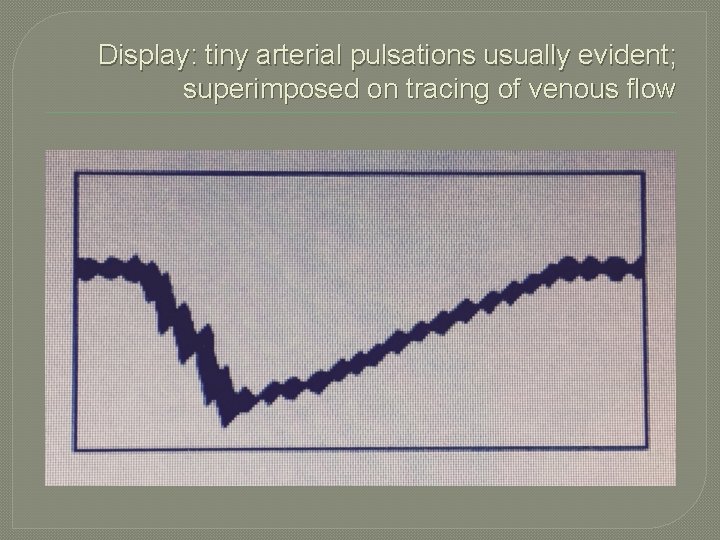
Display: tiny arterial pulsations usually evident; superimposed on tracing of venous flow
Technique Sensor applied to lower leg, approximately 5 – 10 centimeters above medial malleolus (must not be over a varicosity) Strip chart recorder • Running at slow speed (usually 5 mm/sec) • Stylus records on heat sensitive paper Patient instructed to complete series of exaggerated dorsiflexions to empty calf veins. Manual compressions of calf can be performed: must be done bilaterally to ensure consistency
Technique continued… Tracing continues to be obtained after dorsiflexions or manual compressions to record venous refill time and or venous reactive time (VRT) If the VRT is <20 seconds, repeat after TOURNIQUET applied to eliminate influence of superficial system
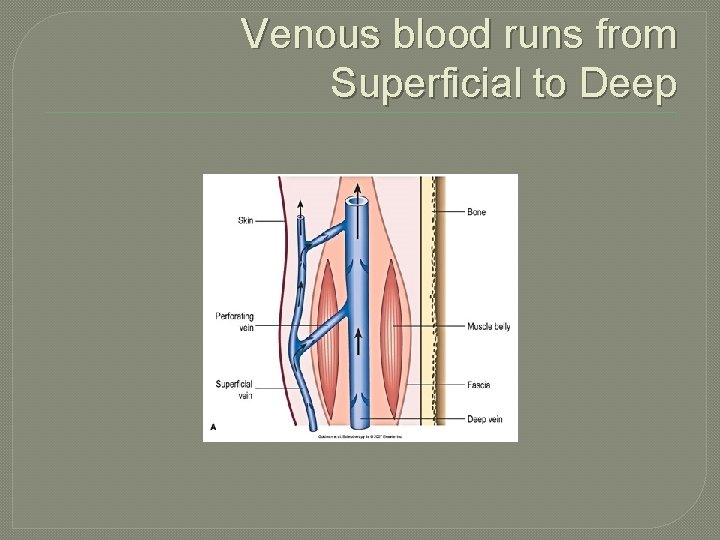
Venous blood runs from Superficial to Deep
Interpretation - Quantitative Normal VRT: > 20 seconds without tourniquet Superficial system incompetence: VRT of < 20 seconds without tourniquet but normalizes , i. e. , > 20 seconds with tourniquet Deep system incompetence: VRT of <20 seconds with and without tourniquet application
Normal VRT > 20 seconds without tourniquet
Superficial System incompetence: VRT of < 20 seconds without tourniquet but normalizes, i. e. , > 20 seconds with tourniquet
NOTE: • X Axis = time • Y Axis = Volume change Deep system incompetence: VRT of < 20 seconds with and without tourniquet application
Trouble - Shooting Artifact from patient movement? Study technically impossible Absent deflections or grossly irregular tracings? Ensure equipment on DC mode (not AC) and or on PPG setting (not Doppler) Deflections off-the-scale or barely discernible? Adjust gain and or sensitivity and or size setting.
Homework Textbook: • Chapter 27: Venous Photoplethysmography Pages: 293 – 296 SDMS Assignments