
Vascular Investigations KKUH King Saud University Riyadh Non

- Slides: 80
Vascular Investigations KKUH & King Saud University Riyadh.
Non Invasive Vascular Tests Utilizes instrument – Doppler Ultrasound. Sound –longitudinal mechanical wave of any frequency. Audible Sound range 20 -20, 000 cycles/sec. 20 Hz-20 k. Hz
Ultrasound-’Ultra’ means ‘Above’ human hearing - >20, 000 cyc/sec(20 k. Hz). Diagnostic Ultrasound – 2 MHz-12 MHz (2 million-12 million cyc/sec).
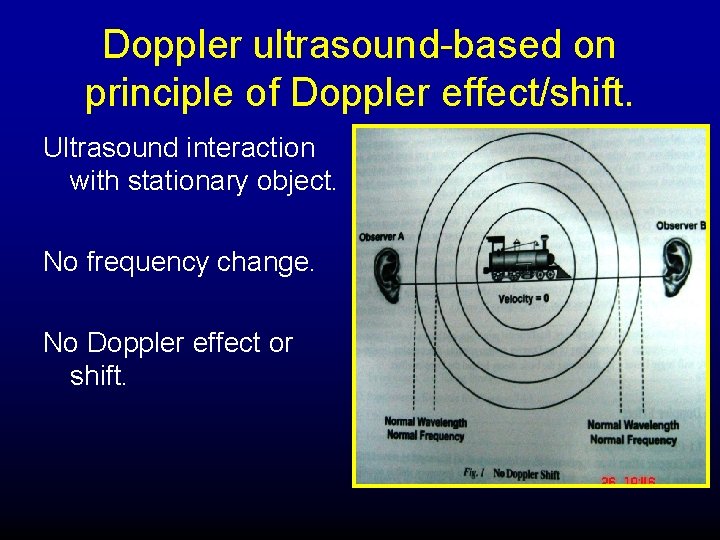
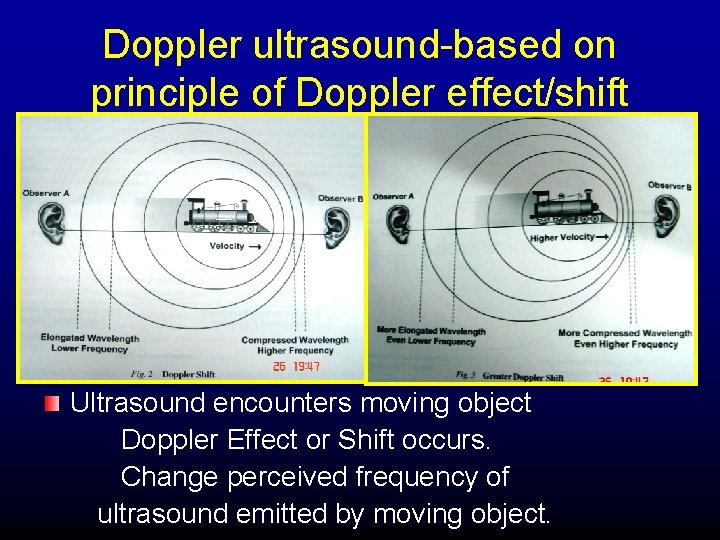
Doppler ultrasound-based on principle of Doppler effect/shift. Ultrasound interaction with stationary object. No frequency change. No Doppler effect or shift.
Doppler ultrasound-based on principle of Doppler effect/shift Ultrasound encounters moving object Doppler Effect or Shift occurs. Change perceived frequency of ultrasound emitted by moving object.
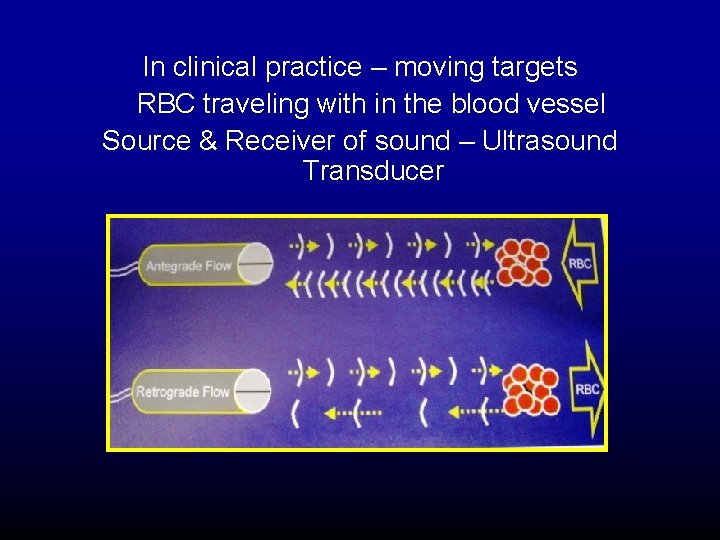
In clinical practice – moving targets RBC traveling with in the blood vessel Source & Receiver of sound – Ultrasound Transducer
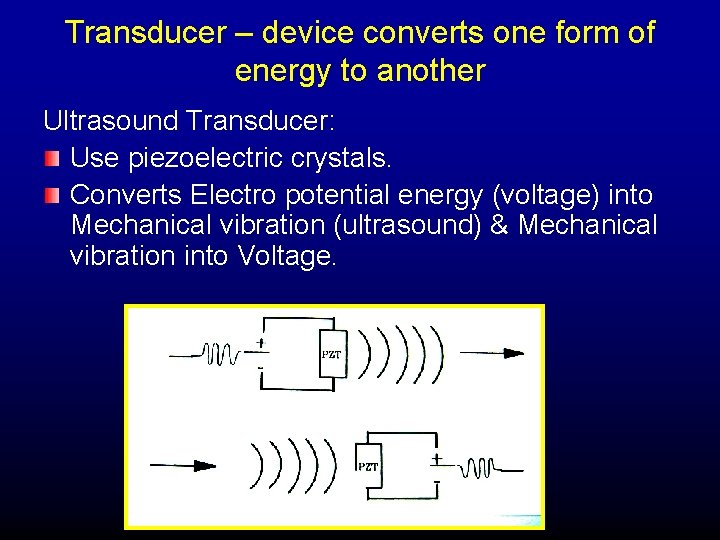
Transducer – device converts one form of energy to another Ultrasound Transducer: Use piezoelectric crystals. Converts Electro potential energy (voltage) into Mechanical vibration (ultrasound) & Mechanical vibration into Voltage.
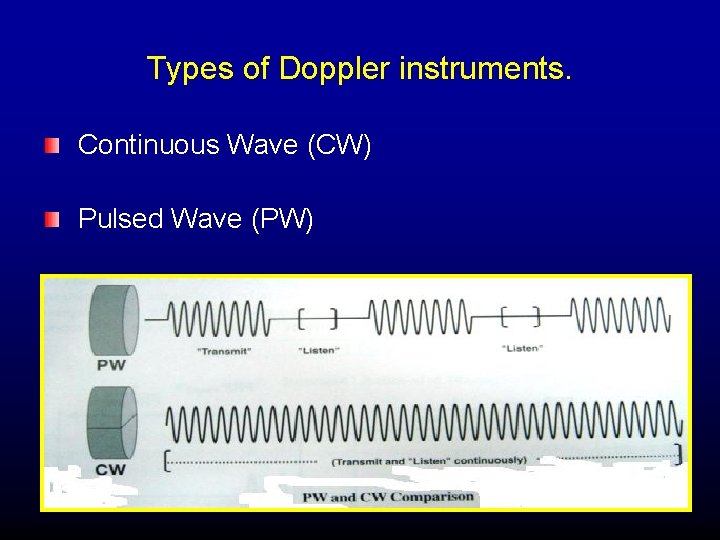
Types of Doppler instruments. Continuous Wave (CW) Pulsed Wave (PW)
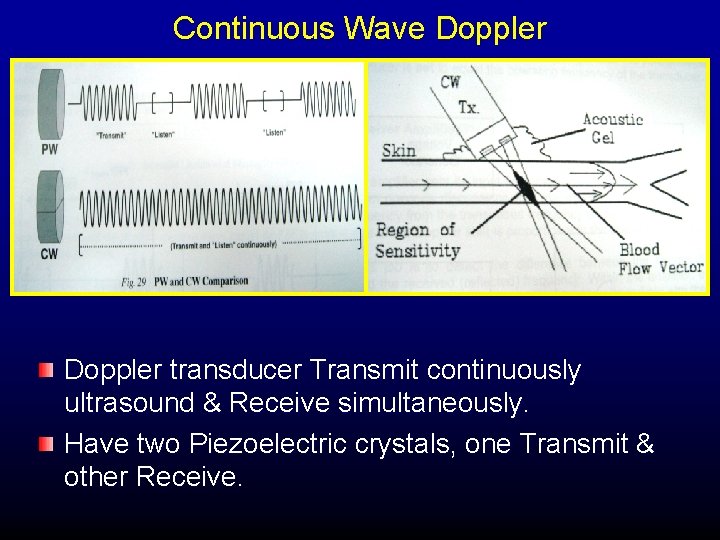
Continuous Wave Doppler transducer Transmit continuously ultrasound & Receive simultaneously. Have two Piezoelectric crystals, one Transmit & other Receive.
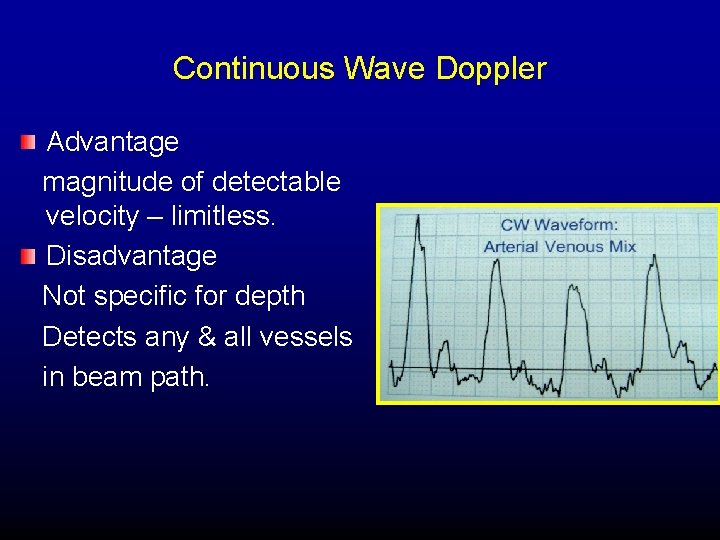
Continuous Wave Doppler Advantage magnitude of detectable velocity – limitless. Disadvantage Not specific for depth Detects any & all vessels in beam path.
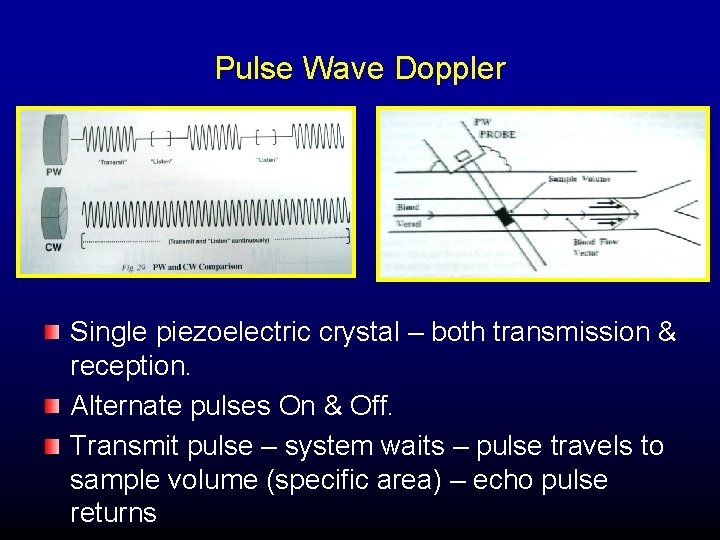
Pulse Wave Doppler Single piezoelectric crystal – both transmission & reception. Alternate pulses On & Off. Transmit pulse – system waits – pulse travels to sample volume (specific area) – echo pulse returns
Pulse Wave Doppler Advantages Specific for depth & range. No mixture of signals like CW Doppler. Disadvantage Limited maximum detectable velocity unlimited for CW Doppler.
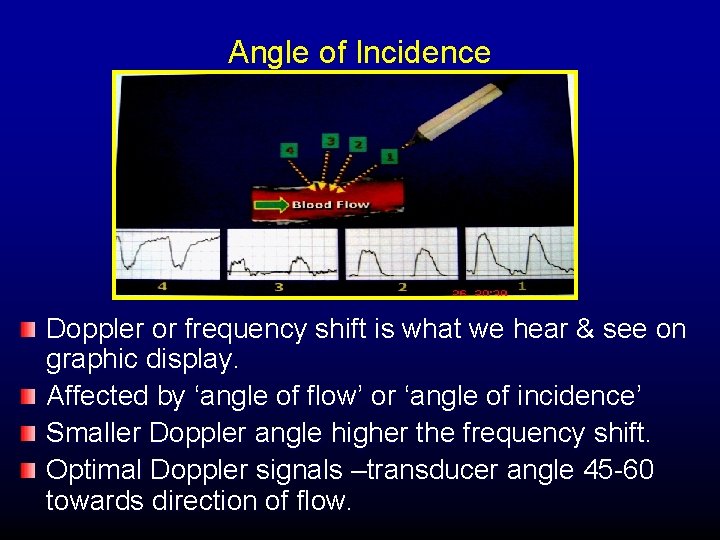
Angle of Incidence Doppler or frequency shift is what we hear & see on graphic display. Affected by ‘angle of flow’ or ‘angle of incidence’ Smaller Doppler angle higher the frequency shift. Optimal Doppler signals –transducer angle 45 -60 towards direction of flow.
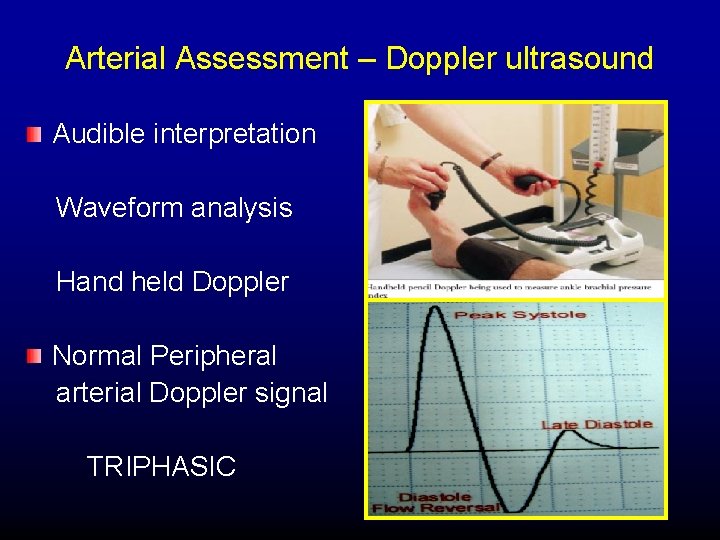
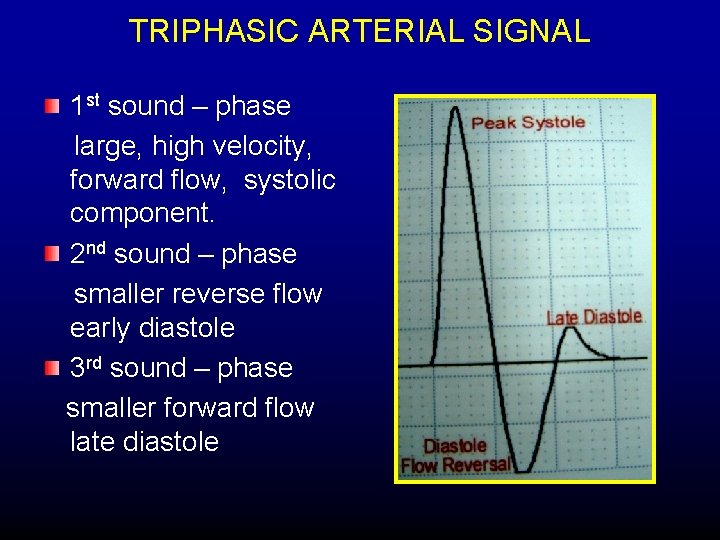
Arterial Assessment – Doppler ultrasound Audible interpretation Waveform analysis Hand held Doppler Normal Peripheral arterial Doppler signal TRIPHASIC
TRIPHASIC ARTERIAL SIGNAL 1 st sound – phase large, high velocity, forward flow, systolic component. 2 nd sound – phase smaller reverse flow early diastole 3 rd sound – phase smaller forward flow late diastole
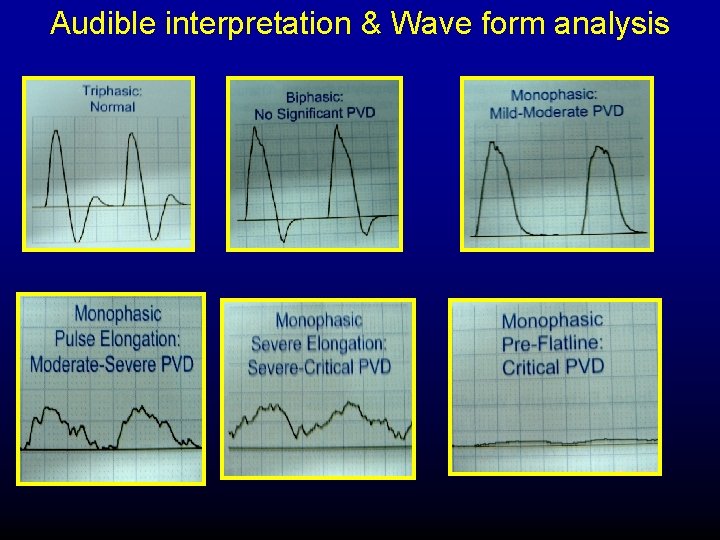
Audible interpretation & Wave form analysis
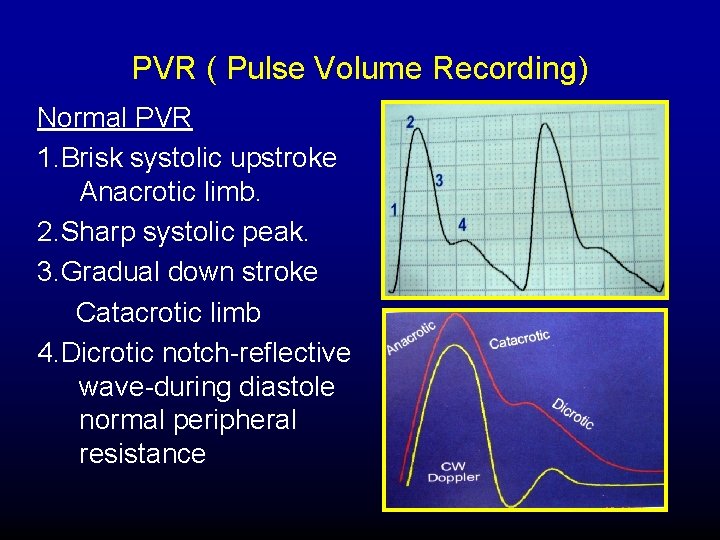
PVR ( Pulse Volume Recording) Normal PVR 1. Brisk systolic upstroke Anacrotic limb. 2. Sharp systolic peak. 3. Gradual down stroke Catacrotic limb 4. Dicrotic notch-reflective wave-during diastole normal peripheral resistance
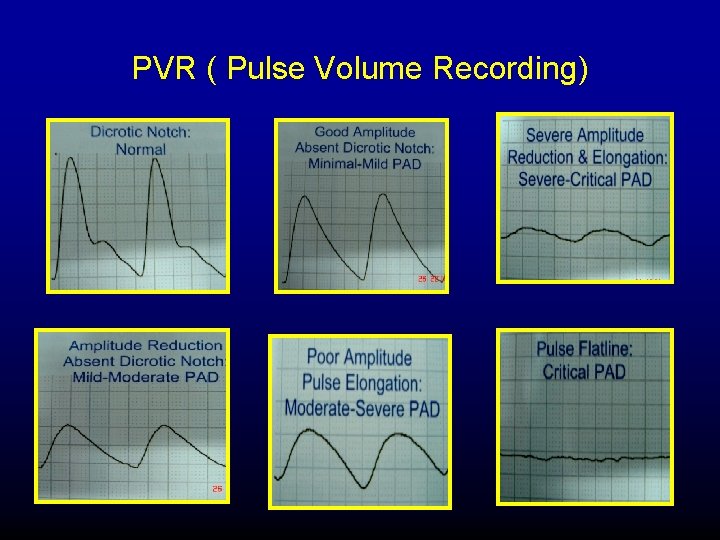
PVR ( Pulse Volume Recording)
Arterial Pressure measurements Peripheral arterial occlusive disease. Sequence of pressure measurement tests. Systolic Brachial & Ankle pressure at rest Calculation of ABI Toe pressure-non compressible tibial arts
Arterial Pressure measurements Sequence of pressure measurement tests cotnd, Segmental pressure & waveforms – low ABI. Stress testing – severity of claudication & to rule out pseudoclaudication
Contraindication to pressure measurements Acute DVT Bandages & casts Ulceration Trauma Surgical site
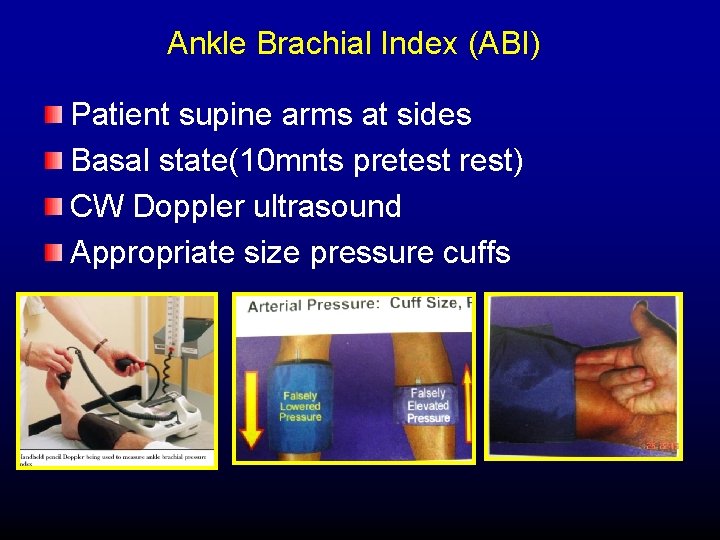
Ankle Brachial Index (ABI) Patient supine arms at sides Basal state(10 mnts pretest rest) CW Doppler ultrasound Appropriate size pressure cuffs
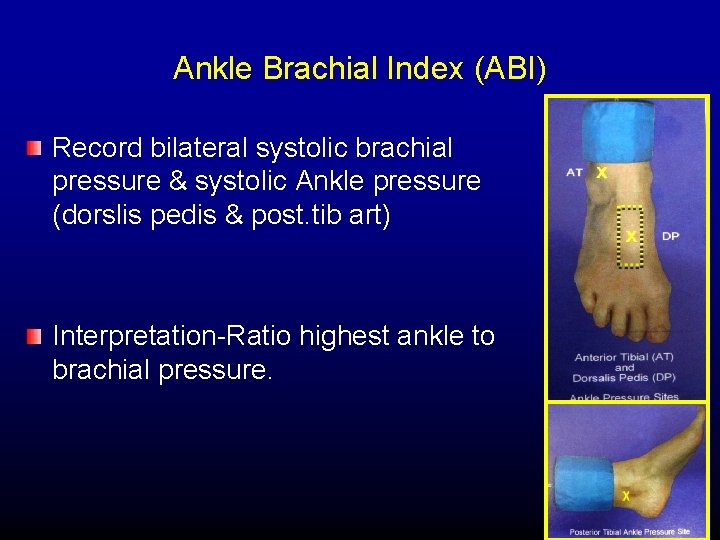
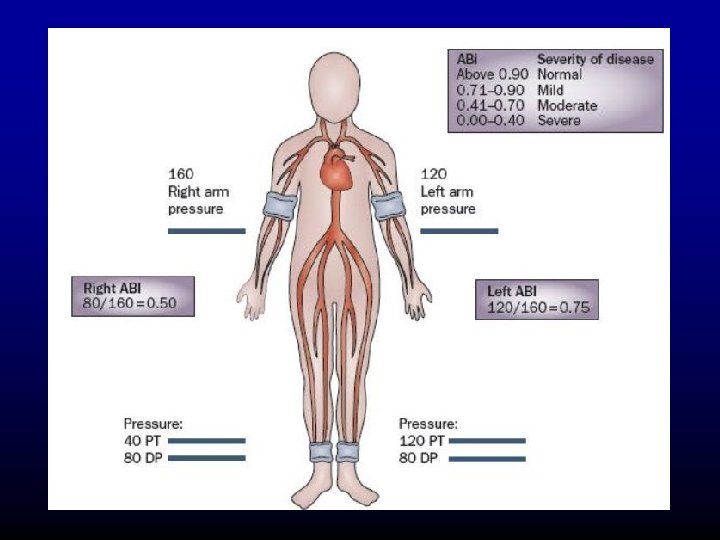
Ankle Brachial Index (ABI) Record bilateral systolic brachial pressure & systolic Ankle pressure (dorslis pedis & post. tib art) Interpretation-Ratio highest ankle to brachial pressure.
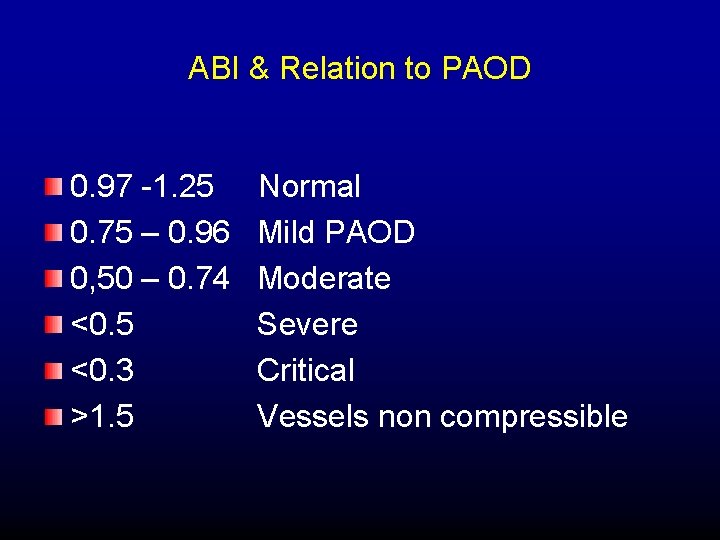
ABI & Relation to PAOD 0. 97 -1. 25 0. 75 – 0. 96 0, 50 – 0. 74 <0. 5 <0. 3 >1. 5 Normal Mild PAOD Moderate Severe Critical Vessels non compressible
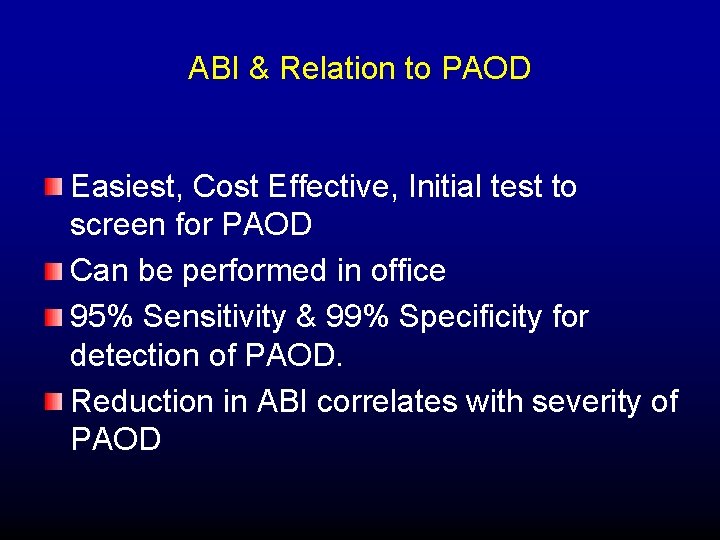
ABI & Relation to PAOD Easiest, Cost Effective, Initial test to screen for PAOD Can be performed in office 95% Sensitivity & 99% Specificity for detection of PAOD. Reduction in ABI correlates with severity of PAOD
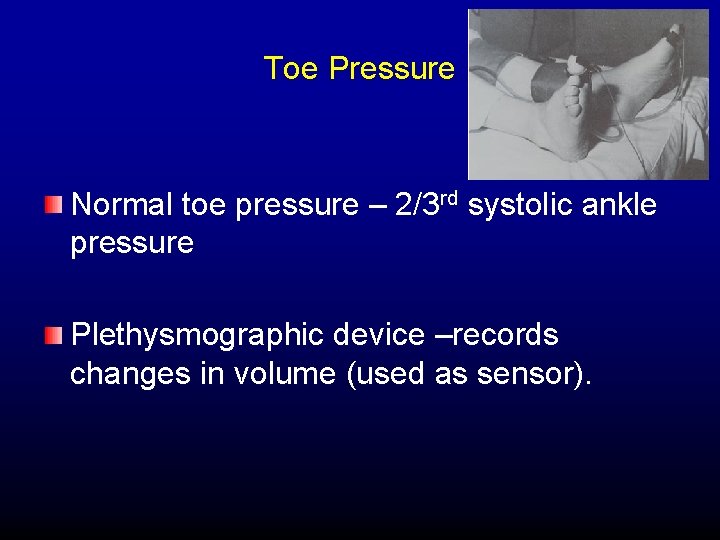
Toe Pressure Normal toe pressure – 2/3 rd systolic ankle pressure Plethysmographic device –records changes in volume (used as sensor).
Toe Pressure contd, Inflate cuff above 2/3 rd of ankle pressure. BP cuff (2. 5 cm) around base of toe. Gradual deflate until arterial tracing demonstrate return of pulsatile flow – recorded as systolic toe pressure.
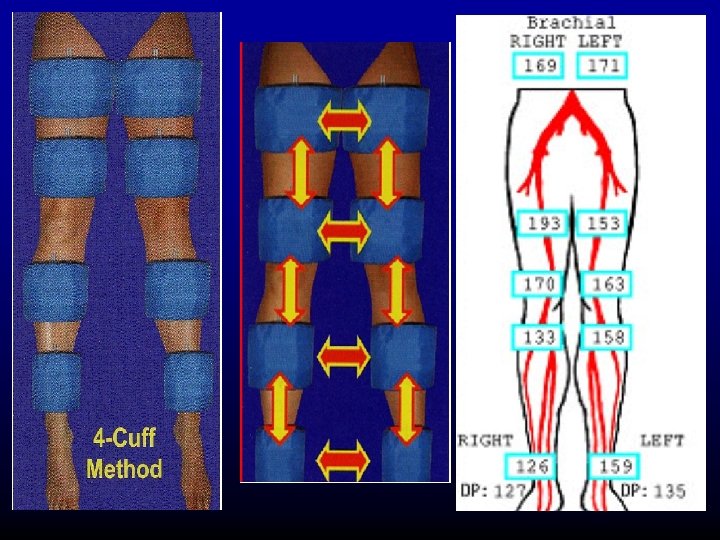
Segmental Pressure Drop in ABI at rest or post exercise indicates hemodynamically significant disease proximal to cuff. Segmental pressure measurement – localizes the diseased arterial segment.
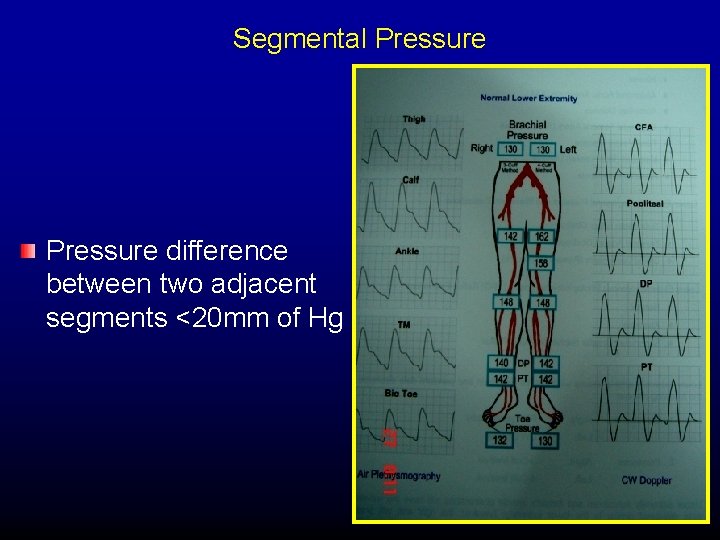
Segmental Pressure difference between two adjacent segments <20 mm of Hg
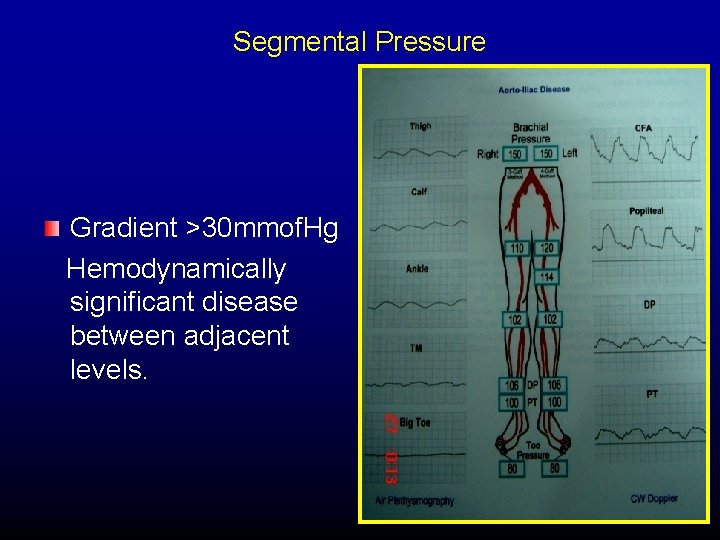
Segmental Pressure Gradient >30 mmof. Hg Hemodynamically significant disease between adjacent levels.
Exercise Test (Stress. Test) Thread mill stress test Reactive hyperemia stress test
Exercise Test (Stress. Test) Assess functional limitation due to PAOD Differentiates PAOD – Pseudoclaudication Ex; neurogenic claudication
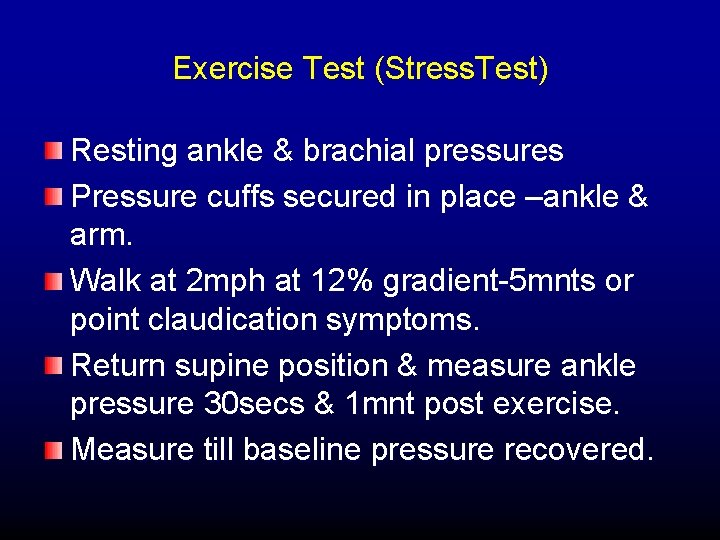
Exercise Test (Stress. Test) Resting ankle & brachial pressures Pressure cuffs secured in place –ankle & arm. Walk at 2 mph at 12% gradient-5 mnts or point claudication symptoms. Return supine position & measure ankle pressure 30 secs & 1 mnt post exercise. Measure till baseline pressure recovered.
Exercise Test (Stress. Test) Note: Duration of exercise. Distance walked. Symptoms prevented exercise.
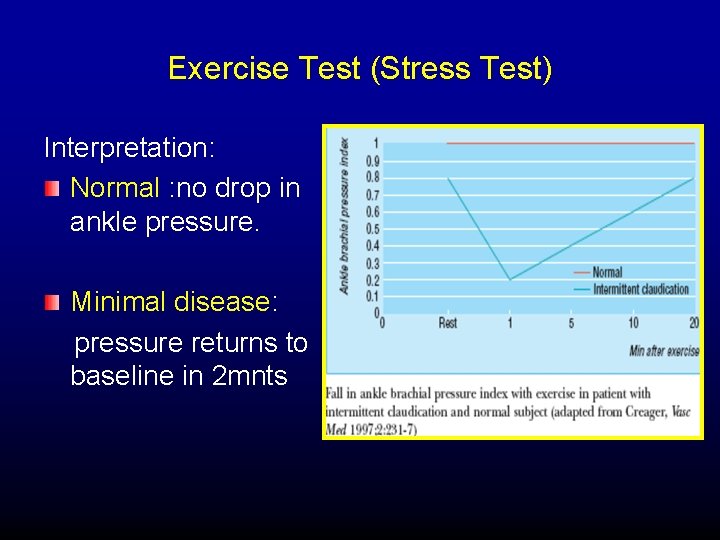
Exercise Test (Stress Test) Interpretation: Normal : no drop in ankle pressure. Minimal disease: pressure returns to baseline in 2 mnts
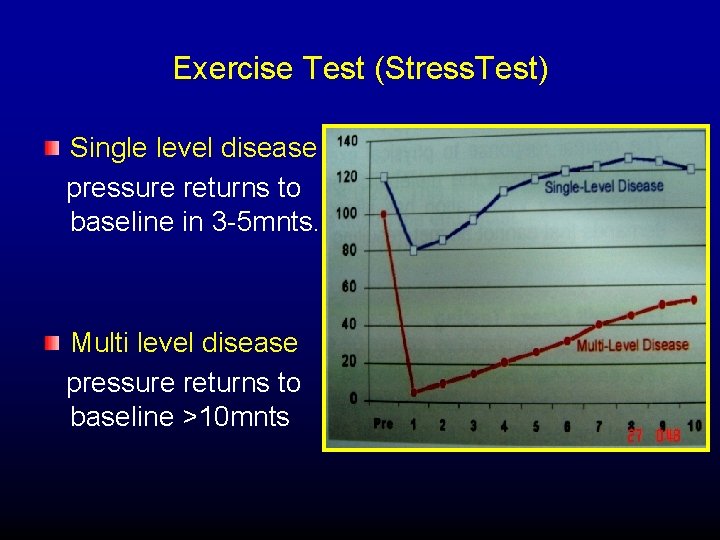
Exercise Test (Stress. Test) Single level disease pressure returns to baseline in 3 -5 mnts. Multi level disease pressure returns to baseline >10 mnts
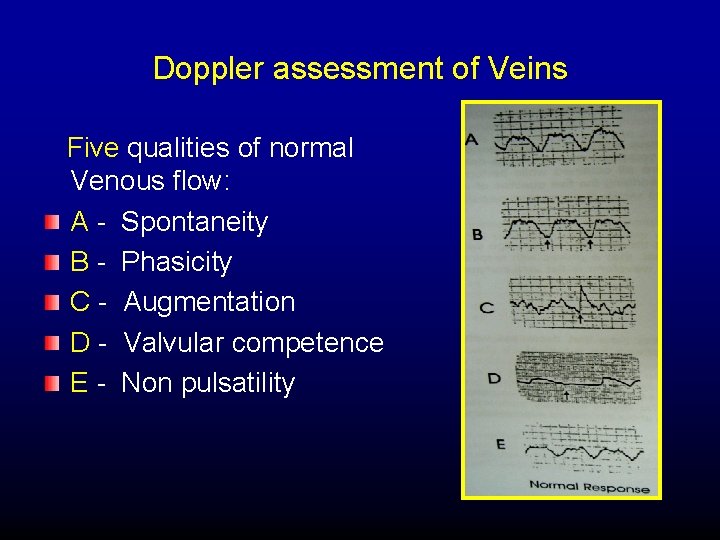
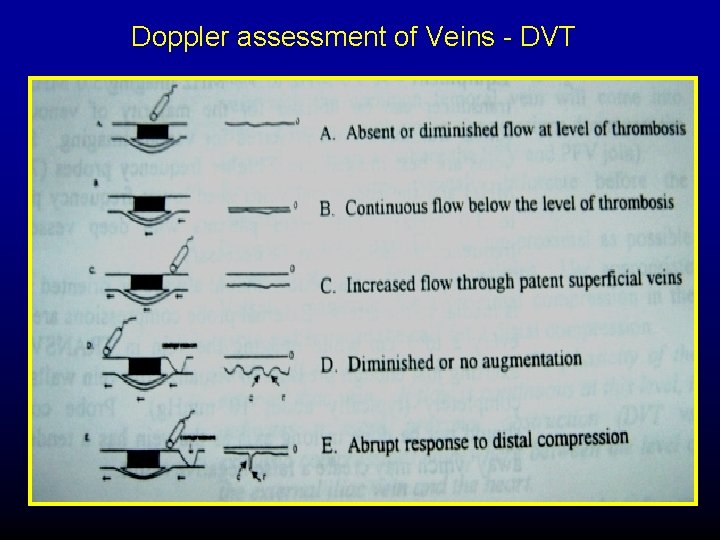
Doppler assessment of Veins Five qualities of normal Venous flow: A - Spontaneity B - Phasicity C - Augmentation D - Valvular competence E - Non pulsatility
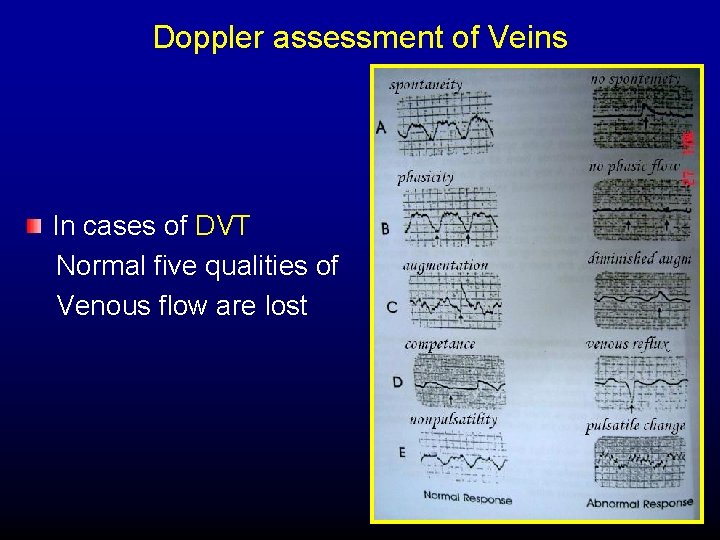
Doppler assessment of Veins In cases of DVT Normal five qualities of Venous flow are lost
Doppler assessment of Veins - DVT
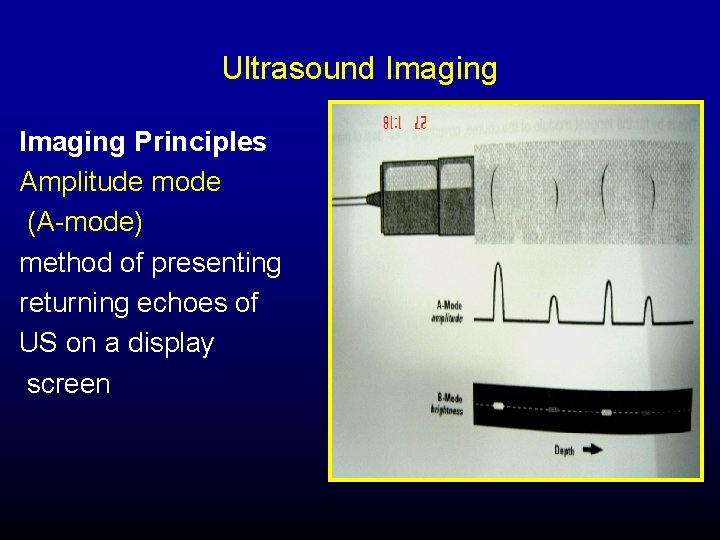
Ultrasound Imaging Principles Amplitude mode (A-mode) method of presenting returning echoes of US on a display screen
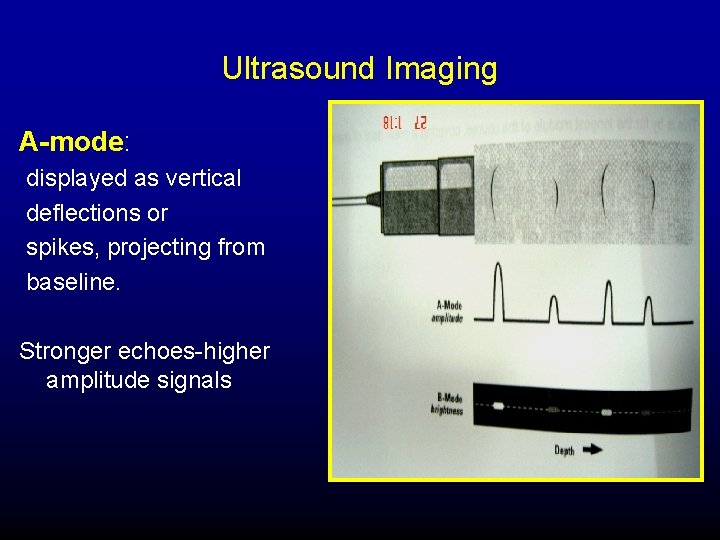
Ultrasound Imaging A-mode: displayed as vertical deflections or spikes, projecting from baseline. Stronger echoes-higher amplitude signals
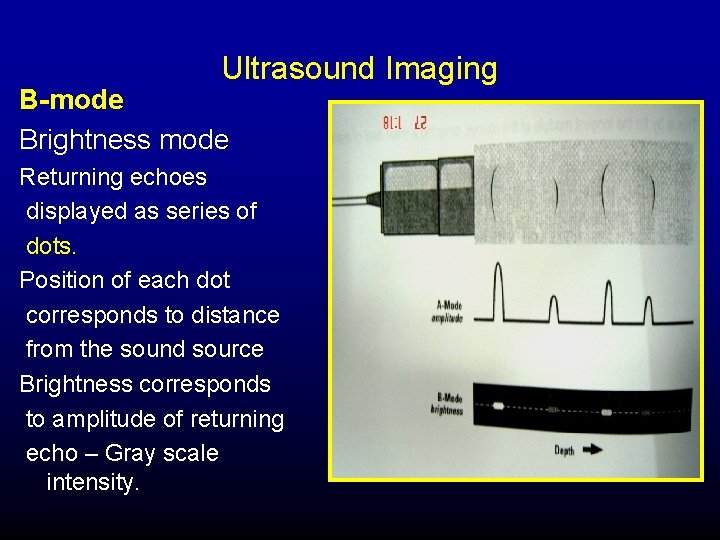
Ultrasound Imaging B-mode Brightness mode Returning echoes displayed as series of dots. Position of each dot corresponds to distance from the sound source Brightness corresponds to amplitude of returning echo – Gray scale intensity.
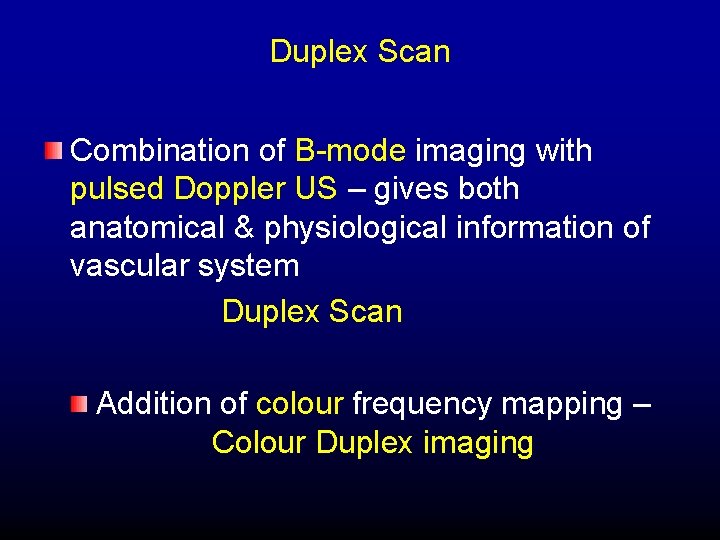
Duplex Scan Combination of B-mode imaging with pulsed Doppler US – gives both anatomical & physiological information of vascular system Duplex Scan Addition of colour frequency mapping – Colour Duplex imaging
Uses of colour duplex imaging Arterial: Identify obstructive or aneurysmal atherosclerotic disease peripheral arteries carotid arteries renal & visceral arteries Surveillance of by pass grafts.
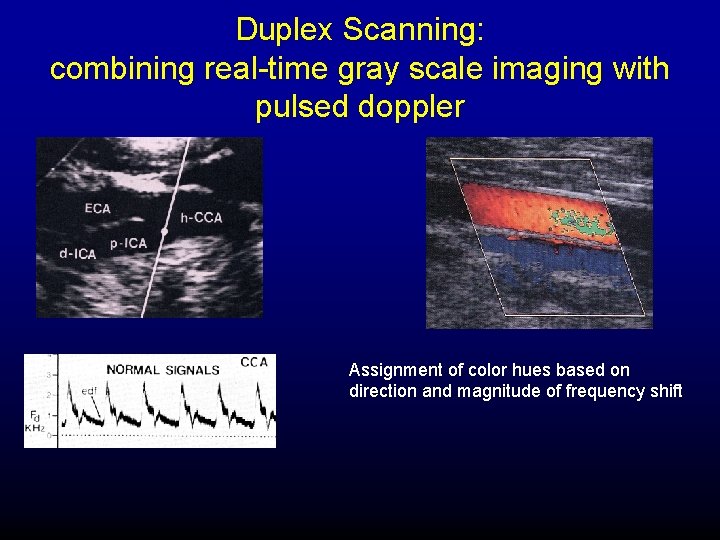
Duplex Scanning: combining real-time gray scale imaging with pulsed doppler Assignment of color hues based on direction and magnitude of frequency shift
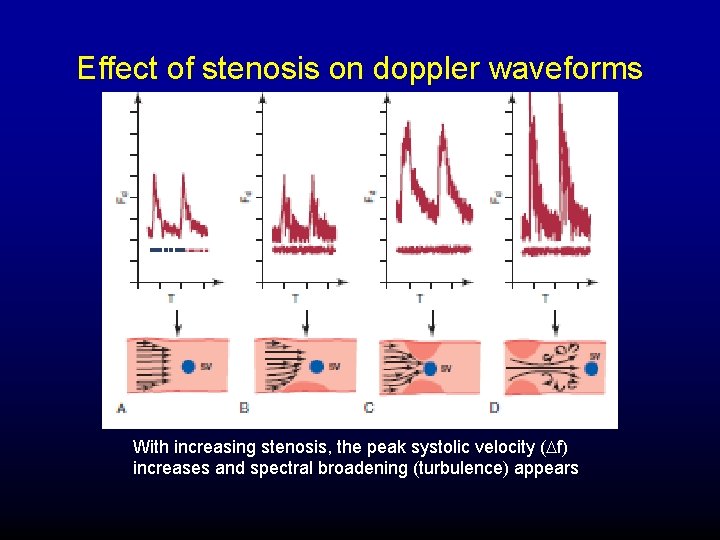
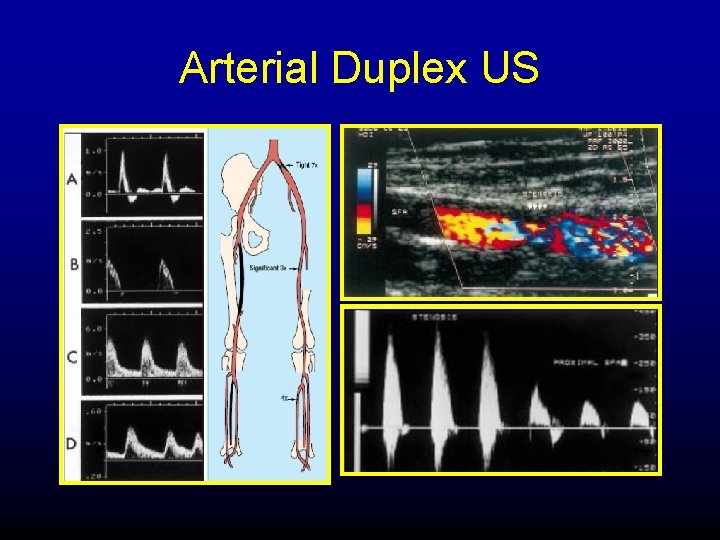
Effect of stenosis on doppler waveforms With increasing stenosis, the peak systolic velocity (Df) increases and spectral broadening (turbulence) appears
Arterial Duplex US
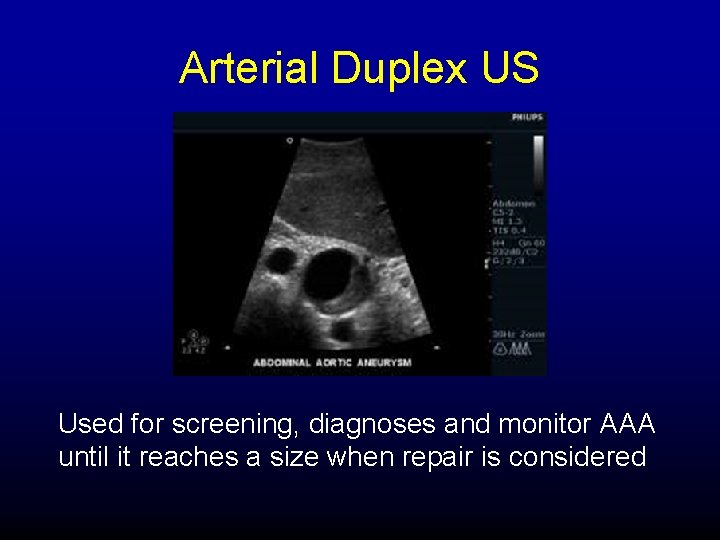
Arterial Duplex US Used for screening, diagnoses and monitor AAA until it reaches a size when repair is considered
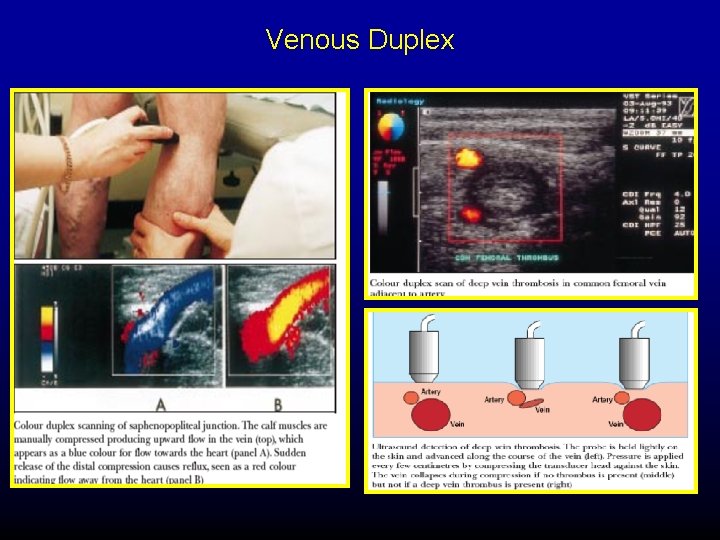
Venous Duplex Diagnosis of DVT Assessing competance of deep vein valves. Superficial venous reflux & identifying Sapheno Femoral & Popliteal Jnc refluxes. Preoperative mapping of saphenous vein
Criteria for Duplex examn. Of venous system Normal Easily compressible Should be echo free Normal valve motion Normal Doppler signals Abnormal (DVT) Non compressible Echogenic thrombus in vein Incompetant valves Absent Doppler signals
Venous Duplex
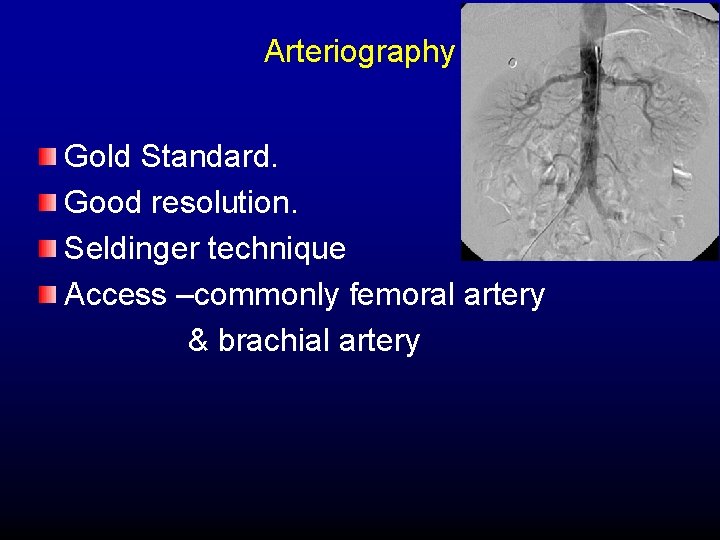
Arteriography Gold Standard. Good resolution. Seldinger technique Access –commonly femoral artery & brachial artery
Arteriography Inject iodinated contrast Two types of contrast Ionic or high osmolar Non ionic or low osmolar
Ionic or High Osmolar Contrast Water soluble Hypertonic, osmolality 5 -10 times of blood. Causes discomfort at injection site. More nephrotoxic.
Non Ionic or Low Osmolar Contrast Has same no of iodine ions , no cations Osmolality 1/3 rd of high osmolar contrast Still hypertonic twice that of plasma. Less nephrotoxic More expensive
Complications Local: Hemorrhage Thrombosis Pseudo aneurysm AV fistula Intimal dissection Embolization
Complications General: Renal – nephrotoxicity Cardiac- hypertension, arrhythmias, CCF. Neurological – Carotid angiogram – TIA stroke, convultions. Pulmonary-bronchospasm, pulm edema.
Complications Allergic reaction to contrast Minor – nausea, vomiting, head ache, chills, fever, itching. Intermediate - hypotension. urticaria, bronchospasm. Major-anaphylaxis, pul edema, laryngeal edema
Complications Nephrotoxicity: 3 rd cause of ARF in hospitalized pts Mild reversible rise in serum creatinine – ESRD & Death Risk Factors – DM, RI, Age, CCF, Dehydr. Normal – 1 -2%, RI – 10% ( Creat: 115 -168) Creat >177 – 62%
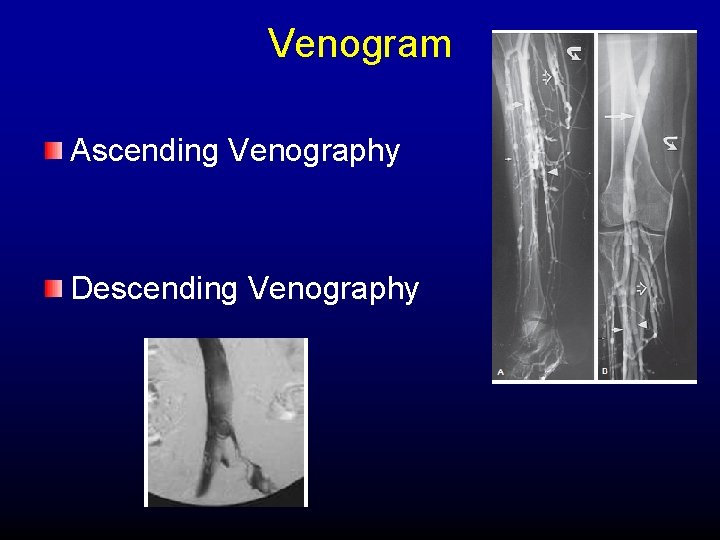
Venogram Ascending Venography Descending Venography
Ascending venography Relatively invasive study Requires painful venipucture Injection of iodinated contrast Exposure to radiation
Ascending venography Indication High clinical suspicion of DVT with negative Or equivocal non invasive vascular tests. Gives information about anatomy & patency of deep veins & locates the incompetant perforators veins.
Ascending venography Inject about 40 -60 ml of contrast into superficial foot arch veins & tourniquet tied above ankle to visualize deep veins. Complications: thrombophlebitis
Decending venogram Indication: To distinguish primary deep venous valvular incompetance from thrombotic disease. Identify level of deep venous reflux & morphology of venous valves.
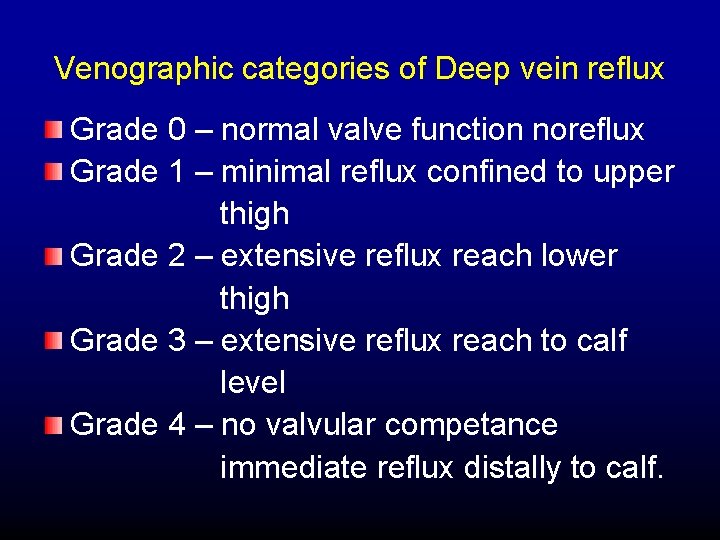
Venographic categories of Deep vein reflux Grade 0 – normal valve function noreflux Grade 1 – minimal reflux confined to upper thigh Grade 2 – extensive reflux reach lower thigh Grade 3 – extensive reflux reach to calf level Grade 4 – no valvular competance immediate reflux distally to calf.
Lymphedema Minimal invasive investigation to identify edema of lymphatic origin Lymphoscintigraphy CT & MRI
Lymphoscintigraphy Isotope Lymphography Radiolabelled Colloid or Protein injected 1 st web of foot Gama Camera monitoring of tracer uptake.
Lymphoscintigraphy Measurement of tracer uptake within the lymph nodes after a defined interval – distinguishes lymph edema from edema of non lymphatic origin. Appearance of tracer outside the main lymph routes – dermal back flow indicates Lymph reflux & proximal obstruction
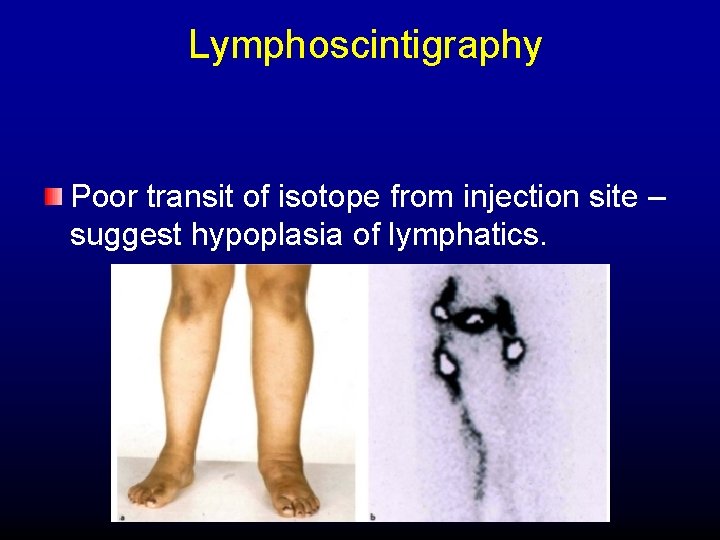
Lymphoscintigraphy Poor transit of isotope from injection site – suggest hypoplasia of lymphatics.
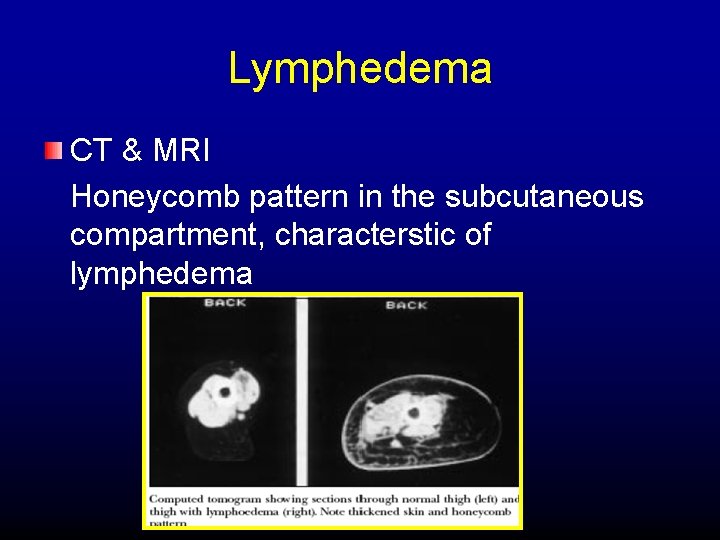
Lymphedema CT & MRI Honeycomb pattern in the subcutaneous compartment, characterstic of lymphedema
Direct contrast X Ray lymphography Lymphangiography lymph vessels identified by injecting vital dyes & lymph vessel cannulated. Lipiodol contrast directly injected Normal limb shows opacification of 5 -15 main lymph vessels as converge to inguinal lymph nodes. Lymphatic obstruction-contrast refluxes into dermal network – dermal backflow.
Other Modalities of Vascular Investigations CT, CTAngiogram MRI, MRAngiogram
CT Angiogram Rapid & Minimally invasive Arterial vasculature can evaluated from multiple angles & planes Provides soft tissue details useful in defining pathologies outside vessel lumen Aneurysm, Dissection, Wall thickening, Arterial Entrapment.
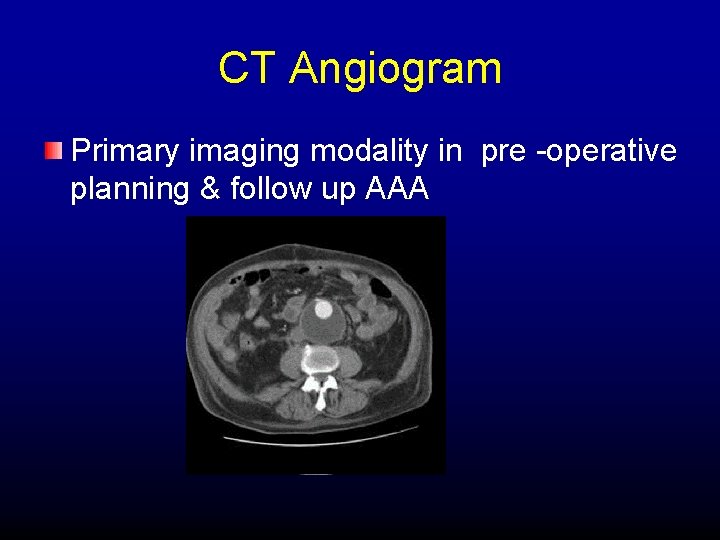
CT Angiogram Primary imaging modality in pre -operative planning & follow up AAA
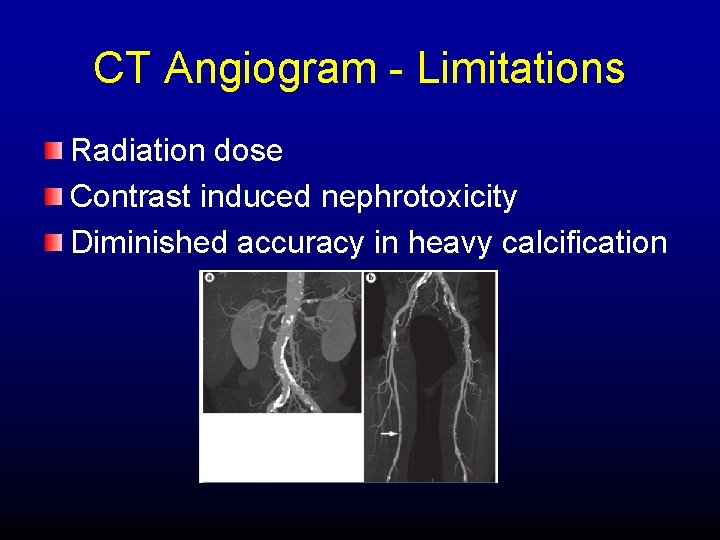
CT Angiogram - Limitations Radiation dose Contrast induced nephrotoxicity Diminished accuracy in heavy calcification
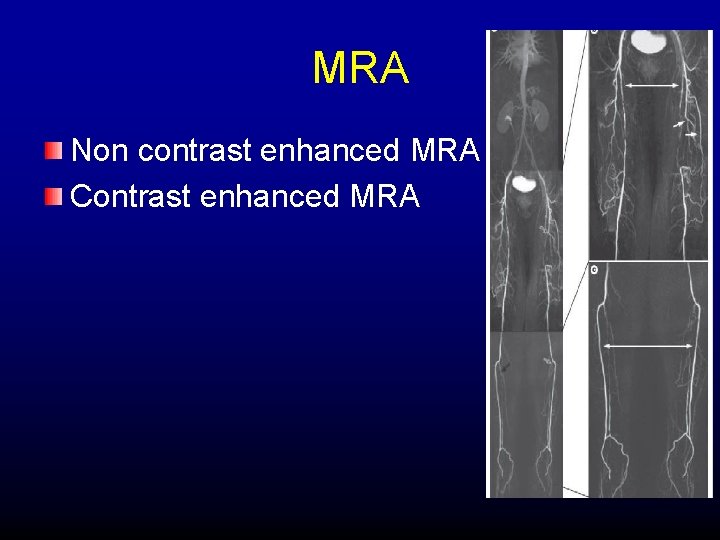
MRA Non contrast enhanced MRA Contrast enhanced MRA
MR Angiogram - Limitations Scan artefacts In Renal Impairment – Gadolinium contrast – nephrogenic systemic fibrosis Metal implants Claustrophobia