
Vascular Analysis of Disease In Nuclear Medicine Blood
Vascular Analysis of Disease In Nuclear Medicine
Blood Flow to the Extremities Consider chronic or acute disease n Blood flow interruption from arterial occlusions n Embolism, thrombus, or a vascular injury n Most procedures analyze venous blood flow and physiological uptake of the radiotracer n However, given certain situations arterial evaluation should be considered n
Clinically Speaking n n n Regional distribution of vascular flow can be done using stress and rest procedures – Sound familiar? Graft patency via blood flow determine viability Evaluation of: ischemic ulcers and preamputation AV malformation, shunts, vascular tumors, embolization Venous evaluation of infection and DVTs Angiography issue is its failure to evaluate collateral circulation n Is there collateral circulation that contrast files to image
Xenon Utilization Purpose – To evaluate blood flow in muscle tissue n Think of 133 Xe and its imaging characteristics n 0. 1 m. L saline with 100 μCi 133 Xe injected IM 1 to 2 cm into muscle n Needle is not removed for 30 seconds, but images or data is collected in a serial mode n Declining activity is quantified with semilog paper n Procedure is done twice: stress and rest Lower extremities n Normal - 2 (rest) and 50 (stress) m. L/min/100 g n Abnormal - <20 (stress) m. L/min/100 g
Arterial Evaluation Siegel el al. injected 99 m. Tc. HAM into the descending aorta or femoral artery n Rest and stress images taken in the extremities n Compared with contrast angiography n Disease was confirmed in both: large vessel occlusion, small vessel disease, ischemic ulcers, and other n Test is rarely done with arterial injection because of its invasive nature n
Diffusible Tracer n n While a patient underwent 201 Tl in cardiology whole body scans were performed to evaluate muscle distribution of the tracer Segall et al. noted stress and redistribution images in the legs with peripheral vascular disease Normal patients: Leg activity = 25% of the total dose with stress having a greater amount than rest Abnormal – Rest imaging in the leg had higher levels of activity when compared with stress
Types of Vascular Evaluation n Determining the level or area of amputation based on ischemic areas in an extremity n n m. L/min/100 g evaluated at three points using 133 Xe: above the knee, below the knee, and the foot Evaluate the pedicle flaps in reconstructive surgery m. L/min/100 g used with 133 Xe and 99 m. Tc. O 4 n If a probe recorded delayed clearance, graft was not viable n n Determine treatment of skin ulcers
Frost Bite and Electrical Burns Frost Bite n 99 m. Tc. O - used to evaluate viable from non-viable 4 tissue in the finger and toes. Lack of activity indicated loss of blood flow Electrical Burns n Using 99 m. Tc. PYP extent of muscle damage can be determined n n Lacking uptake and flow was an indication of necrotic tissue Delayed images also showed a donut shapes (cold center) and focal hotspots indicating damaged viable to the tissue
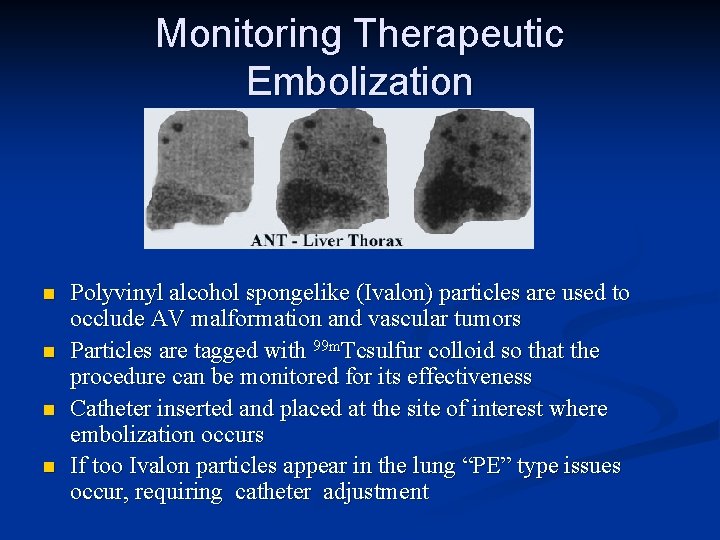
Monitoring Therapeutic Embolization n n Polyvinyl alcohol spongelike (Ivalon) particles are used to occlude AV malformation and vascular tumors Particles are tagged with 99 m. Tcsulfur colloid so that the procedure can be monitored for its effectiveness Catheter inserted and placed at the site of interest where embolization occurs If too Ivalon particles appear in the lung “PE” type issues occur, requiring catheter adjustment
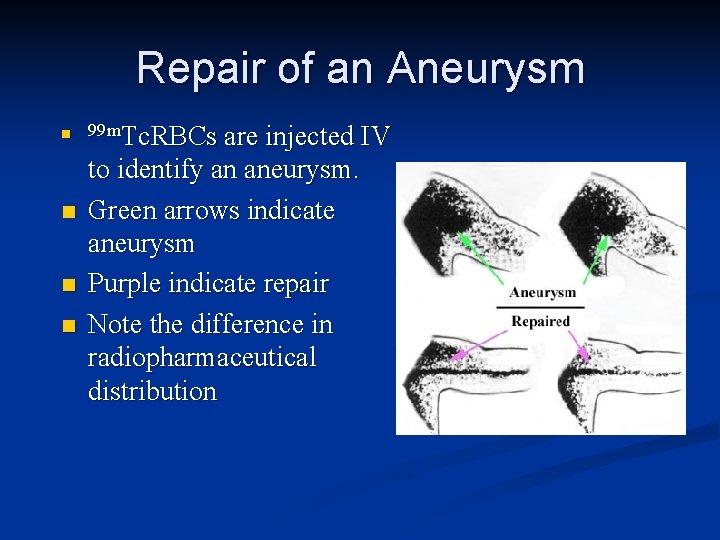
Repair of an Aneurysm n n 99 m. Tc. RBCs are injected IV to identify an aneurysm. Green arrows indicate aneurysm Purple indicate repair Note the difference in radiopharmaceutical distribution

Arterial Injection of Tc 99 m. MAA n n Prior to the application of SIR-Spheres an arterial injection of MAA is administered Shunting must be less than 20% to the lungs Greater than 20% may cause radiation pneumonitis Related lecture https: //www. researchgate. net/figure/Planar-nuclear-medicine-shunt-study. Technetium-99 -macroaggregated-albumin-was-injected_fig 3_8399677
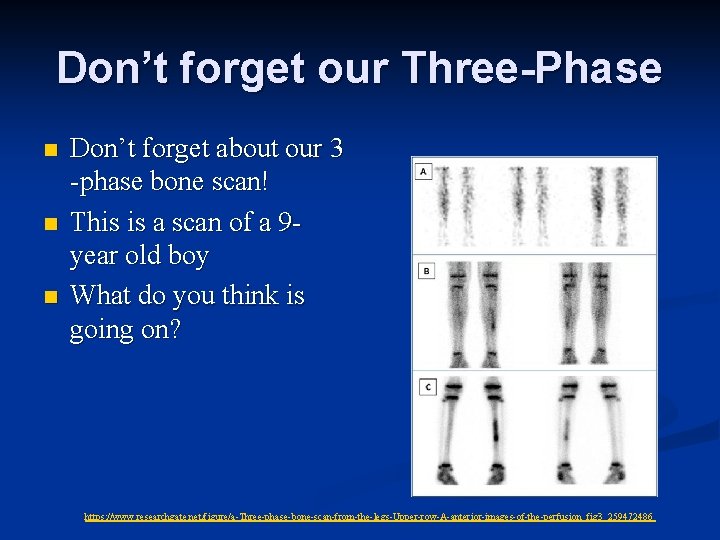
Don’t forget our Three-Phase n n n Don’t forget about our 3 -phase bone scan! This is a scan of a 9 year old boy What do you think is going on? https: //www. researchgate. net/figure/a-Three-phase-bone-scan-from-the-legs-Upper-row-A-anterior-images-of-the-perfusion_fig 3_259472486

Shunt n n A different type of flow study Assessment of a shunt This shunt is surgically implanted with patients’ that have what? There appears to be no blockage https: //www. slideshare. net/ganeshkumar 7982/new-seminar-41895221
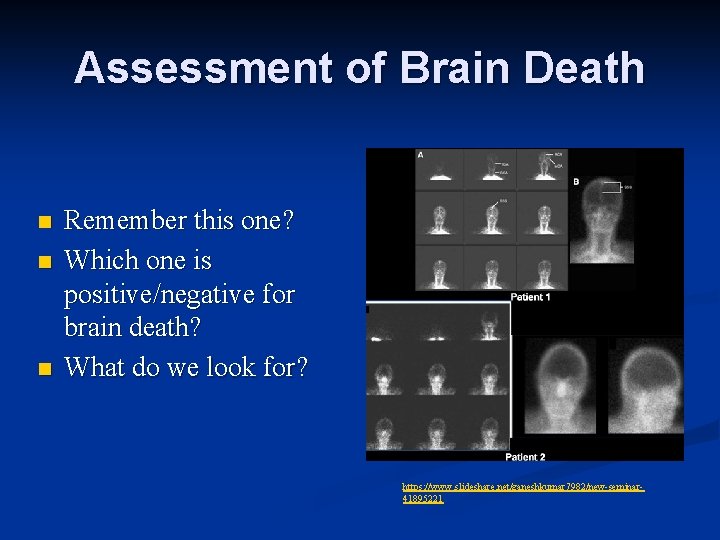
Assessment of Brain Death n n n Remember this one? Which one is positive/negative for brain death? What do we look for? https: //www. slideshare. net/ganeshkumar 7982/new-seminar 41895221
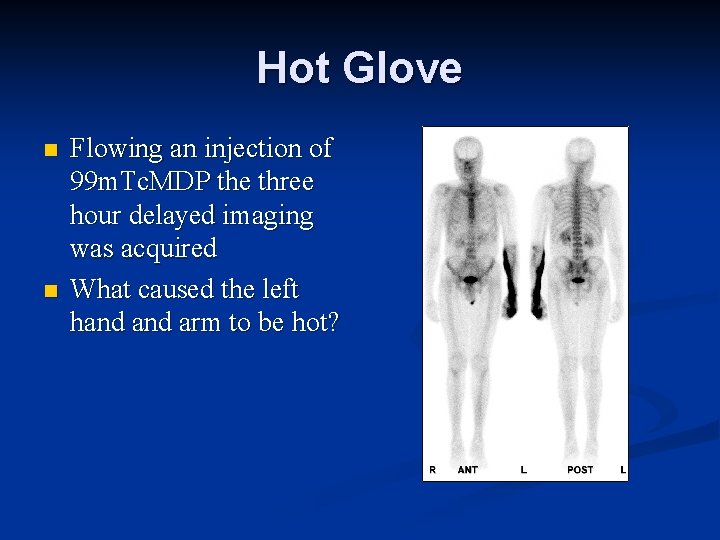
Hot Glove n n Flowing an injection of 99 m. Tc. MDP the three hour delayed imaging was acquired What caused the left hand arm to be hot?

Diagnosis of DVTs n Contrast venography (gold standard) – 100 m. L contrast injected into the dorsal vein in the foot n n DVT is diagnosed when flow abruptly stops or lack of deep vein filling occurs Impedance Plethysmography (IPG) – Using an inflated thigh cuff, blood flow impedance is measure n Releasing cuff pressure and the lack reduced venous pressure via its electrical impedance is an indication of DTV

Diagnosing DVT (cont. ) Ultrasound n Color Doppler with compression technique is used to detect DVT n Color separates venous (blue) from arterial (red) n Compression without the vein compressing indicates DVT
DVT/NMT Procedure Most common radiopharmaceutical is 99 m. Tc. MAA where bilateral IV is setup, one for each foot n 1 – 2 m. Ci are injected at the same time with serial imaging n Alternative approach – tourniquet is applied at different points on the leg and a set of injections with serial images are taken n Detector placement must done at different intervals n n Tib/fib, knees, and thigh
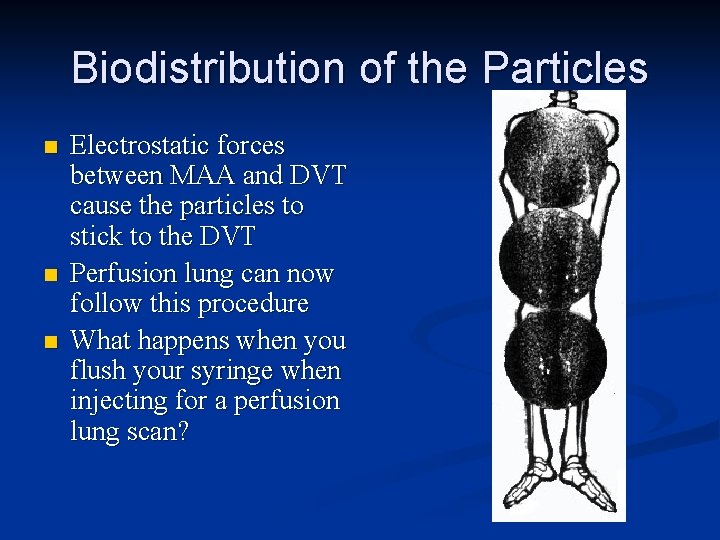
Biodistribution of the Particles n n n Electrostatic forces between MAA and DVT cause the particles to stick to the DVT Perfusion lung can now follow this procedure What happens when you flush your syringe when injecting for a perfusion lung scan?
Acu. Tect: General Information n Used to diagnosis DVT A synthetic peptide (not a Mo. Ab!) - Apcitide Binds to glycoprotein GP IIb/IIIa n n n platelet receive signals that cause activation and aggregation of the thrombus Aggregation depended on GP IIb/IIIa receptor Acut. Tect binds adhesion-molecule receptors found in the accute DVT Was quickly approved by the FDA Produced by Diatide, Incorporated and distributed by Nycomed Amersham
Acu. Tect: Clinical Trails (General) n Two clinical trials where completed on patients suspected of having DVT n n Study A = 136 patients Study B = 145 patients All patients where analyzed with Acut. Tect and Contrast Venography Total of 236 patients where finally processed
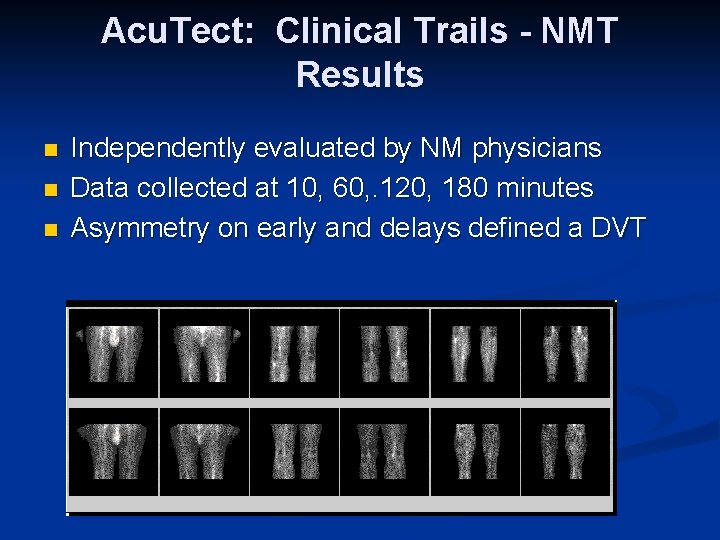
Acu. Tect: Clinical Trails - NMT Results n n n Independently evaluated by NM physicians Data collected at 10, 60, . 120, 180 minutes Asymmetry on early and delays defined a DVT
Acu. Tect: Clinical Trails Contrast Venography n Two groups of radiologies evaluated the data n Group 1: Three independent radiologists from the imaging centers n n n Blinded to all other clinical data No established reading criteria defined Group 2: Three radiologists at one research center n n Blinded to all other clinical data Established criteria
Acu. Tect: Clinical Trails Results n n Acu. Tect Results n Study A = 54 (48%) n Study B = 41 (33%) Contrast Venography Results from Group 1 n Study A = 51 (45%) n Study B = 101 (82%) Contrast Venography Results from Group 2 n Study A = 24 (21%) n Study B = 40 (33%) Acu. Tect vs Group 2 (Research Center) Agreement rate n Study A = 56 -71% n Study B = 66 -73%
Acu. Tect: Comments/ Recommendations n n n Literature research seems limited Can it be done before or after a V/Q lung scan? Protocol suggest 10 and 60 minute delayed images Digital image for contrast enhancement Small peptides may be immunogenic n n 642 observed for 3 hours 1 patient became hypotensive from 10 to 60 minutes post dose
Acu. Tech: Normal variants n n Collateral and superficial veins Postsurgical sites Nonvascular locations: joints, prostheses, muscle, skin, and soft tissue Key - If the uptake does not persist in the late images then its normal
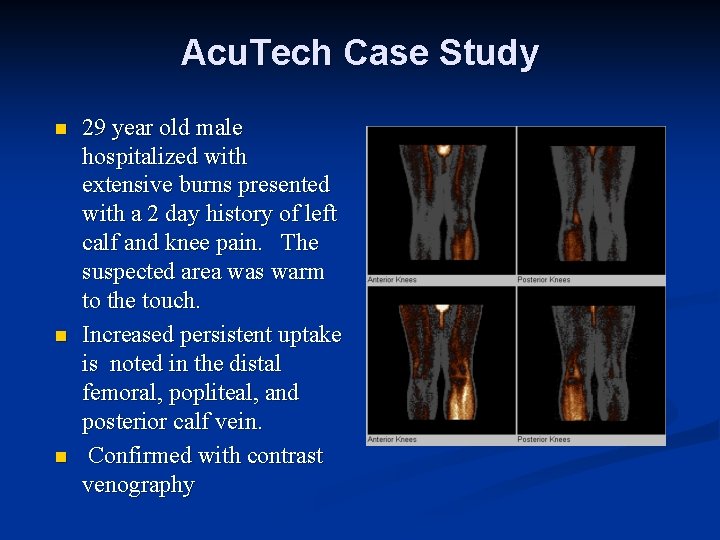
Acu. Tech Case Study n n n 29 year old male hospitalized with extensive burns presented with a 2 day history of left calf and knee pain. The suspected area was warm to the touch. Increased persistent uptake is noted in the distal femoral, popliteal, and posterior calf vein. Confirmed with contrast venography
- Slides: 27