
VARIATIONS OF INHERITANCE Dominant Controlled Inheritance aka simple


- Slides: 52
VARIATIONS OF INHERITANCE
Dominant Controlled Inheritance (aka “simple”) (quick review) • So far, we have been looking at traits that are controlled by the dominant allele. • A homozygous dominant or heterozygous genotype will result in the dominant trait being expressed. • F = purple flower, f = white flower • FF and Ff both result in a purple flower.
Check For Understanding
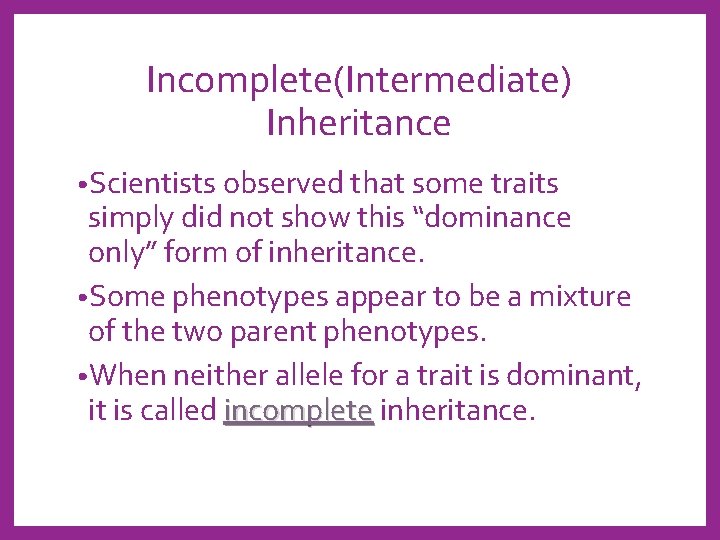
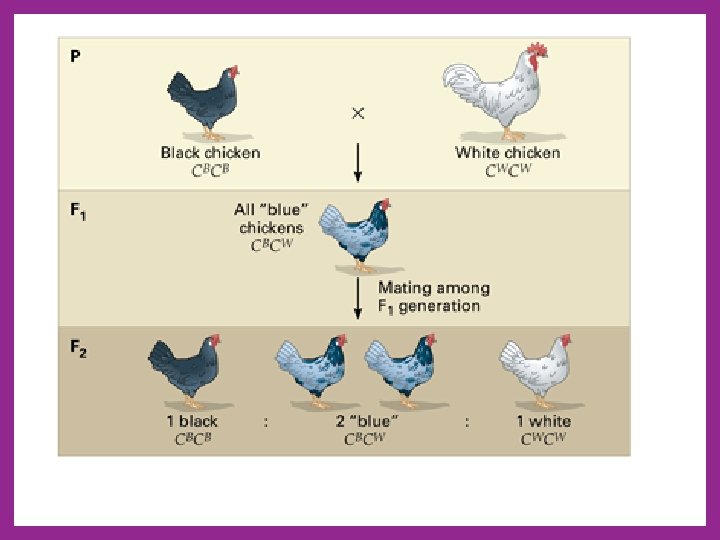
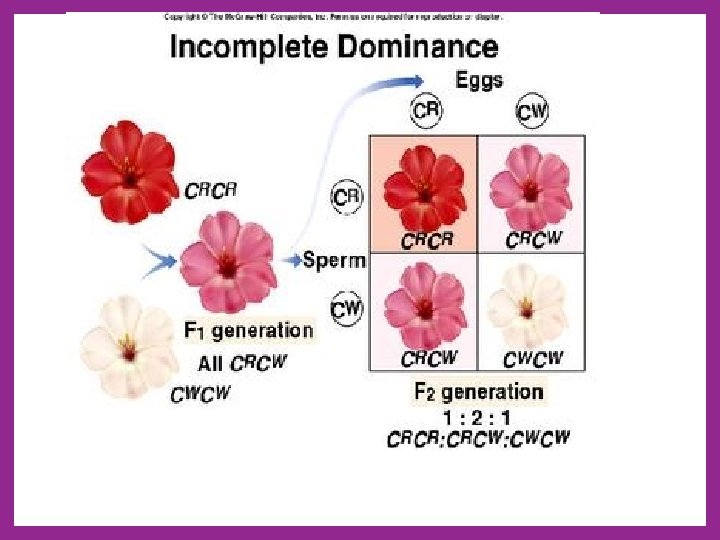
Incomplete(Intermediate) Inheritance • Scientists observed that some traits simply did not show this “dominance only” form of inheritance. • Some phenotypes appear to be a mixture of the two parent phenotypes. • When neither allele for a trait is dominant, it is called incomplete inheritance.
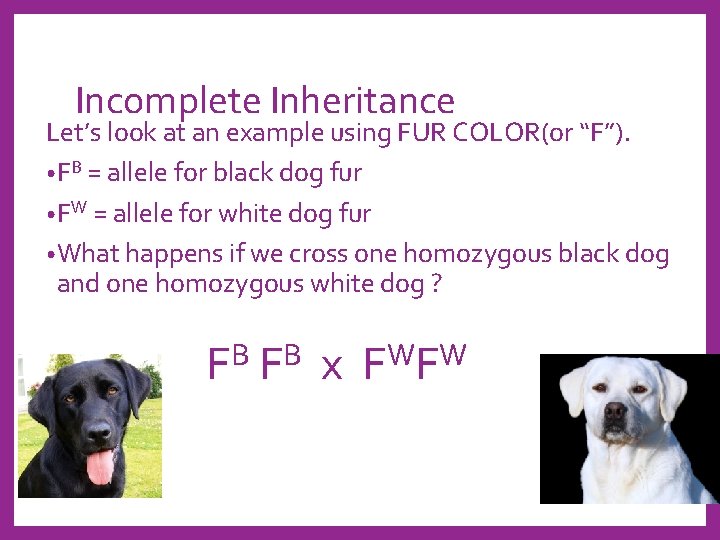
Incomplete Inheritance Let’s look at an example using FUR COLOR(or “F”). • FB = allele for black dog fur • FW = allele for white dog fur • What happens if we cross one homozygous black dog and one homozygous white dog ? F B x F W FW
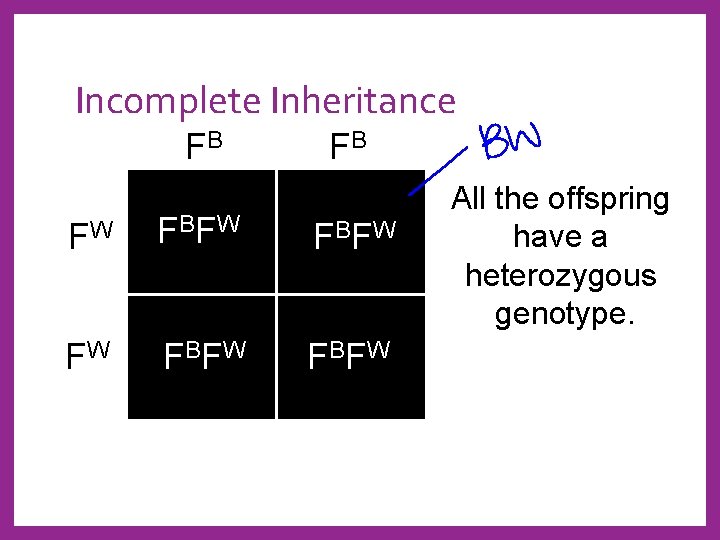
Incomplete Inheritance FB FB FW FBFW All the offspring have a heterozygous genotype.
Incomplete Inheritance • Assume this trait is controlled by incomplete inheritance. • The phenotype for the offspring would be be brown (or tan) colored fur. • Since neither allele is dominant, they both get blended together.
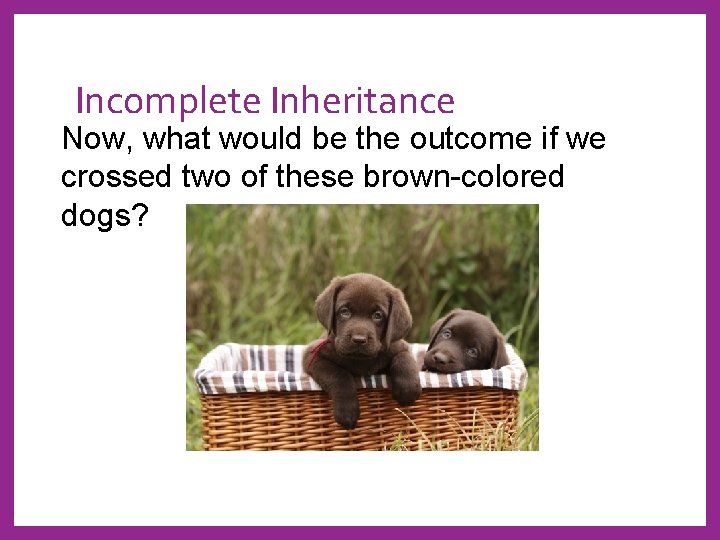
Incomplete Inheritance Now, what would be the outcome if we crossed two of these brown-colored dogs?
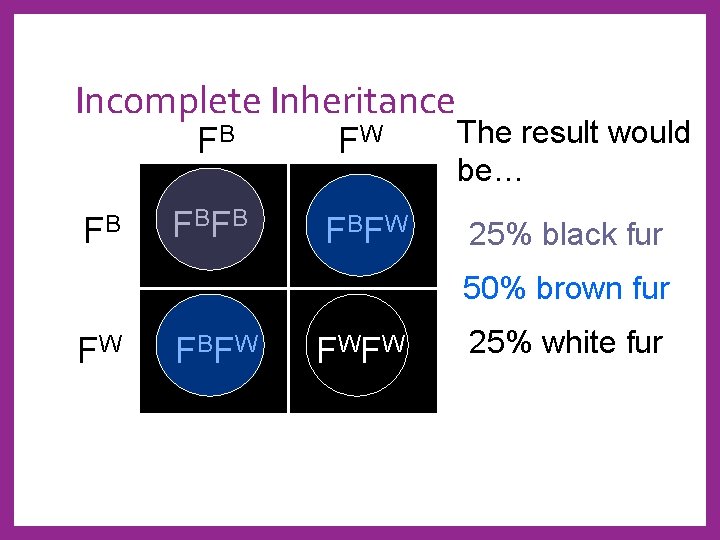
Incomplete Inheritance FB FB FW The result would be… FBFB FBFW 25% black fur 50% brown fur FW FBFW F WF W 25% white fur
Check For Understanding
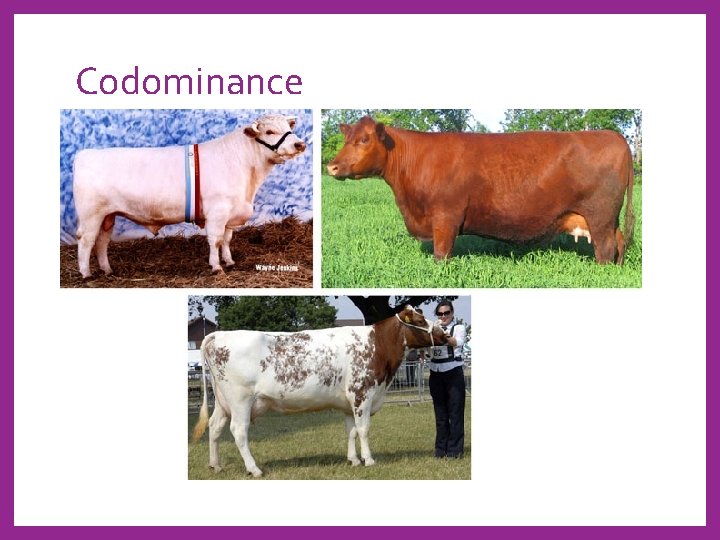
Codominance Inheritance • Sometimes a heterozygous individual will have a phenotype that isn’t a complete mix of the parental traits. • Instead, the offspring will express both traits of the parents at the SAME TIME. • When this happens it is called codominance
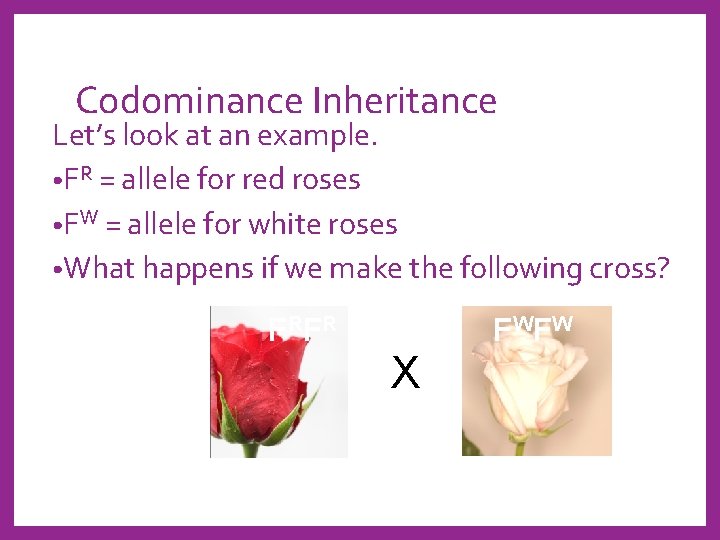
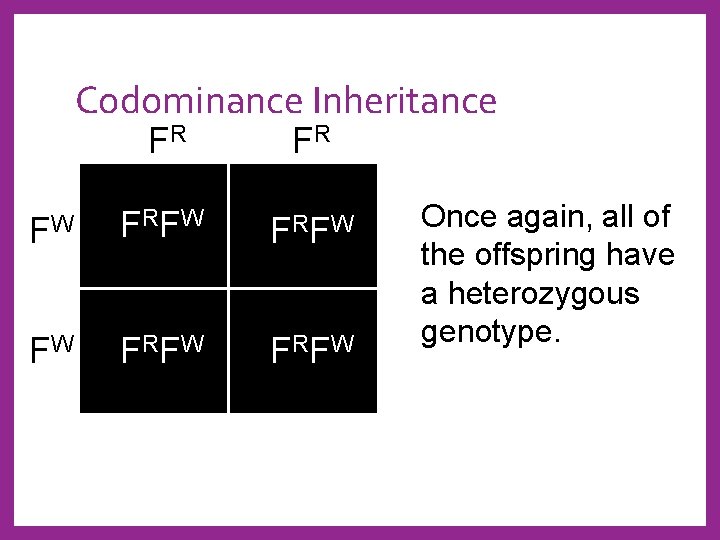
Codominance Inheritance Let’s look at an example. • FR = allele for red roses • FW = allele for white roses • What happens if we make the following cross? F RF R F WF W X
Codominance Inheritance FR FR FW F RF W Once again, all of the offspring have a heterozygous genotype.
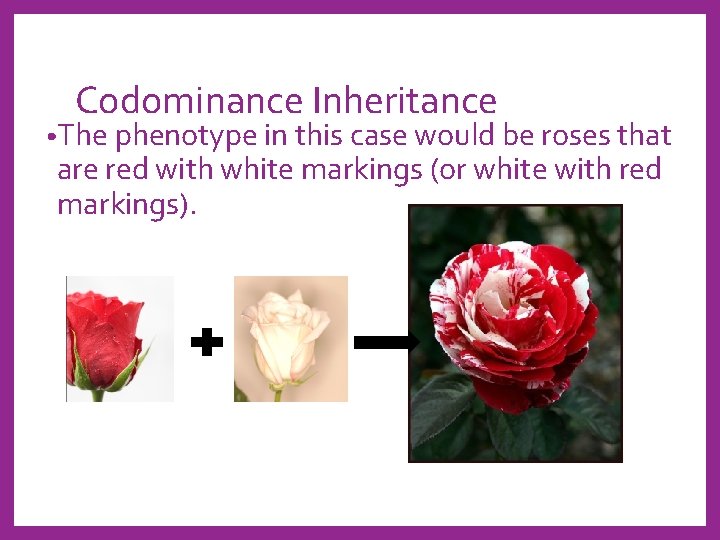
Codominance Inheritance • The phenotype in this case would be roses that are red with white markings (or white with red markings).
Codominance
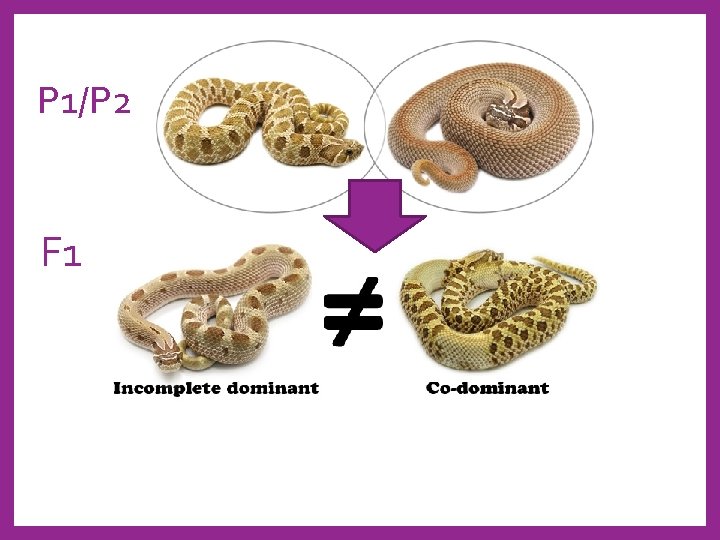
Codominance Inheritance • Intermediate and codominance are similar because they both produce a third phenotype when heterozygous. • They are different because intermediate shows a blend or mix of the parent traits. • While codominance can produce both parent traits simultaneously.
P 1/P 2 F 1
Check For Understanding
Polygenic Inheritance • We’ve already seen the effects of dominance-only(simple), intermediate, and codominance inheritance.
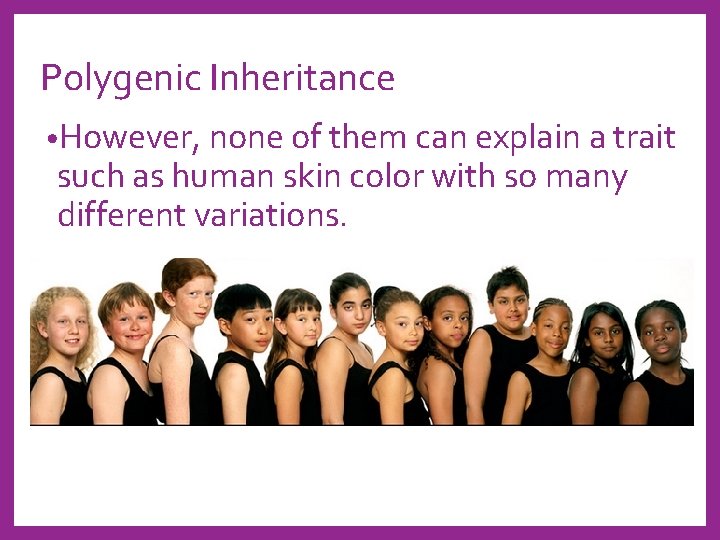
Polygenic Inheritance • However, none of them can explain a trait such as human skin color with so many different variations.
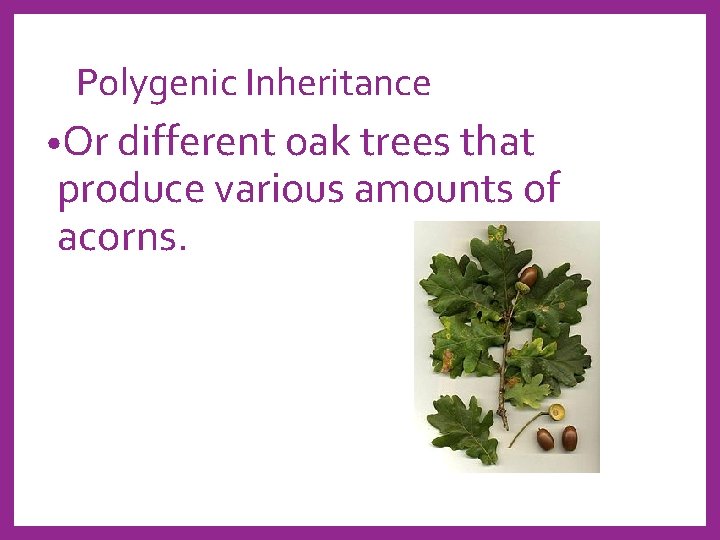
Polygenic Inheritance • Or different oak trees that produce various amounts of acorns.
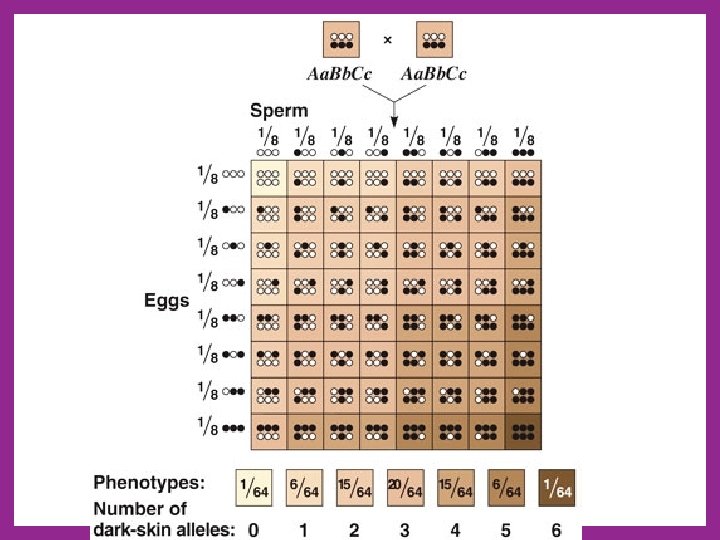
Polygenic Inheritance • The only way to get such large variation is to have multiple genes controlling the trait. • Human height is just such an example of polygenic inheritance. • Let’s say height is controlled by three hypothetical genes: A, B, & C.
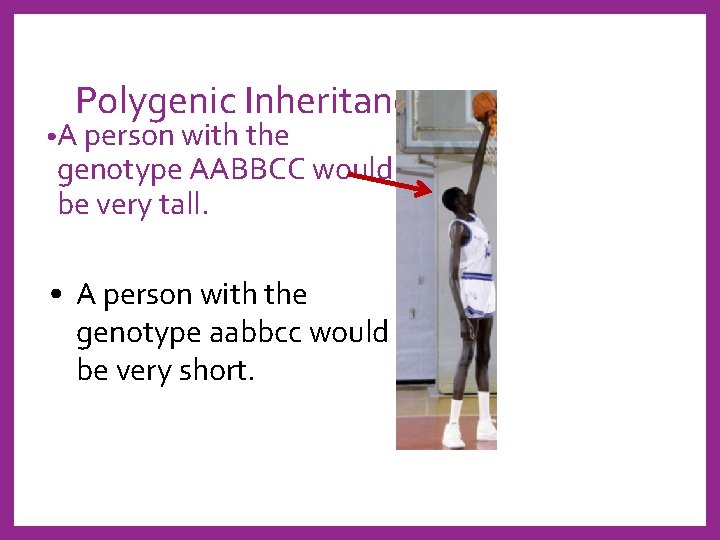
Polygenic Inheritance • A person with the genotype AABBCC would be very tall. • A person with the genotype aabbcc would be very short.
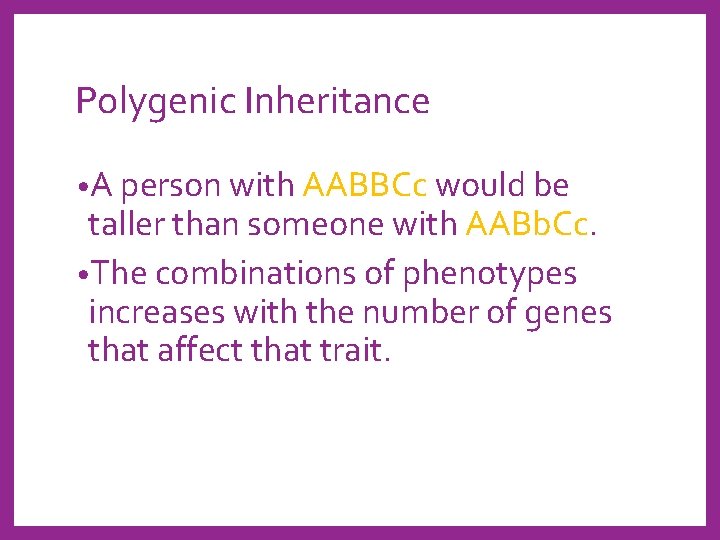
Polygenic Inheritance • A person with AABBCc would be taller than someone with AABb. Cc. • The combinations of phenotypes increases with the number of genes that affect that trait.
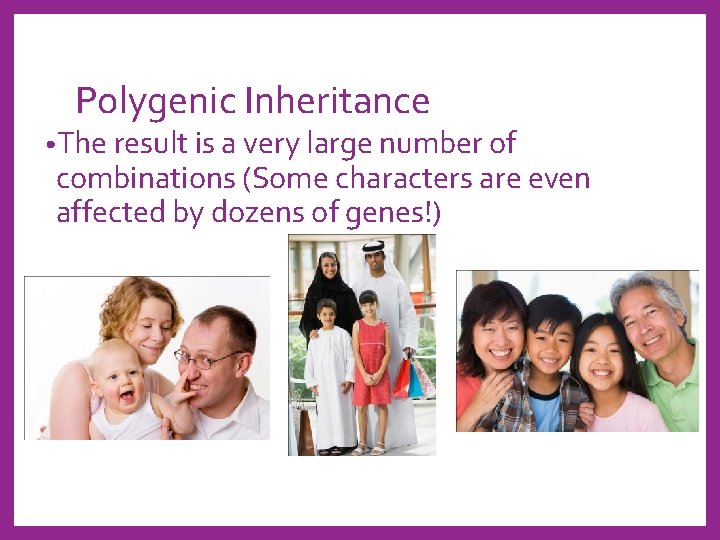
Polygenic Inheritance • The result is a very large number of combinations (Some characters are even affected by dozens of genes!)
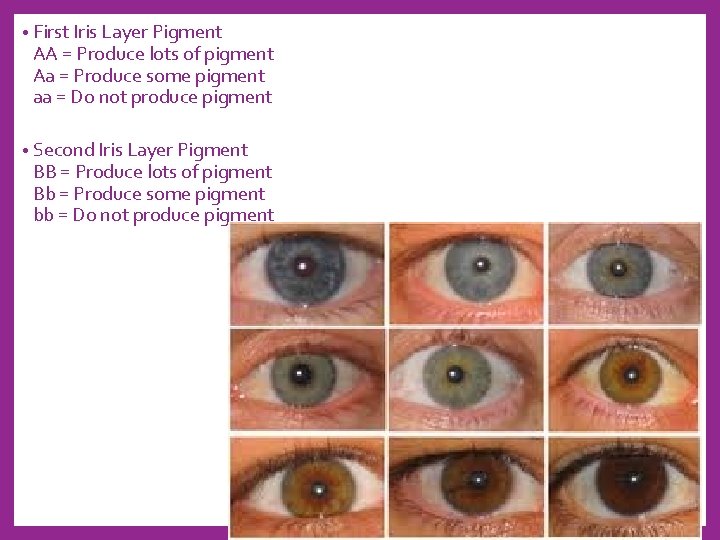
• First Iris Layer Pigment AA = Produce lots of pigment Aa = Produce some pigment aa = Do not produce pigment • Second Iris Layer Pigment BB = Produce lots of pigment Bb = Produce some pigment bb = Do not produce pigment
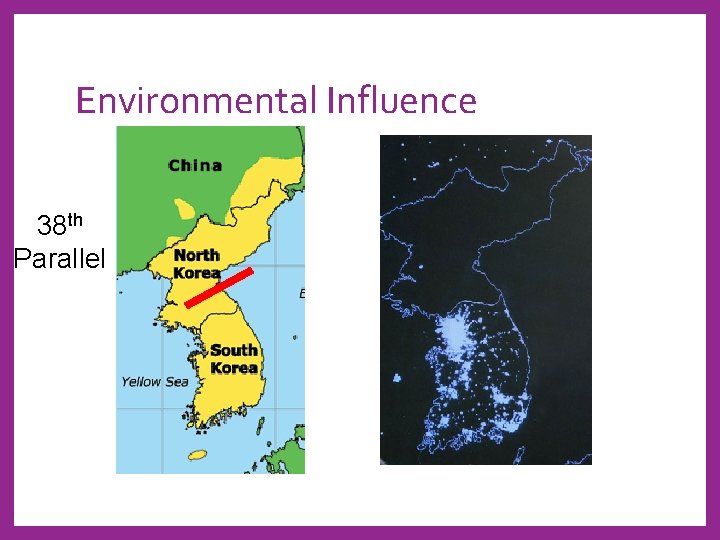
Environmental Influence • The genotype does not always predict an individual’s phenotype. • Many times the environment has a strong impact on how the genes get expressed. • Example: Koreans (both North and South) all share the same common ancestry.
Environmental Influence • North Korean children are on average much shorter. • Why the difference?
Environmental Influence 38 th Parallel
Environmental Influence • Malnutrition is widespread in N. Korea due to a repressive government. • This variation in diet has lead to a difference in phenotype (height) that is not genetically based.
Environmental Influence • This means that many genes are not rigidly set. • The amount of gene expression is largely dependent on an individual’s environment.
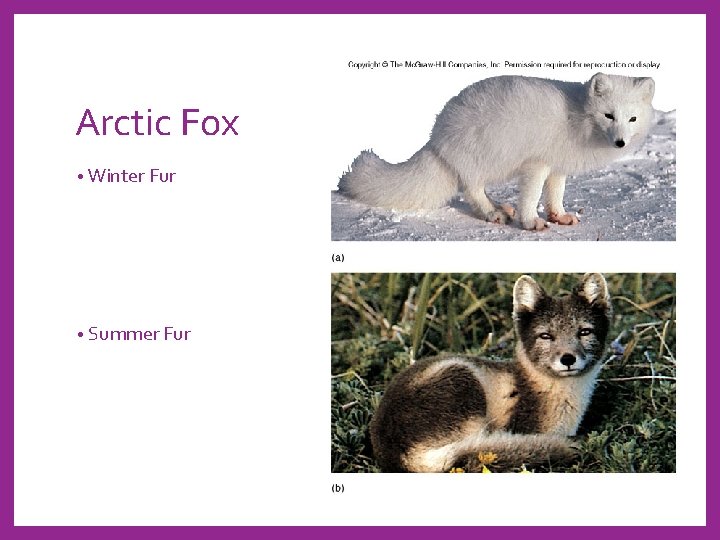
Arctic Fox • Winter Fur • Summer Fur
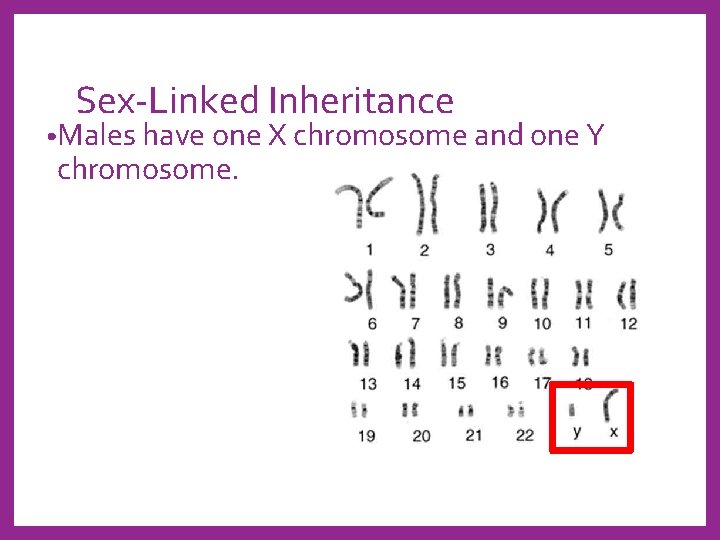
Sex-Linked Inheritance • A normal human has 23 pairs of chromosomes in each of his/her cells. • The last pair are called sex chromosomes.
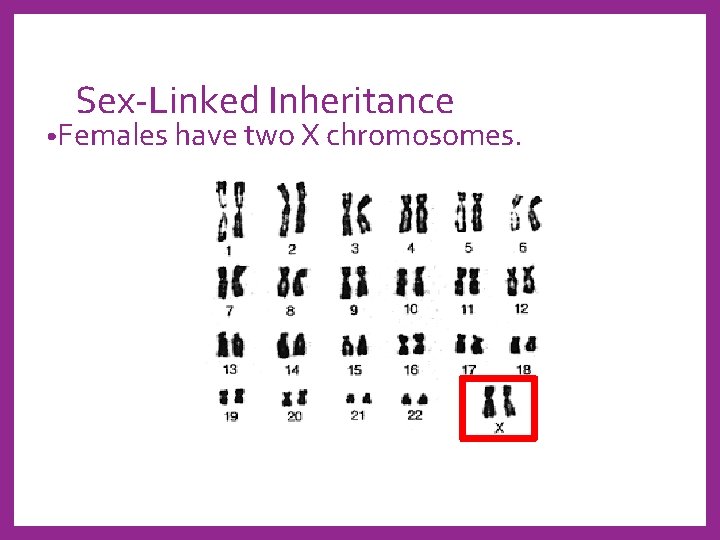
Sex-Linked Inheritance • Females have two X chromosomes.
Sex-Linked Inheritance • Males have one X chromosome and one Y chromosome.
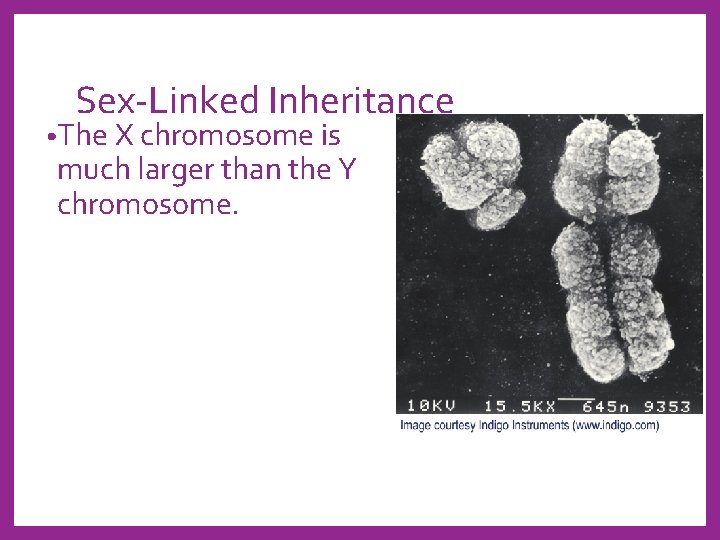
Sex-Linked Inheritance • The X chromosome is much larger than the Y chromosome.
Sex-Linked Inheritance • Therefore, more genes are found on the X chromosome than the Y chromosome. • Males, having only one X chromosome, are more likely to express sex-linked disorders. • Let’s use a real example to see why.
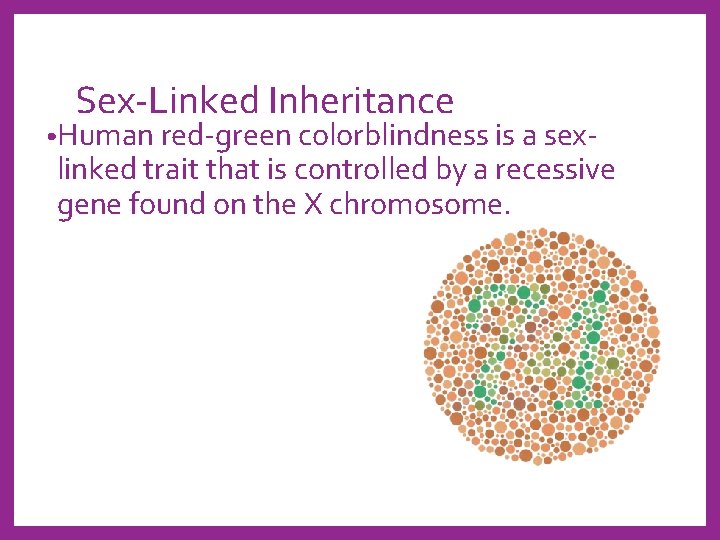
Sex-Linked Inheritance • Human red-green colorblindness is a sex- linked trait that is controlled by a recessive gene found on the X chromosome.
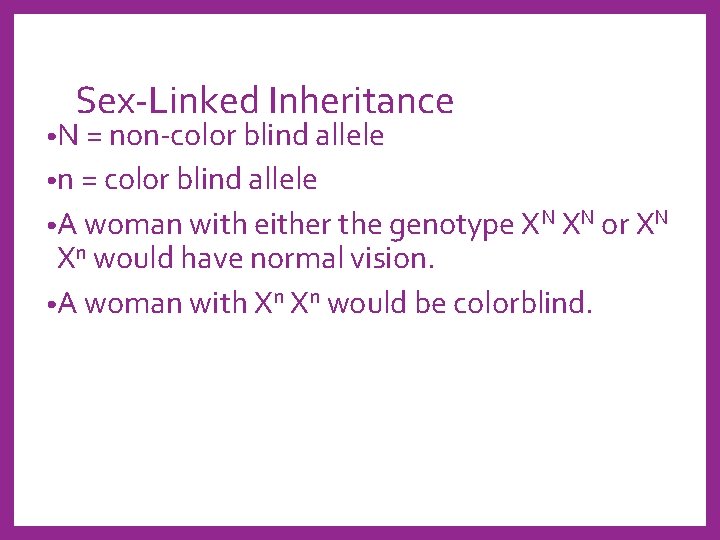
Sex-Linked Inheritance • N = non-color blind allele • n = color blind allele • A woman with either the genotype XN XN or XN Xn would have normal vision. • A woman with Xn Xn would be colorblind.
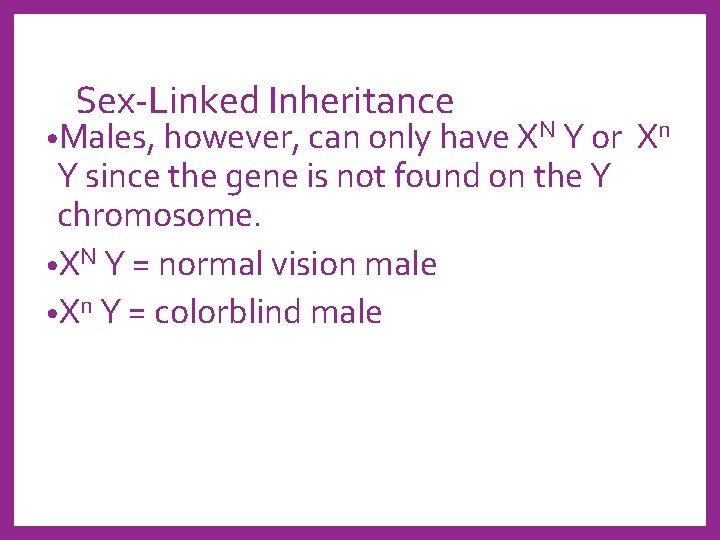
Sex-Linked Inheritance • Males, however, can only have XN Y or Y since the gene is not found on the Y chromosome. • XN Y = normal vision male • Xn Y = colorblind male Xn
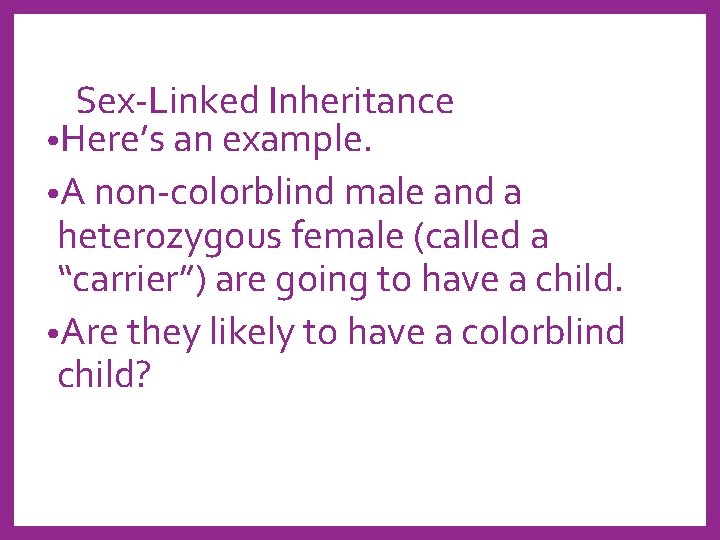
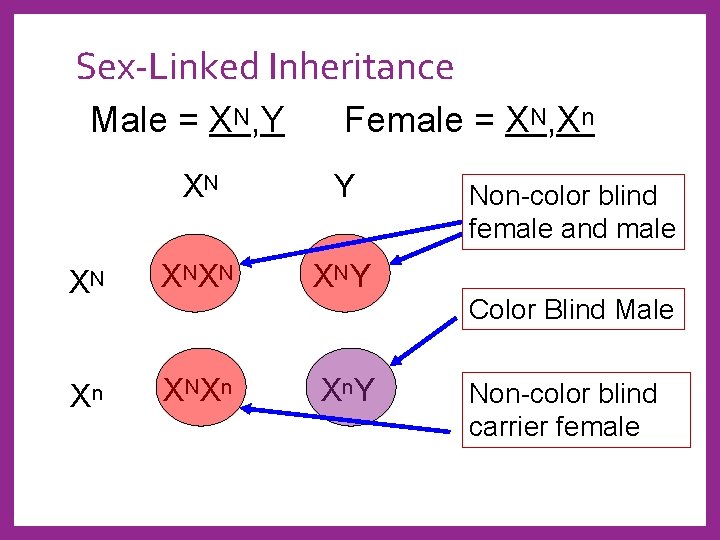
Sex-Linked Inheritance • Here’s an example. • A non-colorblind male and a heterozygous female (called a “carrier”) are going to have a child. • Are they likely to have a colorblind child?
Sex-Linked Inheritance Male = XN, Y Female = XN, Xn XN Y XN X NX N X NY Xn X NX n Non-color blind female and male Color Blind Male X n. Y Non-color blind carrier female
Sex-Linked Inheritance • The predicted results… • This couple has a 0% chance of having a colorblind daughter. • However, half of their sons are expected to be colorblind.
Check For Understanding