
Variations in the frequency of MRSA infections across



![Estimation Issues n Zero observations [xit = 0] n n Some hospitals omitted from](https://slidetodoc.com/presentation_image_h2/3b1885cc0db5165e4520c774e995e244/image-19.jpg "Estimation Issues n Zero observations [xit = 0] n n Some hospitals omitted from")
![Estimation Issues n Clustered sampling [ it is not iid in pooled regression] n](https://slidetodoc.com/presentation_image_h2/3b1885cc0db5165e4520c774e995e244/image-20.jpg "Estimation Issues n Clustered sampling [ it is not iid in pooled regression] n")
![Estimation Issues n Unobserved heterogeneity [ui ≠ 0] n n Omitted variable bias and/or](https://slidetodoc.com/presentation_image_h2/3b1885cc0db5165e4520c774e995e244/image-21.jpg "Estimation Issues n Unobserved heterogeneity [ui ≠ 0] n n Omitted variable bias and/or")
![Estimation Issues n Endogeneity [E(ditvit) ≠ 0] n n Simultaneity bias Solution: use IV](https://slidetodoc.com/presentation_image_h2/3b1885cc0db5165e4520c774e995e244/image-22.jpg "Estimation Issues n Endogeneity [E(ditvit) ≠ 0] n n Simultaneity bias Solution: use IV")


- Slides: 33
Variations in the frequency of MRSA infections across acute NHS hospitals, 2001 -2006 Paul Fenn Dev Vencappa Alastair Gray Oliver Rivero Neil Rickman
Background n This study originated as part of research on the relationship between liability risk-sharing measures and patient safety in the NHS [funded under the ESRC Public Services Programme] n n n Data on risk sharing measures available from the NHS Litigation Authority Discounts available for risk management standards; hypothesis – financial incentives improve (or signal) patient safety measures, including hospital hygeine MRSA surveillance data collected by Health Protection Agency since 2001 has progressively extended the panel of data that can be analysed alongside other Do. H administrative datasets n n Permits a wider set of hypotheses to be tested using panel data estimation methods in relation to the factors driving MRSA infection rates across hospitals and over time Changes in length of stay, casemix and bed utilisation could plausibly affect the rate of hospital infections
Trends
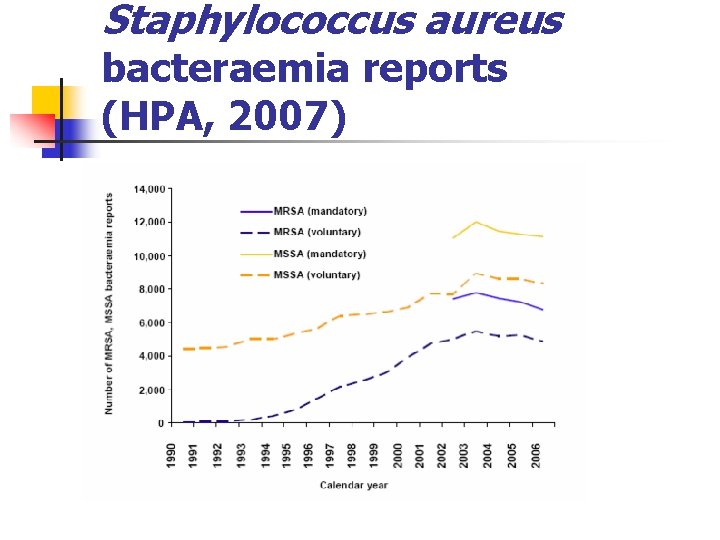
Staphylococcus aureus bacteraemia reports (HPA, 2007)
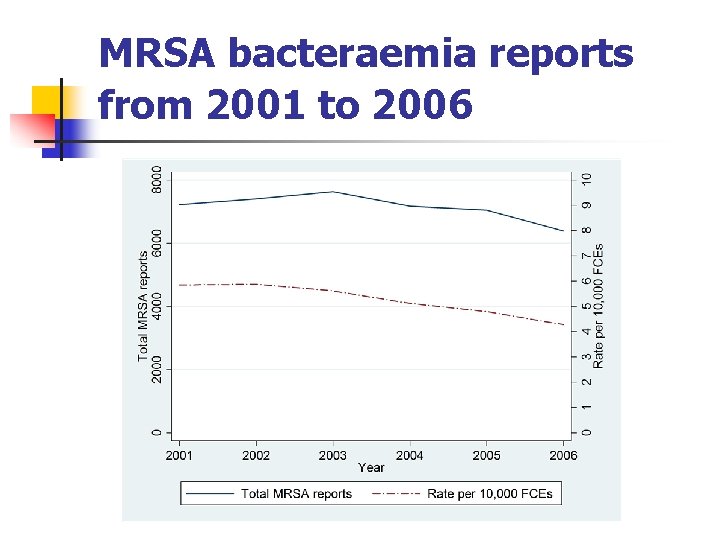
MRSA bacteraemia reports from 2001 to 2006
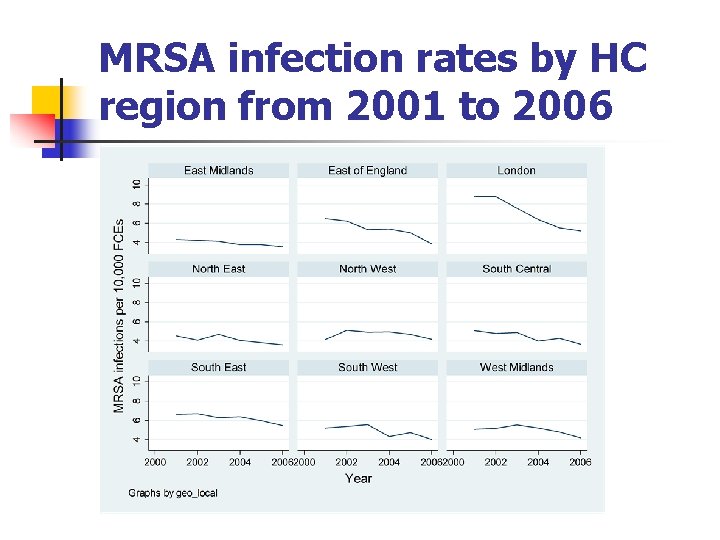
MRSA infection rates by HC region from 2001 to 2006
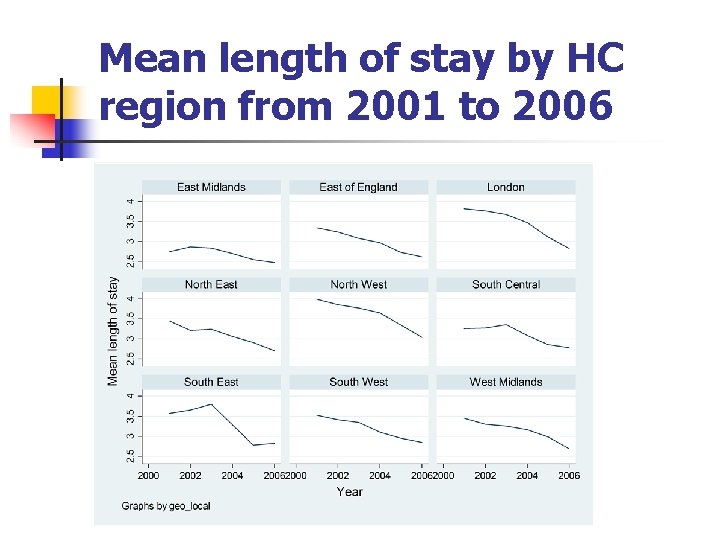
Mean length of stay by HC region from 2001 to 2006
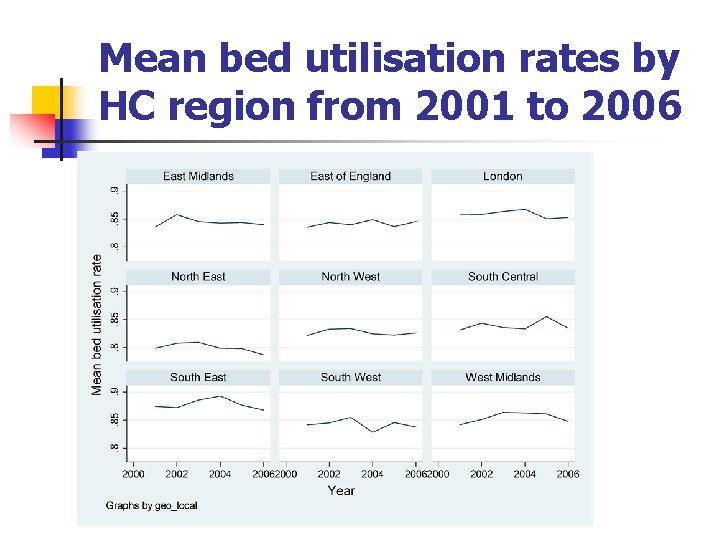
Mean bed utilisation rates by HC region from 2001 to 2006
Distributions
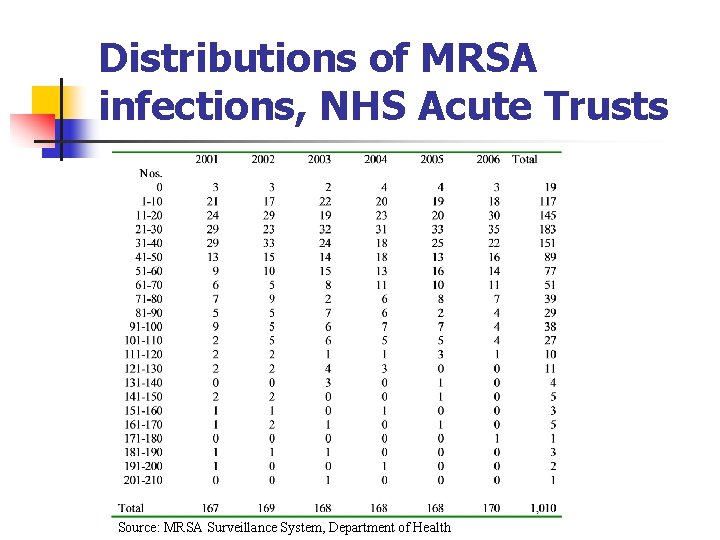
Distributions of MRSA infections, NHS Acute Trusts Source: MRSA Surveillance System, Department of Health
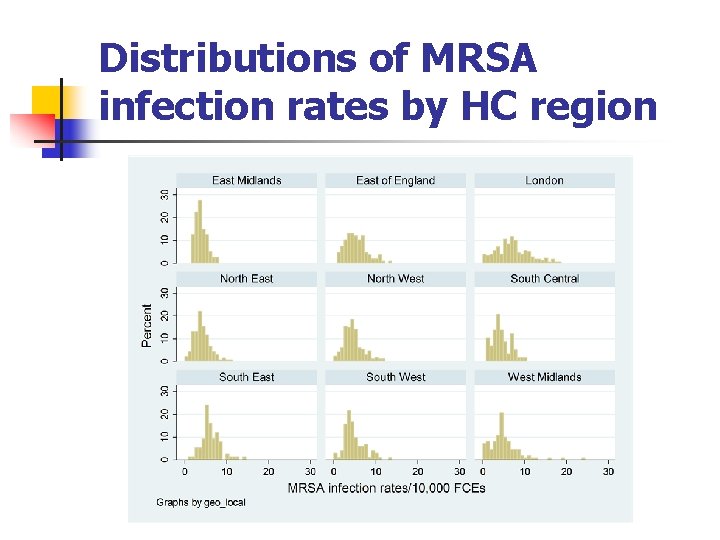
Distributions of MRSA infection rates by HC region
Drivers
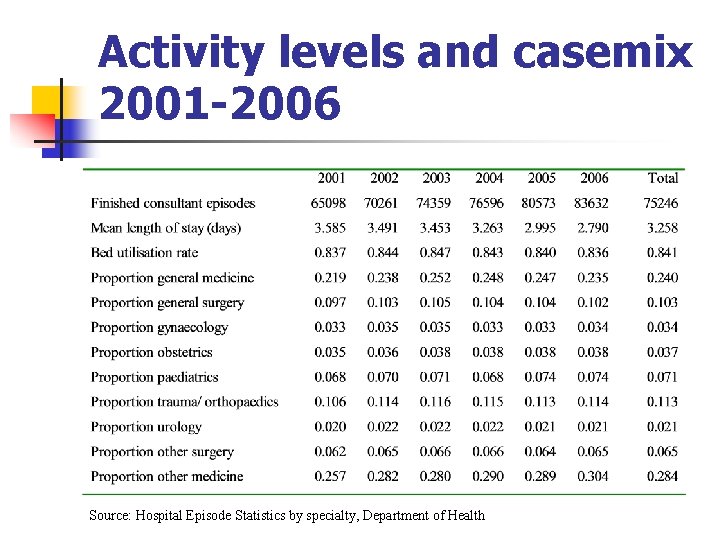
Activity levels and casemix 2001 -2006 Source: Hospital Episode Statistics by specialty, Department of Health
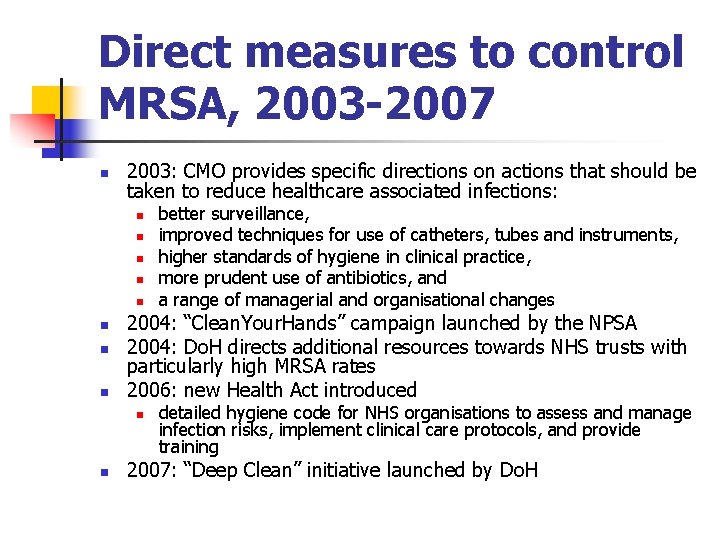
Direct measures to control MRSA, 2003 -2007 n 2003: CMO provides specific directions on actions that should be taken to reduce healthcare associated infections: n n n n 2004: “Clean. Your. Hands” campaign launched by the NPSA 2004: Do. H directs additional resources towards NHS trusts with particularly high MRSA rates 2006: new Health Act introduced n n better surveillance, improved techniques for use of catheters, tubes and instruments, higher standards of hygiene in clinical practice, more prudent use of antibiotics, and a range of managerial and organisational changes detailed hygiene code for NHS organisations to assess and manage infection risks, implement clinical care protocols, and provide training 2007: “Deep Clean” initiative launched by Do. H
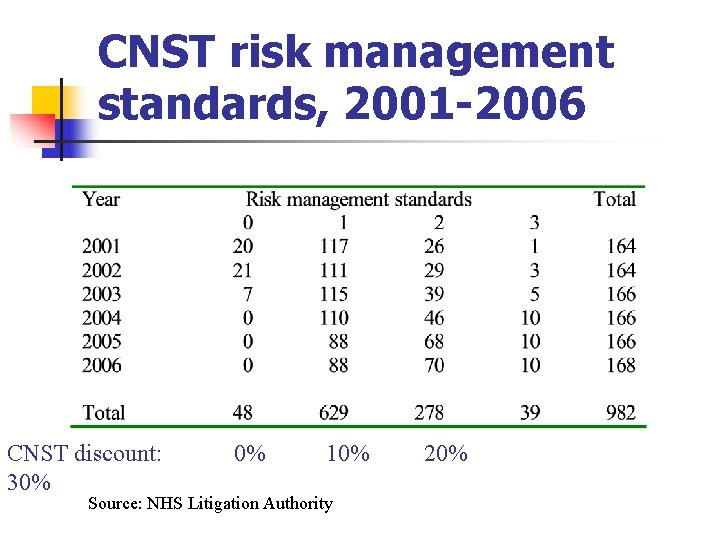
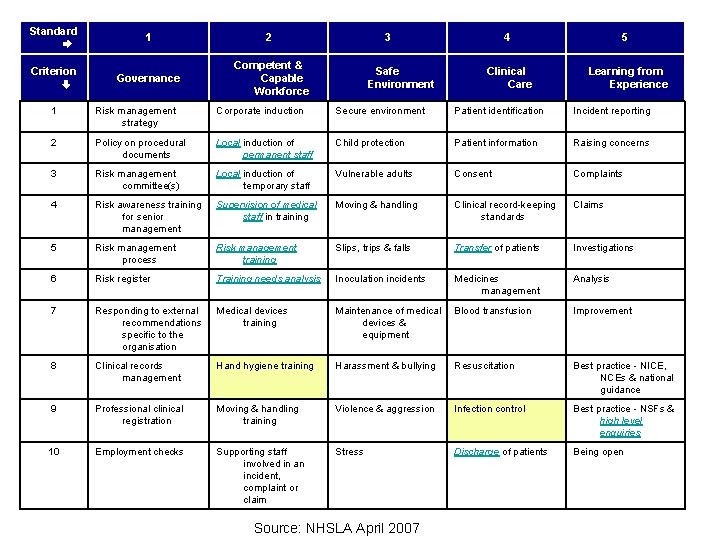
CNST risk management standards, 2001 -2006 CNST discount: 30% 0% 10% Source: NHS Litigation Authority 20%
Standard 1 2 Criterion Governance Competent & Capable Workforce 3 Safe Environment 4 5 Clinical Care Learning from Experience 1 Risk management strategy Corporate induction Secure environment Patient identification Incident reporting 2 Policy on procedural documents Local induction of permanent staff Child protection Patient information Raising concerns 3 Risk management committee(s) Local induction of temporary staff Vulnerable adults Consent Complaints 4 Risk awareness training for senior management Supervision of medical staff in training Moving & handling Clinical record-keeping standards Claims 5 Risk management process Risk management training Slips, trips & falls Transfer of patients Investigations 6 Risk register Training needs analysis Inoculation incidents Medicines management Analysis 7 Responding to external recommendations specific to the organisation Medical devices training Maintenance of medical devices & equipment Blood transfusion Improvement 8 Clinical records management Hand hygiene training Harassment & bullying Resuscitation Best practice - NICE, NCEs & national guidance 9 Professional clinical registration Moving & handling training Violence & aggression Infection control Best practice - NSFs & high level enquiries 10 Employment checks Supporting staff involved in an incident, complaint or claim Stress Discharge of patients Being open Source: NHSLA April 2007
Estimation
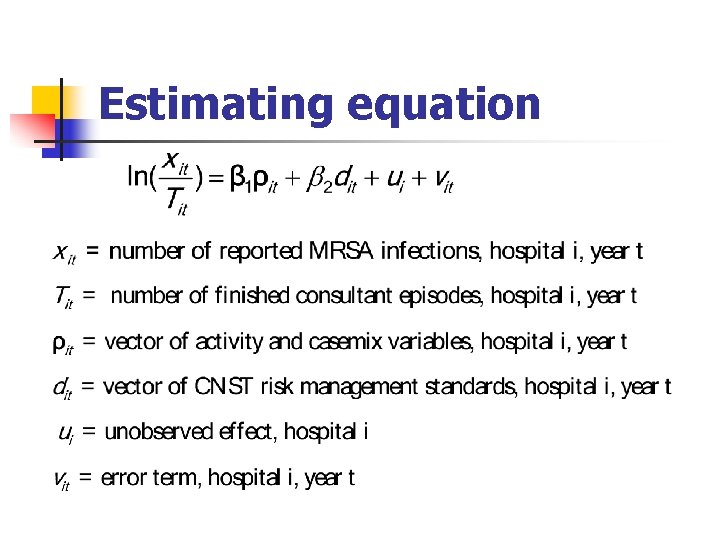
Estimating equation
Estimation Issues n Zero observations [xit = 0] n n Some hospitals omitted from analysis Solution: assume count data process and estimate using QMLE or MLE
Estimation Issues n Clustered sampling [ it is not iid in pooled regression] n n Can lead to over-acceptance of hypotheses relating to β 1 and β 2 Solution: use cluster-robust standard errors
Estimation Issues n Unobserved heterogeneity [ui ≠ 0] n n Omitted variable bias and/or inefficiency if hospital effects unmodelled Solution: use panel data estimation methods (random effects; fixed effects; first differencing)
Estimation Issues n Endogeneity [E(ditvit) ≠ 0] n n Simultaneity bias Solution: use IV or GMM estimation methods n n Internal instruments: lagged values of dit External instruments: claims experience of hospital
Results
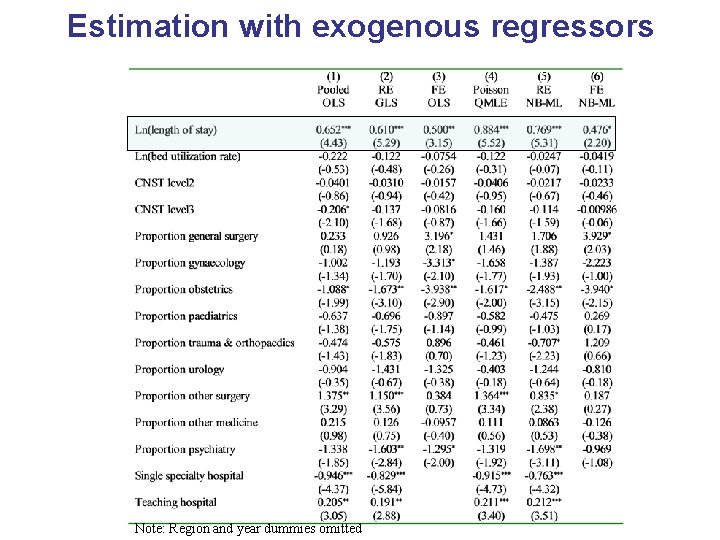
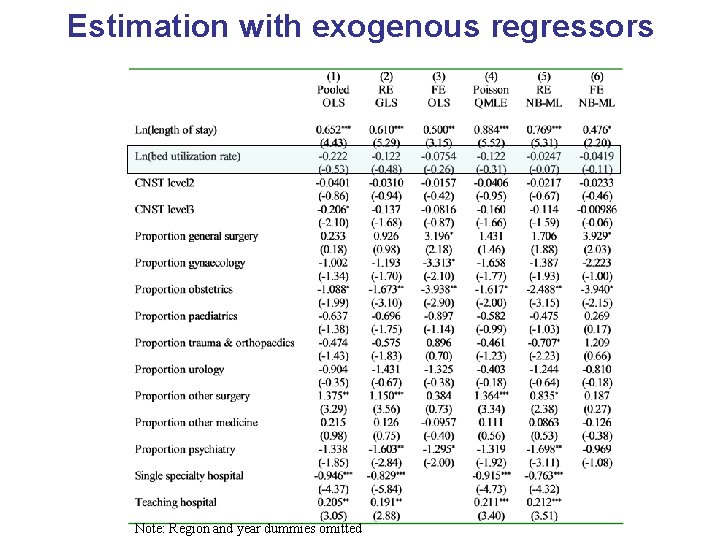
Estimation with exogenous regressors Note: Region and year dummies omitted
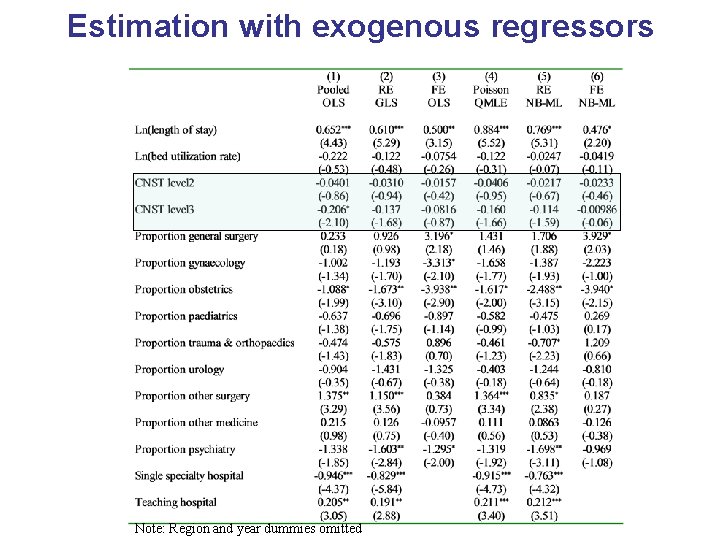
Estimation with exogenous regressors Note: Region and year dummies omitted
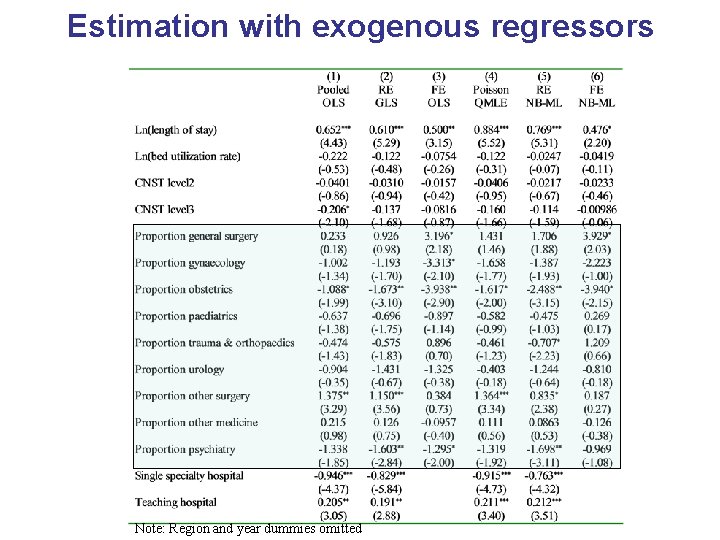
Estimation with exogenous regressors Note: Region and year dummies omitted
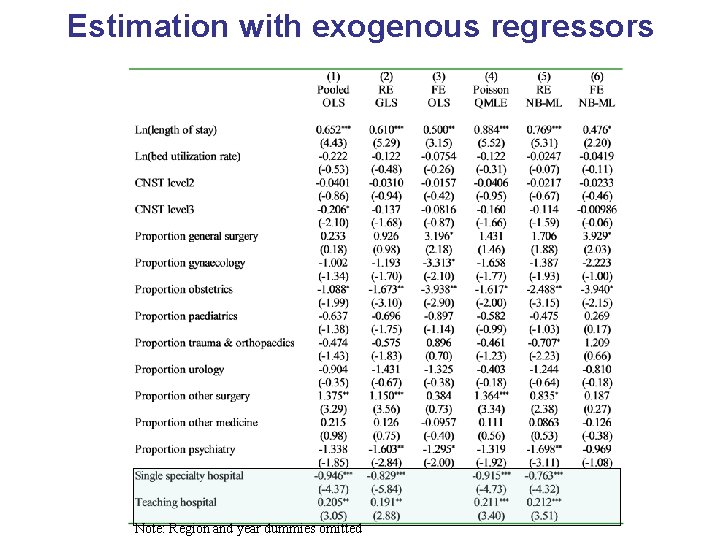
Estimation with exogenous regressors Note: Region and year dummies omitted
Estimation with exogenous regressors Note: Region and year dummies omitted
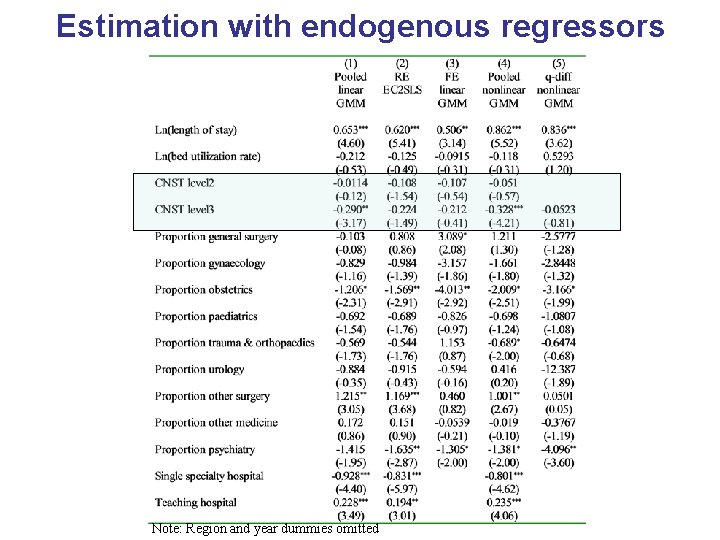
Estimation with endogenous regressors Note: Region and year dummies omitted
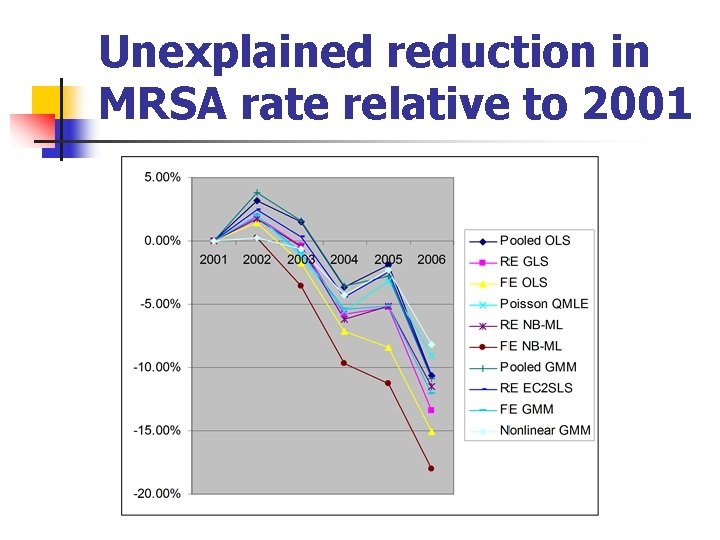
Unexplained reduction in MRSA rate relative to 2001
Conclusions
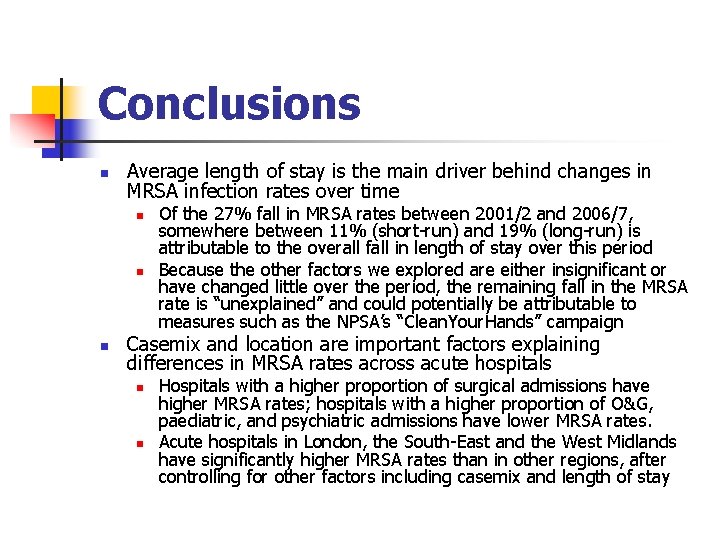
Conclusions n Average length of stay is the main driver behind changes in MRSA infection rates over time n n n Of the 27% fall in MRSA rates between 2001/2 and 2006/7, somewhere between 11% (short-run) and 19% (long-run) is attributable to the overall fall in length of stay over this period Because the other factors we explored are either insignificant or have changed little over the period, the remaining fall in the MRSA rate is “unexplained” and could potentially be attributable to measures such as the NPSA’s “Clean. Your. Hands” campaign Casemix and location are important factors explaining differences in MRSA rates across acute hospitals n n Hospitals with a higher proportion of surgical admissions have higher MRSA rates; hospitals with a higher proportion of O&G, paediatric, and psychiatric admissions have lower MRSA rates. Acute hospitals in London, the South-East and the West Midlands have significantly higher MRSA rates than in other regions, after controlling for other factors including casemix and length of stay
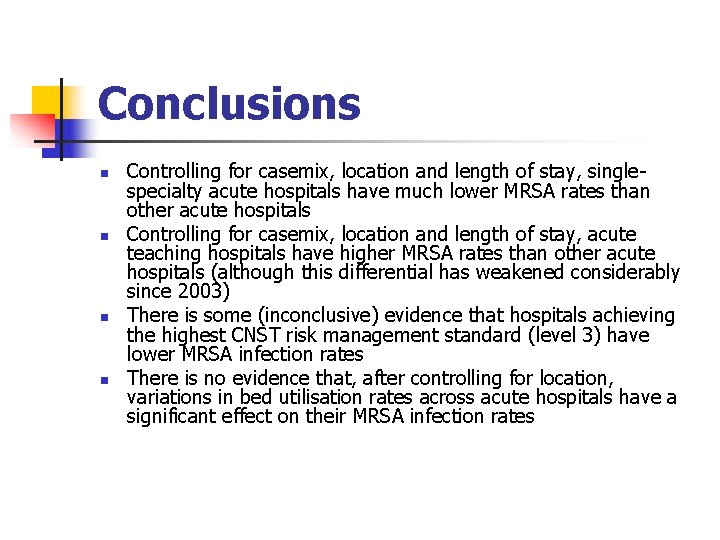
Conclusions n n Controlling for casemix, location and length of stay, singlespecialty acute hospitals have much lower MRSA rates than other acute hospitals Controlling for casemix, location and length of stay, acute teaching hospitals have higher MRSA rates than other acute hospitals (although this differential has weakened considerably since 2003) There is some (inconclusive) evidence that hospitals achieving the highest CNST risk management standard (level 3) have lower MRSA infection rates There is no evidence that, after controlling for location, variations in bed utilisation rates across acute hospitals have a significant effect on their MRSA infection rates