
Variational Principles and Lagranges Equations Definitions Lagrangian density
- Slides: 102
Variational Principles and Lagrange’s Equations
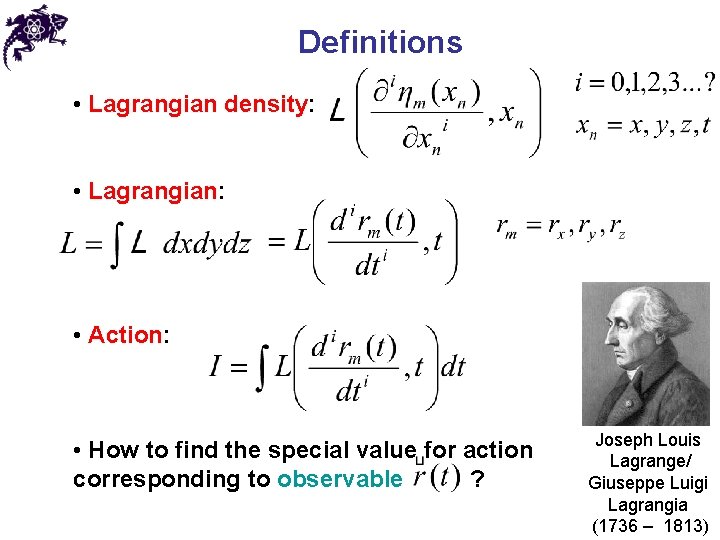
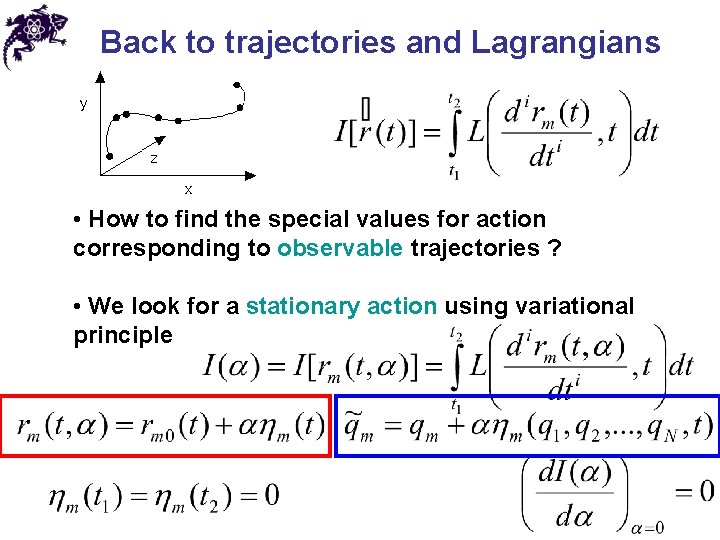
Definitions • Lagrangian density: • Lagrangian: • Action: • How to find the special value for action corresponding to observable ? Joseph Louis Lagrange/ Giuseppe Luigi Lagrangia (1736 – 1813)
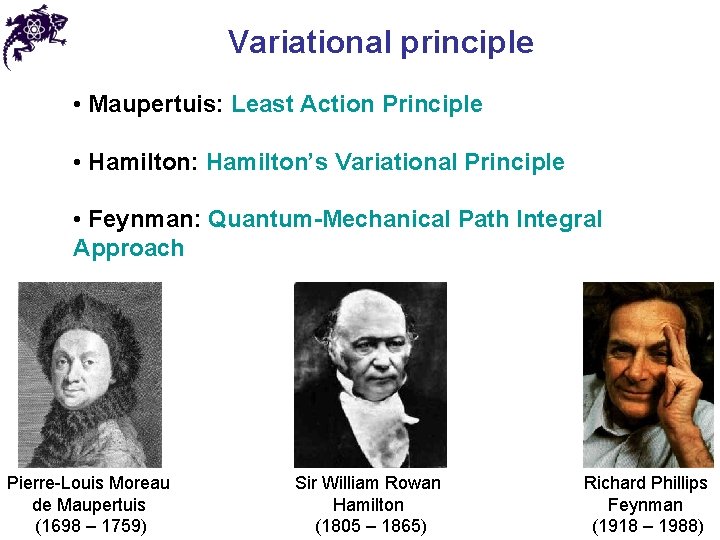
Variational principle • Maupertuis: Least Action Principle • Hamilton: Hamilton’s Variational Principle • Feynman: Quantum-Mechanical Path Integral Approach Pierre-Louis Moreau de Maupertuis (1698 – 1759) Sir William Rowan Hamilton (1805 – 1865) Richard Phillips Feynman (1918 – 1988)
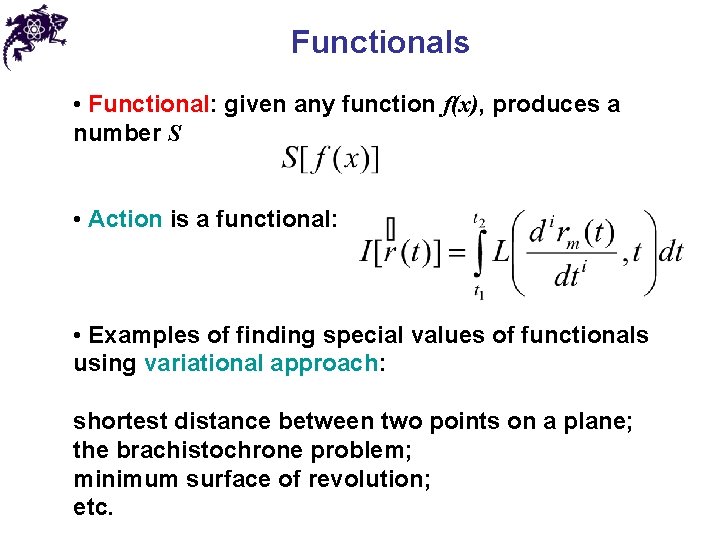
Functionals • Functional: given any function f(x), produces a number S • Action is a functional: • Examples of finding special values of functionals using variational approach: shortest distance between two points on a plane; the brachistochrone problem; minimum surface of revolution; etc.
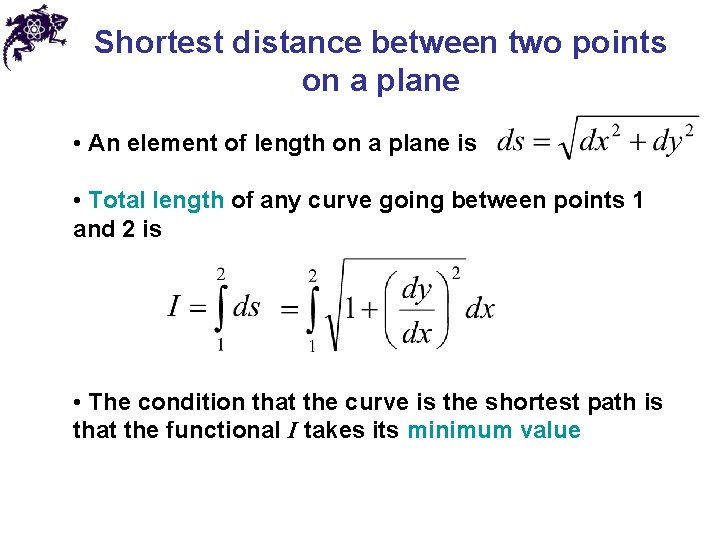
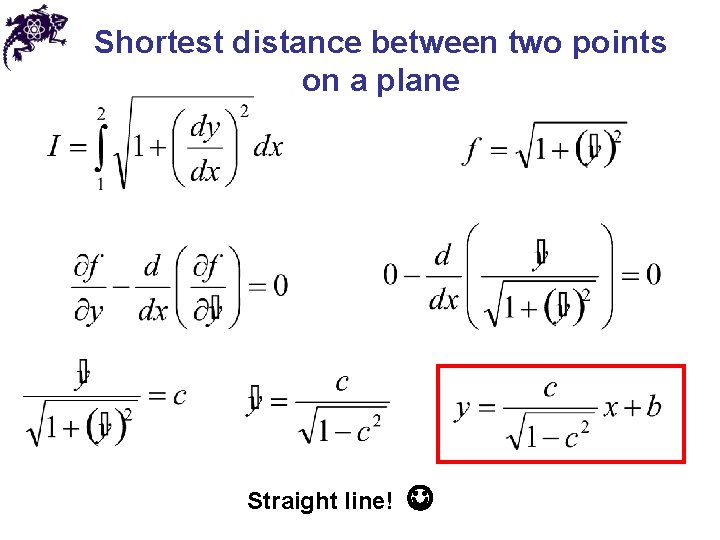
Shortest distance between two points on a plane • An element of length on a plane is • Total length of any curve going between points 1 and 2 is • The condition that the curve is the shortest path is that the functional I takes its minimum value
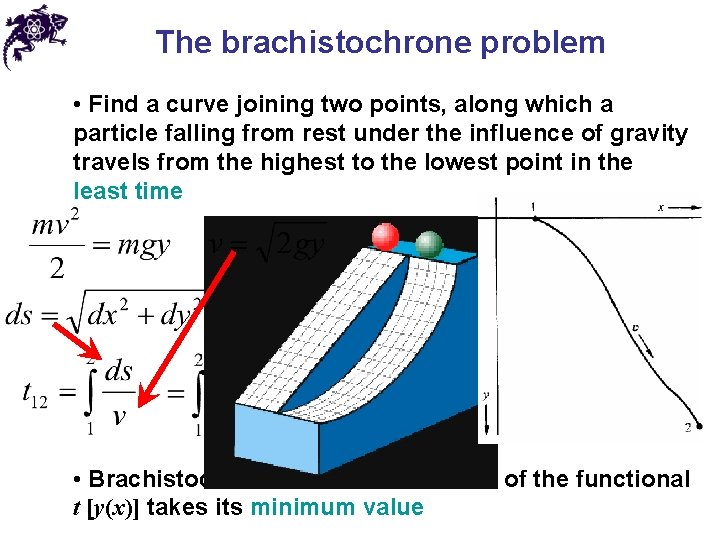
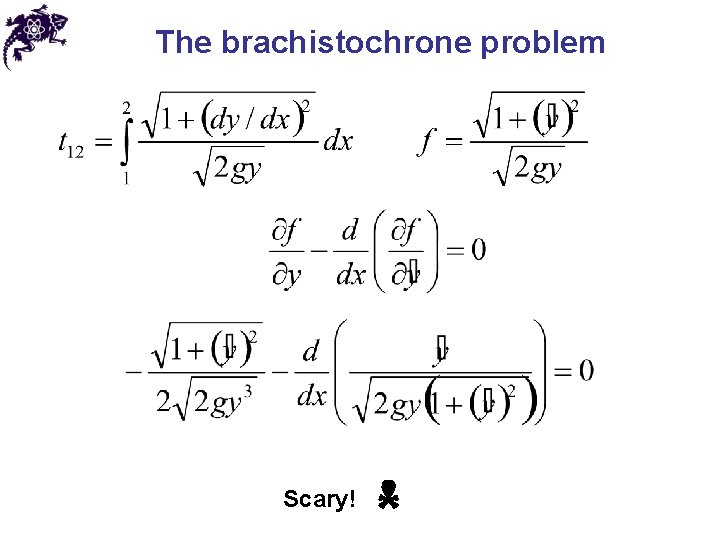
The brachistochrone problem • Find a curve joining two points, along which a particle falling from rest under the influence of gravity travels from the highest to the lowest point in the least time • Brachistochrone solution: the value of the functional t [y(x)] takes its minimum value
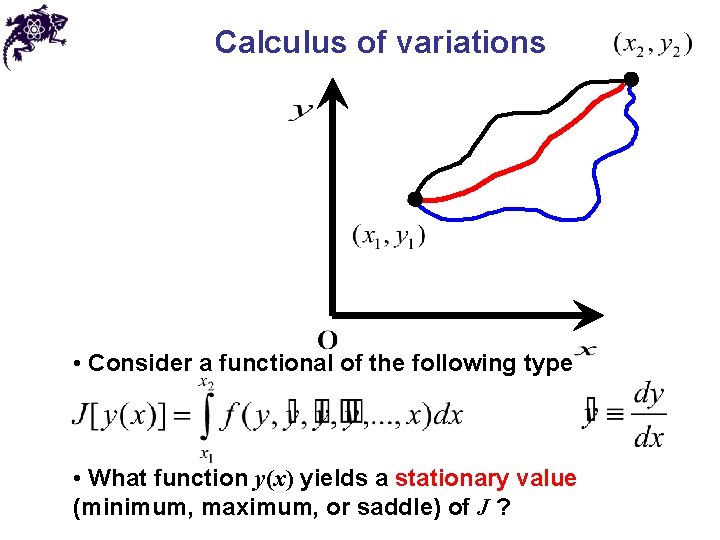
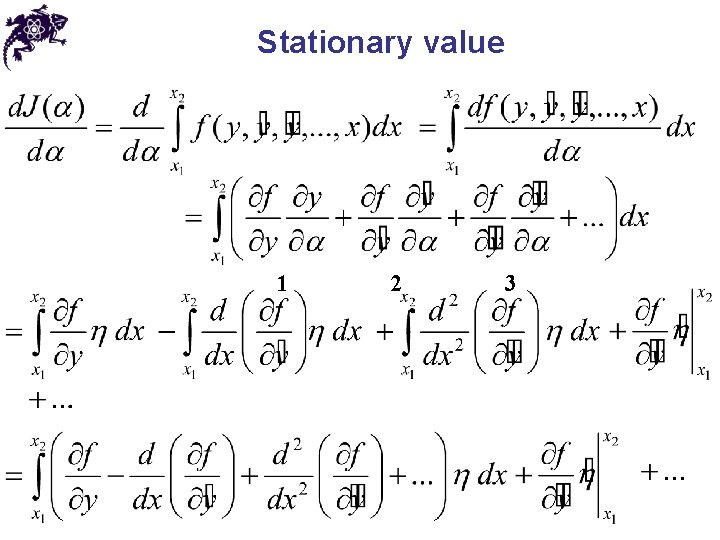
Calculus of variations • Consider a functional of the following type • What function y(x) yields a stationary value (minimum, maximum, or saddle) of J ?
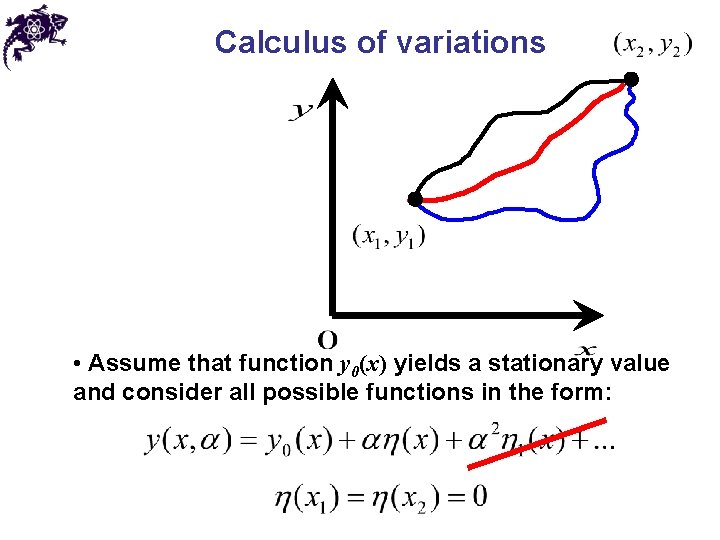
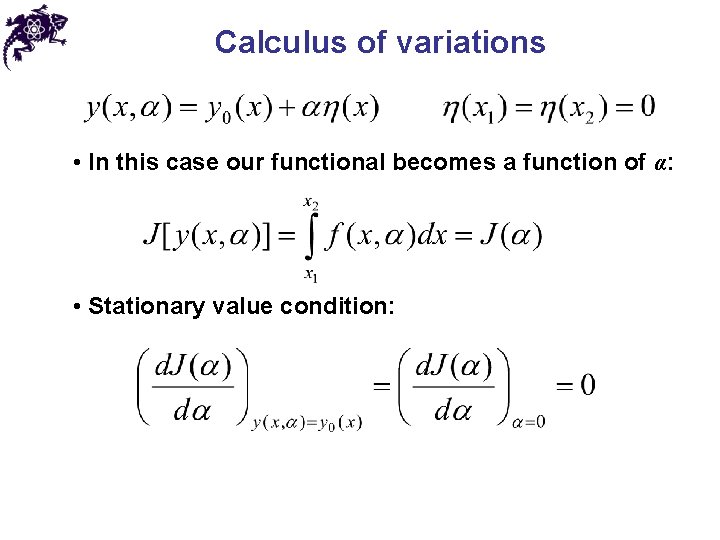
Calculus of variations • Assume that function y 0(x) yields a stationary value and consider all possible functions in the form:
Calculus of variations • In this case our functional becomes a function of α: • Stationary value condition:
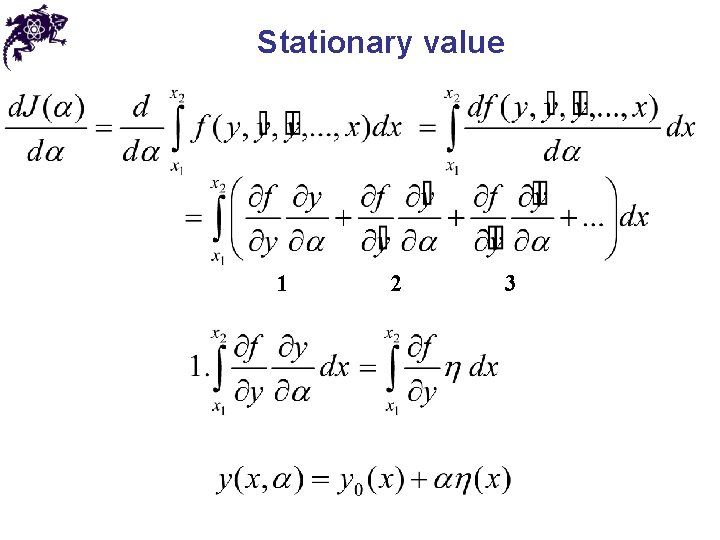
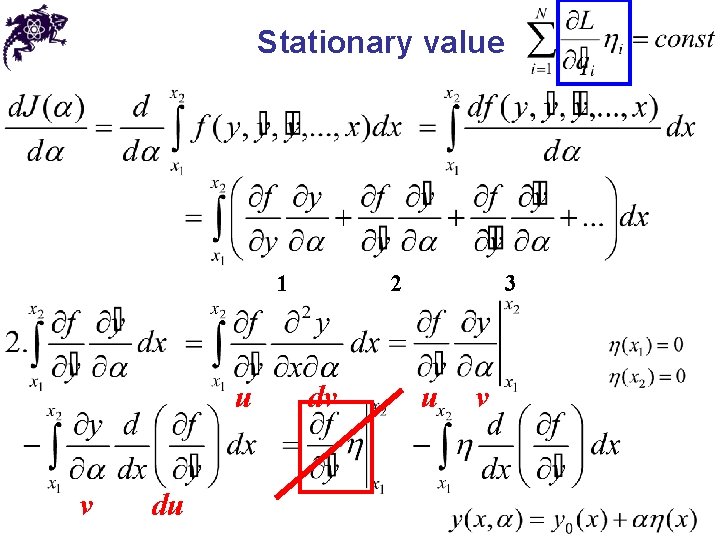
Stationary value 1 2 3
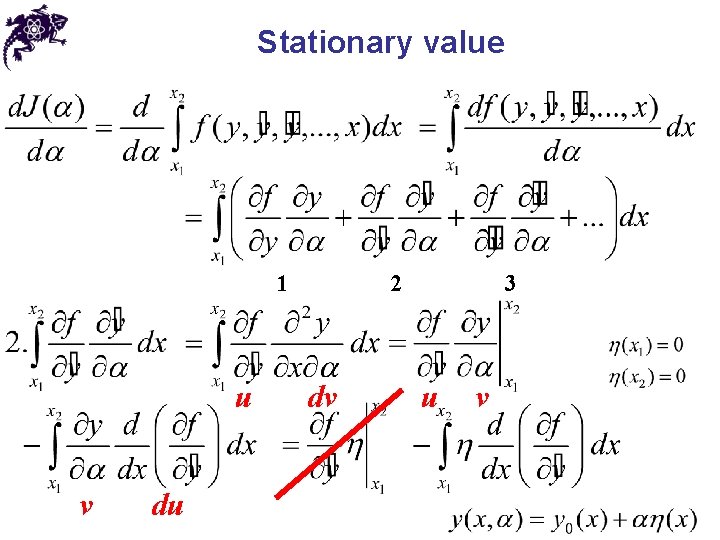
Stationary value 1 u v du 2 dv 3 u v
Stationary value 1 2 3
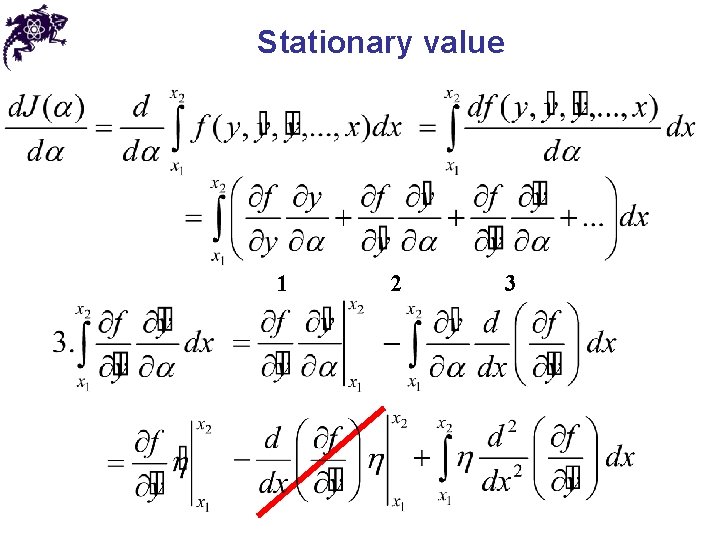
Stationary value 1 2 3
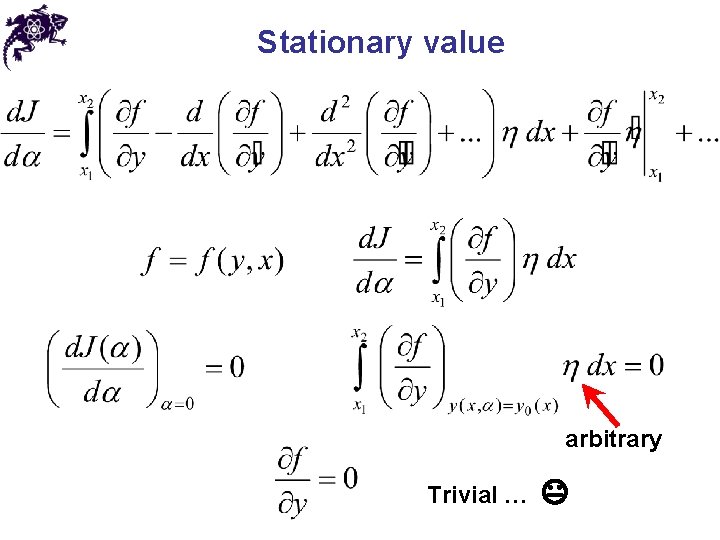
Stationary value arbitrary Trivial …
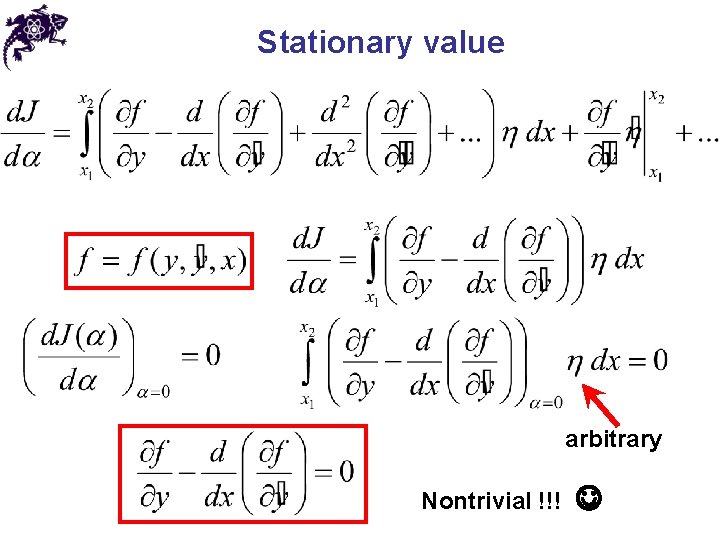
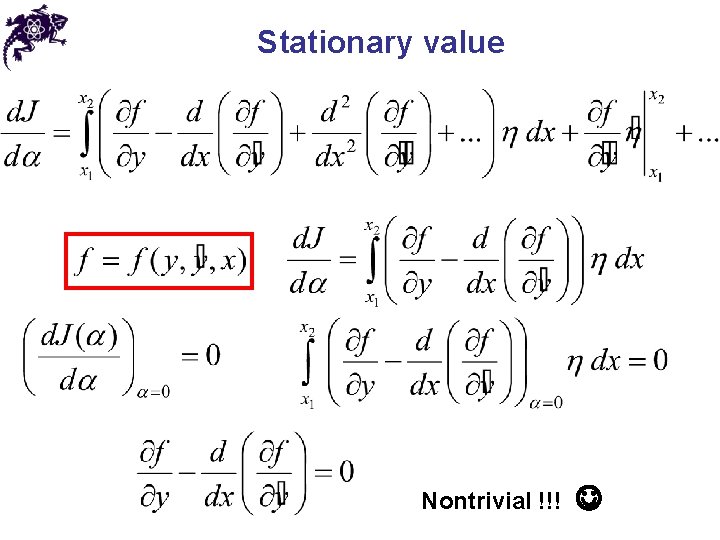
Stationary value arbitrary Nontrivial !!!
Shortest distance between two points on a plane Straight line!
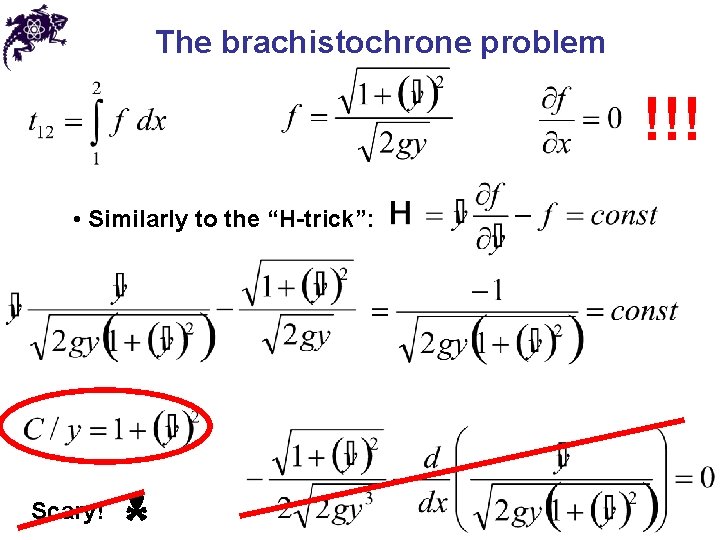
The brachistochrone problem Scary!
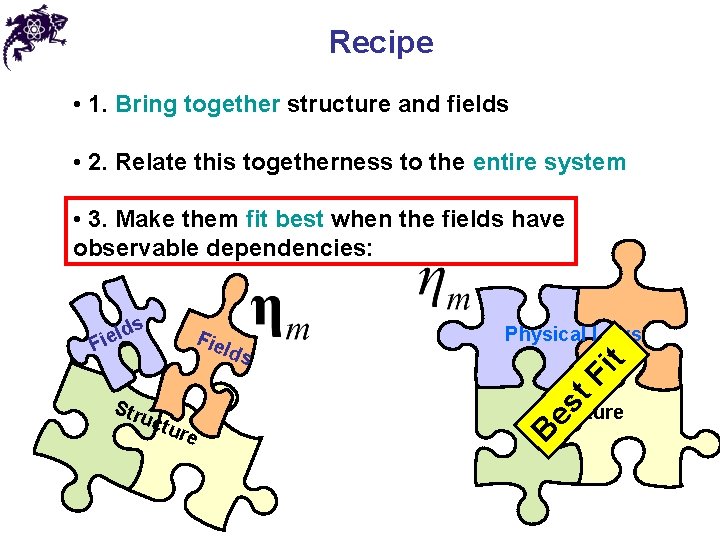
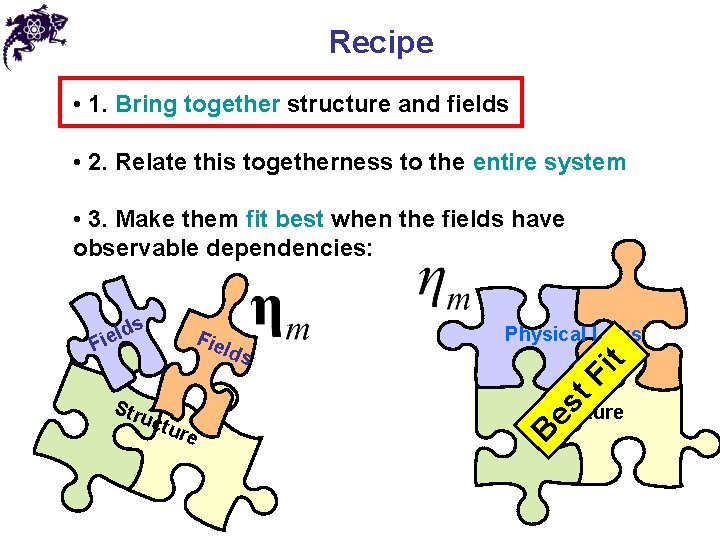
Recipe • 1. Bring together structure and fields • 2. Relate this togetherness to the entire system • 3. Make them fit best when the fields have observable dependencies: Fie lds F Str uc ture Physical Laws B es t. F it s d l ie Structure
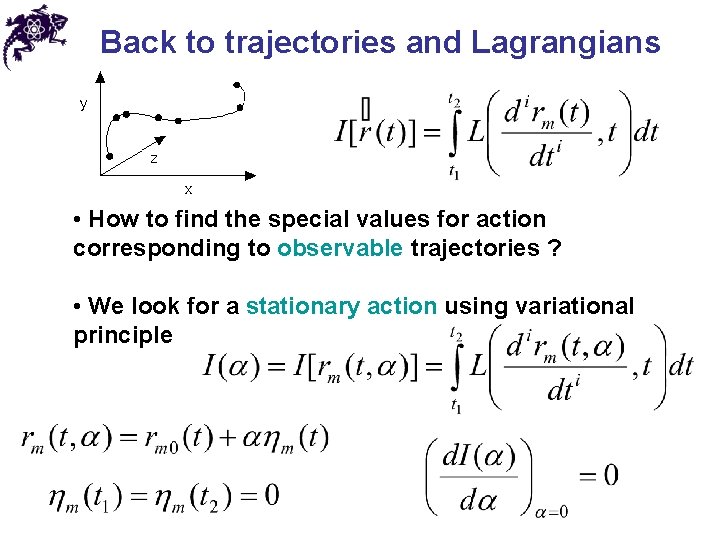
Back to trajectories and Lagrangians • How to find the special values for action corresponding to observable trajectories ? • We look for a stationary action using variational principle
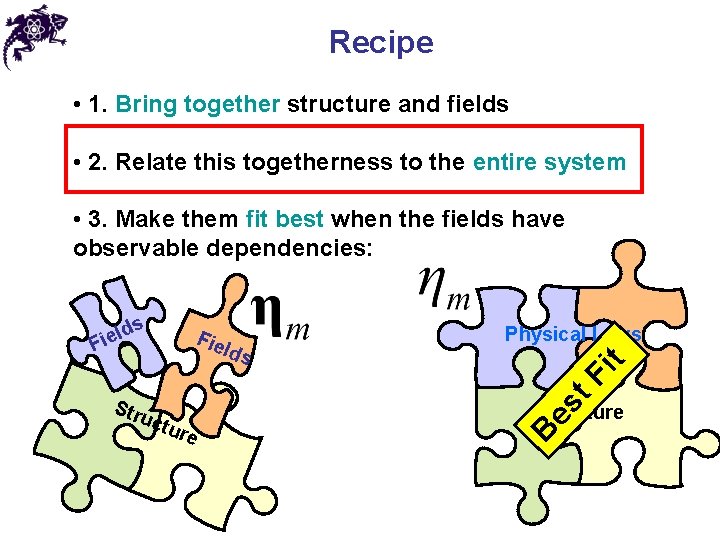
Recipe • 1. Bring together structure and fields • 2. Relate this togetherness to the entire system • 3. Make them fit best when the fields have observable dependencies: Fie lds F Str uc ture Physical Laws B es t. F it s d l ie Structure
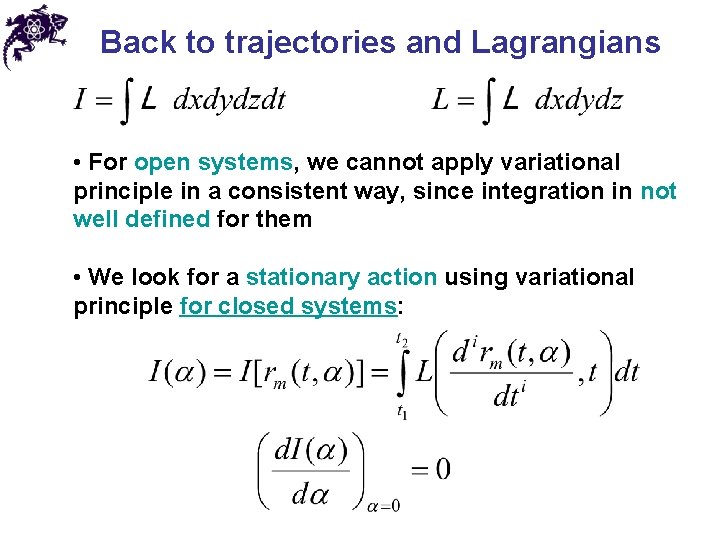
Back to trajectories and Lagrangians • For open systems, we cannot apply variational principle in a consistent way, since integration in not well defined for them • We look for a stationary action using variational principle for closed systems:
Stationary value Nontrivial !!!
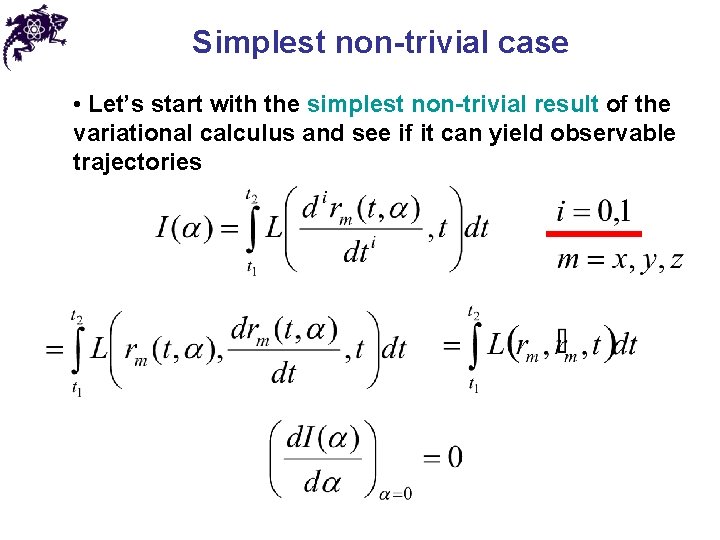
Simplest non-trivial case • Let’s start with the simplest non-trivial result of the variational calculus and see if it can yield observable trajectories
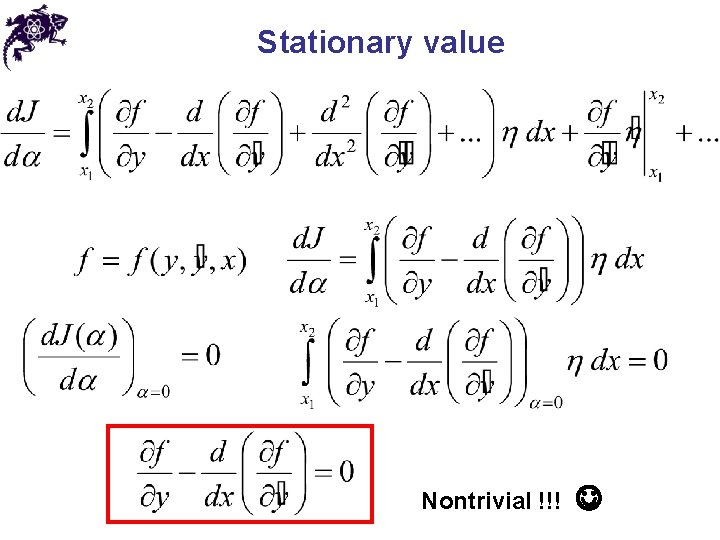
Stationary value Nontrivial !!!
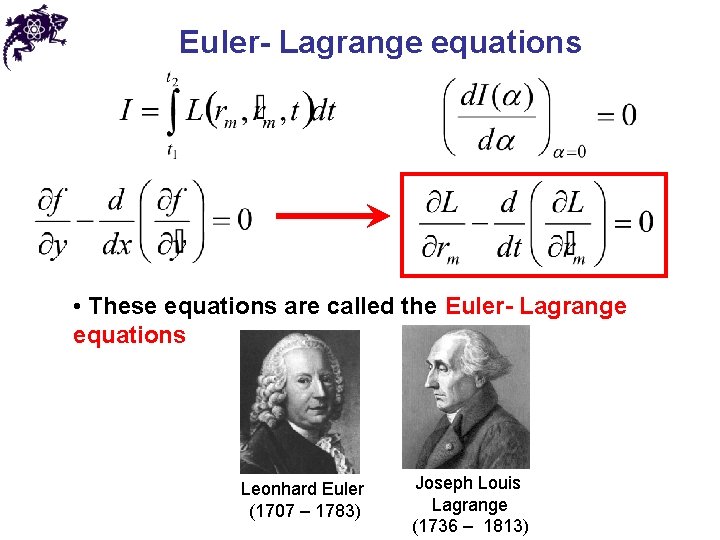
Euler- Lagrange equations • These equations are called the Euler- Lagrange equations Leonhard Euler (1707 – 1783) Joseph Louis Lagrange (1736 – 1813)
Recipe • 1. Bring together structure and fields • 2. Relate this togetherness to the entire system • 3. Make them fit best when the fields have observable dependencies: Fie lds F Str uc ture Physical Laws B es t. F it s d l ie Structure
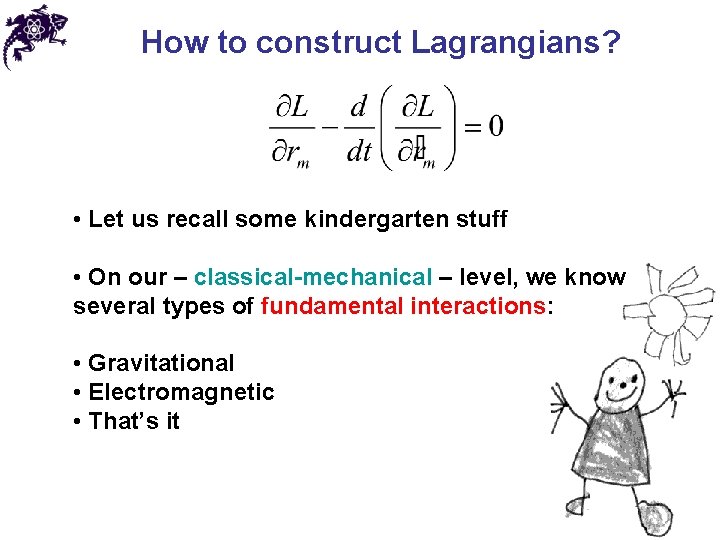
How to construct Lagrangians? • Let us recall some kindergarten stuff • On our – classical-mechanical – level, we know several types of fundamental interactions: • Gravitational • Electromagnetic • That’s it
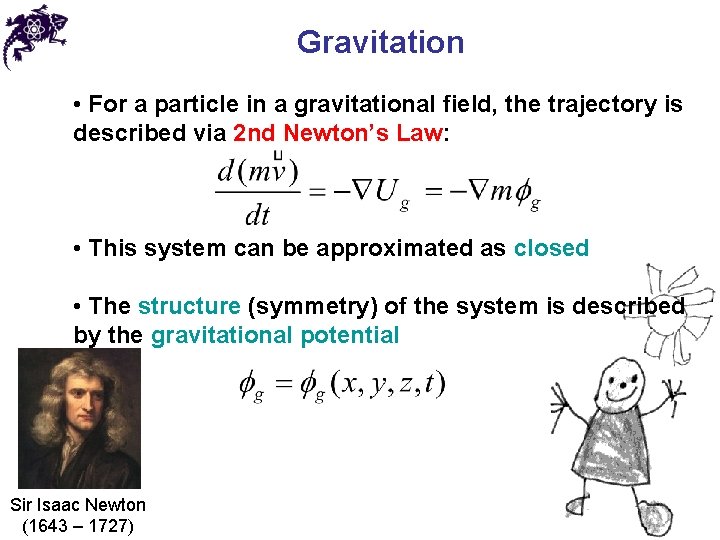
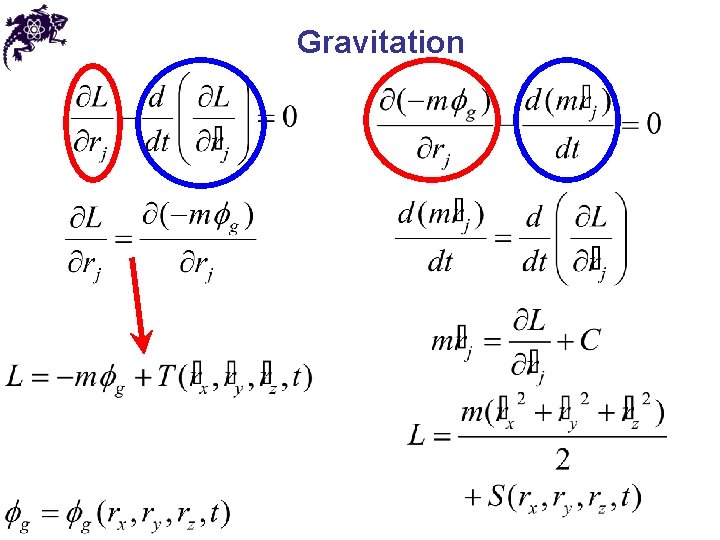
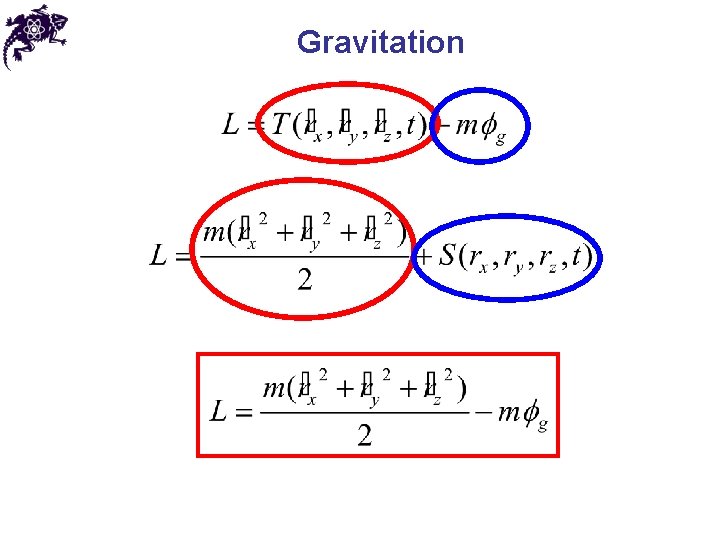
Gravitation • For a particle in a gravitational field, the trajectory is described via 2 nd Newton’s Law: • This system can be approximated as closed • The structure (symmetry) of the system is described by the gravitational potential Sir Isaac Newton (1643 – 1727)
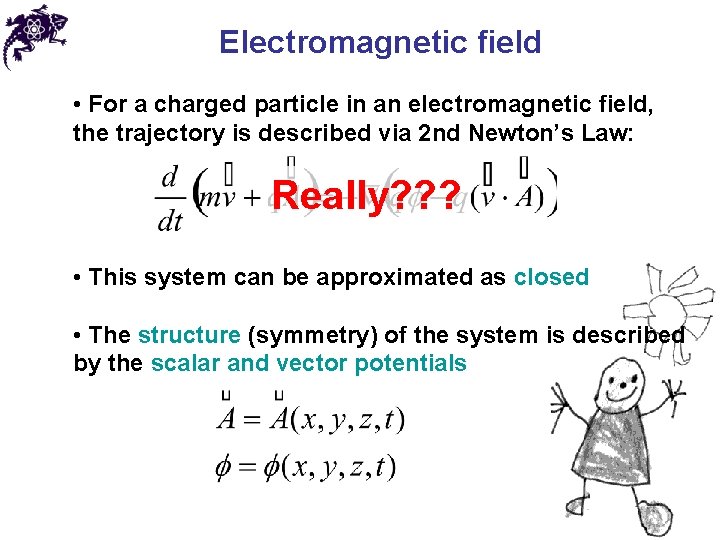
Electromagnetic field • For a charged particle in an electromagnetic field, the trajectory is described via 2 nd Newton’s Law: Really? ? ? • This system can be approximated as closed • The structure (symmetry) of the system is described by the scalar and vector potentials
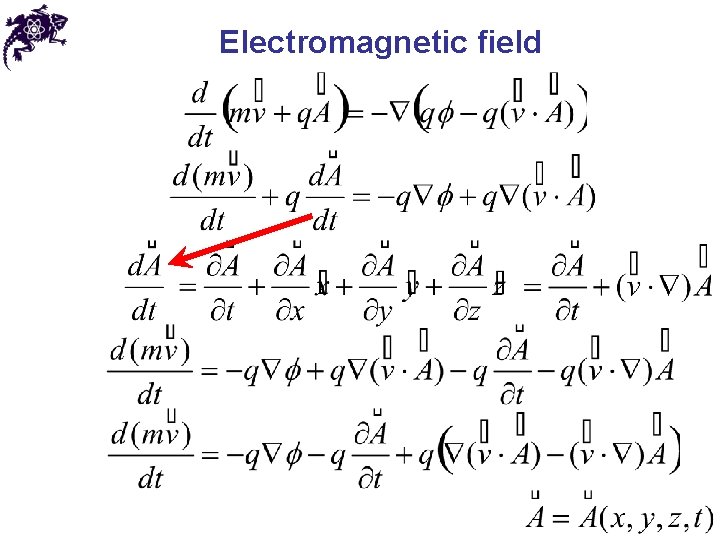
Electromagnetic field
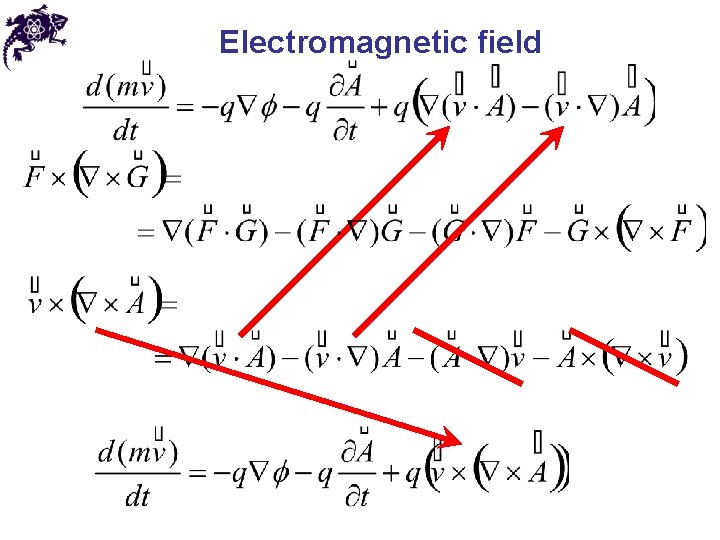
Electromagnetic field
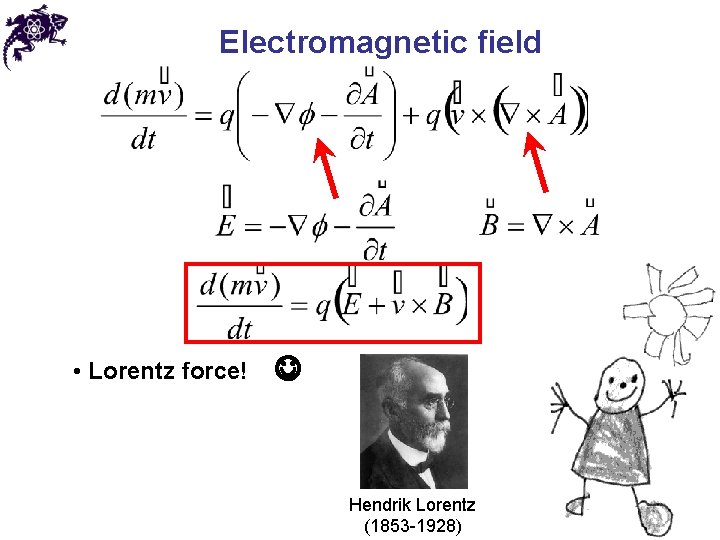
Electromagnetic field • Lorentz force! Hendrik Lorentz (1853 -1928)
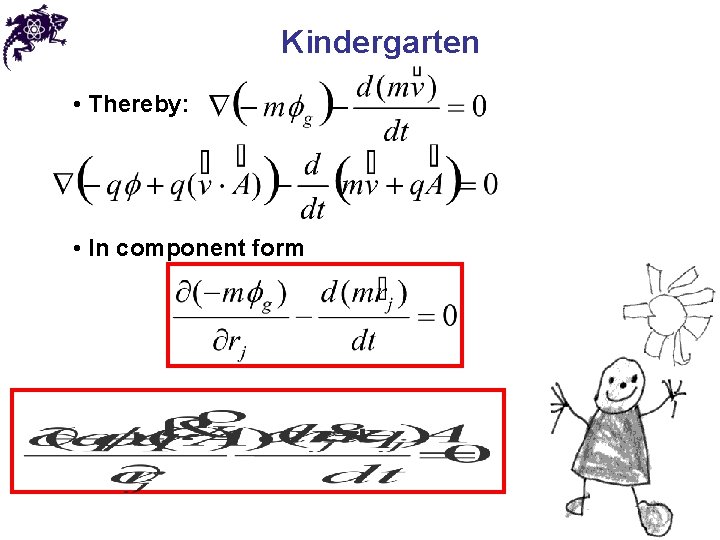
Kindergarten • Thereby: • In component form
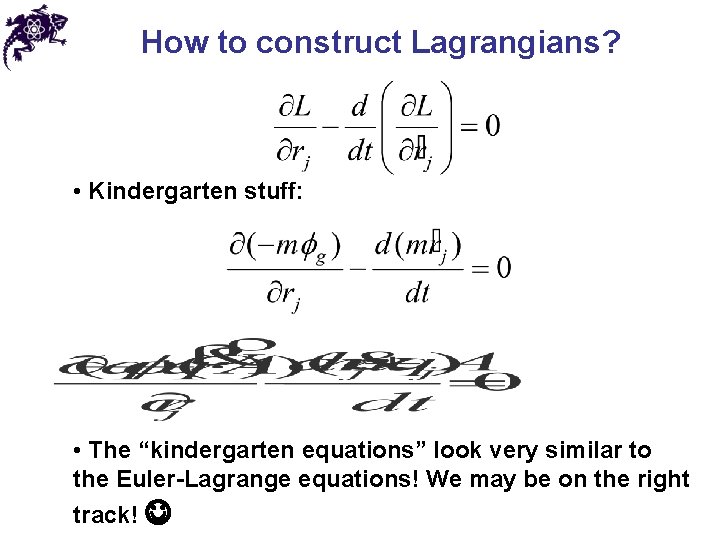
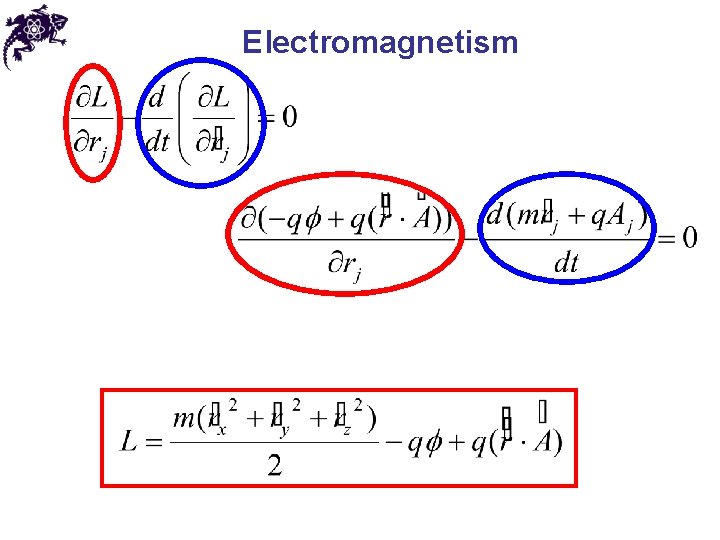
How to construct Lagrangians? • Kindergarten stuff: • The “kindergarten equations” look very similar to the Euler-Lagrange equations! We may be on the right track!
Gravitation
Gravitation
Electromagnetism
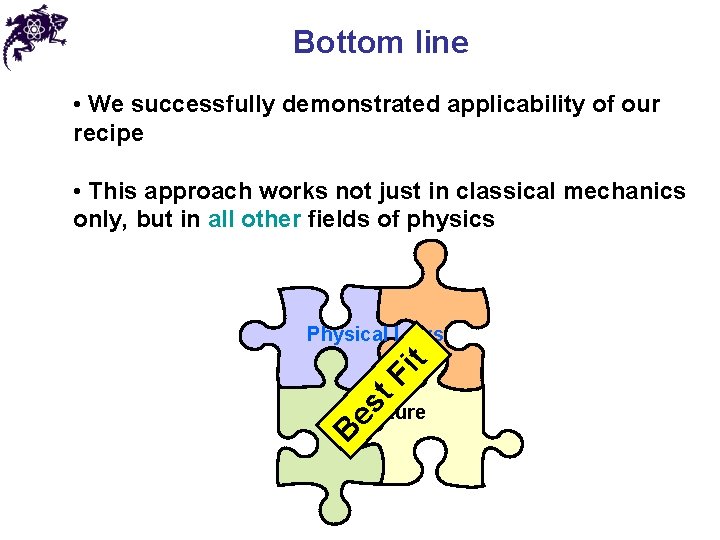
Bottom line • We successfully demonstrated applicability of our recipe • This approach works not just in classical mechanics only, but in all other fields of physics B es t. F it Physical Laws Structure
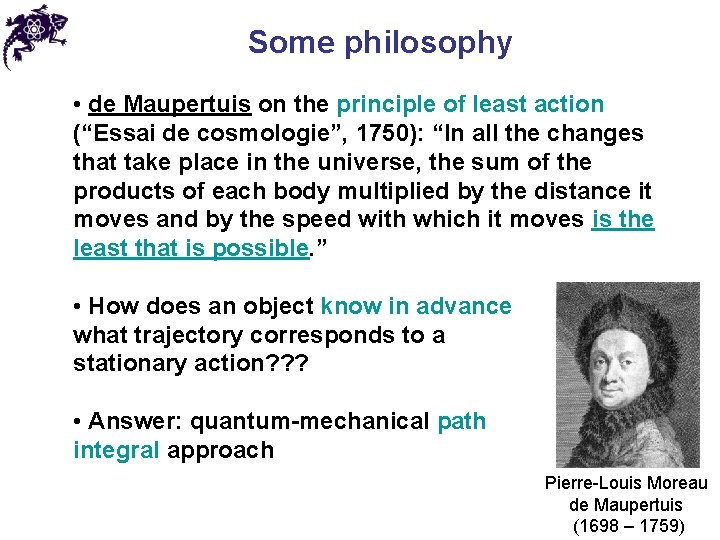
Some philosophy • de Maupertuis on the principle of least action (“Essai de cosmologie”, 1750): “In all the changes that take place in the universe, the sum of the products of each body multiplied by the distance it moves and by the speed with which it moves is the least that is possible. ” • How does an object know in advance what trajectory corresponds to a stationary action? ? ? • Answer: quantum-mechanical path integral approach Pierre-Louis Moreau de Maupertuis (1698 – 1759)
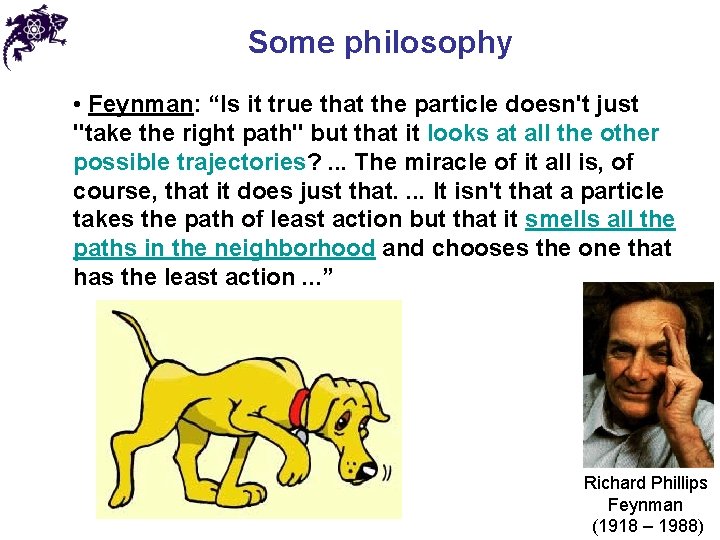
Some philosophy • Feynman: “Is it true that the particle doesn't just "take the right path" but that it looks at all the other possible trajectories? . . . The miracle of it all is, of course, that it does just that. . It isn't that a particle takes the path of least action but that it smells all the paths in the neighborhood and chooses the one that has the least action. . . ” Richard Phillips Feynman (1918 – 1988)
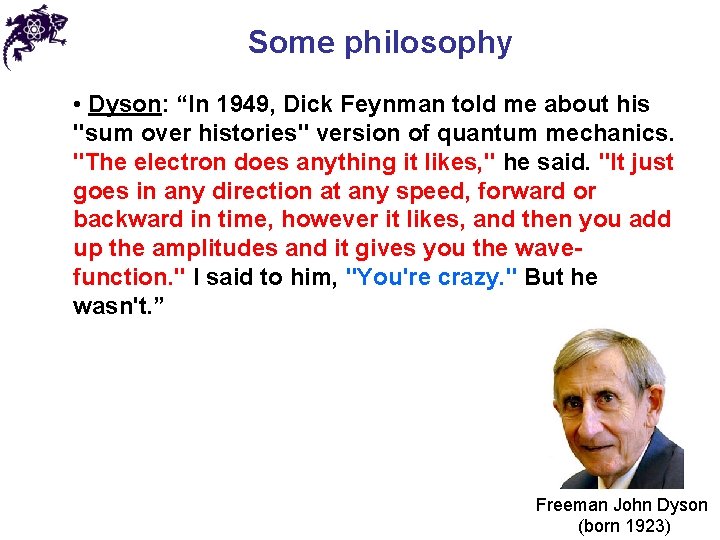
Some philosophy • Dyson: “In 1949, Dick Feynman told me about his "sum over histories" version of quantum mechanics. "The electron does anything it likes, " he said. "It just goes in any direction at any speed, forward or backward in time, however it likes, and then you add up the amplitudes and it gives you the wavefunction. " I said to him, "You're crazy. " But he wasn't. ” Freeman John Dyson (born 1923)
Some philosophy • Philosophical meaning of the Lagrangian formalism: structure of a system determines its observable behavior • So, that's it? • Why do we need all this? • In addition to the deep philosophical meaning, Lagrangian formalism offers great many advantages compared to the Newtonian approach
Lagrangian approach: extra goodies • It is scalar (Newtonian – vectorial) • Allows introduction of configuration space and efficient description of systems with constrains • Becomes relatively simpler as the mechanical system becomes more complex • Applicable outside Newtonian mechanics • Relates conservation laws with symmetries • Scale invariance applications • Gauge invariance applications
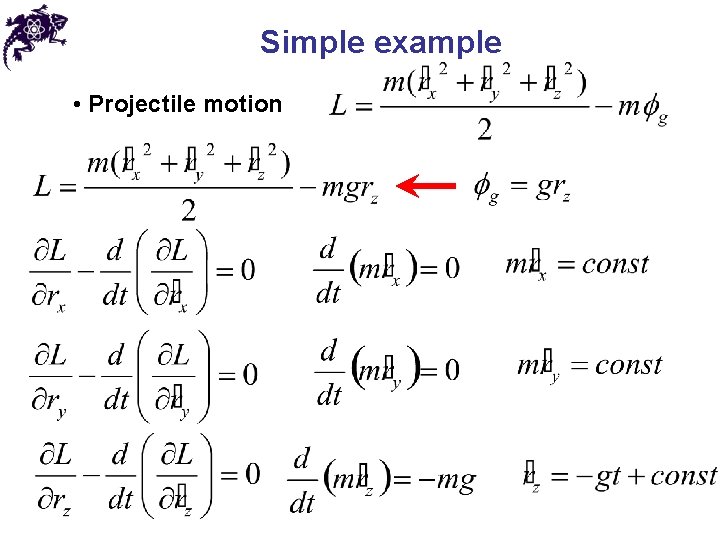
Simple example • Projectile motion
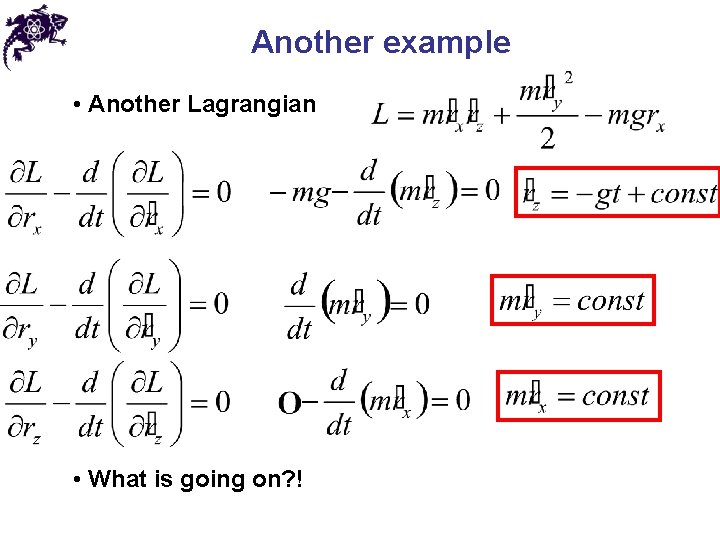
Another example • Another Lagrangian • What is going on? !
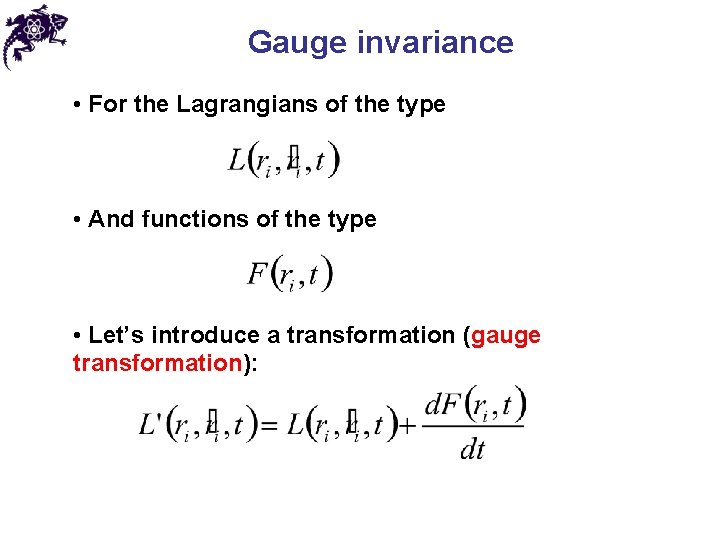
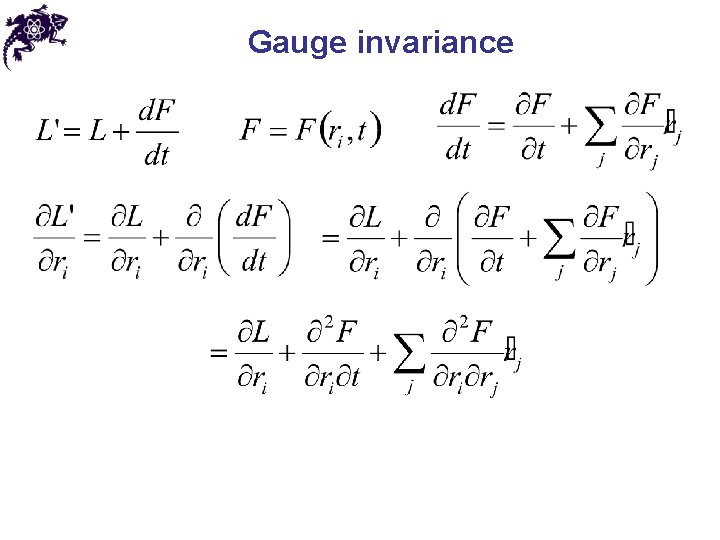
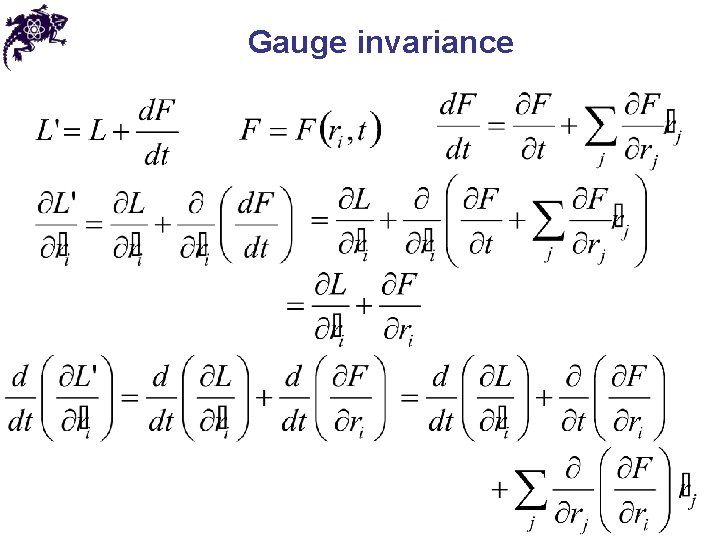
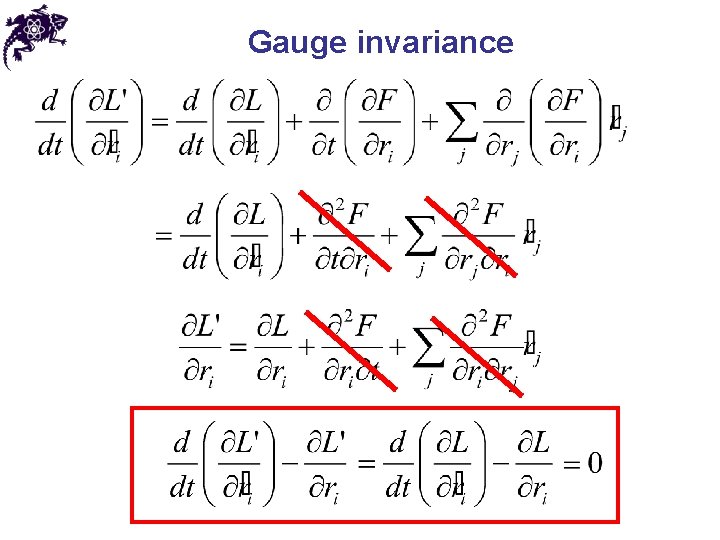
Gauge invariance • For the Lagrangians of the type • And functions of the type • Let’s introduce a transformation (gauge transformation):
Gauge invariance
Gauge invariance
Gauge invariance
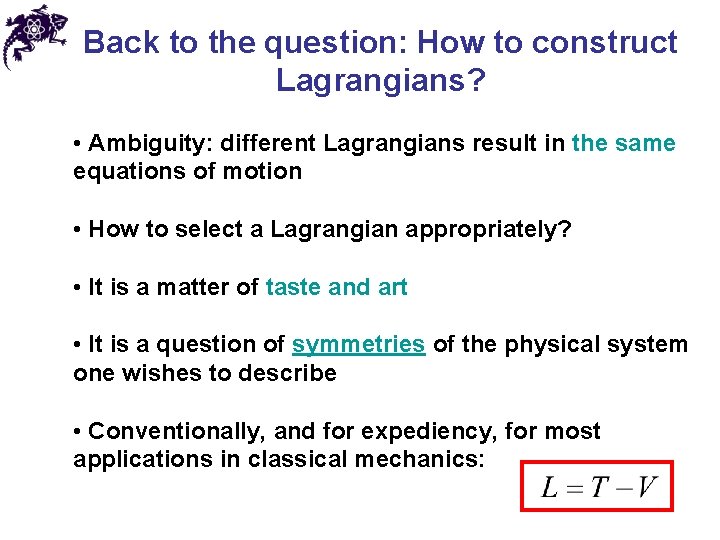
Back to the question: How to construct Lagrangians? • Ambiguity: different Lagrangians result in the same equations of motion • How to select a Lagrangian appropriately? • It is a matter of taste and art • It is a question of symmetries of the physical system one wishes to describe • Conventionally, and for expediency, for most applications in classical mechanics:
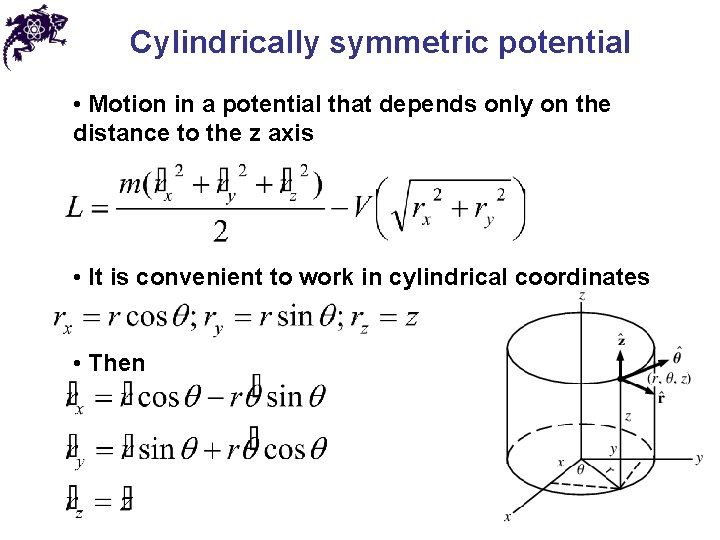
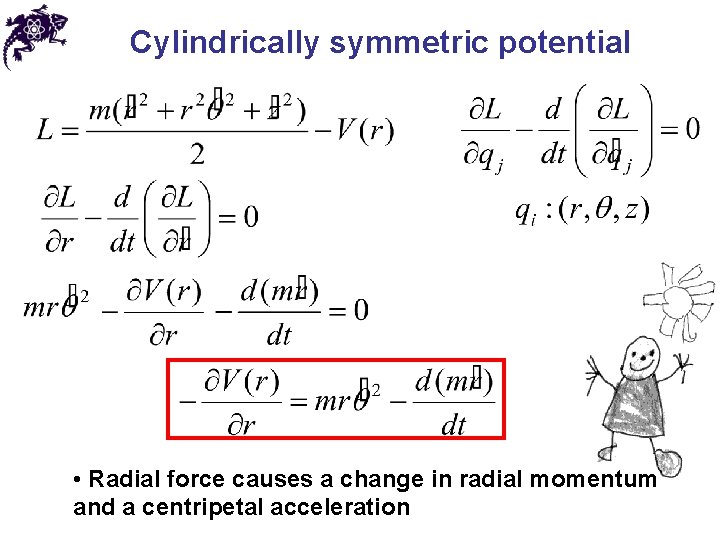
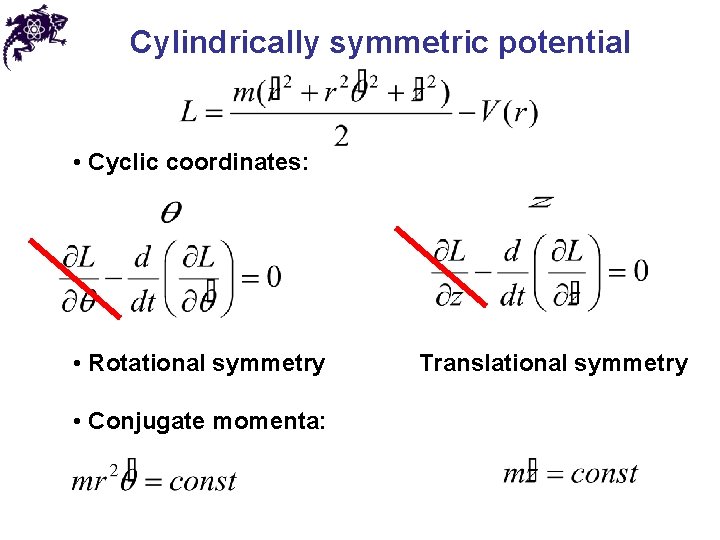
Cylindrically symmetric potential • Motion in a potential that depends only on the distance to the z axis • It is convenient to work in cylindrical coordinates • Then
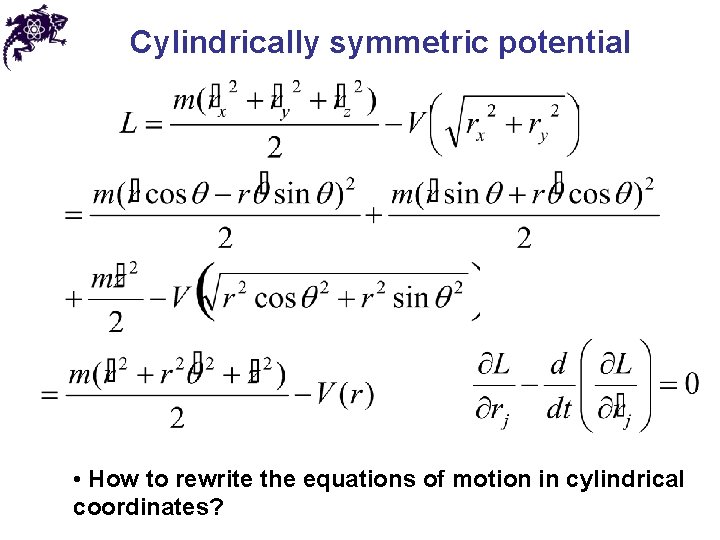
Cylindrically symmetric potential • How to rewrite the equations of motion in cylindrical coordinates?
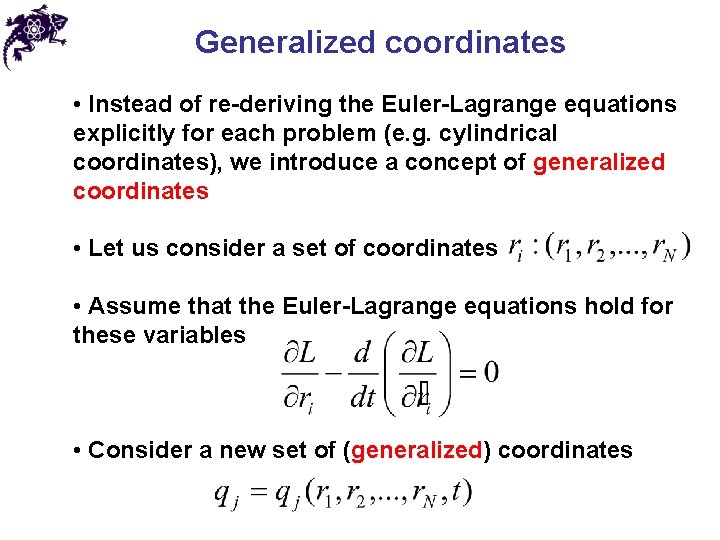
Generalized coordinates • Instead of re-deriving the Euler-Lagrange equations explicitly for each problem (e. g. cylindrical coordinates), we introduce a concept of generalized coordinates • Let us consider a set of coordinates • Assume that the Euler-Lagrange equations hold for these variables • Consider a new set of (generalized) coordinates
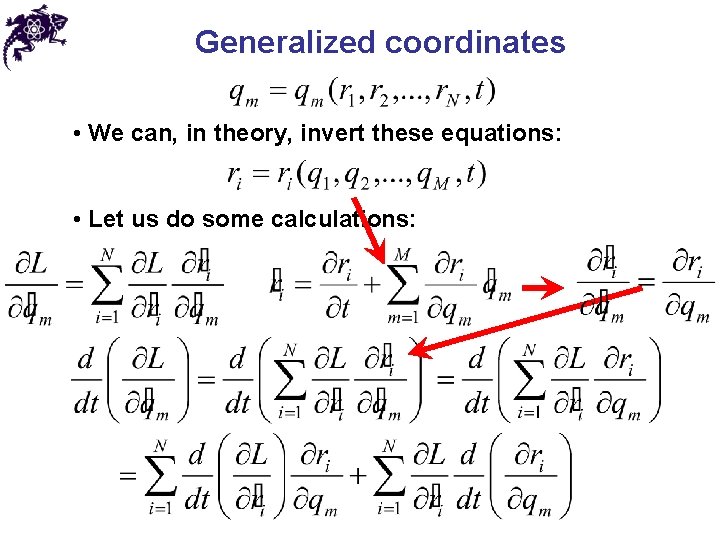
Generalized coordinates • We can, in theory, invert these equations: • Let us do some calculations:
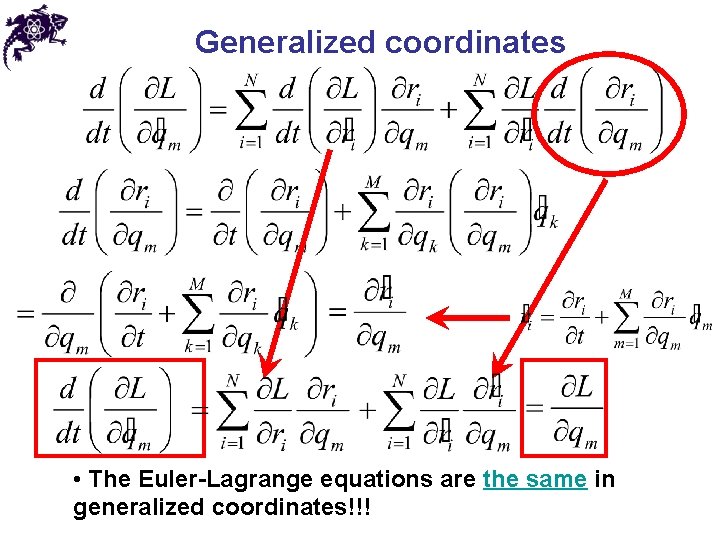
Generalized coordinates • The Euler-Lagrange equations are the same in generalized coordinates!!!
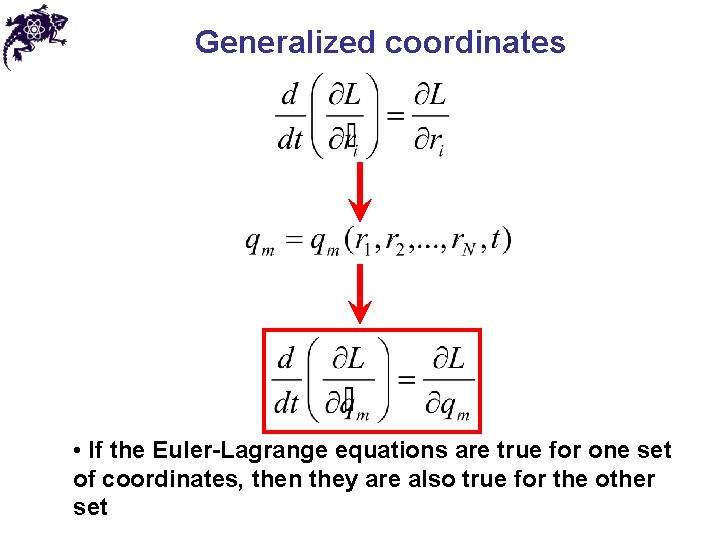
Generalized coordinates • If the Euler-Lagrange equations are true for one set of coordinates, then they are also true for the other set
Cylindrically symmetric potential • Radial force causes a change in radial momentum and a centripetal acceleration
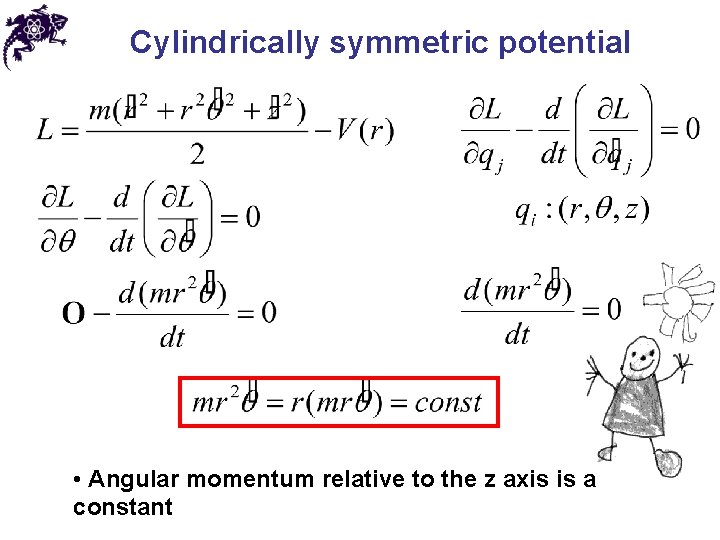
Cylindrically symmetric potential • Angular momentum relative to the z axis is a constant
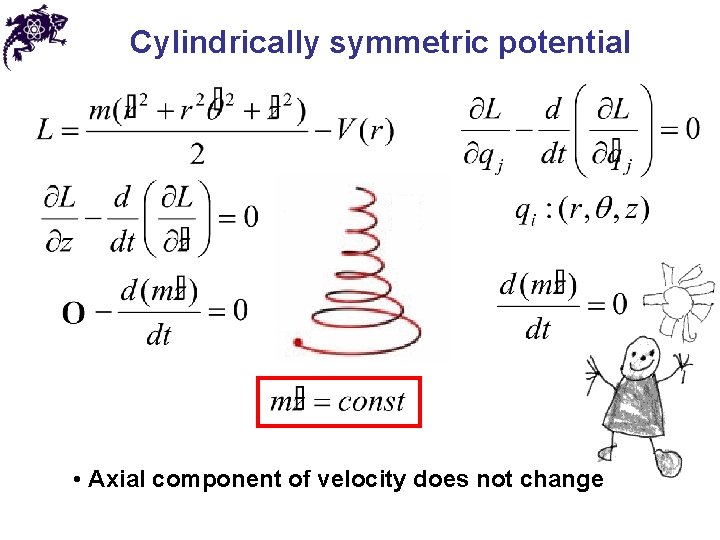
Cylindrically symmetric potential • Axial component of velocity does not change
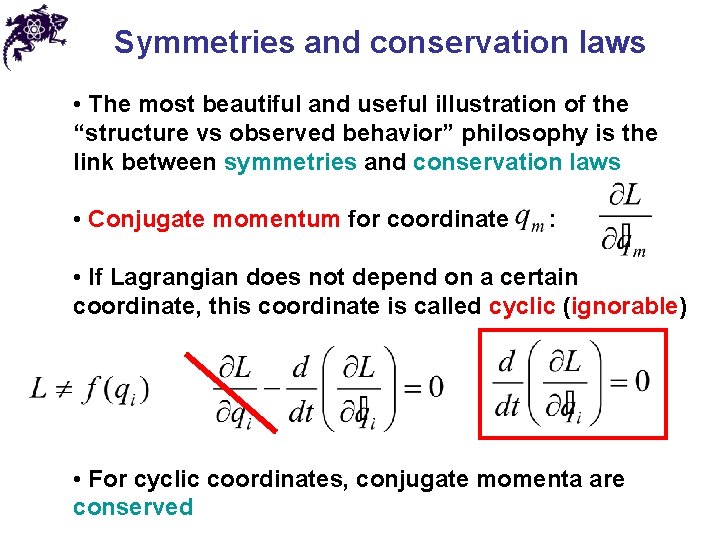
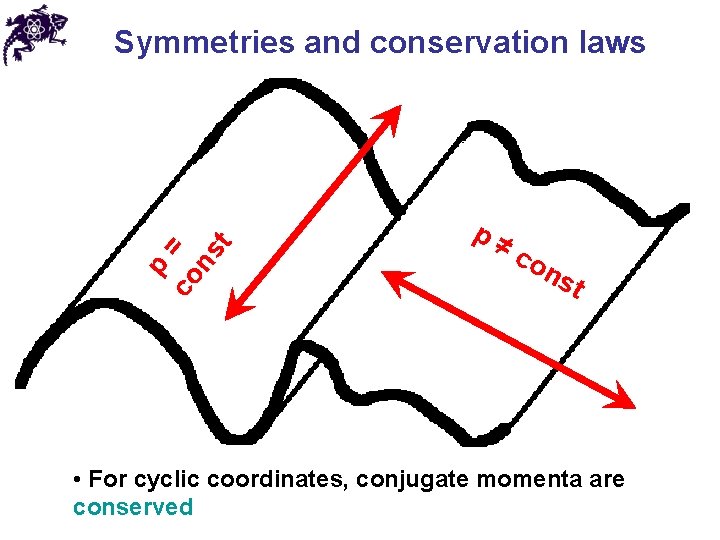
Symmetries and conservation laws • The most beautiful and useful illustration of the “structure vs observed behavior” philosophy is the link between symmetries and conservation laws • Conjugate momentum for coordinate : • If Lagrangian does not depend on a certain coordinate, this coordinate is called cyclic (ignorable) • For cyclic coordinates, conjugate momenta are conserved
p co = ns t Symmetries and conservation laws p≠ co ns t • For cyclic coordinates, conjugate momenta are conserved
Cylindrically symmetric potential • Cyclic coordinates: • Rotational symmetry • Conjugate momenta: Translational symmetry
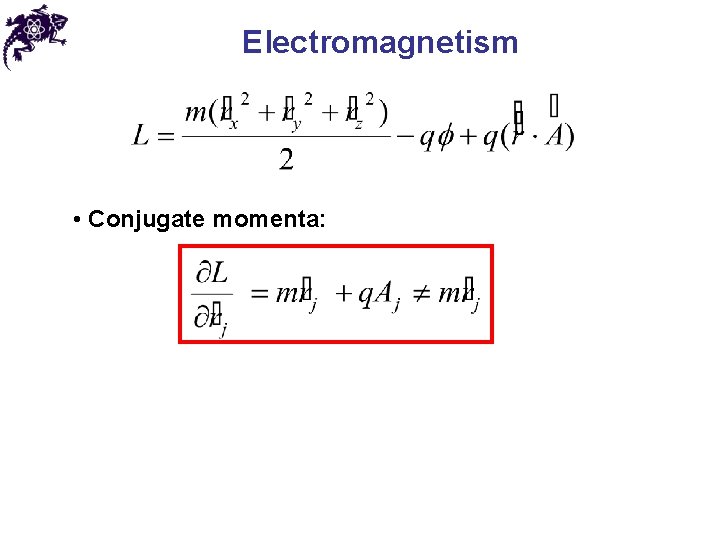
Electromagnetism • Conjugate momenta:
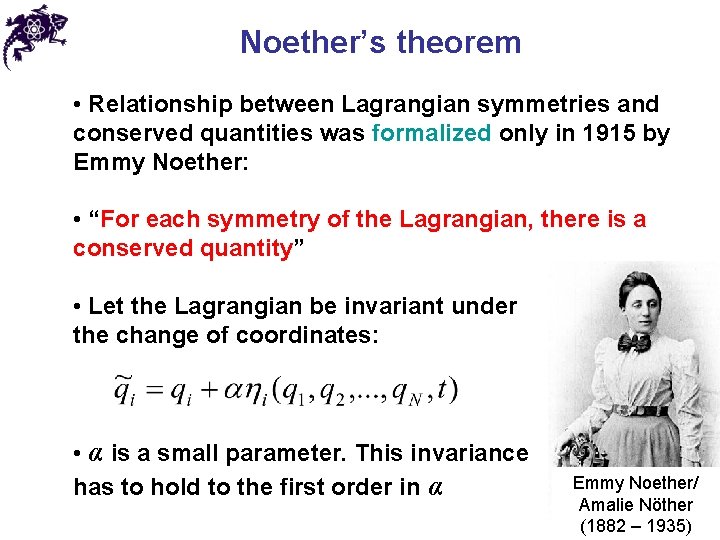
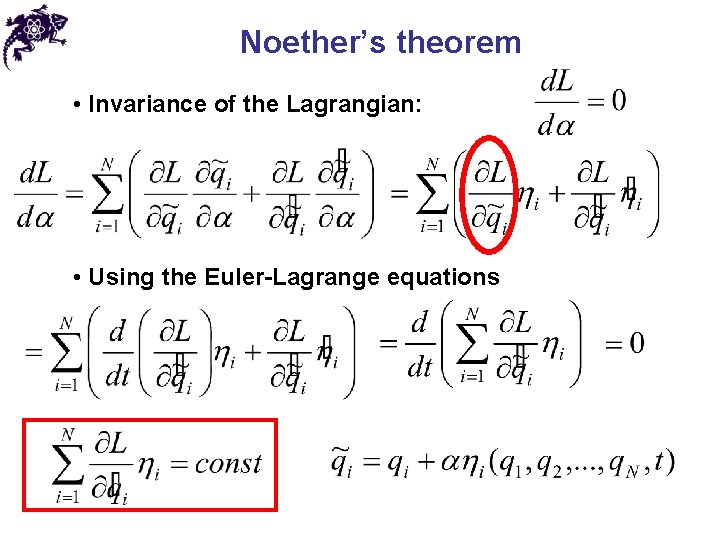
Noether’s theorem • Relationship between Lagrangian symmetries and conserved quantities was formalized only in 1915 by Emmy Noether: • “For each symmetry of the Lagrangian, there is a conserved quantity” • Let the Lagrangian be invariant under the change of coordinates: • α is a small parameter. This invariance has to hold to the first order in α Emmy Noether/ Amalie Nöther (1882 – 1935)
Noether’s theorem • Invariance of the Lagrangian: • Using the Euler-Lagrange equations
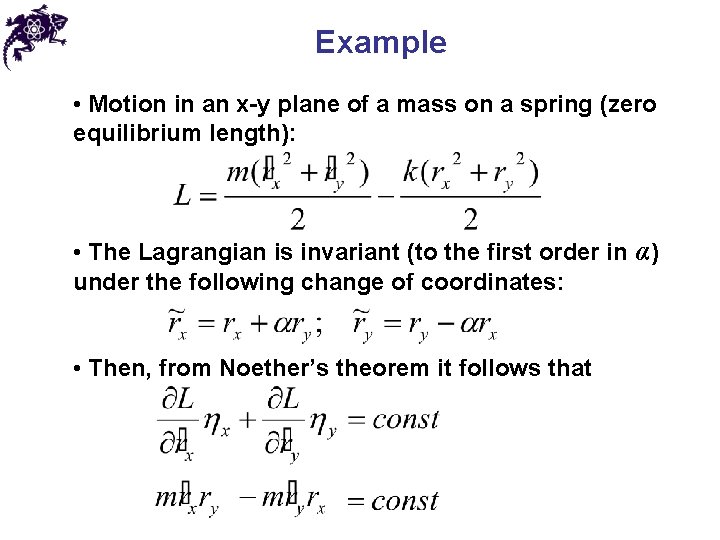
Example • Motion in an x-y plane of a mass on a spring (zero equilibrium length): • The Lagrangian is invariant (to the first order in α) under the following change of coordinates: • Then, from Noether’s theorem it follows that
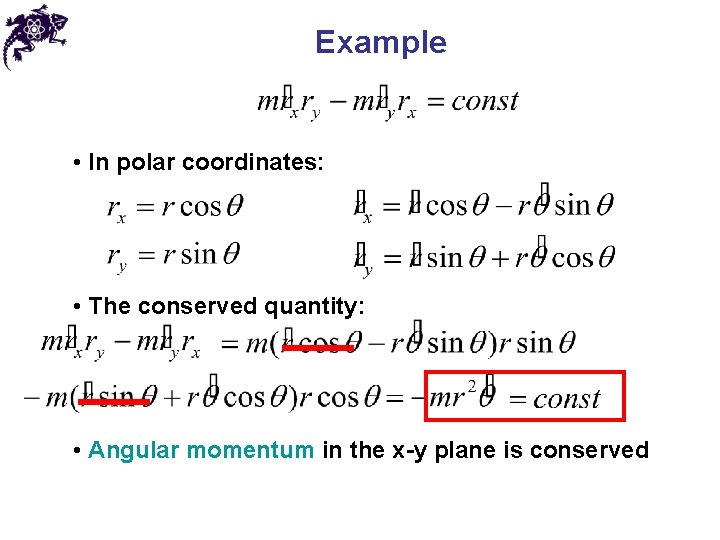
Example • In polar coordinates: • The conserved quantity: • Angular momentum in the x-y plane is conserved
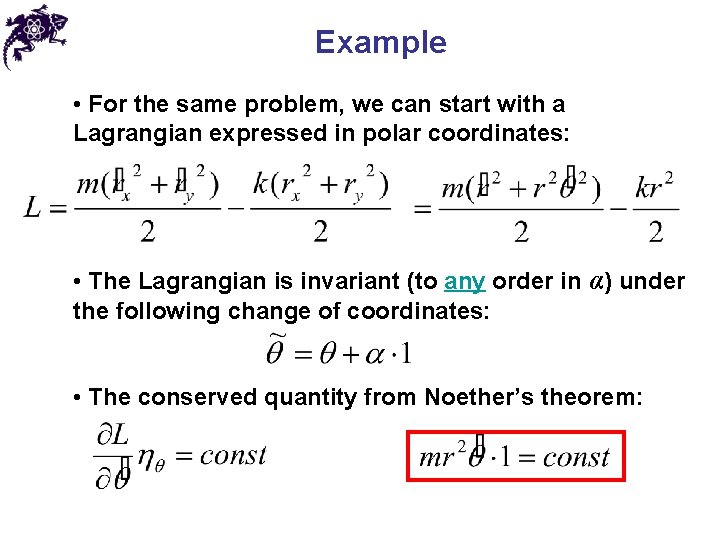
Example • For the same problem, we can start with a Lagrangian expressed in polar coordinates: • The Lagrangian is invariant (to any order in α) under the following change of coordinates: • The conserved quantity from Noether’s theorem:
Back to trajectories and Lagrangians • How to find the special values for action corresponding to observable trajectories ? • We look for a stationary action using variational principle
Stationary value 1 u v du 2 dv 3 u v
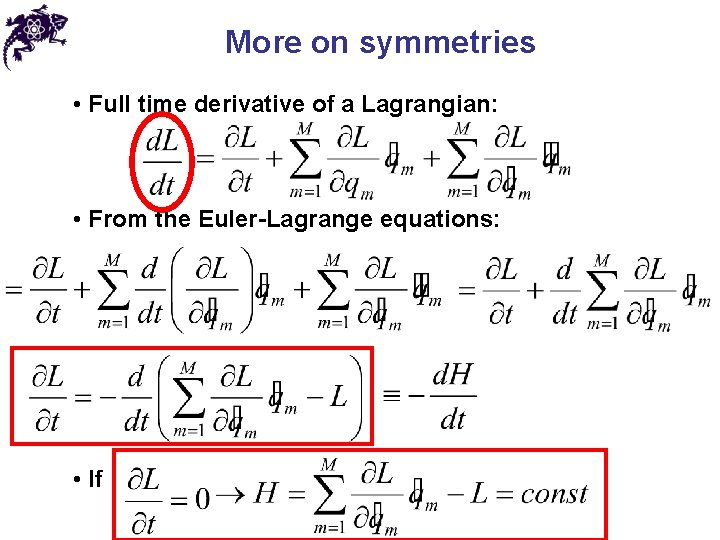
More on symmetries • Full time derivative of a Lagrangian: • From the Euler-Lagrange equations: • If
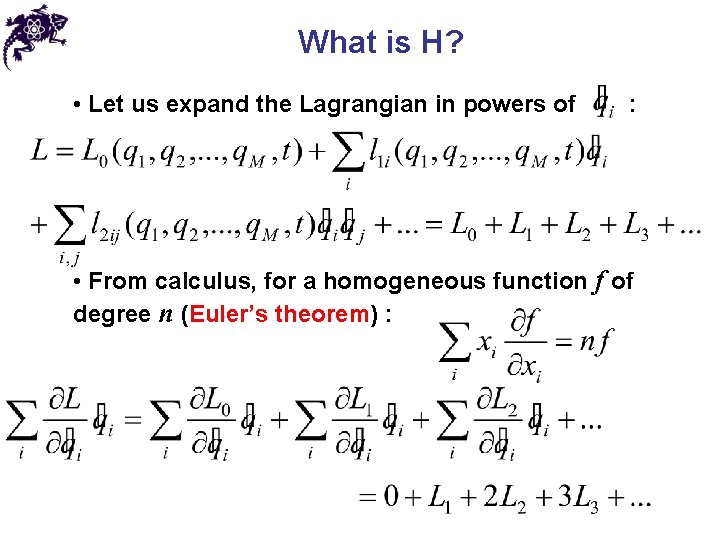
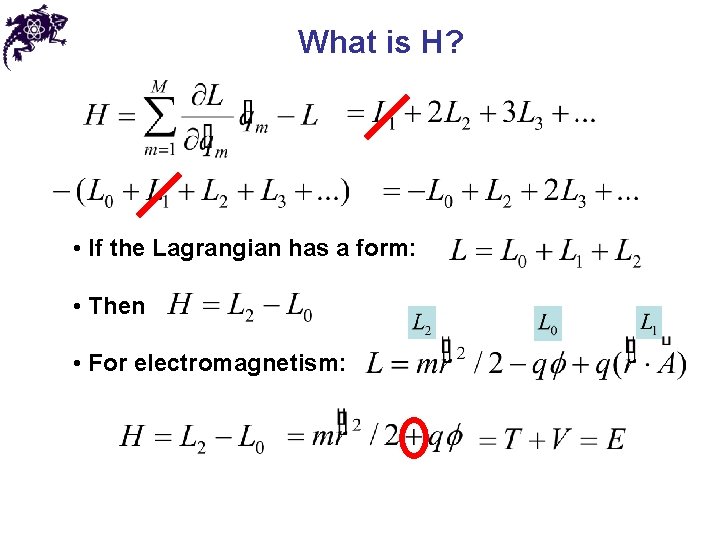
What is H? • Let us expand the Lagrangian in powers of : • From calculus, for a homogeneous function f of degree n (Euler’s theorem) :
What is H? • If the Lagrangian has a form: • Then • For electromagnetism:
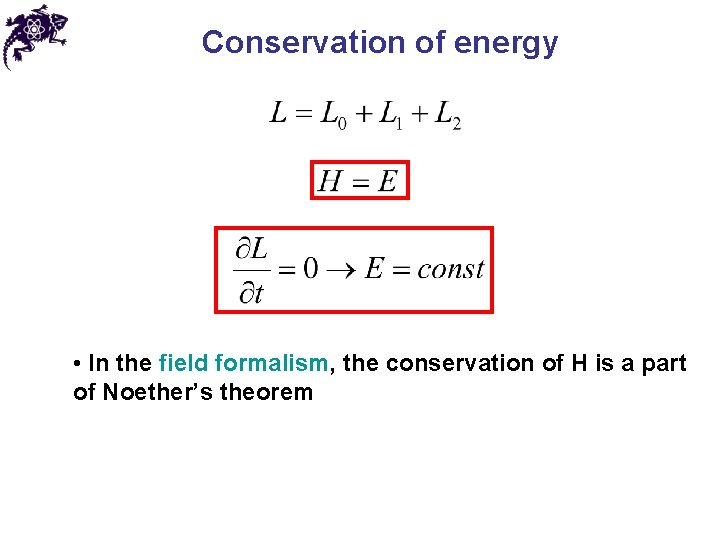
Conservation of energy • In the field formalism, the conservation of H is a part of Noether’s theorem
The brachistochrone problem !!! • Similarly to the “H-trick”: Scary!
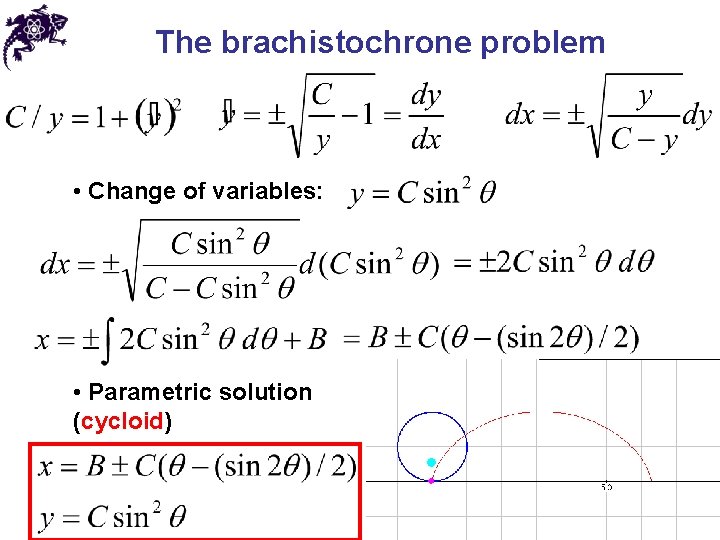
The brachistochrone problem • Change of variables: • Parametric solution (cycloid)
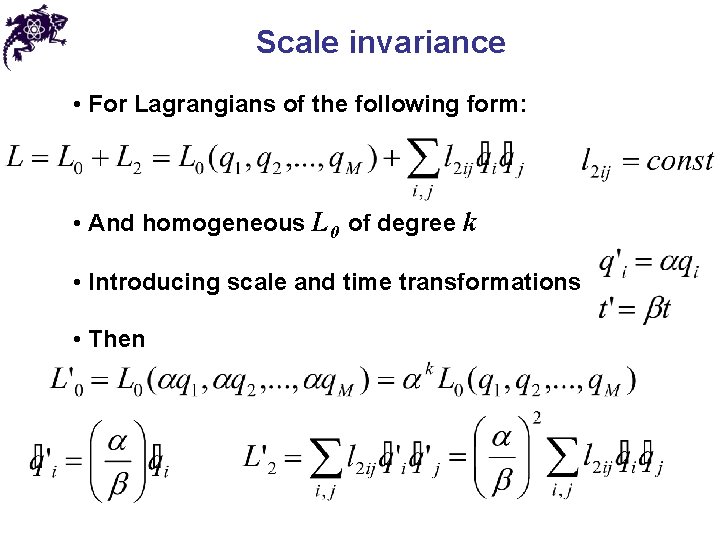
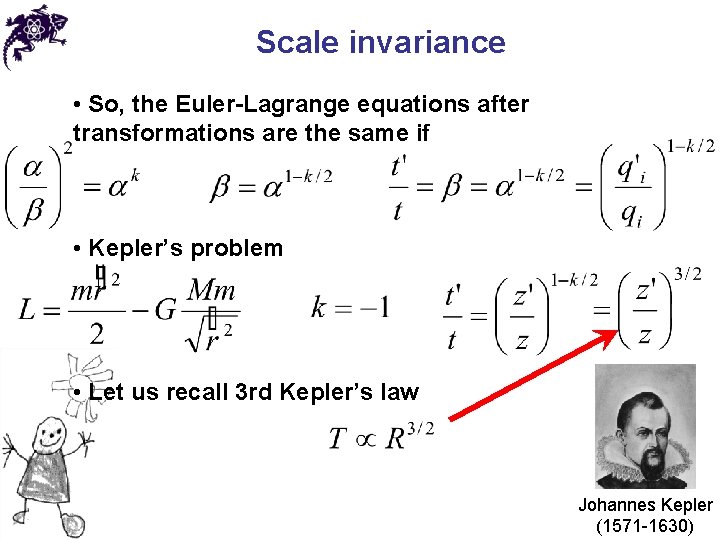
Scale invariance • For Lagrangians of the following form: • And homogeneous L 0 of degree k • Introducing scale and time transformations • Then
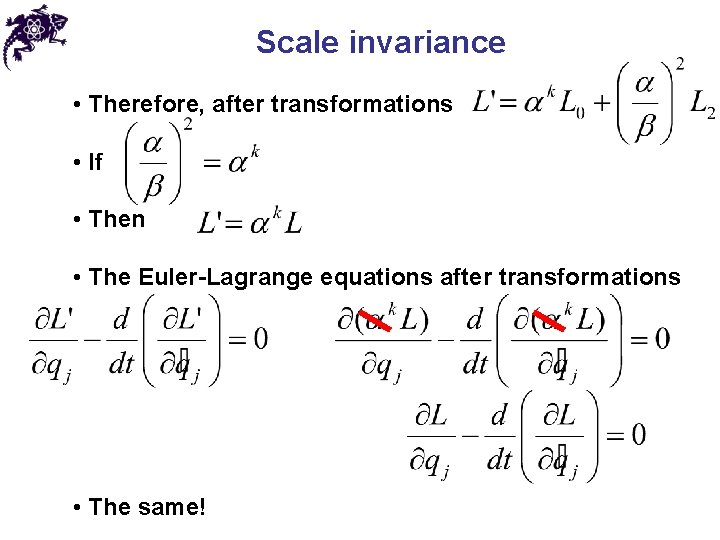
Scale invariance • Therefore, after transformations • If • Then • The Euler-Lagrange equations after transformations • The same!
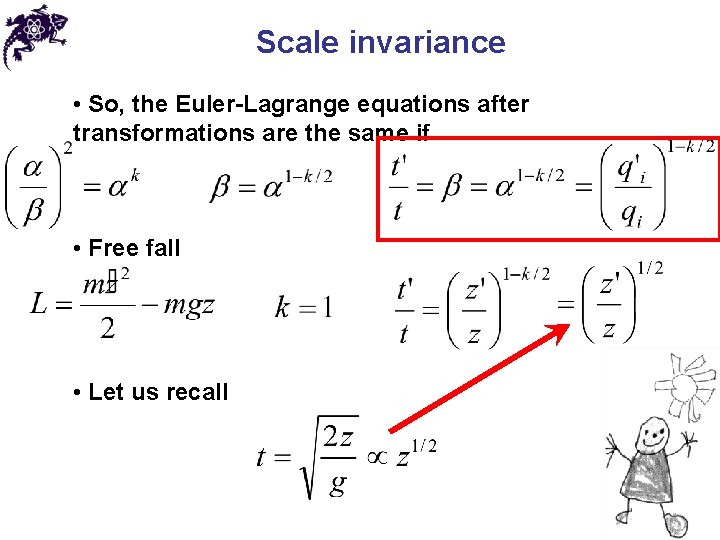
Scale invariance • So, the Euler-Lagrange equations after transformations are the same if • Free fall • Let us recall
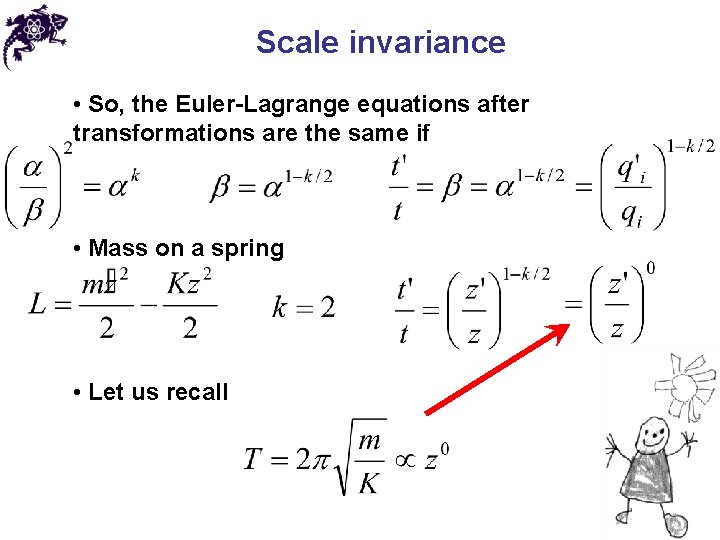
Scale invariance • So, the Euler-Lagrange equations after transformations are the same if • Mass on a spring • Let us recall
Scale invariance • So, the Euler-Lagrange equations after transformations are the same if • Kepler’s problem • Let us recall 3 rd Kepler’s law Johannes Kepler (1571 -1630)
How about open systems? • For some systems we can neglect their interaction with the outside world and formulate their behavior in terms of Lagrangian formalism • For some systems we can not do it • Approach: to describe the system without “leaks” and “feeds” and then add them to the description of the system
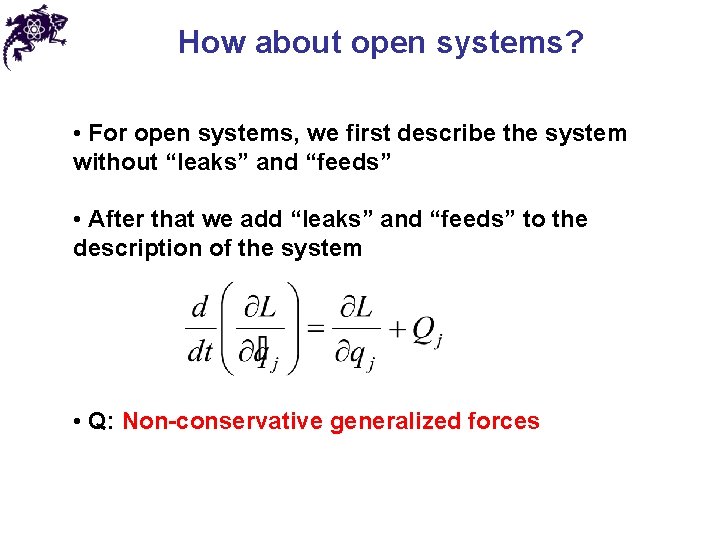
How about open systems? • For open systems, we first describe the system without “leaks” and “feeds” • After that we add “leaks” and “feeds” to the description of the system • Q: Non-conservative generalized forces
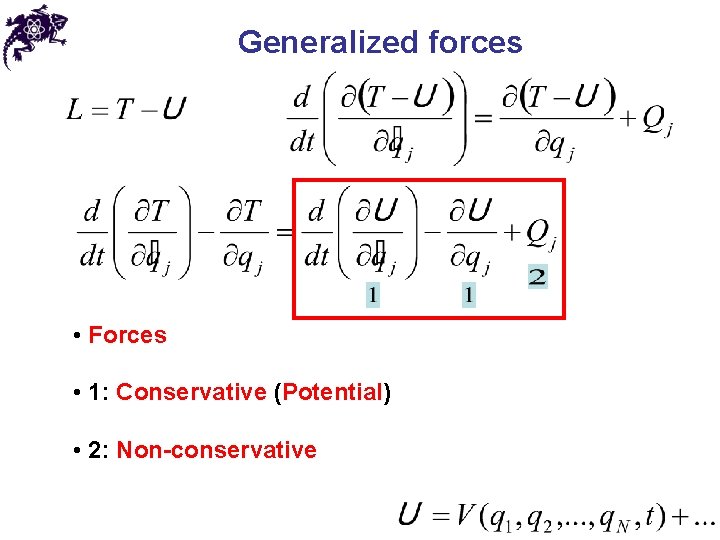
Generalized forces • Forces • 1: Conservative (Potential) • 2: Non-conservative
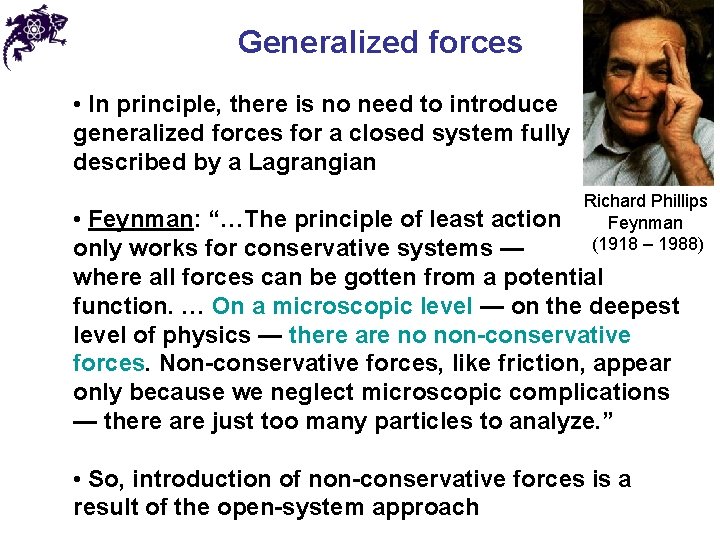
Generalized forces • In principle, there is no need to introduce generalized forces for a closed system fully described by a Lagrangian Richard Phillips Feynman (1918 – 1988) • Feynman: “…The principle of least action only works for conservative systems — where all forces can be gotten from a potential function. … On a microscopic level — on the deepest level of physics — there are no non-conservative forces. Non-conservative forces, like friction, appear only because we neglect microscopic complications — there are just too many particles to analyze. ” • So, introduction of non-conservative forces is a result of the open-system approach
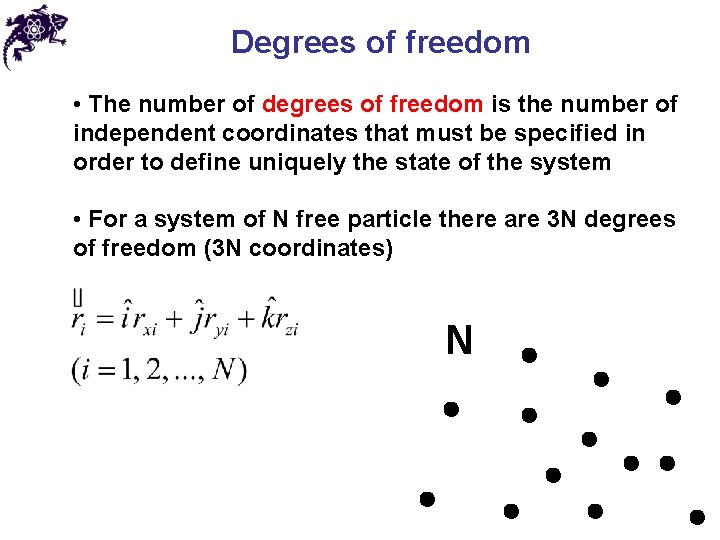
Degrees of freedom • The number of degrees of freedom is the number of independent coordinates that must be specified in order to define uniquely the state of the system • For a system of N free particle there are 3 N degrees of freedom (3 N coordinates) N
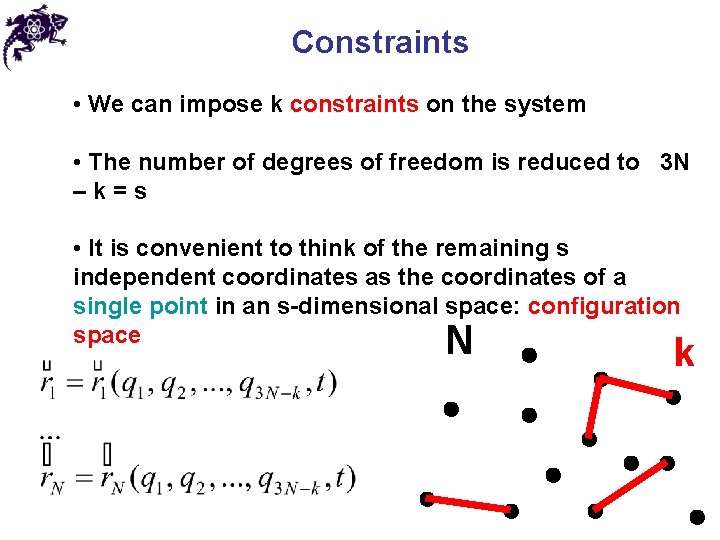
Constraints • We can impose k constraints on the system • The number of degrees of freedom is reduced to 3 N –k=s • It is convenient to think of the remaining s independent coordinates as the coordinates of a single point in an s-dimensional space: configuration space N k
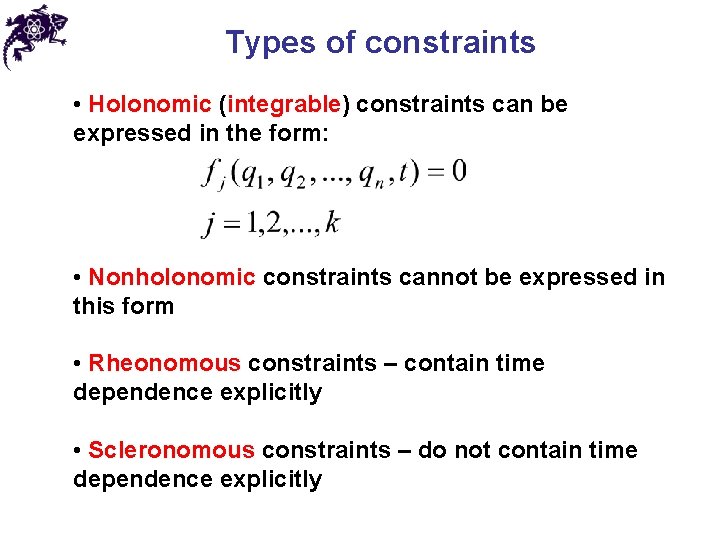
Types of constraints • Holonomic (integrable) constraints can be expressed in the form: • Nonholonomic constraints cannot be expressed in this form • Rheonomous constraints – contain time dependence explicitly • Scleronomous constraints – do not contain time dependence explicitly
Analysis of systems with holonomic constraints • Elimination of variables using constraints equations • Use of independent generalized coordinates • Lagrange’s multiplier method
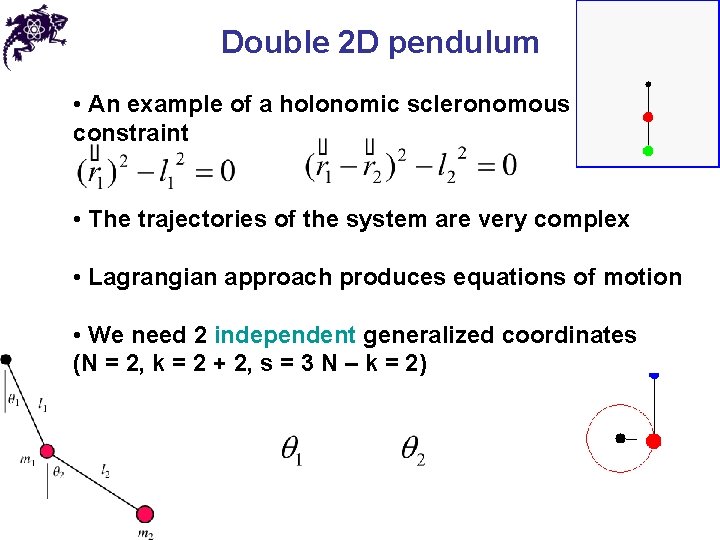
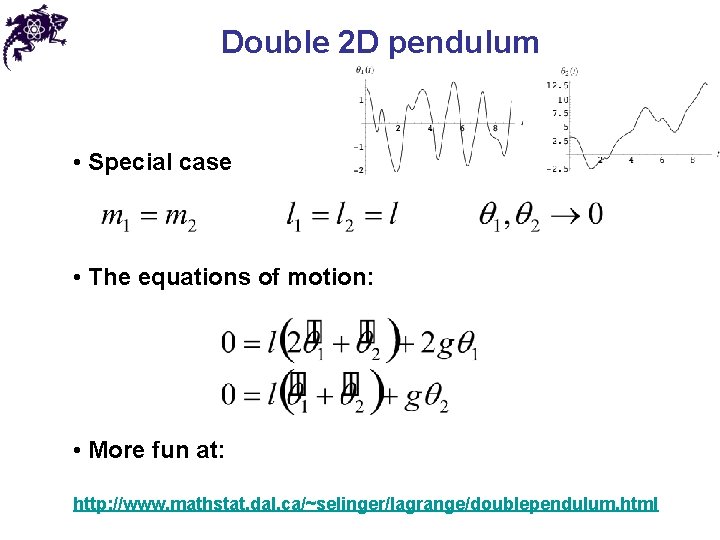
Double 2 D pendulum • An example of a holonomic scleronomous constraint • The trajectories of the system are very complex • Lagrangian approach produces equations of motion • We need 2 independent generalized coordinates (N = 2, k = 2 + 2, s = 3 N – k = 2)
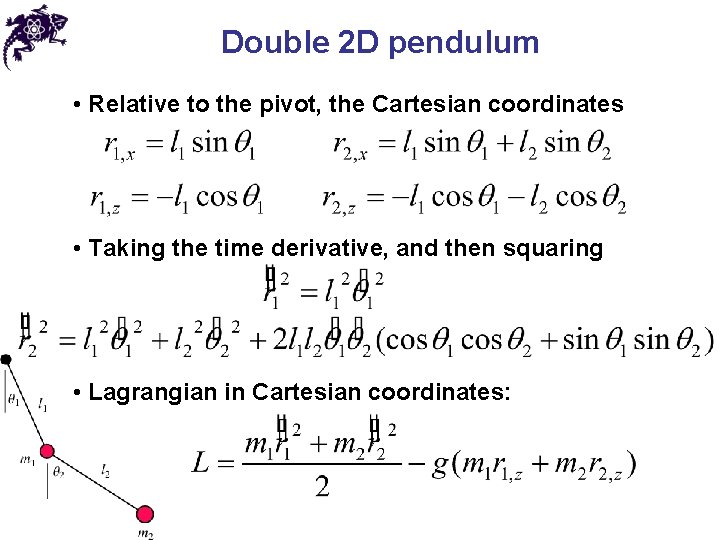
Double 2 D pendulum • Relative to the pivot, the Cartesian coordinates • Taking the time derivative, and then squaring • Lagrangian in Cartesian coordinates:
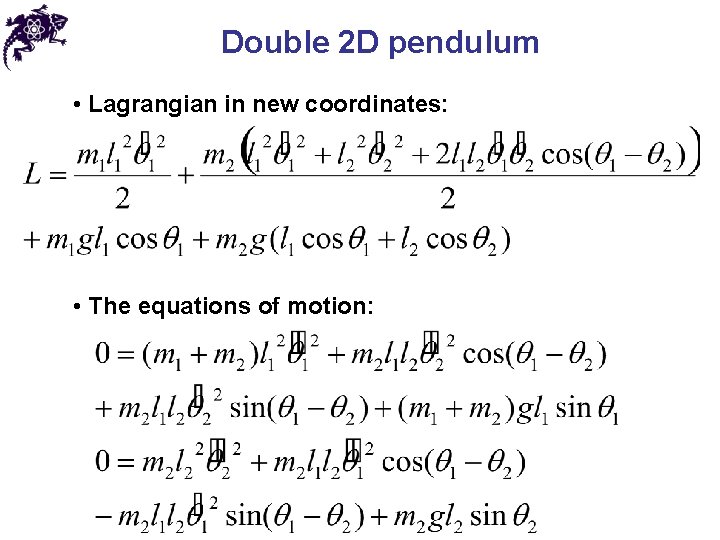
Double 2 D pendulum • Lagrangian in new coordinates: • The equations of motion:
Double 2 D pendulum • Special case • The equations of motion: • More fun at: http: //www. mathstat. dal. ca/~selinger/lagrange/doublependulum. html
Lagrange’s multiplier method • Used when constraint reactions are the object of interest • Instead of considering 3 N - k variables and equations, this method deals with 3 N + k variables • As a results, we obtain 3 N trajectories and k constraint reactions • Lagrange’s multiplier method can be applied to some nonholonomic constraints
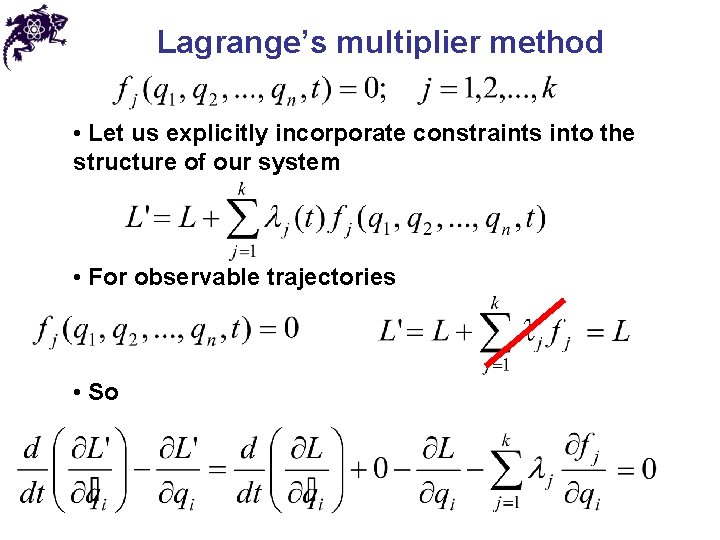
Lagrange’s multiplier method • Let us explicitly incorporate constraints into the structure of our system • For observable trajectories • So
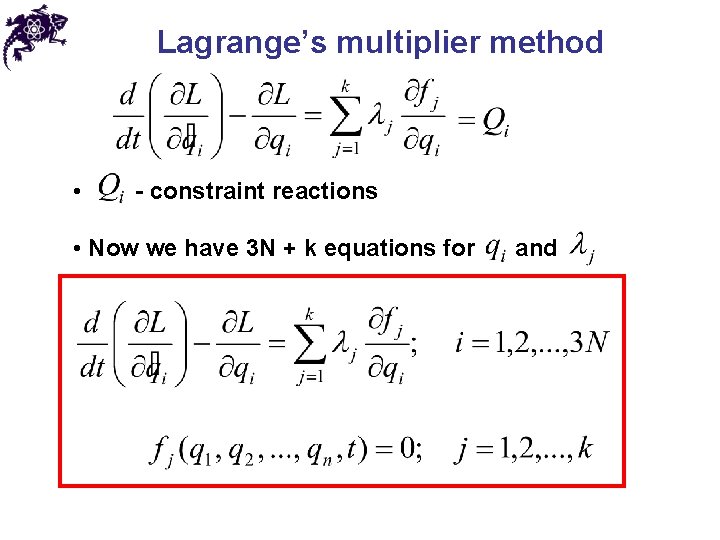
Lagrange’s multiplier method • - constraint reactions • Now we have 3 N + k equations for and
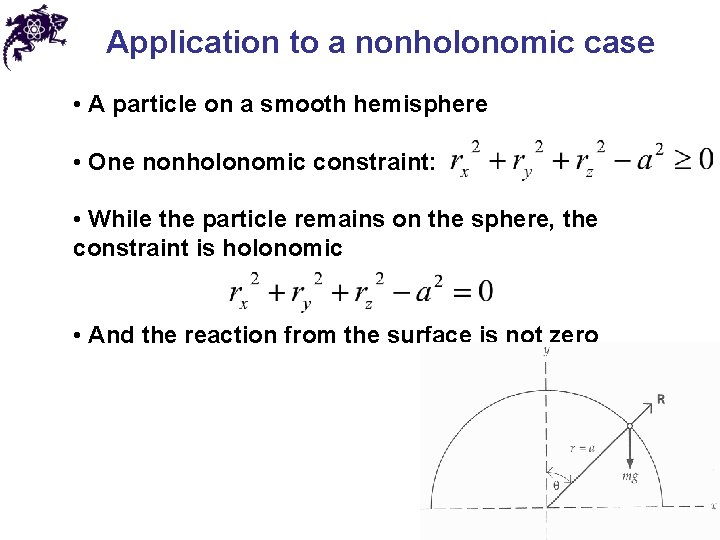
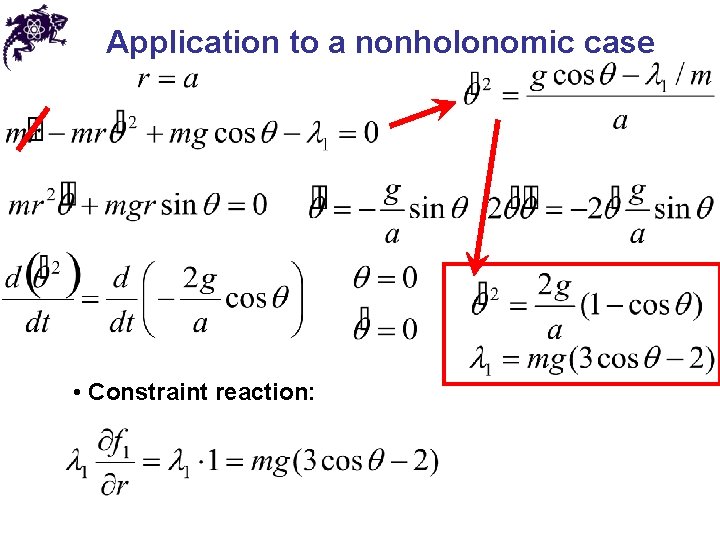
Application to a nonholonomic case • A particle on a smooth hemisphere • One nonholonomic constraint: • While the particle remains on the sphere, the constraint is holonomic • And the reaction from the surface is not zero
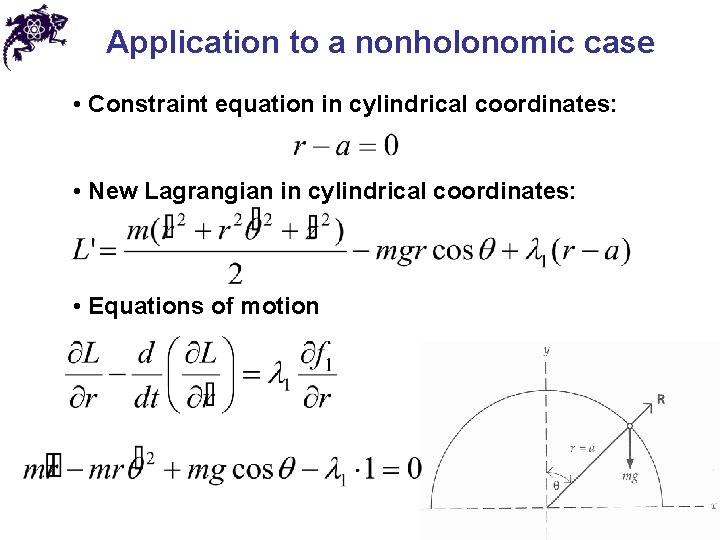
Application to a nonholonomic case • Constraint equation in cylindrical coordinates: • New Lagrangian in cylindrical coordinates: • Equations of motion
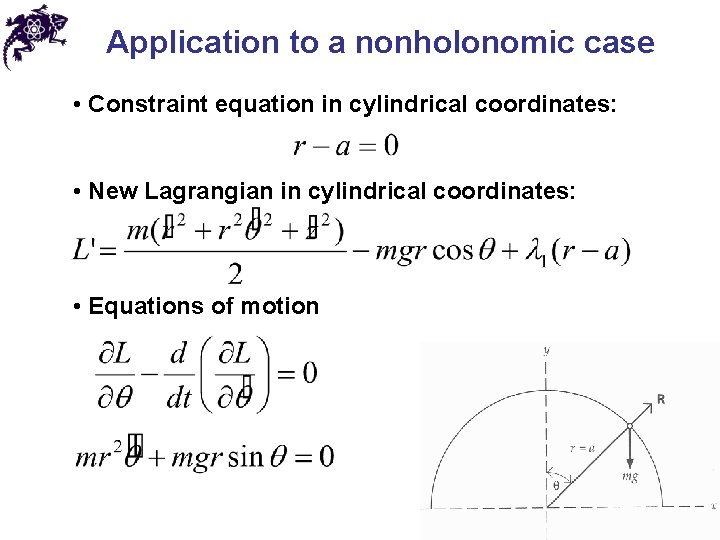
Application to a nonholonomic case • Constraint equation in cylindrical coordinates: • New Lagrangian in cylindrical coordinates: • Equations of motion
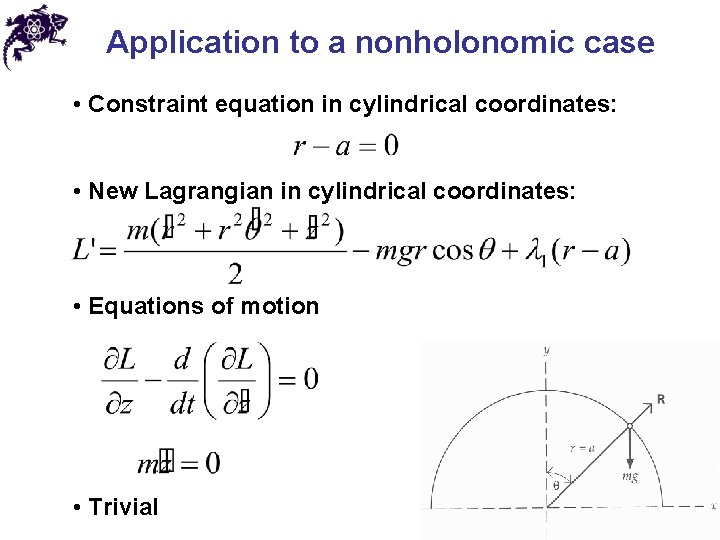
Application to a nonholonomic case • Constraint equation in cylindrical coordinates: • New Lagrangian in cylindrical coordinates: • Equations of motion • Trivial
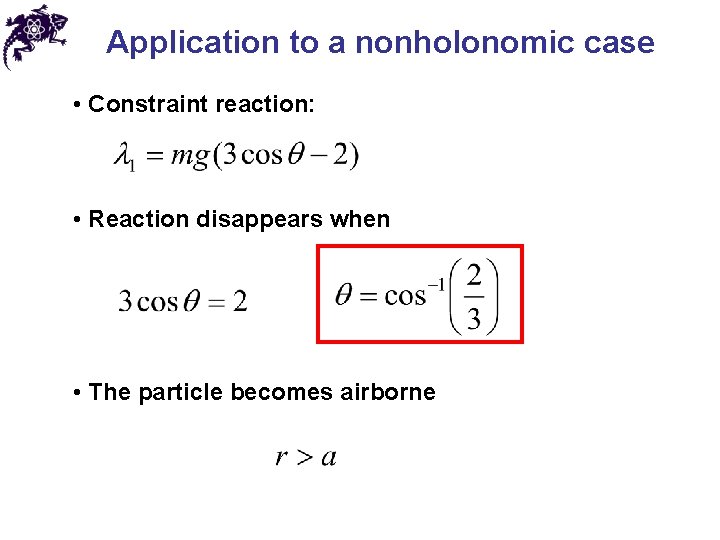
Application to a nonholonomic case • Constraint reaction:
Application to a nonholonomic case • Constraint reaction: • Reaction disappears when • The particle becomes airborne