
Variational filtering in generated coordinates of motion Approximate

- Slides: 37
Variational filtering in generated coordinates of motion Approximate Inference in Stochastic Processes and Dynamical Systems Abstract This presentation reviews variational treatments of dynamic models that furnish timedependent conditional densities on the path or trajectory of a system's states and the time -independent densities of its parameters. These obtain by maximizing a variational action with respect to conditional densities. The action or path-integral of free-energy represents a lower-bound on the model’s log-evidence or marginal likelihood required for model selection and averaging. This approach rests on formulating the optimization in generalized co-ordinates of motion. The resulting scheme can be used for on-line Bayesian inversion of nonlinear dynamic causal models and is shown to outperform existing approaches, such as Kalman and particle filtering. Furthermore, it provides for multiple inference on a models states, parameters and hyperparameters using exactly the same principles. Free-form (Variational filtering) and fixed form (Dynamic Expectation Maximization) variants of the scheme will be demonstrated using simulated (bird-song) and real data (from hemodynamic systems studied in neuroimaging).
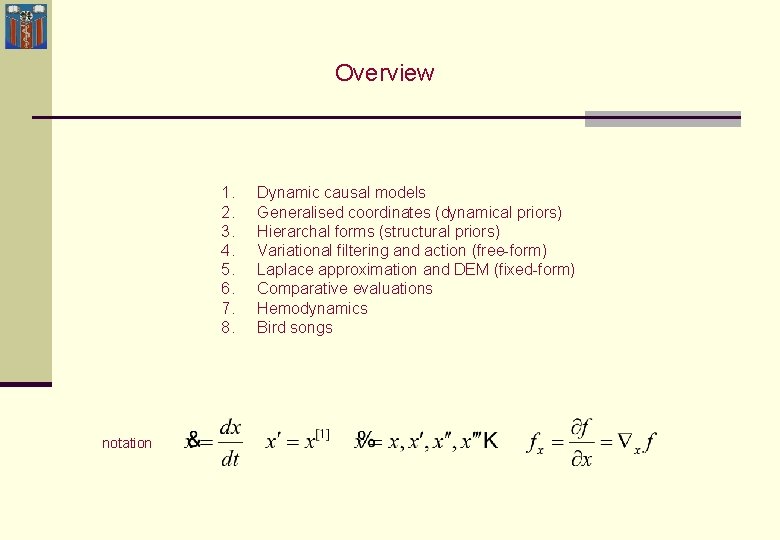
Overview 1. 2. 3. 4. 5. 6. 7. 8. notation Dynamic causal models Generalised coordinates (dynamical priors) Hierarchal forms (structural priors) Variational filtering and action (free-form) Laplace approximation and DEM (fixed-form) Comparative evaluations Hemodynamics Bird songs
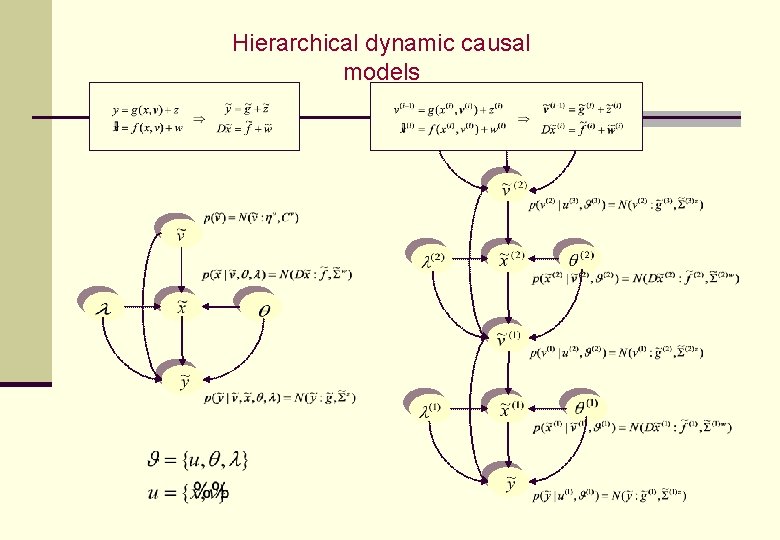
Hierarchical dynamic causal models
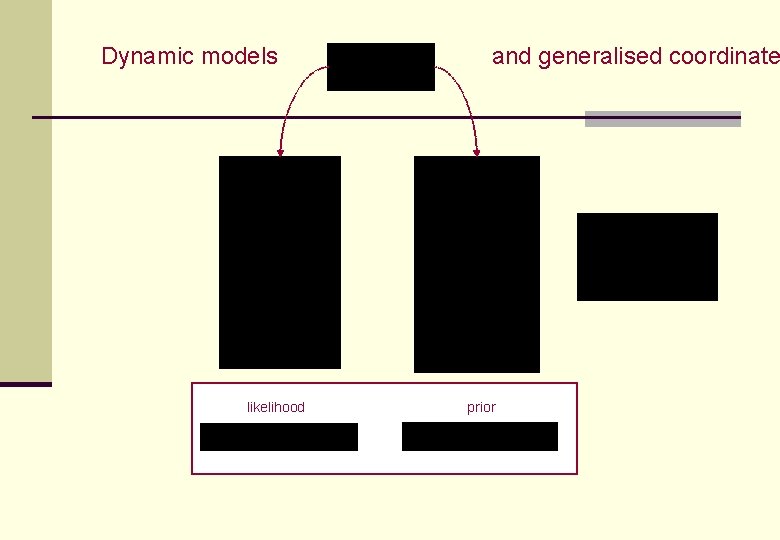
Dynamic models likelihood and generalised coordinate prior
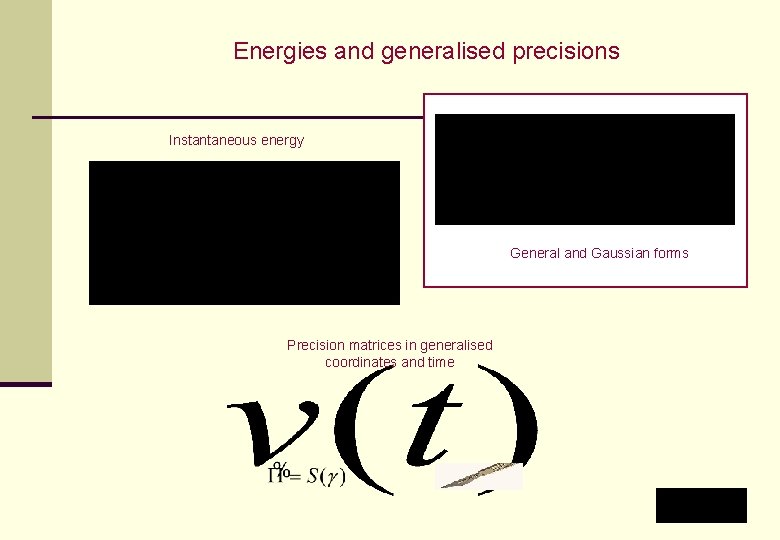
Energies and generalised precisions Instantaneous energy General and Gaussian forms Precision matrices in generalised coordinates and time
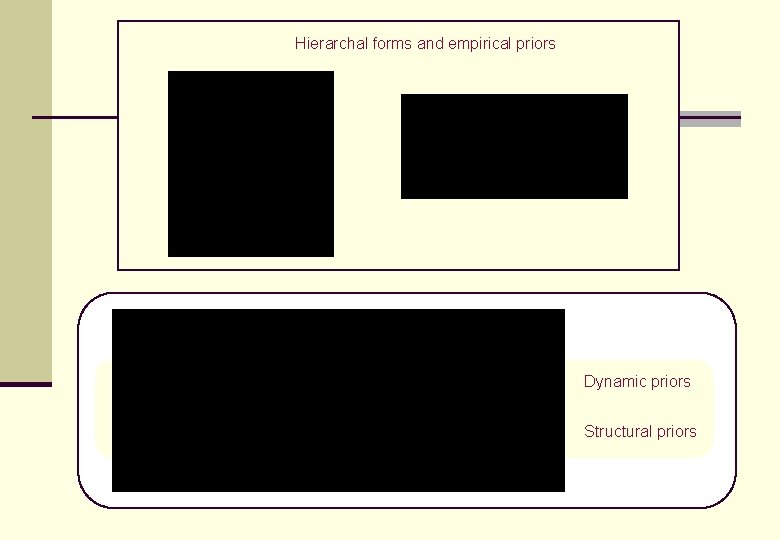
Hierarchal forms and empirical priors Dynamic priors Structural priors
Overview 1. 2. 3. 4. 5. 6. 7. 8. Dynamic causal models Generalised coordinates (dynamical priors) Hierarchal forms (structural priors) Variational filtering and action (free-form) Laplace approximation and DEM (fixed-form) Comparative evaluations Hemodynamics Bird songs
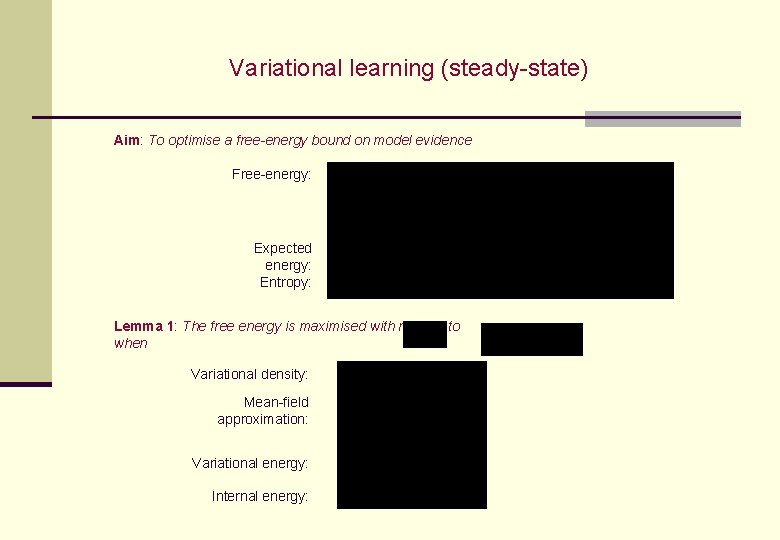
Variational learning (steady-state) Aim: To optimise a free-energy bound on model evidence Free-energy: Expected energy: Entropy: Lemma 1: The free energy is maximised with respect to when Variational density: Mean-field approximation: Variational energy: Internal energy:
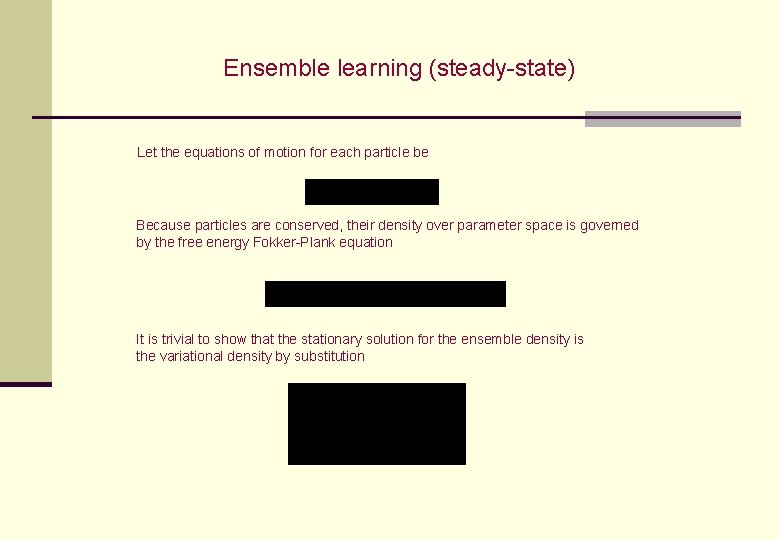
Ensemble learning (steady-state) Let the equations of motion for each particle be Because particles are conserved, their density over parameter space is governed by the free energy Fokker-Plank equation It is trivial to show that the stationary solution for the ensemble density is the variational density by substitution
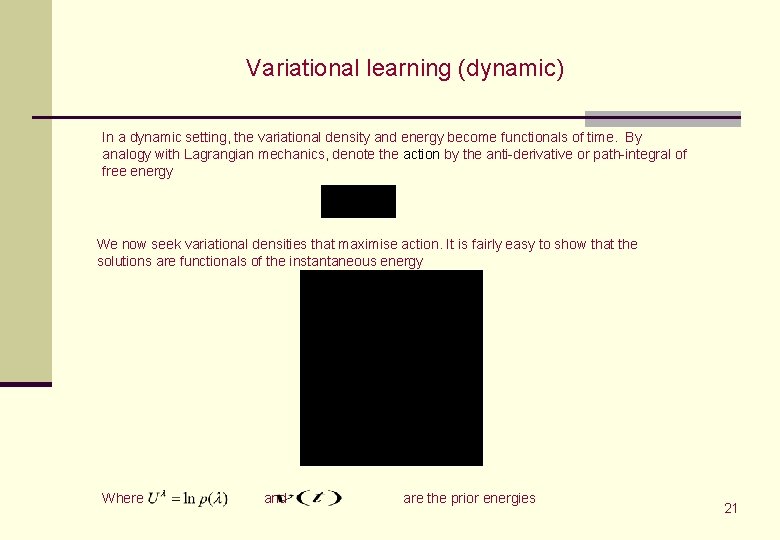
Variational learning (dynamic) In a dynamic setting, the variational density and energy become functionals of time. By analogy with Lagrangian mechanics, denote the action by the anti-derivative or path-integral of free energy We now seek variational densities that maximise action. It is fairly easy to show that the solutions are functionals of the instantaneous energy Where and are the prior energies 21
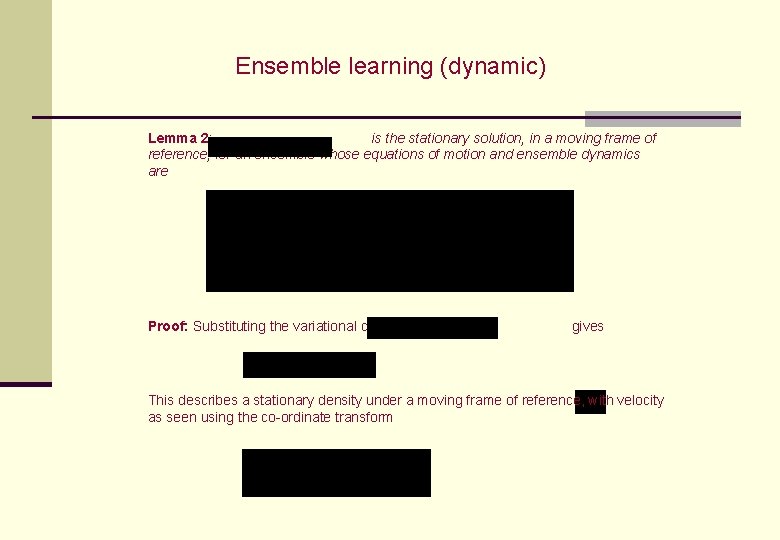
Ensemble learning (dynamic) Lemma 2: is the stationary solution, in a moving frame of reference, for an ensemble whose equations of motion and ensemble dynamics are Proof: Substituting the variational density; gives This describes a stationary density under a moving frame of reference, with velocity as seen using the co-ordinate transform
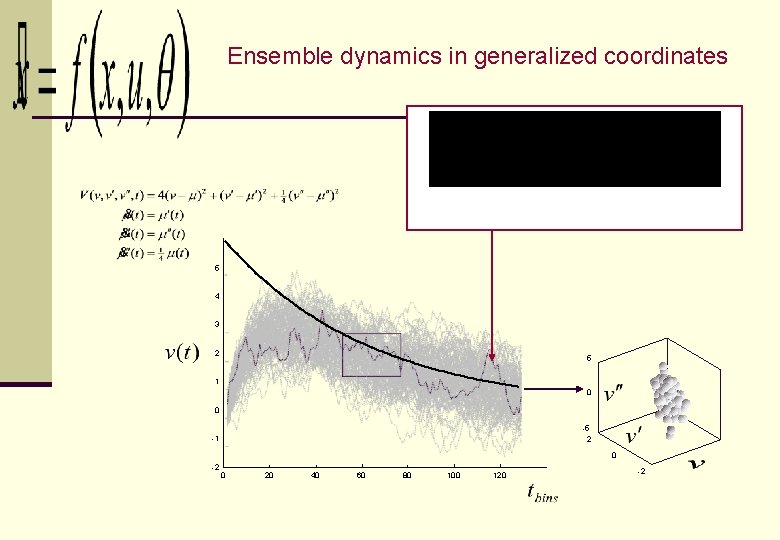
Ensemble dynamics in generalized coordinates 5 4 3 2 5 1 0 0 -5 2 -1 0 -2 0 20 40 60 80 100 120 -2
Overview 1. 2. 3. 4. 5. 6. 7. 8. Dynamic causal models Generalised coordinates (dynamical priors) Hierarchal forms (structural priors) Variational filtering and action (free-form) Laplace approximation and DEM (fixed-form) Comparative evaluations Hemodynamics Bird songs
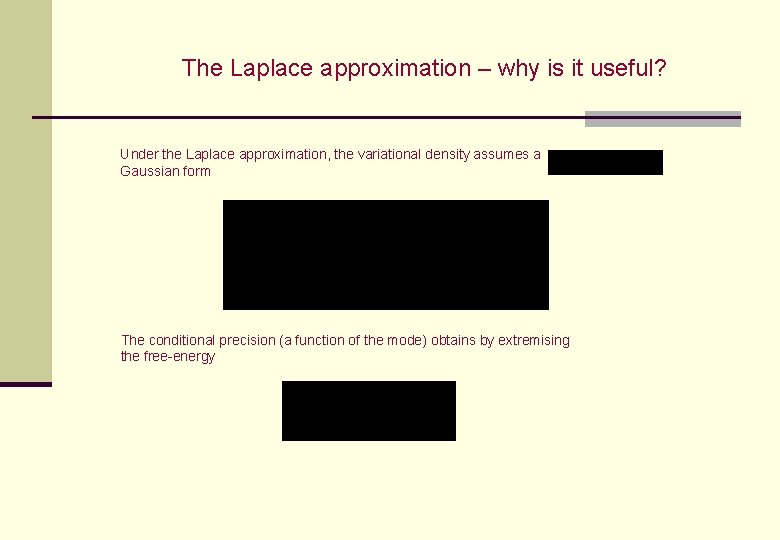
The Laplace approximation – why is it useful? Under the Laplace approximation, the variational density assumes a Gaussian form The conditional precision (a function of the mode) obtains by extremising the free-energy
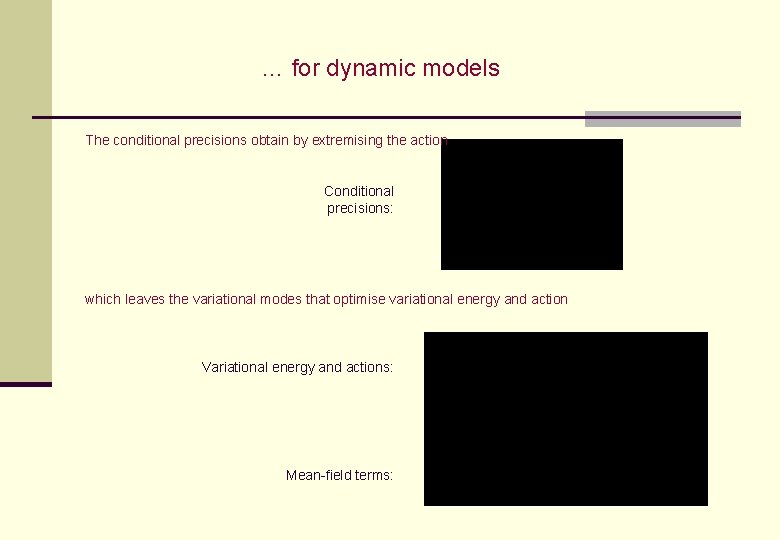
… for dynamic models The conditional precisions obtain by extremising the action Conditional precisions: which leaves the variational modes that optimise variational energy and action Variational energy and actions: Mean-field terms:
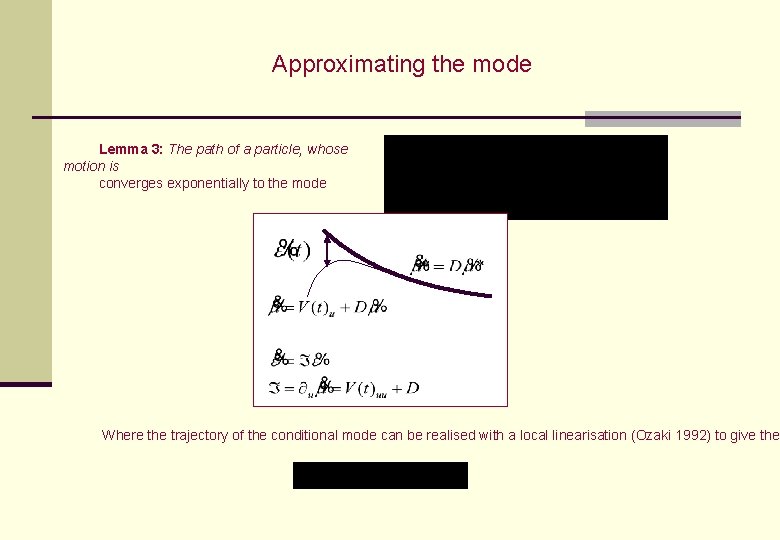
Approximating the mode Lemma 3: The path of a particle, whose motion is converges exponentially to the mode Where the trajectory of the conditional mode can be realised with a local linearisation (Ozaki 1992) to give the
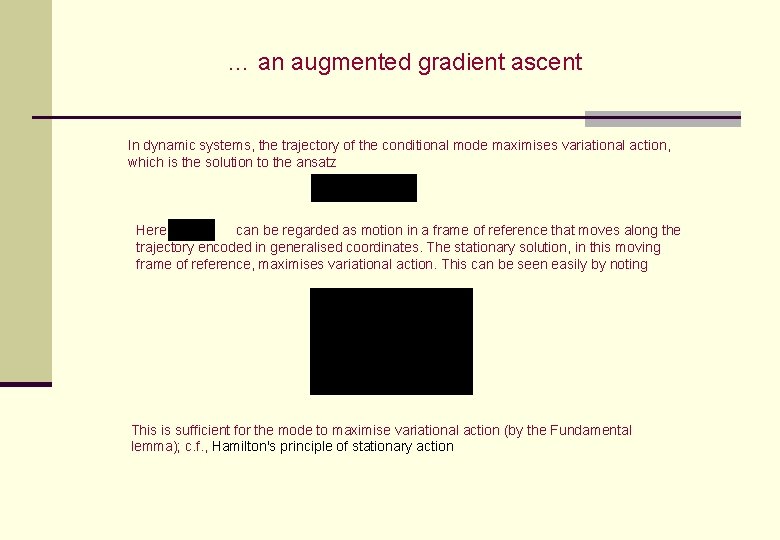
… an augmented gradient ascent In dynamic systems, the trajectory of the conditional mode maximises variational action, which is the solution to the ansatz Here, can be regarded as motion in a frame of reference that moves along the trajectory encoded in generalised coordinates. The stationary solution, in this moving frame of reference, maximises variational action. This can be seen easily by noting This is sufficient for the mode to maximise variational action (by the Fundamental lemma); c. f. , Hamilton's principle of stationary action
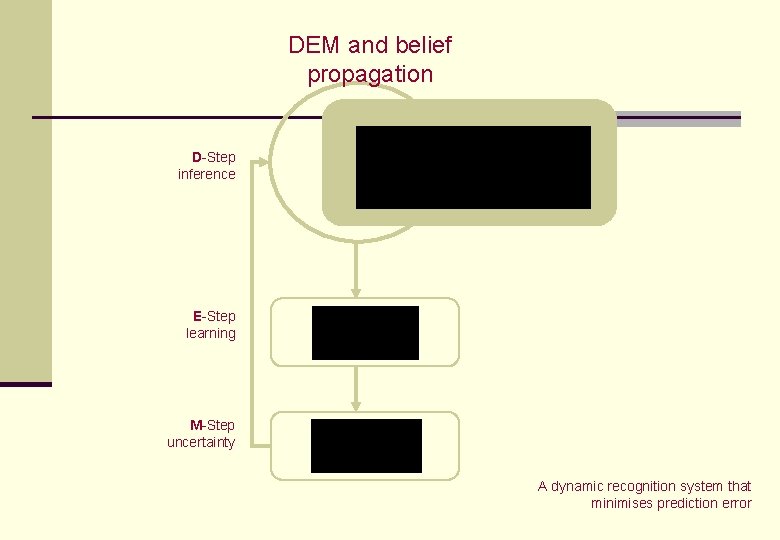
DEM and belief propagation D-Step inference E-Step learning M-Step uncertainty A dynamic recognition system that minimises prediction error
Overview 1. 2. 3. 4. 5. 6. 7. 8. Dynamic causal models Generalised coordinates (dynamical priors) Hierarchal forms (structural priors) Variational filtering and action (free-form) Laplace approximation and DEM (fixed-form) Comparative evaluations Hemodynamics Bird songs
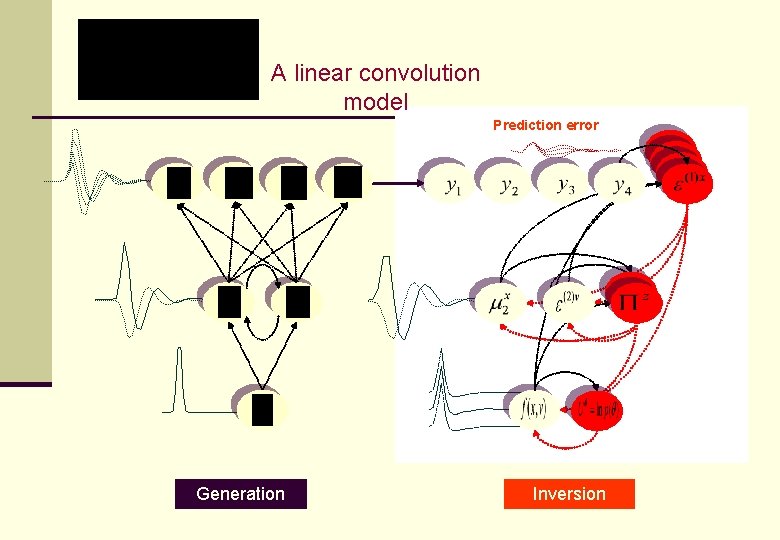
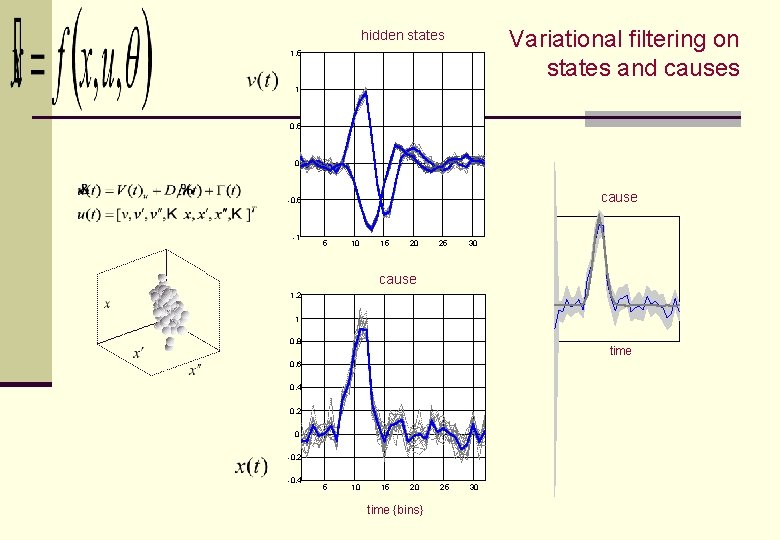
A linear convolution model Prediction error Generation Inversion
Variational filtering on states and causes hidden states 1. 5 1 0. 5 0 cause -0. 5 -1 5 10 15 20 25 30 cause 1. 2 1 0. 8 time 0. 6 0. 4 0. 2 0 -0. 2 -0. 4 5 10 15 20 time {bins} 25 30
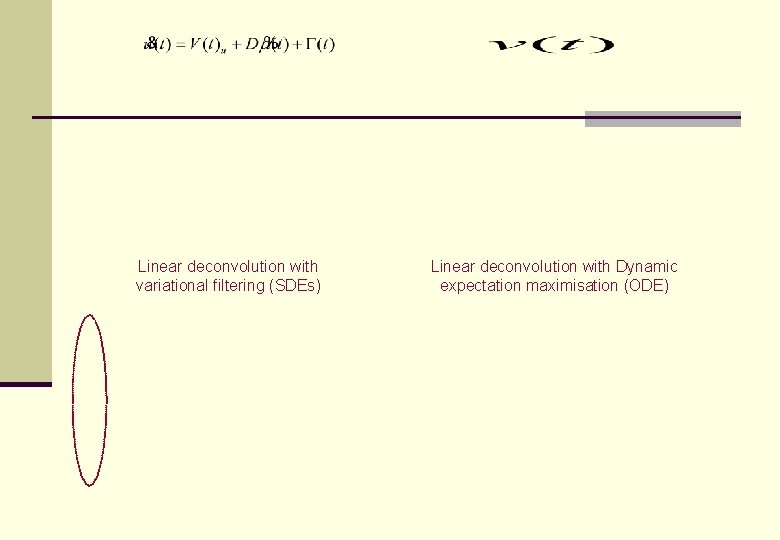
Linear deconvolution with variational filtering (SDEs) Linear deconvolution with Dynamic expectation maximisation (ODE)
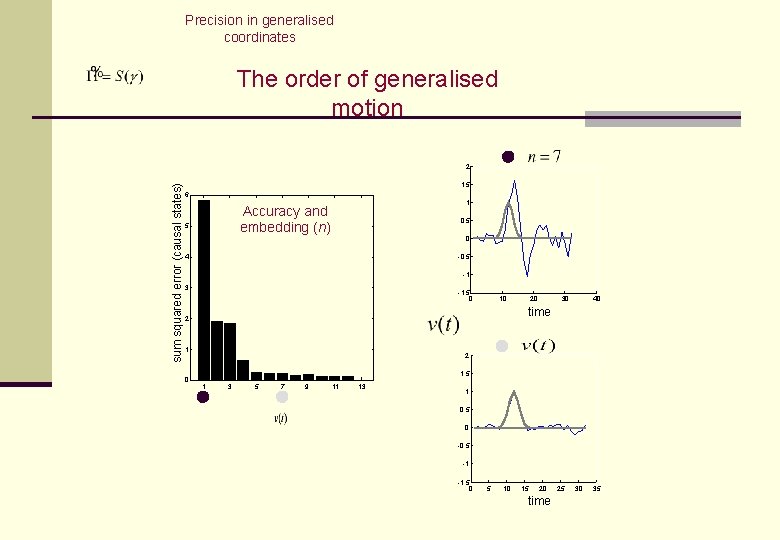
Precision in generalised coordinates The order of generalised motion sum squared error (causal states) 2 1. 5 6 1 Accuracy and embedding (n) 5 0 -0. 5 4 -1 3 -1. 5 0 10 2 1 0 20 30 40 time 2 1. 5 1 3 5 7 9 11 13 1 0. 5 0 -0. 5 -1 -1. 5 0 5 10 15 20 time 25 30 35
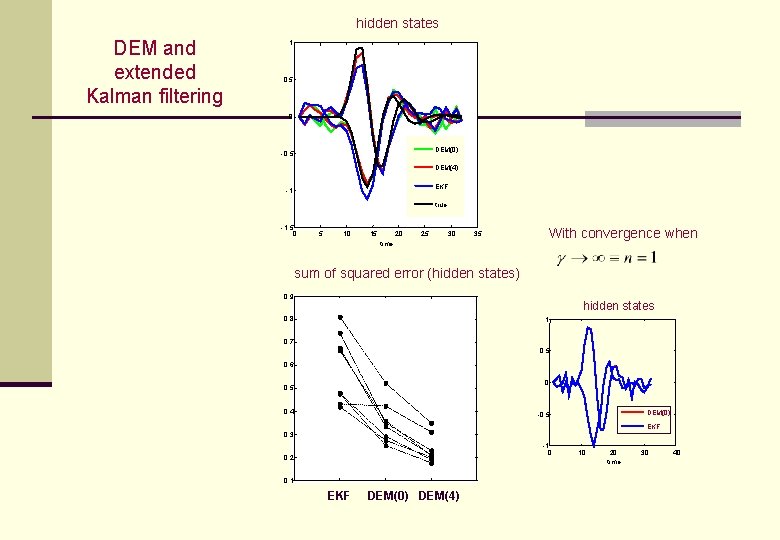
hidden states DEM and extended Kalman filtering 1 0. 5 0 DEM(0) -0. 5 DEM(4) EKF -1 true -1. 5 0 5 10 15 20 25 30 35 time With convergence when sum of squared error (hidden states) 0. 9 hidden states 0. 8 1 0. 7 0. 5 0. 6 0 0. 5 0. 4 DEM(0) -0. 5 EKF 0. 3 -1 0 0. 2 0. 1 EKF DEM(0) DEM(4) 10 20 time 30 40
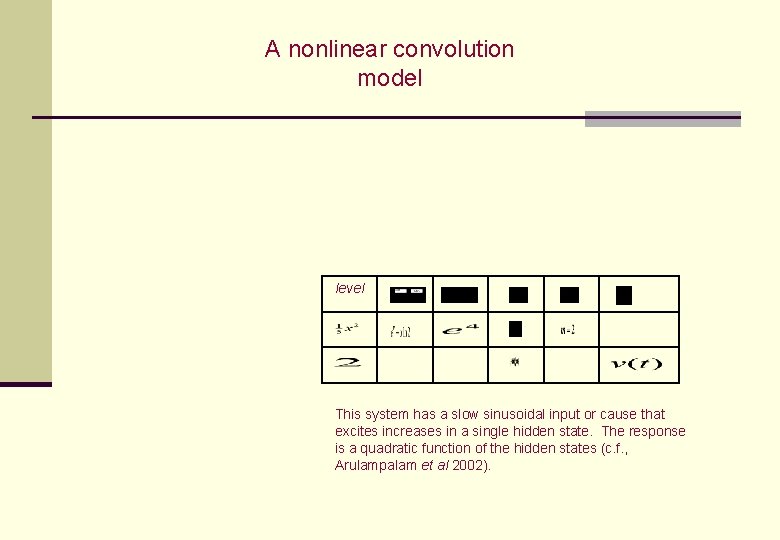
A nonlinear convolution model level This system has a slow sinusoidal input or cause that excites increases in a single hidden state. The response is a quadratic function of the hidden states (c. f. , Arulampalam et al 2002).
DEM and particle filtering Sum of squared error Comparative performance
Inference on states Triple estimation (DEM) Learning parameters
Overview 1. 2. 3. 4. 5. 6. 7. 8. Dynamic causal models Generalised coordinates (dynamical priors) Hierarchal forms (structural priors) Variational filtering and action (free-form) Laplace approximation and DEM (fixed-form) Comparative evaluations Hemodynamics Bird songs
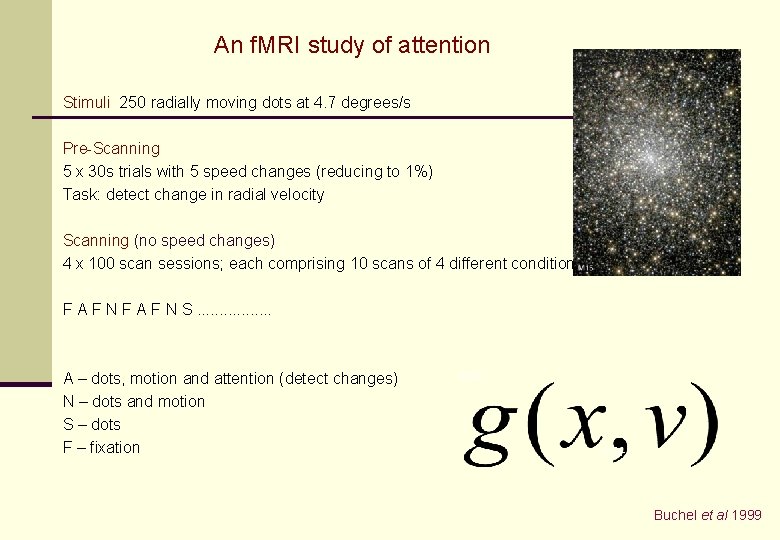
An f. MRI study of attention Stimuli 250 radially moving dots at 4. 7 degrees/s Pre-Scanning 5 x 30 s trials with 5 speed changes (reducing to 1%) Task: detect change in radial velocity Scanning (no speed changes) 4 x 100 scan sessions; each comprising 10 scans of 4 different conditions F A F N S. . . . A – dots, motion and attention (detect changes) N – dots and motion S – dots F – fixation PPC V 5+ Buchel et al 1999
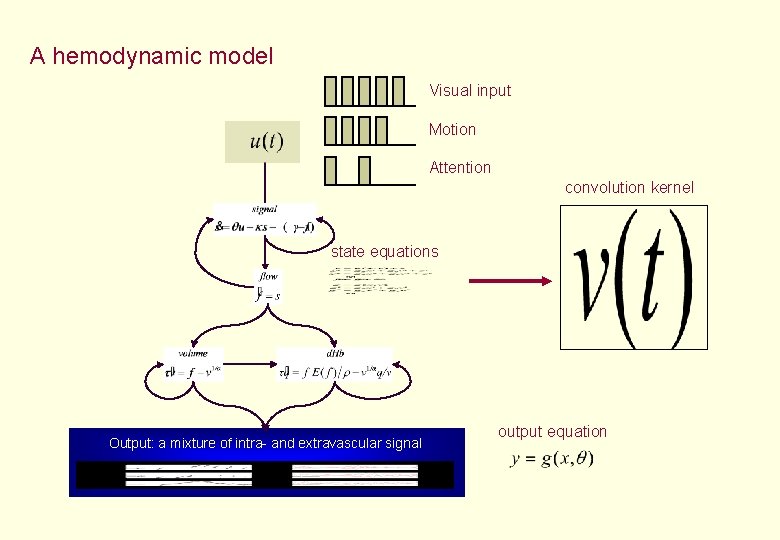
A hemodynamic model Visual input Motion Attention convolution kernel state equations Output: a mixture of intra- and extravascular signal output equation
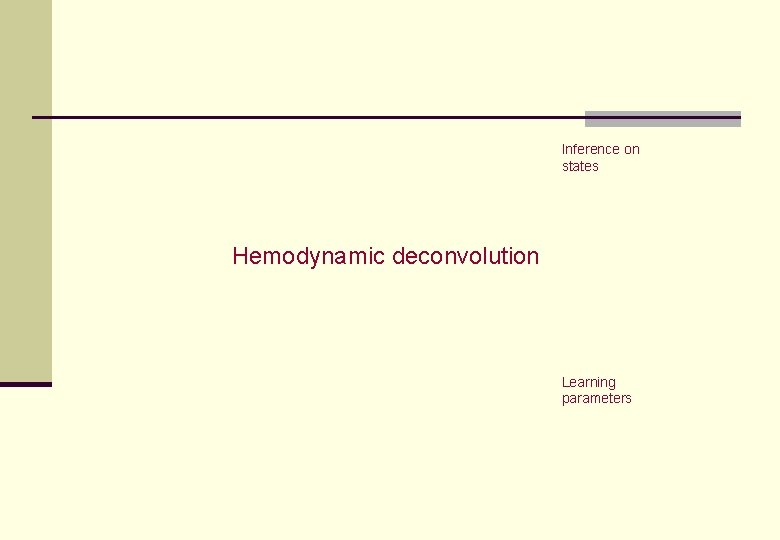
Inference on states Hemodynamic deconvolution Learning parameters
… and a closer look at the states
Overview 1. 2. 3. 4. 5. 6. 7. 8. Dynamic causal models Generalised coordinates (dynamical priors) Hierarchal forms (structural priors) Variational filtering and action (free-form) Laplace approximation and DEM (fixed-form) Comparative evaluations Hemodynamics Bird songs
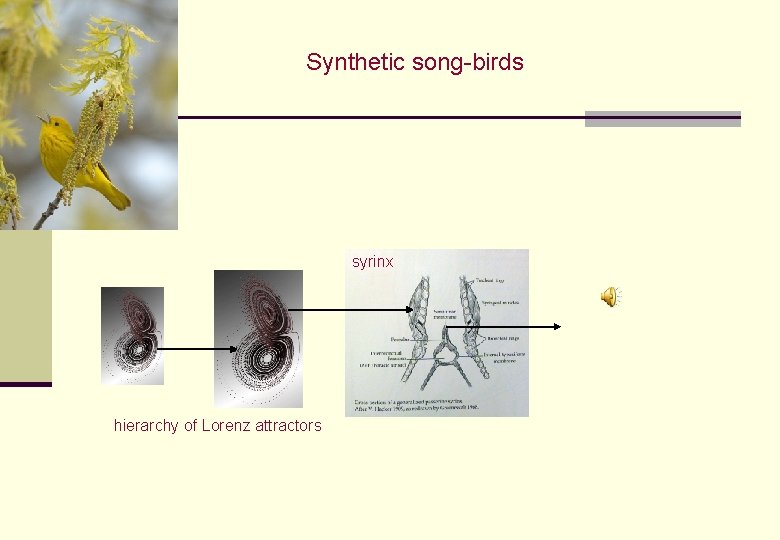
Synthetic song-birds syrinx hierarchy of Lorenz attractors
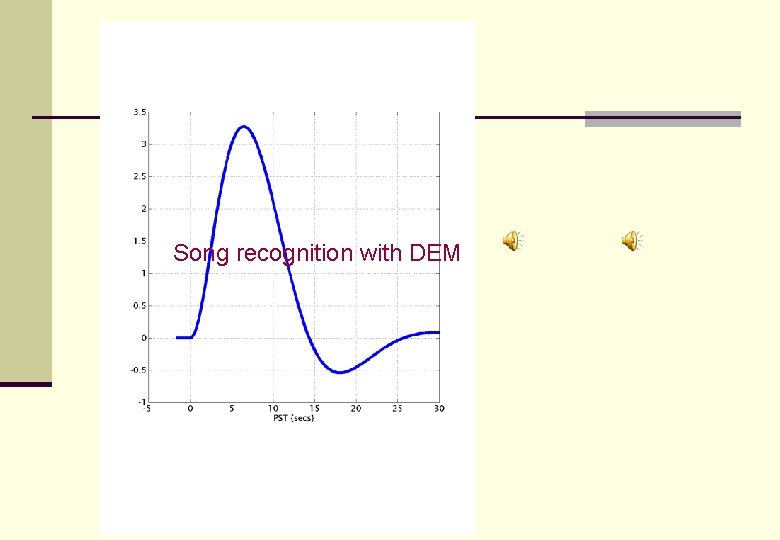
Song recognition with DEM
… and broken birds
Summary 1. 2. 3. 4. 5. 6. 7. 8. Dynamic causal models Generalised coordinates (dynamical priors) Hierarchal forms (structural priors) Variational filtering and action (free-form) Laplace approximation and DEM (fixed-form) Comparative evaluations Hemodynamics Bird songs