
Variation Anne Watson John Mason South West Mathematics

- Slides: 24
Variation Anne Watson & John Mason South West Mathematics PD Providers Conference Jurassic Maths Hub Exeter Sept 2018
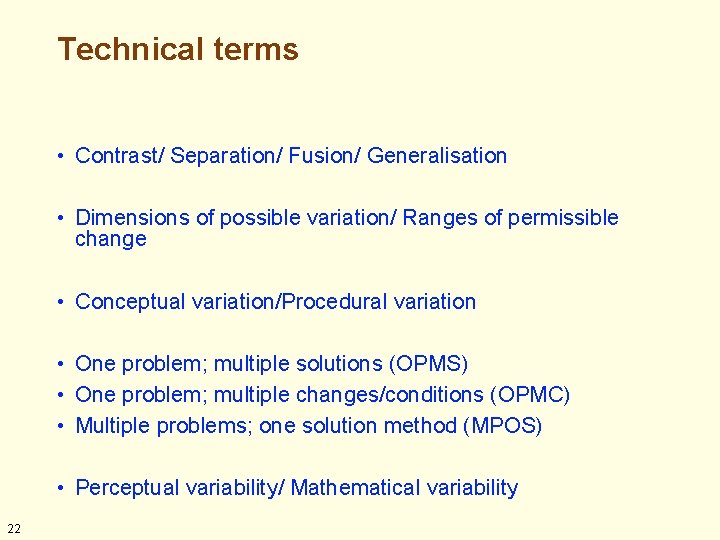
Technical terms • Contrast/ Separation/ Fusion/ Generalisation • Dimensions of possible variation/ Ranges of permissible change • Conceptual variation/Procedural variation • One problem; multiple solutions (OPMS) • One problem; multiple changes/conditions (OPMC) • Multiple problems; one solution method (MPOS) • Perceptual variability/ Mathematical variability 2
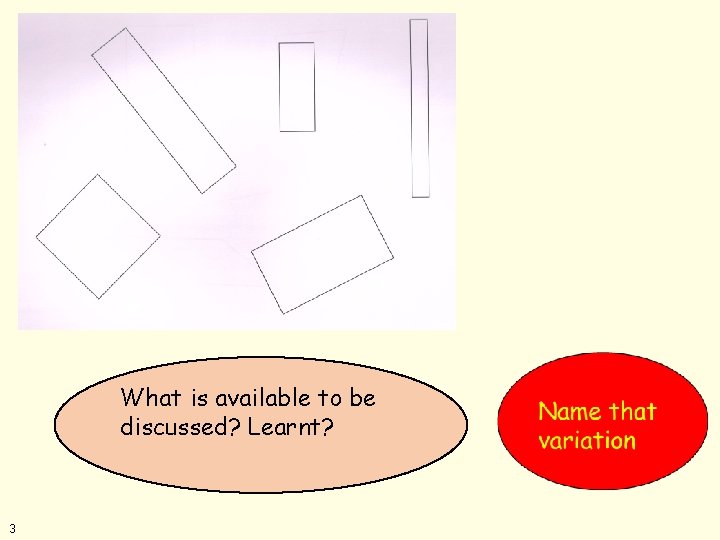
What is available to be discussed? Learnt? 3
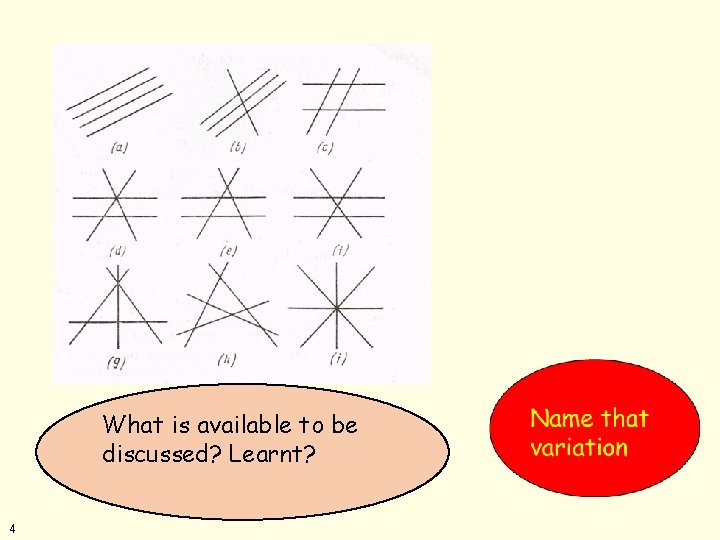
What is available to be discussed? Learnt? 4
t is available to be ussed? Learnt? Name that variation 5
3 6 s available to be sed? Learnt? 3 4 Name that variation 6
7
hat is available to be cussed? Learnt? 9
What is available to be discussed? Learnt? 10
11 What is available to be discussed? Learnt?
What is available to be discussed? Learnt? 12
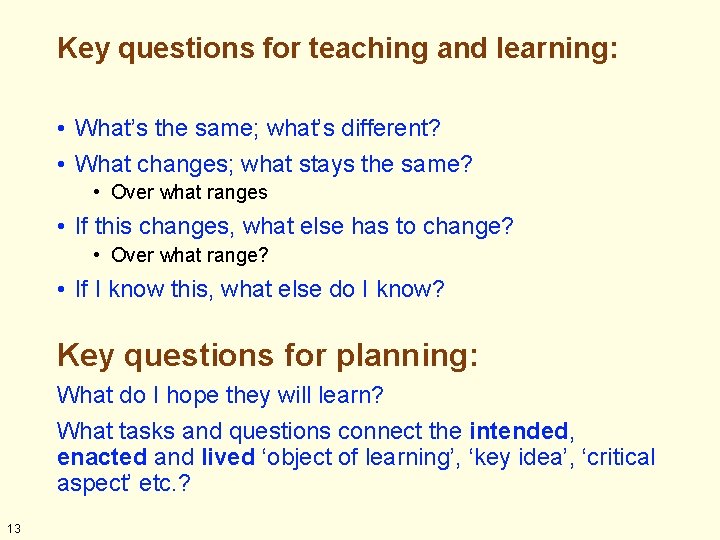
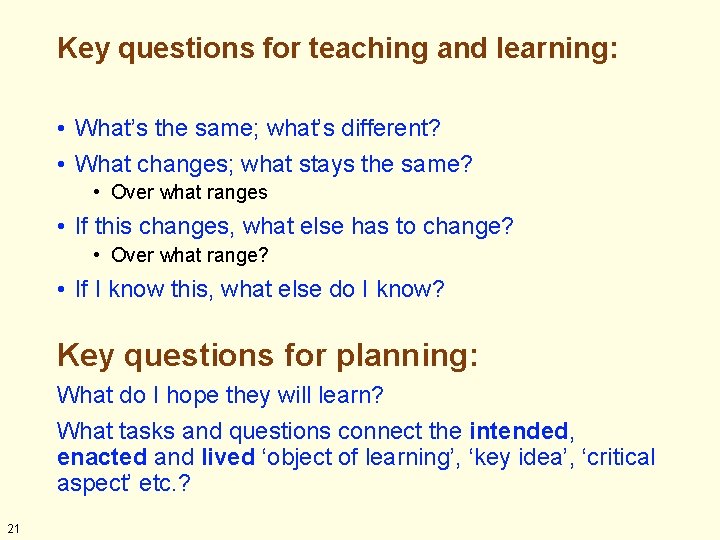
Key questions for teaching and learning: • What’s the same; what’s different? • What changes; what stays the same? • Over what ranges • If this changes, what else has to change? • Over what range? • If I know this, what else do I know? Key questions for planning: What do I hope they will learn? What tasks and questions connect the intended, enacted and lived ‘object of learning’, ‘key idea’, ‘critical aspect’ etc. ? 13
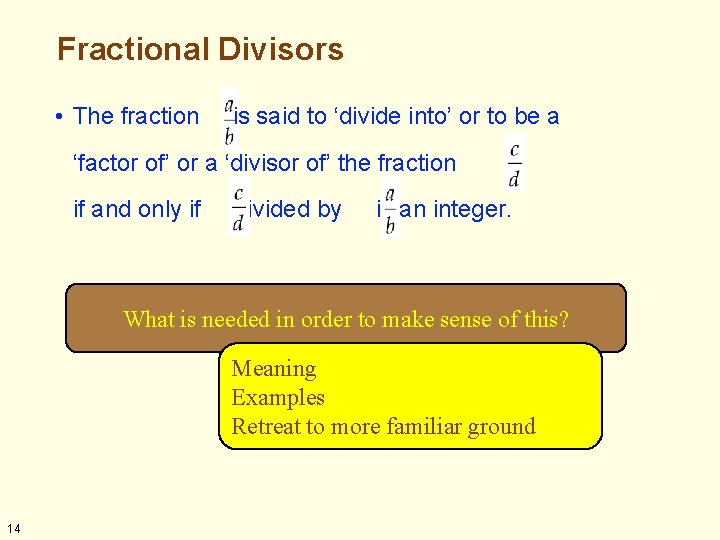
Fractional Divisors • The fraction is said to ‘divide into’ or to be a ‘factor of’ or a ‘divisor of’ the fraction if and only if divided by is an integer. What is needed in order to make sense of this? Meaning Examples Retreat to more familiar ground 14
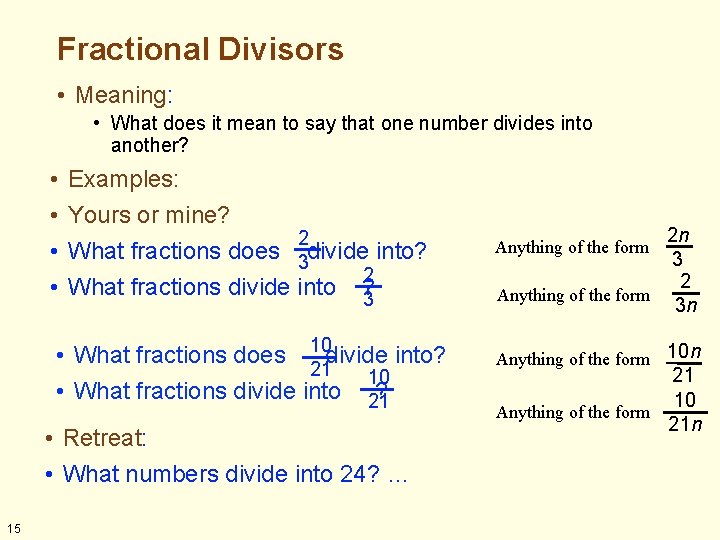
Fractional Divisors • Meaning: • What does it mean to say that one number divides into another? • • Examples: Yours or mine? 2 What fractions does divide into? 3 2 What fractions divide into ? 3 10 • What fractions does divide into? 21 10 • What fractions divide into ? 21 • Retreat: • What numbers divide into 24? … 15 2 n 3 2 Anything of the form 3 n Anything of the form 10 n 21 10 Anything of the form 21 n
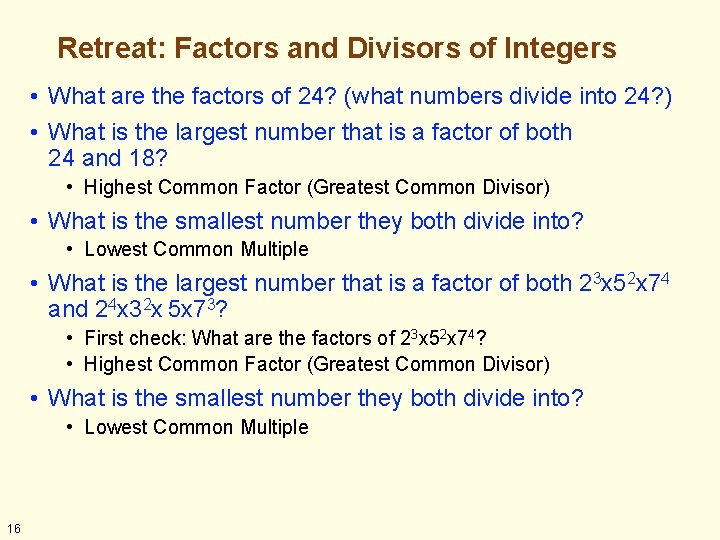
Retreat: Factors and Divisors of Integers • What are the factors of 24? (what numbers divide into 24? ) • What is the largest number that is a factor of both 24 and 18? • Highest Common Factor (Greatest Common Divisor) • What is the smallest number they both divide into? • Lowest Common Multiple • What is the largest number that is a factor of both 23 x 52 x 74 and 24 x 32 x 5 x 73? • First check: What are the factors of 23 x 52 x 74? • Highest Common Factor (Greatest Common Divisor) • What is the smallest number they both divide into? • Lowest Common Multiple 16
LCM & HCF of Rational Numbers • How do you find the LCM and the HCF of two rational numbers? • Does it make sense (suppose you use different fractions for the same rational)? 17
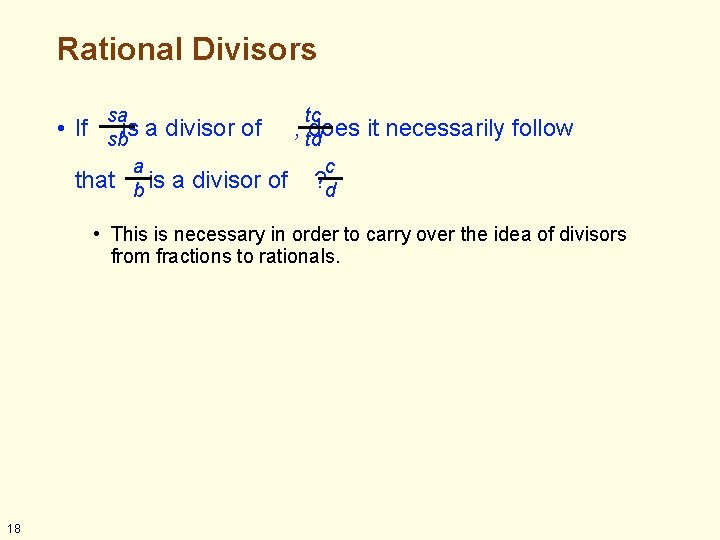
Rational Divisors sa • If sb is a divisor of a tc , td does it necessarily follow c that is a divisor of ? b d • This is necessary in order to carry over the idea of divisors from fractions to rationals. 18
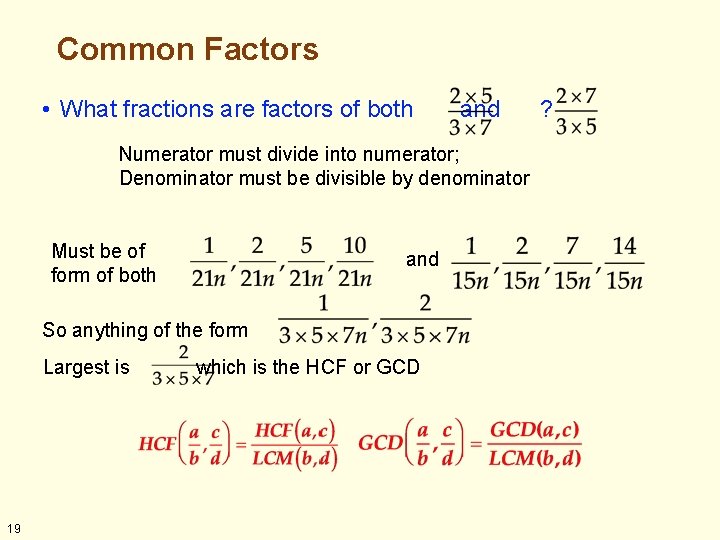
Common Factors • What fractions are factors of both and ? Numerator must divide into numerator; Denominator must be divisible by denominator Must be of form of both and So anything of the form Largest is which is the HCF or GCD 19
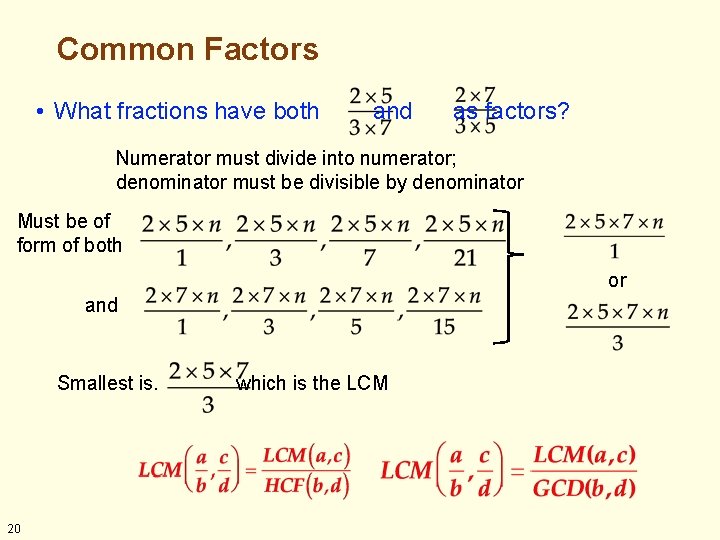
Common Factors • What fractions have both and as factors? Numerator must divide into numerator; denominator must be divisible by denominator Must be of form of both or and Smallest is. which is the LCM 20
Key questions for teaching and learning: • What’s the same; what’s different? • What changes; what stays the same? • Over what ranges • If this changes, what else has to change? • Over what range? • If I know this, what else do I know? Key questions for planning: What do I hope they will learn? What tasks and questions connect the intended, enacted and lived ‘object of learning’, ‘key idea’, ‘critical aspect’ etc. ? 21
Technical terms • Contrast/ Separation/ Fusion/ Generalisation • Dimensions of possible variation/ Ranges of permissible change • Conceptual variation/Procedural variation • One problem; multiple solutions (OPMS) • One problem; multiple changes/conditions (OPMC) • Multiple problems; one solution method (MPOS) • Perceptual variability/ Mathematical variability 22
Reflection • What forms of variation did you detect? • What further variation would you require in order to develop fluency, appreciation and comprehension? • Could you do that varying for yourself? 23
Follow-Up • Variation unplugged www. pmtheta. com (Anne. W) • Variation in mathematics (2018) Association of Teachers of Mathematics (Anne. W) • Anne Watson & John Mason (2006) Variation and mathematical structure, Mathematics Teaching, 194 (ATM). • These PPT slides PMTheta. com (joint presentations) 24
Discussion • What is more important to teachers … … identifying and naming different forms of variation? 25 … developing pedagogic insight around key mathematical ideas?