
Variance Shadow Maps Andrew Lauritzen Rapid Mind Overview


- Slides: 42
Variance Shadow Maps Andrew Lauritzen, Rapid. Mind
Overview of Shadow Mapping Introduced by Williams in 1978 Advantages compared to shadow volumes: Cost less sensitive to geometric complexity Can be queried at arbitrary locations Often easier to implement Disadvantages: Aliasing Copyright © NVIDIA Corporation 2004
Shadow Mapping Algorithm Render scene from light’s point of view Store depth of each pixel When shading a surface: Transform surface point into light coordinates Compare current surface depth to stored depth If depth > stored depth, the pixel is in shadow; otherwise the pixel is lit Copyright © NVIDIA Corporation 2004
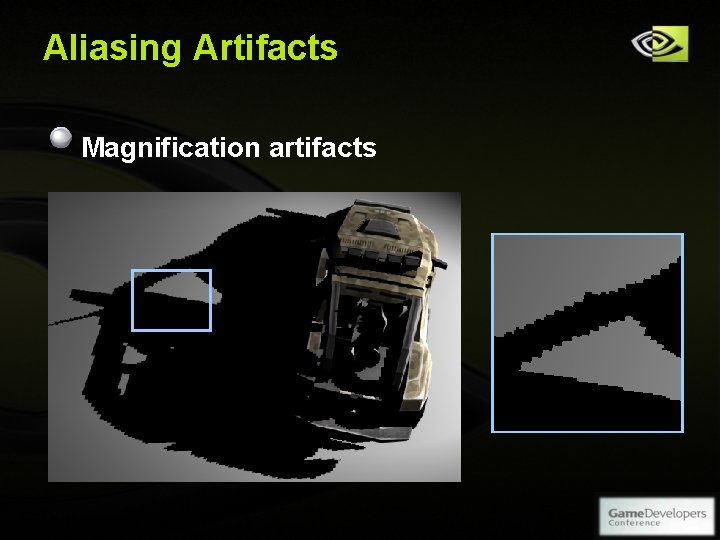
Aliasing Artifacts Magnification artifacts Copyright © NVIDIA Corporation 2004
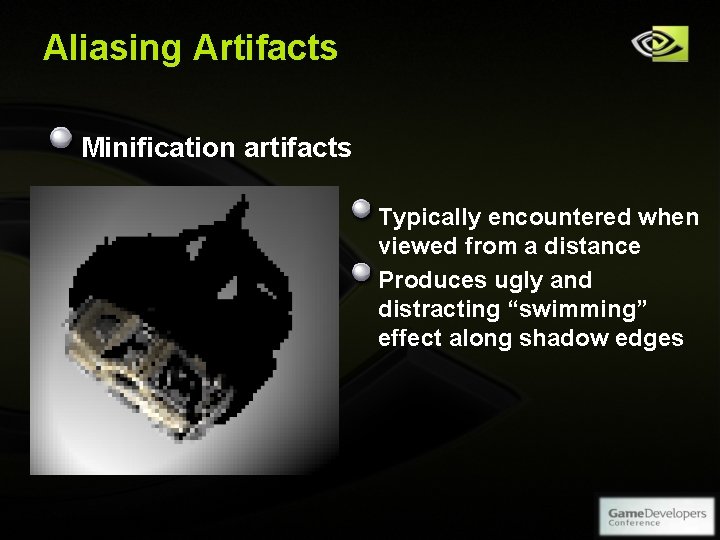
Aliasing Artifacts Minification artifacts Typically encountered when viewed from a distance Produces ugly and distracting “swimming” effect along shadow edges Copyright © NVIDIA Corporation 2004
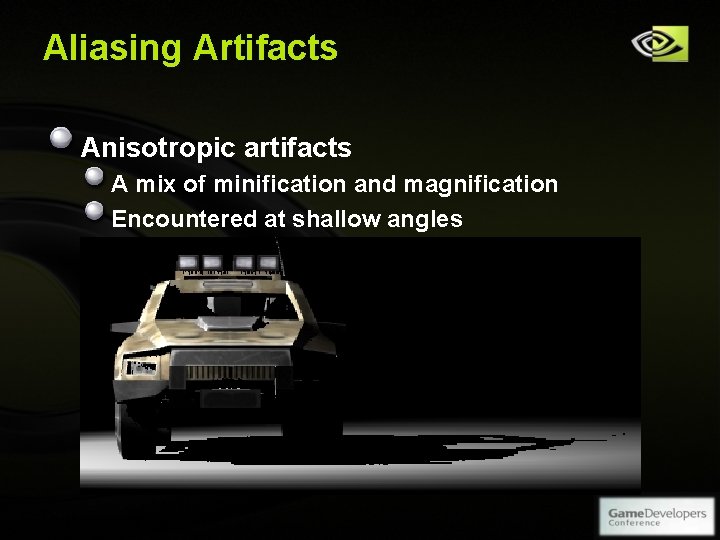
Aliasing Artifacts Anisotropic artifacts A mix of minification and magnification Encountered at shallow angles Copyright © NVIDIA Corporation 2004
Solutions? Also encountered with colour textures Reduce aliasing by hardware filtering Magnification artifacts => linear interpolation Minification artifacts => trilinear, mipmapping Anisotropic artifacts => anisotropic filtering Copyright © NVIDIA Corporation 2004
Solutions? Can we apply these to shadow maps? Not at the moment Interpolating depths is incorrect Gives depth < average(occluder_depth) Want average(depth < occluder_depth) Copyright © NVIDIA Corporation 2004
Percentage Closer Filtering Proposed by Reeves et al. in 1987 Filter result of the depth comparison Sample surrounding shadow map pixels Do a depth comparison for each pixel Percentage lit is the percentage of pixels that pass the depth comparison (i. e. are “closer” than the nearest occluder) NVIDIA hardware support for bilinear PCF Good results, but can be expensive! Copyright © NVIDIA Corporation 2004
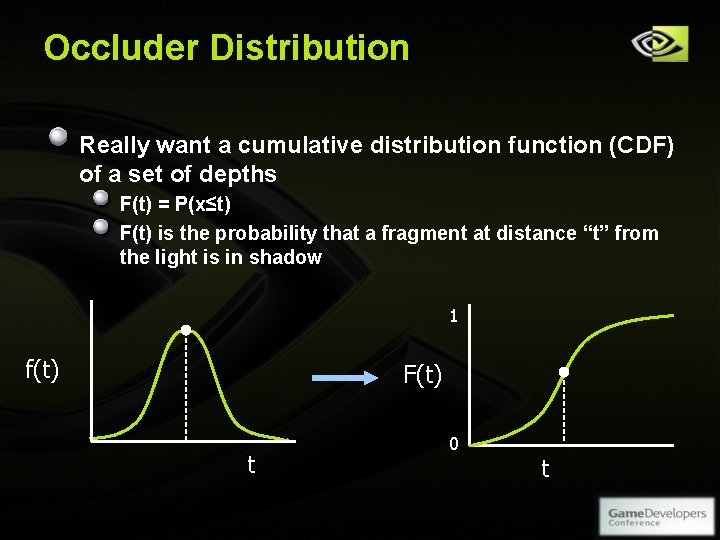
Occluder Distribution Really want a cumulative distribution function (CDF) of a set of depths F(t) = P(x≤t) F(t) is the probability that a fragment at distance “t” from the light is in shadow 1 f(t) F(t) t Copyright © NVIDIA Corporation 2004 0 t
Deep Shadow Maps Lokovic and Veach, in 2000 Per-pixel piecewise linear function No hardware filtering Complex reconstruction Copyright © NVIDIA Corporation 2004
Occluder Distribution A representation that filters linearly? Allows us to utilize hardware filtering Idea: Moments of distribution function! E(x) is the mean, E(x 2), E(x 3), etc. Linear in distribution Copyright © NVIDIA Corporation 2004
Variance Shadow Maps Store depth squared as well as depth Gives E(x) and E(x 2) where x is the depth of the nearest occluder Use the moments to approximate the fraction of the distribution that is more distant than the surface point being shaded Copyright © NVIDIA Corporation 2004
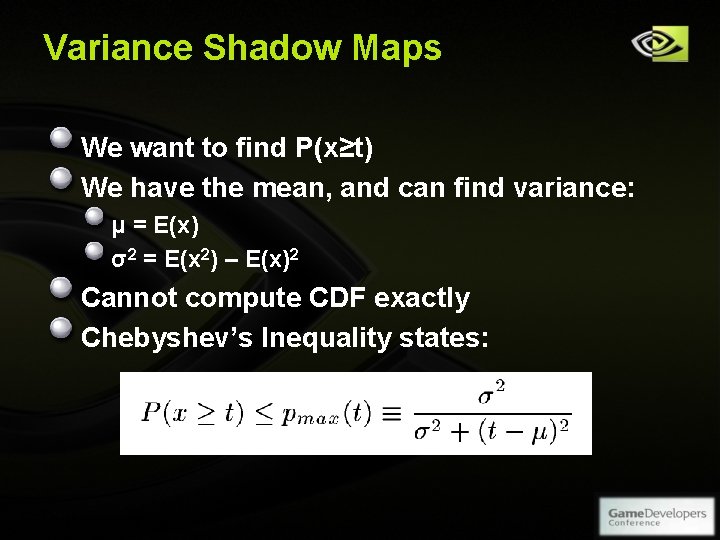
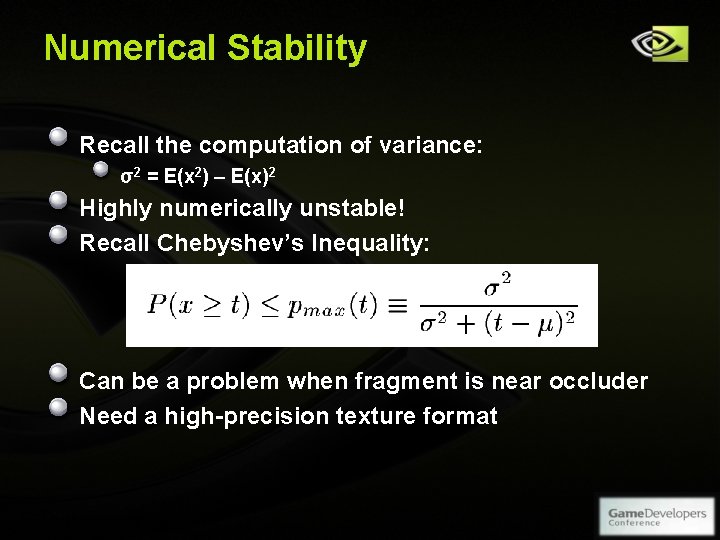
Variance Shadow Maps We want to find P(x≥t) We have the mean, and can find variance: μ = E(x) σ2 = E(x 2) – E(x)2 Cannot compute CDF exactly Chebyshev’s Inequality states: Copyright © NVIDIA Corporation 2004
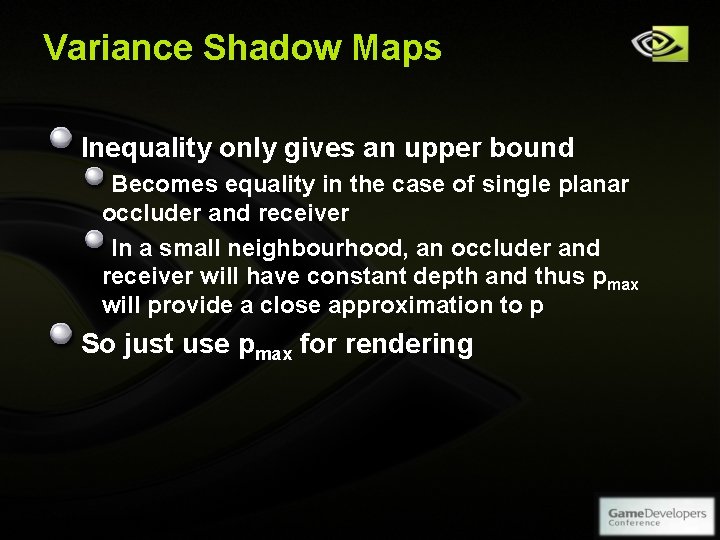
Variance Shadow Maps Inequality only gives an upper bound Becomes equality in the case of single planar occluder and receiver In a small neighbourhood, an occluder and receiver will have constant depth and thus pmax will provide a close approximation to p So just use pmax for rendering Copyright © NVIDIA Corporation 2004
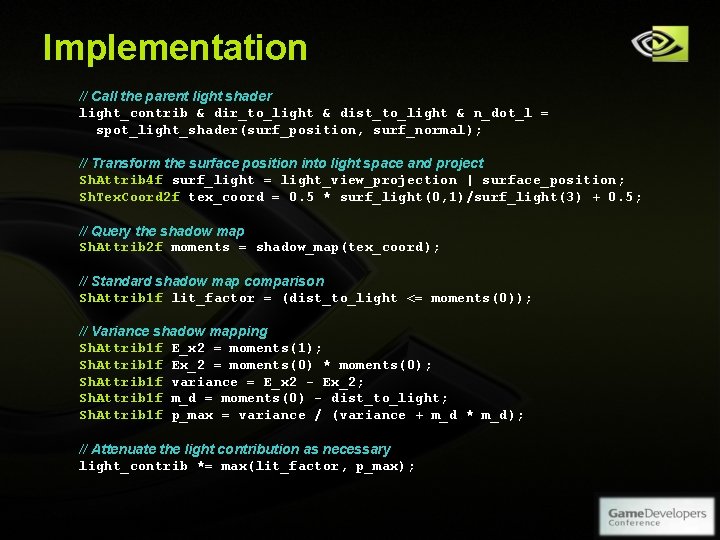
Implementation // Call the parent light shader light_contrib & dir_to_light & dist_to_light & n_dot_l = spot_light_shader(surf_position, surf_normal); // Transform the surface position into light space and project Sh. Attrib 4 f surf_light = light_view_projection | surface_position; Sh. Tex. Coord 2 f tex_coord = 0. 5 * surf_light(0, 1)/surf_light(3) + 0. 5; // Query the shadow map Sh. Attrib 2 f moments = shadow_map(tex_coord); // Standard shadow map comparison Sh. Attrib 1 f lit_factor = (dist_to_light <= moments(0)); // Variance shadow mapping Sh. Attrib 1 f E_x 2 = moments(1); Sh. Attrib 1 f Ex_2 = moments(0) * moments(0); Sh. Attrib 1 f variance = E_x 2 - Ex_2; Sh. Attrib 1 f m_d = moments(0) - dist_to_light; Sh. Attrib 1 f p_max = variance / (variance + m_d * m_d); // Attenuate the light contribution as necessary light_contrib *= max(lit_factor, p_max); Copyright © NVIDIA Corporation 2004
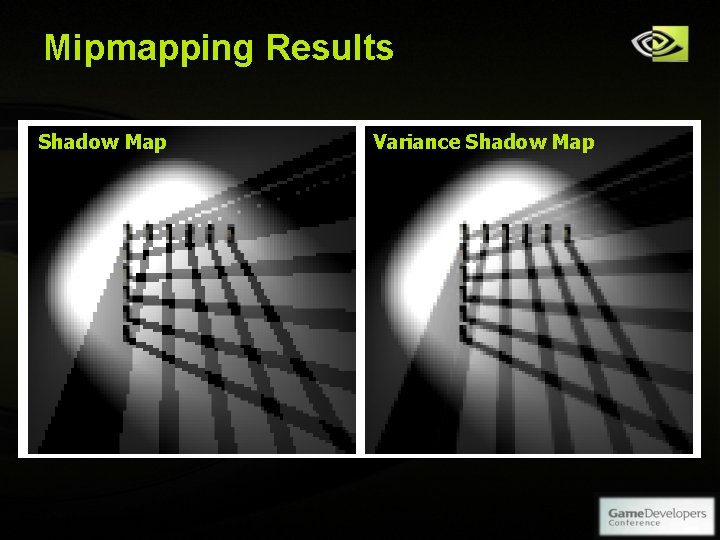
Mipmapping Results Shadow Map Copyright © NVIDIA Corporation 2004 Variance Shadow Map
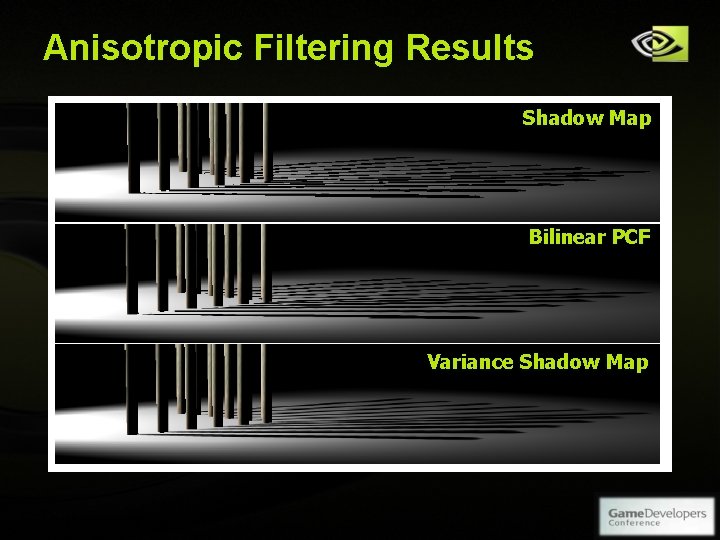
Anisotropic Filtering Results Shadow Map Bilinear PCF Variance Shadow Map Copyright © NVIDIA Corporation 2004
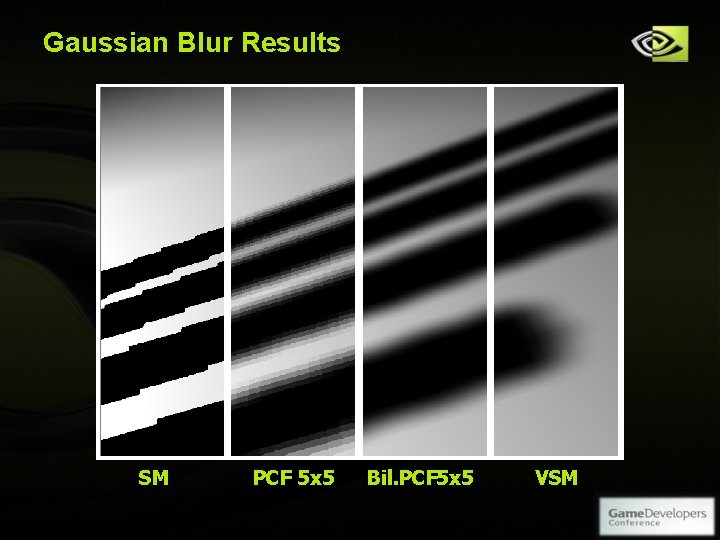
Variance Shadow Maps Can we do more? Our shadow maps can be arbitrarily filtered now Pre-filter shadow map using a Gaussian blur Equivalent to percentage closer filtering Separable convolution => O(n) on kernel size Much faster than PCF complexity of O(n 2) Copyright © NVIDIA Corporation 2004
Gaussian Blur Results SM Copyright © NVIDIA Corporation 2004 PCF 5 x 5 Bil. PCF 5 x 5 VSM
Super-sampling Generate more samples and filter Render large shadow map and down-sample Or simply use texture LOD bias Tiled rendering of a huge shadow map Render 4 tiles at 4096 x 4096 each Down-sample to a single texture Gives an anti-aliased 4096 x 4096 shadow map Copyright © NVIDIA Corporation 2004
Multi-sampling Simply enable multi-sampling while rendering the shadow map Support is dependent on chosen texture format More of this later… Notes on gamma correction Hardware might “gamma correct” the samples This is incorrect for non-colour data! Ideally we want to turn this “feature” off… Copyright © NVIDIA Corporation 2004
Other Fun Stuff Orthogonal to projection-warping techniques Perspective shadow maps (PSM) Trapezoidal shadow maps (TSM) Copyright © NVIDIA Corporation 2004
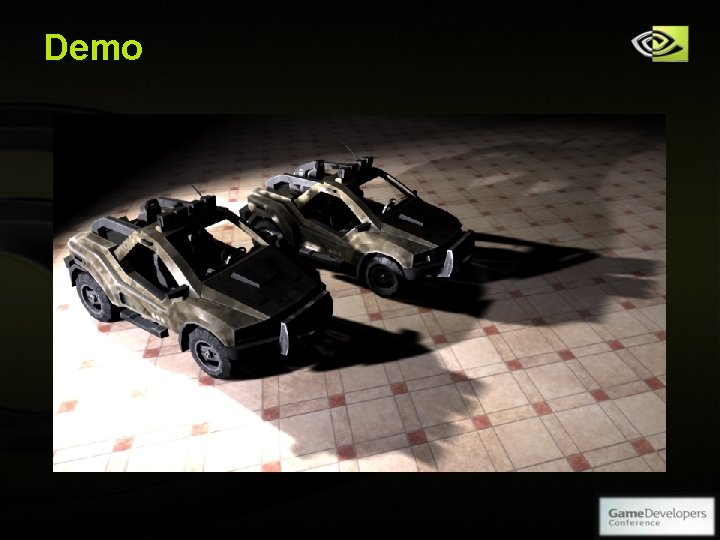
Demo Copyright © NVIDIA Corporation 2004
Texture Formats Ideal texture format: Renderable Two components High precision Supports filtering (anisotropic, mipmapping) Supports multisampling Copyright © NVIDIA Corporation 2004
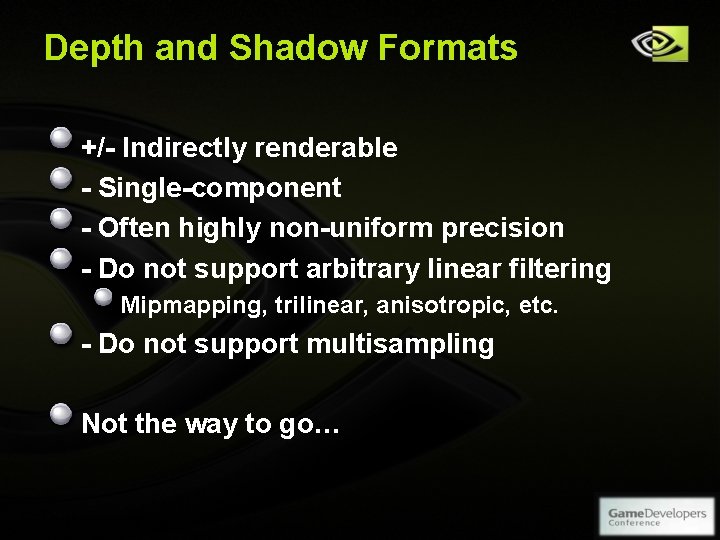
Depth and Shadow Formats +/- Indirectly renderable - Single-component - Often highly non-uniform precision - Do not support arbitrary linear filtering Mipmapping, trilinear, anisotropic, etc. - Do not support multisampling Not the way to go… Copyright © NVIDIA Corporation 2004
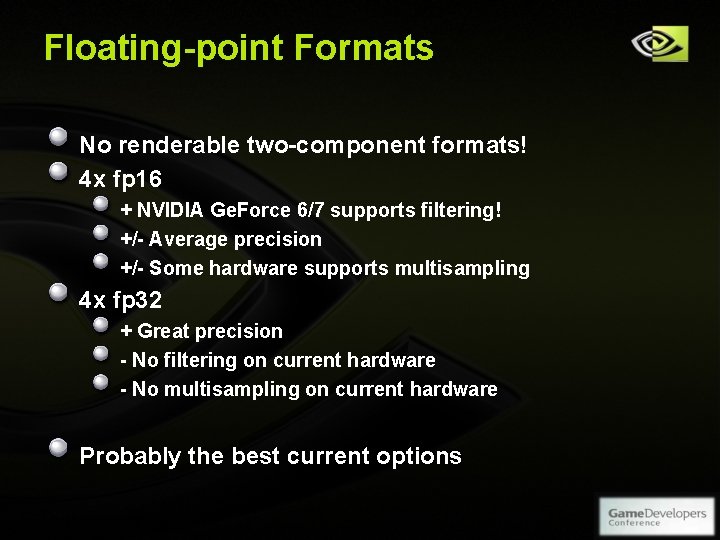
Floating-point Formats No renderable two-component formats! 4 x fp 16 + NVIDIA Ge. Force 6/7 supports filtering! +/- Average precision +/- Some hardware supports multisampling 4 x fp 32 + Great precision - No filtering on current hardware - No multisampling on current hardware Probably the best current options Copyright © NVIDIA Corporation 2004
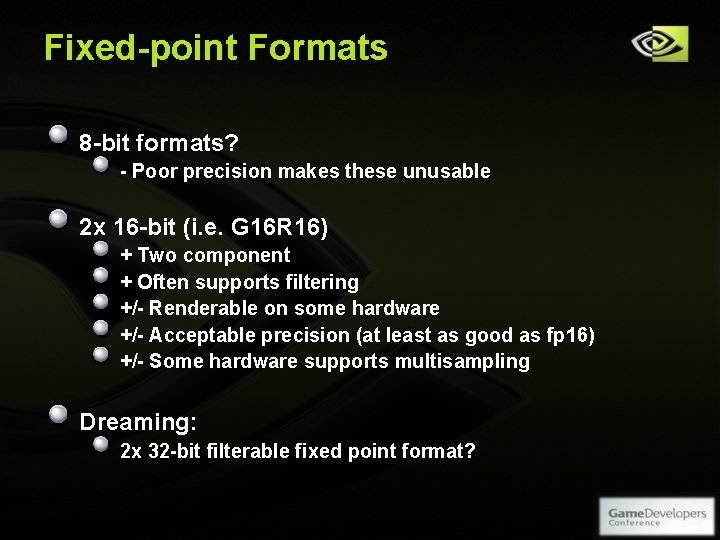
Fixed-point Formats 8 -bit formats? - Poor precision makes these unusable 2 x 16 -bit (i. e. G 16 R 16) + Two component + Often supports filtering +/- Renderable on some hardware +/- Acceptable precision (at least as good as fp 16) +/- Some hardware supports multisampling Dreaming: 2 x 32 -bit filterable fixed point format? Copyright © NVIDIA Corporation 2004
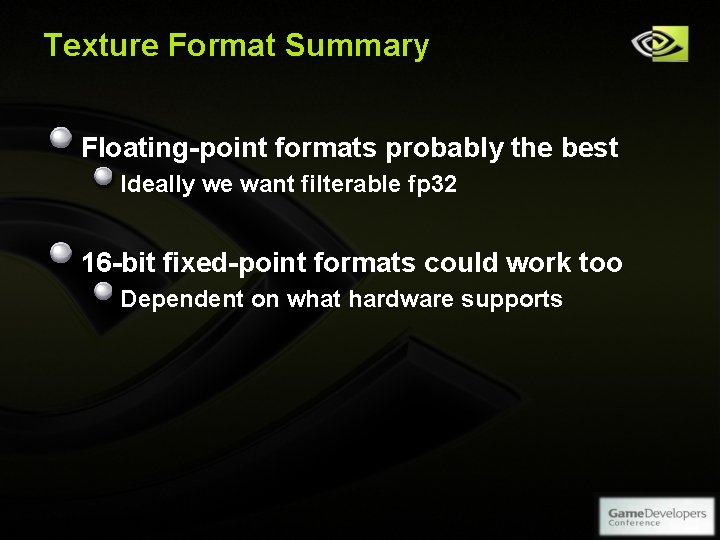
Texture Format Summary Floating-point formats probably the best Ideally we want filterable fp 32 16 -bit fixed-point formats could work too Dependent on what hardware supports Copyright © NVIDIA Corporation 2004
Numerical Stability Recall the computation of variance: σ2 = E(x 2) – E(x)2 Highly numerically unstable! Recall Chebyshev’s Inequality: Can be a problem when fragment is near occluder Need a high-precision texture format Copyright © NVIDIA Corporation 2004
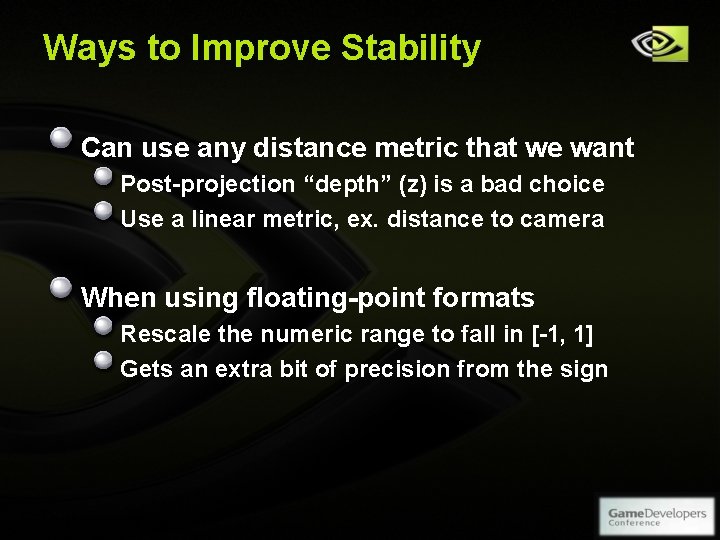
Ways to Improve Stability Can use any distance metric that we want Post-projection “depth” (z) is a bad choice Use a linear metric, ex. distance to camera When using floating-point formats Rescale the numeric range to fall in [-1, 1] Gets an extra bit of precision from the sign Copyright © NVIDIA Corporation 2004
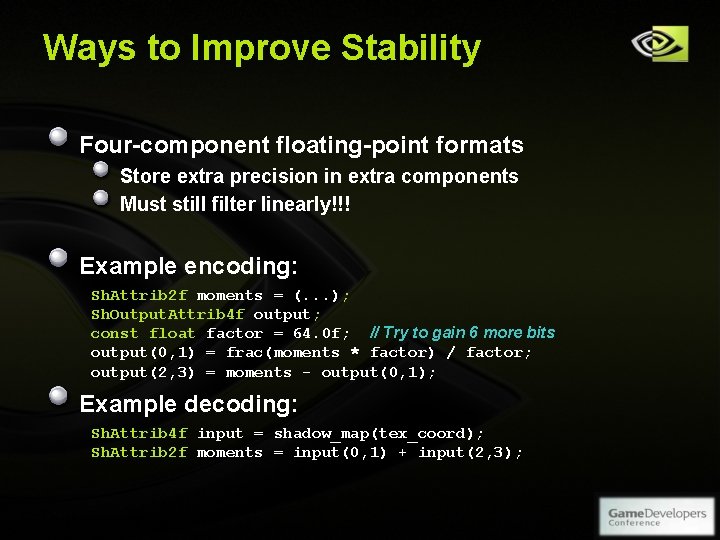
Ways to Improve Stability Four-component floating-point formats Store extra precision in extra components Must still filter linearly!!! Example encoding: Sh. Attrib 2 f moments = (. . . ); Sh. Output. Attrib 4 f output; const float factor = 64. 0 f; // Try to gain 6 more bits output(0, 1) = frac(moments * factor) / factor; output(2, 3) = moments - output(0, 1); Example decoding: Sh. Attrib 4 f input = shadow_map(tex_coord); Sh. Attrib 2 f moments = input(0, 1) + input(2, 3); Copyright © NVIDIA Corporation 2004
Ways to Improve Stability Use a 32 -bit per component floating-point texture! We’ve had no precision problems with fp 32 Copyright © NVIDIA Corporation 2004
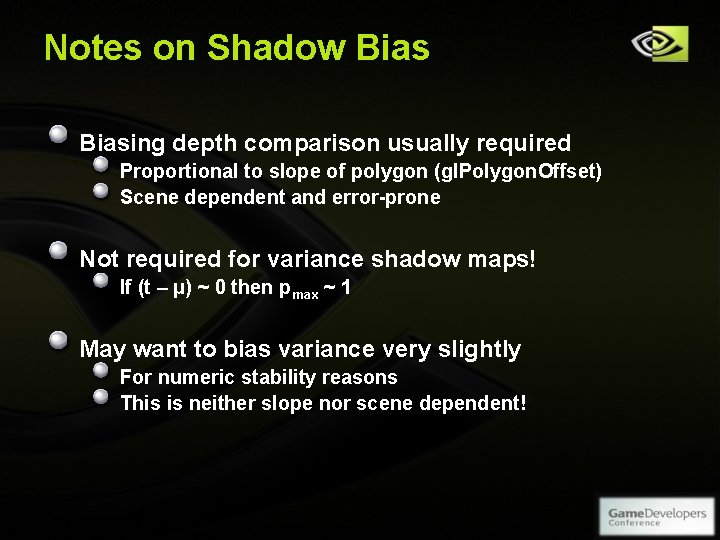
Notes on Shadow Biasing depth comparison usually required Proportional to slope of polygon (gl. Polygon. Offset) Scene dependent and error-prone Not required for variance shadow maps! If (t – μ) ~ 0 then pmax ~ 1 May want to bias variance very slightly For numeric stability reasons This is neither slope nor scene dependent! Copyright © NVIDIA Corporation 2004
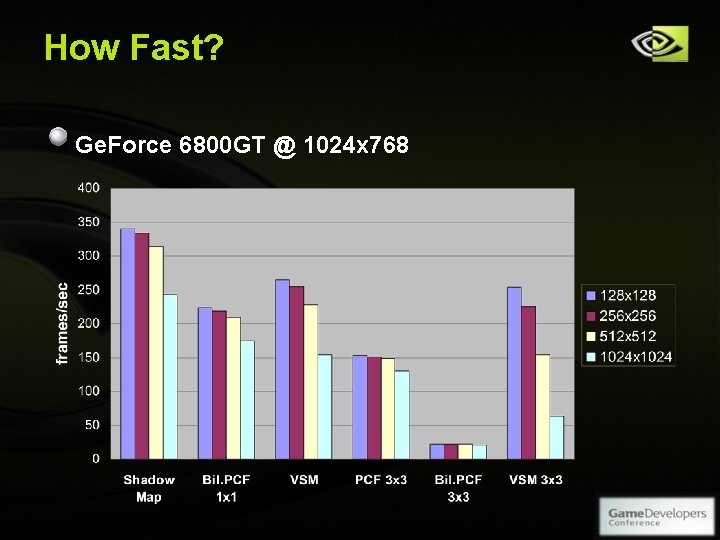
How Fast? Ge. Force 6800 GT @ 1024 x 768 Copyright © NVIDIA Corporation 2004
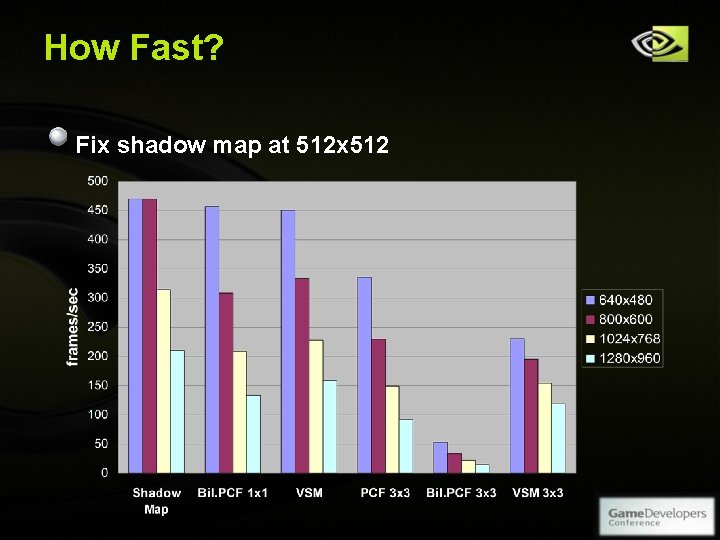
How Fast? Fix shadow map at 512 x 512 Copyright © NVIDIA Corporation 2004
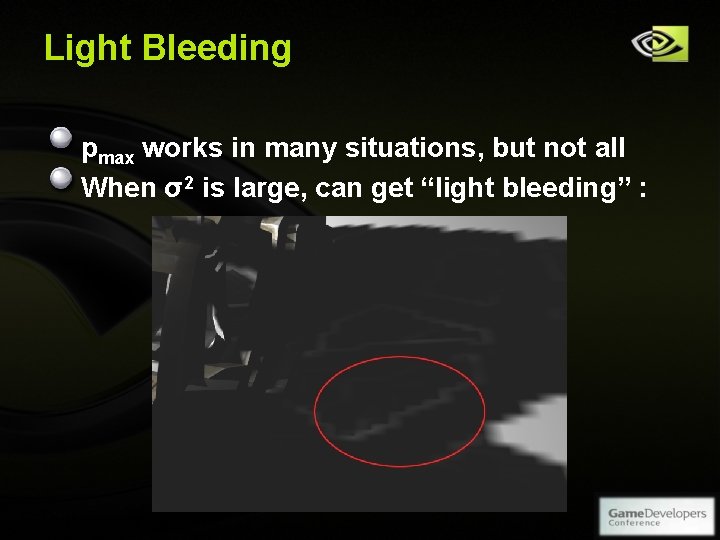
Light Bleeding pmax works in many situations, but not all When σ2 is large, can get “light bleeding” : Copyright © NVIDIA Corporation 2004
Ways to Reduce Light Bleeding Lower depth complexity in light space Ex. Use variance shadow maps for the sun, not headlights Construct scenes with this artifact in mind Control attenuation ranges carefully Use ambient or multiple lights Contrast will be lessened Use static lights Moving lights makes the projection obvious Use smaller filter regions Artifact is only as large as the filter region Copyright © NVIDIA Corporation 2004
Ultimate Solutions Find a higher-order inequality? Fast, programmable hardware filtering? Combine with percentage closer soft shadows Randima Fernando (NVIDIA), 2005 Cheap, perceptually-correct soft shadows? Lots of potentially fruitful hybrid techniques! Copyright © NVIDIA Corporation 2004
Conclusion Introduced a simple solution to many forms of shadow map aliasing Implemented easily on modern hardware Compares favourably in both performance and quality to existing techniques Copyright © NVIDIA Corporation 2004
For More Information… Donnelly and Lauritzen, Variance Shadow Maps, ACM Symposium on Interactive 3 D Graphics and Games 2006 http: //www. punkuser. net/vsm/ Questions? Copyright © NVIDIA Corporation 2004
The Source for GPU Programming Copyright © NVIDIA Corporation 2004