
Variable Stars The Milky Way Variable Stars Eclipsing
Variable Stars & The Milky Way
Variable Stars • Eclipsing binaries (stars do not change physically, only their relative position changes) • Nova (two stars “collaborating” to produce “star eruption”) • Cepheids (stars do change physically) • RR Lyrae Stars (stars do change physically) • Mira Stars (stars do change physically)
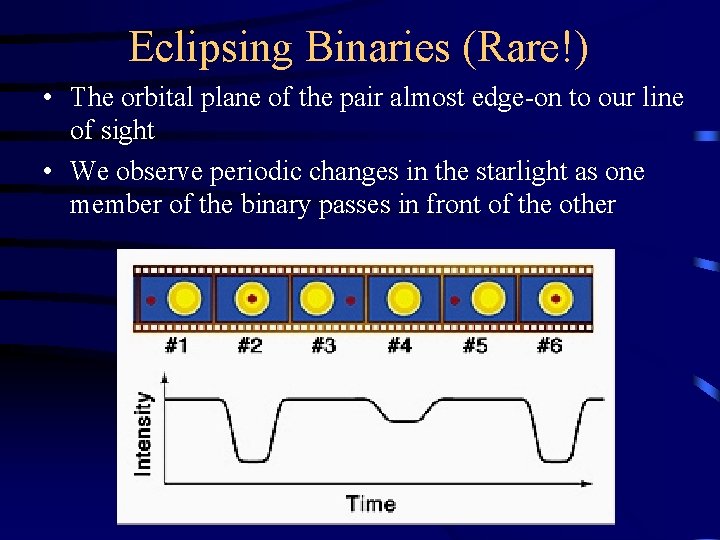
Eclipsing Binaries (Rare!) • The orbital plane of the pair almost edge-on to our line of sight • We observe periodic changes in the starlight as one member of the binary passes in front of the other
Cepheids • Named after δ Cephei • Period-Luminosity Relations • Two types of Cepheids: – Type I: higher luminosity, metal-rich, Pop. 1 – Type II: lower lum. , metal-poor, Population 2 • Used as “standard candles” • “yard-sticks” for distance measurement • Cepheids in Andromeda Galaxies established the “extragalacticity” of this “nebula”
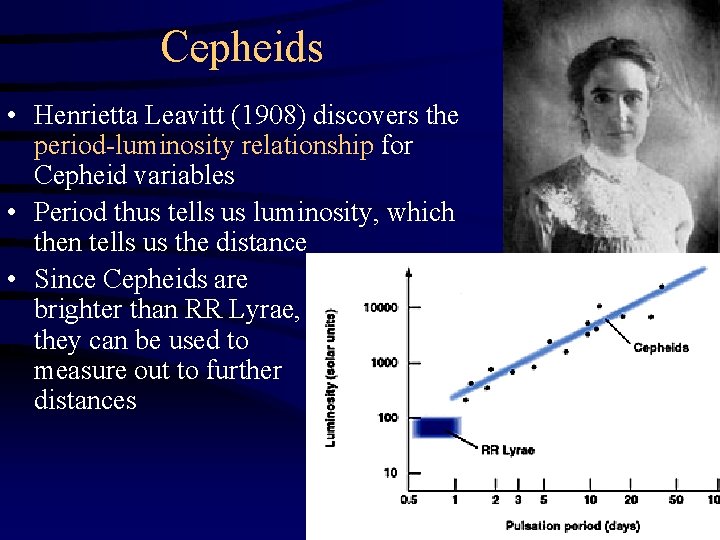
Cepheids • Henrietta Leavitt (1908) discovers the period-luminosity relationship for Cepheid variables • Period thus tells us luminosity, which then tells us the distance • Since Cepheids are brighter than RR Lyrae, they can be used to measure out to further distances
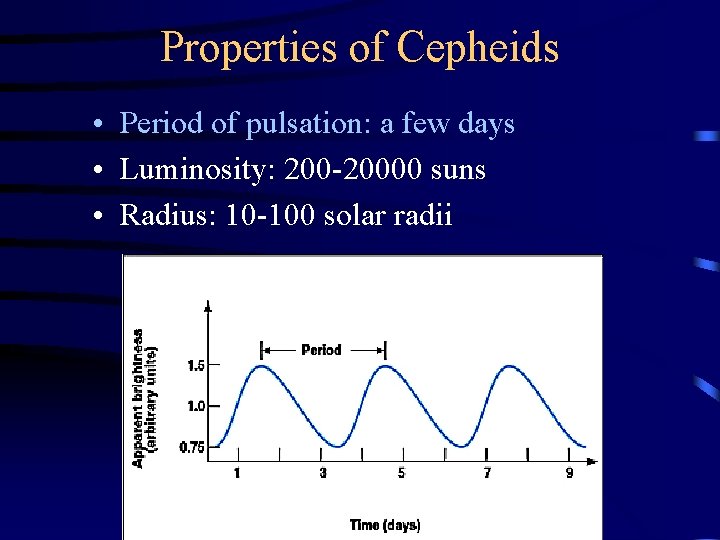
Properties of Cepheids • Period of pulsation: a few days • Luminosity: 200 -20000 suns • Radius: 10 -100 solar radii
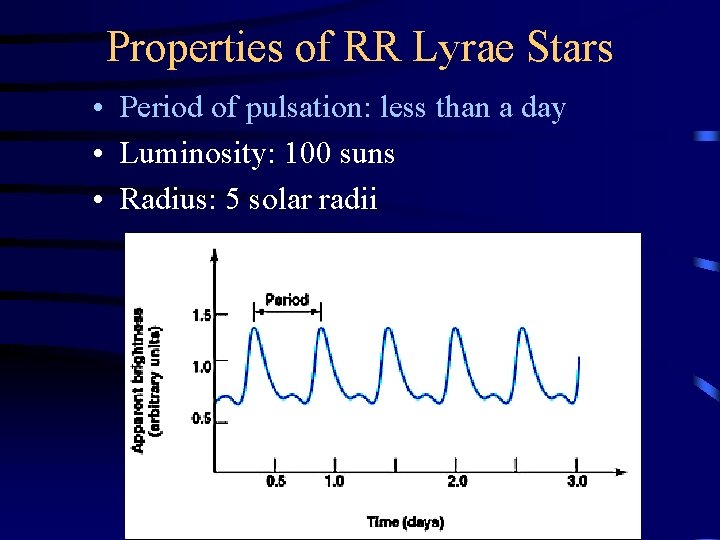
Properties of RR Lyrae Stars • Period of pulsation: less than a day • Luminosity: 100 suns • Radius: 5 solar radii
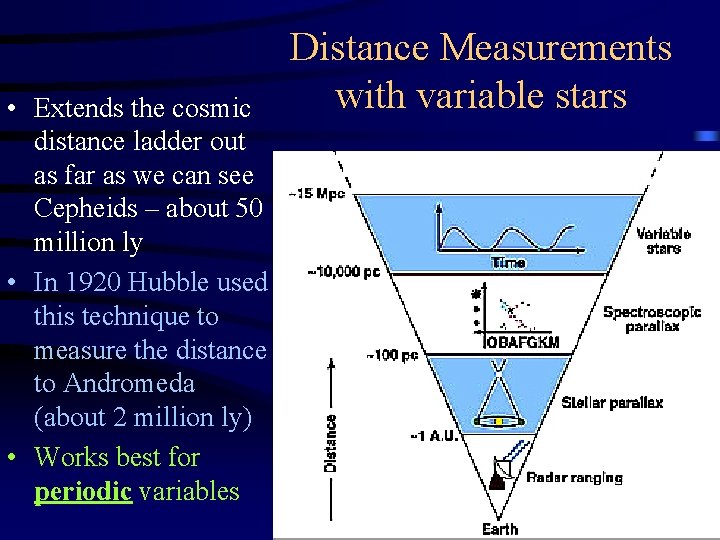
• Extends the cosmic distance ladder out as far as we can see Cepheids – about 50 million ly • In 1920 Hubble used this technique to measure the distance to Andromeda (about 2 million ly) • Works best for periodic variables Distance Measurements with variable stars
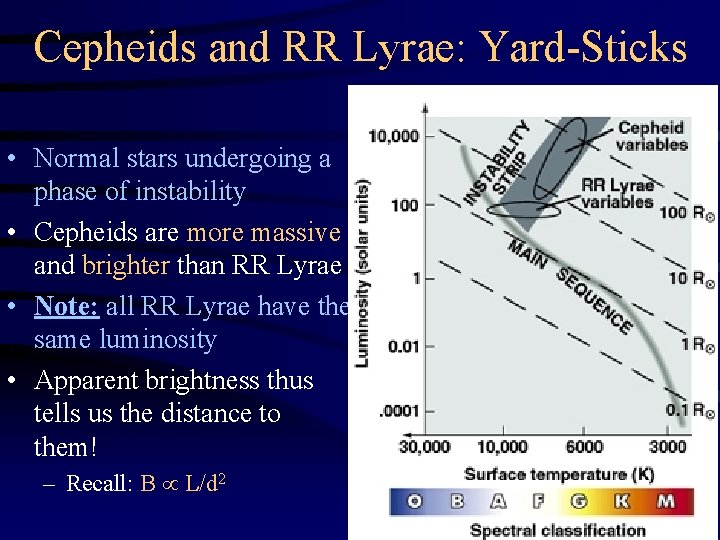
Cepheids and RR Lyrae: Yard-Sticks • Normal stars undergoing a phase of instability • Cepheids are more massive and brighter than RR Lyrae • Note: all RR Lyrae have the same luminosity • Apparent brightness thus tells us the distance to them! – Recall: B L/d 2
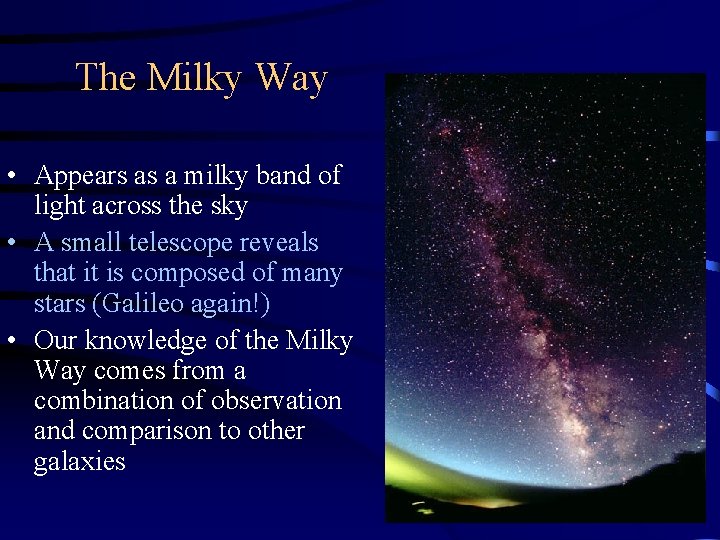
The Milky Way • Appears as a milky band of light across the sky • A small telescope reveals that it is composed of many stars (Galileo again!) • Our knowledge of the Milky Way comes from a combination of observation and comparison to other galaxies
How do we know? Obviously a bogus picture of our milky way! • Question: How can we say anything about our Milky Way, if we cannot see it from outside?
Enter: the Genius • William Herschel (XVIII century) • Simple model: – Assumed all stars have the same absolute brightness – Counts stars as a function of apparent magnitude – Brighter stars closer to us; fainter stars further away – Cut off in brightness corresponds to a cut off at a certain distance. • Conclusion: there are no stars beyond a certain distance
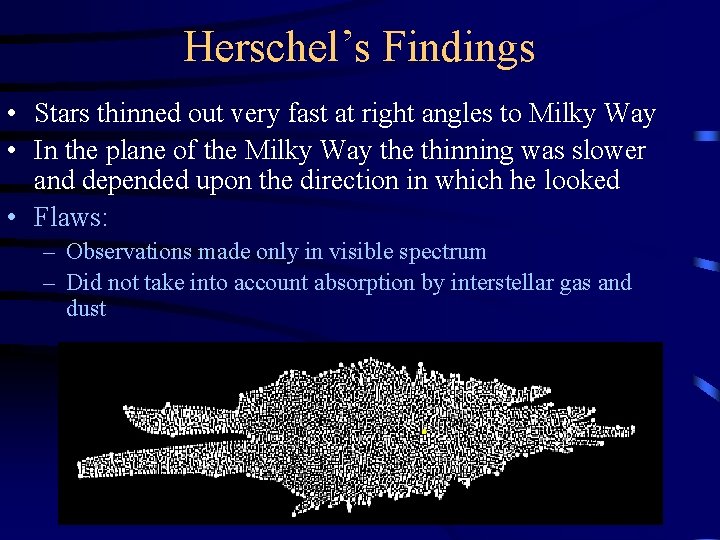
Herschel’s Findings • Stars thinned out very fast at right angles to Milky Way • In the plane of the Milky Way the thinning was slower and depended upon the direction in which he looked • Flaws: – Observations made only in visible spectrum – Did not take into account absorption by interstellar gas and dust
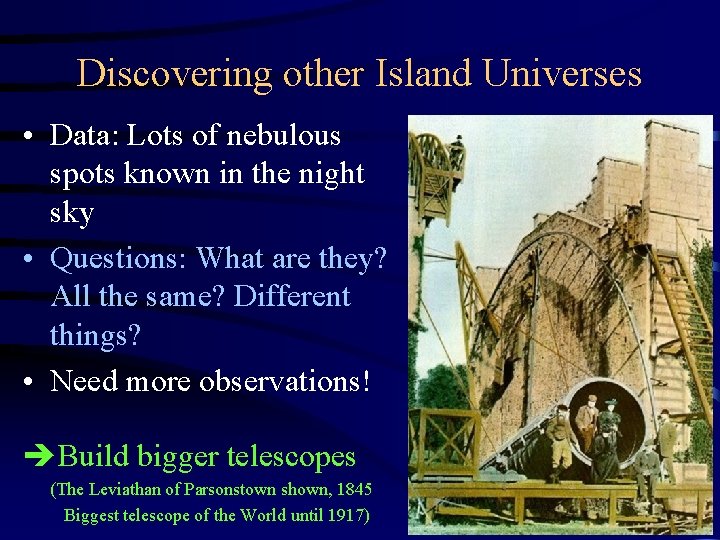
Discovering other Island Universes • Data: Lots of nebulous spots known in the night sky • Questions: What are they? All the same? Different things? • Need more observations! èBuild bigger telescopes (The Leviathan of Parsonstown shown, 1845 Biggest telescope of the World until 1917)
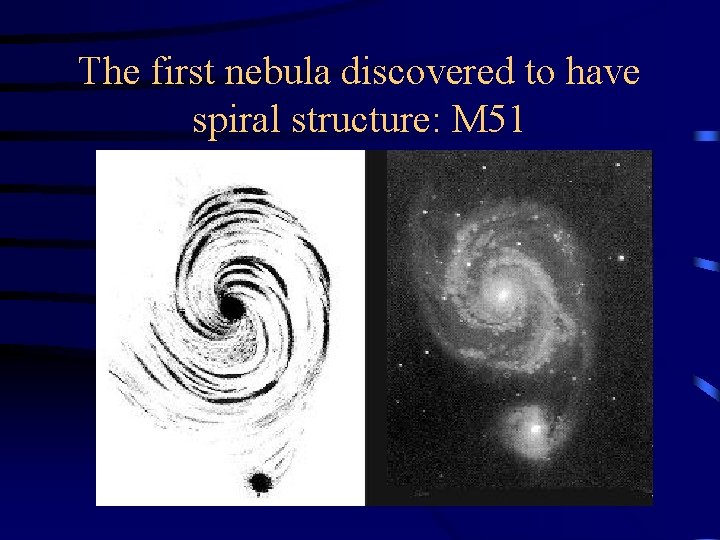
The first nebula discovered to have spiral structure: M 51
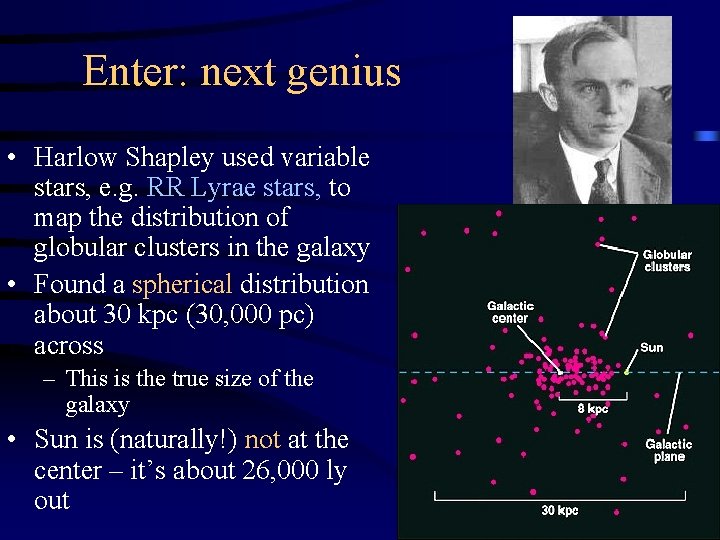
Enter: next genius • Harlow Shapley used variable stars, e. g. RR Lyrae stars, to map the distribution of globular clusters in the galaxy • Found a spherical distribution about 30 kpc (30, 000 pc) across – This is the true size of the galaxy • Sun is (naturally!) not at the center – it’s about 26, 000 ly out
Standing on the shoulders of Giants • Shapley used methods developed by others to measure the distance to globulars • Cepheid variables show luminosity-period correlations discovered by Henrietta Leavitt • Shapley single-handedly increase the size of the universe tenfold!
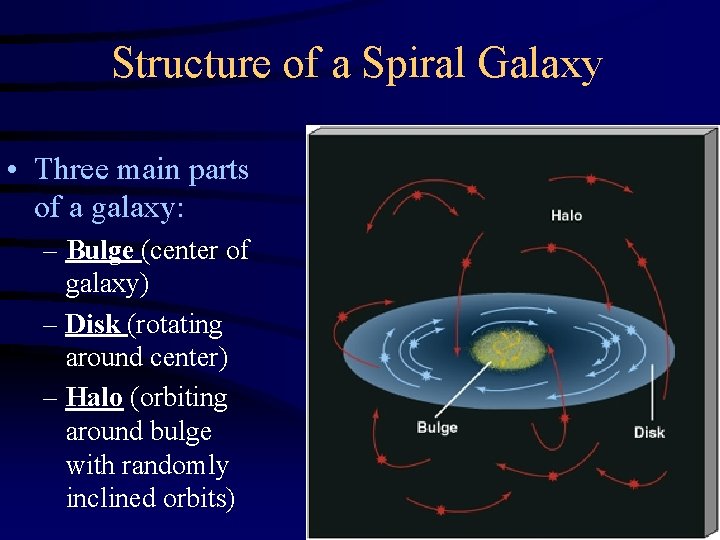
Structure of a Spiral Galaxy • Three main parts of a galaxy: – Bulge (center of galaxy) – Disk (rotating around center) – Halo (orbiting around bulge with randomly inclined orbits)
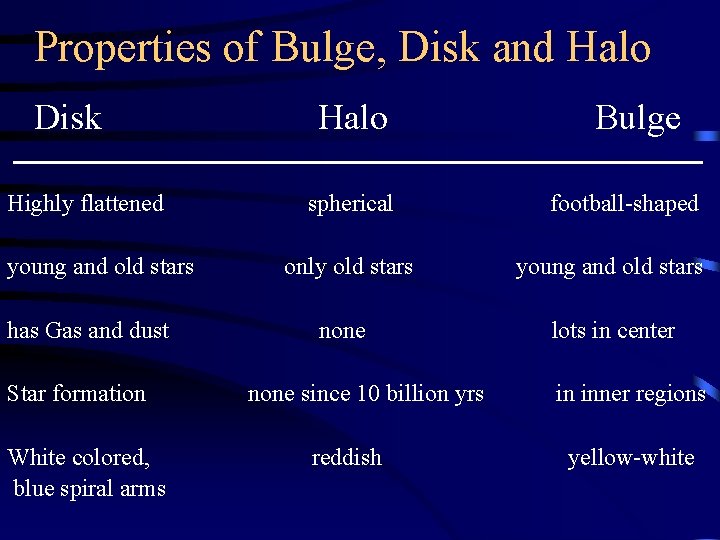
Properties of Bulge, Disk and Halo Disk Highly flattened young and old stars has Gas and dust Star formation White colored, blue spiral arms Halo spherical Bulge football-shaped only old stars young and old stars none lots in center none since 10 billion yrs reddish in inner regions yellow-white
- Slides: 19