
Variable Reflectivity Dielectric Mirrors for THzFEL Applications Mufit
Variable Reflectivity Dielectric Mirrors for THz-FEL Applications Mufit Tecimer 1, Karsten Holldack 2, Luis R. Elias 1 1 THz FEL Group, University of Hawai’i at Manoa, Honolulu, USA 2 Helmholtz Zentrum Berlin, BESSY II, Berlin, Germany IRMMW-THz 2009 Busan, S. Korea September 21, 2009
Dielectric Multilayer Mirrors • THz Cavity Ring Down Spectroscopy (2003 -2005), • Cavity mirrors for FIR p-Ge Laser, R=99. 93% achieved using 3 periods of Si/vacuum gap (2005), • Si multilayer based THz wave filter tested by THz TDS (2008), ………. . mostly utilizing high resistivity Si multilayers as low loss material (a ~0. 02/cm-1) and high index of refraction n~3. 41 • Our study of adopting dielectric multilayers as broadband coupler and high reflectivity mirrors for THz Free Electron Lasers (~0. 5 THz - 3 THz) as well as for external Pulse Stacker Cavities started in 2007. As low loss materials: crystalline Quarz (n~2. 11) and high resistivity Si. (in between: Diamond n~2. 37, negligible a )
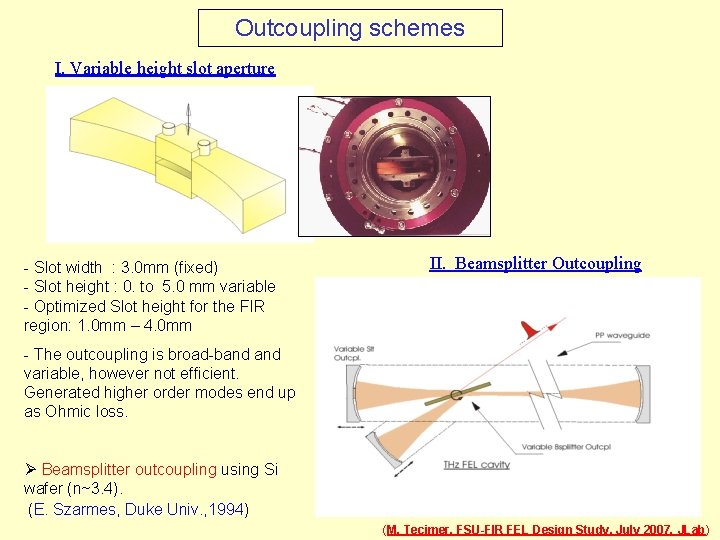
Outcoupling schemes I. Variable height slot aperture - Slot width : 3. 0 mm (fixed) - Slot height : 0. to 5. 0 mm variable - Optimized Slot height for the FIR region: 1. 0 mm – 4. 0 mm II. Beamsplitter Outcoupling - The outcoupling is broad-band variable, however not efficient. Generated higher order modes end up as Ohmic loss. Ø Beamsplitter outcoupling using Si wafer (n~3. 4). (E. Szarmes, Duke Univ. , 1994) (M. Tecimer, FSU-FIR FEL Design Study, July 2007, JLab)
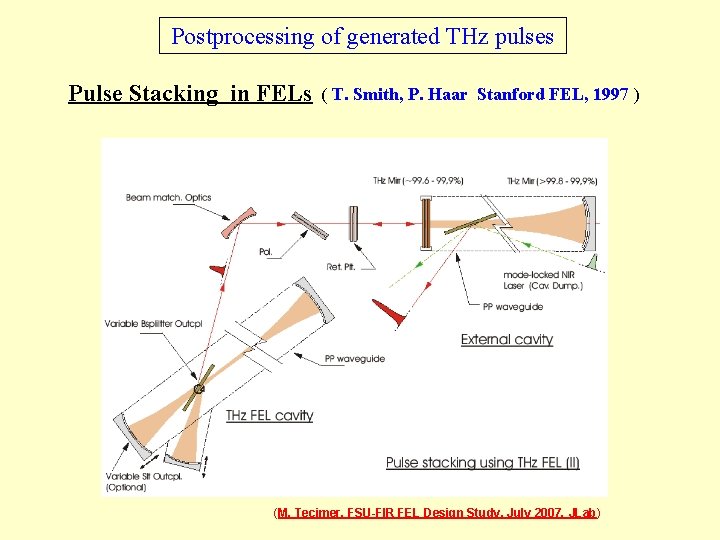
Postprocessing of generated THz pulses Pulse Stacking in FELs ( T. Smith, P. Haar Stanford FEL, 1997 ) (M. Tecimer, FSU-FIR FEL Design Study, July 2007, JLab)
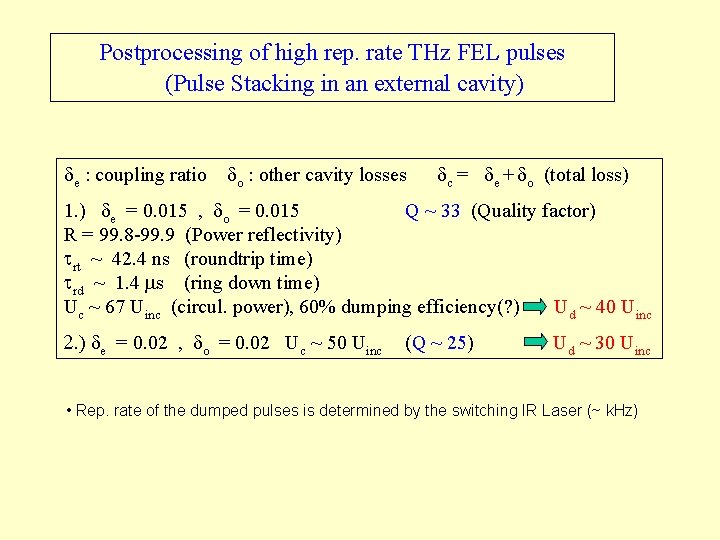
Postprocessing of high rep. rate THz FEL pulses (Pulse Stacking in an external cavity) de : coupling ratio do : other cavity losses dc = de + do (total loss) 1. ) de = 0. 015 , do = 0. 015 Q ~ 33 (Quality factor) R = 99. 8 -99. 9 (Power reflectivity) trt ~ 42. 4 ns (roundtrip time) trd ~ 1. 4 ms (ring down time) Uc ~ 67 Uinc (circul. power), 60% dumping efficiency(? ) Ud ~ 40 Uinc 2. ) de = 0. 02 , do = 0. 02 Uc ~ 50 Uinc (Q ~ 25) Ud ~ 30 Uinc • Rep. rate of the dumped pulses is determined by the switching IR Laser (~ k. Hz)
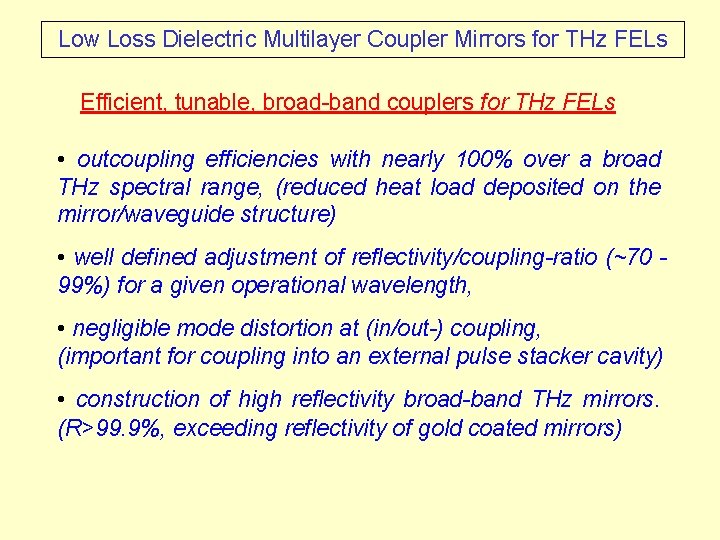
Low Loss Dielectric Multilayer Coupler Mirrors for THz FELs Efficient, tunable, broad-band couplers for THz FELs • outcoupling efficiencies with nearly 100% over a broad THz spectral range, (reduced heat load deposited on the mirror/waveguide structure) • well defined adjustment of reflectivity/coupling-ratio (~70 99%) for a given operational wavelength, • negligible mode distortion at (in/out-) coupling, (important for coupling into an external pulse stacker cavity) • construction of high reflectivity broad-band THz mirrors. (R>99. 9%, exceeding reflectivity of gold coated mirrors)
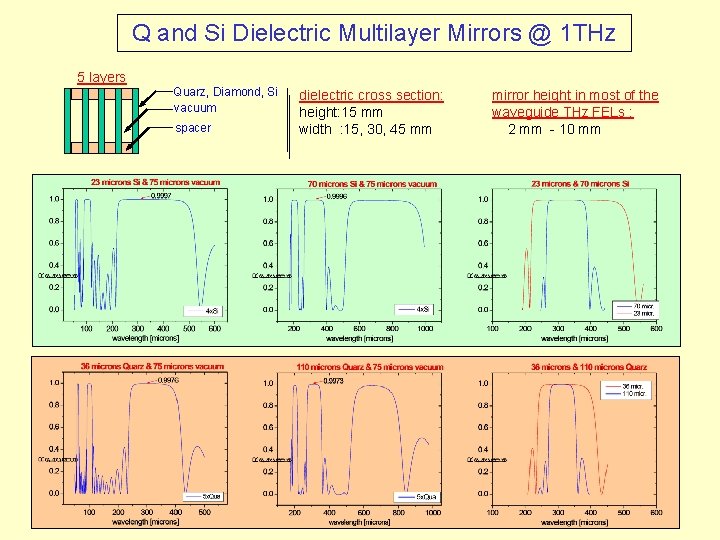
Q and Si Dielectric Multilayer Mirrors @ 1 THz 5 layers Quarz, Diamond, Si vacuum spacer dielectric cross section: height: 15 mm width : 15, 30, 45 mm mirror height in most of the waveguide THz FELs : 2 mm - 10 mm
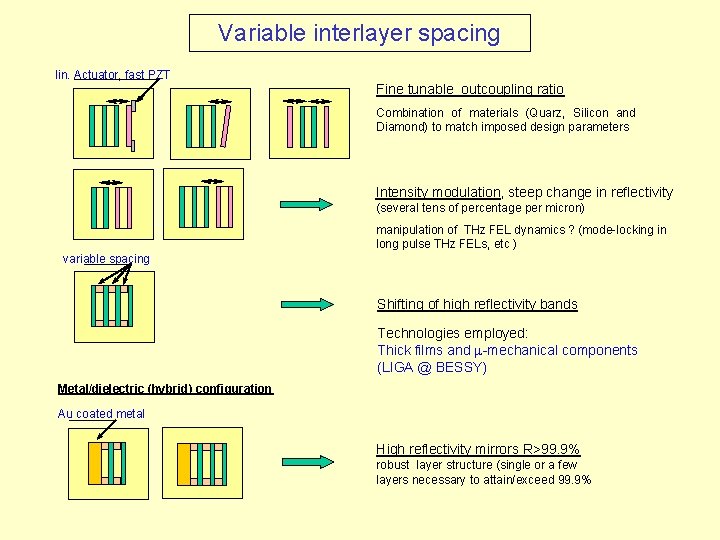
Variable interlayer spacing lin. Actuator, fast PZT Fine tunable outcoupling ratio Combination of materials (Quarz, Silicon and Diamond) to match imposed design parameters Intensity modulation, steep change in reflectivity (several tens of percentage per micron) manipulation of THz FEL dynamics ? (mode-locking in long pulse THz FELs, etc ) variable spacing Shifting of high reflectivity bands Technologies employed: Thick films and m-mechanical components (LIGA @ BESSY) Metal/dielectric (hybrid) configuration Au coated metal High reflectivity mirrors R>99. 9% robust layer structure (single or a few layers necessary to attain/exceed 99. 9%
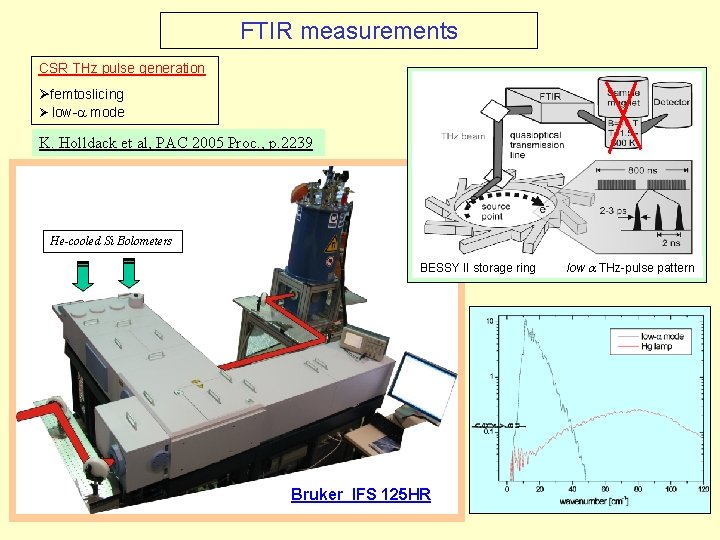
FTIR measurements CSR THz pulse generation Øfemtoslicing Ø low-a mode K. Holldack et al, PAC 2005 Proc. , p. 2239 He-cooled Si Bolometers BESSY II storage ring Bruker IFS 125 HR low a THz-pulse pattern
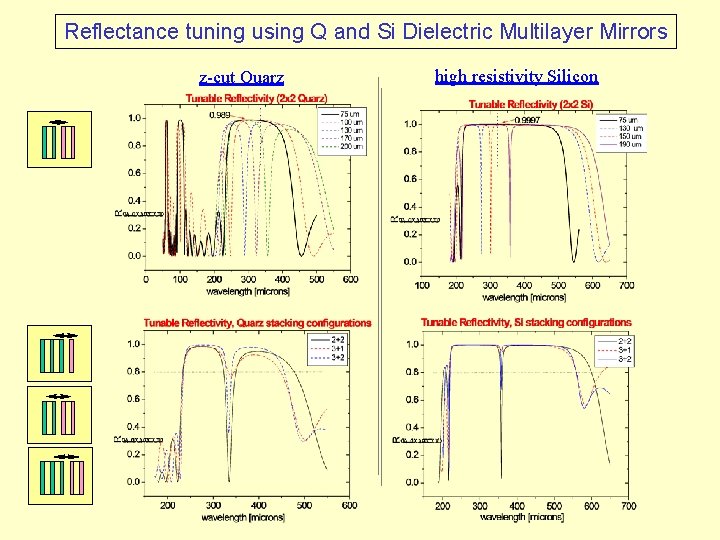
Reflectance tuning using Q and Si Dielectric Multilayer Mirrors z-cut Quarz high resistivity Silicon

Reflectance tuning using Q and Si Dielectric Multilayer Mirrors fine tunable outcoupling ratio 3 x. Q Q or C ~ 0. 1 %/mm ~ 10. 0%/mm Intensity modulation (steep change in reflectivity)
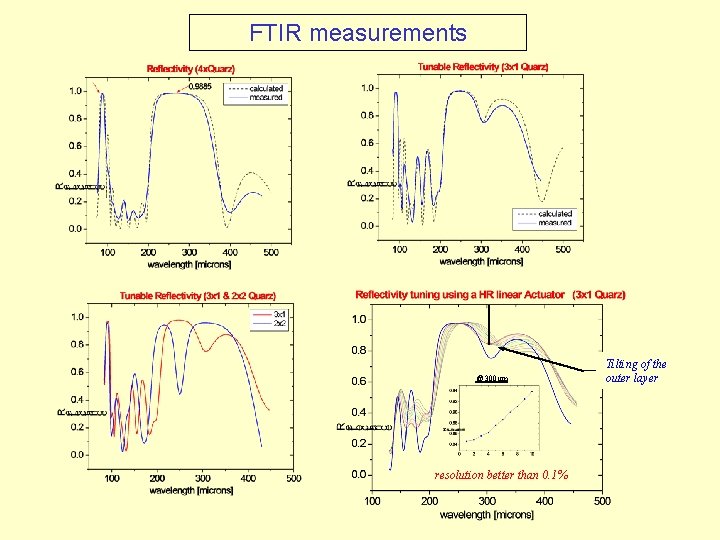
FTIR measurements @ 300 mm resolution better than 0. 1% Tilting of the outer layer
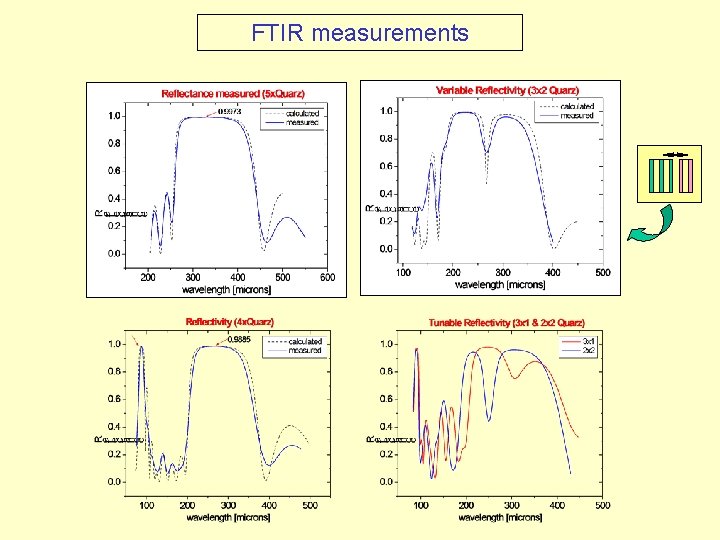
FTIR measurements
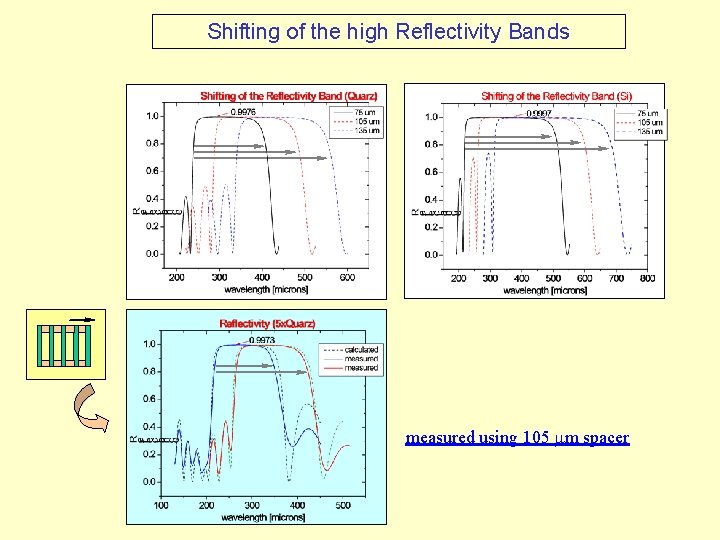
Shifting of the high Reflectivity Bands measured using 105 mm spacer
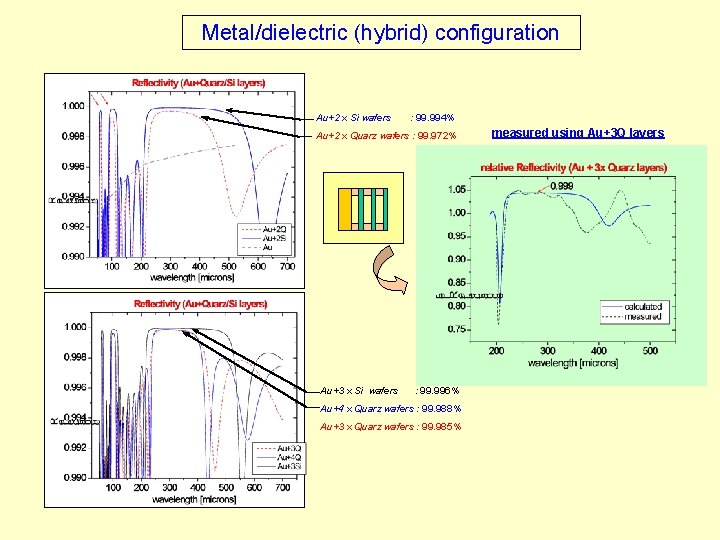
Metal/dielectric (hybrid) configuration Au+2 x Si wafers : 99. 994% Au+2 x Quarz wafers : 99. 972% Au+3 x Si wafers : 99. 996% Au+4 x Quarz wafers : 99. 988% Au+3 x Quarz wafers : 99. 985% measured using Au+3 Q layers
Summary ØWe have experimentally demonstrated that a well defined adjustment of reflectivity and (output) coupling ratio can be accomplished efficiently by using dielectric multilayers in the THz spectral region. ØThe preliminary experimental results obtained indicate the use of the presented schemes as fast THz modulators. ØMetal/dielectric (hybrid) mirrors is an alternative means in constructing high reflectivity mirrors, possibly outperforming the ‘pure’ counterparts. ØAn intense, stable, broadband CSR source combined with a high resolution FTIR Spectrometer is being used to test the performance of the dielectric mirrors in the THz spectral range. Partially supported by NSF Grant #0520481 -Subcontr. #R 00916

Thank you for your attention
- Slides: 17