
Variability in Software Systems The Key to Software

Variability in Software Systems The Key to Software Reuse Jilles van Gurp
Contents • • Overview of the past 2 years Papers in thesis Problems/Causes Solutions – Frameworks – Software Product Lines – Variability • Future/Current Work • Conclusion 1/16/2022 Jilles van Gurp 2
History • • • Studied CS in Utrecht Joined Jan Bosch in Ronneby late 1998 Got a masters degree from Utrecht early 1999 Continued doing research for Jan Bosch Moved to Groningen summer 2000 Finished my Lic. in October 2000 1/16/2022 Jilles van Gurp 3
Licentiate Thesis • Thesis consists of 4 papers + introduction • Download & view: http: //www. xs 4 all. nl/~jgurp • Or pick one of the available copies. 1/16/2022 Jilles van Gurp 4
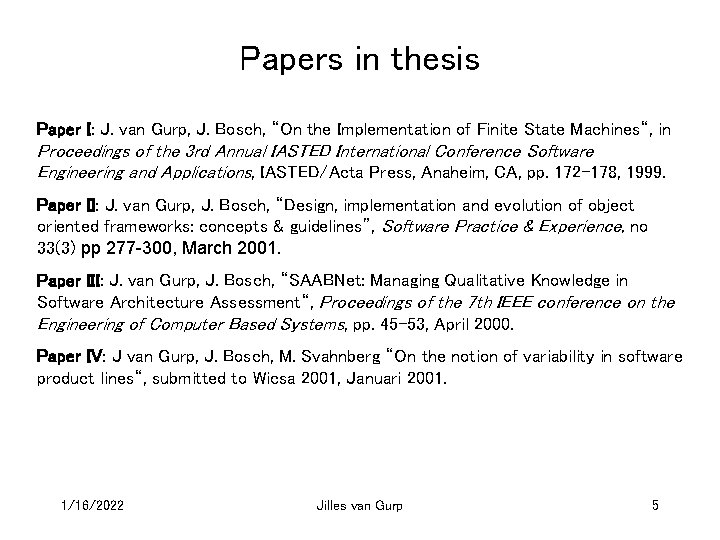
Papers in thesis Paper I: J. van Gurp, J. Bosch, “On the Implementation of Finite State Machines“, in Proceedings of the 3 rd Annual IASTED International Conference Software Engineering and Applications, IASTED/Acta Press, Anaheim, CA, pp. 172 -178, 1999. Paper II: J. van Gurp, J. Bosch, “Design, implementation and evolution of object oriented frameworks: concepts & guidelines”, Software Practice & Experience, no 33(3) pp 277 -300, March 2001. Paper III: J. van Gurp, J. Bosch, “SAABNet: Managing Qualitative Knowledge in Software Architecture Assessment“, Proceedings of the 7 th IEEE conference on the Engineering of Computer Based Systems, pp. 45 -53, April 2000. Paper IV: J van Gurp, J. Bosch, M. Svahnberg “On the notion of variability in software product lines“, submitted to Wicsa 2001, Januari 2001. 1/16/2022 Jilles van Gurp 5
Looking back • I started with frameworks • Then came assessment of frameworks and architectures (paper III) • Currently I’m concerned with the key mechanisms behind frameworks and reusable architectures • The keyword is variability 1/16/2022 Jilles van Gurp 6
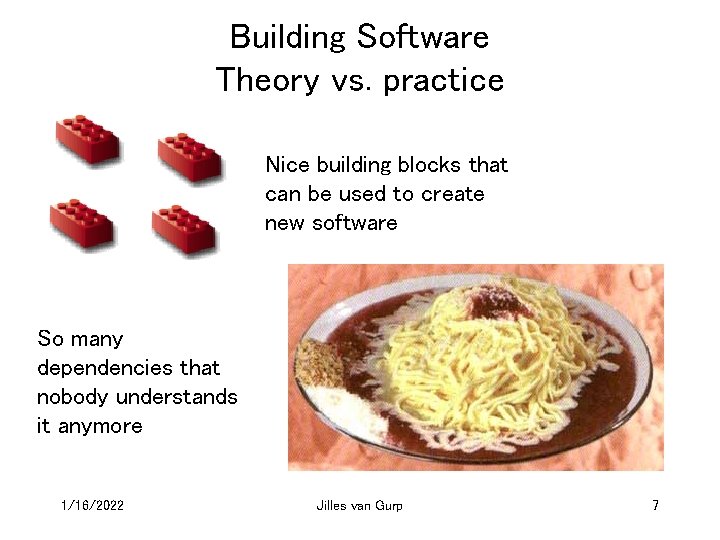
Building Software Theory vs. practice Nice building blocks that can be used to create new software So many dependencies that nobody understands it anymore 1/16/2022 Jilles van Gurp 7
Theory vs. practice (2) • Theory: Component = building block with well defined interfaces • Practice: Component = large (100 KLOC is nothing) blob of software with no clear boundaries 1/16/2022 Jilles van Gurp 8
Problems • • Everything is connected to everything Changes may have system wide consequences Each change increases the above problems Radical changes are increasingly less cost effective • The development strategy is to work around problems rather than addressing them 1/16/2022 Jilles van Gurp 9
Causes • Requirements are not stable, new ones are added constantly • Some of the requirement changes were not anticipated during the design • The software was not designed to incorporate such changes 1/16/2022 Jilles van Gurp 10
Solutions • OO Frameworks? • Software Product Lines? • Variability management? 1/16/2022 Jilles van Gurp 11
OO Frameworks? • RE Johnson: Framework = Components + design patterns • We: Framework: a set of classes, abstract classes, interfaces and OO components bundled in a set of modules that partially implement an application in a particular domain. 1/16/2022 Jilles van Gurp 12
Why yet another definition? • We discuss a lot in thesis: – – OO SPLs Components …. • Without proper definition the discussion becomes meaningless • Unfortunately there are no one-size-fits-all definitions, so we created our own 1/16/2022 Jilles van Gurp 13
Why so specific? • Terms like OO and frameworks tend to be heavily overloaded • We want to make statements about frameworks, we need to decompose • The more specific our definitions are, the more specific our statements are 1/16/2022 Jilles van Gurp 14
Contributions in OO Fws • Definitions based on existing literature and current practice. • Motivated the use of Role Oriented Programming (next slide) • Guidelines for designers (Paper II) 1/16/2022 Jilles van Gurp 15
Roles & Objects • Without roles: Class = Type • With Roles: Class has more than one Type • Class Type = interface. So a class with roles has more than one interface. 1/16/2022 Jilles van Gurp 16
Roles, why? • Objects collaborate in many ways • Usually only part of the interface is needed in a particular collaboration • The rest of the interface is not needed in such collaborations • Objects of other classes may collaborate in the same way 1/16/2022 Jilles van Gurp 17
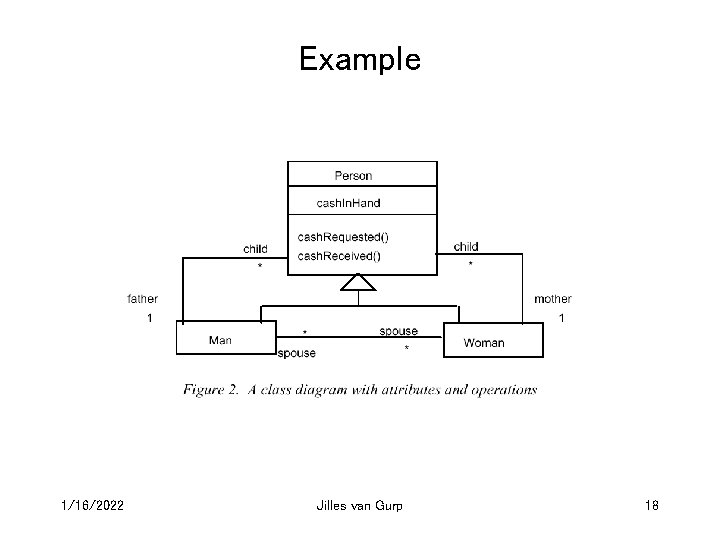
Example 1/16/2022 Jilles van Gurp 18
Expressiveness • This model expresses that – a person can own cash – receive cash – be requested for cash • However, it can’t express that – a person gives cash to another person because there’s no way to identify the involved persons in the transaction from the set of all persons 1/16/2022 Jilles van Gurp 19
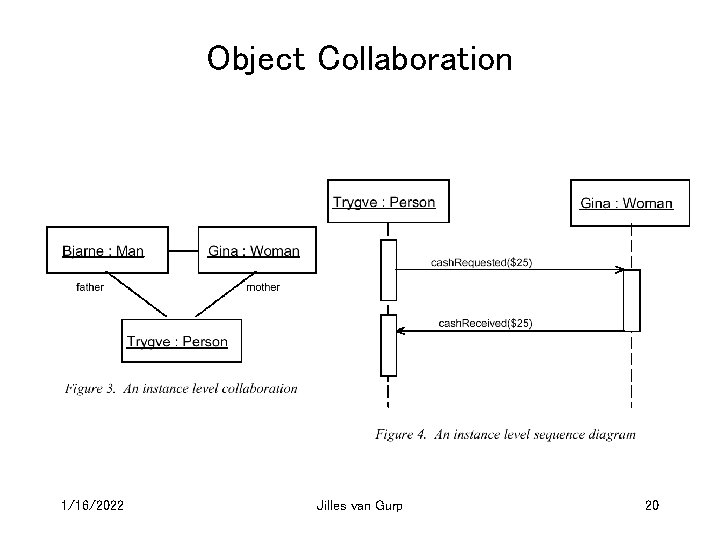
Object Collaboration 1/16/2022 Jilles van Gurp 20
Expressiveness • This model is very concrete – a particular object with the identity “Trygve” requests and receives cash from another particular object “Gina”. • This model is too concrete because it only applies to Trygve and Gina • It doesn’t scale up (imagine having to model the collaborations for 1000 persons like this) 1/16/2022 Jilles van Gurp 21

Specification level Collaboration 1/16/2022 Jilles van Gurp 22
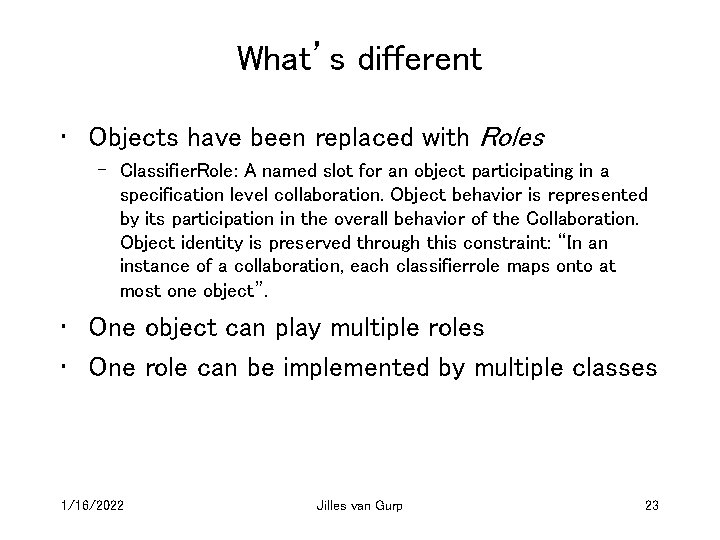
What’s different • Objects have been replaced with Roles – Classifier. Role: A named slot for an object participating in a specification level collaboration. Object behavior is represented by its participation in the overall behavior of the Collaboration. Object identity is preserved through this constraint: “In an instance of a collaboration, each classifierrole maps onto at most one object”. • One object can play multiple roles • One role can be implemented by multiple classes 1/16/2022 Jilles van Gurp 23
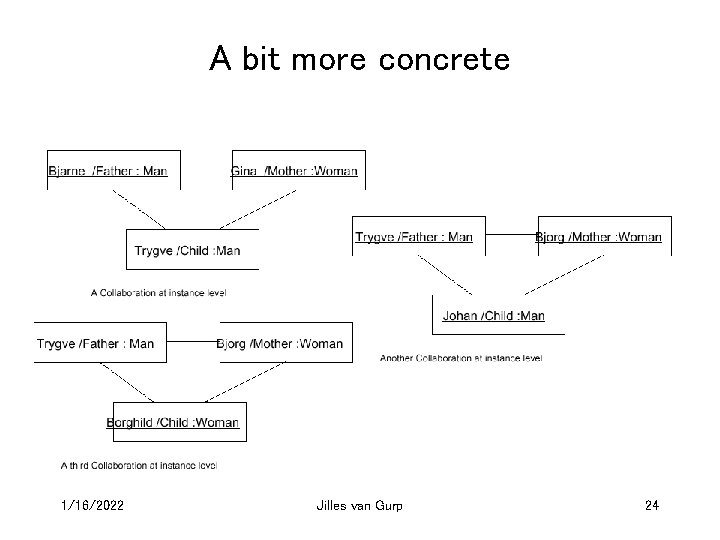
A bit more concrete 1/16/2022 Jilles van Gurp 24
Implementation • Java allows classes to implement more than 1 interface. • Multiple Inheritance can be used to do the trick in other languages (Mixin) • IDL interfaces can be used in a COM or Corba like architecture 1/16/2022 Jilles van Gurp 25
Software Product Lines? • >> Frameworks • Similar to product lines in e. g. a car factory • Involves: – – Architecture (e. g. frameworks) Reusable parts (e. g. components, libraries) Hotspots/plug points (e. g. IDL interfaces, abstract classes) Development Process Issues (e. g. waterfall model) • Large amounts of code are involved (millions LOC) 1/16/2022 Jilles van Gurp 26
More about SPLs … • See the SPL book: Design and Use of Software Architectures Adopting and Evolving a Product-Line Approach By Jan Bosch ISBN 0 -201 -67494 -7, Addison Wesley, June 2000 1/16/2022 Jilles van Gurp 27
So, why build a SPL? • Practice shows: – Opportunistic reuse does not work: you need to plan ahead otherwise you’ll keep reinventing the wheel. – It saves you time when creating new products: • time to market • allows you to focus on the product specifics 1/16/2022 Jilles van Gurp 28
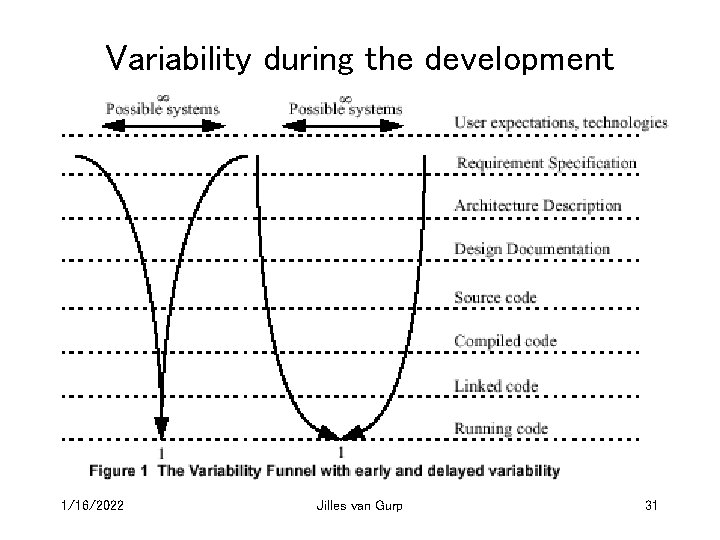
Building a SPL • Is planning for change: you decide what things are not going to change from product to product • It’s separating the static parts (commonality) of your software from the variable parts (variability) 1/16/2022 Jilles van Gurp 29
Variability? • A returning topic in both SPLs and FWs • The title of my thesis says it is the key to software reuse 1/16/2022 Jilles van Gurp 30
Variability during the development 1/16/2022 Jilles van Gurp 31
Variability is … • Delaying design decisions • Leaving things open 1/16/2022 Jilles van Gurp 32
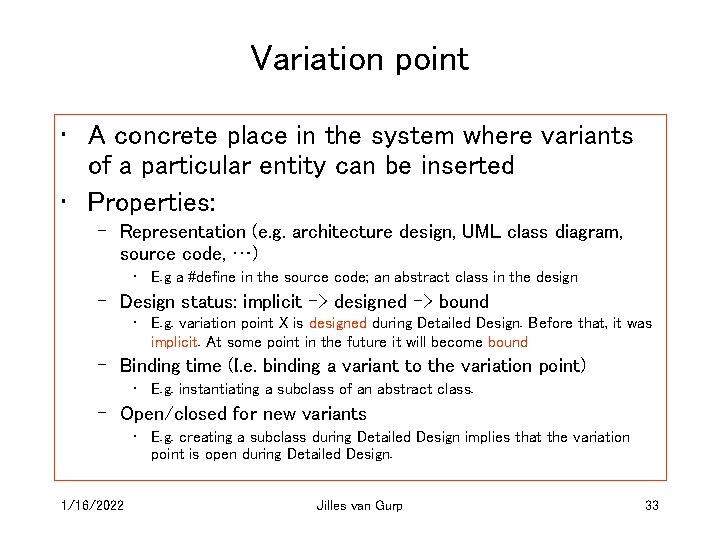
Variation point • A concrete place in the system where variants of a particular entity can be inserted • Properties: – Representation (e. g. architecture design, UML class diagram, source code, …) • E. g a #define in the source code; an abstract class in the design – Design status: implicit -> designed -> bound • E. g. variation point X is designed during Detailed Design. Before that, it was implicit. At some point in the future it will become bound – Binding time (I. e. binding a variant to the variation point) • E. g. instantiating a subclass of an abstract class. – Open/closed for new variants • E. g. creating a subclass during Detailed Design implies that the variation point is open during Detailed Design. 1/16/2022 Jilles van Gurp 33
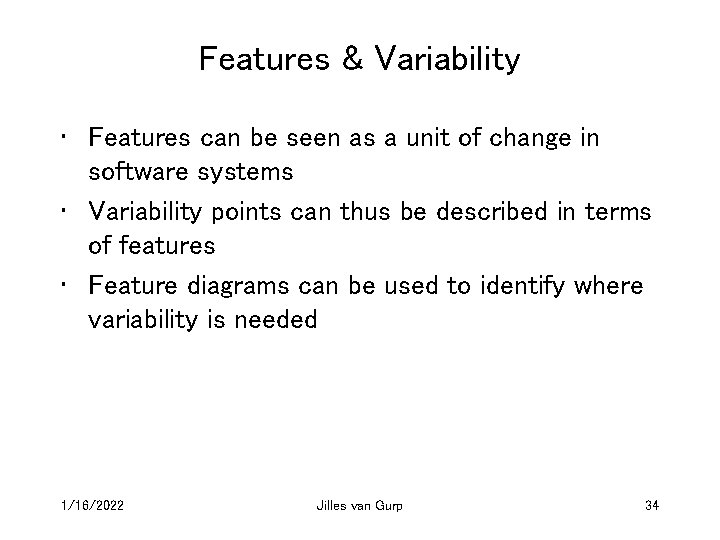
Features & Variability • Features can be seen as a unit of change in software systems • Variability points can thus be described in terms of features • Feature diagrams can be used to identify where variability is needed 1/16/2022 Jilles van Gurp 34
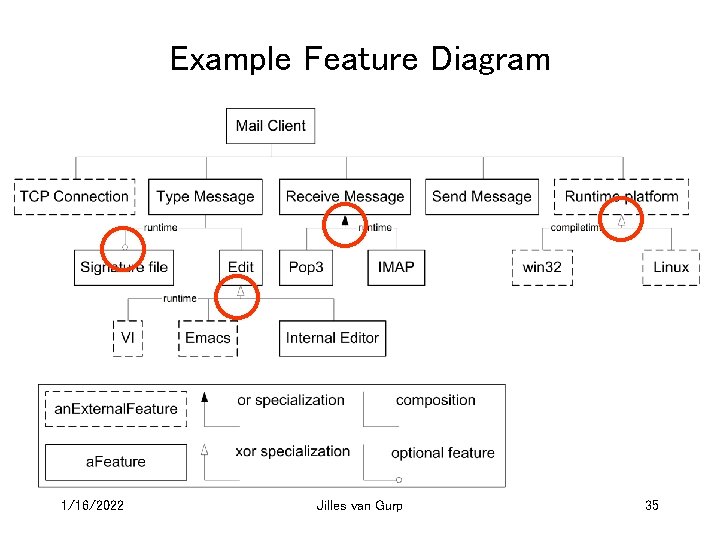
Example Feature Diagram 1/16/2022 Jilles van Gurp 35
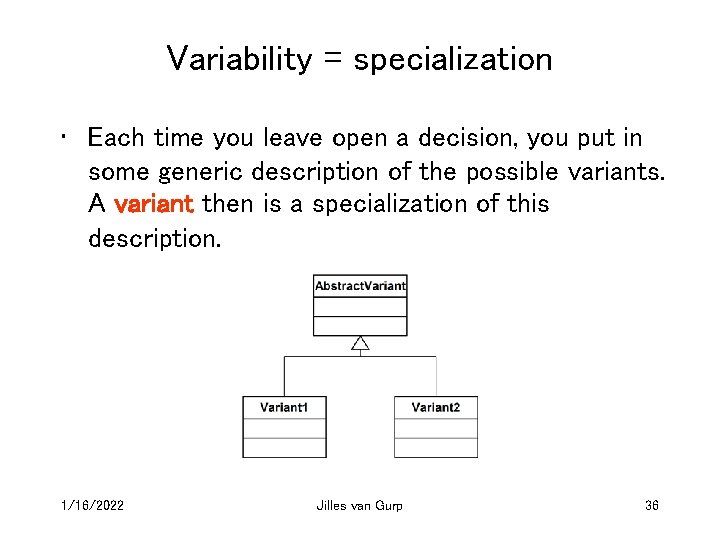
Variability = specialization • Each time you leave open a decision, you put in some generic description of the possible variants. A variant then is a specialization of this description. 1/16/2022 Jilles van Gurp 36
Variability != limited to design phase • We can have variability in any development phase, including run-time! 1/16/2022 Jilles van Gurp 37
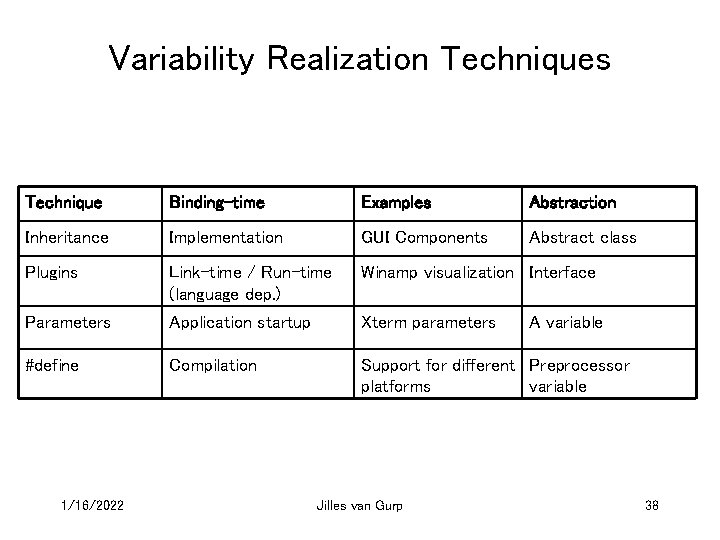
Variability Realization Techniques Technique Binding-time Examples Abstraction Inheritance Implementation GUI Components Abstract class Plugins Link-time / Run-time (language dep. ) Winamp visualization Interface Parameters Application startup Xterm parameters #define Compilation Support for different Preprocessor platforms variable 1/16/2022 Jilles van Gurp A variable 38
Management of variation points • Identify variation points (e. g. by making feature diagrams) • Assess the variation point properties • Specify the abstract variant (e. g. create abstract class) • Collect the variants (e. g. create subclasses) • Bind the variation points to a variant (e. g. instantiate a class and assign the instance to a property) 1/16/2022 Jilles van Gurp 39
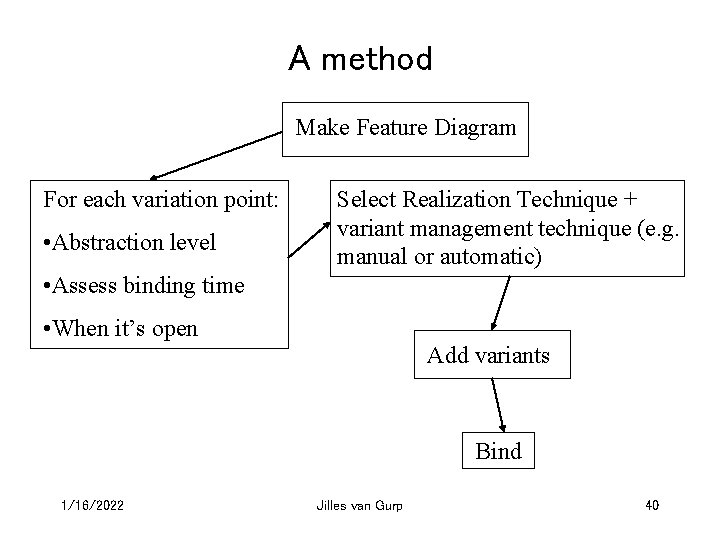
A method Make Feature Diagram For each variation point: • Abstraction level Select Realization Technique + variant management technique (e. g. manual or automatic) • Assess binding time • When it’s open Add variants Bind 1/16/2022 Jilles van Gurp 40
Reuse requires Variability • Reusing = using an existing piece of software in a new situation • The reused part needs to be adapted to the new situation – Set paramaters, Change the interface, Remove redundant pieces, Adjust some functionality • Reusable parts must facilitate variability – The more situations a part can adjust to the more reusable it is – A part that can only adjust to 1 situation is not reusable 1/16/2022 Jilles van Gurp 41
How much variability do we need? • Just enough to meet future requirements • Too much: Flexibility usually costs you in terms of complexity, time to market, performance, maintainability … • Too few: You may not be able to meet a new requirement, you may have to work around design errors, starting from scratch is becoming good alternative to adapting the system. 1/16/2022 Jilles van Gurp 42
Future/current work • What are the limitations of OO? • How can we work around these limitations? • How useful are OO extensions such as AOP and SOP? – AOP = Aspect Oriented Programming – SOP = Subject Oriented Programming • Can we lift novel approaches to the architecture level? 1/16/2022 Jilles van Gurp 43
Constraints on our work • We can’t expect radical programming paradigm shifts so we have to rely on existing technology • Whatever we come up with: it has to be applicable to large industrial systems • We don’t want to focus on implementation solutions, instead we want to focus on architecture 1/16/2022 Jilles van Gurp 44
Recent work • Two Wicsa Papers: – Revised version of the variability paper – A paper discussing a case study regarding Architecture Erosion • Architecture Design & Separation of concerns 1/16/2022 Jilles van Gurp 45
Summary/conclusion • Title says all: Variability in Software Systems The Key to Software Reuse • Questions? 1/16/2022 Jilles van Gurp 46
- Slides: 46