
Variability in Ostariophysan Fish Brain Anatomy in Relation
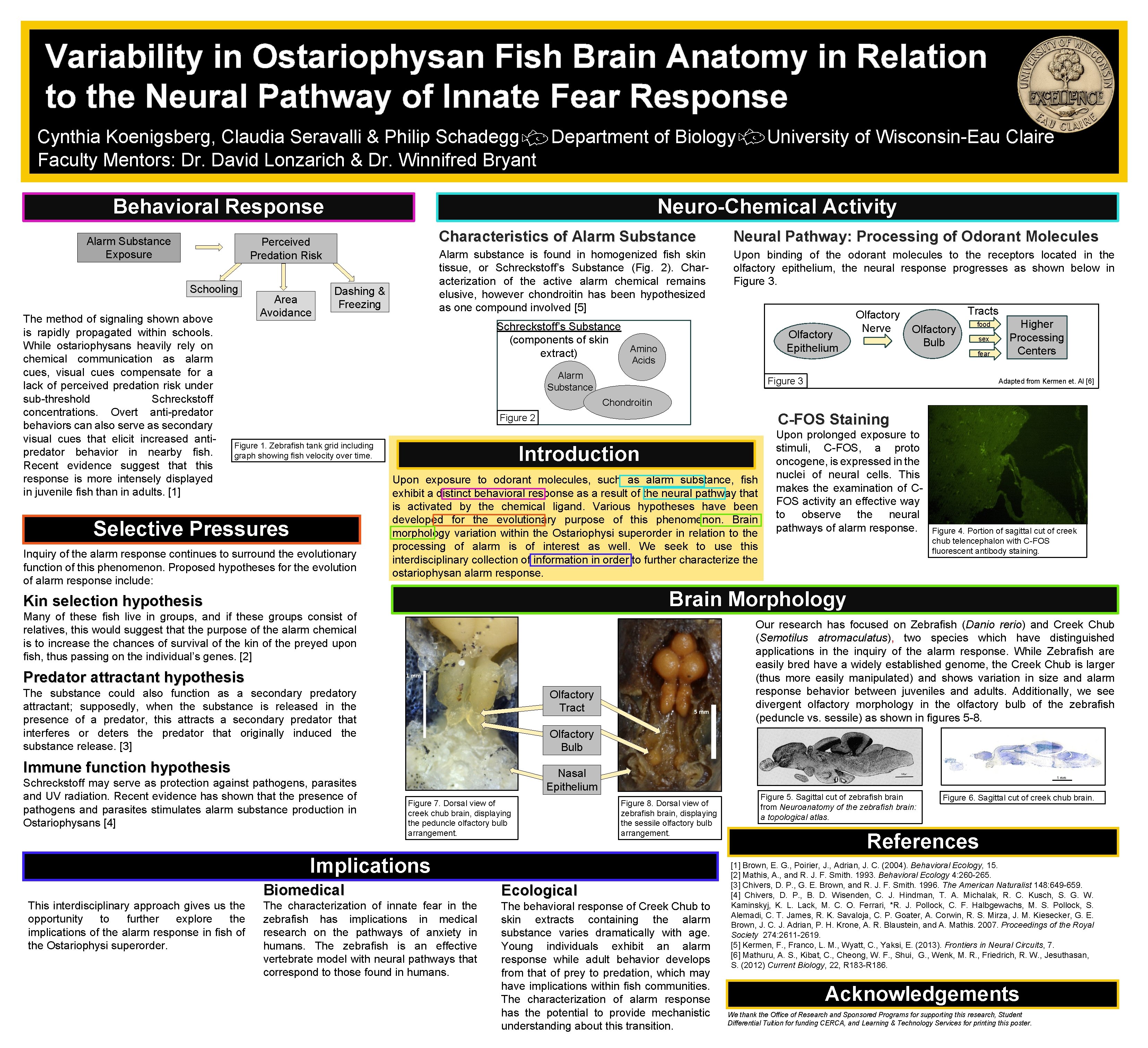
Variability in Ostariophysan Fish Brain Anatomy in Relation to the Neural Pathway of Innate Fear Response Cynthia Koenigsberg, Claudia Seravalli & Philip Schadegg Department of Biology Faculty Mentors: Dr. David Lonzarich & Dr. Winnifred Bryant Behavioral Response Alarm Substance Exposure Neuro-Chemical Activity Perceived Predation Risk Schooling The method of signaling shown above is rapidly propagated within schools. While ostariophysans heavily rely on chemical communication as alarm cues, visual cues compensate for a lack of perceived predation risk under sub-threshold Schreckstoff concentrations. Overt anti-predator behaviors can also serve as secondary visual cues that elicit increased antipredator behavior in nearby fish. Recent evidence suggest that this response is more intensely displayed in juvenile fish than in adults. [1] Area Avoidance University of Wisconsin-Eau Claire Dashing & Freezing Characteristics of Alarm Substance Neural Pathway: Processing of Odorant Molecules Alarm substance is found in homogenized fish skin tissue, or Schreckstoff’s Substance (Fig. 2). Characterization of the active alarm chemical remains elusive, however chondroitin has been hypothesized as one compound involved [5] Upon binding of the odorant molecules to the receptors located in the olfactory epithelium, the neural response progresses as shown below in Figure 3. Schreckstoff’s Substance (components of skin Amino extract) Olfactory Epithelium Olfactory Nerve Tracts Olfactory Bulb sex fear Acids Alarm Substance food Figure 3 Higher Processing Centers Adapted from Kermen et. Al [6] Chondroitin C-FOS Staining Figure 2 Figure 1. Zebrafish tank grid including graph showing fish velocity over time. Selective Pressures Inquiry of the alarm response continues to surround the evolutionary function of this phenomenon. Proposed hypotheses for the evolution of alarm response include: Introduction Upon exposure to odorant molecules, such as alarm substance, fish exhibit a distinct behavioral response as a result of the neural pathway that is activated by the chemical ligand. Various hypotheses have been developed for the evolutionary purpose of this phenomenon. Brain morphology variation within the Ostariophysi superorder in relation to the processing of alarm is of interest as well. We seek to use this interdisciplinary collection of information in order to further characterize the ostariophysan alarm response. Many of these fish live in groups, and if these groups consist of relatives, this would suggest that the purpose of the alarm chemical is to increase the chances of survival of the kin of the preyed upon fish, thus passing on the individual’s genes. [2] Our research has focused on Zebrafish (Danio rerio) and Creek Chub (Semotilus atromaculatus), two species which have distinguished applications in the inquiry of the alarm response. While Zebrafish are easily bred have a widely established genome, the Creek Chub is larger (thus more easily manipulated) and shows variation in size and alarm response behavior between juveniles and adults. Additionally, we see divergent olfactory morphology in the olfactory bulb of the zebrafish (peduncle vs. sessile) as shown in figures 5 -8. Predator attractant hypothesis The substance could also function as a secondary predatory attractant; supposedly, when the substance is released in the presence of a predator, this attracts a secondary predator that interferes or deters the predator that originally induced the substance release. [3] Olfactory Tract Olfactory Bulb Immune function hypothesis Nasal Epithelium Figure 7. Dorsal view of creek chub brain, displaying the peduncle olfactory bulb arrangement. 1 mm Figure 8. Dorsal view of zebrafish brain, displaying the sessile olfactory bulb arrangement. Implications Biomedical This interdisciplinary approach gives us the opportunity to further explore the implications of the alarm response in fish of the Ostariophysi superorder. Figure 4. Portion of sagittal cut of creek chub telencephalon with C-FOS fluorescent antibody staining. Brain Morphology Kin selection hypothesis Schreckstoff may serve as protection against pathogens, parasites and UV radiation. Recent evidence has shown that the presence of pathogens and parasites stimulates alarm substance production in Ostariophysans [4] Upon prolonged exposure to stimuli, C-FOS, a proto oncogene, is expressed in the nuclei of neural cells. This makes the examination of CFOS activity an effective way to observe the neural pathways of alarm response. The characterization of innate fear in the zebrafish has implications in medical research on the pathways of anxiety in humans. The zebrafish is an effective vertebrate model with neural pathways that correspond to those found in humans. Ecological The behavioral response of Creek Chub to skin extracts containing the alarm substance varies dramatically with age. Young individuals exhibit an alarm response while adult behavior develops from that of prey to predation, which may have implications within fish communities. The characterization of alarm response has the potential to provide mechanistic understanding about this transition. Figure 5. Sagittal cut of zebrafish brain from Neuroanatomy of the zebrafish brain: a topological atlas. Figure 6. Sagittal cut of creek chub brain. References [1] Brown, E. G. , Poirier, J. , Adrian, J. C. (2004). Behavioral Ecology, 15. [2] Mathis, A. , and R. J. F. Smith. 1993. Behavioral Ecology 4: 260 -265. [3] Chivers, D. P. , G. E. Brown, and R. J. F. Smith. 1996. The American Naturalist 148: 649 -659. [4] Chivers, D. P. , B. D. Wisenden, C. J. Hindman, T. A. Michalak, R. C. Kusch, S. G. W. Kaminskyj, K. L. Lack, M. C. O. Ferrari, *R. J. Pollock, C. F. Halbgewachs, M. S. Pollock, S. Alemadi, C. T. James, R. K. Savaloja, C. P. Goater, A. Corwin, R. S. Mirza, J. M. Kiesecker, G. E. Brown, J. C. J. Adrian, P. H. Krone, A. R. Blaustein, and A. Mathis. 2007. Proceedings of the Royal Society 274: 2611 -2619. [5] Kermen, F. , Franco, L. M. , Wyatt, C. , Yaksi, E. (2013). Frontiers in Neural Circuits, 7. [6] Mathuru, A. S. , Kibat, C. , Cheong, W. F. , Shui, G. , Wenk, M. R. , Friedrich, R. W. , Jesuthasan, S. (2012) Current Biology, 22, R 183 -R 186. Acknowledgements We thank the Office of Research and Sponsored Programs for supporting this research, Student Differential Tuition for funding CERCA, and Learning & Technology Services for printing this poster.
- Slides: 1