
VARi D Variation Detection in ColorSpace and LetterSpace
- Slides: 1
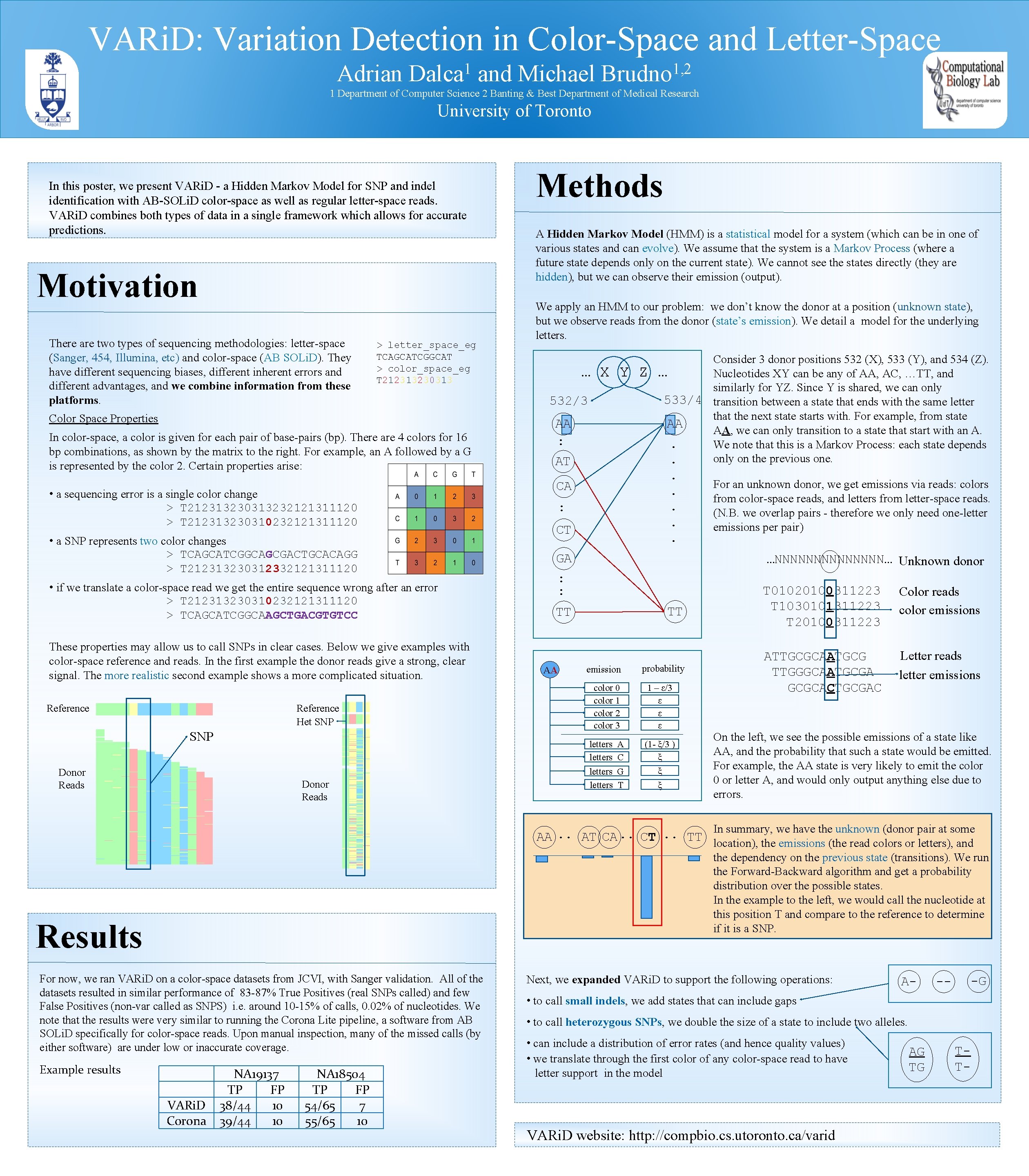
VARi. D: Variation Detection in Color-Space and Letter-Space Adrian 1 Dalca and Michael 1, 2 Brudno 1 Department of Computer Science 2 Banting & Best Department of Medical Research University of Toronto In this poster, we present VARi. D - a Hidden Markov Model for SNP and indel identification with AB-SOLi. D color-space as well as regular letter-space reads. VARi. D combines both types of data in a single framework which allows for accurate predictions. Motivation There are two types of sequencing methodologies: letter-space (Sanger, 454, Illumina, etc) and color-space (AB SOLi. D). They have different sequencing biases, different inherent errors and different advantages, and we combine information from these platforms. > letter_space_eg TCAGCATCGGCAT > color_space_eg T 212313230313 Color Space Properties In color-space, a color is given for each pair of base-pairs (bp). There are 4 colors for 16 bp combinations, as shown by the matrix to the right. For example, an A followed by a G is represented by the color 2. Certain properties arise: • a sequencing error is a single color change > T 212313230313232121311120 > T 212313230310232121311120 • a SNP represents two color changes > TCAGCATCGGCAGCGACTGCACAGG > T 212313230312332121311120 • if we translate a color-space read we get the entire sequence wrong after an error > T 212313230310232121311120 > TCAGCATCGGCAAGCTGACGTGTCC These properties may allow us to call SNPs in clear cases. Below we give examples with color-space reference and reads. In the first example the donor reads give a strong, clear signal. The more realistic second example shows a more complicated situation. Reference Het SNP Reference SNP Donor Reads Methods A Hidden Markov Model (HMM) is a statistical model for a system (which can be in one of various states and can evolve). We assume that the system is a Markov Process (where a future state depends only on the current state). We cannot see the states directly (they are hidden), but we can observe their emission (output). We apply an HMM to our problem: we don’t know the donor at a position (unknown state), but we observe reads from the donor (state’s emission). We detail a model for the underlying letters. … X Y Z 532/3 AA : AT Consider 3 donor positions 532 (X), 533 (Y), and 534 (Z). … Nucleotides XY can be any of AA, AC, …TT, and similarly for YZ. Since Y is shared, we can only 533/4 transition between a state that ends with the same letter that the next state starts with. For example, from state AA AA, we can only transition to a state that start with an A. . We note that this is a Markov Process: each state depends only on the previous one. . . . CA : CT GA …NNNNNNN… Unknown donor : : TT TT AA For an unknown donor, we get emissions via reads: colors from color-space reads, and letters from letter-space reads. (N. B. we overlap pairs - therefore we only need one-letter emissions per pair) emission probability color 0 color 1 color 2 color 3 1 – ε/3 ε ε ε letters A letters C (1 - ξ/3 ) ξ ξ ξ letters G letters T T 01020100311223 T 1030101311223 T 20100311223 Color reads color emissions ATTGCGCAATGCG TTGGGCAATGCGA GCGCACTGCGAC Letter reads letter emissions On the left, we see the possible emissions of a state like AA, and the probability that such a state would be emitted. For example, the AA state is very likely to emit the color 0 or letter A, and would only output anything else due to errors. In summary, we have the unknown (donor pair at some AA. . AT CA. . CT. . TT location), the emissions (the read colors or letters), and the dependency on the previous state (transitions). We run the Forward-Backward algorithm and get a probability distribution over the possible states. In the example to the left, we would call the nucleotide at this position T and compare to the reference to determine if it is a SNP. Results For now, we ran VARi. D on a color-space datasets from JCVI, with Sanger validation. All of the datasets resulted in similar performance of 83 -87% True Positives (real SNPs called) and few False Positives (non-var called as SNPS) i. e. around 10 -15% of calls, 0. 02% of nucleotides. We note that the results were very similar to running the Corona Lite pipeline, a software from AB SOLi. D specifically for color-space reads. Upon manual inspection, many of the missed calls (by either software) are under low or inaccurate coverage. Example results VARi. D Corona NA 19137 TP FP 38/44 10 39/44 10 NA 18504 TP FP 54/65 7 55/65 10 Next, we expanded VARi. D to support the following operations: A- -- -G • to call small indels, we add states that can include gaps • to call heterozygous SNPs, we double the size of a state to include two alleles. • can include a distribution of error rates (and hence quality values) • we translate through the first color of any color-space read to have letter support in the model VARi. D website: http: //compbio. cs. utoronto. ca/varid AG TG TT-