
Vapour Recovery Units with Dry Screw Vacuum Pumps
- Slides: 52
Vapour Recovery Units with Dry Screw Vacuum Pumps Ties Mulder Commercial Director Carbo. Vac
• Field of Application • Legislation • Dry Vacuum Vapour Recovery Systems • Advantages of the Dry Systems • Some Examples Dry Vacuum Vapour Recovery Units - PP Presentation 2/52
• Field of Application • Legislation • Dry Vacuum Vapour Recovery Systems • Advantages of the Dry Systems • Some Examples Dry Vacuum Vapour Recovery Units - PP Presentation 3/52
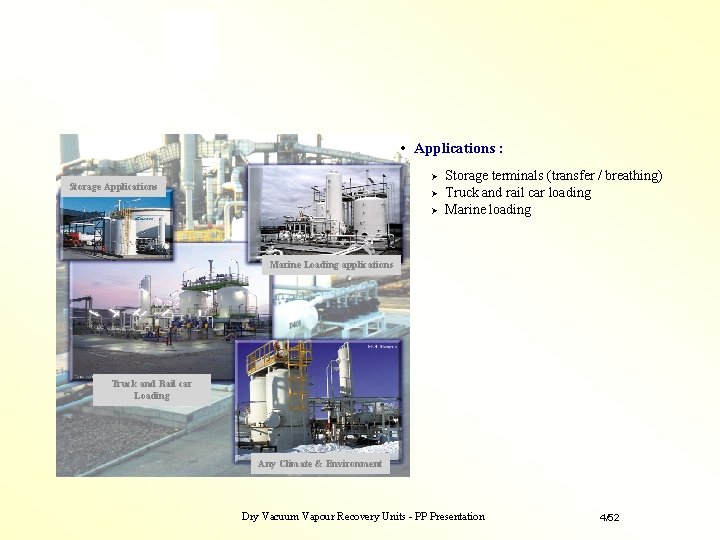
• Applications : Storage terminals (transfer / breathing) Storage Applications Truck and rail car loading Marine loading Marine Loading applications Truck and Rail car Loading Any Climate & Environment Dry Vacuum Vapour Recovery Units - PP Presentation 4/52
• Our Activities • Legislation • Dry Vacuum Vapour Recovery Systems • Advantages of the Dry Systems • Some Examples Dry Vacuum Vapour Recovery Units - PP Presentation 5/52
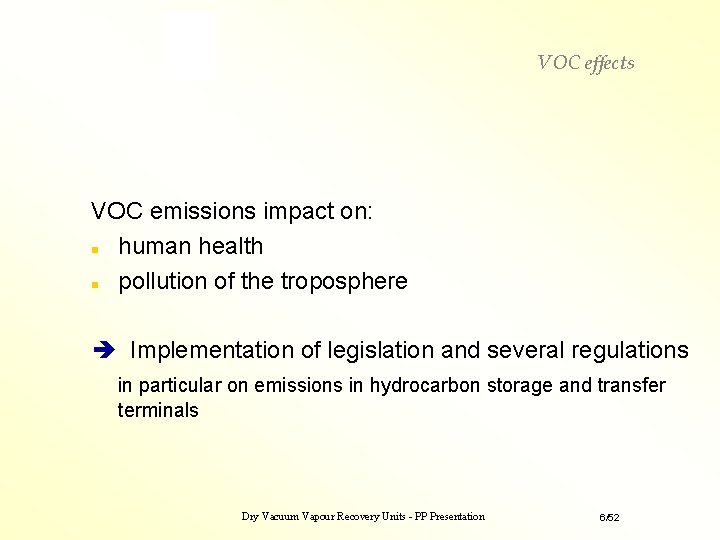
VOC effects VOC emissions impact on: n human health n pollution of the troposphere Implementation of legislation and several regulations in particular on emissions in hydrocarbon storage and transfer terminals Dry Vacuum Vapour Recovery Units - PP Presentation 6/52
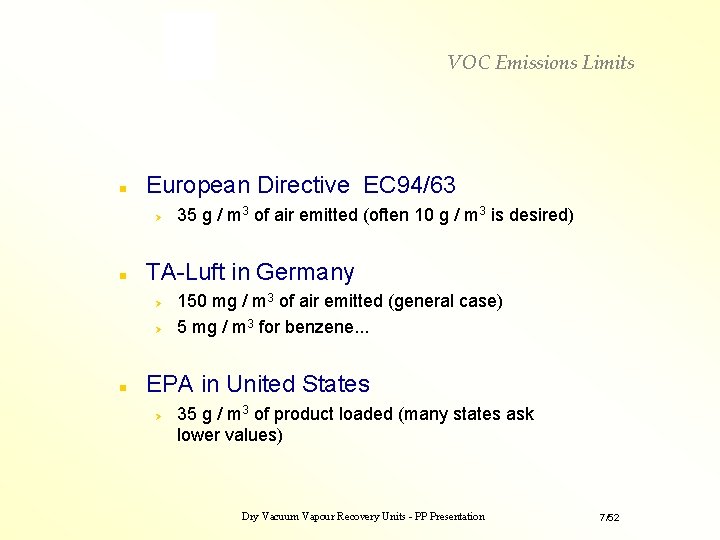
VOC Emissions Limits n European Directive EC 94/63 n TA-Luft in Germany n 35 g / m 3 of air emitted (often 10 g / m 3 is desired) 150 mg / m 3 of air emitted (general case) 5 mg / m 3 for benzene. . . EPA in United States 35 g / m 3 of product loaded (many states ask lower values) Dry Vacuum Vapour Recovery Units - PP Presentation 7/52
• Our Activities • Legislation • Dry Vacuum Vapour Recovery Systems • Advantages of the Dry Systems • Some Examples Dry Vacuum Vapour Recovery Units - PP Presentation 8/52
How to size a VRU Important data for VRU sizing for truck and rail car loading: • Peak flow rate = max. flow rate generated by the loading facility (i. e max. number of loading points connected simultaneously x flow rate per point) Determination of the pressure drop of the VRU and the vapour collecting system Determination of the lines size, carbon bed diameter All vapours have to pass through the VRU. Influence on price is small. • Max. throughput per cycle = max. vapour amount generated in 15 minutes (for truck loading) (i. e number of loading bays x volume loaded per cycle or vessel capacity) For continuous throughputs the cycle time is usually fixed at 12 minutes Determination of the activated carbon volume in the beds • Max. throughput per 4 hour period = evaluation of the intensity of the activities at the terminal during the busiest period Determination of the required vacuum capacity Determination of the re-absorber and absorbents circulation pumps • Max. daily throughput = evaluation of the loading profile per day Adjustment of the vacuum capacity Dry Vacuum Vapour Recovery Units - PP Presentation 9/52
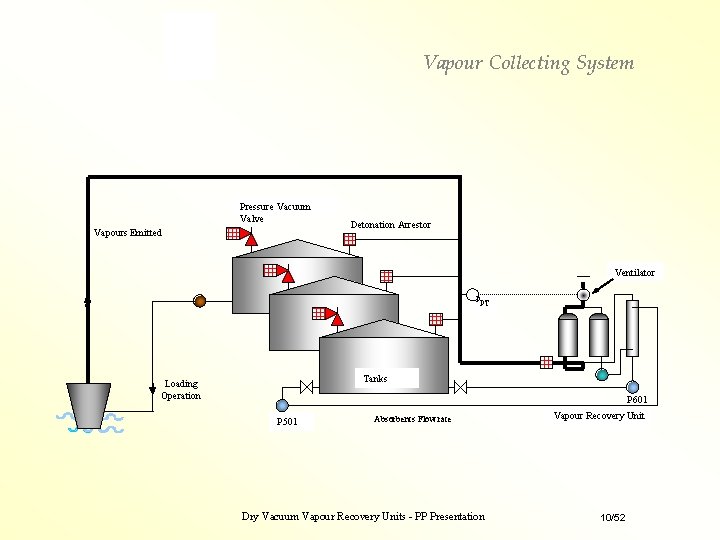
Vapour Collecting System Pressure Vacuum Valve Vapours Emitted Detonation Arrestor Ventilator P PT Tanks Loading Operation P 601 P 501 Absorbents Flow rate Dry Vacuum Vapour Recovery Units - PP Presentation Vapour Recovery Unit 10/52
Typical Flow Diagram of Dry. Vac™ Dry Vacuum Vapour Recovery Units - PP Presentation 11/52
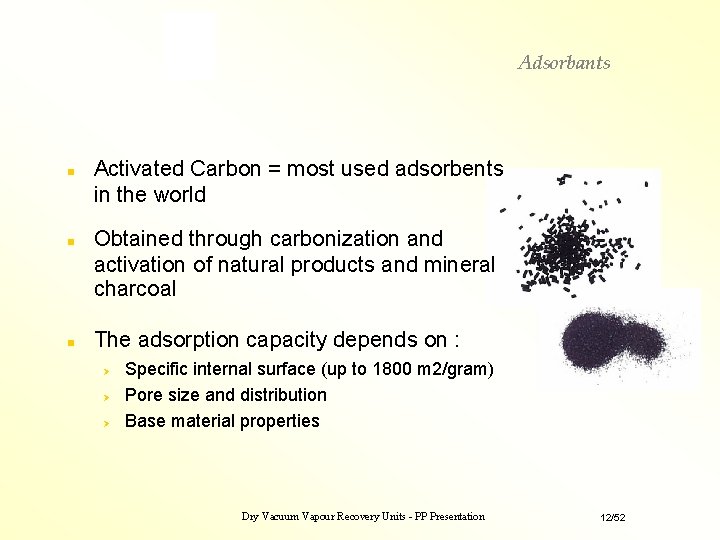
Adsorbants n n n Activated Carbon = most used adsorbents in the world Obtained through carbonization and activation of natural products and mineral charcoal The adsorption capacity depends on : Specific internal surface (up to 1800 m 2/gram) Pore size and distribution Base material properties Dry Vacuum Vapour Recovery Units - PP Presentation 12/52
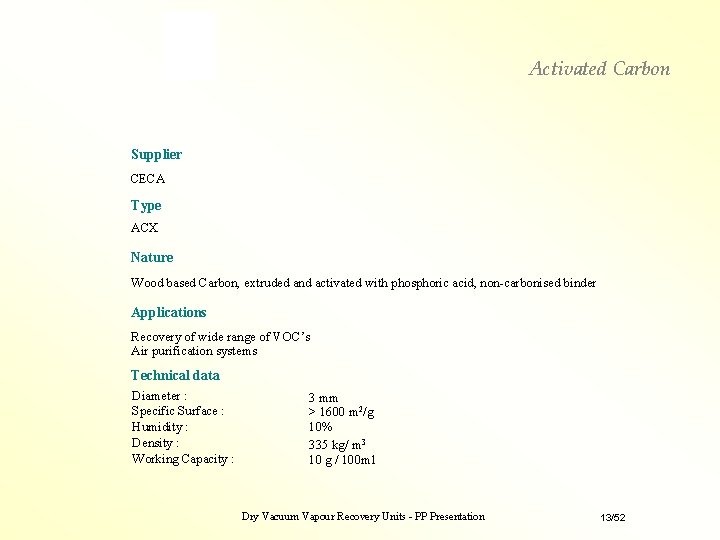
Activated Carbon Supplier CECA Type ACX Nature Wood based Carbon, extruded and activated with phosphoric acid, non-carbonised binder Applications Recovery of wide range of VOC’s Air purification systems Technical data Diameter : Specific Surface : Humidity : Density : Working Capacity : 3 mm > 1600 m 2/g 10% 335 kg/ m 3 10 g / 100 ml Dry Vacuum Vapour Recovery Units - PP Presentation 13/52
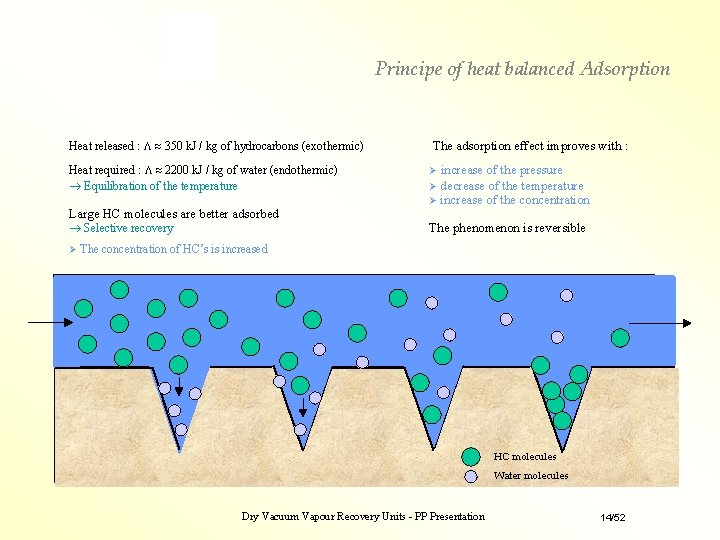
Principe of heat balanced Adsorption Heat released : 350 k. J / kg of hydrocarbons (exothermic) The adsorption effect improves with : Heat required : 2200 k. J / kg of water (endothermic) Equilibration of the temperature increase of the pressure Large HC molecules are better adsorbed Selective recovery decrease of the temperature increase of the concentration The phenomenon is reversible The concentration of HC’s is increased HC molecules Water molecules Dry Vacuum Vapour Recovery Units - PP Presentation 14/52
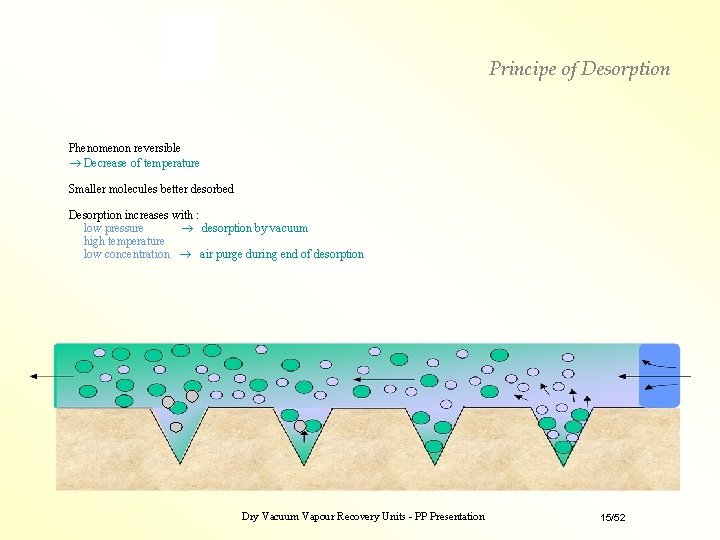
Principe of Desorption Phenomenon reversible Decrease of temperature Smaller molecules better desorbed Desorption increases with : low pressure desorption by vacuum high temperature low concentration air purge during end of desorption Dry Vacuum Vapour Recovery Units - PP Presentation 15/52
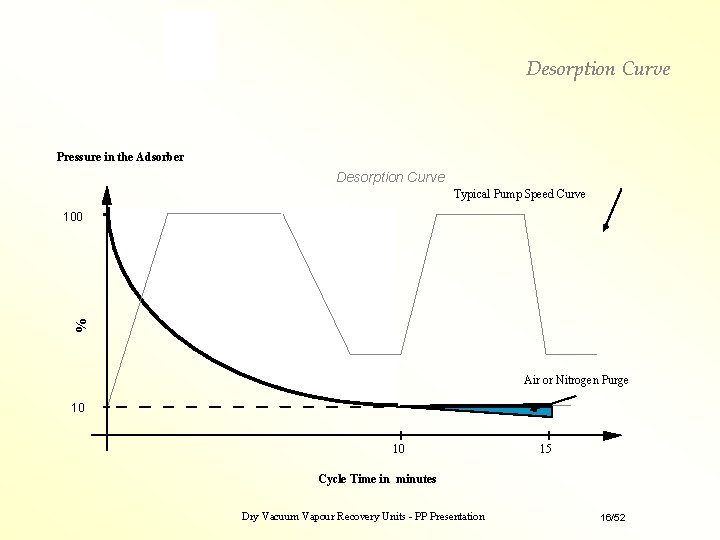
Desorption Curve Pressure in the Adsorber Desorption Curve Typical Pump Speed Curve % 100 Air or Nitrogen Purge 10 10 15 Cycle Time in minutes Dry Vacuum Vapour Recovery Units - PP Presentation 16/52
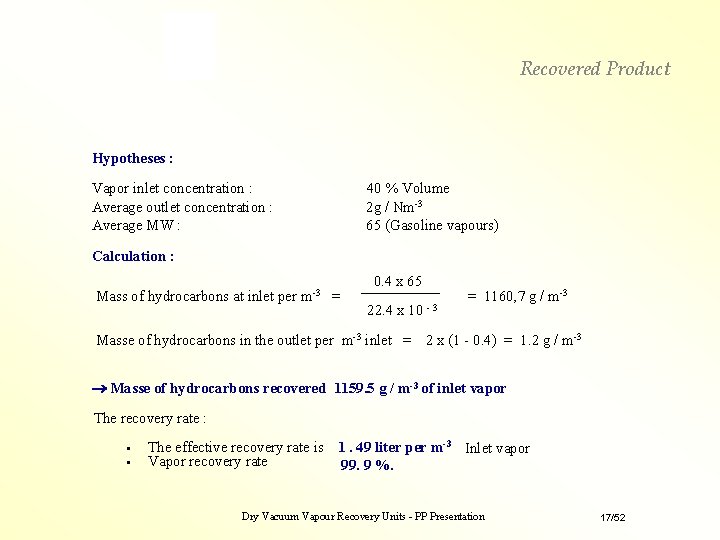
Recovered Product Hypotheses : Vapor inlet concentration : Average outlet concentration : Average MW : 40 % Volume 2 g / Nm-3 65 (Gasoline vapours) Calculation : 0. 4 x 65 Mass of hydrocarbons at inlet per m-3 = 22. 4 x 10 - 3 = 1160, 7 g / m-3 Masse of hydrocarbons in the outlet per m-3 inlet = 2 x (1 - 0. 4) = 1. 2 g / m-3 ® Masse of hydrocarbons recovered 1159. 5 g / m-3 of inlet vapor The recovery rate : § § The effective recovery rate is 1. 49 liter per m-3 Inlet vapor Vapor recovery rate 99. 9 %. Dry Vacuum Vapour Recovery Units - PP Presentation 17/52
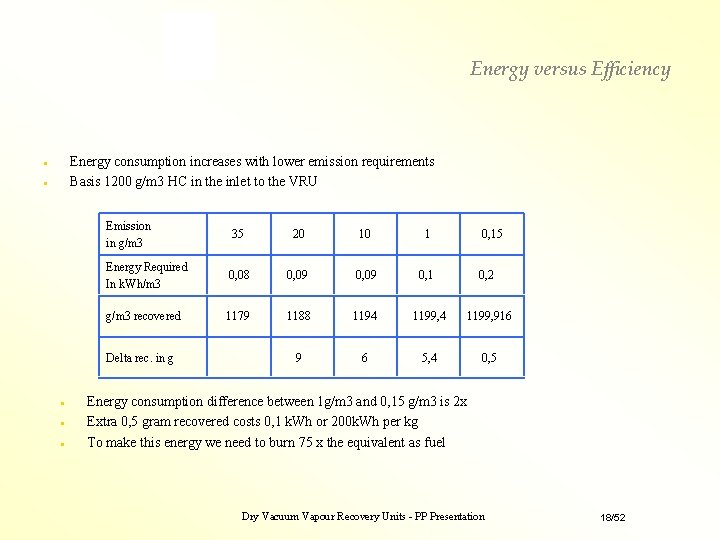
Energy versus Efficiency Energy consumption increases with lower emission requirements Basis 1200 g/m 3 HC in the inlet to the VRU n n Emission in g/m 3 35 20 10 1 0, 15 Energy Required In k. Wh/m 3 0, 08 0, 09 0, 1 0, 2 g/m 3 recovered 1179 1188 1194 1199, 916 9 6 5, 4 0, 5 Delta rec. in g n n n Energy consumption difference between 1 g/m 3 and 0, 15 g/m 3 is 2 x Extra 0, 5 gram recovered costs 0, 1 k. Wh or 200 k. Wh per kg To make this energy we need to burn 75 x the equivalent as fuel Dry Vacuum Vapour Recovery Units - PP Presentation 18/52
VRU schematic Dry Vacuum Vapour Recovery Units - PP Presentation 19/52
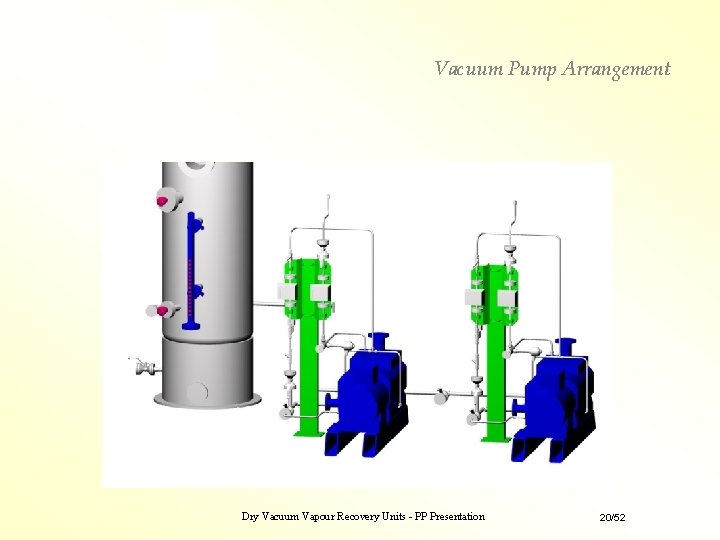
Vacuum Pump Arrangement Dry Vacuum Vapour Recovery Units - PP Presentation 20/52
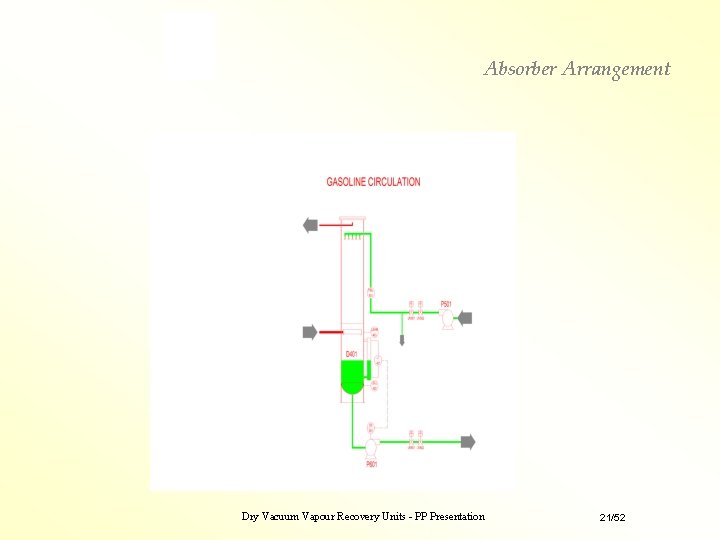
Absorber Arrangement Dry Vacuum Vapour Recovery Units - PP Presentation 21/52
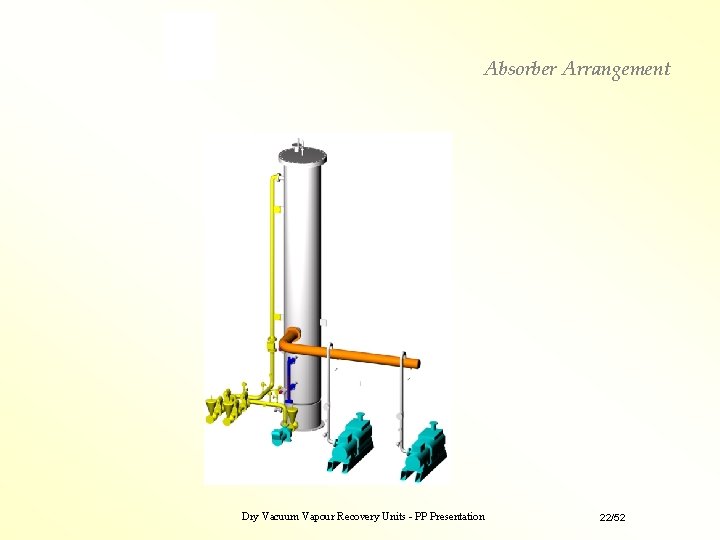
Absorber Arrangement Dry Vacuum Vapour Recovery Units - PP Presentation 22/52
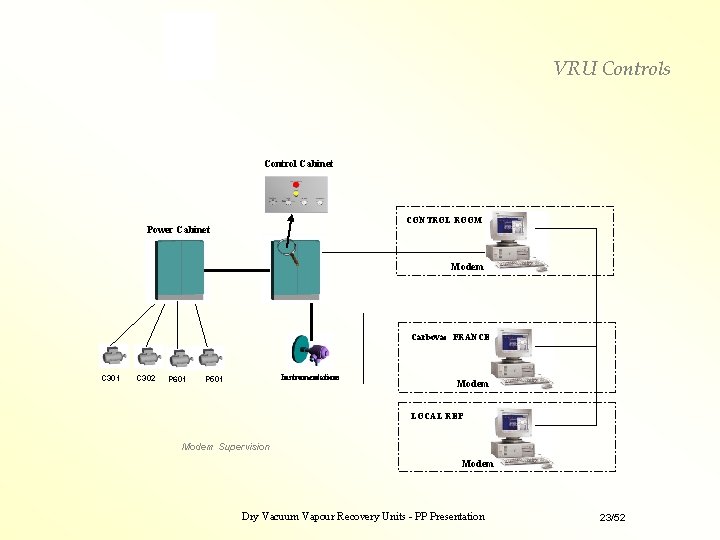
VRU Controls Control Cabinet CONTROL ROOM Power Cabinet Modem Carbovac FRANCE C 301 C 302 P 601 Instrumentations P 501 Modem LOCAL REP Modem Supervision Modem Dry Vacuum Vapour Recovery Units - PP Presentation 23/52
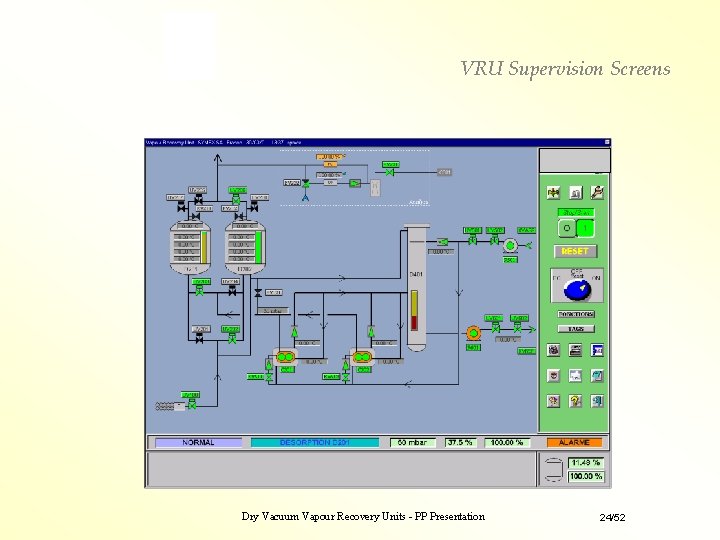
VRU Supervision Screens Dry Vacuum Vapour Recovery Units - PP Presentation 24/52
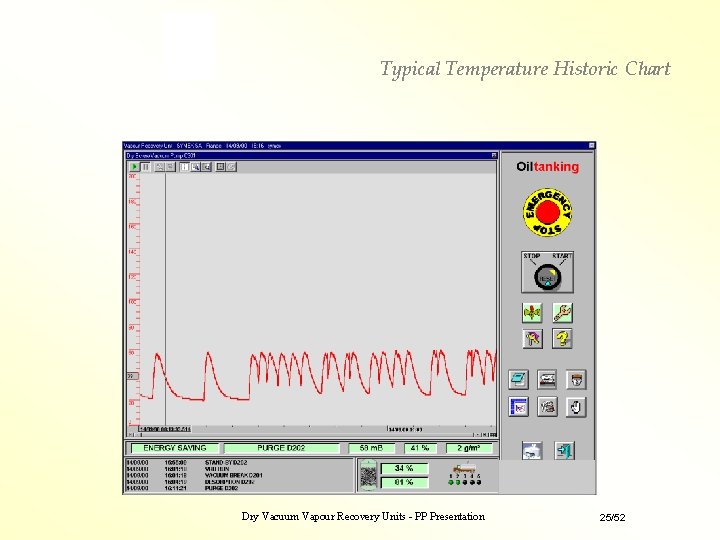
Typical Temperature Historic Chart Dry Vacuum Vapour Recovery Units - PP Presentation 25/52
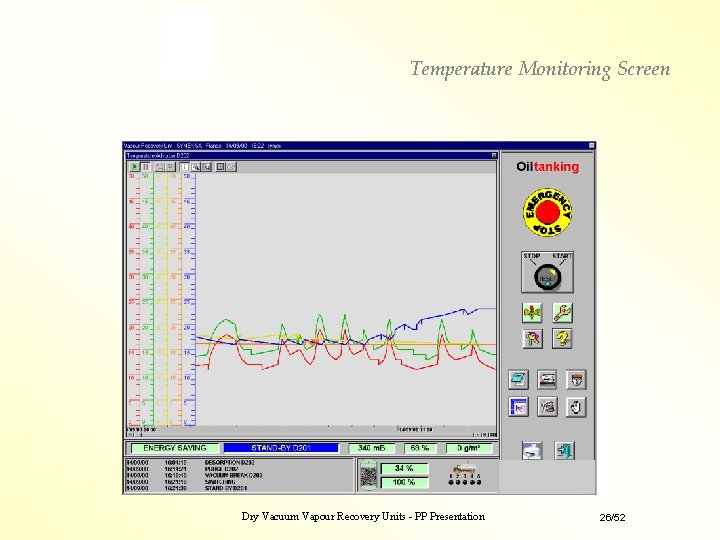
Temperature Monitoring Screen Dry Vacuum Vapour Recovery Units - PP Presentation 26/52
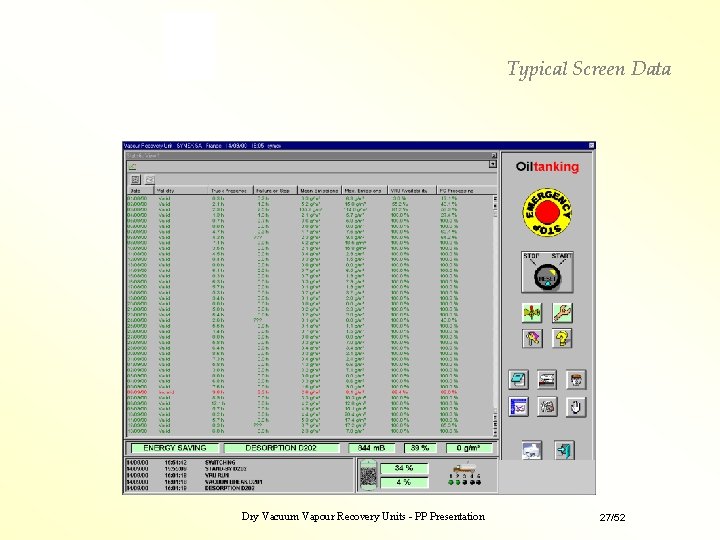
Typical Screen Data Dry Vacuum Vapour Recovery Units - PP Presentation 27/52
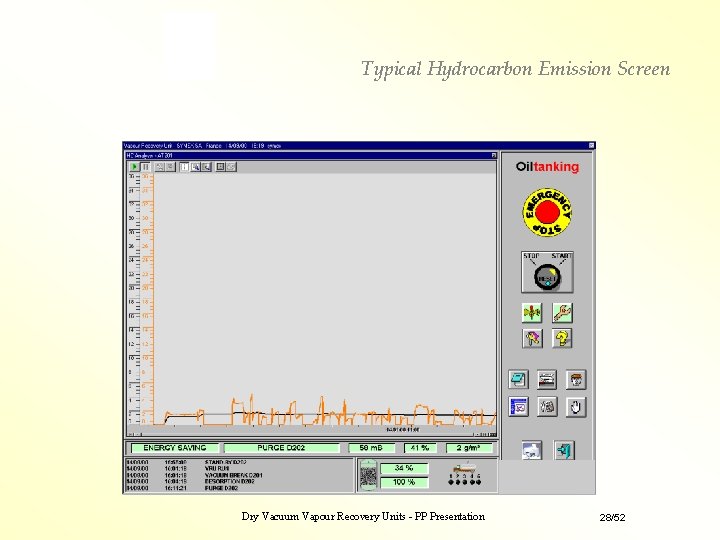
Typical Hydrocarbon Emission Screen Dry Vacuum Vapour Recovery Units - PP Presentation 28/52
• Our Activities • Legislation • Dry Vacuum Vapour Recovery Systems • Advantages of the Dry Systems • Some Examples Dry Vacuum Vapour Recovery Units - PP Presentation 29/52
Advantages of the Dry Vacuum System Advantages the Dry Vacuum Vapour Recovery System • Effective energy reduction program - Speed control of the dry screw vacuum pumps - Energy consumption proportional to the mass of hydrocarbons loaded • Activated Carbon - Very low sensitivity for hot spots through heat balanced adsorption. - Very good vapour distribution inside the adsorbers. - Very low pressure drop over the carbon beds. - Good mechanical resistance. - Very good bleed through values for low emissions ( 0, 01 et 5 g/m 3). - Long life time of more than 15 years. • Re-absorber level control through frequency controlled return pump Dry Vacuum Vapour Recovery Units - PP Presentation 30/52
Comparison of Dry Vacuum System with liquid ring vacuum systems Advantages the Dry Vacuum Vapour Recovery System • Simplification of the process The system is reduced to the absolute essential components required for functioning. There is no Glycol, no heat exchanger, no glycol circulation pump, no separator. less space required. • Absence of glycol No attack on the glycol by bacteria and fungi causing acidity and corrosion No glycol losses and yearly exchanges. • Less maintenance requirements • Less energy consumption < 0. 12 k. Wh/m 3 of vapor treated. • Flexibility of the process - more products can be treated (alcohol, ethers, MTBE) • Lower absorbents circulation flow rate. Dry Vacuum Vapour Recovery Units - PP Presentation 31/52
Disadvantages of liquid ring systems Disadvantages of the Liquid Ring Systems • Energy consumption ( 0. 25 k. Wh/m 3 of vapor treated on daily bases) • Seal fluid system Glycol losses Problems with corrosion and abrasion • Limited vacuum level ( 80 mbar abs. ) • Creation of secondary waste products • Non compatibility with certain in glycol solvable products (alcohol, MTBE) • Maintenance and quality checks of the glycol Dry Vacuum Vapour Recovery Units - PP Presentation 32/52
Dry Vacuum Vapour Recovery Systems n n Why change to dry Selection of Vacuum Pumps Dry Screw Vacuum Pump Safety Aspects Some Images Dry Vacuum Vapour Recovery Units - PP Presentation 33/52
Dry Vacuum Vapour Recovery Systems n Why change to DRY Corrosion and abrasion Energy consumption Simplicity of the system Range of vacuum levels Range of products to recover Proportional energy control Dry Vacuum Vapour Recovery Units - PP Presentation 34/52
Dry Vacuum Vapour Recovery Systems n Selection of Vacuum Pumps Roots blowers (single, multi stage) Rotary vane pumps (dry, oil lubricated) Dry screw pumps Dry Vacuum Vapour Recovery Units - PP Presentation 35/52
Dry Vacuum Vapour Recovery Systems n Roots Blowers (multi stage) Only low pressure drop possible per stage Noise Elevated internal temperatures Inter stage cooling required Maintenance sensitive equipment High energy requirements Dry Vacuum Vapour Recovery Units - PP Presentation 36/52
Dry Vacuum Vapour Recovery Systems n Rotary vane pumps (waste oil principle) Moving parts touch inside the pump (friction) Oil consumption Pollution of the recovered product Not explosion proof design Very maintenance sensitive Cannot handle liquid slugs Not designed for process applications Dry Vacuum Vapour Recovery Units - PP Presentation 37/52
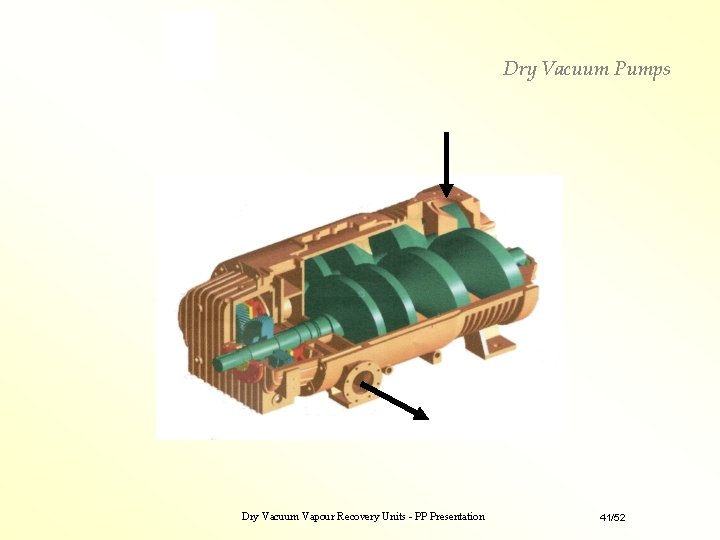
Dry Vacuum Vapour Recovery Systems n Dry screw vacuum pumps No touching part inside the pump (no friction) Low energy consumption No pollution of the recovered product Can handle liquid slugs Explosion proof design Dry Vacuum Vapour Recovery Units - PP Presentation 38/52
Dry Vacuum Vapour Recovery Systems n Specifics of the BUSCH COBRA Intermediate chambers between process and bearings (can be purged, flushed or vented) No mechanical seals (overhaul period >40 000 h) Interesting standard capacity range (400, 800, 1200 and 2500 m 3/h) No nitrogen purge required World wide service network Dry Vacuum Vapour Recovery Units - PP Presentation 39/52
Dry Vacuum Vapour Recovery Systems n Safety Aspects Robust construction Low pumping temperatures ( 50°C, 120 F ) No internal friction Explosion proof design at 15 barg (220 psi) Full monitoring by VSD’s Dry Vacuum Vapour Recovery Units - PP Presentation 40/52
Dry Vacuum Pumps Dry Vacuum Vapour Recovery Units - PP Presentation 41/52
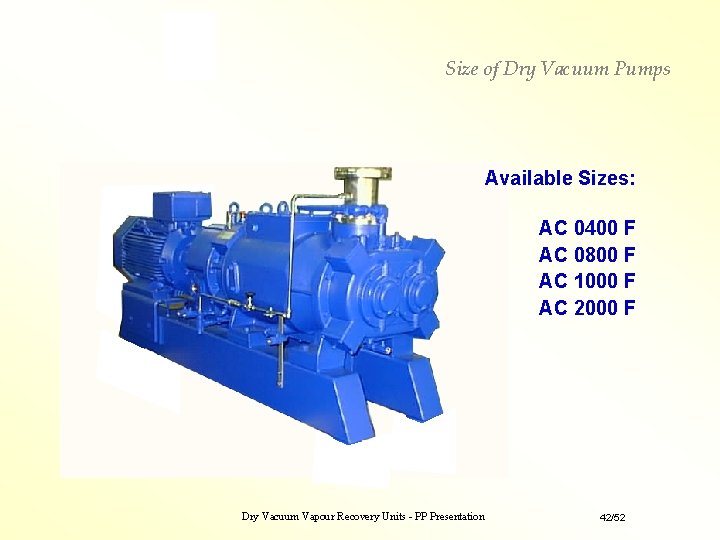
Size of Dry Vacuum Pumps Available Sizes: AC 0400 F AC 0800 F AC 1000 F AC 2000 F Dry Vacuum Vapour Recovery Units - PP Presentation 42/52
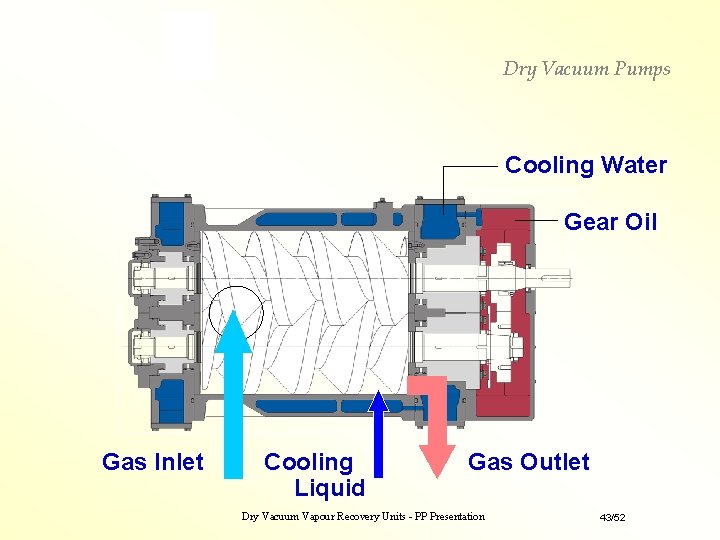
Dry Vacuum Pumps Cooling Water Gear Oil Gas Inlet Cooling Liquid Gas Outlet Dry Vacuum Vapour Recovery Units - PP Presentation 43/52
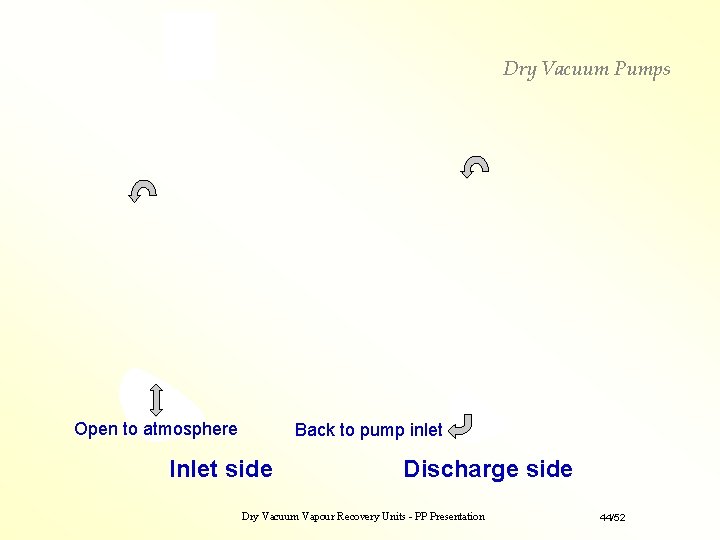
Dry Vacuum Pumps Open to atmosphere Back to pump inlet Inlet side Discharge side Dry Vacuum Vapour Recovery Units - PP Presentation 44/52
• Field of Application • Legislation • Dry Vacuum Vapour Recovery Systems • Advantages of the Dry Systems • Some Examples Dry Vacuum Vapour Recovery Units - PP Presentation 45/52
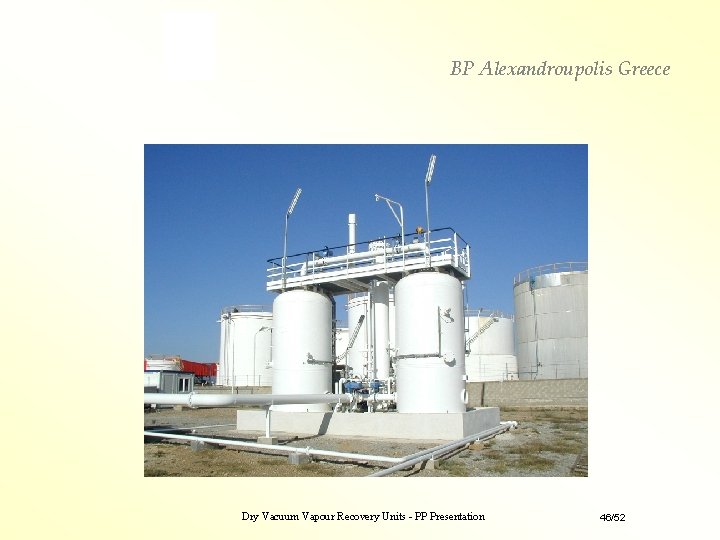
BP Alexandroupolis Greece Dry Vacuum Vapour Recovery Units - PP Presentation 46/52
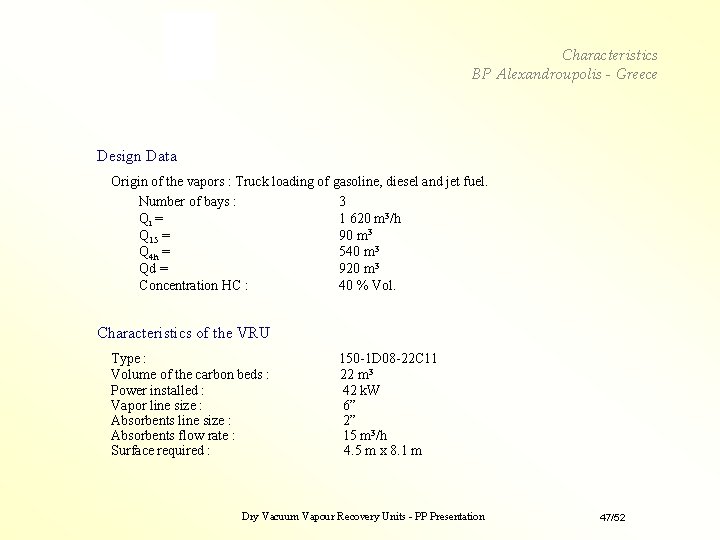
Characteristics BP Alexandroupolis - Greece Design Data Origin of the vapors : Truck loading of gasoline, diesel and jet fuel. Number of bays : 3 Qi = 1 620 m 3/h Q 15 = 90 m 3 Q 4 h = 540 m 3 Qd = 920 m 3 Concentration HC : 40 % Vol. Characteristics of the VRU Type : 150 -1 D 08 -22 C 11 Volume of the carbon beds : 22 m 3 Power installed : 42 k. W Vapor line size : 6” Absorbents line size : 2” Absorbents flow rate : 15 m 3/h Surface required : 4. 5 m x 8. 1 m Dry Vacuum Vapour Recovery Units - PP Presentation 47/52
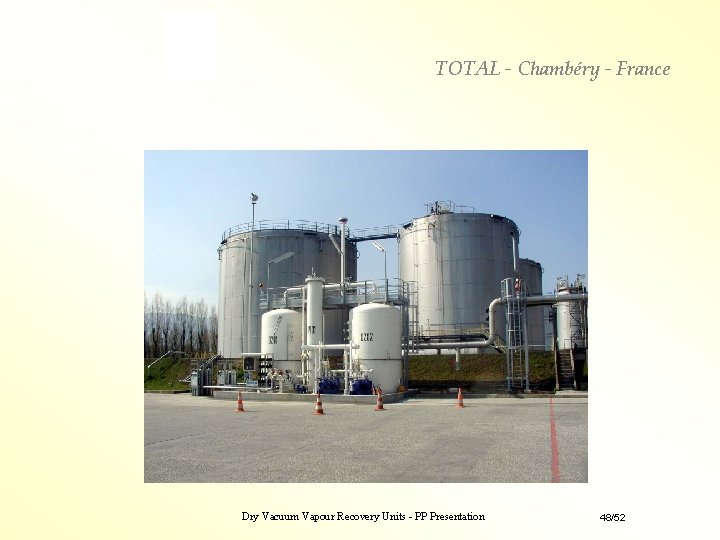
TOTAL - Chambéry - France Dry Vacuum Vapour Recovery Units - PP Presentation 48/52
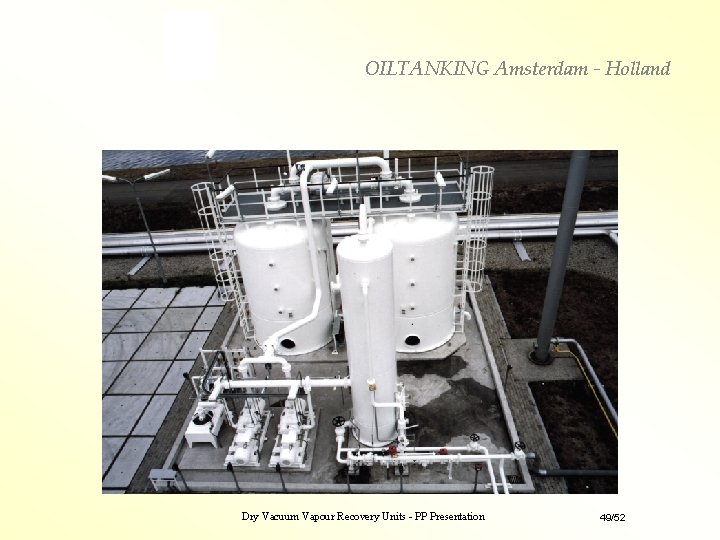
OILTANKING Amsterdam - Holland Dry Vacuum Vapour Recovery Units - PP Presentation 49/52
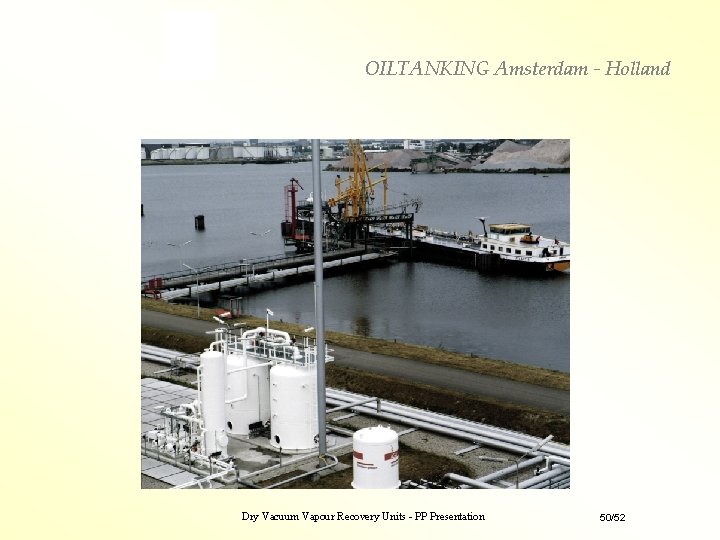
OILTANKING Amsterdam - Holland Dry Vacuum Vapour Recovery Units - PP Presentation 50/52
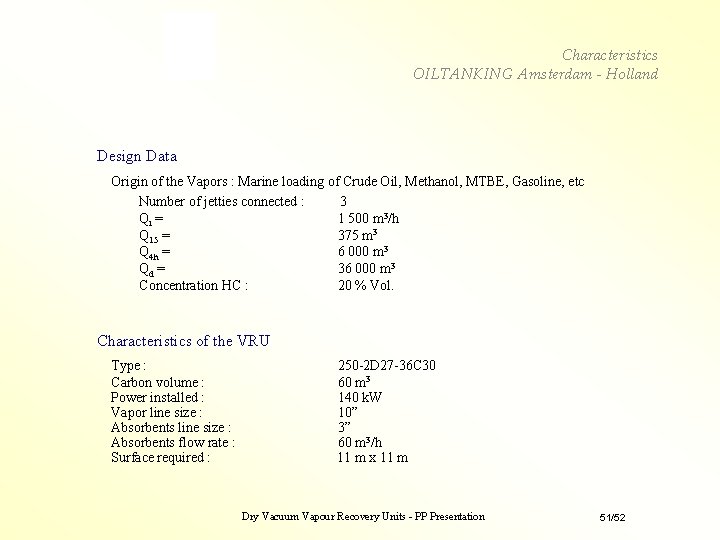
Characteristics OILTANKING Amsterdam - Holland Design Data Origin of the Vapors : Marine loading of Crude Oil, Methanol, MTBE, Gasoline, etc Number of jetties connected : 3 Qi = 1 500 m 3/h Q 15 = 375 m 3 Q 4 h = 6 000 m 3 Qd = 36 000 m 3 Concentration HC : 20 % Vol. Characteristics of the VRU Type : 250 -2 D 27 -36 C 30 Carbon volume : 60 m 3 Power installed : 140 k. W Vapor line size : 10” Absorbents line size : 3” Absorbents flow rate : 60 m 3/h Surface required : 11 m x 11 m Dry Vacuum Vapour Recovery Units - PP Presentation 51/52
Computer Image of VRU Oiltanking Terneuzen Dry Vacuum Vapour Recovery Units - PP Presentation 52/52