
Vaporiser o o principles of operation construction troubleshooting
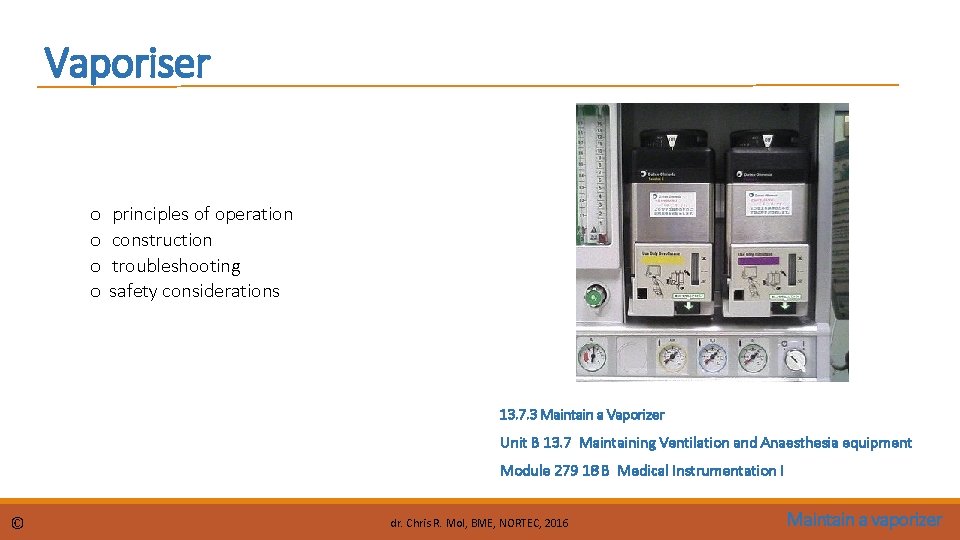
Vaporiser o o principles of operation construction troubleshooting safety considerations 13. 7. 3 Maintain a Vaporizer Unit B 13. 7 Maintaining Ventilation and Anaesthesia equipment Module 279 18 B Medical Instrumentation I © dr. Chris R. Mol, BME, NORTEC, 2016 Maintain a vaporizer
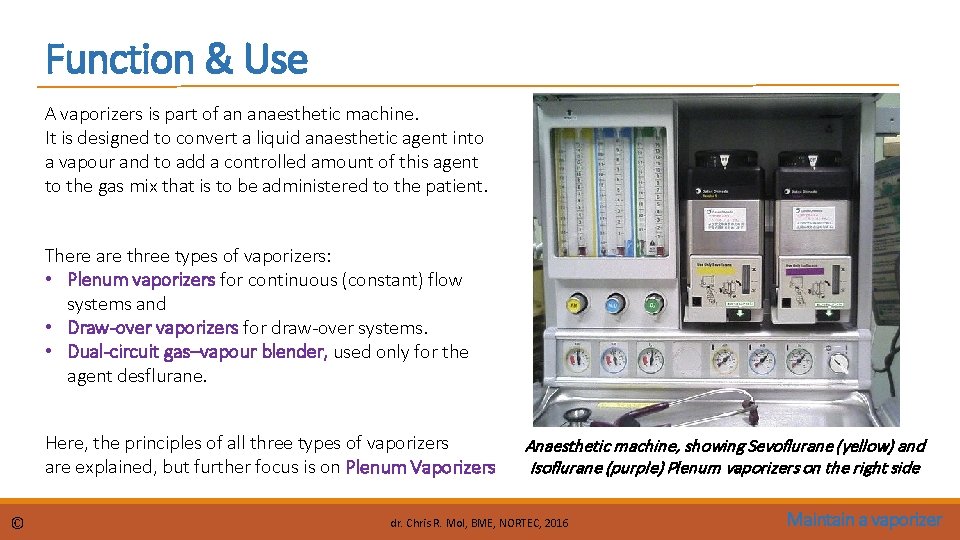
Function & Use A vaporizers is part of an anaesthetic machine. It is designed to convert a liquid anaesthetic agent into a vapour and to add a controlled amount of this agent to the gas mix that is to be administered to the patient. There are three types of vaporizers: • Plenum vaporizers for continuous (constant) flow systems and • Draw-over vaporizers for draw-over systems. • Dual-circuit gas–vapour blender, used only for the agent desflurane. Here, the principles of all three types of vaporizers are explained, but further focus is on Plenum Vaporizers © Anaesthetic machine, showing Sevoflurane (yellow) and Isoflurane (purple) Plenum vaporizers on the right side dr. Chris R. Mol, BME, NORTEC, 2016 Maintain a vaporizer
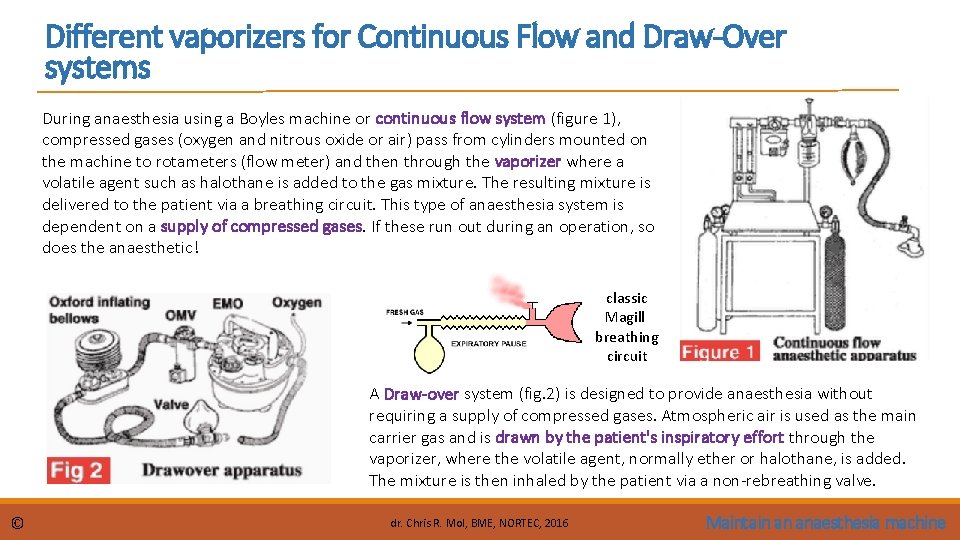
Different vaporizers for Continuous Flow and Draw-Over systems During anaesthesia using a Boyles machine or continuous flow system (figure 1), compressed gases (oxygen and nitrous oxide or air) pass from cylinders mounted on the machine to rotameters (flow meter) and then through the vaporizer where a volatile agent such as halothane is added to the gas mixture. The resulting mixture is delivered to the patient via a breathing circuit. This type of anaesthesia system is dependent on a supply of compressed gases. If these run out during an operation, so does the anaesthetic! classic Magill breathing circuit A Draw-over system (fig. 2) is designed to provide anaesthesia without requiring a supply of compressed gases. Atmospheric air is used as the main carrier gas and is drawn by the patient's inspiratory effort through the vaporizer, where the volatile agent, normally ether or halothane, is added. The mixture is then inhaled by the patient via a non-rebreathing valve. © dr. Chris R. Mol, BME, NORTEC, 2016 Maintain an anaesthesia machine
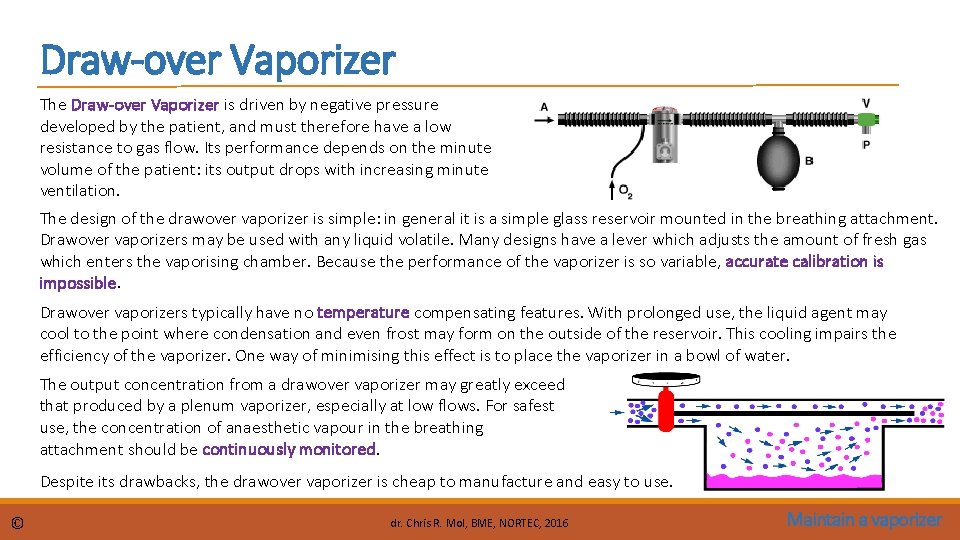
Draw-over Vaporizer The Draw-over Vaporizer is driven by negative pressure developed by the patient, and must therefore have a low resistance to gas flow. Its performance depends on the minute volume of the patient: its output drops with increasing minute ventilation. The design of the drawover vaporizer is simple: in general it is a simple glass reservoir mounted in the breathing attachment. Drawover vaporizers may be used with any liquid volatile. Many designs have a lever which adjusts the amount of fresh gas which enters the vaporising chamber. Because the performance of the vaporizer is so variable, accurate calibration is impossible. Drawover vaporizers typically have no temperature compensating features. With prolonged use, the liquid agent may cool to the point where condensation and even frost may form on the outside of the reservoir. This cooling impairs the efficiency of the vaporizer. One way of minimising this effect is to place the vaporizer in a bowl of water. The output concentration from a drawover vaporizer may greatly exceed that produced by a plenum vaporizer, especially at low flows. For safest use, the concentration of anaesthetic vapour in the breathing attachment should be continuously monitored. Despite its drawbacks, the drawover vaporizer is cheap to manufacture and easy to use. © dr. Chris R. Mol, BME, NORTEC, 2016 Maintain a vaporizer
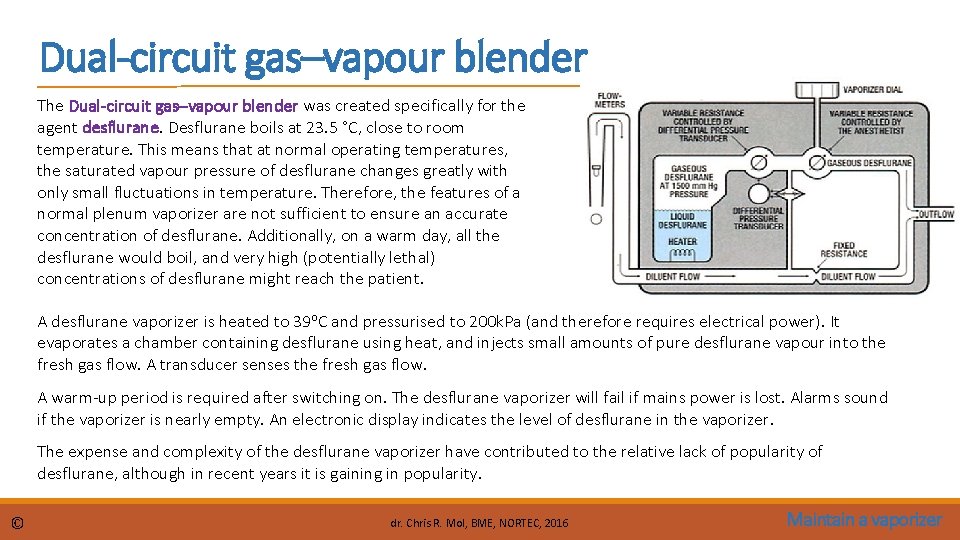
Dual-circuit gas–vapour blender The Dual-circuit gas–vapour blender was created specifically for the agent desflurane. Desflurane boils at 23. 5 °C, close to room temperature. This means that at normal operating temperatures, the saturated vapour pressure of desflurane changes greatly with only small fluctuations in temperature. Therefore, the features of a normal plenum vaporizer are not sufficient to ensure an accurate concentration of desflurane. Additionally, on a warm day, all the desflurane would boil, and very high (potentially lethal) concentrations of desflurane might reach the patient. A desflurane vaporizer is heated to 39 o. C and pressurised to 200 k. Pa (and therefore requires electrical power). It evaporates a chamber containing desflurane using heat, and injects small amounts of pure desflurane vapour into the fresh gas flow. A transducer senses the fresh gas flow. A warm-up period is required after switching on. The desflurane vaporizer will fail if mains power is lost. Alarms sound if the vaporizer is nearly empty. An electronic display indicates the level of desflurane in the vaporizer. The expense and complexity of the desflurane vaporizer have contributed to the relative lack of popularity of desflurane, although in recent years it is gaining in popularity. © dr. Chris R. Mol, BME, NORTEC, 2016 Maintain a vaporizer
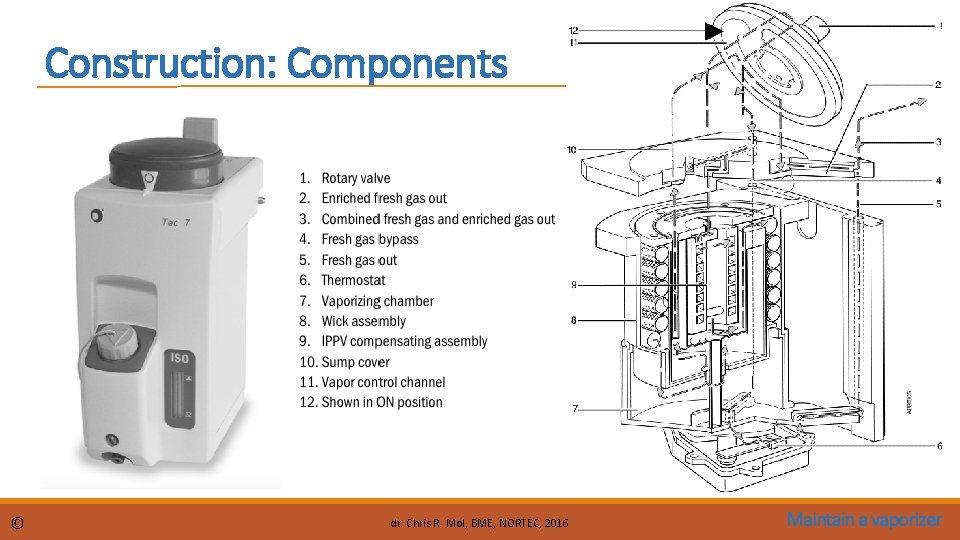
Principle of Operation: Plenum Vaporizer The Plenum Vaporizer is driven by positive pressure from the anaesthetic machine, and is usually mounted on the machine. The performance of the vaporizer doesn't change regardless of whether the patient is breathing spontaneously or is mechanically ventilated. The Plenum Vaporizer works by accurately splitting the incoming gas into two streams (see figure next sheet). One of these streams passes straight through the vaporizer in the bypass channel. The other is diverted into the vaporising chamber. Gas in the vaporising chamber becomes fully saturated with volatile anaesthetic vapour. This gas is then mixed with the gas in the bypass channel before leaving the vaporizer. The internal resistance of the vaporizer is usually high, but because of the supply pressure is constant the vaporizer can be accurately calibrated to deliver a precise concentration of volatile anaesthetic vapour over a wide range of fresh gas flows. The Plenum Vaporizer is an elegant device which works reliably, without external power, for many hundreds of hours of continuous use, and requires very little maintenance. © dr. Chris R. Mol, BME, NORTEC, 2016 Maintain a vaporizer
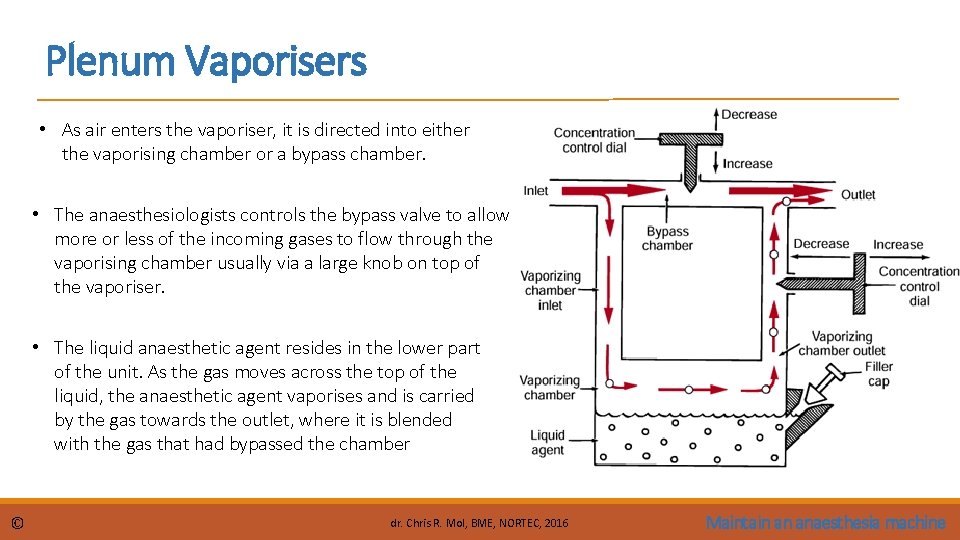
Plenum Vaporisers • As air enters the vaporiser, it is directed into either the vaporising chamber or a bypass chamber. • The anaesthesiologists controls the bypass valve to allow more or less of the incoming gases to flow through the vaporising chamber usually via a large knob on top of the vaporiser. • The liquid anaesthetic agent resides in the lower part of the unit. As the gas moves across the top of the liquid, the anaesthetic agent vaporises and is carried by the gas towards the outlet, where it is blended with the gas that had bypassed the chamber © dr. Chris R. Mol, BME, NORTEC, 2016 Maintain an anaesthesia machine
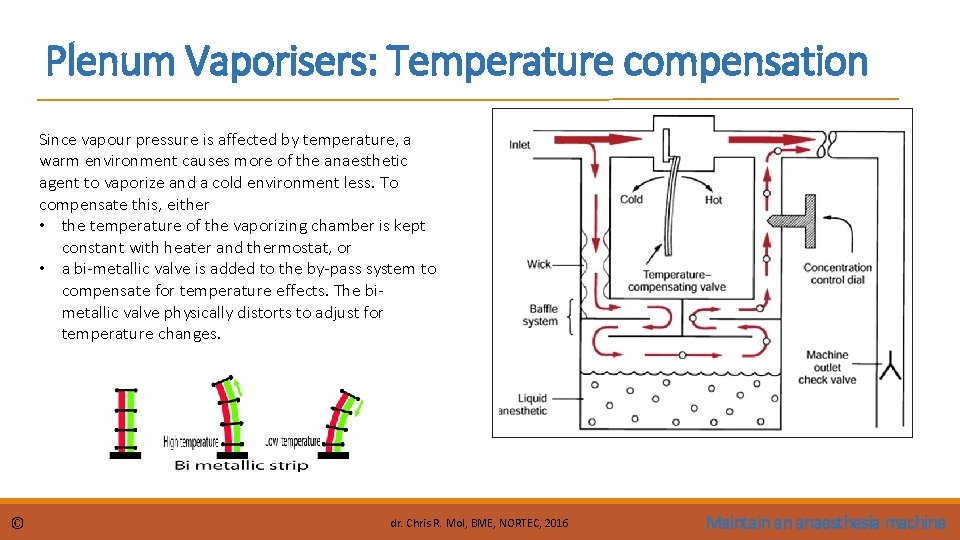
Plenum Vaporisers: Temperature compensation Since vapour pressure is affected by temperature, a warm environment causes more of the anaesthetic agent to vaporize and a cold environment less. To compensate this, either • the temperature of the vaporizing chamber is kept constant with heater and thermostat, or • a bi-metallic valve is added to the by-pass system to compensate for temperature effects. The bimetallic valve physically distorts to adjust for temperature changes. © dr. Chris R. Mol, BME, NORTEC, 2016 Maintain an anaesthesia machine
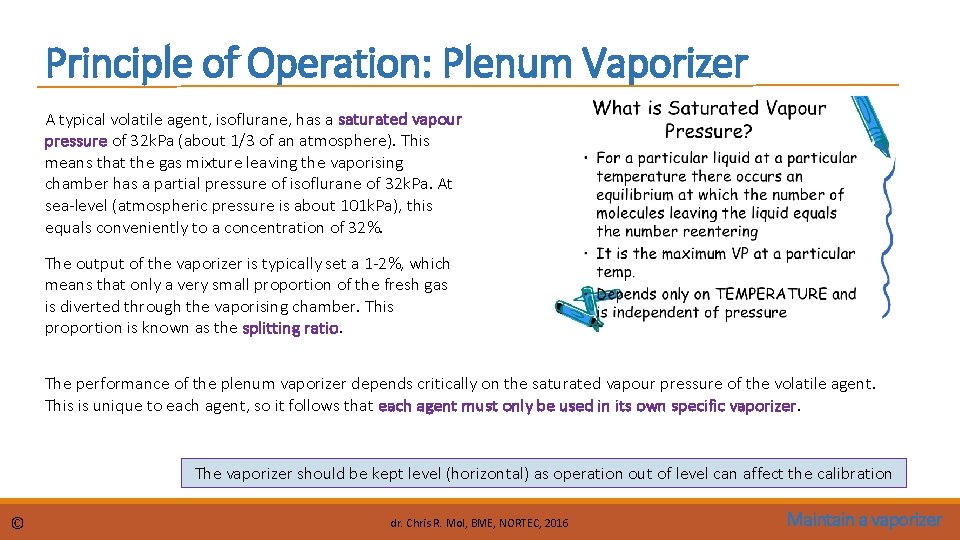
Principle of Operation: Plenum Vaporizer A typical volatile agent, isoflurane, has a saturated vapour pressure of 32 k. Pa (about 1/3 of an atmosphere). This means that the gas mixture leaving the vaporising chamber has a partial pressure of isoflurane of 32 k. Pa. At sea-level (atmospheric pressure is about 101 k. Pa), this equals conveniently to a concentration of 32%. The output of the vaporizer is typically set a 1 -2%, which means that only a very small proportion of the fresh gas is diverted through the vaporising chamber. This proportion is known as the splitting ratio. The performance of the plenum vaporizer depends critically on the saturated vapour pressure of the volatile agent. This is unique to each agent, so it follows that each agent must only be used in its own specific vaporizer. The vaporizer should be kept level (horizontal) as operation out of level can affect the calibration © dr. Chris R. Mol, BME, NORTEC, 2016 Maintain a vaporizer
Construction: Components © dr. Chris R. Mol, BME, NORTEC, 2016 Maintain a vaporizer
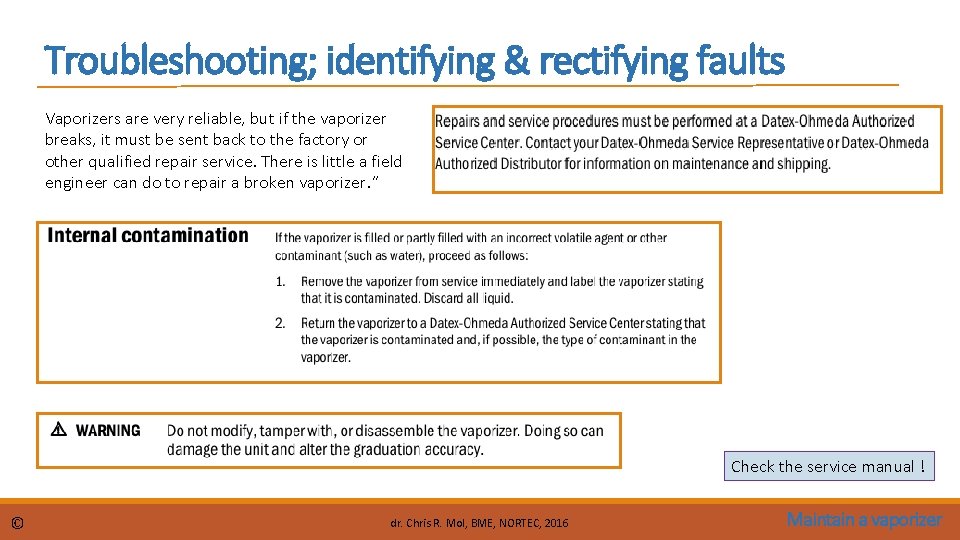
Troubleshooting; identifying & rectifying faults Vaporizers are very reliable, but if the vaporizer breaks, it must be sent back to the factory or other qualified repair service. There is little a field engineer can do to repair a broken vaporizer. “ Check the service manual ! © dr. Chris R. Mol, BME, NORTEC, 2016 Maintain a vaporizer
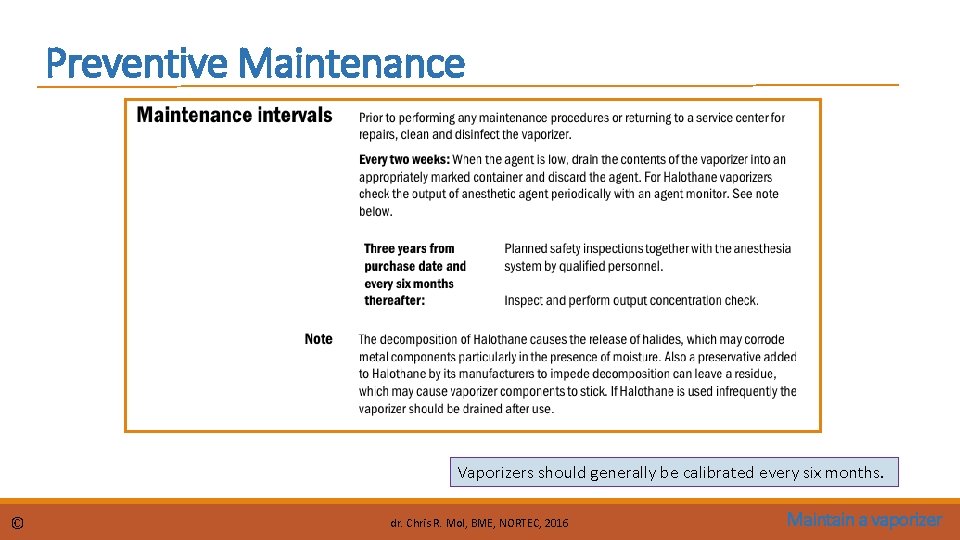
Preventive Maintenance Vaporizers should generally be calibrated every six months. © dr. Chris R. Mol, BME, NORTEC, 2016 Maintain a vaporizer
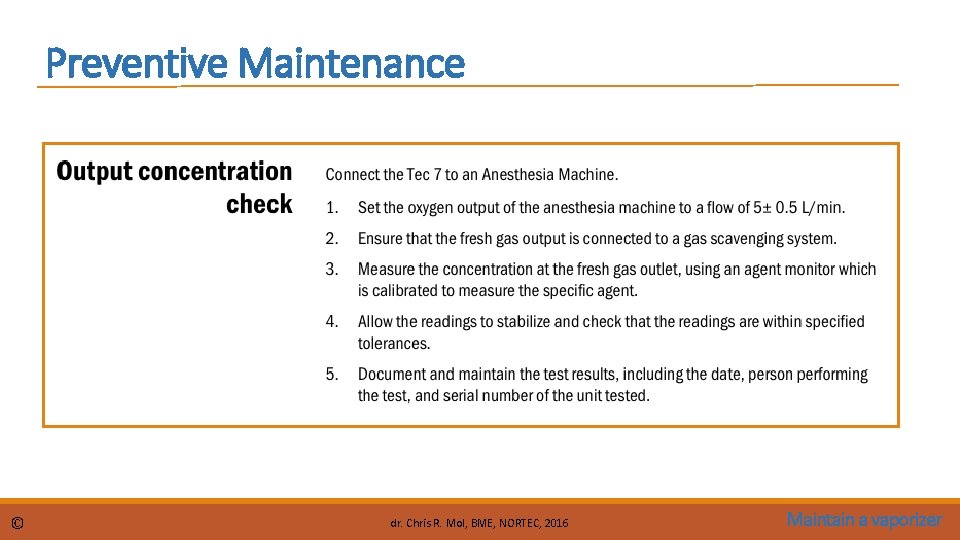
Preventive Maintenance © dr. Chris R. Mol, BME, NORTEC, 2016 Maintain a vaporizer
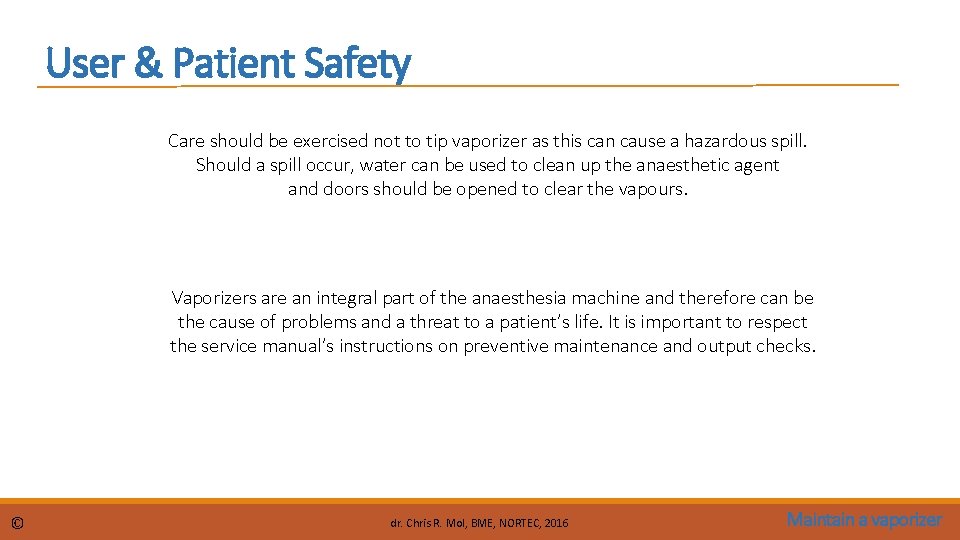
User & Patient Safety Care should be exercised not to tip vaporizer as this can cause a hazardous spill. Should a spill occur, water can be used to clean up the anaesthetic agent and doors should be opened to clear the vapours. Vaporizers are an integral part of the anaesthesia machine and therefore can be the cause of problems and a threat to a patient’s life. It is important to respect the service manual’s instructions on preventive maintenance and output checks. © dr. Chris R. Mol, BME, NORTEC, 2016 Maintain a vaporizer

END The creation of this presentation was supported by a grant from THET: see https: //www. thet. org/
- Slides: 15