
VANGASALI PRESENTATION 25 NOVEMBER 2020 OVERALL GOAL INCREASING
VANGASALI PRESENTATION 25 NOVEMBER 2020
OVERALL GOAL – INCREASING ACCESS TO AND REGULATION OF ECD The National ECD Policy has as one of it’s aims: “By 2030, a full comprehensive age-and developmentally stage-appropriate quality early childhood development programme is available and accessible to all infants and young children and their caregivers. ”
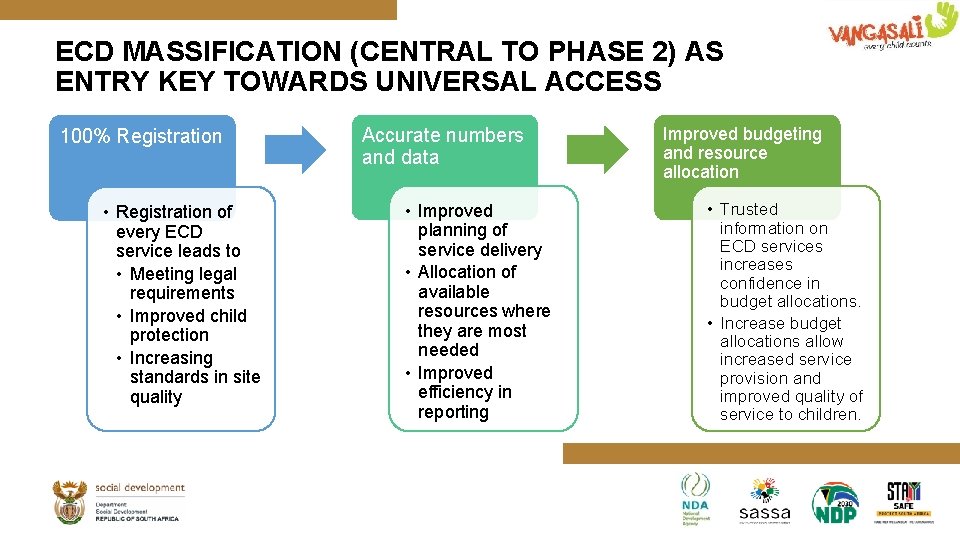
ECD MASSIFICATION (CENTRAL TO PHASE 2) AS ENTRY KEY TOWARDS UNIVERSAL ACCESS 100% Registration • Registration of every ECD service leads to • Meeting legal requirements • Improved child protection • Increasing standards in site quality Accurate numbers and data • Improved planning of service delivery • Allocation of available resources where they are most needed • Improved efficiency in reporting Improved budgeting and resource allocation • Trusted information on ECD services increases confidence in budget allocations. • Increase budget allocations allow increased service provision and improved quality of service to children.
REFLECTIONS ON THE ECD SECTOR IN A NATIONAL DISASTER • DSD had no database of all ECD Services in the country so response planning ability was limited • Vangasali phase 1 was launched to start the process of getting a comprehensive national database and now has more than 45, 000 ECD services • The best way to have a verified database is for all ECD services to apply for registration and be assessed Vangasali Target • All ECD services not already registered must submit an application within 6 months of reopening • This was also part of the commitment made in the reopening declaration that ECD services signed
REFLECTIONS ON THE ECD SECTOR IN A NATIONAL DISASTER • As DSD, we need to know where children are being cared for and assess those services to ensure basic child protection and safety • We must proactively find and process all ECD services for registration and in doing so we will highlight the blockages to registration outside of DSD’s control with empirical data to build case for policy amendments
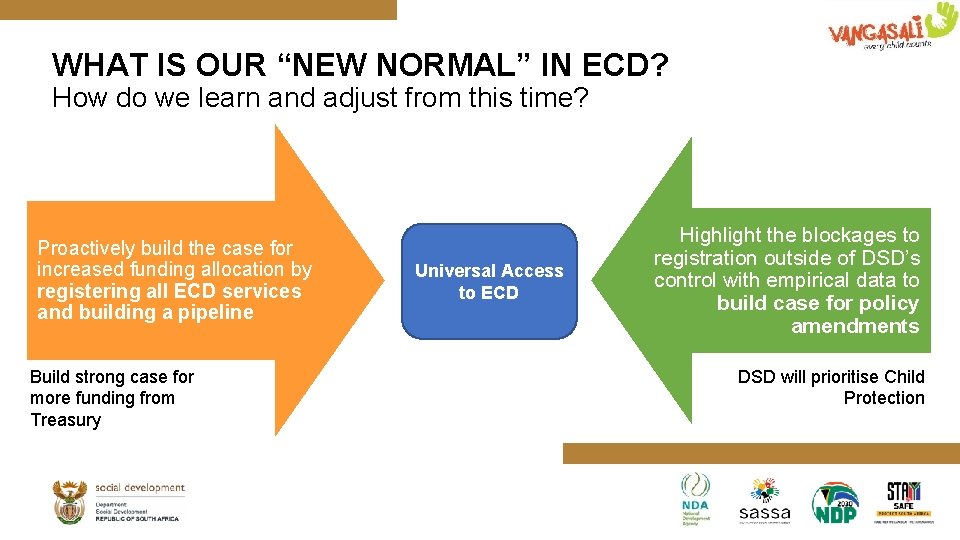
WHAT IS OUR “NEW NORMAL” IN ECD? How do we learn and adjust from this time? Proactively build the case for increased funding allocation by registering all ECD services and building a pipeline Build strong case for more funding from Treasury Universal Access to ECD Highlight the blockages to registration outside of DSD’s control with empirical data to build case for policy amendments DSD will prioritise Child Protection

OVERVIEW OF VANGASALI’S 3 PHASES Phase 1 Identify All ECD Services Phase 2 All ECD Services apply for registration • • Orientation of officials Understanding of process and receiving an application pack Application submission and site assessments Further regulatory amendments to align with the Registration Framework Phase 3 All Registrations Assessed and Decisions Made • ECD sites needing support to meet Bronze level requirements • Through DSD resources and local government, donors, NGOs and private sector stakeholders would also assist in facilitating this.
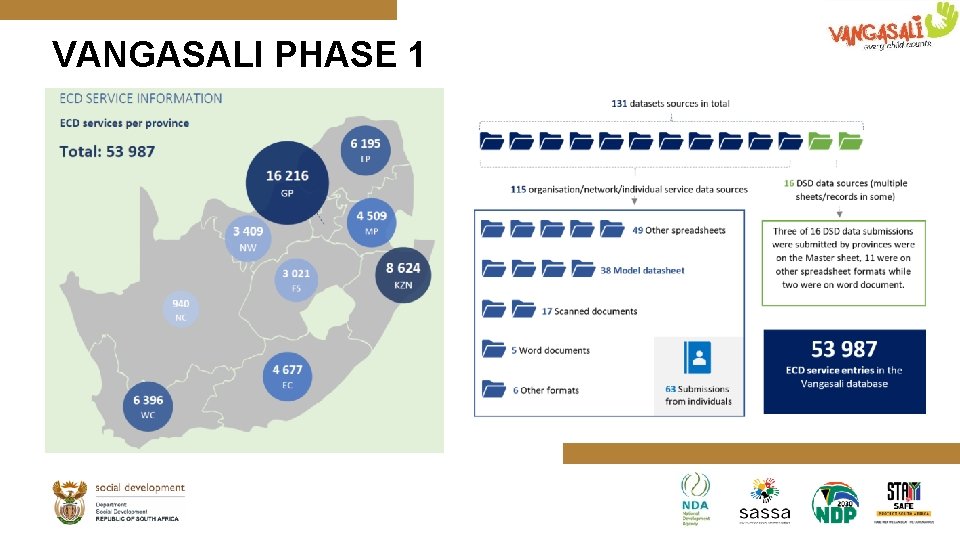
VANGASALI PHASE 1
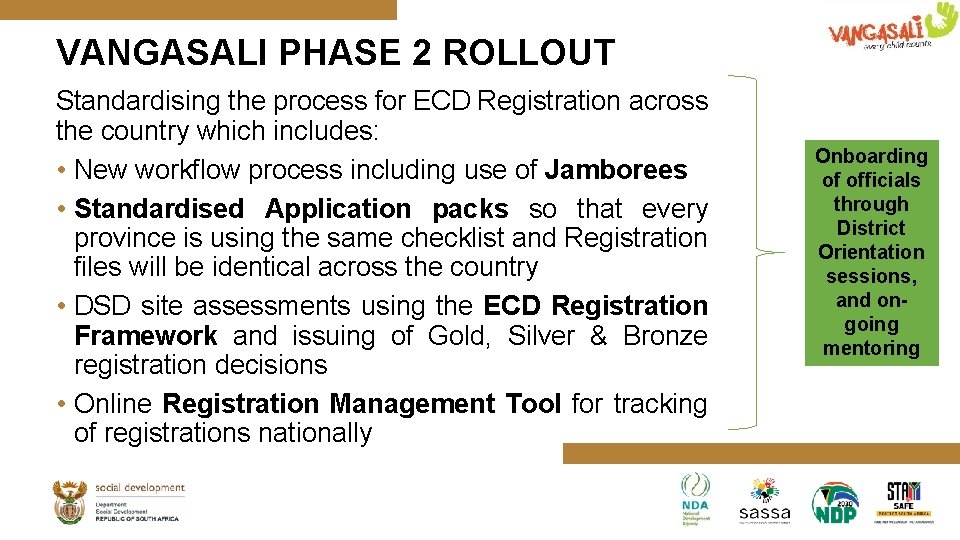
VANGASALI PHASE 2 ROLLOUT Standardising the process for ECD Registration across the country which includes: • New workflow process including use of Jamborees • Standardised Application packs so that every province is using the same checklist and Registration files will be identical across the country • DSD site assessments using the ECD Registration Framework and issuing of Gold, Silver & Bronze registration decisions • Online Registration Management Tool for tracking of registrations nationally Onboarding of officials through District Orientation sessions, and ongoing mentoring
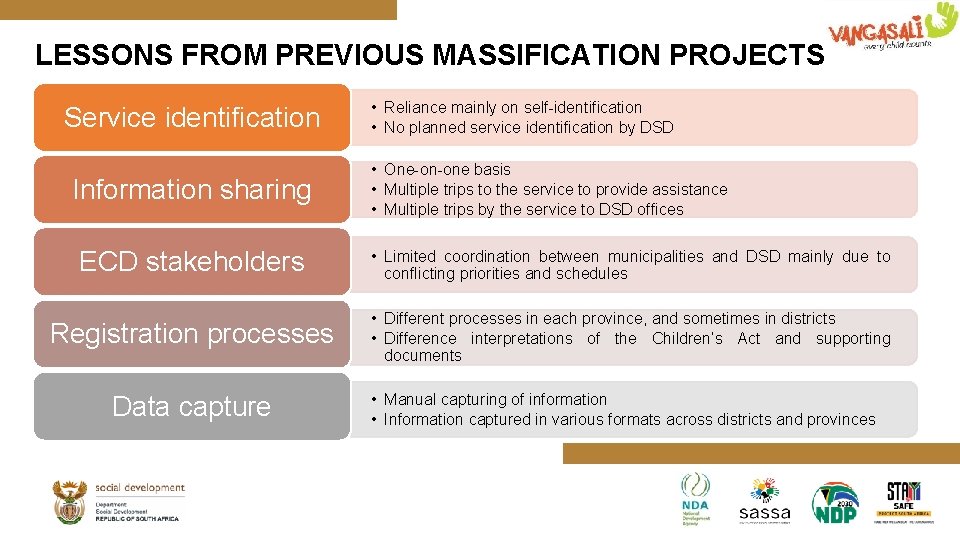
LESSONS FROM PREVIOUS MASSIFICATION PROJECTS Service identification Information sharing • Reliance mainly on self-identification • No planned service identification by DSD • One-on-one basis • Multiple trips to the service to provide assistance • Multiple trips by the service to DSD offices ECD stakeholders • Limited coordination between municipalities and DSD mainly due to conflicting priorities and schedules Registration processes • Different processes in each province, and sometimes in districts • Difference interpretations of the Children’s Act and supporting documents Data capture • Manual capturing of information • Information captured in various formats across districts and provinces
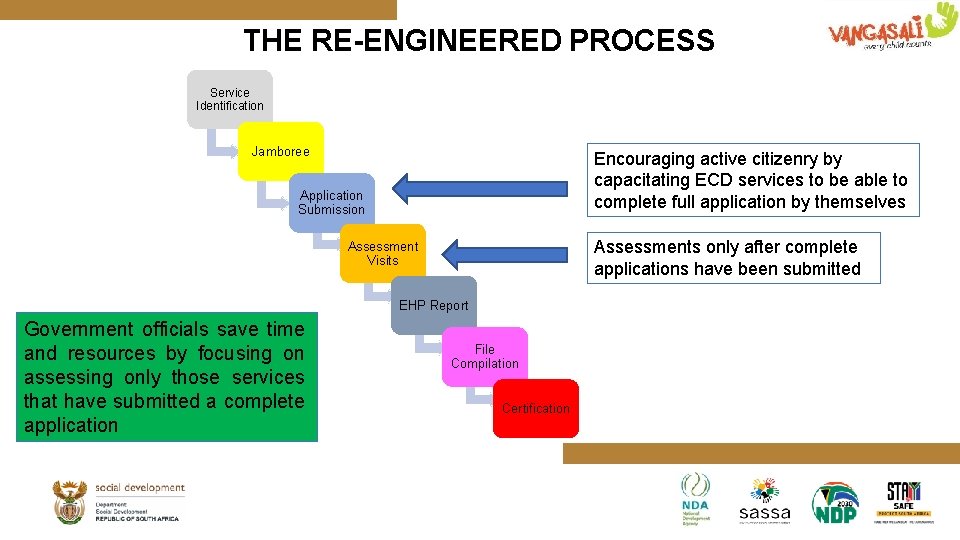
THE RE-ENGINEERED PROCESS Service Identification Jamboree Encouraging active citizenry by capacitating ECD services to be able to complete full application by themselves Application Submission Assessments only after complete applications have been submitted Assessment Visits EHP Report Government officials save time and resources by focusing on assessing only those services that have submitted a complete application File Compilation Certification
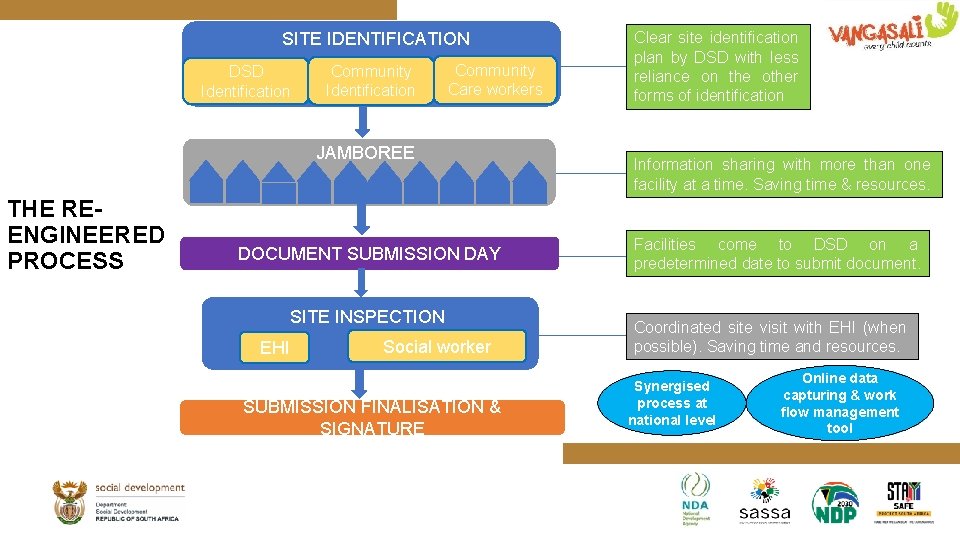
SITE IDENTIFICATION DSD Identification Community Care workers JAMBOREE THE REENGINEERED PROCESS DOCUMENT SUBMISSION DAY SITE INSPECTION EHI Social worker SUBMISSION FINALISATION & SIGNATURE Clear site identification plan by DSD with less reliance on the other forms of identification Information sharing with more than one facility at a time. Saving time & resources. Facilities come to DSD on a predetermined date to submit document. Coordinated site visit with EHI (when possible). Saving time and resources. Synergised process at national level Online data capturing & work flow management tool
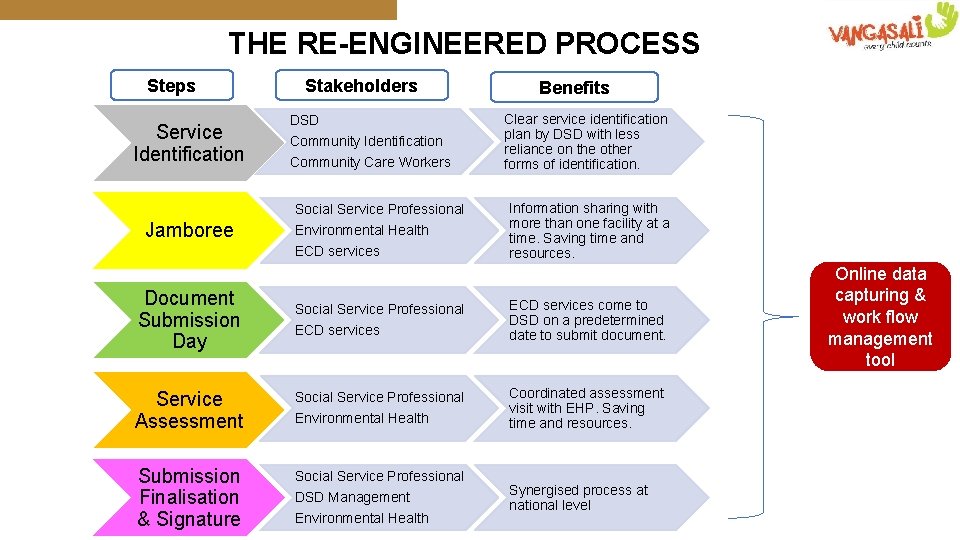
THE RE-ENGINEERED PROCESS SITE IDENTIFICATION Steps Service Identification Jamboree Stakeholders DSD Community Identification Community Care Workers Social Service Professional Environmental Health ECD services Document Submission Day Social Service Professional ECD services Service Assessment Social Service Professional Submission Finalisation & Signature Social Service Professional DSD Management Environmental Health Benefits Clear service identification plan by DSD with less reliance on the other forms of identification. Information sharing with more than one facility at a time. Saving time and resources. ECD services come to DSD on a predetermined date to submit document. Coordinated assessment visit with EHP. Saving time and resources. Synergised process at national level Online data capturing & work flow management tool
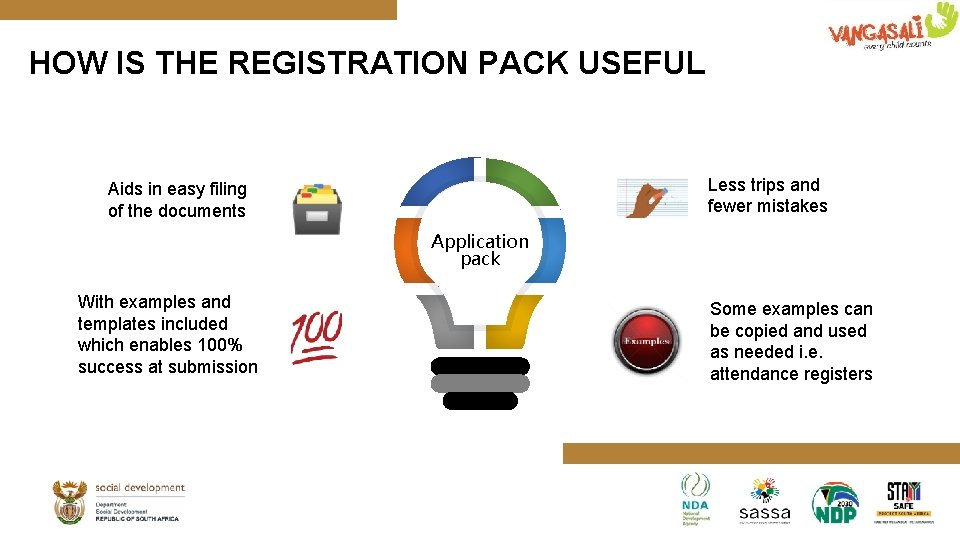
HOW IS THE REGISTRATION PACK USEFUL Less trips and fewer mistakes Aids in easy filing of the documents Application pack With examples and templates included which enables 100% success at submission Some examples can be copied and used as needed i. e. attendance registers
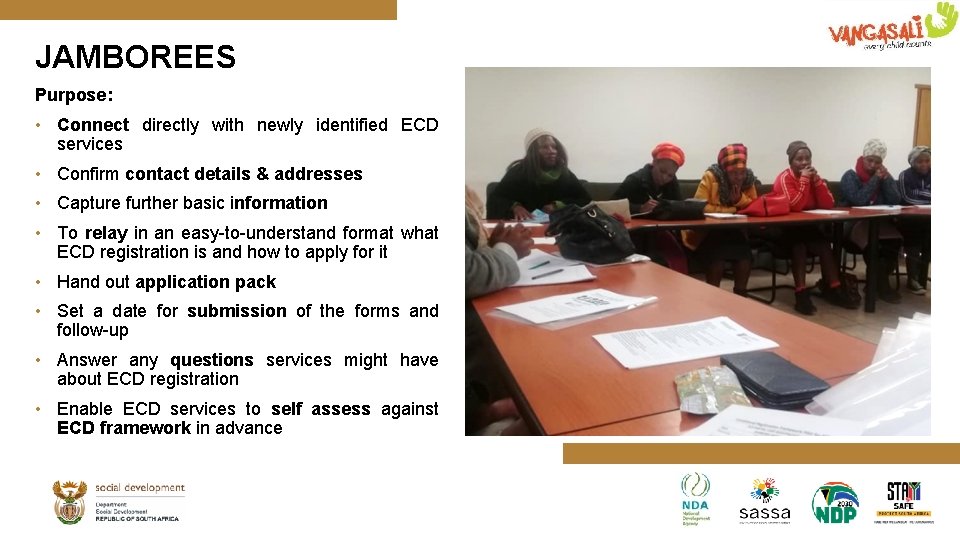
JAMBOREES Purpose: • Connect directly with newly identified ECD services • Confirm contact details & addresses • Capture further basic information • To relay in an easy-to-understand format what ECD registration is and how to apply for it • Hand out application pack • Set a date for submission of the forms and follow-up • Answer any questions services might have about ECD registration • Enable ECD services to self assess against ECD framework in advance
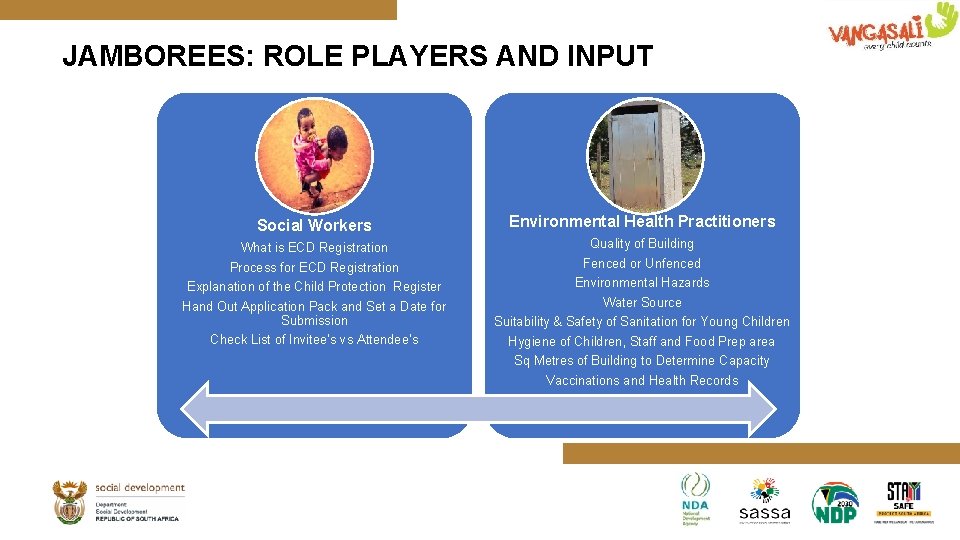
JAMBOREES: ROLE PLAYERS AND INPUT Social Workers Environmental Health Practitioners What is ECD Registration Process for ECD Registration Explanation of the Child Protection Register Hand Out Application Pack and Set a Date for Submission Check List of Invitee’s vs Attendee’s Quality of Building Fenced or Unfenced Environmental Hazards Water Source Suitability & Safety of Sanitation for Young Children Hygiene of Children, Staff and Food Prep area Sq Metres of Building to Determine Capacity Vaccinations and Health Records
DSD & EHP Partnership • Crucial to scaling up registration is the Intergovernmental working relationships between DSD and Environmental Health at district and local level. • Some suggestions of good practice are: • District Level Steering Groups for Registration Massification which include DSD, Do. H, EHP, Town Planning, Infrastructure, Emergency Services • MOU between DSD and District Municipality on ECD detailing alignment on sharing databases, KPIs and targets for ECD registration and monitoring, levels of staff dedicated for ECD
Online Registration Management Tool – New Leaders Foundation • Support the Vangasali Campaign objectives with timely access to reliable, accurate data • To improve ECD registration throughput by tracking the registration workflow • To provide insights to stakeholders so that they are empowered to act through automated reports • To inform needs and enable quicker feedback loops by digitising the Registration Framework 18
OBJECTIVES OF THE REGISTRATION MANAGEMENT TOOL Support the Vangasali Campaign objectives with timely access to reliable, accurate data Support prepare ECD services dataset for the function shift Draw lessons and insights for the ECD MIS development 19
THE REGISTRATION MANAGEMENT TOOL WILL SUPPORT THE FOLLOWING REQUIREMENTS TO MEET CAMPAIGN OBJECTIVES Store details of identified ECD Services for registration Track registration progress of each ECD Service Capture responses to the ECD Framework of each registration to determine levels of compliance Report on leading and lagging indicators for the registration throughput to drive efficiency and highlight bottlenecks 20
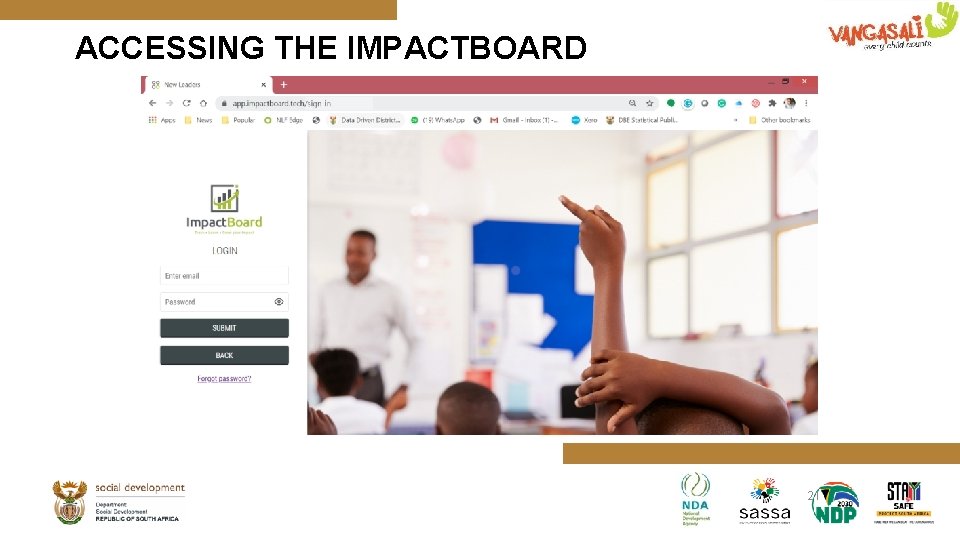
ACCESSING THE IMPACTBOARD 21
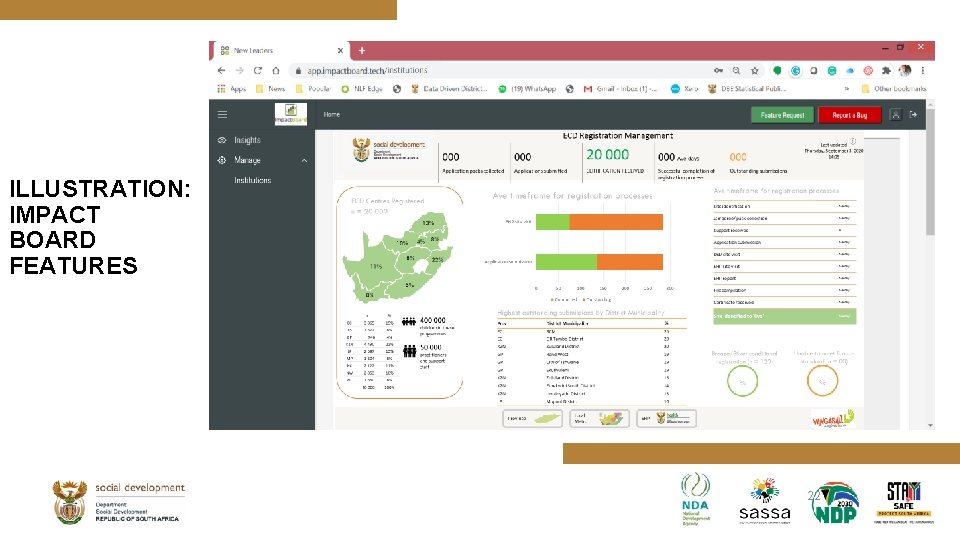
ILLUSTRATION: IMPACT BOARD FEATURES 22
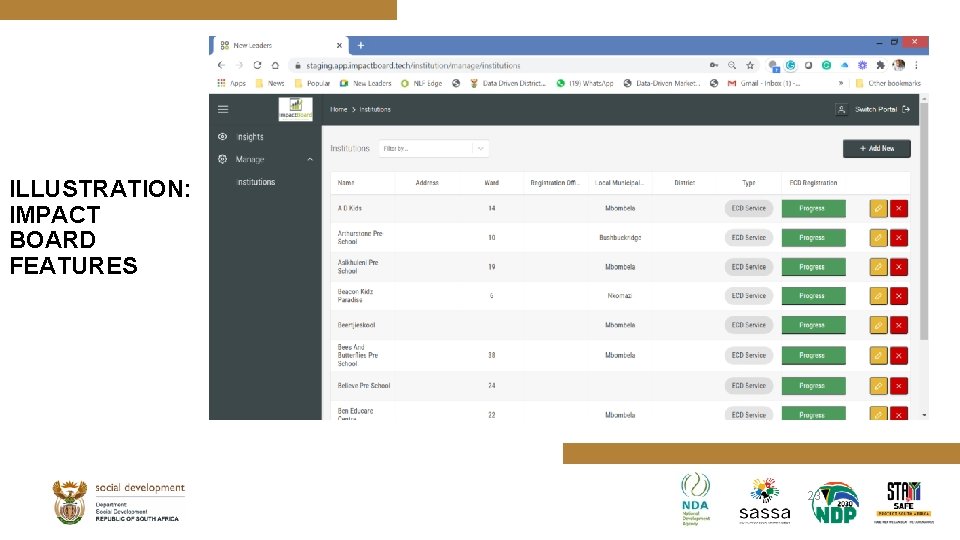
ILLUSTRATION: IMPACT BOARD FEATURES 23
Impact Board Access for Environmental Health Managers Guest access to the Impact board can be provided for environmental health officials which will enable: • Visibility of the list of ECD services requiring registration in the local DSD office demarcation • Closer working relationship with DSD and improved ECD inspection workload planning for the coming weeks and months • Tailored dashboard that enables visibility of the pipeline of ECD’s and key indicators of progress in ECD registration relating to Environmental Health
Vangasali Champion Roles Role of District Champion is: • Schedule District orientation sessions in collaboration with NDSD & Impande SA and ensure all service offices allocate dedicated staff to be part of the project (recommend 2 SSP’s per office minimum) • Stakeholder engagement with Environmental Health Management to request their attendance at orientation and involvement in the project • Monitor service offices performance through the automated reporting scorecards and respond accordingly Role of Provincial Champion is: • Ensure District Orientations are scheduled and well attended • Ensure District DSD are successfully engaging with Environmental Health to work together and attend orientation • Monitor District performance through the automated reporting scorecards and respond accordingly
DISTRICT ONLINE ORIENTATIONS • Scheduled to take place online from October – December, on Zoom/MS Teams/Google Meet for 3. 5 hours (10 am – 1. 30 pm) • District Champion to co-ordinate and schedule the orientations - District Champion to liaise with EHPs and Service offices and book online orientation sessions The following attendees are requested: • Social workers from every DSD office conducting ECD registration • DSD Supervisors and managers where possible • Environmental Health representatives – preferably all EHP’s that conduct ECD assessments
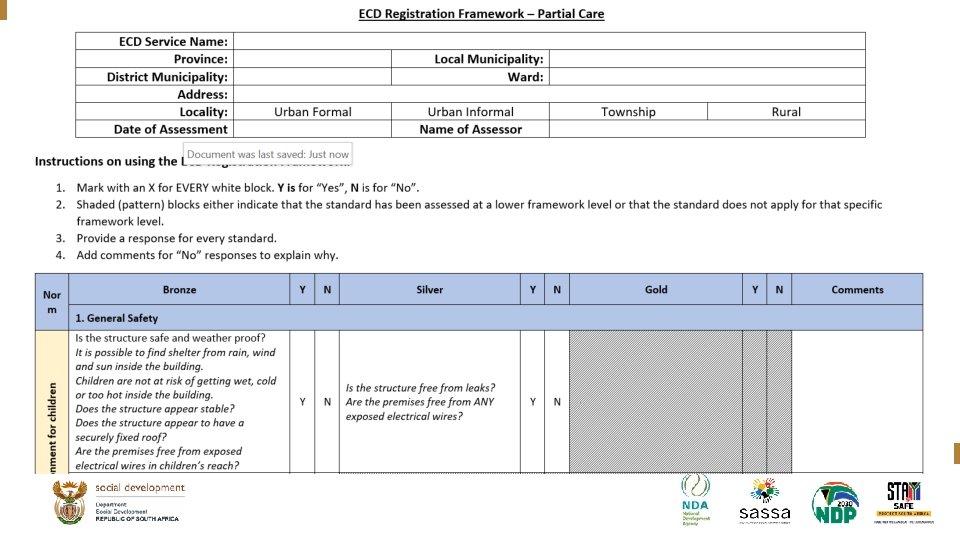
Snapshot of the DSD ECD Registration Framework
The DSD ECD Registration Framework • The preferred method to utilise the framework is using the Online Registration Management Tool • Where there are challenges with devices and data then the paper-based Framework can be utilised
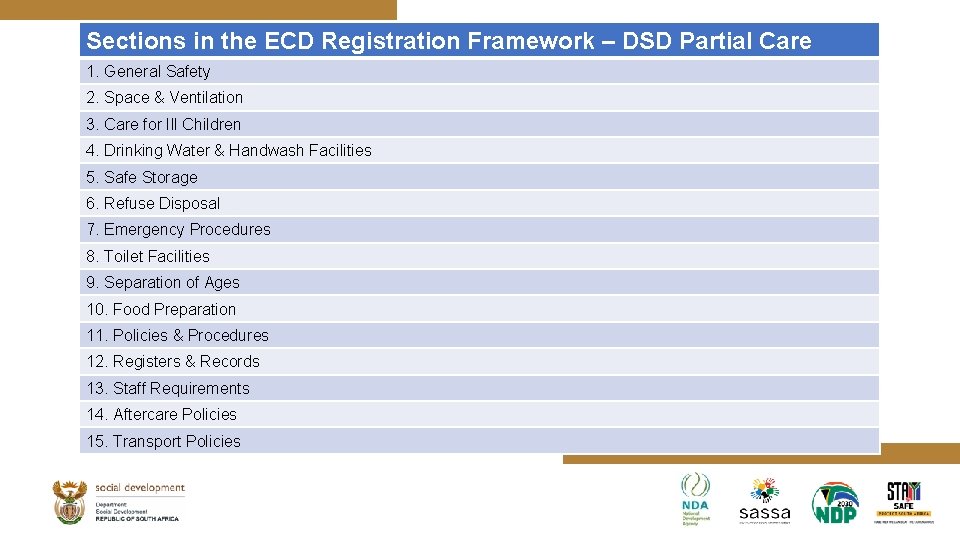
Sections in the ECD Registration Framework – DSD Partial Care 1. General Safety 2. Space & Ventilation 3. Care for Ill Children 4. Drinking Water & Handwash Facilities 5. Safe Storage 6. Refuse Disposal 7. Emergency Procedures 8. Toilet Facilities 9. Separation of Ages 10. Food Preparation 11. Policies & Procedures 12. Registers & Records 13. Staff Requirements 14. Aftercare Policies 15. Transport Policies
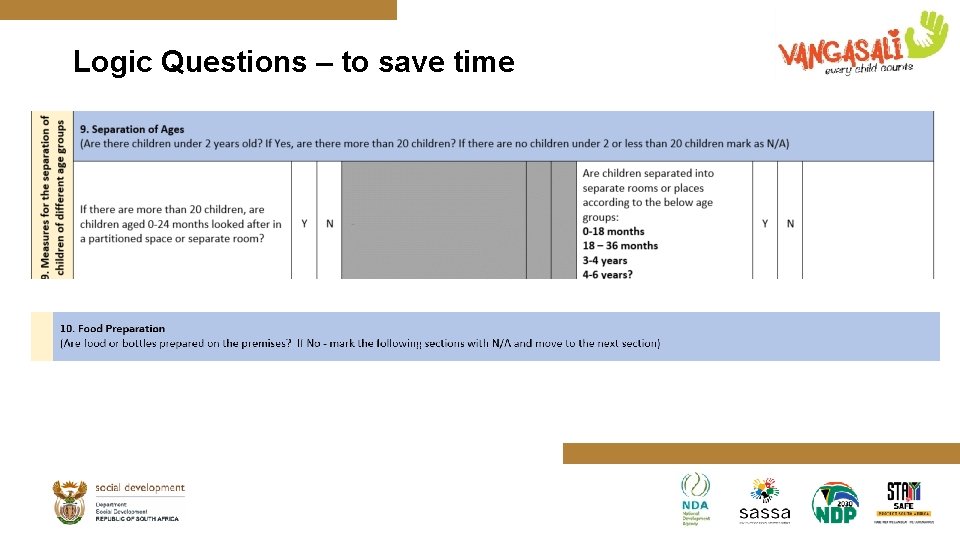
Logic Questions – to save time
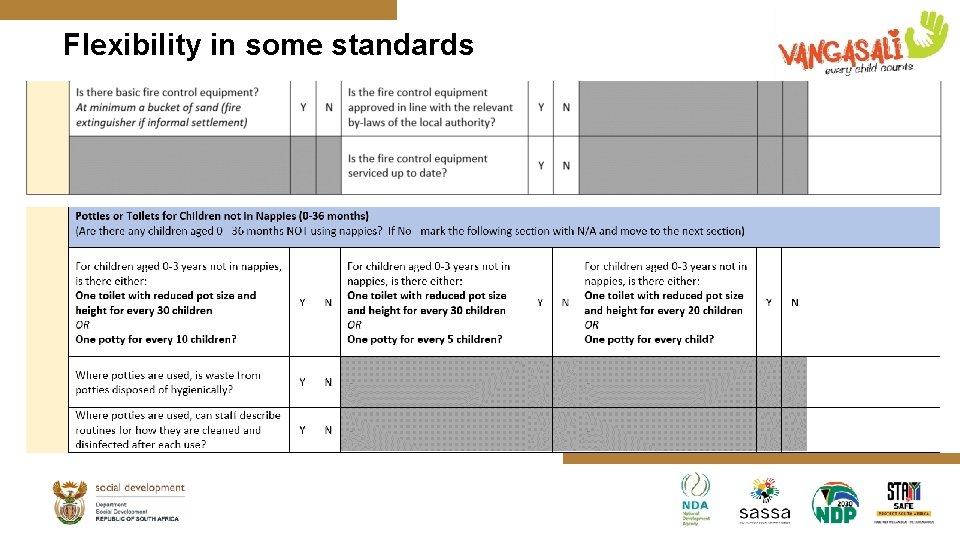
Flexibility in some standards
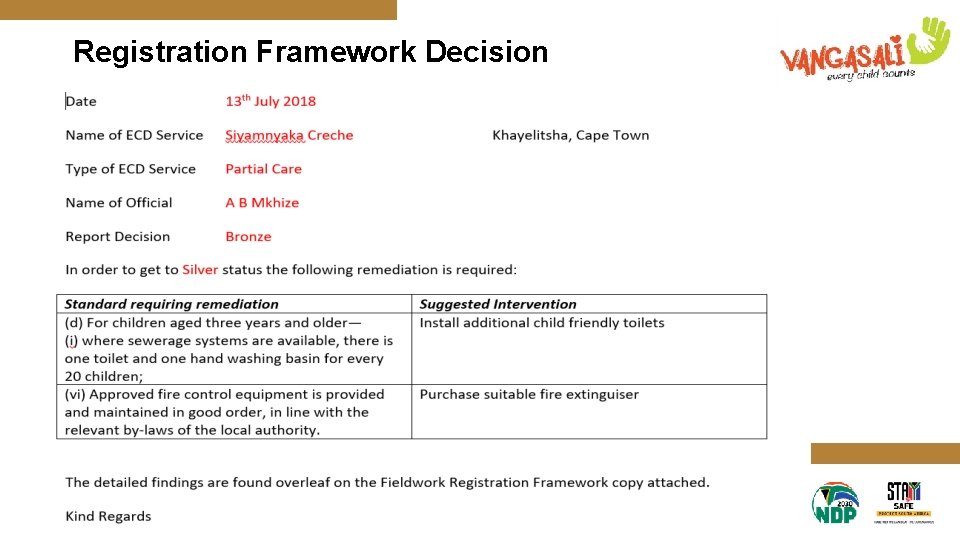
Registration Framework Decision
THANK YOU
- Slides: 34