
Vanderbilt Eye Institute Joshua Ki Hu Vanderbilt Eye
Vanderbilt Eye Institute Joshua Ki Hu Vanderbilt Eye Institute Ophthalmology, PGY-4 DATE 05. 30. 08 RESIDENT PHYSICIAN PERFORMED PHACOEMULSIFICATION: INTRAOPERATIVE COMPLICATION RATES AND THE SURGICAL LEARNING CURVE
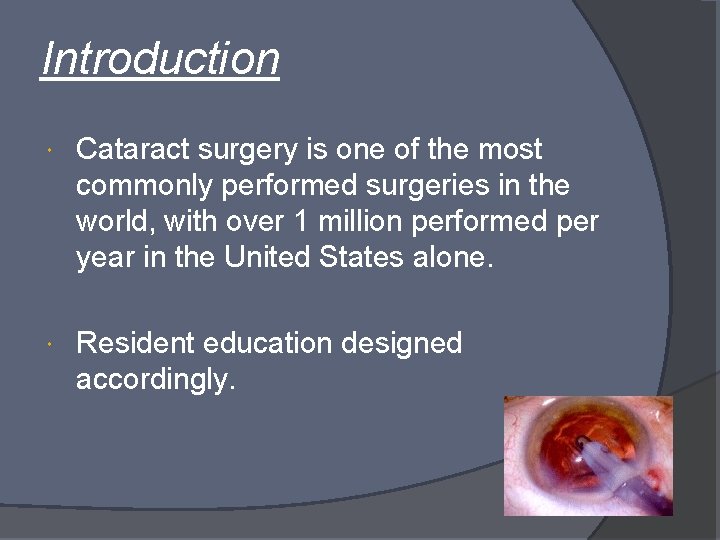
Introduction Cataract surgery is one of the most commonly performed surgeries in the world, with over 1 million performed per year in the United States alone. Resident education designed accordingly.
In 2002 a resident survey revealed that: - the number of phacoemulsification procedures performed by a single resident ranged from 50 to 300 - the majority perform between 80 and 140 (avg. 120) - 25% performed less than 80
In 2007, the Residency Review Committee of the ACGME increased the minimum number of resident performed phacoemulsification procedures from 45 to 86. Few studies to date attempt to identify time point/case number for significant improvement in resident performed surgery.
The aim of this study is to identify a time point/case number for which a significant decline in complication rates occurs. Also as a measure of internal “quality” of Vanderbilt’s residency program. Are patients being subjected to an acceptable level of complications in the early parts of training?
Materials and Methods Retrospective chart review VA Hospitals, Nashville, TN, charts from patients who had undergone resident performed phacoemulsification during a 6 year period from July 8, 1999, through June 28, 2005 were reviewed.
The surgical cases were categorized based on the resident surgeon performing the cataract surgery, and then sorted chronologically and given a sequential case number. The total number of intraoperative complications including posterior capsular tear, vitreous loss, and retained lens fragments were recorded, as well as the case numbers for which they occurred.
The study was powered at 80% with statistical significance set at p = 0. 05 to detect a 50% change in complication frequency (estimated to be 15%) Sample size = 304
The cases were divided into groups spanning every 20 procedures Statistical analysis was performed - using chi square analysis - calculating 95% confidence intervals
Results 19 resident surgeons Under guidance 23 different attending surgeons 99. 4% cases performed on males 51. 6% Right eyes, 48. 4% Left eyes
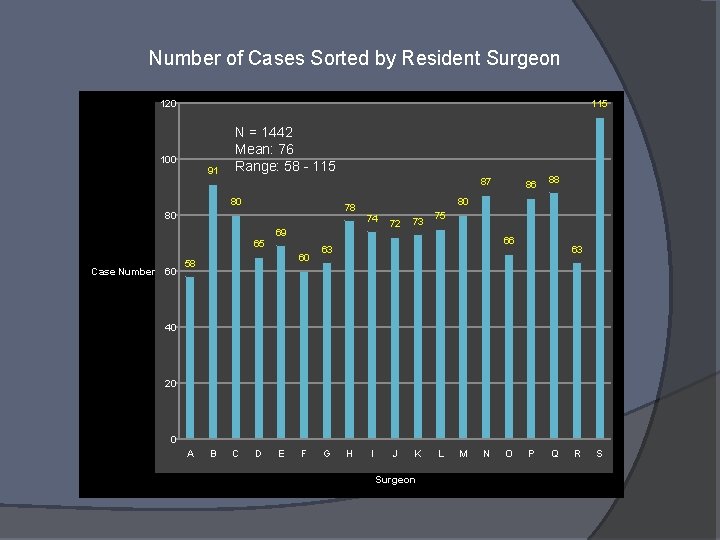
Number of Cases Sorted by Resident Surgeon 120 115 100 91 N = 1442 Mean: 76 Range: 58 - 115 87 80 78 80 65 Case Number 60 60 88 80 74 69 58 86 72 73 75 66 63 63 40 20 0 A B C D E F G H I J K Surgeon L M N O P Q R S
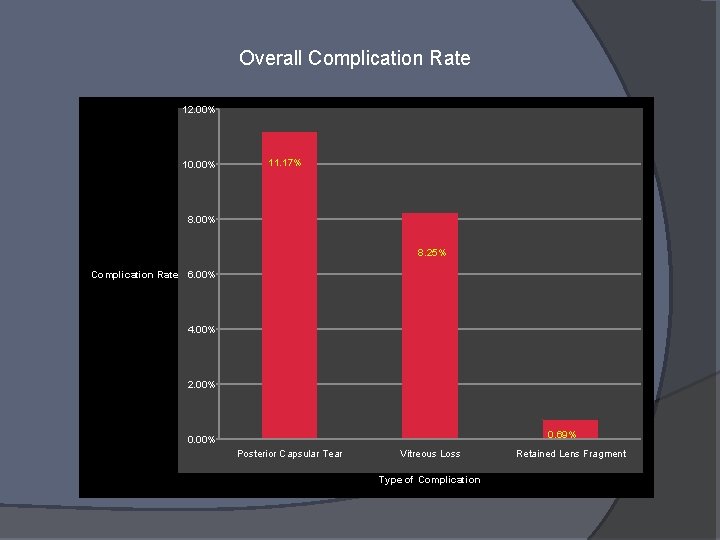
Overall Complication Rate 12. 00% 10. 00% 11. 17% 8. 00% 8. 25% Complication Rate 6. 00% 4. 00% 2. 00% 0. 69% 0. 00% Posterior Capsular Tear Vitreous Loss Type of Complication Retained Lens Fragment
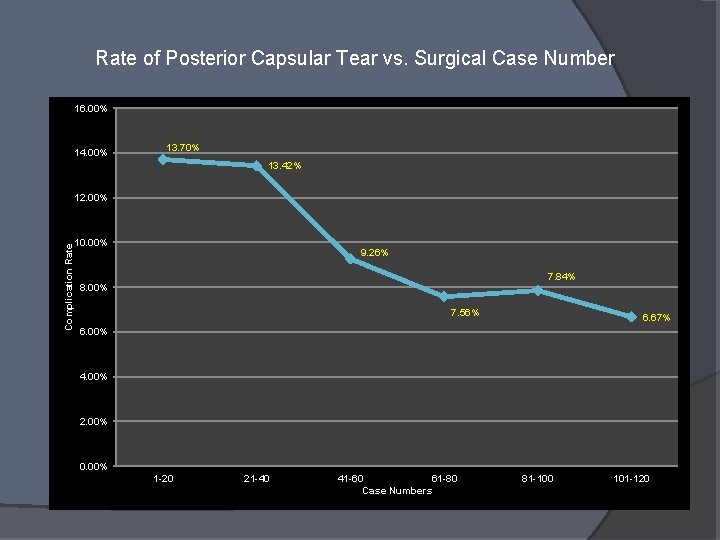
Rate of Posterior Capsular Tear vs. Surgical Case Number 16. 00% 14. 00% 13. 70% 13. 42% Complication Rate 12. 00% 10. 00% 9. 26% 7. 84% 8. 00% 7. 56% 6. 67% 6. 00% 4. 00% 2. 00% 0. 00% 1 -20 21 -40 41 -60 61 -80 Case Numbers 81 -100 101 -120
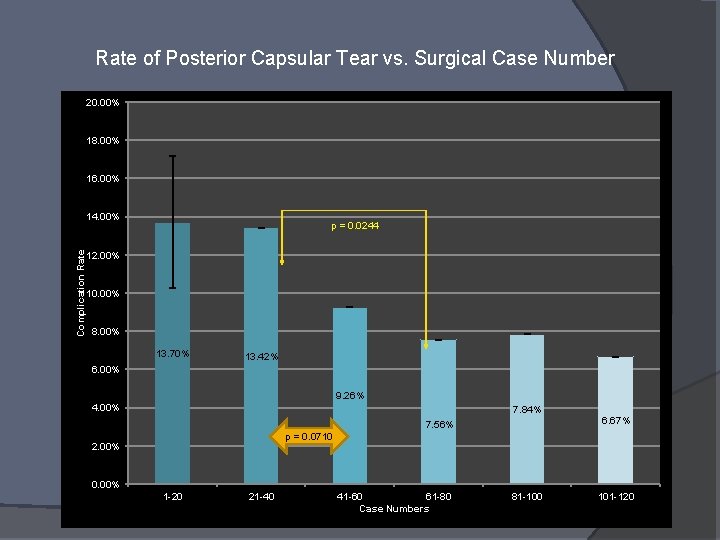
Rate of Posterior Capsular Tear vs. Surgical Case Number 20. 00% 18. 00% 16. 00% Complication Rate 14. 00% p = 0. 0244 12. 00% 10. 00% 8. 00% 13. 70% 13. 42% 6. 00% 9. 26% 4. 00% 7. 84% 6. 67% 7. 56% p = 0. 0710 2. 00% 0. 00% 1 -20 21 -40 41 -60 61 -80 Case Numbers 81 -100 101 -120
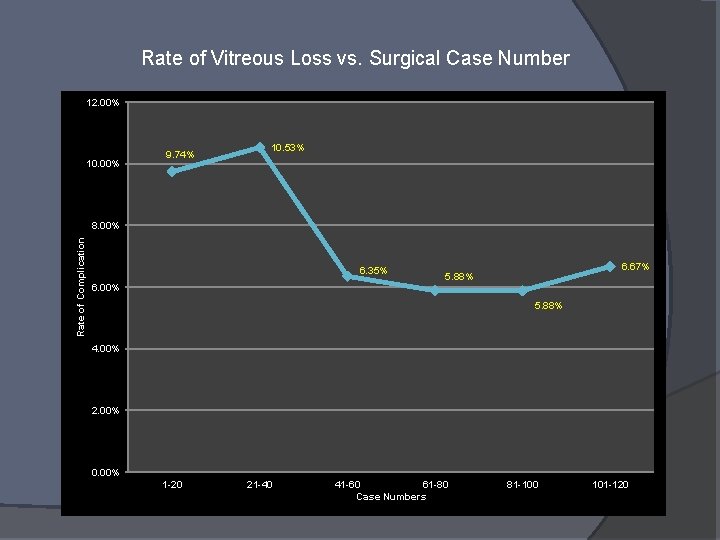
Rate of Vitreous Loss vs. Surgical Case Number 12. 00% 10. 00% 9. 74% 10. 53% Rate of Complication 8. 00% 6. 35% 6. 00% 6. 67% 5. 88% 4. 00% 2. 00% 0. 00% 1 -20 21 -40 41 -60 61 -80 Case Numbers 81 -100 101 -120
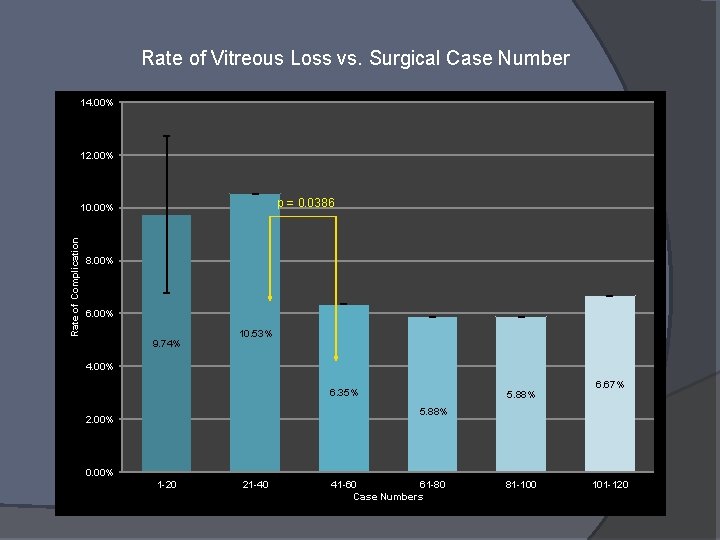
Rate of Vitreous Loss vs. Surgical Case Number 14. 00% 12. 00% p = 0. 0386 Rate of Complication 10. 00% 8. 00% 6. 00% 9. 74% 10. 53% 4. 00% 6. 35% 5. 88% 6. 67% 5. 88% 2. 00% 0. 00% 1 -20 21 -40 41 -60 61 -80 Case Numbers 81 -100 101 -120
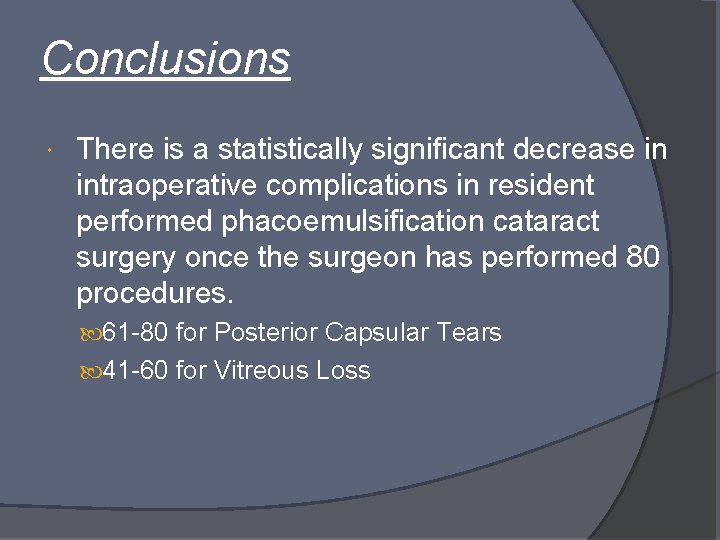
Conclusions There is a statistically significant decrease in intraoperative complications in resident performed phacoemulsification cataract surgery once the surgeon has performed 80 procedures. 61 -80 for Posterior Capsular Tears 41 -60 for Vitreous Loss
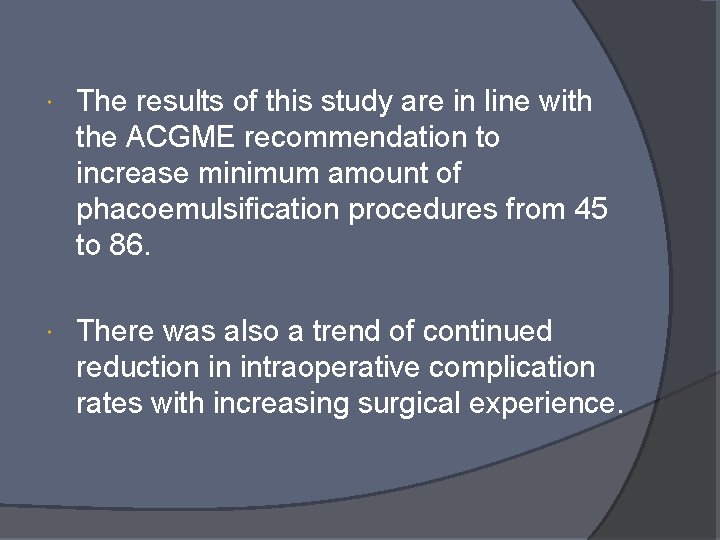
The results of this study are in line with the ACGME recommendation to increase minimum amount of phacoemulsification procedures from 45 to 86. There was also a trend of continued reduction in intraoperative complication rates with increasing surgical experience.
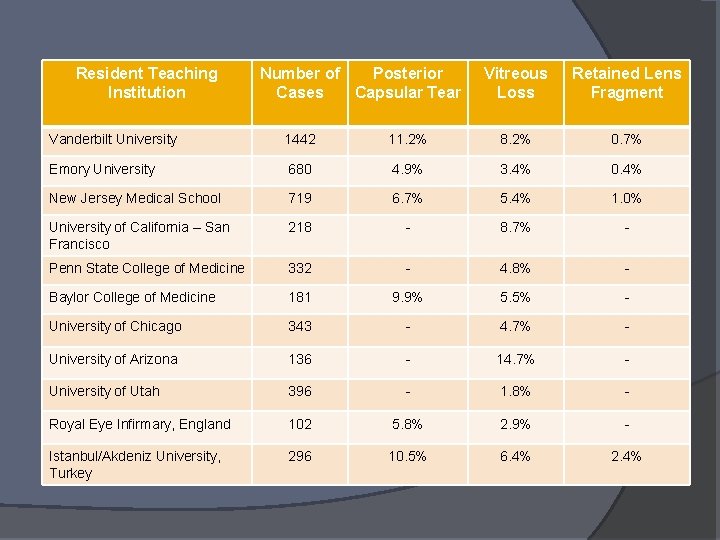
Resident Teaching Institution Number of Posterior Cases Capsular Tear Vitreous Loss Retained Lens Fragment Vanderbilt University 1442 11. 2% 8. 2% 0. 7% Emory University 680 4. 9% 3. 4% 0. 4% New Jersey Medical School 719 6. 7% 5. 4% 1. 0% University of California – San Francisco 218 - 8. 7% - Penn State College of Medicine 332 - 4. 8% - Baylor College of Medicine 181 9. 9% 5. 5% - University of Chicago 343 - 4. 7% - University of Arizona 136 - 14. 7% - University of Utah 396 - 1. 8% - Royal Eye Infirmary, England 102 5. 8% 2. 9% - Istanbul/Akdeniz University, Turkey 296 10. 5% 6. 4% 2. 4%
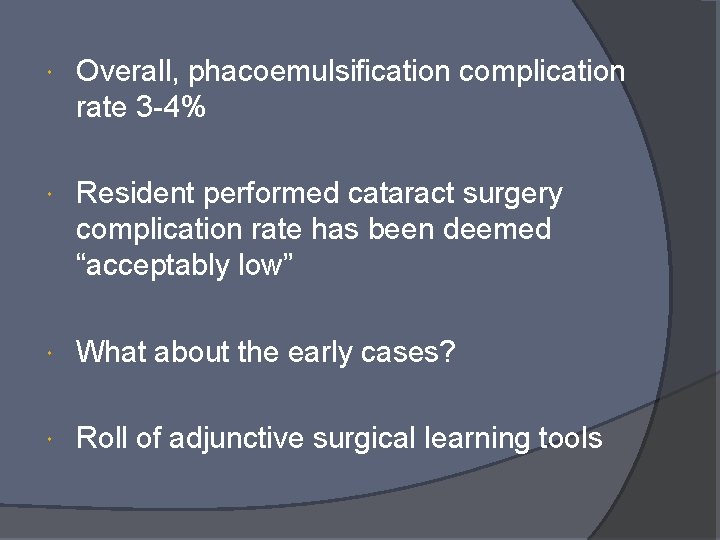
Overall, phacoemulsification complication rate 3 -4% Resident performed cataract surgery complication rate has been deemed “acceptably low” What about the early cases? Roll of adjunctive surgical learning tools
Limitations Case series subject to limitations of retrospective study. Accuracy of medical record? The data included only those procedures performed at the VA Hospital.
Acknowledgements Dr. Amy Chomsky VA Staff Vanderbilt Eye Institute Residents and Teaching Faculty
References Randleman JB, et al. The Resident Surgeon Phacoemulsification Learning Curve. Arch Ophthalmol. 2007; 125(9): 1215 -1219. Bhagat N, et al. Complications in resident-performed phacoemulsification cataract surgery at New Jersey Medical School. Br J Ophthalmol. 2007; 91: 1315 -1317. Smith JH, et al. Outcomes of cataract surgery by residents at a public county hospital. Am J Ophthalmol. 1997; 123(4): 448 -454. Quillen DA, et al. Visual Outcomes and Incidence of Vitreous Loss for Residents Performing Phacoemulsification Without Prior Planned Extracapsular Cataract Extraction Experience. Am J Ophthalmol. 2003; 135: 732 -733. Ang GS, et al. Effect and outcomes of posterior capsular rupture in a district hospital setting. J Cataract Refract Surg. 2006; 32(4): 623 -627. Chan FM, et al. Short-term outcomes in eyes with posterior capsule rupture during catarat surgery. J Cataract Refract Surg. 2003; 29(3): 537 -541. Pingree MF, et al. Cataract surgery complications in 1 year at an academic institution. J Cataract Refract Surg. 1999; 25: 705 -708.
Rowden A, et al. Resident cataract surgical training in United States residency programs. J Cataract Refract Surg. 2002; 28(12): 2202 -2205. Cruz OA, et al. Visual results and complications of phacoemulsification with intraocular lens implantation performed by ophthalmology residents. Ophthalmology. 1992; 99(3): 448 -452. Corey RP, et al. Surgical outcomes of cataract extractions performed by residents using phacoemulsification. J Cataract Refract Surg. 1998; 24(1): 66 -72. Tarbet KJ, et al. Complications and results of phacoemulsification performed by residents. J Cataract Refract Surg. 1995; 21(6): 661 -665. Prasad S. Phacoemulsification learning curve: experience of two junior trainee ophthalmologists. J Cataract Refract Surg. 1998; 24(1): 73 -77. Unal Mustafa, et al. Phacoemulsification with topical anesthesia: Resident experience. J Cataract Refract Surg. 2006; 32: 1361 -1365. Allinson RW, et al. Incidence of vitreous loss among third-year residents performing phacoemulsification. Ophthalmology. 1992; 99: 448 -452. Albanis CV, et al. Outcomes of extracapsular cataract extraction and phacoemulsification performed in university training program. Ophthalmic Surg Lasers. 1998; 29: 643 -648.
- Slides: 24