
Valuing Differences Recognizing Honoring and Benefiting From Diversity
Valuing Differences Recognizing, Honoring, and Benefiting From Diversity
Agenda § § § Four layers of diversity Assessing our differences Diversity in the classroom Taking action Closing and final thoughts Faculty Certification

Objectives Faculty Certification § Identify individual differences and layers of diversity. § Differentiate between stereotypes and prejudice. § Identify faculty and student expectations in the classroom.
Faculty Certification Self-reflection requires awareness of one’s own § norms, § values, and § beliefs.
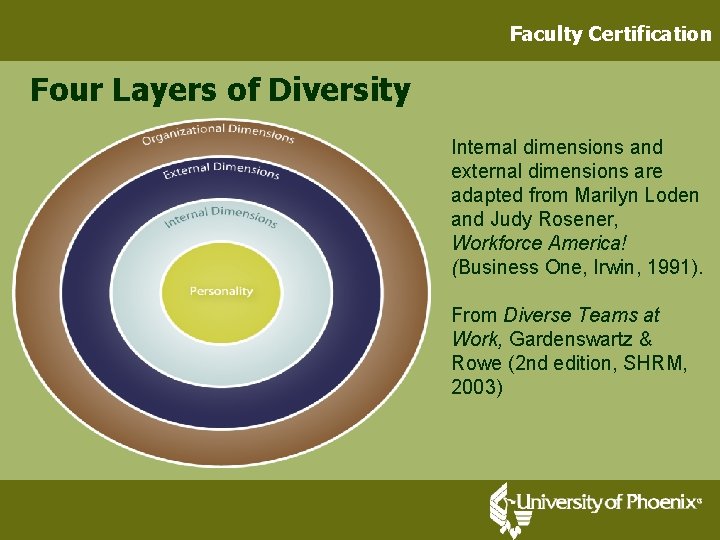
Faculty Certification Four Layers of Diversity Internal dimensions and external dimensions are adapted from Marilyn Loden and Judy Rosener, Workforce America! (Business One, Irwin, 1991). From Diverse Teams at Work, Gardenswartz & Rowe (2 nd edition, SHRM, 2003)
Faculty Certification The term stereotype originates from the process of making metal plates for printing to set an image. Stereotyping happens in two ways: 1. Taking an attribute of an individual and applying it to everyone in the group to which you assign the individual 2. Taking an attribute of a group and applying it to every individual in the group
Faculty Certification Realities About Stereotyping § § § Resistance to change Generalization based on limited experience Nonrational Self-fulfilling prophecy Two-sided coin (perpetrators and targets)
Faculty Certification Culture as Software § Human beings are programmed by cultural “software. ” § Cultural software determines our behavior and attitudes. § Recognizing our own programming teaches us that we have the capacity to control our choices. Culture = Software Awareness + Knowledge = Choices
Faculty Certification Prejudice § Occurs between groups § Involves a positive or negative evaluation of a group § Is a biased perception of a group § Is based on real or imagined characteristics of the group Devine, P. G. (1995), Jones, J. M. (1997), Nelson, T. (2006)
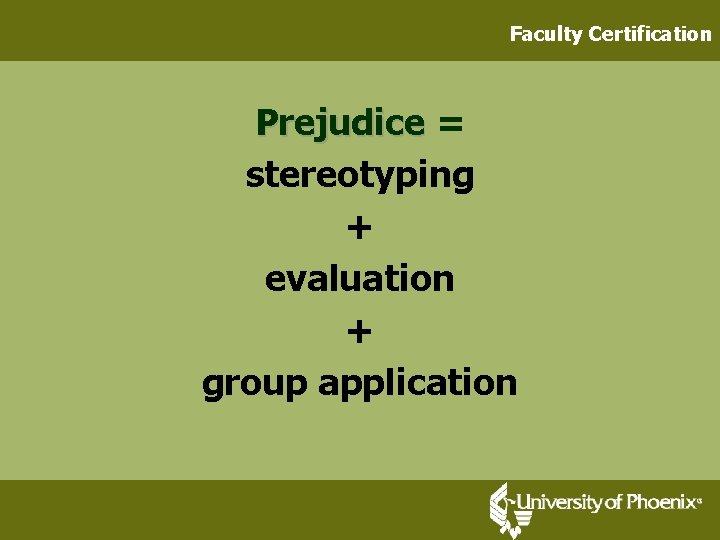
Faculty Certification Prejudice = stereotyping + evaluation + group application
Faculty Certification Diversity in the Classroom § Respect § Professionalism § Inclusion
Faculty Certification Demographics, Skills and Abilities, Social Systems Students attending university classes have a variety of differences: § Demographic § Skills and abilities § Social systems
Faculty Certification Dealing With Diversity in the Classroom § Establish expectations. § Provide feedback and support. § Address conflicts in a professional, diplomatic, and clear manner.
Faculty Certification Student Code of Conduct § Demonstrate mutual respect for students and faculty. § Foster and support an environment that is conducive to learning. § Demonstrate self-reliance and direction in the completion of individual and group learning goals and assignments. § Recognize and embrace diversity. § Accept responsibility and accountability for interactions with students and faculty.
Faculty Certification Faculty Code of Conduct § Demonstrate professional behavior § Create a positive learning environment § Be prepared.
Faculty Certification How do we minimize or eliminate negative effects of stereotypes in the classroom? § Diplomatically challenge stereotypic statements made by you and others. § Question your own assumptions. § Ask questions and be open to learn.
Final Thoughts Faculty Certification “We all have the same basic needs for dignity, survival, and social contact. What is different between individuals and groups is the way in which these needs are satisfied. ” Sondra Thiederman, Ph. D
References Faculty Certification • Devine, P. G. (1995). Getting hooked on research in social psychology: Examples from eyewitness identification and prejudice. In G. Brannigan & M. R. Merrens (Eds. ), The social psychologists , (pp. 160 -184). New York, NY: Mc. Graw-Hill. • Jones, J. (1997). Prejudice and racism. New York, NY: Mc. Graw-Hill. • Nelson, T. (2006) The psychology of prejudice (2 nd ed. ). London, England: Pearson. • Thiederman, S. (2008). Making diversity work. New York, NY: Kaplan.


Faculty Certification

Faculty Certification
- Slides: 21