
Values Inventory 91916 Career Success Skills Values Inventories

- Slides: 9
+ Values Inventory 9/19/16 Career Success Skills
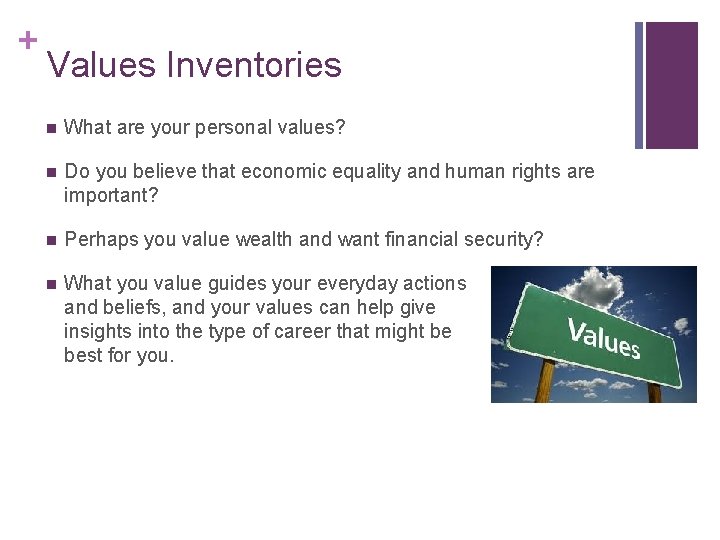
+ Values Inventories n What are your personal values? n Do you believe that economic equality and human rights are important? n Perhaps you value wealth and want financial security? n What you value guides your everyday actions and beliefs, and your values can help give insights into the type of career that might be best for you.
+ Value Inventories n Value inventories are questionnaires that help you determine your personal values so that you can find a career that is in line with what you hold important. n Your values guide every action that you perform in life, so it is important to understand what you hold valuable! n Value inventories help you learn what you hold valuable, whether they are intrinsic or extrinsic. Identifying and understanding your values can help you find a career pathway that best fits your personal value system. Basically, they are designed to help you match your values with a career.
+ Value Inventories Reviewing your personal values will make sure that you get the most job satisfaction. For example n If you value environmental responsibility, you may want to explore careers in environmental research or charities. n If you value play and recreation, you may be better off as a college football coach.
+ Intrinsic & Extrinsic Values n There are two basic types of values; intrinsic & extrinsic. n Intrinsic values are things that are valuable in and of themselves, such as pleasure. Examples: helping others, independence, leadership, responsibility, satisfaction, being creative. n For extrinsic values the motivation comes from external, or outside forces. Examples: high pay, job security, job benefits, time to spend with family, fast and easy entry to job.
+ Personal Values n Personal values are those beliefs that you hold dear, which don’t necessarily relate to a work environment. For example, spiritual needs, a sense of adventure, or artistic expression are all personal values that may have little or no relevance to your career. n Examples: n Accountability n Commitment n Family n Friendship n Wealth n Creativity n Perseverance
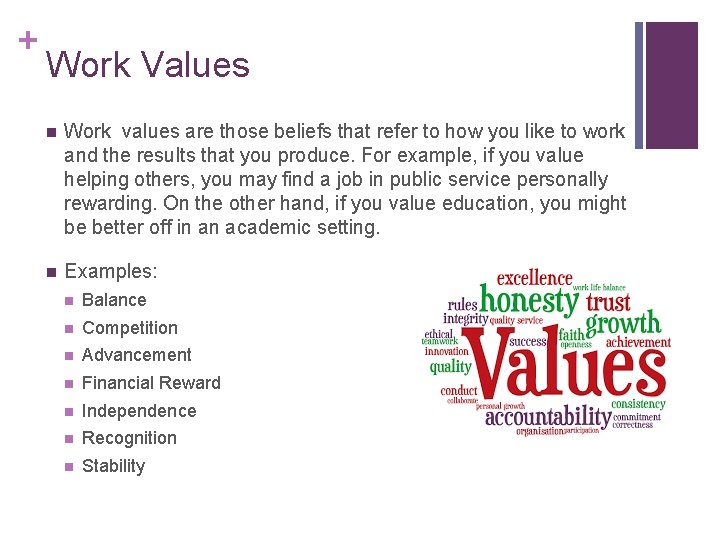
+ Work Values n Work values are those beliefs that refer to how you like to work and the results that you produce. For example, if you value helping others, you may find a job in public service personally rewarding. On the other hand, if you value education, you might be better off in an academic setting. n Examples: n Balance n Competition n Advancement n Financial Reward n Independence n Recognition n Stability
+ Values n Personal values and work values will often coincide with, or match, each other. Finding a career in which both your personal and work values match will ultimately lead to more satisfaction in your career.
+ Practice – Take a Values Inventory Complete a Values Inventory Two Options: 1. Paper-Based Values Inventory or 2. Internet-Based https: //survey. valuescentre. com/survey. html? id=s 1 TAEQUStmx-p. UIlema 6 Q