
Values as Pillars in Tourism Education Pauline J
- Slides: 41
Values as Pillars in Tourism Education Pauline J. Sheldon University of Hawai’i, USA
Values – what are they? • “Deeply held beliefs that drive activities” – Personal, social, public, cultural • • • Some universal; some culture-specific Silent, implicit, unexamined Bridge between past - present – future Difficult to shift – maybe education can Current Crisis of Values
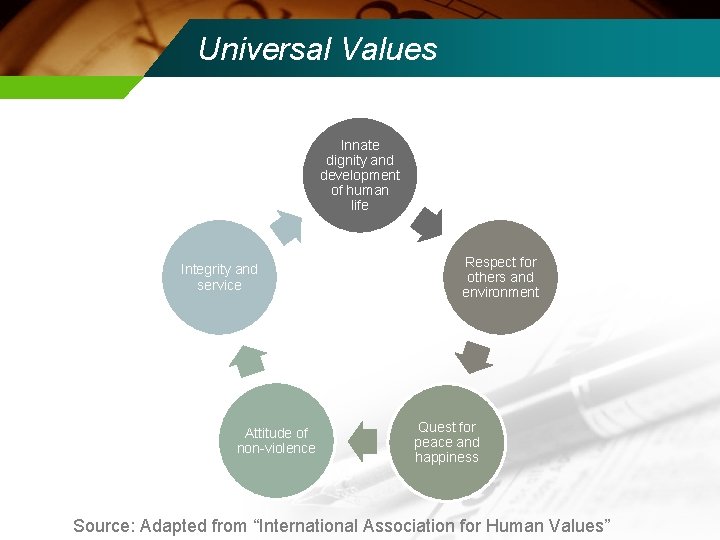
Universal Values Innate dignity and development of human life Integrity and service Attitude of non-violence Respect for others and environment Quest for peace and happiness Source: Adapted from “International Association for Human Values”
Shift in Corporate Values Property-Centered Corporation: • Maximum growth • Maximum profits • Creating wealth for financial elite and CEO • CORPORATION AS PIECE OF PROPERTY Life-Centered Corporation: • Organic growth • Ethical profits • Serving variety of stakeholders • CORPORATION AS LIVING SYSTEM.
Changing Societal Values • There are important values entirely apart from money. “Human rights. ” • Prosperity is about money but also health, balance, family. “Quality of life. ” • Long-term is more important than shortterm. “Sustainability. ” • Public goods take priority over private interests. “Protecting the commons. ”
Shift in Tourist Values • OLD • Seek complexity of consumerism in destinations • Seek hedonistic experiences ignoring local cultures • Lack of interest in environmental issues • NEW • Value simplicity and authenticity • Believe in engaged action & service • Concerned about ecology • Are altruistic, self actualizing and spiritually engaged
Tourism Education? • Has there been a parallel shift in tourism education? • Shouldn’t educational institutions be leading this shift? • Don’t we have to prepare out students for a VERY different world?
Tourism Education Futures Initiative (TEFI) Pauline Sheldon, University of Hawaii, USA Daniel Fesenmaier, Temple University, USA John Tribe, University of Surrey, UK Leo Jago, Victoria University, Australia Janne Liburd, S. Denmark University AND ABOUT 70 OTHER LEADING EDUCATORS AND INDUSTRY MEMBERS FROM ABOUT 28 COUNTRIES
THE TEFI VISION • “TEFI seeks to provide vision, knowledge and a framework for tourism education programs to promote global citizenship and optimism for a better world. ” www. tourismeducationsummit. com
Rationale For Change • Education must shift from unthinking reproduction • Focus on means rather than ends • Tsunamis of change – Climate change – Peak oil – Human rights – Food and water shortages
TEFI Process ww. tourismeducationsummit. com • Three Annual Summits – Lectures by leading scholars and industry – Breakout group discussions – Agreements and vision setting • Work Group Assignments – Set foundation for following summit – Enable connections/networking with groups and programs • Move from Values to Implementation
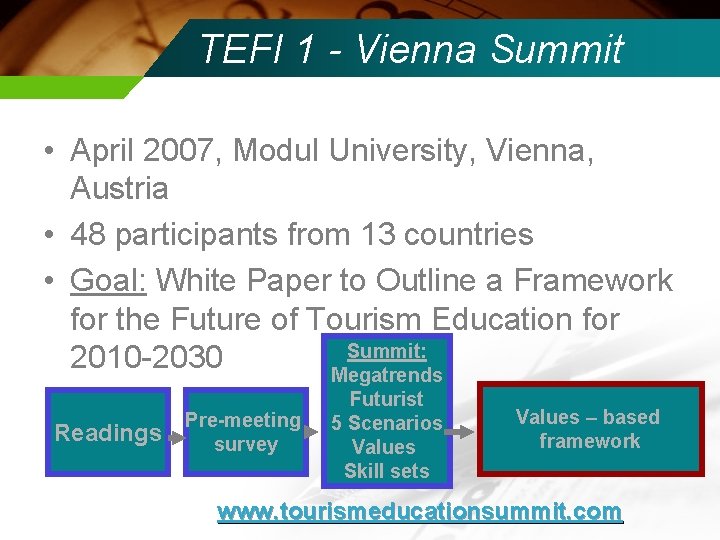
TEFI 1 - Vienna Summit • April 2007, Modul University, Vienna, Austria • 48 participants from 13 countries • Goal: White Paper to Outline a Framework for the Future of Tourism Education for Summit: 2010 -2030 Megatrends Readings Pre-meeting survey Futurist 5 Scenarios Values Skill sets Values – based framework www. tourismeducationsummit. com
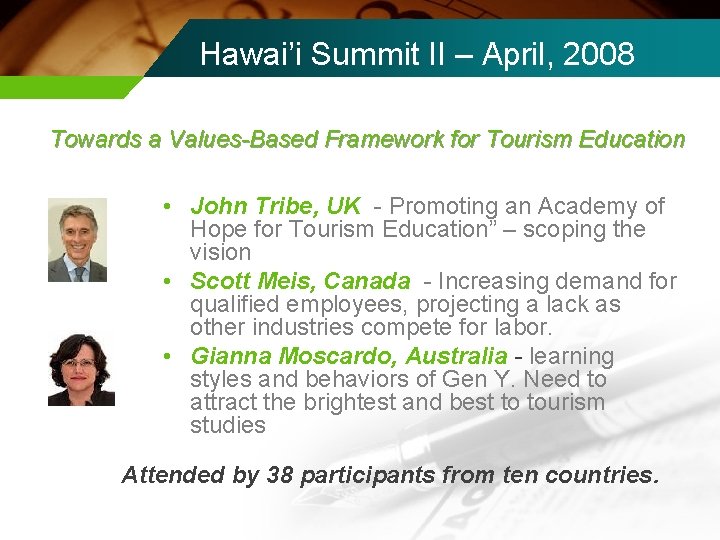
Hawai’i Summit II – April, 2008 Towards a Values-Based Framework for Tourism Education • John Tribe, UK - Promoting an Academy of Hope for Tourism Education” – scoping the vision • Scott Meis, Canada - Increasing demand for qualified employees, projecting a lack as other industries compete for labor. • Gianna Moscardo, Australia - learning styles and behaviors of Gen Y. Need to attract the brightest and best to tourism studies Attended by 38 participants from ten countries.
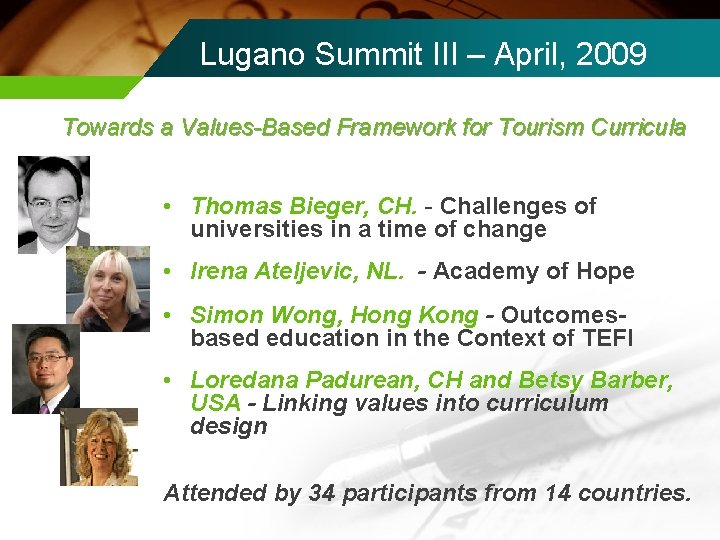
Lugano Summit III – April, 2009 Towards a Values-Based Framework for Tourism Curricula • Thomas Bieger, CH. - Challenges of universities in a time of change • Irena Ateljevic, NL. - Academy of Hope • Simon Wong, Hong Kong - Outcomesbased education in the Context of TEFI • Loredana Padurean, CH and Betsy Barber, USA - Linking values into curriculum design Attended by 34 participants from 14 countries.
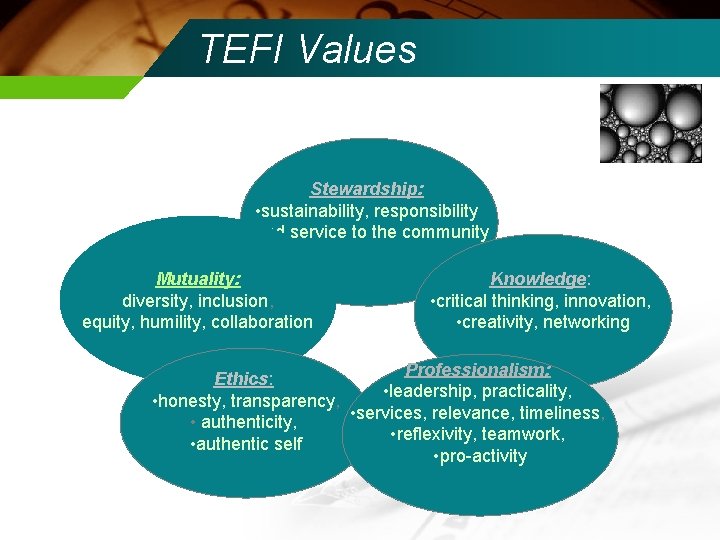
TEFI Values Stewardship: • sustainability, responsibility • and service to the community Mutuality: diversity, inclusion, equity, humility, collaboration Knowledge: • critical thinking, innovation, • creativity, networking Professionalism: Ethics: • leadership, practicality, • honesty, transparency, • services, relevance, timeliness, • authenticity, • reflexivity, teamwork, • authentic self • pro-activity
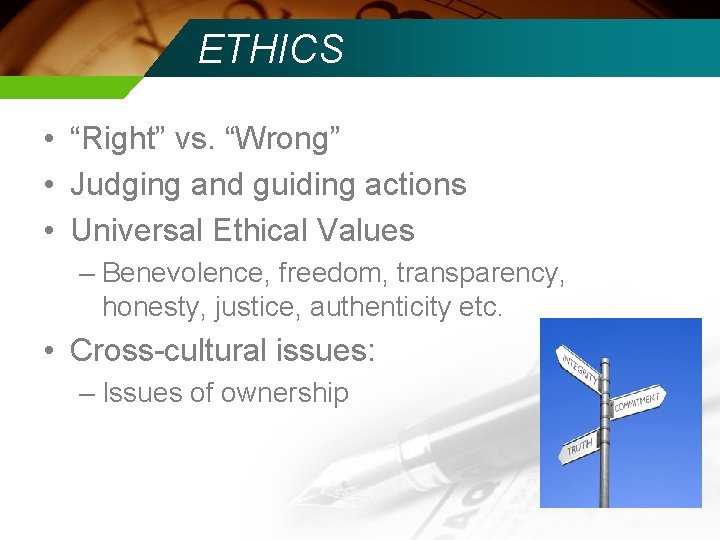
ETHICS • “Right” vs. “Wrong” • Judging and guiding actions • Universal Ethical Values – Benevolence, freedom, transparency, honesty, justice, authenticity etc. • Cross-cultural issues: – Issues of ownership
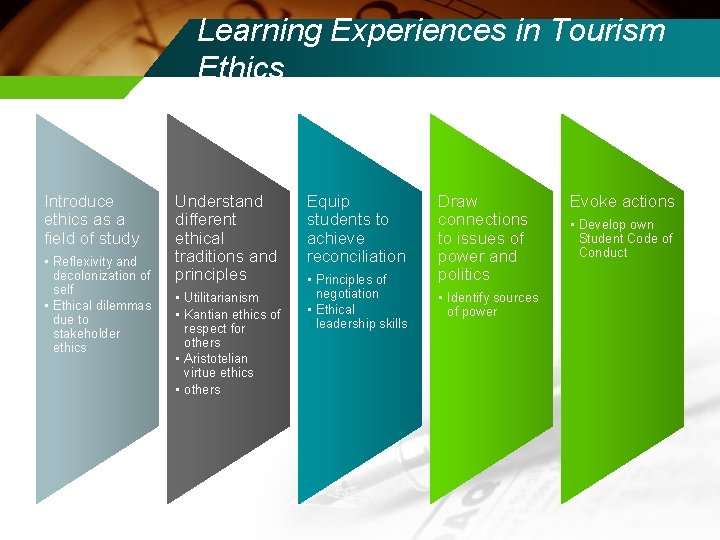
Learning Experiences in Tourism Ethics Introduce ethics as a field of study • Reflexivity and decolonization of self • Ethical dilemmas due to stakeholder ethics Understand different ethical traditions and principles • Utilitarianism • Kantian ethics of respect for others • Aristotelian virtue ethics • others Equip students to achieve reconciliation • Principles of negotiation • Ethical leadership skills Draw connections to issues of power and politics • Identify sources of power Evoke actions • Develop own Student Code of Conduct
KNOWLEDGE • Complex cognitive processes of perception, reasoning, learning, communication, association, application • Tacit and Explicit • Knowledge Creation addresses – Creativity & innovation – Critical Thinking – Networking • Cross-Cultural issues: – Access to knowledge, knowledge creation processes
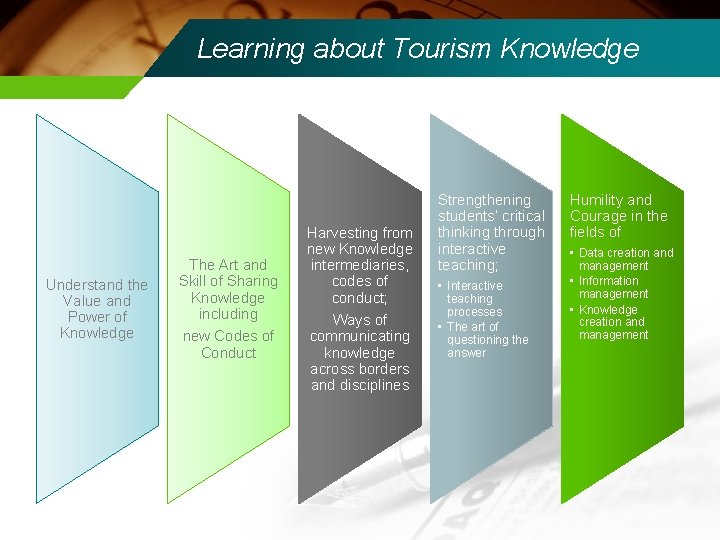
Learning about Tourism Knowledge Understand the Value and Power of Knowledge The Art and Skill of Sharing Knowledge including new Codes of Conduct Harvesting from new Knowledge intermediaries, codes of conduct; Ways of communicating knowledge across borders and disciplines Strengthening students’ critical thinking through interactive teaching; • Interactive teaching processes • The art of questioning the answer Humility and Courage in the fields of • Data creation and management • Information management • Knowledge creation and management
STEWARDSHIP • “Choosing service over self-interest” – Responsibility – Sustainability – Service to Others • All Stakeholders have responsibility for environment • Need understanding of stakeholder motives and exercising of power/influence • Need to engage with the non-tourism world • Cross-cultural differences: stage of development; quantity and quality of resources
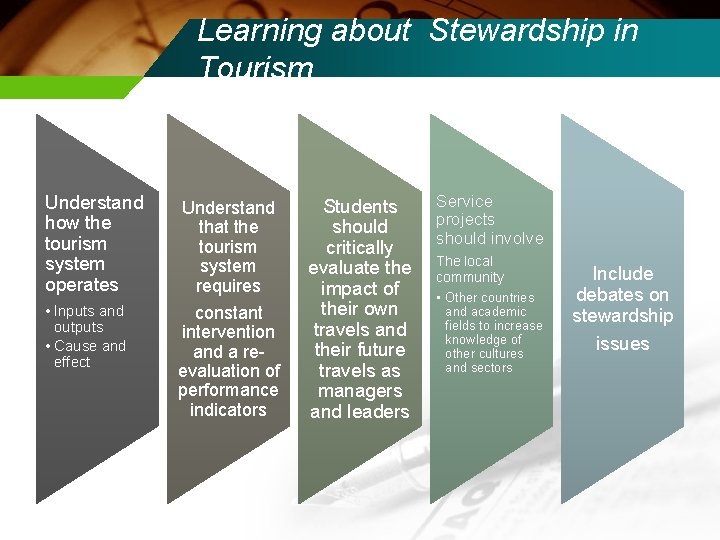
Learning about Stewardship in Tourism Understand how the tourism system operates • Inputs and outputs • Cause and effect Understand that the tourism system requires constant intervention and a reevaluation of performance indicators Students should critically evaluate the impact of their own travels and their future travels as managers and leaders Service projects should involve The local community • Other countries and academic fields to increase knowledge of other cultures and sectors Include debates on stewardship issues
MUTUALITY • “…grounded in human relationships mutuality requires attitudinal developments involving acceptance, selfawareness, open-mindedness and empowerment. . ” • Mutuality as an evolving process starting with selfawareness (Inglehart 1997) • Influences behaviors and attitudes • Respect of self and other • Diversity, inclusion, humility, equity, collaboration • Cross-cultural issues: – level of homogeneity of population
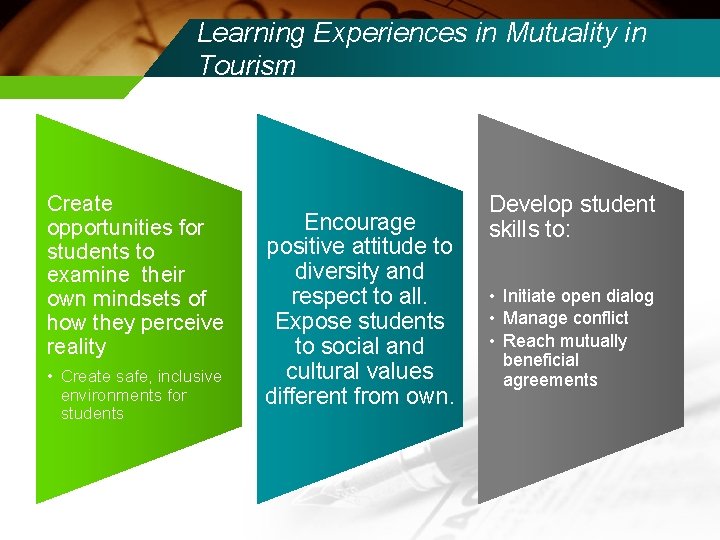
Learning Experiences in Mutuality in Tourism Create opportunities for students to examine their own mindsets of how they perceive reality • Create safe, inclusive environments for students Encourage positive attitude to diversity and respect to all. Expose students to social and cultural values different from own. Develop student skills to: • Initiate open dialog • Manage conflict • Reach mutually beneficial agreements
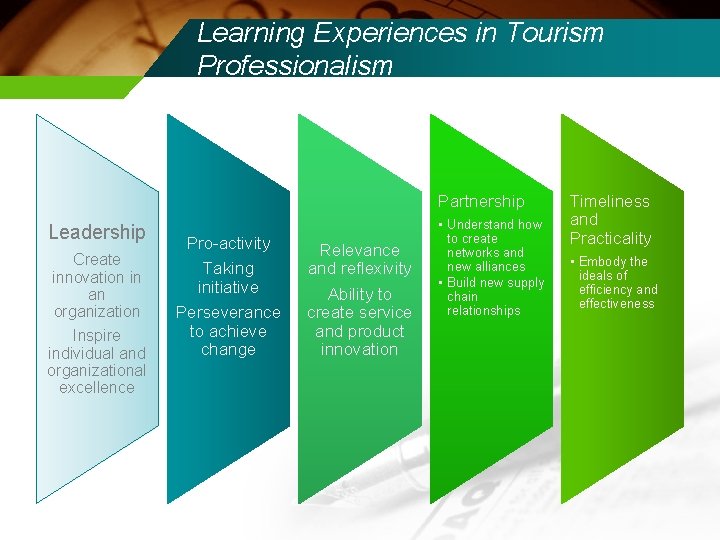
PROFESSIONALISM • “The ability to align personal and organizational conduct with ethical and professional standards that include a responsibility to customer and community and a commitment to lifelong learning”. • Leadership and pro-activity • Practicality and timeliness • Partnership development & teamwork • Relevance and reflexivity • Cross-cultural differences: – Level of prestige of tourism profession
Learning Experiences in Tourism Professionalism Partnership Leadership Create innovation in an organization Inspire individual and organizational excellence Pro-activity Taking initiative Perseverance to achieve change Relevance and reflexivity Ability to create service and product innovation • Understand how to create networks and new alliances • Build new supply chain relationships Timeliness and Practicality • Embody the ideals of efficiency and effectiveness
TEFI Values and the Way Forward…
The Way Forward for TEFI • • Networking Distribution Pilot Projects The Next Two Summits
Networking • Accreditation Agencies: – UNWTO Ted. Qual – ACPHA – Others • Collaborating with other agencies working to make education more responsible – Academy of Hope – UN Principles for Responsible Management Education – Education and Science Council, UNWTO – BEST Education Network
Distribution • Creation of TEFI Ambassadors • Website: www. tourismeducationsummit. com • Faculty Code of Ethics/Conduct • Journal Articles • Handbook for Faculty • One week Seminars for Faculty around the world • Conference Presentations
Pilot Projects • Pilot Projects in Academia – Modul University: Scholarship of Hope; Oath – Temple University: Course templates – University of Hawaii: Redesign of Curriculum • Pilot Projects in Industry – Engagement with Innovators – Stewardship internships
Professional Oaths of Honor • Modul University, Vienna Austria • Thunderbird Business School, USA – “As a global citizen, I promise: I will strive to act with honesty and integrity, I will respect the rights and dignity of all people, I will strive to create sustainable prosperity worldwide, I will oppose all forms of corruption and exploitation, and I will take responsibility for my actions. As I hold true to these principles, it is my hope that I may enjoy an honorable reputation and peace of conscience. This pledge I make freely and upon my honor. ”
Pilot Courses: Temple University Leisure and Tourism in a Diverse Society STEWARDSHIP • Service to the Community MUTUAL RESPECT • Diversity • Inclusion • Equity • Humility Upon conclusion of this course students will be able to: • Demonstrate service to the community by organizing a service project. • Prepare a statement on Mutual Respect including the terms diversity and inclusion. • Formulate a policy on equity (inclusive of persons with disabilities) for your business. • Write a reaction paper on how you felt when role playing a disability. Assignments include: Event Planning, Reaction Papers, Policy Development and Role Playing.
Pilot: Temple University: Research Methodology (core) PROFESSIONALISM • Teamwork MUTUAL RESPECT • Collaboration KNOWLEDGE • Critical Thinking • Innovation • Creativity Upon conclusion of this course students will be able to: • Write a proposal to conduct research (critical thinking, innovation, and creativity) • Identify and critically evaluate literature (both practical and academic) that provides the foundation for research • Critique a survey focusing on the various aspects of survey design and concept evaluation • With a team, conduct a study which includes sampling, survey design, data collection, analysis and interpretation • With a team, present in both written and oral formats the results of a research project. Assignments include: Exams and Quizzes, Research Proposal, Research Paper, and Presentation
The Next Two Years • • TEFI Values Assessment Inventory Academy of Hope Scholarship Grant-writing 2010 and 2011 Meetings – 2010 TEFI Meeting: Assessment and Tools for Change – 2011: TEFI World Congress: Activating Change in Tourism Education • Please join us…
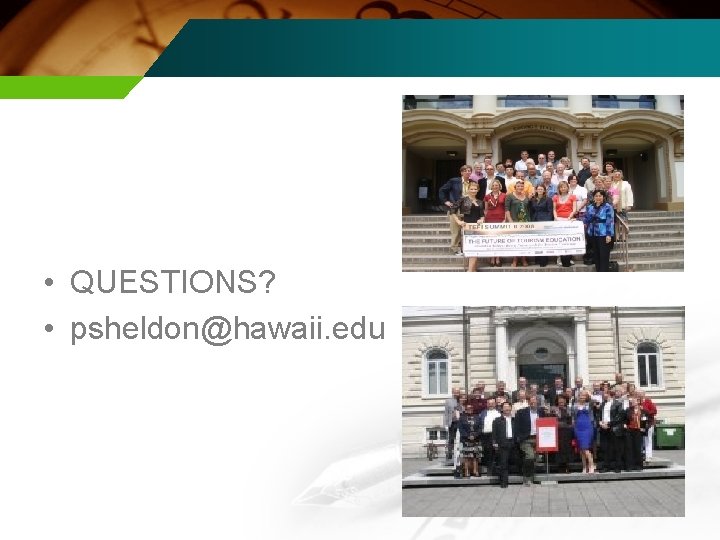
• QUESTIONS? • psheldon@hawaii. edu
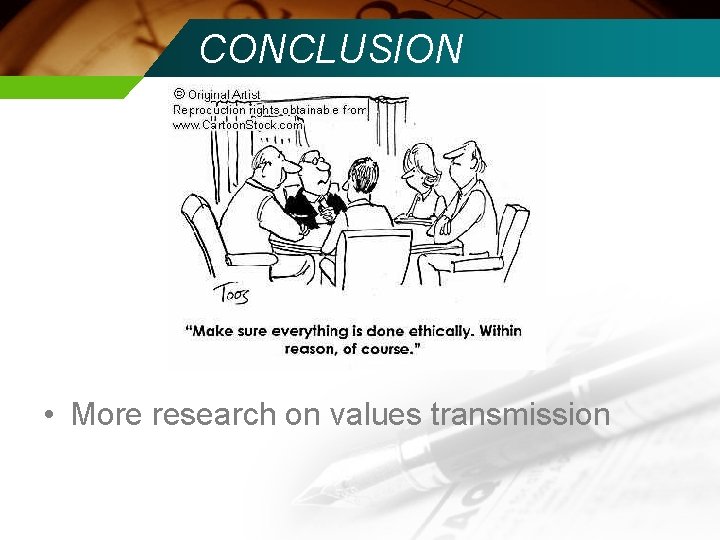
CONCLUSION • More research on values transmission
TEFI Process • Development of a foundation based upon leading innovators in tourism research and education worldwide • Proactive, focusing on the development of leaders of change • Combination of Summit and Working Groups • Summits involve lecture to stimulate – challenge the status quo and discussion groups to address these challenges • Working Groups focus on building tools to support learning & build partnerships with industry leaders
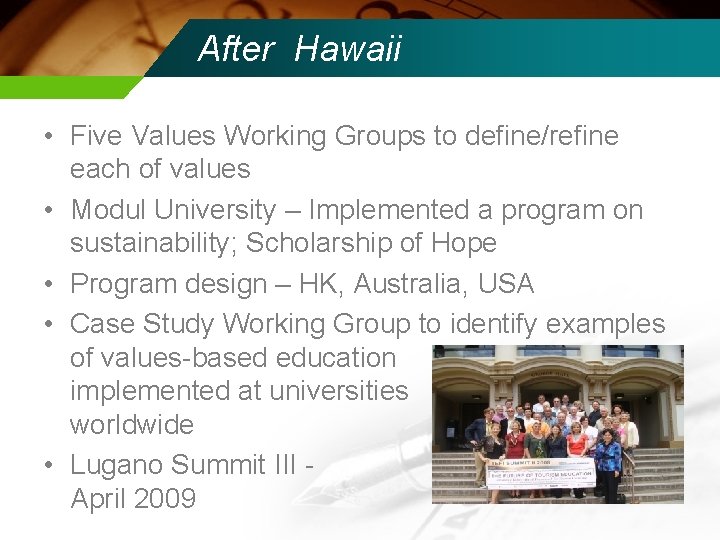
After Hawaii • Five Values Working Groups to define/refine each of values • Modul University – Implemented a program on sustainability; Scholarship of Hope • Program design – HK, Australia, USA • Case Study Working Group to identify examples of values-based education implemented at universities worldwide • Lugano Summit III - – April 2009
After Lugano • White Paper outlining the foundations for TEFI and its values • Working Group - Faculty Code of Ethics • Working Group - Pilot programs at universities world wide • Working Group - TEFI Inventory for program assessment • Summit IV - Summit V
After Vienna • Article in Journal of Teaching in Travel and Tourism • Website: www. tourismeducationsummit. com • BEST Education Network houses TEFI • Hawai’i Summit II - April 2008 Towards a Values-Based Framework for Tourism Education.