
ValueAdded Assessment What is it and How Can
- Slides: 1
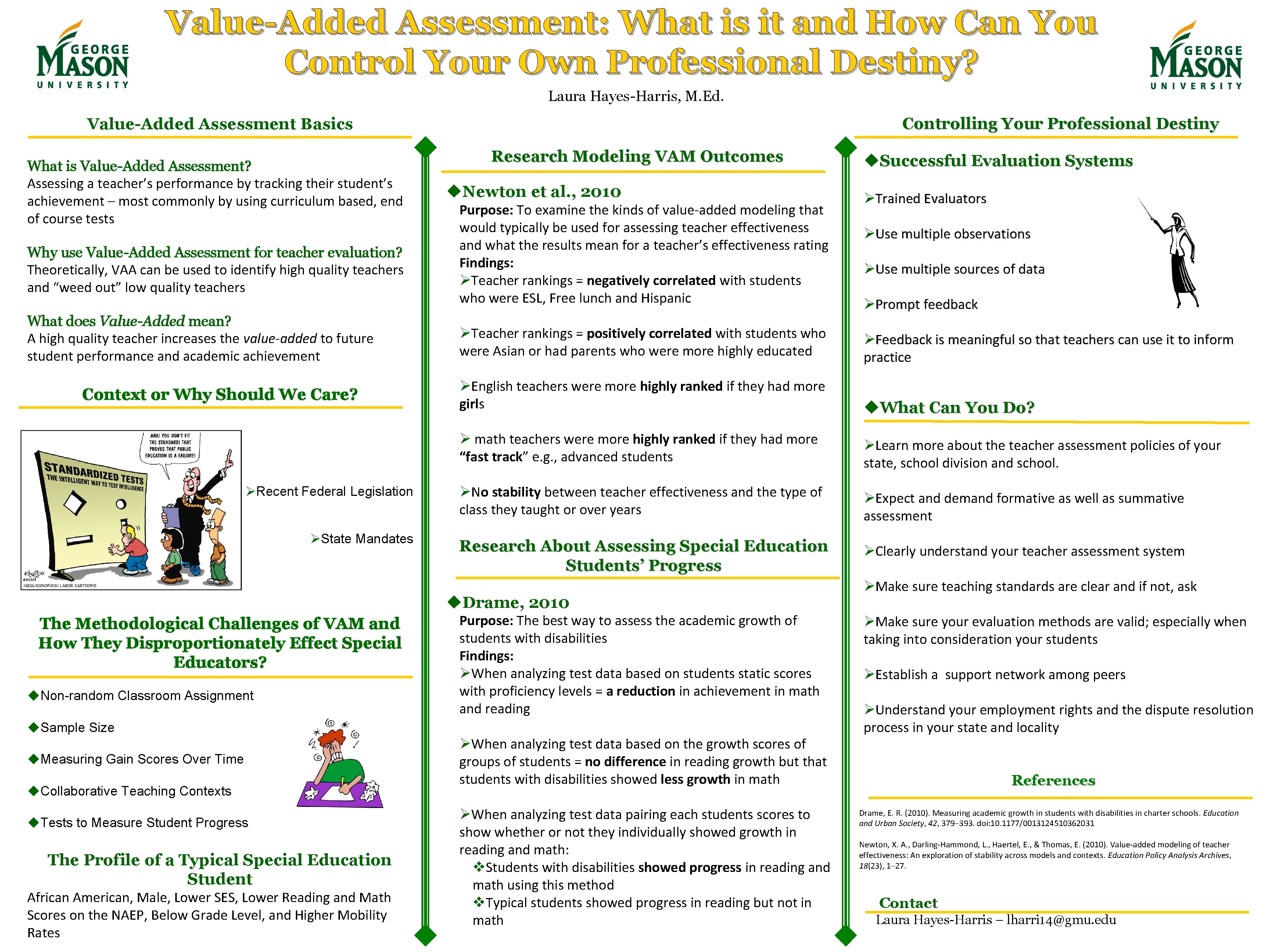
Value-Added Assessment: What is it and How Can You Control Your Own Professional Destiny? Laura Hayes-Harris, M. Ed. Controlling Your Professional Destiny Value-Added Assessment Basics What is Value-Added Assessment? Assessing a teacher’s performance by tracking their student’s achievement – most commonly by using curriculum based, end of course tests Why use Value-Added Assessment for teacher evaluation? Theoretically, VAA can be used to identify high quality teachers and “weed out” low quality teachers What does Value-Added mean? A high quality teacher increases the value-added to future student performance and academic achievement Context or Why Should We Care? ØRecent Federal Legislation ØState Mandates Research Modeling VAM Outcomes u. Newton et al. , 2010 Purpose: To examine the kinds of value-added modeling that would typically be used for assessing teacher effectiveness and what the results mean for a teacher’s effectiveness rating Findings: ØTeacher rankings = negatively correlated with students who were ESL, Free lunch and Hispanic u. Non-random Classroom Assignment u. Sample Size u. Measuring Gain Scores Over Time u. Collaborative Teaching Contexts u. Tests to Measure Student Progress The Profile of a Typical Special Education Student African American, Male, Lower SES, Lower Reading and Math Scores on the NAEP, Below Grade Level, and Higher Mobility Rates ØTrained Evaluators ØUse multiple observations ØUse multiple sources of data ØPrompt feedback ØTeacher rankings = positively correlated with students who were Asian or had parents who were more highly educated ØFeedback is meaningful so that teachers can use it to inform practice ØEnglish teachers were more highly ranked if they had more girls u. What Can You Do? Ø math teachers were more highly ranked if they had more “fast track” e. g. , advanced students ØLearn more about the teacher assessment policies of your state, school division and school. ØNo stability between teacher effectiveness and the type of class they taught or over years ØExpect and demand formative as well as summative assessment Research About Assessing Special Education Students’ Progress ØClearly understand your teacher assessment system u. Drame, 2010 The Methodological Challenges of VAM and How They Disproportionately Effect Special Educators? u. Successful Evaluation Systems Purpose: The best way to assess the academic growth of students with disabilities Findings: ØWhen analyzing test data based on students static scores with proficiency levels = a reduction in achievement in math and reading ØWhen analyzing test data based on the growth scores of groups of students = no difference in reading growth but that students with disabilities showed less growth in math ØWhen analyzing test data pairing each students scores to show whether or not they individually showed growth in reading and math: v. Students with disabilities showed progress in reading and math using this method v. Typical students showed progress in reading but not in math ØMake sure teaching standards are clear and if not, ask ØMake sure your evaluation methods are valid; especially when taking into consideration your students ØEstablish a support network among peers ØUnderstand your employment rights and the dispute resolution process in your state and locality References Drame, E. R. (2010). Measuring academic growth in students with disabilities in charter schools. Education and Urban Society, 42, 379– 393. doi: 10. 1177/0013124510362031 Newton, X. A. , Darling-Hammond, L. , Haertel, E. , & Thomas, E. (2010). Value-added modeling of teacher effectiveness: An exploration of stability across models and contexts. Education Policy Analysis Archives, 18(23), 1– 27. Contact Laura Hayes-Harris – lharri 14@gmu. edu