
Value selling at SKF service Strategic marketing case
- Slides: 21
Value selling at SKF service Strategic marketing case 3 Stheffany Godoy G Ella Leppänen Weiyi Liu
Agenda Bearing market SKF’s business environment Problem identification Our suggestion Short-term solution Short-term implementations Long-term suggestions
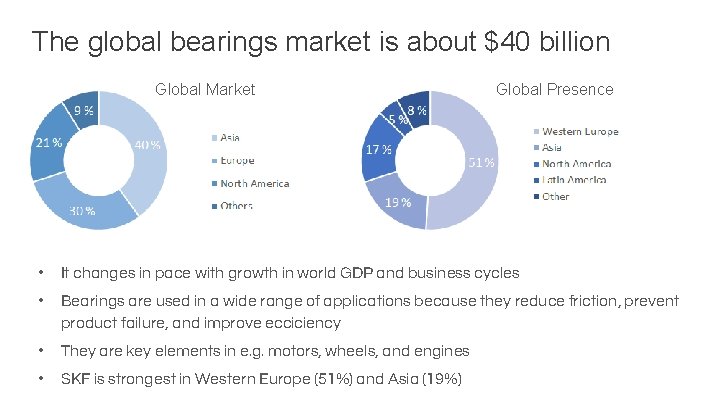
The global bearings market is about $40 billion Global Market Global Presence • It changes in pace with growth in world GDP and business cycles • Bearings are used in a wide range of applications because they reduce friction, prevent product failure, and improve ecciciency • They are key elements in e. g. motors, wheels, and engines • SKF is strongest in Western Europe (51%) and Asia (19%)
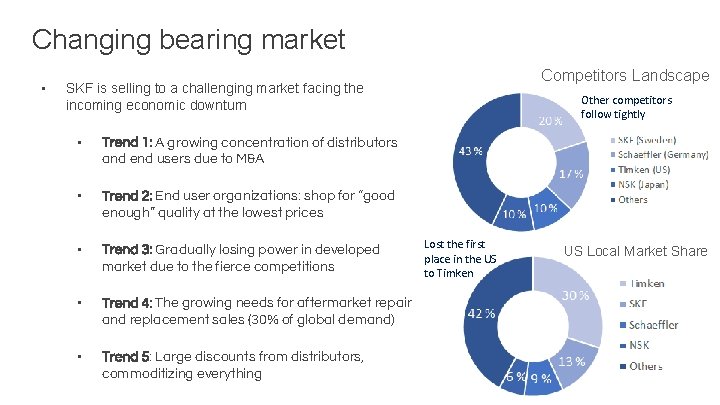
Changing bearing market • Competitors Landscape SKF is selling to a challenging market facing the incoming economic downturn • Trend 1: A growing concentration of distributors and end users due to M&A • Trend 2: End user organizations: shop for “good enough” quality at the lowest prices • Trend 3: Gradually losing power in developed market due to the fierce competitions • Trend 4: The growing needs for aftermarket repair and replacement sales (30% of global demand) • Trend 5: Large discounts from distributors, commoditizing everything Other competitors follow tightly Lost the first place in the US to Timken US Local Market Share
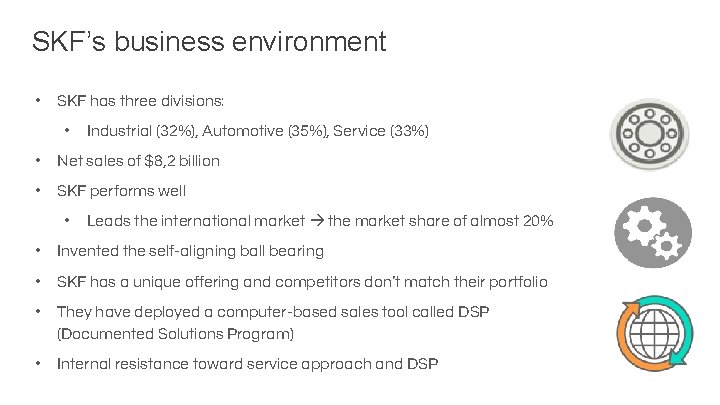
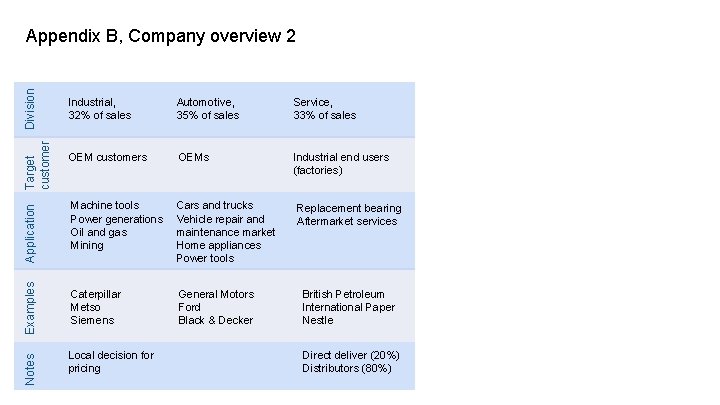
SKF’s business environment • SKF has three divisions: • Industrial (32%), Automotive (35%), Service (33%) • Net sales of $8, 2 billion • SKF performs well • Leads the international market the market share of almost 20% • Invented the self-aligning ball bearing • SKF has a unique offering and competitors don’t match their portfolio • They have deployed a computer-based sales tool called DSP (Documented Solutions Program) • Internal resistance toward service approach and DSP
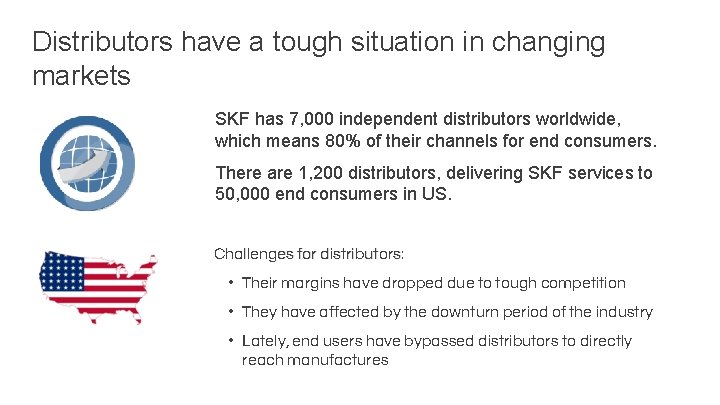
Distributors have a tough situation in changing markets SKF has 7, 000 independent distributors worldwide, which means 80% of their channels for end consumers. There are 1, 200 distributors, delivering SKF services to 50, 000 end consumers in US. Challenges for distributors: • Their margins have dropped due to tough competition • They have affected by the downturn period of the industry • Lately, end users have bypassed distributors to directly reach manufactures
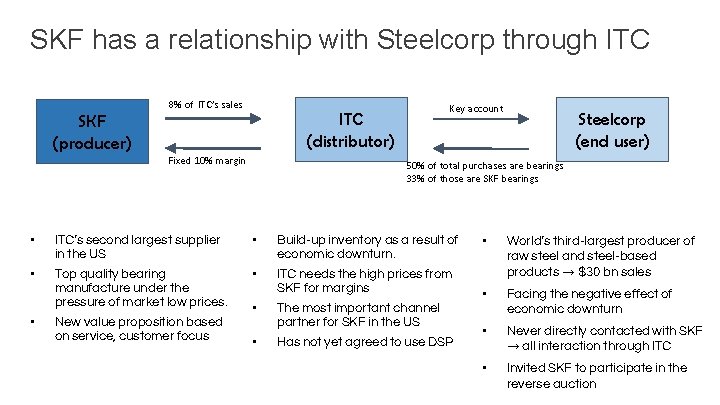
SKF has a relationship with Steelcorp through ITC 8% of ITC’s sales Key account ITC (distributor) SKF (producer) Fixed 10% margin 50% of total purchases are bearings 33% of those are SKF bearings • ITC’s second largest supplier in the US • Build-up inventory as a result of economic downturn. • Top quality bearing manufacture under the pressure of market low prices. • ITC needs the high prices from SKF for margins • The most important channel partner for SKF in the US • Has not yet agreed to use DSP • New value proposition based on service, customer focus Steelcorp (end user) • World’s third-largest producer of raw steel and steel-based products → $30 bn sales • Facing the negative effect of economic downturn • Never directly contacted with SKF → all interaction through ITC • Invited SKF to participate in the reverse auction
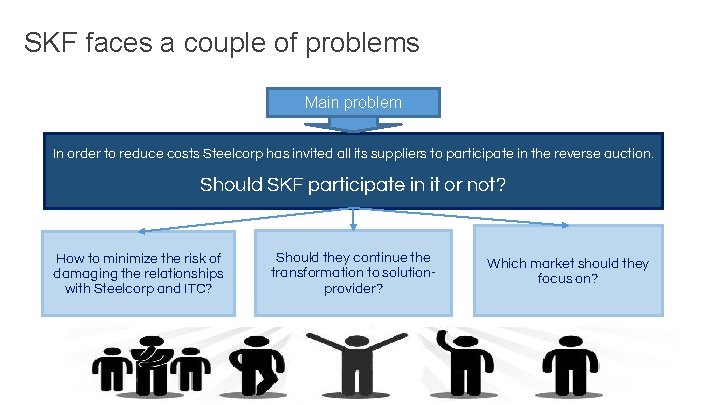
SKF faces a couple of problems Main problem In order to reduce costs Steelcorp has invited all its suppliers to participate in the reverse auction. Should SKF participate in it or not? How to minimize the risk of damaging the relationships with Steelcorp and ITC? Should they continue the transformation to solutionprovider? Which market should they focus on?
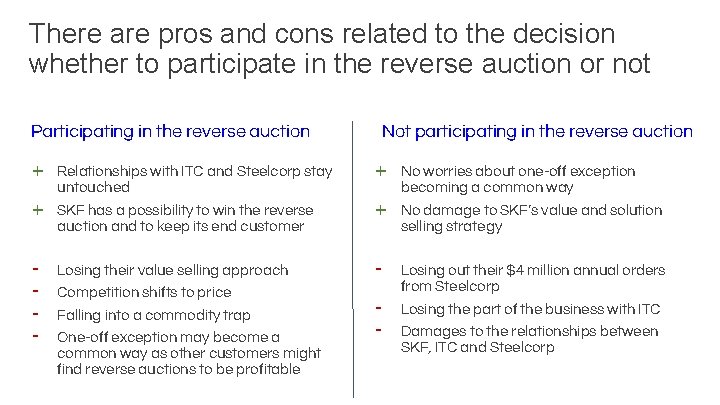
There are pros and cons related to the decision whether to participate in the reverse auction or not Participating in the reverse auction + + Not participating in the reverse auction Relationships with ITC and Steelcorp stay untouched SKF has a possibility to win the reverse auction and to keep its end customer + Losing their value selling approach Competition shifts to price Falling into a commodity trap One-off exception may become a common way as other customers might find reverse auctions to be profitable - + No worries about one-off exception becoming a common way No damage to SKF’s value and solution selling strategy - - Losing out their $4 million annual orders from Steelcorp Losing the part of the business with ITC Damages to the relationships between SKF, ITC and Steelcorp
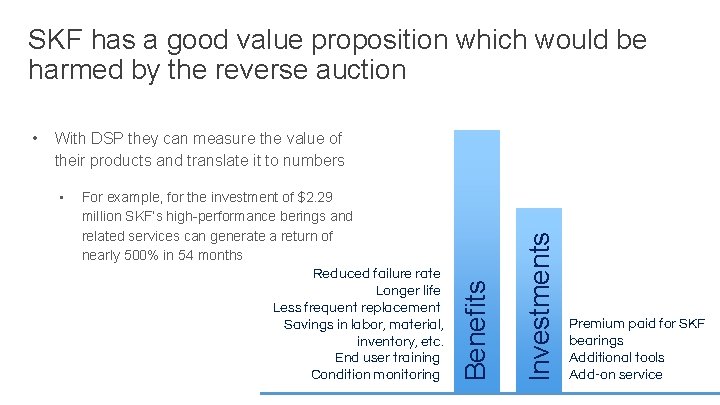
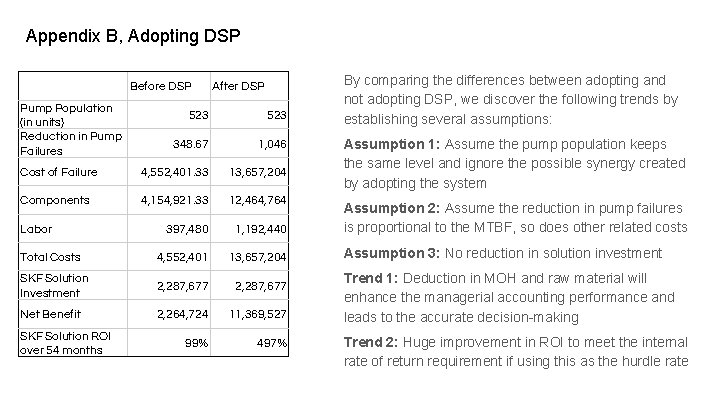
SKF has a good value proposition which would be harmed by the reverse auction • For example, for the investment of $2. 29 million SKF’s high-performance berings and related services can generate a return of nearly 500% in 54 months Reduced failure rate Longer life Less frequent replacement Savings in labor, material, inventory, etc. End user training Condition monitoring Investments With DSP they can measure the value of their products and translate it to numbers Benefits • Premium paid for SKF bearings Additional tools Add-on service
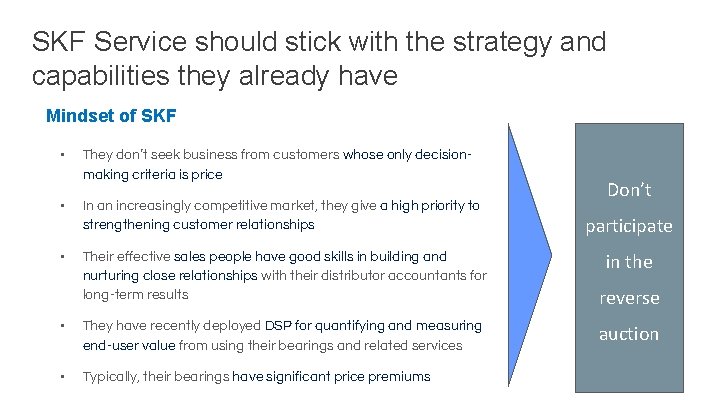
SKF Service should stick with the strategy and capabilities they already have Mindset of SKF • They don’t seek business from customers whose only decisionmaking criteria is price • In an increasingly competitive market, they give a high priority to strengthening customer relationships • Their effective sales people have good skills in building and nurturing close relationships with their distributor accountants for long-term results • They have recently deployed DSP for quantifying and measuring end-user value from using their bearings and related services • Typically, their bearings have significant price premiums Don’t participate in the reverse auction
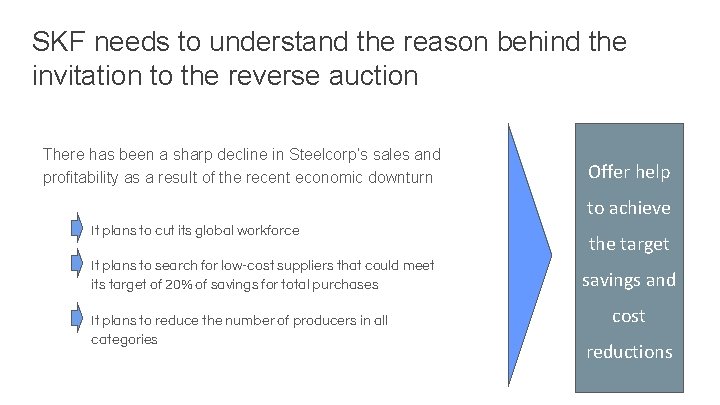
SKF needs to understand the reason behind the invitation to the reverse auction There has been a sharp decline in Steelcorp’s sales and profitability as a result of the recent economic downturn Offer help to achieve It plans to cut its global workforce It plans to search for low-cost suppliers that could meet its target of 20% of savings for total purchases It plans to reduce the number of producers in all categories the target savings and cost reductions
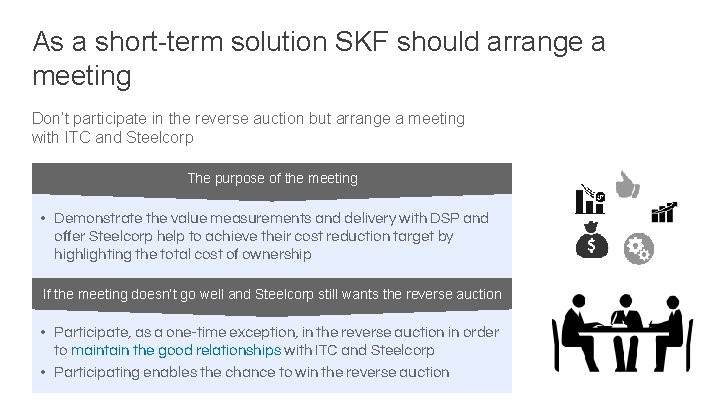
As a short-term solution SKF should arrange a meeting Don’t participate in the reverse auction but arrange a meeting with ITC and Steelcorp The purpose of the meeting • Demonstrate the value measurements and delivery with DSP and offer Steelcorp help to achieve their cost reduction target by highlighting the total cost of ownership If the meeting doesn’t go well and Steelcorp still wants the reverse auction • Participate, as a one-time exception, in the reverse auction in order to maintain the good relationships with ITC and Steelcorp • Participating enables the chance to win the reverse auction
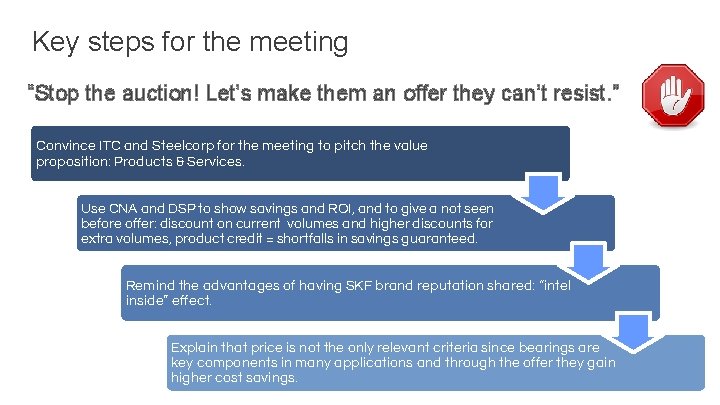
Key steps for the meeting “Stop the auction! Let’s make them an offer they can’t resist. ” Convince ITC and Steelcorp for the meeting to pitch the value proposition: Products & Services. Use CNA and DSP to show savings and ROI, and to give a not seen before offer: discount on current volumes and higher discounts for extra volumes, product credit = shortfalls in savings guaranteed. Remind the advantages of having SKF brand reputation shared: “intel inside” effect. Explain that price is not the only relevant criteria since bearings are key components in many applications and through the offer they gain higher cost savings.
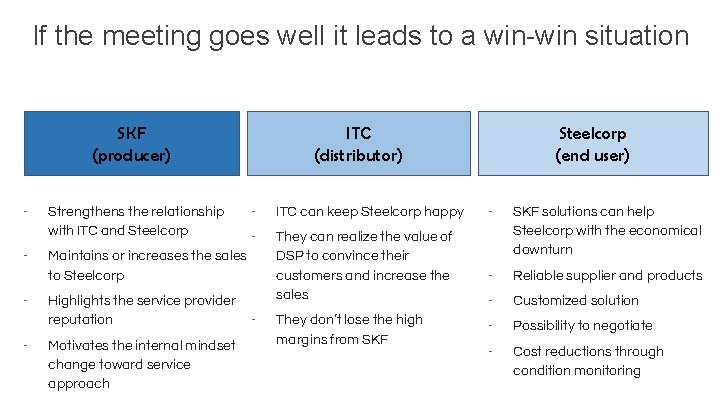
If the meeting goes well it leads to a win-win situation SKF (producer) - Strengthens the relationship with ITC and Steelcorp ITC (distributor) - ITC can keep Steelcorp happy - They can realize the value of DSP to convince their customers and increase the sales Maintains or increases the sales to Steelcorp Highlights the service provider reputation Motivates the internal mindset change toward service approach They don’t lose the high margins from SKF Steelcorp (end user) - SKF solutions can help Steelcorp with the economical downturn - Reliable supplier and products - Customized solution - Possibility to negotiate - Cost reductions through condition monitoring
In the long-term SKF needs to focus on the service approach • Share the benefits of DSP (now less than 15% of end users have been introduced to DSP) and increase direct sales (through complementary channels), but reroute customers to distributors • Reinforce the movement from selling products to providing solutions • Educate distributors and end users from price to value through service based DSP and CNA • Focus on positioning in the markets where the brand is already strong (Westren Europe and Asia), and exploit the brand recognition in emerging markets and create and strengthen the relationships with distributors • Eliminate the internal barriers for service transformation • E. g. through bonuses based on service sales
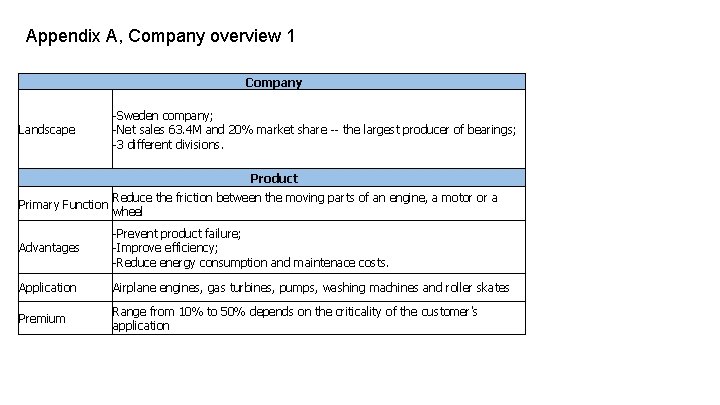
Appendix A, Company overview 1 Company Landscape -Sweden company; -Net sales 63. 4 M and 20% market share -- the largest producer of bearings; -3 different divisions. Product Primary Function Reduce the friction between the moving parts of an engine, a motor or a wheel Advantages -Prevent product failure; -Improve efficiency; -Reduce energy consumption and maintenace costs. Application Airplane engines, gas turbines, pumps, washing machines and roller skates Premium Range from 10% to 50% depends on the criticality of the customer's application
Notes Examples Application Division Target customer Appendix B, Company overview 2 Industrial, 32% of sales Automotive, 35% of sales Service, 33% of sales OEM customers OEMs Industrial end users (factories) Machine tools Power generations Oil and gas Mining Cars and trucks Vehicle repair and maintenance market Home appliances Power tools Caterpillar Metso Siemens General Motors Ford Black & Decker Local decision for pricing Replacement bearing Aftermarket services British Petroleum International Paper Nestle Direct deliver (20%) Distributors (80%)
Appendix B, Adopting DSP Before DSP Pump Population (in units) Reduction in Pump Failures After DSP 523 348. 67 1, 046 Cost of Failure 4, 552, 401. 33 13, 657, 204 Components 4, 154, 921. 33 12, 464, 764 397, 480 1, 192, 440 Total Costs 4, 552, 401 13, 657, 204 SKF Solution Investment 2, 287, 677 Net Benefit 2, 264, 724 11, 369, 527 99% 497% Labor SKF Solution ROI over 54 months By comparing the differences between adopting and not adopting DSP, we discover the following trends by establishing several assumptions: Assumption 1: Assume the pump population keeps the same level and ignore the possible synergy created by adopting the system Assumption 2: Assume the reduction in pump failures is proportional to the MTBF, so does other related costs Assumption 3: No reduction in solution investment Trend 1: Deduction in MOH and raw material will enhance the managerial accounting performance and leads to the accurate decision-making Trend 2: Huge improvement in ROI to meet the internal rate of return requirement if using this as the hurdle rate
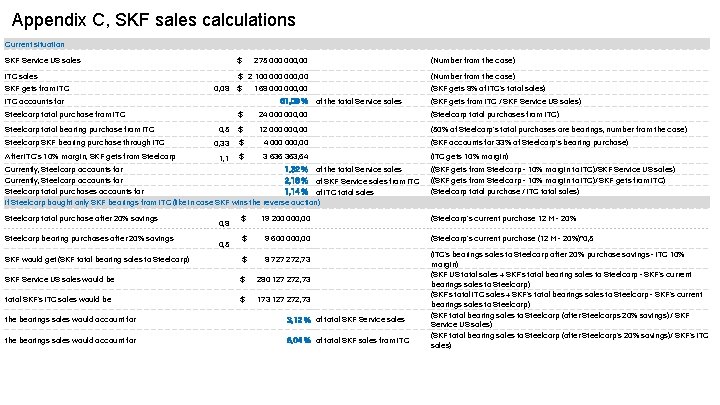
Appendix C, SKF sales calculations Current situation SKF Service US sales ITC sales SKF gets from ITC ITC accounts for Steelcorp total purchase from ITC Steelcorp total bearing purchase from ITC $ 275 000, 00 $ 2 100 000, 00 0, 08 $ 168 000, 00 61, 09 % of the total Service sales $ 24 000, 00 0, 5 $ 12 000, 00 $ 4 000, 00 Steelcorp SKF bearing purchase through ITC 0, 33 After ITC's 10% margin, SKF gets from Steelcorp (Number from the case) (SKF gets 8% of ITC's total sales) (SKF gets from ITC / SKF Service US sales) (Steelcorp total purchases from ITC) (50% of Steelcorp's total purchases are bearings, number from the case) (SKF accounts for 33% of Steelcorp's bearing purchase) 1, 1 $ 3 636 363, 64 Currently, Steelcorp accounts for 1, 32 % of the total Service sales Currently, Steelcorp accounts for 2, 16 % of SKF Service sales from ITC Steelcorp total purchases accounts for 1, 14 % of ITC total sales If Steelcorp bought only SKF bearings from ITC (like in case SKF wins the reverse auction) (ITC gets 10% margin) Steelcorp total purchase after 20% savings (Steelcorp's current purchase 12 M - 20% 0, 8 Steelcorp bearing purchases after 20% savings 0, 5 SKF would get (SKF total bearing sales to Steelcorp) SKF Service US sales would be total SKF's ITC sales would be the bearings sales would account for $ 19 200 000, 00 $ 9 600 000, 00 $ 8 727 272, 73 $ 280 127 272, 73 $ 173 127 272, 73 3, 12 % of total SKF Service sales 5, 04 % of total SKF sales from ITC ((SKF gets from Steelcorp - 10% margin to ITC)/SKF Service US sales) ((SKF gets from Steelcorp - 10% margin to ITC)/ SKF gets from ITC) (Steelcorp total purchase / ITC total sales) (Steelcorp's current purchase (12 M - 20%)*0, 5 (ITC's bearings sales to Steelcorp after 20% purchase savings - ITC 10% margin) (SKF US total sales + SKF's total bearing sales to Steelcorp - SKF's current bearings sales to Steelcorp) (SKF's total ITC sales + SKF's total bearings sales to Steelcorp - SKF's current bearings sales to Steelcorp) (SKF total bearing sales to Steelcorp (after Steelcorps 20% savings) / SKF Service US sales) (SKF total bearing sales to Steelcorp (after Steelcorp's 20% savings)/ SKF's ITC sales)
Appendix D, Reasoning why to participate in the reverse auction Why the relationships with ITC and Steelcorp are so important that SKF should participate in the reverse auction even though we first state that do not participate in If the meeting doesn’t go well SKF should participate in the reverse auction, because • They shouldn’t lose Steelcorp • Steelcorp and ITC are among the SKF Service division’s largest customers • Currently Steelcorp accounts for 1. 32% of the total SKF Service sales which can be seen as a big number since Steelcorp is a regular customer, and if SKF could be the only supplier for Steelcorp (in case of winning the reverse auction), Steelcorp would account for more than 3% of the total SKF Service sales which is even bigger amount (Appendix C) • They shouldn’t harm the relationship with ITC because sales through ITC accounts for almost 62% of the total SKF Service sales ITC is a significant partner for SKF (Appendix C) • SKF values good customer and partner relationships and not participating would harm them • During economic downturn every single customer counts